

IEC 62271-109:2008/AMD1:2013
(Amendment)Amendment 1 - High-voltage switchgear and controlgear - Part 109: Alternating-current series capacitor by-pass switches
General Information
- Abstract
- Status
- Published
- Publication Date
- 27-May-2013
- Technical Committee
- SC 17A - Switching devices
- Drafting Committee
- MT 44 - TC 17/SC 17A/MT 44
- Current Stage
- DELPUB - Deleted Publication
- Start Date
- 08-Apr-2019
- Completion Date
- 28-Aug-2026
Overview
IEC 62271-109:2008/AMD1:2013 is an amendment to the international standard IEC 62271-109, which pertains to high-voltage switchgear and controlgear, specifically focusing on alternating-current series capacitor by-pass switches. Developed by the International Electrotechnical Commission (IEC), this amendment enhances the technical definitions, test procedures, and performance requirements crucial for manufacturers and users in the high-voltage power industry. The standard forms part of the global framework ensuring safe, reliable, and efficient operation of by-pass switches used in series capacitor banks in electrical power systems.
Key Topics
By-pass Making Current Definition: The amendment refines the definition of the peak transient by-pass current - now termed "by-pass making current" - which is the maximum instantaneous current value combining the capacitor bank discharge component and power-frequency fault current during by-pass switch operation.
Rated Operating Sequence: Clarifies the sequence of operations including timing for closing (C) and opening-closing (OC) operations, specifying time intervals (t and t') and conditions for adjustable by-passing insertion time tailored for rapid auto-reopening switches.
Rated By-pass Making Current (I_BP): Specifies how the maximum by-pass making current must be determined under fault conditions with the capacitor bank pre-charged to the overvoltage protector’s limiting voltage. It accounts for actual power-frequency fault current and damping effects, with recommendations for pre-arcing time and frequency limits.
Test Procedures for By-pass Making Current: Introduces two alternatives for testing making current capability, including the number of making operations and current load parameters to verify switch endurance and performance.
Primary By-pass Switch Application: Details conditions under which by-pass switches can serve as primary protection devices without fast by-passing devices like spark gaps. It explains how test results correlate to operational scenarios involving capacitor bank discharge and fault currents, including formulae for equivalent current values.
Annexes with Practical Guidance: Annex E describes typical layouts and operating conditions when by-pass switches function as primary by-passing devices, while Annex F provides explanations on transient recovery voltage during switch reinsertion, discussing capacitive and inductive reactances.
Applications
IEC 62271-109 amendment 1 is critical for:
High-Voltage Substation Design: Guiding engineers in selecting and specifying alternating-current series capacitor by-pass switches that meet rigorous performance and safety requirements.
Series Capacitor Bank Protection: Ensuring that by-pass switches properly manage transient currents and protect series capacitor banks from overvoltages and fault conditions without compromising system stability.
Testing and Quality Assurance: Providing manufacturers with standardized test procedures and rated parameters to validate product reliability and conformity before deployment.
System Fault Management: Enhancing the capability of power system operators to maintain continuous service during fault conditions by correctly implementing by-pass switches that accommodate both capacitor discharge and fault currents.
Improved Device Coordination: Assisting in system studies and coordination between by-pass switches, overvoltage protectors, varistors, and fast by-passing devices for optimized protection schemes.
Related Standards
For comprehensive understanding and compliance, IEC 62271-109 amendment 1 refers and relates to several other IEC standards:
IEC 60143-1 and IEC 60143-2: Standards covering capacitors for power systems, which complement the by-pass switch requirements by providing data on capacitor characteristics, discharge behavior, and protective measures.
IEC 62271 Series: Broader set of standards on high-voltage switchgear and controlgear encompassing various device types, ensuring harmonized safety and performance criteria across equipment.
IEC Vocabulary (Electropedia): Provides precise terminology and definitions used within the standard to maintain clarity and uniform interpretation.
Keywords: IEC 62271-109 amendment 1, high-voltage switchgear, alternating-current series capacitor, by-pass switches, rated by-pass making current, capacitor bank protection, transient by-pass current, high-voltage controlgear standards, IEC standards, power system fault management, electrical substation equipment.
Relations
- Effective Date
- 05-Sep-2023
- Effective Date
- 05-Sep-2023
Get Certified
Connect with accredited certification bodies for this standard

IMQ S.p.A. (Certification)
Italian electrical product certification.

SLG Prüf- und Zertifizierungs GmbH
German testing and certification body.

UL Solutions
Global safety science company with testing, inspection and certification.
Sponsored listings
Frequently Asked Questions
IEC 62271-109:2008/AMD1:2013 is a standard published by the International Electrotechnical Commission (IEC). Its full title is "Amendment 1 - High-voltage switchgear and controlgear - Part 109: Alternating-current series capacitor by-pass switches". This standard covers: Amendment 1 - High-voltage switchgear and controlgear - Part 109: Alternating-current series capacitor by-pass switches
Amendment 1 - High-voltage switchgear and controlgear - Part 109: Alternating-current series capacitor by-pass switches
IEC 62271-109:2008/AMD1:2013 is classified under the following ICS (International Classification for Standards) categories: 29.130.10 - High voltage switchgear and controlgear. The ICS classification helps identify the subject area and facilitates finding related standards.
IEC 62271-109:2008/AMD1:2013 has the following relationships with other standards: It is inter standard links to IEC 62271-109:2008, IEC 62271-109:2019. Understanding these relationships helps ensure you are using the most current and applicable version of the standard.
IEC 62271-109:2008/AMD1:2013 is available in PDF format for immediate download after purchase. The document can be added to your cart and obtained through the secure checkout process. Digital delivery ensures instant access to the complete standard document.
Standards Content (Sample)
IEC 62271-109 ®
Edition 2.0 2013-05
INTERNATIONAL
STANDARD
NORME
INTERNATIONALE
AMENDMENT 1
AMENDEMENT 1
High-voltage switchgear and controlgear –
Part 109: Alternating-current series capacitor by-pass switches
Appareillage à haute tension –
Partie 109: Interrupteurs de contournement pour condensateurs série à courant
alternatif
IEC 62271-109:2008/A1:2013
All rights reserved. Unless otherwise specified, no part of this publication may be reproduced or utilized in any form
or by any means, electronic or mechanical, including photocopying and microfilm, without permission in writing from
either IEC or IEC's member National Committee in the country of the requester.
If you have any questions about IEC copyright or have an enquiry about obtaining additional rights to this publication,
please contact the address below or your local IEC member National Committee for further information.
Droits de reproduction réservés. Sauf indication contraire, aucune partie de cette publication ne peut être reproduite ni
utilisée sous quelque forme que ce soit et par aucun procédé, électronique ou mécanique, y compris la photocopie et les
microfilms, sans l'accord écrit de la CEI ou du Comité national de la CEI du pays du demandeur.
Si vous avez des questions sur le copyright de la CEI ou si vous désirez obtenir des droits supplémentaires sur cette
publication, utilisez les coordonnées ci-après ou contactez le Comité national de la CEI de votre pays de résidence.
IEC Central Office Tel.: +41 22 919 02 11
3, rue de Varembé Fax: +41 22 919 03 00
CH-1211 Geneva 20 info@iec.ch
Switzerland www.iec.ch
About the IEC
The International Electrotechnical Commission (IEC) is the leading global organization that prepares and publishes
International Standards for all electrical, electronic and related technologies.
About IEC publications
The technical content of IEC publications is kept under constant review by the IEC. Please make sure that you have the
latest edition, a corrigenda or an amendment might have been published.
Useful links:
IEC publications search - www.iec.ch/searchpub Electropedia - www.electropedia.org
The advanced search enables you to find IEC publications The world's leading online dictionary of electronic and
by a variety of criteria (reference number, text, technical electrical terms containing more than 30 000 terms and
committee,…). definitions in English and French, with equivalent terms in
It also gives information on projects, replaced and additional languages. Also known as the International
withdrawn publications. Electrotechnical Vocabulary (IEV) on-line.
IEC Just Published - webstore.iec.ch/justpublished Customer Service Centre - webstore.iec.ch/csc
Stay up to date on all new IEC publications. Just Published If you wish to give us your feedback on this publication
details all new publications released. Available on-line and or need further assistance, please contact the
also once a month by email. Customer Service Centre: csc@iec.ch.
A propos de la CEI
La Commission Electrotechnique Internationale (CEI) est la première organisation mondiale qui élabore et publie des
Normes internationales pour tout ce qui a trait à l'électricité, à l'électronique et aux technologies apparentées.
A propos des publications CEI
Le contenu technique des publications de la CEI est constamment revu. Veuillez vous assurer que vous possédez
l’édition la plus récente, un corrigendum ou amendement peut avoir été publié.
Liens utiles:
Recherche de publications CEI - www.iec.ch/searchpub Electropedia - www.electropedia.org
La recherche avancée vous permet de trouver des Le premier dictionnaire en ligne au monde de termes
publications CEI en utilisant différents critères (numéro de électroniques et électriques. Il contient plus de 30 000
référence, texte, comité d’études,…). termes et définitions en anglais et en français, ainsi que
Elle donne aussi des informations sur les projets et les les termes équivalents dans les langues additionnelles.
publications remplacées ou retirées. Egalement appelé Vocabulaire Electrotechnique
International (VEI) en ligne.
Just Published CEI - webstore.iec.ch/justpublished
Service Clients - webstore.iec.ch/csc
Restez informé sur les nouvelles publications de la CEI.
Just Published détaille les nouvelles publications parues. Si vous désirez nous donner des commentaires sur
Disponible en ligne et aussi une fois par mois par email. cette publication ou si vous avez des questions
contactez-nous: csc@iec.ch.
IEC 62271-109 ®
Edition 2.0 2013-05
INTERNATIONAL
STANDARD
NORME
INTERNATIONALE
AMENDMENT 1
AMENDEMENT 1
High-voltage switchgear and controlgear –
Part 109: Alternating-current series capacitor by-pass switches
Appareillage à haute tension –
Partie 109: Interrupteurs de contournement pour condensateurs série à courant
alternatif
INTERNATIONAL
ELECTROTECHNICAL
COMMISSION
COMMISSION
ELECTROTECHNIQUE
PRICE CODE
INTERNATIONALE
CODE PRIX F
ICS 29.130.10 ISBN 978-2-83220-826-7
– 2 – 62271-109 Amend.1 © IEC:2013
FOREWORD
This amendment has been prepared by subcommittee 17A: High-voltage switchgear and
controlgear, of IEC technical committee 17: Switchgear and controlgear.
The text of this amendment is based on the following documents:
FDIS Report on voting
17A/1038/FDIS 17A/1043/RVD
Full information on the voting for the approval of this amendment can be found in the report
on voting indicated in the above table.
The committee has decided that the contents of this amendment and the base publication will
remain unchanged until the stability date indicated on the IEC web site under
"http://webstore.iec.ch" in the data related to the specific publication. At this date, the
publication will be
• reconfirmed,
• withdrawn,
• replaced by a revised edition, or
• amended.
_____________
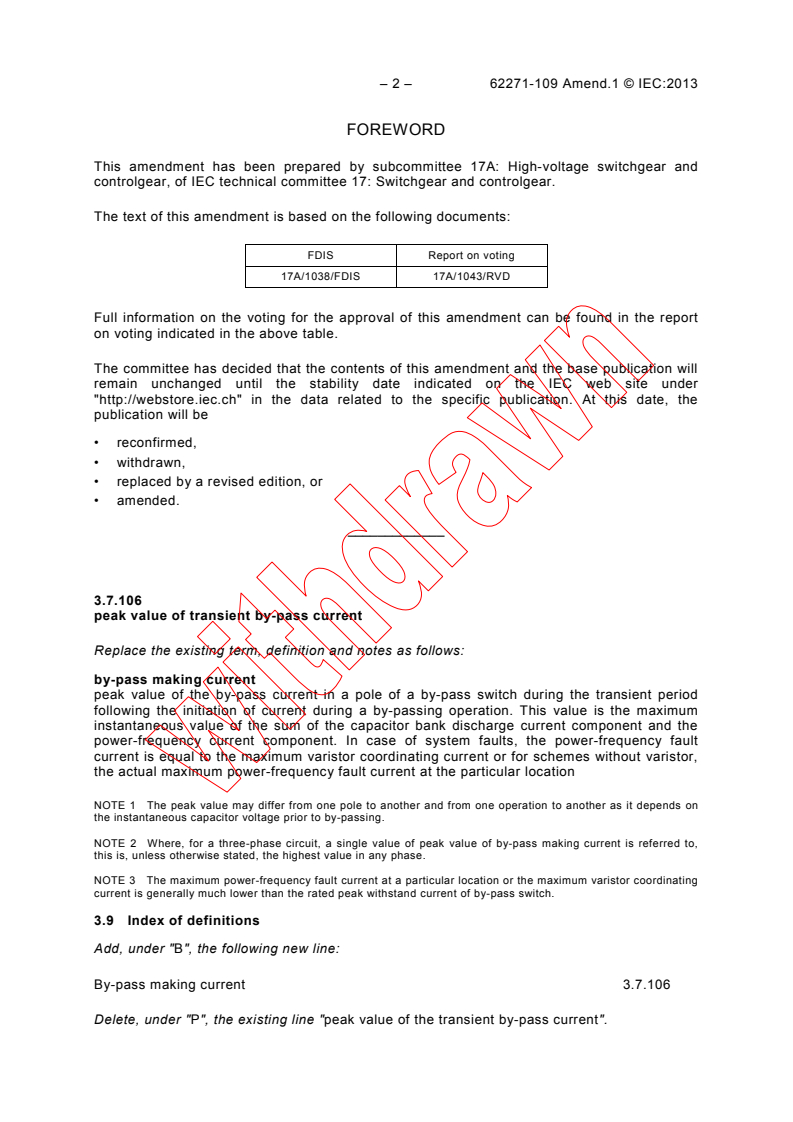
3.7.106
peak value of transient by-pass current
Replace the existing term, definition and notes as follows:
by-pass making current
peak value of the by-pass current in a pole of a by-pass switch during the transient period
following the initiation of current during a by-passing operation. This value is the maximum
instantaneous value of the sum of the capacitor bank discharge current component and the
power-frequency current component. In case of system faults, the power-frequency fault
current is equal to the maximum varistor coordinating current or for schemes without varistor,
the actual maximum power-frequency fault current at the particular location
NOTE 1 The peak value may differ from one pole to another and from one operation to another as it depends on
the instantaneous capacitor voltage prior to by-passing.
NOTE 2 Where, for a three-phase circuit, a single value of peak value of by-pass making current is referred to,
this is, unless otherwise stated, the highest value in any phase.
NOTE 3 The maximum power-frequency fault current at a particular location or the maximum varistor coordinating
current is generally much lower than the rated peak withstand current of by-pass switch.
3.9 Index of definitions
Add, under "B", the following new line:
By-pass making current 3.7.106
Delete, under "P", the existing line "peak value of the transient by-pass current".
62271-109 Amend.1 © IEC:2013 – 3 –
4.101 Rated operating sequence
Replace the existing Notes 1, 2 and 3 of this subclause by the following new text and notes:
where
C represents a closing operation;
OC represents an opening operation followed immediately (that is, without any
intentional delay) by a closing operation;
t and t' are time intervals between successive operations;
t and t' should always be expressed in minutes or in seconds.
If the by-passing-insertion time is adjustable, the limits of adjustment should be specified.
NOTE 1 Instead of t = 0,3 s, other value: t = 0,2 s is also used for by-pass switches intended for rapid auto-
reopening.
NOTE 2 Instead of t' = 3 min., other values: t' = 15 s and t' = 1 min are also used for by-pass switches intended
for rapid auto-reopening.
NOTE 3 Other operating sequences may be specified depending upon system requirements.
4.102 Rated by-pass making current (I )
BP
Replace the existing first paragraph of this subclause by the following new paragraph:
The rated by-pass making current is the maximum value of the by-pass making current that
the by-pass switch shall be capable of making under line fault condition when the capacitor
bank is pre-charged to the limiting voltage of the overvoltage protector (U ) and with a
PL
frequency of the by-pass discharge current corresponding to the actual capacitance of the
capacitor bank with its associated inductance of the damping circuit. The effective damping of
the by-pass discharge current can be taken into consideration.
Replace the existing note of this subclause by the following new note:
NOTE The rated by-pass making current should be determined by system studies as the maximum sum of the
instantaneous capacitor bank discharge current and the instantaneous fault current component during the pre-
arcing period (see also IEC 60143-2). A value of pre-arcing time of 5 ms is suggested in case no data is available.
Replace the existing third paragraph of this subclause by the following new paragraph:
The by-pass making performance is covered when the required peak value of the by-pass
making current is equal to or lower than the peak current value used in the relevant type test.
This rule is considered to be valid only when the frequency f of the by-pass making current
BP
is equal to or lower than 130 % of the corresponding value used during type tests.
6.104.5 Number of making operations
Replace the existing text of the subclause, including the note, by the following new text and
table:
The by-pass making current test can be performed using one of the two alternatives given in
Table 7.
The by-pass switch conditions shall be in accordance with 6.102.3.1.
– 4 – 62271-109 Amend.1 © IEC:2013
Table 7 – Test procedures for by-pass making current tests
Alternative No. of making Test current
operations
Alternative 1 20 I
BP
I
BP
Alternative 2
20 I
DISCHARGE
8 Guide to the selection of by-pass switches for service
Replace the existing text of this subclause by the following new text:
For more information refer to IEC 60143-1, IEC 60143-2 and Annexes E and F of this
standard.
Annex E – By-pass switches used as the primary by-passing devices
Replace the existing annex by the following new annex:
62271-109 Amend.1 © IEC:2013 – 5 –
Annex E
(normative)
By-pass switches used as the primary by-passing devices
By-pass switches are sometimes used as the primary protection of the overvoltage protector
of the series capacitor bank (e.g. without the use of a fast by-passing device such as a spark-
gap) for cases where the power-frequency fault current is relatively low (capacitor banks
generally located in the middle of the line length) or where the use of a spark-gap could result
in non-reliable operation of the spark-gap. For such series capacitor schemes, the varistor
bank is designed to absorb the resulting energy produced by a line fault until the by-pass
switch is closed. Figure E.1 illustrates the typical component layout.
C
NLR
D
S
IEC 1448/06
Key
C series capacitor
NLR non linear resistor (varistor)
D damping circuit
S by-pass switch
Figure E.1 – Typical component layout for by-pass switches
used as the primary by-passing device
For this particular application, the requirements stated in this standard also apply with the
following addition.
The by-pass switch will be subjected, for all line faults, to the capacitor bank discharge
current component (I ) and to the power-frequency fault current. For schemes using
DISCHARGE
fast by-passing devices (for example s
...