

IEC 60598-2-3:1993/AMD2:2000
(Amendment)Amendment 2 - Luminaires - Part 2: Particular requirements - Section 3: Luminaires for road and street lighting
General Information
- Abstract
- Status
- Published
- Publication Date
- 20-Dec-2000
- Technical Committee
- SC 34D - Luminaires
- Current Stage
- DELPUB - Deleted Publication
- Start Date
- 04-Dec-2002
- Completion Date
- 28-Aug-2026

Overview
IEC 60598-2-3:1993/AMD2:2000 is an amendment to the IEC international standard that specifies particular requirements for luminaires designed for road and street lighting. Prepared by IEC technical committee 34D (Luminaires) under the broader scope of lamps and related equipment, this amendment addresses crucial aspects of mechanical and structural safety, especially concerning luminaires subjected to wind loads and tests on glass components. Ensuring robust and reliable luminaires is essential for public safety and efficient street lighting infrastructure.
Key Topics
This standard amendment provides authoritative guidance on:
- Static Load Testing: Establishes procedures for testing mast arm or post top mounted luminaires to verify their capability to withstand wind-induced forces. The most critical surface is identified for load application based on the drag coefficient (Cd) and surface area (S).
- Wind Load Calculations: Specifies wind speed values to be used according to luminaire mounting heights:
- Up to 8 meters: 45 m/s (163 km/h)
- 8 to 15 meters: 52 m/s (188 km/h)
- Over 15 meters: 57 m/s (205 km/h)
- Attachment Security: Requires means of attachment to be secured as per the manufacturer's specifications, ensuring attachment stability under load.
- Glass Fracture Test: Outlines particle counting methodology post-glass fracture to assess safety compliance, including guidelines for measurement locations and exclusions.
- Drag Coefficient Measurement: References ISO 4354 for wind load actions and provides practical guidance for wind tunnel testing to determine the drag coefficient for luminaires.
- Amended Figures and Procedures: Presents updated diagrams (static load test, glass particle counting) to clarify compliance procedures.
Applications
The requirements and procedures specified in this amendment are practically valuable in several ways:
- Road and Street Lighting: Ensures that luminaires installed in outdoor public areas, such as streets, highways, and pedestrian pathways, meet rigorous safety standards regarding wind resistance and structural durability.
- Municipal Infrastructure Projects: Provides municipalities and contractors with compliance benchmarks when selecting and installing streetlighting equipment.
- Lighting Product Development: Assists manufacturers in designing and testing luminaires to ensure conformity with international requirements for wind loads and glass safety.
- Quality Assurance and Certification: Facilitates third-party testing organizations and certification bodies in evaluating products for global markets.
- Regulatory Compliance: Supports adoption by national and local authorities in their regulations and procurement policies for public lighting infrastructure.
Related Standards
For a comprehensive approach to safety and performance in lighting, the following related international standards are referenced or relevant:
- IEC 60598 Series - General standards for luminaires, covering safety, performance, and application-specific requirements.
- ISO 4354:1997, Wind Actions on Structures - Provides detailed methodologies for assessing wind loads on structures, referenced for determining drag coefficients.
- IEC TC 34 Standards - Additional component and safety standards for lamps and associated equipment.
Keywords: IEC 60598-2-3, street lighting luminaires, road lighting, wind load testing, static load, drag coefficient, luminaire glass test, public lighting safety, international standards, ISO 4354 compliance.
Relations
- Effective Date
- 05-Sep-2023
- Effective Date
- 05-Sep-2023
Get Certified
Connect with accredited certification bodies for this standard

IMQ S.p.A. (Certification)
Italian electrical product certification.

SLG Prüf- und Zertifizierungs GmbH
German testing and certification body.

UL Solutions
Global safety science company with testing, inspection and certification.
Sponsored listings
Frequently Asked Questions
IEC 60598-2-3:1993/AMD2:2000 is a standard published by the International Electrotechnical Commission (IEC). Its full title is "Amendment 2 - Luminaires - Part 2: Particular requirements - Section 3: Luminaires for road and street lighting". This standard covers: Amendment 2 - Luminaires - Part 2: Particular requirements - Section 3: Luminaires for road and street lighting
Amendment 2 - Luminaires - Part 2: Particular requirements - Section 3: Luminaires for road and street lighting
IEC 60598-2-3:1993/AMD2:2000 is classified under the following ICS (International Classification for Standards) categories: 29.140.40 - Luminaires; 93.080.30 - Road equipment and installations. The ICS classification helps identify the subject area and facilitates finding related standards.
IEC 60598-2-3:1993/AMD2:2000 has the following relationships with other standards: It is inter standard links to IEC 60598-2-3:1993, IEC 60598-2-3:2002. Understanding these relationships helps ensure you are using the most current and applicable version of the standard.
IEC 60598-2-3:1993/AMD2:2000 is available in PDF format for immediate download after purchase. The document can be added to your cart and obtained through the secure checkout process. Digital delivery ensures instant access to the complete standard document.
Standards Content (Sample)
NORME CEI
INTERNATIONALE IEC
60598-2-3
INTERNATIONAL
STANDARD
AMENDEMENT 2
AMENDMENT 2
2000-12
Amendement 2
Luminaires –
Partie 2-3:
Règles particulières –
Luminaires d'éclairage public
Amendment 2
Luminaires –
Part 2-3:
Particular requirements –
Luminaires for road and street lighting
IEC 2000 Droits de reproduction réservés Copyright - all rights reserved
International Electrotechnical Commission 3, rue de Varembé Geneva, Switzerland
Telefax: +41 22 919 0300 e-mail: inmail@iec.ch IEC web site http://www.iec.ch
CODE PRIX
Commission Electrotechnique Internationale
F
PRICE CODE
International Electrotechnical Commission
Pour prix, voir catalogue en vigueur
For price, see current catalogue
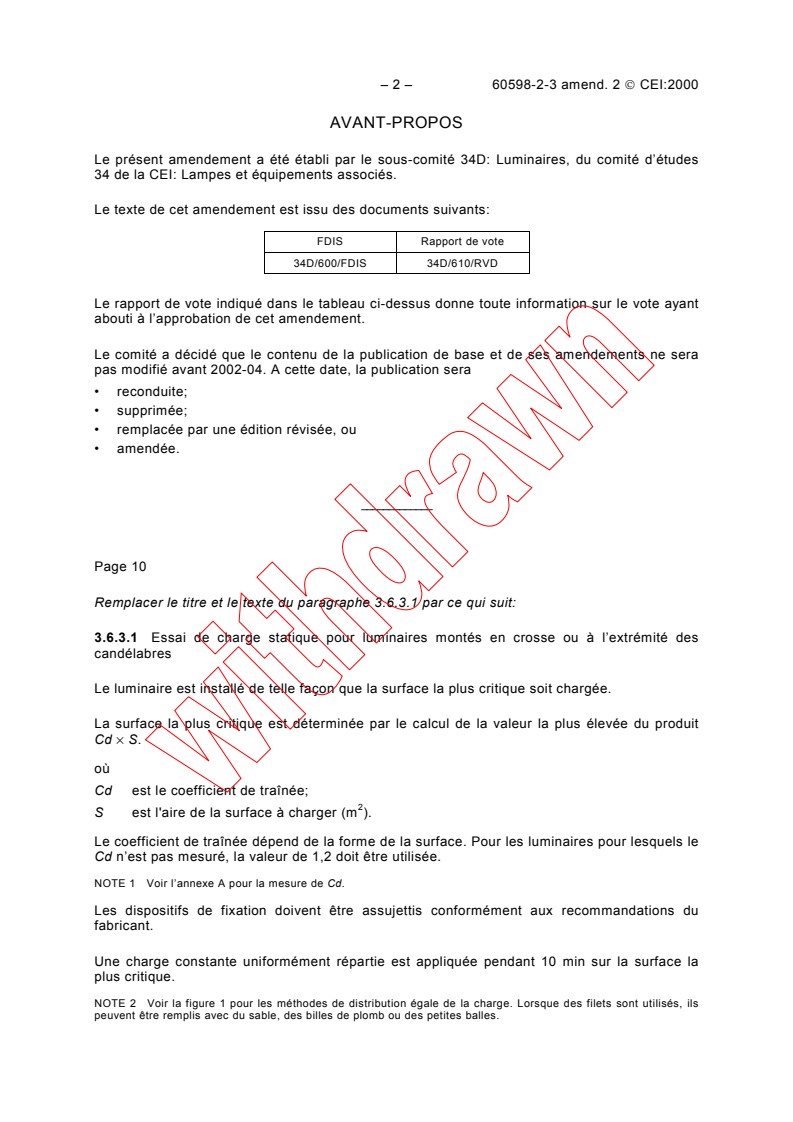
– 2 – 60598-2-3 amend. 2 CEI:2000
AVANT-PROPOS
Le présent amendement a été établi par le sous-comité 34D: Luminaires, du comité d’études
34 de la CEI: Lampes et équipements associés.
Le texte de cet amendement est issu des documents suivants:
FDIS Rapport de vote
34D/600/FDIS 34D/610/RVD
Le rapport de vote indiqué dans le tableau ci-dessus donne toute information sur le vote ayant
abouti à l’approbation de cet amendement.
Le comité a décidé que le contenu de la publication de base et de ses amendements ne sera
pas modifié avant 2002-04. A cette date, la publication sera
• reconduite;
• supprimée;
• remplacée par une édition révisée, ou
• amendée.
_____________
Page 10
Remplacer le titre et le texte du paragraphe 3.6.3.1 par ce qui suit:
3.6.3.1 Essai de charge statique pour luminaires montés en crosse ou à l’extrémité des
candélabres
Le luminaire est installé de telle façon que la surface la plus critique soit chargée.
La surface la plus critique est déterminée par le calcul de la valeur la plus élevée du produit
Cd × S.
où
Cd est le coefficient de traînée;
S est l'aire de la surface à charger (m ).
Le coefficient de traînée dépend de la forme de la surface. Pour les luminaires pour lesquels le
Cd n’est pas mesuré, la valeur de 1,2 doit être utilisée.
NOTE 1 Voir l’annexe A pour la mesure de Cd.
Les dispositifs de fixation doivent être assujettis conformément aux recommandations du
fabricant.
Une charge constante uniformément répartie est appliquée pendant 10 min sur la surface la
plus critique.
NOTE 2 Voir la figure 1 pour les méthodes de distribution égale de la charge. Lorsque des filets sont utilisés, ils
peuvent être remplis avec du sable, des billes de plomb ou des petites balles.
60598-2-3 Amend. 2 IEC:2000 – 3 –
FOREWORD
This amendment has been prepared by subcommittee 34D: Luminaires, of IEC technical
committee 34: Lamps and related equipment.
The text of this amendment is based on the following documents:
FDIS Report on voting
34D/600/FDIS 34D/610/RVD
Full information on the voting for the approval of this amendment can be found in the report on
voting indicated in the above table.
The committee has decided that the contents of the base publication and its amendments will
remain unchanged until 2002-04. At this date, the publication will be
• reconfirmed;
• withdrawn;
• replaced by a revised edition, or
• amended.
___________
Page 11
Replace the title and text of subclause 3.6.3.1 by the following:
3.6.3.1 Static load test for mast arm or post top mounted luminaires
The luminaire is mounted in such a way that the most critical surface is loaded.
The most critical surface is determined by calculating the highest value of Cd × S
where
Cd is the drag coefficient;
S is the area of the surface to be loaded (m ).
The drag coefficient depends on the shape of the surface. For luminaires for which the Cd is
not measured the value of 1,2 shall be taken.
NOTE 1 See annex A for measurement of Cd.
The means of attachment shall be secured in accordance with the manufacturer’s instructions.
A constant evenly distributed load is applied for 10 min on the most critical surface.
NOTE 2 See figure 1 for methods of equal distribution of the load. In cases where bags are used, these can be
filled with sand, lead shot or small balls.
– 4 – 60598-2-3 amend. 2 CEI:2000
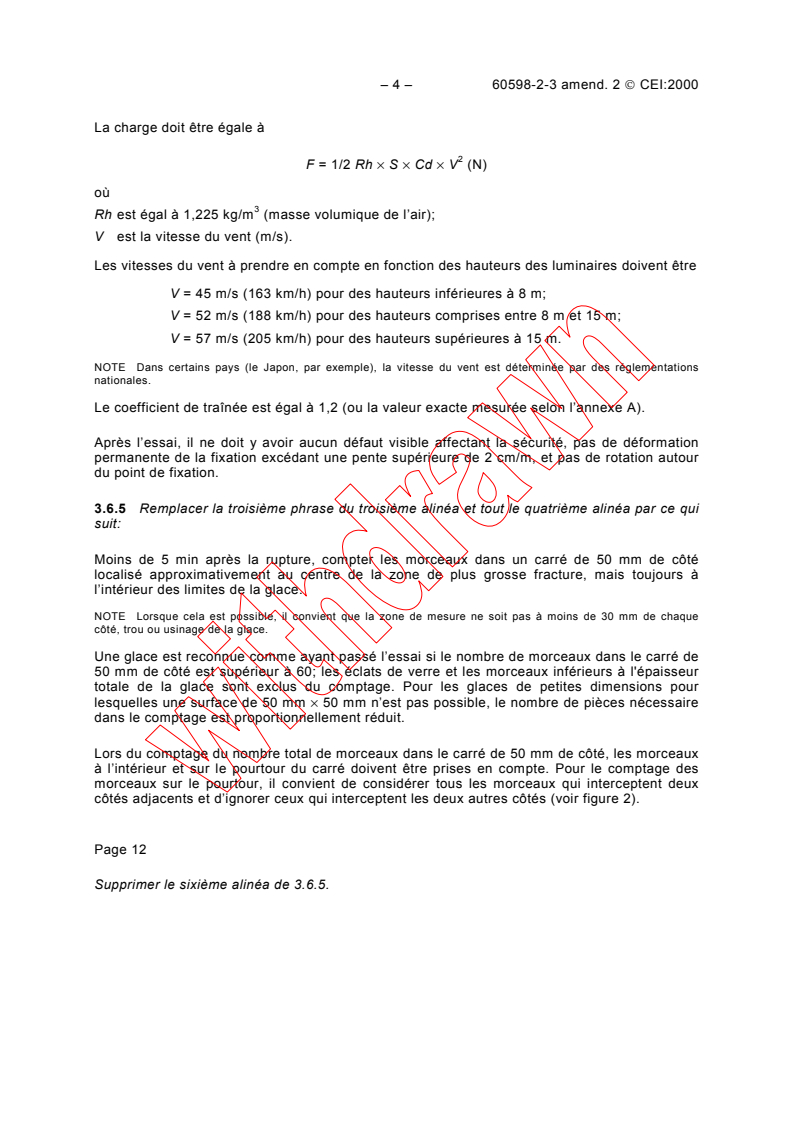
La charge doit être égale à
F = 1/2 Rh × S × Cd × V (N)
où
Rh est égal à 1,225 kg/m (masse volumique de l’air);
V est la vitesse du vent (m/s).
Les vitesses du vent à prendre en compte en fonction des hauteurs des luminaires doivent être
V = 45 m/s (163 km/h) pour des hauteurs inférieures à 8 m;
V = 52 m/s (188 km/h) pour des hauteurs comprises entre 8 m et 15 m;
V = 57 m/s (205 km/h) pour des hauteurs supérieures à 15 m.
NOTE Dans certains pays (le Japon, par exemple), la vitesse du vent est déterminée par des réglementations
nationales.
Le coefficient de traînée est égal à 1,2 (ou la valeur exacte mesurée selon l’annexe A).
Après l’essai, il ne doit y avoir aucun défaut visible affectant la sécurité, pas de déformation
permanente de la fixation excédant une pente supérieure de 2 cm/m, et pas de rotation autour
du point de fixation.
3.6.5 Remplacer la troisième phrase du troisième alinéa et tout le quatrième alinéa par ce qui
suit:
Moins de 5 min après la rupture, compter les morceaux dans un carré de 50 mm de côté
localisé approximativement au centre de la zone de plus grosse fracture, mais toujours à
l’intérieur des limites de la glace.
NOTE Lorsque cela est possible, il convient que la zone de mesure ne soit pas à moins de 30 mm de chaque
côté, trou ou usinage de la glace.
Une glace est reconnue comme ayant passé l’essai si le nombre de morceaux dans le carré de
50 mm de côté est supérieur à 60; les éclats de verre et les morceaux inférieurs à l'épaisseur
totale de la glace sont exclus du comptage. Pour les glaces de petites dimensions pour
lesquelles une surface de 50 mm × 50 mm n’est pas possible, le nombre de pièces nécessaire
dans le comptage est proportionnellement réduit.
Lors du comptage du nombre total de morceaux dans le carré de 50 mm de côté, les morceaux
à l’intérieur et sur le pourtour du carré doivent être prises en compte. Pour le comptage des
morceaux sur le pourtour, il convient de considérer tous les morceaux qui interceptent deux
côtés adjacents et d’ignorer
...