


IEC TS 60034-27-2:2012
(Main)Rotating electrical machines - Part 27-2: On-line partial discharge measurements on the stator winding insulation of rotating electrical machines
General Information
- Abstract
IEC/TS 60034-27-2:2012(E) provides a common basis for:
- measuring techniques and instruments;
- the arrangement of the installation;
- normalization and sensitivity assessment;
- measuring procedures;
- noise reduction;
- the documentation of results;
- the interpretation of results with respect to partial discharge on-line measurements on the stator winding insulation of non-converter driven rotating electrical machines with rated voltage of 3 kV and up. Keywords: rotating electrical machines
- Status
- Replaced
- Publication Date
- 21-Mar-2012
- Technical Committee
- TC 2 - Rotating machinery
- Drafting Committee
- WG 29 - TC 2/WG 29
- Current Stage
- DELPUB - Deleted Publication
- Start Date
- 07-Dec-2023
- Completion Date
- 31-Jul-2019
Buy Documents
IEC TS 60034-27-2:2012 - Rotating electrical machines - Part 27-2: On-line partial discharge measurements on the stator winding insulation of rotating electrical machines
IEC TS 60034-27-2:2012 - Rotating electrical machines - Part 27-2: On-line partial discharge measurements on the stator winding insulation of rotating electrical machines Released:3/22/2012
Relations
- Effective Date
- 05-Sep-2023
Buy Documents
IEC TS 60034-27-2:2012 - Rotating electrical machines - Part 27-2: On-line partial discharge measurements on the stator winding insulation of rotating electrical machines
IEC TS 60034-27-2:2012 - Rotating electrical machines - Part 27-2: On-line partial discharge measurements on the stator winding insulation of rotating electrical machines Released:3/22/2012
Get Certified
Connect with accredited certification bodies for this standard

IMQ S.p.A. (Certification)
Italian electrical product certification.

SLG Prüf- und Zertifizierungs GmbH
German testing and certification body.

UL Solutions
Global safety science company with testing, inspection and certification.
Sponsored listings
Frequently Asked Questions
IEC TS 60034-27-2:2012 is a technical specification published by the International Electrotechnical Commission (IEC). Its full title is "Rotating electrical machines - Part 27-2: On-line partial discharge measurements on the stator winding insulation of rotating electrical machines". This standard covers: IEC/TS 60034-27-2:2012(E) provides a common basis for: - measuring techniques and instruments; - the arrangement of the installation; - normalization and sensitivity assessment; - measuring procedures; - noise reduction; - the documentation of results; - the interpretation of results with respect to partial discharge on-line measurements on the stator winding insulation of non-converter driven rotating electrical machines with rated voltage of 3 kV and up. Keywords: rotating electrical machines
IEC/TS 60034-27-2:2012(E) provides a common basis for: - measuring techniques and instruments; - the arrangement of the installation; - normalization and sensitivity assessment; - measuring procedures; - noise reduction; - the documentation of results; - the interpretation of results with respect to partial discharge on-line measurements on the stator winding insulation of non-converter driven rotating electrical machines with rated voltage of 3 kV and up. Keywords: rotating electrical machines
IEC TS 60034-27-2:2012 is classified under the following ICS (International Classification for Standards) categories: 29.160.01 - Rotating machinery in general. The ICS classification helps identify the subject area and facilitates finding related standards.
IEC TS 60034-27-2:2012 has the following relationships with other standards: It is inter standard links to IEC 60034-27-2:2023. Understanding these relationships helps ensure you are using the most current and applicable version of the standard.
IEC TS 60034-27-2:2012 is available in PDF format for immediate download after purchase. The document can be added to your cart and obtained through the secure checkout process. Digital delivery ensures instant access to the complete standard document.
Standards Content (Sample)
IEC/TS 60034-27-2 ®
Edition 1.0 2012-03
TECHNICAL
SPECIFICATION
colour
inside
Rotating electrical machines –
Part 27-2: On-line partial discharge measurements on the stator winding
insulation of rotating electrical machines
IEC/TS 60034-27-2:2012(E)
All rights reserved. Unless otherwise specified, no part of this publication may be reproduced or utilized in any form
or by any means, electronic or mechanical, including photocopying and microfilm, without permission in writing from
either IEC or IEC's member National Committee in the country of the requester.
If you have any questions about IEC copyright or have an enquiry about obtaining additional rights to this publication,
please contact the address below or your local IEC member National Committee for further information.
IEC Central Office Tel.: +41 22 919 02 11
3, rue de Varembé Fax: +41 22 919 03 00
CH-1211 Geneva 20 info@iec.ch
Switzerland www.iec.ch
About the IEC
The International Electrotechnical Commission (IEC) is the leading global organization that prepares and publishes
International Standards for all electrical, electronic and related technologies.
About IEC publications
The technical content of IEC publications is kept under constant review by the IEC. Please make sure that you have the
latest edition, a corrigenda or an amendment might have been published.
Useful links:
IEC publications search - www.iec.ch/searchpub Electropedia - www.electropedia.org
The advanced search enables you to find IEC publications The world's leading online dictionary of electronic and
by a variety of criteria (reference number, text, technical electrical terms containing more than 30 000 terms and
committee,…). definitions in English and French, with equivalent terms in
It also gives information on projects, replaced and additional languages. Also known as the International
withdrawn publications. Electrotechnical Vocabulary (IEV) on-line.
IEC Just Published - webstore.iec.ch/justpublished Customer Service Centre - webstore.iec.ch/csc
Stay up to date on all new IEC publications. Just Published If you wish to give us your feedback on this publication
details all new publications released. Available on-line and or need further assistance, please contact the
also once a month by email. Customer Service Centre: csc@iec.ch.
IEC/TS 60034-27-2 ®
Edition 1.0 2012-03
TECHNICAL
SPECIFICATION
colour
inside
Rotating electrical machines –
Part 27-2: On-line partial discharge measurements on the stator winding
insulation of rotating electrical machines
INTERNATIONAL
ELECTROTECHNICAL
COMMISSION
PRICE CODE
XA
ICS 29.160 ISBN 978-2-8322-0056-8
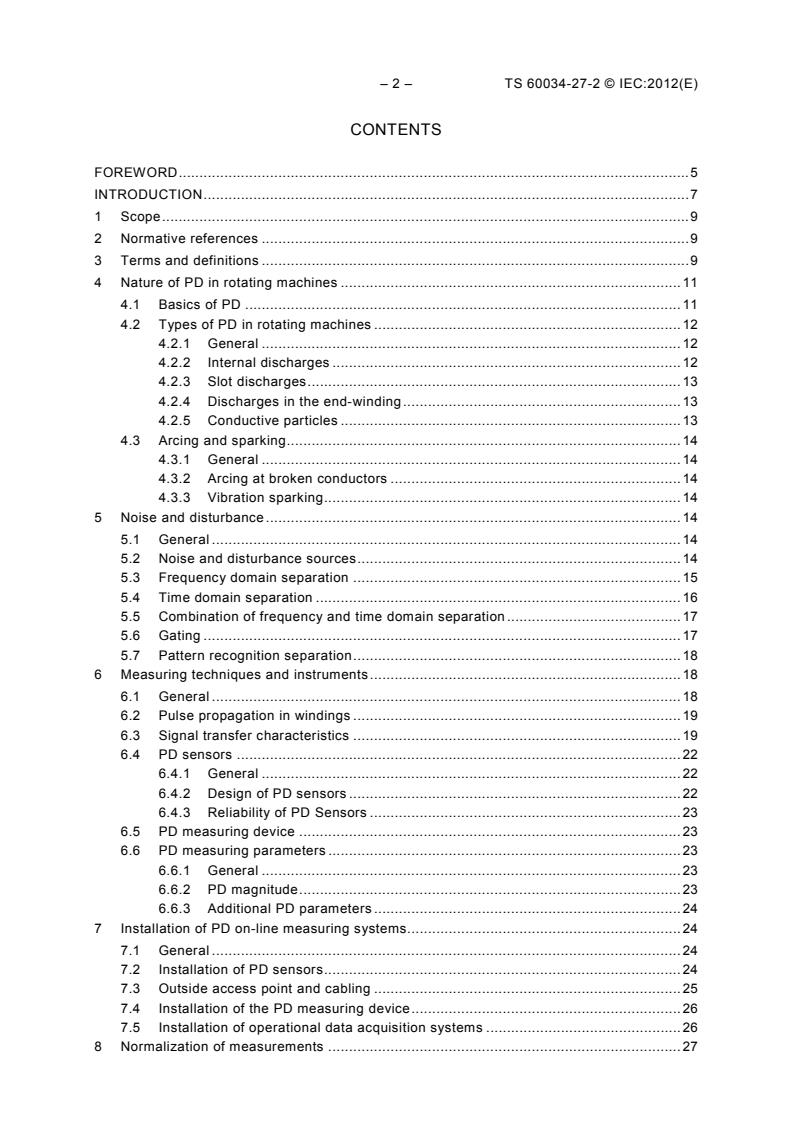
– 2 – TS 60034-27-2 © IEC:2012(E)
CONTENTS
FOREWORD . 5
INTRODUCTION . 7
1 Scope . 9
2 Normative references . 9
3 Terms and definitions . 9
4 Nature of PD in rotating machines . 11
4.1 Basics of PD . 11
4.2 Types of PD in rotating machines . 12
4.2.1 General . 12
4.2.2 Internal discharges . 12
4.2.3 Slot discharges . 13
4.2.4 Discharges in the end-winding . 13
4.2.5 Conductive particles . 13
4.3 Arcing and sparking . 14
4.3.1 General . 14
4.3.2 Arcing at broken conductors . 14
4.3.3 Vibration sparking . 14
5 Noise and disturbance . 14
5.1 General . 14
5.2 Noise and disturbance sources . 14
5.3 Frequency domain separation . 15
5.4 Time domain separation . 16
5.5 Combination of frequency and time domain separation . 17
5.6 Gating . 17
5.7 Pattern recognition separation . 18
6 Measuring techniques and instruments . 18
6.1 General . 18
6.2 Pulse propagation in windings . 19
6.3 Signal transfer characteristics . 19
6.4 PD sensors . 22
6.4.1 General . 22
6.4.2 Design of PD sensors . 22
6.4.3 Reliability of PD Sensors . 23
6.5 PD measuring device . 23
6.6 PD measuring parameters . 23
6.6.1 General . 23
6.6.2 PD magnitude . 23
6.6.3 Additional PD parameters . 24
7 Installation of PD on-line measuring systems . 24
7.1 General . 24
7.2 Installation of PD sensors . 24
7.3 Outside access point and cabling . 25
7.4 Installation of the PD measuring device . 26
7.5 Installation of operational data acquisition systems . 26
8 Normalization of measurements . 27
TS 60034-27-2 © IEC:2012(E) – 3 –
8.1 General . 27
8.2 Normalization for low frequency systems . 27
8.2.1 General . 27
8.2.2 Normalization procedure . 27
8.3 Normalization / sensitivity check for high & very high frequency systems . 29
8.3.1 Specification for the electronic pulse generation . 29
8.3.2 Configuration of the machine . 30
8.3.3 Sensitivity check . 30
9 Measuring procedures . 30
9.1 General . 30
9.2 Machine operating parameters . 31
9.3 Baseline measurement . 31
9.3.1 General . 31
9.3.2 Recommended test procedure . 31
9.4 Periodic on-line PD measurements . 32
9.5 Continuous on-line PD measurements . 33
10 Visualization of measurements . 33
10.1 General . 33
10.2 Visualization of trending parameters . 33
10.3 Visualization of PD patterns . 34
11 Interpretation of on-line measurements. 37
11.1 General . 37
11.2 Evaluation of basic trend parameters. 37
11.3 Evaluation of PD patterns . 38
11.3.1 General . 38
11.3.2 PD pattern interpretation . 38
11.4 Effect of machine operating factors . 39
11.4.1 General . 39
11.4.2 Machine operating factors . 39
11.4.3 Steady state load conditions . 39
11.4.4 Transient load conditions . 40
12 Test report. 41
Annex A (informative) Examples of Phase Resolved Partial Discharge (PRPD) pattern . 44
Bibliography . 55
Figure 1 – Time domain disturbance separation by time of pulse arrival . 16
Figure 2 – Combined time and frequency domain disturbance separation (TF-map) . 17
Figure 3 – Idealized frequency response of a PD pulse at the PD source and at the
machine terminals; Frequency response of different PD measuring systems: a) low
frequency range, b) high frequency range, c) very high frequency range . 21
Figure 4 – Measuring object, during normalization . 28
Figure 5 – Arrangement for sensitivity check . 29
Figure 6 – Recommended test procedure with consecutive load and temperature
conditions . 32
Figure 7 – Example of visualization of trending parameters. 34
Figure 8 – Example of a Φ-q-n partial discharge pattern, with colour code for the pulse
number H(n)/s . 35
– 4 – TS 60034-27-2 © IEC:2012(E)
Figure 9 – Example of a three phase, phase shifted Φ-q-n plot . 36
Figure A.1 – Stylized examples of PD phase resolved patterns . 44
Figure A.2 – Example of internal void discharges PRPD pattern, recorded during
laboratory simulation. 45
Figure A.3 – Example of internal delamination PRPD pattern, recorded during
laboratory simulation. 46
Figure A.4 – Example of delamination between conductor and insulation PRPD pattern,
recorded during laboratory simulation . 47
Figure A.5 – Slot partial discharges activity and corresponding PRPD pattern, recorded
during laboratory simulation . 47
Figure A.6 – Corona activity at the S/C and stress grading coating, and corresponding
PRPD pattern, recorded during laboratory simulation . 48
Figure A.7 – Surface tracking activity along the end arm and corresponding PRPD
pattern, recorded during laboratory simulation . 48
Figure A.8 – Gap type discharge activities and corresponding PRPD patterns, recorded
during laboratory simulations . 49
Figure A.9 – Example of internal void discharges PRPD pattern, recorded on-line . 50
Figure A.10 – Example of internal delamination PRPD pattern, recorded on-line . 51
Figure A.11 – Example of delamination between conductor and insulation PRPD
pattern, recorded on-line . 51
Figure A.12 – Degradation caused by slot partial discharges activity and corresponding
PRPD pattern recorded on-line . 52
Figure A.13 – Degradation caused by corona activity at the S/C and stress grading
coating and corresponding PRPD pattern, recorded on-line . 53
Figure A.14 – Surface tracking activity along the end arm and corresponding PRPD
pattern, recorded on-line . 53
Figure A.15 – Degradation caused by gap type discharges and corresponding PRPD
patterns, recorded on-line . 54
Figure A.16 – PRPD pattern recorded on-line, illustrating multiple PD sources . 54
TS 60034-27-2 © IEC:2012(E) – 5 –
INTERNATIONAL ELECTROTECHNICAL COMMISSION
______________
ROTATING ELECTRICAL MACHINES –
Part 27-2: On-line partial discharge measurements on the stator
winding insulation of rotating electrical machines
FOREWORD
1) The International Electrotechnical Commission (IEC) is a worldwide organization for standardization comprising
all national electrotechnical committees (IEC National Committees). The object of IEC is to promote interna-
tional co-operation on all questions concerning standardization in the electrical and electronic fields. To this
end and in addition to other activities, IEC publishes International Standards, Technical Specifications, Tech-
nical Reports, Publicly Available Specifications (PAS) and Guides (hereafter referred to as “IEC Publica-
tion(s)”). Their preparation is entrusted to technical committees; any IEC National Committee interested in the
subject dealt with may participate in this preparatory work. International, governmental and non-governmental
organizations liaising with the IEC also participate in this preparation. IEC collaborates closely with the Interna-
tional Organization for Standardization (ISO) in accordance with conditions determined by agreement between
the two organizations.
2) The formal decisions or agreements of IEC on technical matters express, as nearly as possible, an international
consensus of opinion on the relevant subjects since each technical committee has representation from all inter-
ested IEC National Committees.
3) IEC Publications have the form of recommendations for international use and are accepted by IEC National
Committees in that sense. While all reasonable efforts are made to ensure that the technical content of IEC
Publications is accurate, IEC cannot be held responsible for the way in which they are used or for any misinter-
pretation by any end user.
4) In order to promote international uniformity, IEC National Committees undertake to apply IEC Publications
transparently to the maximum extent possible in their national and regional publications. Any divergence be-
tween any IEC Publication and the corresponding national or regional publication shall be clearly indicated in
the latter.
5) IEC itself does not provide any attestation of conformity. Independent certification bodies provide conformity
assessment services and, in some areas, access to IEC marks of conformity. IEC is not responsible for any
services carried out by independent certification bodies.
6) All users should ensure that they have the latest edition of this publication.
7) No liability shall attach to IEC or its directors, employees, servants or agents including individual experts and
members of its technical committees and IEC National Committees for any personal injury, property damage or
other damage of any nature whatsoever, whether direct or indirect, or for costs (including legal fees) and ex-
penses arising out of the publication, use of, or reliance upon, this IEC Publication or any other IEC Publica-
tions.
8) Attention is drawn to the Normative references cited in this publication. Use of the referenced publications is
indispensable for the correct application of this publication.
9) Attention is drawn to the possibility that some of the elements of this IEC Publication may be the subject of
patent rights. IEC shall not be held responsible for identifying any or all such patent rights.
The main task of IEC technical committees is to prepare International Standards. In excep-
tional circumstances, a technical committee may propose the publication of a technical speci-
fication when
• the required support cannot be obtained for the publication of an International Standard,
despite repeated efforts, or
• the subject is still under technical development or where, for any other reason, there is the
future but no immediate possibility of an agreement on an International Standard.
Technical specifications are subject to review within three years of publication to decide
whether they can be transformed into International Standards.
IEC/TS 60034-27-2, which is a technical specification, has been prepared by IEC technical
committee 2: Rotating machinery.
– 6 – TS 60034-27-2 © IEC:2012(E)
The text of this technical specification is based on the following documents:
Enquiry draft Report on voting
2/1636/DTS 2/1649/RVC
Full information on the voting for the approval of this technical specification can be found in
the report on voting indicated in the above table.
This publication has been drafted in accordance with the ISO/IEC Directives, Part 2.
NOTE A table of cross-references of all IEC TC 2 publications can be found on the IEC TC 2 dashboard on the
IEC website.
The committee has decided that the contents of this publication will remain unchanged until
the stability date indicated on the IEC web site under "http://webstore.iec.ch" in the data re-
lated to the specific publication. At this date, the publication will be
• transformed into an International standard,
• reconfirmed,
• withdrawn,
• replaced by a revised edition, or
• amended.
A bilingual version of this publication may be issued at a later date.
IMPORTANT – The 'colour inside' logo on the cover page of this publication indicates
that it contains colours which are considered to be useful for the correct understand-
ing of its contents. Users should therefore print this document using a colour printer.
TS 60034-27-2 © IEC:2012(E) – 7 –
INTRODUCTION
For many years, the measurement of partial discharges (PD) has been employed as a sensi-
tive means of assessing the quality of new insulation as well as a means of detecting local-
ized sources of PD in used electrical winding insulation arising from operational stresses in
service. Compared with other dielectric tests (i.e. the measurement of dissipation factor or
insulation resistance) the differentiating character of partial discharge measurements allows
localized weak points of the insulation system to be identified. Especially on-line PD meas-
urements are not only sensitive to partial discharges but also to various arcing and sparking
phenomena.
With regard to condition assessment of rotating machines, the measurement of partial dis-
charges can provide information on:
– points of weakness in the insulation system;
– degradation processes;
– maintenance measures and intervals between overhauls.
Although the PD testing of rotating machines has gained widespread acceptance, it has
emerged from several studies that not only are there many different methods of measurement
in existence but also the criteria and methods of analysing and finally assessing the measured
data are often very different and not really comparable. Consequently, there is a need to give
some guidance to those users who are considering the use of PD measurements to assess
the condition of their insulation systems.
Partial discharge testing of stator windings can be divided into two broad groups:
a) off-line measurements, in which the stator winding is isolated from the power system and
a separate power supply is employed to energize the winding;
b) on-line measurements, in which the rotating machine is operating normally and connected
to the power system.
Both of these approaches have advantages and disadvantages with respect to one another. A
detailed discussion of PD off-line testing is provided in IEC/TS 60034-27, whereas this tech-
nical specification is confined to on-line techniques. The approach to deal with PD on- and
off-line measurement techniques in two different technical specifications is considered neces-
sary to render each specification sufficiently concise to be of use by non-specialists in the
field of PD measurement.
PD on-line measurements are recorded with the rotating machine experiencing all of the op-
erating stresses; thermal, electrical, environmental and mechanical. On-line PD testing has
the following advantages:
– the voltage distribution across the winding is the same as during operation;
– the measurements are made at operating temperature;
– normal mechanical forces are present.
Due to the realistic stress impact on the winding during measurement and due to the fact that
the measurement is performed during normal operation, on-line PD testing has become very
popular. Since no service interruption is required, once the PD sensors are installed during a
scheduled unit outage, and no external power source is needed, on-line testing is usually cost
effective compared to off-line PD measurement. Condition changes of the stator winding insu-
lation system can be identified and evaluated at an early stage based on a real-time condition
assessment and thus condition-based and predictive maintenance strategies can be im-
proved.
Empirical limits verified in practice can be used as a basis for evaluating test results. Fur-
thermore, PD trend evaluation and comparisons with machines of similar design and similar
– 8 – TS 60034-27-2 © IEC:2012(E)
insulation system measured under similar conditions, using the same measuring equipment,
are recommended to ensure reliable assessment of the condition of the stator winding insula-
tion.
This technical specification does not deal with online PD measurements on converter driven
electrical machines because different measuring techniques are needed to distinguish be-
tween noise from the converter and PD from the winding. For this purpose IEC/TS 61934 may
apply.
Limitations
On-line PD tests on stator windings produce comparative, rather than absolute measure-
ments. This creates a fundamental limitation for the interpretation of PD data, and implies
that simple limits for allowable PD cannot be established unless many precautions are taken.
For the same reasons, PD acceptance criteria for new or rewound stator windings cannot be
established unless many precautions are taken. The reasons for the difficulty to set absolute
limits for PD include:
• There are many types of PD sensors as well as recording and analyzing instruments.
Generally they are incompatible and will produce different results for the same PD activity.
• Even with the same measuring system, partial discharges will interact with the winding
capacitance, inductance and/or surge impedance to produce different voltage and current
pulses. Thus PD measurements from machines with different ratings and/or winding con-
nections may produce different PD results, even though the actual amount of damage may
be the same.
• Different types of defects can produce different PD magnitudes, even with the same
amount of damage.
• PD may occur close or far from the PD sensor. In general if the PD is physically far from
the PD sensor, it will produce a smaller response at the PD sensor due to attenuation.
Users should also be aware that there is no evidence that the time to failure of the stator
winding insulation can be estimated using any PD quantity, even in combination with other
electrical tests. Also, determining the root cause of an insulation deterioration process using
pattern recognition, especially if more than one process is occurring, is still somewhat subjec-
tive, although the technology is evolving rapidly.
Noise and disturbance may have a great impact on the detected signals, especially for on-line
PD measurements. Cross-coupling of PD and noise on one phase can obscure PD on anoth-
er phase. With some measuring systems, this can make objective interpretation of the test
results difficult.
Users of PD measurement should be aware that, due to the principles of the method, not all
insulation-related problems in stator windings can be detected by measuring partial discharg-
es, e.g. insulation failures involving continuous leakage currents due to conductive paths be-
tween different elements of the insulation or pulse-less discharge phenomena.
TS 60034-27-2 © IEC:2012(E) – 9 –
ROTATING ELECTRICAL MACHINES –
Part 27-2: On-line partial discharge measurements on the stator
winding insulation of rotating electrical machines
1 Scope
This part of IEC 60034, which is a technical specification, provides a common basis for
– measuring techniques and instruments;
– the arrangement of the installation;
– normalization and sensitivity assessment;
– measuring procedures;
– noise reduction;
– the documentation of results;
– the interpretation of results;
with respect to partial discharge on-line measurements on the stator winding insulation of
non-converter driven rotating electrical machines with rated voltage of 3 kV and up. This
technical specification covers PD measuring systems and methods detecting electrical PD
signals. The same measuring devices and procedures can also be used to detect electrical
sparking and arcing phenomena.
NOTE The main differences between on-line measurements and off-line measurements are due to a different
voltage distribution along the winding and various thermal and mechanical effects related to the operation, like
vibration, contact arcing or temperature gradients between stator copper and stator iron core. Furthermore, espe-
cially for hydrogen-cooled machines the gas and the gas pressure is different for off- and on-line PD measure-
ments.
2 Normative references
The following documents, in whole or in part, are normatively referenced in this document and
are indispensable for its application. For dated references, only the edition cited applies. For
undated references, the latest edition of the referenced document (including any amend-
ments) applies.
IEC 60270:2000, High-voltage test techniques – Partial discharge measurements
IEC/TS 60034-27, Rotating electrical machines – Part 27: Off-line partial discharge measure-
ments on the stator winding insulation of rotating electrical machines
3 Terms and definitions
For the purposes of this document the general terms and definitions for partial discharge
measurements given in IEC 60270 apply, together with the following.
3.1
off-line measurement
measurement taken with the rotating machine at standstill, the machine being disconnected
from the power system
Note 1 to entry: The necessary test voltage is applied to the winding from a separate voltage source.
– 10 – TS 60034-27-2 © IEC:2012(E)
3.2
on-line measurement
measurement taken with the rotating machine in normal operation
3.3
periodic on-line PD measurement
on-line PD measurement performed on the machine at regular intervals
3.4
continuous on-line PD measurement
on-line PD measurement performed on the machine with a measuring device continuously
acquiring PD data
3.5
stress control coating
paint or tape on the surface of the groundwall insulation that extends beyond the conductive
slot portion coating in high-voltage stator bars and coils
Note 1 to entry: The stress control coating reduces the electric field stress along the winding overhang to below a
critical value that would initiate PD on the surface. The stress control coating overlaps the conductive slot portion
coating to provide electrical contact between them.
3.6
conductive slot coating
conductive paint or tape layer in intimate contact with the groundwall insulation in the slot
portion of the coil side, often called ‘semiconductive’ coating
Note 1 to entry: This coating together with adequate slot design provides electrical contact to the stator core,
without shorting the core laminations.
3.7
corona discharge
visible partial discharge adjacent to the surface of a conductor in gases
3.8
slot discharges
discharges that occur between the outer surface of the slot portion of a coil or bar and the
grounded core laminations due to high voltage
3.9
vibration sparking
interrupted surface currents between the outer surface of the slot portion of a bar and the
grounded core laminations due to axially induced voltages on the conductive slot coating
combined with bar vibrations
3.10
internal discharges
discharges that occur within the insulation system
3.11
surface discharges
discharges that occur on the surface of the insulation or on the surface of winding compo-
nents in the winding overhang or the active part of the machine winding
3.12
pulse magnitude distribution
number of pulses within a series of equally-spaced windows of pulse magnitude during a pre-
defined measuring time
TS 60034-27-2 © IEC:2012(E) – 11 –
3.13
pulse phase distribution
number of pulses within a series of equally-spaced windows of phase during a predefined
measuring time
3.14
phase resolved partial discharge pattern
PD distribution map of PD magnitude vs. a.c. cycle phase position, for visualization of the PD
behaviour during a predefined measuring time
3.15
PD sensor
general type of transducer, which can be used to detect PD signals from the machine winding
Note 1 to entry: A PD sensor typically consists of a high voltage coupling capacitor of low inductance design and
a low voltage coupling device in series.
3.16
coupling device
usually an active or passive four-terminal network that converts the input currents to output
voltage signals
Note 1 to entry: These signals are transmitted to the measuring device by a transmission system. The frequency
response of the coupling device is normally chosen at least so as to efficiently prevent the test voltage frequency
and its harmonics from reaching the measuring device.
3.17
resistance temperature detector
RTD
temperature detector inserted into the stator winding, usually between the top and bottom bar
or between embedded coil sides in a given slot
3.18
largest repeatedly occurring PD magnitude Q
m
the largest magnitude recorded by a measuring system which has the pulse train response in
accordance with 4.3.3 of IEC 60270, or the magnitude associated with a PD pulse repetition
rate of a specified number of pulses per second, which can be directly inferred from a pulse
magnitude distribution.
Note 1 to entry: A recommended pulse repetition rate is 10 pulses or more per second.
4 Nature of PD in rotating machines
4.1 Basics of PD
Generally, partial discharges (PD) can develop at locations where the dielectric properties of
insulating materials are inhomogeneous. At such locations, the local electrical field strength
may be enhanced. Due to local electrical over-stressing this may lead to a local, partial
breakdown. This partial breakdown is not a total breakdown of the insulation system. PD in
general requires a gas volume to develop, e.g. in gas filled voids embedded in the insulation,
adjacent to conductors or at insulation interfaces.
A partial discharge can occur when the local field strength exceeds the dielectric strength of
the insulating material. This process may result in numerous PD pulses during one cycle of
the applied voltage.
The amount of charge transferred in the discharge is closely related to the specific properties
of the inhomogeneity such as the dimensions, the actual breakdown voltage and the specific
dielectric properties of the materials involved, e.g. surface properties, kind of gas, gas pres-
sure, etc.
– 12 – TS 60034-27-2 © IEC:2012(E)
Stator winding insulation systems for high voltage machines will normally have some PD ac-
tivity, but are inherently resistant to partial discharges due to their inorganic mica compo-
nents. However, significant PD in these machines is usually more a symptom of insulation
deficiencies, like manufacturing problems or in-service deterioration, rather than being a di-
rect cause of failure. Nevertheless, depending on the individual processes, PD in machines
may also directly attack the insulation and thus influence the ageing process. The time to fail-
ure or failure probability may not always correlate with PD levels, but depends significantly on
other factors, for example operating temperature, wedging conditions, bar vibrations, degree
of contamination, etc.
The measurement and the analysis of the specific PD behaviour can be efficiently used for
quality control of new windings and winding components and for early detection of insulation
deficiencies caused by thermal, electrical, ambient and mechanical ageing factors in service,
which might result in an insulation fault.
The main differences between on-line measurements and off-line measurements are due to a
different voltage distribution along the winding and various thermal and mechanical effects
related to the operation, like vibration, contact arcing or temperature gradients between stator
copper and stator iron core. Furthermore, especially for hydrogen-cooled machines the gas
and the gas pressure is different for off- and on-line PD measurements.
4.2 Types of PD in rotating machines
4.2.1 General
Partial discharges may develop throughout the stator winding insulation system due to specif-
ic manufacturing technologies, manufacturing deficiencies, normal in-service ageing, or ab-
normal ageing. Machine design, the nature of the materials used, manufacturing methods,
operating conditions, etc. can profoundly affect the quantity, location, characteristics, evolu-
tion and the significance of PD. For a given machine, the existing PD sources may be identi-
fied and distinguished in many cases by their characteristic PD behaviour.
4.2.2 Internal discharges
4.2.2.1 Internal voids
Although manufacturing processes are designed to minimize internal voids, inevitably there is
some void content. For example in a resin impregnated mica tape insulation system, that is
commonly used in high voltage rotating machines, the mica in the insulation system prevents
the partial discharges from developing into a complete breakdown. As long as internal voids
are small and do not significantly enlarge, operational reliability is not reduced.
4.2.2.2 Internal delamination
Internal delamination within the main insulation can be caused by imperfect curing of the insu-
lation system during manufacturing or by mechanical or thermal over-stressing during opera-
tion. Large voids may develop over a large surface resulting in discharges of relatively high
energy, which may significantly attack the insulation. In particular, delamination will reduce
the thermal conductivity of the insulation, which might lead to accelerated ageing or even a
thermal runaway. Thus, delamination needs careful consideration when PD activity is being
assessed.
4.2.2.3 Delamination between conductors and insulation
Thermal cycling may cause delamination at the interface of the conductor and the main insu-
lation. This delamination can result in partial discharges which can relatively rapidly result in
failure especially in multi-turn coils.
TS 60034-27-2 © IEC:2012(E) – 13 –
4.2.2.4 Electrical treeing
Electrical treeing in machine insulation is an ageing process in which fine erosion channels
propagate through the epoxy around the mica barriers and may finally lead to electrical
breakdown of the main insulation. Electrical treeing can start at any point of locally enhanced
electric field within the insulation, e.g. rough structures of the inner conductor, insulation im-
purities, gas filled voids or delaminations in the insulation. This process is associated with
internal partial discharge activity.
4.2.3 Slot discharges
Slot discharges in high voltage machines will develop when the conductive slot portion coat-
ing is damaged due to bar/coil movement in the slot or slot exit area, for example by a loss of
wedging pressure due to settlement, erosion of the material, abrasion, chemical attack or
manufacturing deficiencies. Higher discharges will develop when serious mechanical damage
is already present, which may result in additional damage to the main insulation and eventual-
ly in an insulation fault. Slot discharges are generally caused by locally enhanced electric
fields, and thus these processes occur only at the higher voltage end of each phase. The
absolute time between detection of this phenomenon and final insulation failure is generally
unknown. However, compared to other typical deterioration effects this time could be relative-
ly short, especially in the presence of bar/coil vibrations. Thus, reliable detection at an early
stage is necessary to decide if appropriate remedial actions are required.
4.2.4 Discharges in the end-winding
4.2.4.1 General
Partial discharges in the end-winding area may occur at several locations with high local elec-
tric field strengths. Such discharges usually occur at interfaces between different elements of
the stator winding overhang.
4.2.4.2 Surface discharges
Surface discharges generally occur whenever the electrical field along a surface exceeds the
breakdown field of the surrounding gas. This may occur if no stress control coating is applied
or the stress control coating of the end-winding becomes ineffective because of poorly de-
signed interfaces, contamination, porosity, thermal effects, etc. When reliable field grading is
no longer assured surface discharges will develop, which may gradually erode the materials.
This is normally a very slow failure mechanism, even though the PD behaviour might be sub-
jected to relatively fast changes due to surface effects. Surface discharges usually result in a
phase to ground fault.
4.2.4.3 Phase to phase discharges
PD may occur between phases, for example due to inadequate phase to phase clearances or
at elements of the overhang support system like spacers or cords. Depending on specific de-
sign details these discharges may have large magnitudes and may either occur as surface
discharges or internal discharges and thus the time between detection of this phenomenon
and final insulation failure is uncertain. Phase to phase discharges may result in a phase to
phase breakdown.
4.2.5 Conductive particles
Conductive particles, especially small particles, for example due to contamination of the wind-
ing, may result in a strong local concentration of partial discharges. This may result in a ‘pin-
hole’ in the insulation.
– 14 – TS 60034-27-2 © IEC:2012(E)
4.3 Arcing and sparking
4.3.1 General
In contrast to the types of PD described in 4.2, which are caused by locally enhanced electric
fields, arcing and sparking phenomena occur due to interruption of currents resulting from the
magnetic flux within the stator core. These processes involve higher energy and tempera-
tures, which leads to a faster degradation of the insulation materials. Arcing and sparking lead
to transient pulses, which can also be detected by PD measuring systems.
4.3.2 Arcing at broken conductors
Broken conductors, resulting from mechanical vibrations, may lead to intermittent contacts
and consequently to arc formation.
4.3.3 Vibration sparking
Due to the magnetic field in the stator core parasitic surface currents will flow axially along
the conductive slot coating of a bar. In case the bar vibrates, these currents may be interrupt-
ed at a contact point to the core iron, and the interrup
...
IEC/TS 60034-27-2 ®
Edition 1.0 2012-03
TECHNICAL
SPECIFICATION
colour
inside
Rotating electrical machines –
Part 27-2: On-line partial discharge measurements on the stator winding
insulation of rotating electrical machines
IEC/TS 60034-27-2:2012(E)
All rights reserved. Unless otherwise specified, no part of this publication may be reproduced or utilized in any form
or by any means, electronic or mechanical, including photocopying and microfilm, without permission in writing from
either IEC or IEC's member National Committee in the country of the requester.
If you have any questions about IEC copyright or have an enquiry about obtaining additional rights to this publication,
please contact the address below or your local IEC member National Committee for further information.
IEC Central Office Tel.: +41 22 919 02 11
3, rue de Varembé Fax: +41 22 919 03 00
CH-1211 Geneva 20 info@iec.ch
Switzerland www.iec.ch
About the IEC
The International Electrotechnical Commission (IEC) is the leading global organization that prepares and publishes
International Standards for all electrical, electronic and related technologies.
About IEC publications
The technical content of IEC publications is kept under constant review by the IEC. Please make sure that you have the
latest edition, a corrigenda or an amendment might have been published.
Useful links:
IEC publications search - www.iec.ch/searchpub Electropedia - www.electropedia.org
The advanced search enables you to find IEC publications The world's leading online dictionary of electronic and
by a variety of criteria (reference number, text, technical electrical terms containing more than 30 000 terms and
committee,…). definitions in English and French, with equivalent terms in
It also gives information on projects, replaced and additional languages. Also known as the International
withdrawn publications. Electrotechnical Vocabulary (IEV) on-line.
IEC Just Published - webstore.iec.ch/justpublished Customer Service Centre - webstore.iec.ch/csc
Stay up to date on all new IEC publications. Just Published If you wish to give us your feedback on this publication
details all new publications released. Available on-line and or need further assistance, please contact the
also once a month by email. Customer Service Centre: csc@iec.ch.
IEC/TS 60034-27-2 ®
Edition 1.0 2012-03
TECHNICAL
SPECIFICATION
colour
inside
Rotating electrical machines –
Part 27-2: On-line partial discharge measurements on the stator winding
insulation of rotating electrical machines
INTERNATIONAL
ELECTROTECHNICAL
COMMISSION
PRICE CODE
XA
ICS 29.160 ISBN 978-2-8322-0056-8
– 2 – TS 60034-27-2 © IEC:2012(E)
CONTENTS
FOREWORD . 5
INTRODUCTION . 7
1 Scope . 9
2 Normative references . 9
3 Terms and definitions . 9
4 Nature of PD in rotating machines . 11
4.1 Basics of PD . 11
4.2 Types of PD in rotating machines . 12
4.2.1 General . 12
4.2.2 Internal discharges . 12
4.2.3 Slot discharges . 13
4.2.4 Discharges in the end-winding . 13
4.2.5 Conductive particles . 13
4.3 Arcing and sparking . 14
4.3.1 General . 14
4.3.2 Arcing at broken conductors . 14
4.3.3 Vibration sparking . 14
5 Noise and disturbance . 14
5.1 General . 14
5.2 Noise and disturbance sources . 14
5.3 Frequency domain separation . 15
5.4 Time domain separation . 16
5.5 Combination of frequency and time domain separation . 17
5.6 Gating . 17
5.7 Pattern recognition separation . 18
6 Measuring techniques and instruments . 18
6.1 General . 18
6.2 Pulse propagation in windings . 19
6.3 Signal transfer characteristics . 19
6.4 PD sensors . 22
6.4.1 General . 22
6.4.2 Design of PD sensors . 22
6.4.3 Reliability of PD Sensors . 23
6.5 PD measuring device . 23
6.6 PD measuring parameters . 23
6.6.1 General . 23
6.6.2 PD magnitude . 23
6.6.3 Additional PD parameters . 24
7 Installation of PD on-line measuring systems . 24
7.1 General . 24
7.2 Installation of PD sensors . 24
7.3 Outside access point and cabling . 25
7.4 Installation of the PD measuring device . 26
7.5 Installation of operational data acquisition systems . 26
8 Normalization of measurements . 27
TS 60034-27-2 © IEC:2012(E) – 3 –
8.1 General . 27
8.2 Normalization for low frequency systems . 27
8.2.1 General . 27
8.2.2 Normalization procedure . 27
8.3 Normalization / sensitivity check for high & very high frequency systems . 29
8.3.1 Specification for the electronic pulse generation . 29
8.3.2 Configuration of the machine . 30
8.3.3 Sensitivity check . 30
9 Measuring procedures . 30
9.1 General . 30
9.2 Machine operating parameters . 31
9.3 Baseline measurement . 31
9.3.1 General . 31
9.3.2 Recommended test procedure . 31
9.4 Periodic on-line PD measurements . 32
9.5 Continuous on-line PD measurements . 33
10 Visualization of measurements . 33
10.1 General . 33
10.2 Visualization of trending parameters . 33
10.3 Visualization of PD patterns . 34
11 Interpretation of on-line measurements. 37
11.1 General . 37
11.2 Evaluation of basic trend parameters. 37
11.3 Evaluation of PD patterns . 38
11.3.1 General . 38
11.3.2 PD pattern interpretation . 38
11.4 Effect of machine operating factors . 39
11.4.1 General . 39
11.4.2 Machine operating factors . 39
11.4.3 Steady state load conditions . 39
11.4.4 Transient load conditions . 40
12 Test report. 41
Annex A (informative) Examples of Phase Resolved Partial Discharge (PRPD) pattern . 44
Bibliography . 55
Figure 1 – Time domain disturbance separation by time of pulse arrival . 16
Figure 2 – Combined time and frequency domain disturbance separation (TF-map) . 17
Figure 3 – Idealized frequency response of a PD pulse at the PD source and at the
machine terminals; Frequency response of different PD measuring systems: a) low
frequency range, b) high frequency range, c) very high frequency range . 21
Figure 4 – Measuring object, during normalization . 28
Figure 5 – Arrangement for sensitivity check . 29
Figure 6 – Recommended test procedure with consecutive load and temperature
conditions . 32
Figure 7 – Example of visualization of trending parameters. 34
Figure 8 – Example of a Φ-q-n partial discharge pattern, with colour code for the pulse
number H(n)/s . 35
– 4 – TS 60034-27-2 © IEC:2012(E)
Figure 9 – Example of a three phase, phase shifted Φ-q-n plot . 36
Figure A.1 – Stylized examples of PD phase resolved patterns . 44
Figure A.2 – Example of internal void discharges PRPD pattern, recorded during
laboratory simulation. 45
Figure A.3 – Example of internal delamination PRPD pattern, recorded during
laboratory simulation. 46
Figure A.4 – Example of delamination between conductor and insulation PRPD pattern,
recorded during laboratory simulation . 47
Figure A.5 – Slot partial discharges activity and corresponding PRPD pattern, recorded
during laboratory simulation . 47
Figure A.6 – Corona activity at the S/C and stress grading coating, and corresponding
PRPD pattern, recorded during laboratory simulation . 48
Figure A.7 – Surface tracking activity along the end arm and corresponding PRPD
pattern, recorded during laboratory simulation . 48
Figure A.8 – Gap type discharge activities and corresponding PRPD patterns, recorded
during laboratory simulations . 49
Figure A.9 – Example of internal void discharges PRPD pattern, recorded on-line . 50
Figure A.10 – Example of internal delamination PRPD pattern, recorded on-line . 51
Figure A.11 – Example of delamination between conductor and insulation PRPD
pattern, recorded on-line . 51
Figure A.12 – Degradation caused by slot partial discharges activity and corresponding
PRPD pattern recorded on-line . 52
Figure A.13 – Degradation caused by corona activity at the S/C and stress grading
coating and corresponding PRPD pattern, recorded on-line . 53
Figure A.14 – Surface tracking activity along the end arm and corresponding PRPD
pattern, recorded on-line . 53
Figure A.15 – Degradation caused by gap type discharges and corresponding PRPD
patterns, recorded on-line . 54
Figure A.16 – PRPD pattern recorded on-line, illustrating multiple PD sources . 54
TS 60034-27-2 © IEC:2012(E) – 5 –
INTERNATIONAL ELECTROTECHNICAL COMMISSION
______________
ROTATING ELECTRICAL MACHINES –
Part 27-2: On-line partial discharge measurements on the stator
winding insulation of rotating electrical machines
FOREWORD
1) The International Electrotechnical Commission (IEC) is a worldwide organization for standardization comprising
all national electrotechnical committees (IEC National Committees). The object of IEC is to promote interna-
tional co-operation on all questions concerning standardization in the electrical and electronic fields. To this
end and in addition to other activities, IEC publishes International Standards, Technical Specifications, Tech-
nical Reports, Publicly Available Specifications (PAS) and Guides (hereafter referred to as “IEC Publica-
tion(s)”). Their preparation is entrusted to technical committees; any IEC National Committee interested in the
subject dealt with may participate in this preparatory work. International, governmental and non-governmental
organizations liaising with the IEC also participate in this preparation. IEC collaborates closely with the Interna-
tional Organization for Standardization (ISO) in accordance with conditions determined by agreement between
the two organizations.
2) The formal decisions or agreements of IEC on technical matters express, as nearly as possible, an international
consensus of opinion on the relevant subjects since each technical committee has representation from all inter-
ested IEC National Committees.
3) IEC Publications have the form of recommendations for international use and are accepted by IEC National
Committees in that sense. While all reasonable efforts are made to ensure that the technical content of IEC
Publications is accurate, IEC cannot be held responsible for the way in which they are used or for any misinter-
pretation by any end user.
4) In order to promote international uniformity, IEC National Committees undertake to apply IEC Publications
transparently to the maximum extent possible in their national and regional publications. Any divergence be-
tween any IEC Publication and the corresponding national or regional publication shall be clearly indicated in
the latter.
5) IEC itself does not provide any attestation of conformity. Independent certification bodies provide conformity
assessment services and, in some areas, access to IEC marks of conformity. IEC is not responsible for any
services carried out by independent certification bodies.
6) All users should ensure that they have the latest edition of this publication.
7) No liability shall attach to IEC or its directors, employees, servants or agents including individual experts and
members of its technical committees and IEC National Committees for any personal injury, property damage or
other damage of any nature whatsoever, whether direct or indirect, or for costs (including legal fees) and ex-
penses arising out of the publication, use of, or reliance upon, this IEC Publication or any other IEC Publica-
tions.
8) Attention is drawn to the Normative references cited in this publication. Use of the referenced publications is
indispensable for the correct application of this publication.
9) Attention is drawn to the possibility that some of the elements of this IEC Publication may be the subject of
patent rights. IEC shall not be held responsible for identifying any or all such patent rights.
The main task of IEC technical committees is to prepare International Standards. In excep-
tional circumstances, a technical committee may propose the publication of a technical speci-
fication when
• the required support cannot be obtained for the publication of an International Standard,
despite repeated efforts, or
• the subject is still under technical development or where, for any other reason, there is the
future but no immediate possibility of an agreement on an International Standard.
Technical specifications are subject to review within three years of publication to decide
whether they can be transformed into International Standards.
IEC/TS 60034-27-2, which is a technical specification, has been prepared by IEC technical
committee 2: Rotating machinery.
– 6 – TS 60034-27-2 © IEC:2012(E)
The text of this technical specification is based on the following documents:
Enquiry draft Report on voting
2/1636/DTS 2/1649/RVC
Full information on the voting for the approval of this technical specification can be found in
the report on voting indicated in the above table.
This publication has been drafted in accordance with the ISO/IEC Directives, Part 2.
NOTE A table of cross-references of all IEC TC 2 publications can be found on the IEC TC 2 dashboard on the
IEC website.
The committee has decided that the contents of this publication will remain unchanged until
the stability date indicated on the IEC web site under "http://webstore.iec.ch" in the data re-
lated to the specific publication. At this date, the publication will be
• transformed into an International standard,
• reconfirmed,
• withdrawn,
• replaced by a revised edition, or
• amended.
A bilingual version of this publication may be issued at a later date.
IMPORTANT – The 'colour inside' logo on the cover page of this publication indicates
that it contains colours which are considered to be useful for the correct understand-
ing of its contents. Users should therefore print this document using a colour printer.
TS 60034-27-2 © IEC:2012(E) – 7 –
INTRODUCTION
For many years, the measurement of partial discharges (PD) has been employed as a sensi-
tive means of assessing the quality of new insulation as well as a means of detecting local-
ized sources of PD in used electrical winding insulation arising from operational stresses in
service. Compared with other dielectric tests (i.e. the measurement of dissipation factor or
insulation resistance) the differentiating character of partial discharge measurements allows
localized weak points of the insulation system to be identified. Especially on-line PD meas-
urements are not only sensitive to partial discharges but also to various arcing and sparking
phenomena.
With regard to condition assessment of rotating machines, the measurement of partial dis-
charges can provide information on:
– points of weakness in the insulation system;
– degradation processes;
– maintenance measures and intervals between overhauls.
Although the PD testing of rotating machines has gained widespread acceptance, it has
emerged from several studies that not only are there many different methods of measurement
in existence but also the criteria and methods of analysing and finally assessing the measured
data are often very different and not really comparable. Consequently, there is a need to give
some guidance to those users who are considering the use of PD measurements to assess
the condition of their insulation systems.
Partial discharge testing of stator windings can be divided into two broad groups:
a) off-line measurements, in which the stator winding is isolated from the power system and
a separate power supply is employed to energize the winding;
b) on-line measurements, in which the rotating machine is operating normally and connected
to the power system.
Both of these approaches have advantages and disadvantages with respect to one another. A
detailed discussion of PD off-line testing is provided in IEC/TS 60034-27, whereas this tech-
nical specification is confined to on-line techniques. The approach to deal with PD on- and
off-line measurement techniques in two different technical specifications is considered neces-
sary to render each specification sufficiently concise to be of use by non-specialists in the
field of PD measurement.
PD on-line measurements are recorded with the rotating machine experiencing all of the op-
erating stresses; thermal, electrical, environmental and mechanical. On-line PD testing has
the following advantages:
– the voltage distribution across the winding is the same as during operation;
– the measurements are made at operating temperature;
– normal mechanical forces are present.
Due to the realistic stress impact on the winding during measurement and due to the fact that
the measurement is performed during normal operation, on-line PD testing has become very
popular. Since no service interruption is required, once the PD sensors are installed during a
scheduled unit outage, and no external power source is needed, on-line testing is usually cost
effective compared to off-line PD measurement. Condition changes of the stator winding insu-
lation system can be identified and evaluated at an early stage based on a real-time condition
assessment and thus condition-based and predictive maintenance strategies can be im-
proved.
Empirical limits verified in practice can be used as a basis for evaluating test results. Fur-
thermore, PD trend evaluation and comparisons with machines of similar design and similar
– 8 – TS 60034-27-2 © IEC:2012(E)
insulation system measured under similar conditions, using the same measuring equipment,
are recommended to ensure reliable assessment of the condition of the stator winding insula-
tion.
This technical specification does not deal with online PD measurements on converter driven
electrical machines because different measuring techniques are needed to distinguish be-
tween noise from the converter and PD from the winding. For this purpose IEC/TS 61934 may
apply.
Limitations
On-line PD tests on stator windings produce comparative, rather than absolute measure-
ments. This creates a fundamental limitation for the interpretation of PD data, and implies
that simple limits for allowable PD cannot be established unless many precautions are taken.
For the same reasons, PD acceptance criteria for new or rewound stator windings cannot be
established unless many precautions are taken. The reasons for the difficulty to set absolute
limits for PD include:
• There are many types of PD sensors as well as recording and analyzing instruments.
Generally they are incompatible and will produce different results for the same PD activity.
• Even with the same measuring system, partial discharges will interact with the winding
capacitance, inductance and/or surge impedance to produce different voltage and current
pulses. Thus PD measurements from machines with different ratings and/or winding con-
nections may produce different PD results, even though the actual amount of damage may
be the same.
• Different types of defects can produce different PD magnitudes, even with the same
amount of damage.
• PD may occur close or far from the PD sensor. In general if the PD is physically far from
the PD sensor, it will produce a smaller response at the PD sensor due to attenuation.
Users should also be aware that there is no evidence that the time to failure of the stator
winding insulation can be estimated using any PD quantity, even in combination with other
electrical tests. Also, determining the root cause of an insulation deterioration process using
pattern recognition, especially if more than one process is occurring, is still somewhat subjec-
tive, although the technology is evolving rapidly.
Noise and disturbance may have a great impact on the detected signals, especially for on-line
PD measurements. Cross-coupling of PD and noise on one phase can obscure PD on anoth-
er phase. With some measuring systems, this can make objective interpretation of the test
results difficult.
Users of PD measurement should be aware that, due to the principles of the method, not all
insulation-related problems in stator windings can be detected by measuring partial discharg-
es, e.g. insulation failures involving continuous leakage currents due to conductive paths be-
tween different elements of the insulation or pulse-less discharge phenomena.
TS 60034-27-2 © IEC:2012(E) – 9 –
ROTATING ELECTRICAL MACHINES –
Part 27-2: On-line partial discharge measurements on the stator
winding insulation of rotating electrical machines
1 Scope
This part of IEC 60034, which is a technical specification, provides a common basis for
– measuring techniques and instruments;
– the arrangement of the installation;
– normalization and sensitivity assessment;
– measuring procedures;
– noise reduction;
– the documentation of results;
– the interpretation of results;
with respect to partial discharge on-line measurements on the stator winding insulation of
non-converter driven rotating electrical machines with rated voltage of 3 kV and up. This
technical specification covers PD measuring systems and methods detecting electrical PD
signals. The same measuring devices and procedures can also be used to detect electrical
sparking and arcing phenomena.
NOTE The main differences between on-line measurements and off-line measurements are due to a different
voltage distribution along the winding and various thermal and mechanical effects related to the operation, like
vibration, contact arcing or temperature gradients between stator copper and stator iron core. Furthermore, espe-
cially for hydrogen-cooled machines the gas and the gas pressure is different for off- and on-line PD measure-
ments.
2 Normative references
The following documents, in whole or in part, are normatively referenced in this document and
are indispensable for its application. For dated references, only the edition cited applies. For
undated references, the latest edition of the referenced document (including any amend-
ments) applies.
IEC 60270:2000, High-voltage test techniques – Partial discharge measurements
IEC/TS 60034-27, Rotating electrical machines – Part 27: Off-line partial discharge measure-
ments on the stator winding insulation of rotating electrical machines
3 Terms and definitions
For the purposes of this document the general terms and definitions for partial discharge
measurements given in IEC 60270 apply, together with the following.
3.1
off-line measurement
measurement taken with the rotating machine at standstill, the machine being disconnected
from the power system
Note 1 to entry: The necessary test voltage is applied to the winding from a separate voltage source.
– 10 – TS 60034-27-2 © IEC:2012(E)
3.2
on-line measurement
measurement taken with the rotating machine in normal operation
3.3
periodic on-line PD measurement
on-line PD measurement performed on the machine at regular intervals
3.4
continuous on-line PD measurement
on-line PD measurement performed on the machine with a measuring device continuously
acquiring PD data
3.5
stress control coating
paint or tape on the surface of the groundwall insulation that extends beyond the conductive
slot portion coating in high-voltage stator bars and coils
Note 1 to entry: The stress control coating reduces the electric field stress along the winding overhang to below a
critical value that would initiate PD on the surface. The stress control coating overlaps the conductive slot portion
coating to provide electrical contact between them.
3.6
conductive slot coating
conductive paint or tape layer in intimate contact with the groundwall insulation in the slot
portion of the coil side, often called ‘semiconductive’ coating
Note 1 to entry: This coating together with adequate slot design provides electrical contact to the stator core,
without shorting the core laminations.
3.7
corona discharge
visible partial discharge adjacent to the surface of a conductor in gases
3.8
slot discharges
discharges that occur between the outer surface of the slot portion of a coil or bar and the
grounded core laminations due to high voltage
3.9
vibration sparking
interrupted surface currents between the outer surface of the slot portion of a bar and the
grounded core laminations due to axially induced voltages on the conductive slot coating
combined with bar vibrations
3.10
internal discharges
discharges that occur within the insulation system
3.11
surface discharges
discharges that occur on the surface of the insulation or on the surface of winding compo-
nents in the winding overhang or the active part of the machine winding
3.12
pulse magnitude distribution
number of pulses within a series of equally-spaced windows of pulse magnitude during a pre-
defined measuring time
TS 60034-27-2 © IEC:2012(E) – 11 –
3.13
pulse phase distribution
number of pulses within a series of equally-spaced windows of phase during a predefined
measuring time
3.14
phase resolved partial discharge pattern
PD distribution map of PD magnitude vs. a.c. cycle phase position, for visualization of the PD
behaviour during a predefined measuring time
3.15
PD sensor
general type of transducer, which can be used to detect PD signals from the machine winding
Note 1 to entry: A PD sensor typically consists of a high voltage coupling capacitor of low inductance design and
a low voltage coupling device in series.
3.16
coupling device
usually an active or passive four-terminal network that converts the input currents to output
voltage signals
Note 1 to entry: These signals are transmitted to the measuring device by a transmission system. The frequency
response of the coupling device is normally chosen at least so as to efficiently prevent the test voltage frequency
and its harmonics from reaching the measuring device.
3.17
resistance temperature detector
RTD
temperature detector inserted into the stator winding, usually between the top and bottom bar
or between embedded coil sides in a given slot
3.18
largest repeatedly occurring PD magnitude Q
m
the largest magnitude recorded by a measuring system which has the pulse train response in
accordance with 4.3.3 of IEC 60270, or the magnitude associated with a PD pulse repetition
rate of a specified number of pulses per second, which can be directly inferred from a pulse
magnitude distribution.
Note 1 to entry: A recommended pulse repetition rate is 10 pulses or more per second.
4 Nature of PD in rotating machines
4.1 Basics of PD
Generally, partial discharges (PD) can develop at locations where the dielectric properties of
insulating materials are inhomogeneous. At such locations, the local electrical field strength
may be enhanced. Due to local electrical over-stressing this may lead to a local, partial
breakdown. This partial breakdown is not a total breakdown of the insulation system. PD in
general requires a gas volume to develop, e.g. in gas filled voids embedded in the insulation,
adjacent to conductors or at insulation interfaces.
A partial discharge can occur when the local field strength exceeds the dielectric strength of
the insulating material. This process may result in numerous PD pulses during one cycle of
the applied voltage.
The amount of charge transferred in the discharge is closely related to the specific properties
of the inhomogeneity such as the dimensions, the actual breakdown voltage and the specific
dielectric properties of the materials involved, e.g. surface properties, kind of gas, gas pres-
sure, etc.
– 12 – TS 60034-27-2 © IEC:2012(E)
Stator winding insulation systems for high voltage machines will normally have some PD ac-
tivity, but are inherently resistant to partial discharges due to their inorganic mica compo-
nents. However, significant PD in these machines is usually more a symptom of insulation
deficiencies, like manufacturing problems or in-service deterioration, rather than being a di-
rect cause of failure. Nevertheless, depending on the individual processes, PD in machines
may also directly attack the insulation and thus influence the ageing process. The time to fail-
ure or failure probability may not always correlate with PD levels, but depends significantly on
other factors, for example operating temperature, wedging conditions, bar vibrations, degree
of contamination, etc.
The measurement and the analysis of the specific PD behaviour can be efficiently used for
quality control of new windings and winding components and for early detection of insulation
deficiencies caused by thermal, electrical, ambient and mechanical ageing factors in service,
which might result in an insulation fault.
The main differences between on-line measurements and off-line measurements are due to a
different voltage distribution along the winding and various thermal and mechanical effects
related to the operation, like vibration, contact arcing or temperature gradients between stator
copper and stator iron core. Furthermore, especially for hydrogen-cooled machines the gas
and the gas pressure is different for off- and on-line PD measurements.
4.2 Types of PD in rotating machines
4.2.1 General
Partial discharges may develop throughout the stator winding insulation system due to specif-
ic manufacturing technologies, manufacturing deficiencies, normal in-service ageing, or ab-
normal ageing. Machine design, the nature of the materials used, manufacturing methods,
operating conditions, etc. can profoundly affect the quantity, location, characteristics, evolu-
tion and the significance of PD. For a given machine, the existing PD sources may be identi-
fied and distinguished in many cases by their characteristic PD behaviour.
4.2.2 Internal discharges
4.2.2.1 Internal voids
Although manufacturing processes are designed to minimize internal voids, inevitably there is
some void content. For example in a resin impregnated mica tape insulation system, that is
commonly used in high voltage rotating machines, the mica in the insulation system prevents
the partial discharges from developing into a complete breakdown. As long as internal voids
are small and do not significantly enlarge, operational reliability is not reduced.
4.2.2.2 Internal delamination
Internal delamination within the main insulation can be caused by imperfect curing of the insu-
lation system during manufacturing or by mechanical or thermal over-stressing during opera-
tion. Large voids may develop over a large surface resulting in discharges of relatively high
energy, which may significantly attack the insulation. In particular, delamination will reduce
the thermal conductivity of the insulation, which might lead to accelerated ageing or even a
thermal runaway. Thus, delamination needs careful consideration when PD activity is being
assessed.
4.2.2.3 Delamination between conductors and insulation
Thermal cycling may cause delamination at the interface of the conductor and the main insu-
lation. This delamination can result in partial discharges which can relatively rapidly result in
failure especially in multi-turn coils.
TS 60034-27-2 © IEC:2012(E) – 13 –
4.2.2.4 Electrical treeing
Electrical treeing in machine insulation is an ageing process in which fine erosion channels
propagate through the epoxy around the mica barriers and may finally lead to electrical
breakdown of the main insulation. Electrical treeing can start at any point of locally enhanced
electric field within the insulation, e.g. rough structures of the inner conductor, insulation im-
purities, gas filled voids or delaminations in the insulation. This process is associated with
internal partial discharge activity.
4.2.3 Slot discharges
Slot discharges in high voltage machines will develop when the conductive slot portion coat-
ing is damaged due to bar/coil movement in the slot or slot exit area, for example by a loss of
wedging pressure due to settlement, erosion of the material, abrasion, chemical attack or
manufacturing deficiencies. Higher discharges will develop when serious mechanical damage
is already present, which may result in additional damage to the main insulation and eventual-
ly in an insulation fault. Slot discharges are generally caused by locally enhanced electric
fields, and thus these processes occur only at the higher voltage end of each phase. The
absolute time between detection of this phenomenon and final insulation failure is generally
unknown. However, compared to other typical deterioration effects this time could be relative-
ly short, especially in the presence of bar/coil vibrations. Thus, reliable detection at an early
stage is necessary to decide if appropriate remedial actions are required.
4.2.4 Discharges in the end-winding
4.2.4.1 General
Partial discharges in the end-winding area may occur at several locations with high local elec-
tric field strengths. Such discharges usually occur at interfaces between different elements of
the stator winding overhang.
4.2.4.2 Surface discharges
Surface discharges generally occur whenever the electrical field along a surface exceeds the
breakdown field of the surrounding gas. This may occur if no stress control coating is applied
or the stress control coating of the end-winding becomes ineffective because of poorly de-
signed interfaces, contamination, porosity, thermal effects, etc. When reliable field grading is
no longer assured surface discharges will develop, which may gradually erode the materials.
This is normally a very slow failure mechanism, even though the PD behaviour might be sub-
jected to relatively fast changes due to surface effects. Surface discharges usually result in a
phase to ground fault.
4.2.4.3 Phase to phase discharges
PD may occur between phases, for example due to inadequate phase to phase clearances or
at elements of the overhang support system like spacers or cords. Depending on specific de-
sign details these discharges may have large magnitudes and may either occur as surface
discharges or internal discharges and thus the time between detection of this phenomenon
and final insulation failure is uncertain. Phase to phase discharges may result in a phase to
phase breakdown.
4.2.5 Conductive particles
Conductive particles, especially small particles, for example due to contamination of the wind-
ing, may result in a strong local concentration of partial discharges. This may result in a ‘pin-
hole’ in the insulation.
– 14 – TS 60034-27-2 © IEC:2012(E)
4.3 Arcing and sparking
4.3.1 General
In contrast to the types of PD described in 4.2, which are caused by locally enhanced electric
fields, arcing and sparking phenomena occur due to interruption of currents resulting from the
magnetic flux within the stator core. These processes involve higher energy and tempera-
tures, which leads to a faster degradation of the insulation materials. Arcing and sparking lead
to transient pulses, which can also be detected by PD measuring systems.
4.3.2 Arcing at broke
...