

IEC 60507:2013
(Main)Artificial pollution tests on high-voltage ceramic and glass insulators to be used on a.c. systems
General Information
- Abstract
IEC 60507:2013 is applicable for the determination of the power frequency withstand characteristics of ceramic and glass insulators to be used outdoors and exposed to polluted atmospheres, on a.c. systems with the highest voltage of the system greater than 1 000 V. These tests are not directly applicable to polymeric insulators, to greased insulators or to special types of insulators (insulators with semiconducting glaze or covered with any organic insulating material). The object of this International Standard is to prescribe procedures for artificial pollution tests applicable to insulators for overhead lines, substations and traction lines and to bushings. It may also be applied to hollow insulators with suitable precautions to avoid internal flashover. In applying these procedures to apparatus incorporating hollow insulators, the relevant technical committees should consider their effect on any internal equipment and the special precautions which may be necessary. This edition includes the following significant technical changes with respect to the previous edition:
a) Corrections and the addition of explanatory material;
b) The addition of Clause 4.3.2 on atmospheric correction;
c) The change of the upper limit of conductivity of water to 0.1 S/m; and
d) The extension to UHV voltages.
The contents of the corrigendum of August 2018 have been included in this copy.
- Status
- Published
- Publication Date
- 12-Dec-2013
- Technical Committee
- TC 36 - Insulators
- Drafting Committee
- MT 15 - TC 36/MT 15
- Current Stage
- PPUB - Publication issued
- Start Date
- 13-Dec-2013
- Completion Date
- 31-Jan-2014
Overview
IEC 60507:2013 is an international standard established by the International Electrotechnical Commission (IEC) that defines artificial pollution tests on high-voltage ceramic and glass insulators intended for outdoor use in alternating current (a.c.) systems operating above 1,000 V. This standard specifies test methods to assess the power frequency withstand characteristics of these insulators when exposed to polluted atmospheres.
The standard is essential for ensuring the reliability and safety of insulators on overhead power lines, substations, traction lines, and bushings amid environmental pollution. It excludes polymeric and greased insulators, as well as insulators with semiconducting glaze or those covered with organic insulating materials.
The third edition (2013) incorporates significant technical updates such as atmospheric correction procedures, revised water conductivity limits, and provisions extending applicability to ultra-high voltage (UHV) systems.
Key Topics
- Scope and Application: Focuses on ceramic and glass insulators used outdoors in polluted environments for a.c. systems > 1,000 V. Not applicable to polymeric or greased insulators.
- Artificial Pollution Test Methods:
- Salt Fog Method: Tests durability against saline pollution through controlled salt fog exposure.
- Solid Layer Methods: Simulates pollution by applying inert materials mixed with contaminants like kieselguhr or kaolin, to form a pollution layer on insulators.
- Test Setup and Conditions:
- Test configurations and insulator arrangements for consistent and repeatable results.
- Cleaning procedures before testing to standardize conditions.
- Atmospheric correction to account for environmental factors during testing.
- Testing Plant Requirements:
- Specifies minimum short-circuit current capabilities for testing equipment relative to insulator creepage distances.
- Guidelines for test voltage settings and water conductivity adjustments.
- Withstand Criteria and Evaluation: Parameters to determine if an insulator passes or fails the pollution withstand test based on voltage application and conductivity measurements.
- Additional Guidelines and Annexes:
- Advisory notes on testing plants and equipment.
- Procedures for measuring layer conductivity and ensuring uniform pollution distribution.
- Special recommendations for ultra-high voltage tests and hollow insulator considerations.
Applications
IEC 60507:2013 is widely applied by manufacturers, testing laboratories, and utilities involved with:
- High-Voltage Power Transmission and Distribution: Ensures insulators maintain performance under polluted atmospheric conditions, which can cause flashover and power outages.
- Substation Equipment Testing: Validates insulator suitability for use in substations exposed to environmental contaminants.
- Traction and Railway Electrification Systems: Confirms insulator reliability in pollution-prone outdoor environments critical for safe railway operations.
- Quality Assurance and Compliance: Provides a standardized methodology for routine test certification, research, and product development ensuring international conformity.
- Design of New Insulators: Supports design validation under artificial pollution scenarios simulating real-world environmental stress.
Related Standards
- IEC 60815: Guidelines for selecting insulators in polluted environments, complementing IEC 60507 by focusing on system design criteria.
- IEC 61109: Details composite insulator testing, supplementing IEC 60507’s focus exclusively on ceramic and glass types.
- IEC 62217: Tests for polymeric insulators, providing alternate pollution test protocols where IEC 60507 does not apply.
- ISO 2859 and related IEC testing standards: For quality control and sampling inspection within electrical materials.
Keywords: IEC 60507, artificial pollution tests, high-voltage insulators, ceramic insulators, glass insulators, AC systems, pollution withstand test, salt fog method, solid layer pollution, insulator reliability, electrical insulation testing, high-voltage testing standards, ultra-high voltage insulators, IEC standards.
Relations
- Effective Date
- 05-Sep-2023
Get Certified
Connect with accredited certification bodies for this standard

IMQ S.p.A. (Certification)
Italian electrical product certification.

SLG Prüf- und Zertifizierungs GmbH
German testing and certification body.

UL Solutions
Global safety science company with testing, inspection and certification.
Sponsored listings
Frequently Asked Questions
IEC 60507:2013 is a standard published by the International Electrotechnical Commission (IEC). Its full title is "Artificial pollution tests on high-voltage ceramic and glass insulators to be used on a.c. systems". This standard covers: IEC 60507:2013 is applicable for the determination of the power frequency withstand characteristics of ceramic and glass insulators to be used outdoors and exposed to polluted atmospheres, on a.c. systems with the highest voltage of the system greater than 1 000 V. These tests are not directly applicable to polymeric insulators, to greased insulators or to special types of insulators (insulators with semiconducting glaze or covered with any organic insulating material). The object of this International Standard is to prescribe procedures for artificial pollution tests applicable to insulators for overhead lines, substations and traction lines and to bushings. It may also be applied to hollow insulators with suitable precautions to avoid internal flashover. In applying these procedures to apparatus incorporating hollow insulators, the relevant technical committees should consider their effect on any internal equipment and the special precautions which may be necessary. This edition includes the following significant technical changes with respect to the previous edition: a) Corrections and the addition of explanatory material; b) The addition of Clause 4.3.2 on atmospheric correction; c) The change of the upper limit of conductivity of water to 0.1 S/m; and d) The extension to UHV voltages. The contents of the corrigendum of August 2018 have been included in this copy.
IEC 60507:2013 is applicable for the determination of the power frequency withstand characteristics of ceramic and glass insulators to be used outdoors and exposed to polluted atmospheres, on a.c. systems with the highest voltage of the system greater than 1 000 V. These tests are not directly applicable to polymeric insulators, to greased insulators or to special types of insulators (insulators with semiconducting glaze or covered with any organic insulating material). The object of this International Standard is to prescribe procedures for artificial pollution tests applicable to insulators for overhead lines, substations and traction lines and to bushings. It may also be applied to hollow insulators with suitable precautions to avoid internal flashover. In applying these procedures to apparatus incorporating hollow insulators, the relevant technical committees should consider their effect on any internal equipment and the special precautions which may be necessary. This edition includes the following significant technical changes with respect to the previous edition: a) Corrections and the addition of explanatory material; b) The addition of Clause 4.3.2 on atmospheric correction; c) The change of the upper limit of conductivity of water to 0.1 S/m; and d) The extension to UHV voltages. The contents of the corrigendum of August 2018 have been included in this copy.
IEC 60507:2013 is classified under the following ICS (International Classification for Standards) categories: 29.020 - Electrical engineering in general; 29.080.10 - Insulators; 33.100.10 - Emission; 33.200 - Telecontrol. Telemetering. The ICS classification helps identify the subject area and facilitates finding related standards.
IEC 60507:2013 has the following relationships with other standards: It is inter standard links to IEC 60507:2013/COR1:2018. Understanding these relationships helps ensure you are using the most current and applicable version of the standard.
IEC 60507:2013 is available in PDF format for immediate download after purchase. The document can be added to your cart and obtained through the secure checkout process. Digital delivery ensures instant access to the complete standard document.
Standards Content (Sample)
IEC 60507 ®
Edition 3.0 2013-12
INTERNATIONAL
STANDARD
NORME
INTERNATIONALE
Artificial pollution tests on high-voltage ceramic and glass insulators to be used
on a.c. systems
Essais sous pollution artificielle des isolateurs haute tension en céramique et en
verre destinés aux réseaux à courant alternatif
All rights reserved. Unless otherwise specified, no part of this publication may be reproduced or utilized in any form
or by any means, electronic or mechanical, including photocopying and microfilm, without permission in writing from
either IEC or IEC's member National Committee in the country of the requester.
If you have any questions about IEC copyright or have an enquiry about obtaining additional rights to this publication,
please contact the address below or your local IEC member National Committee for further information.
Droits de reproduction réservés. Sauf indication contraire, aucune partie de cette publication ne peut être reproduite ni
utilisée sous quelque forme que ce soit et par aucun procédé, électronique ou mécanique, y compris la photocopie et les
microfilms, sans l'accord écrit de la CEI ou du Comité national de la CEI du pays du demandeur.
Si vous avez des questions sur le copyright de la CEI ou si vous désirez obtenir des droits supplémentaires sur cette
publication, utilisez les coordonnées ci-après ou contactez le Comité national de la CEI de votre pays de résidence.
IEC Central Office Tel.: +41 22 919 02 11
3, rue de Varembé Fax: +41 22 919 03 00
CH-1211 Geneva 20 info@iec.ch
Switzerland www.iec.ch
About the IEC
The International Electrotechnical Commission (IEC) is the leading global organization that prepares and publishes
International Standards for all electrical, electronic and related technologies.
About IEC publications
The technical content of IEC publications is kept under constant review by the IEC. Please make sure that you have the
latest edition, a corrigenda or an amendment might have been published.
Useful links:
IEC publications search - www.iec.ch/searchpub Electropedia - www.electropedia.org
The advanced search enables you to find IEC publications The world's leading online dictionary of electronic and
by a variety of criteria (reference number, text, technical electrical terms containing more than 30 000 terms and
committee,…). definitions in English and French, with equivalent terms in
It also gives information on projects, replaced and additional languages. Also known as the International
withdrawn publications. Electrotechnical Vocabulary (IEV) on-line.
IEC Just Published - webstore.iec.ch/justpublished Customer Service Centre - webstore.iec.ch/csc
Stay up to date on all new IEC publications. Just Published If you wish to give us your feedback on this publication
details all new publications released. Available on-line and or need further assistance, please contact the
also once a month by email. Customer Service Centre: csc@iec.ch.
A propos de la CEI
La Commission Electrotechnique Internationale (CEI) est la première organisation mondiale qui élabore et publie des
Normes internationales pour tout ce qui a trait à l'électricité, à l'électronique et aux technologies apparentées.
A propos des publications CEI
Le contenu technique des publications de la CEI est constamment revu. Veuillez vous assurer que vous possédez
l’édition la plus récente, un corrigendum ou amendement peut avoir été publié.
Liens utiles:
Recherche de publications CEI - www.iec.ch/searchpub Electropedia - www.electropedia.org
La recherche avancée vous permet de trouver des Le premier dictionnaire en ligne au monde de termes
publications CEI en utilisant différents critères (numéro de électroniques et électriques. Il contient plus de 30 000
référence, texte, comité d’études,…). termes et définitions en anglais et en français, ainsi que
Elle donne aussi des informations sur les projets et les les termes équivalents dans les langues additionnelles.
publications remplacées ou retirées. Egalement appelé Vocabulaire Electrotechnique
International (VEI) en ligne.
Just Published CEI - webstore.iec.ch/justpublished
Service Clients - webstore.iec.ch/csc
Restez informé sur les nouvelles publications de la CEI.
Just Published détaille les nouvelles publications parues. Si vous désirez nous donner des commentaires sur
Disponible en ligne et aussi une fois par mois par email. cette publication ou si vous avez des questions
contactez-nous: csc@iec.ch.
IEC 60507 ®
Edition 3.0 2013-12
INTERNATIONAL
STANDARD
NORME
INTERNATIONALE
Artificial pollution tests on high-voltage ceramic and glass insulators to be used
on a.c. systems
Essais sous pollution artificielle des isolateurs haute tension en céramique et
en verre destinés aux réseaux à courant alternatif
INTERNATIONAL
ELECTROTECHNICAL
COMMISSION
COMMISSION
ELECTROTECHNIQUE
PRICE CODE
INTERNATIONALE
CODE PRIX W
ICS 29.080.10 ISBN 978-2-8322-1297-4
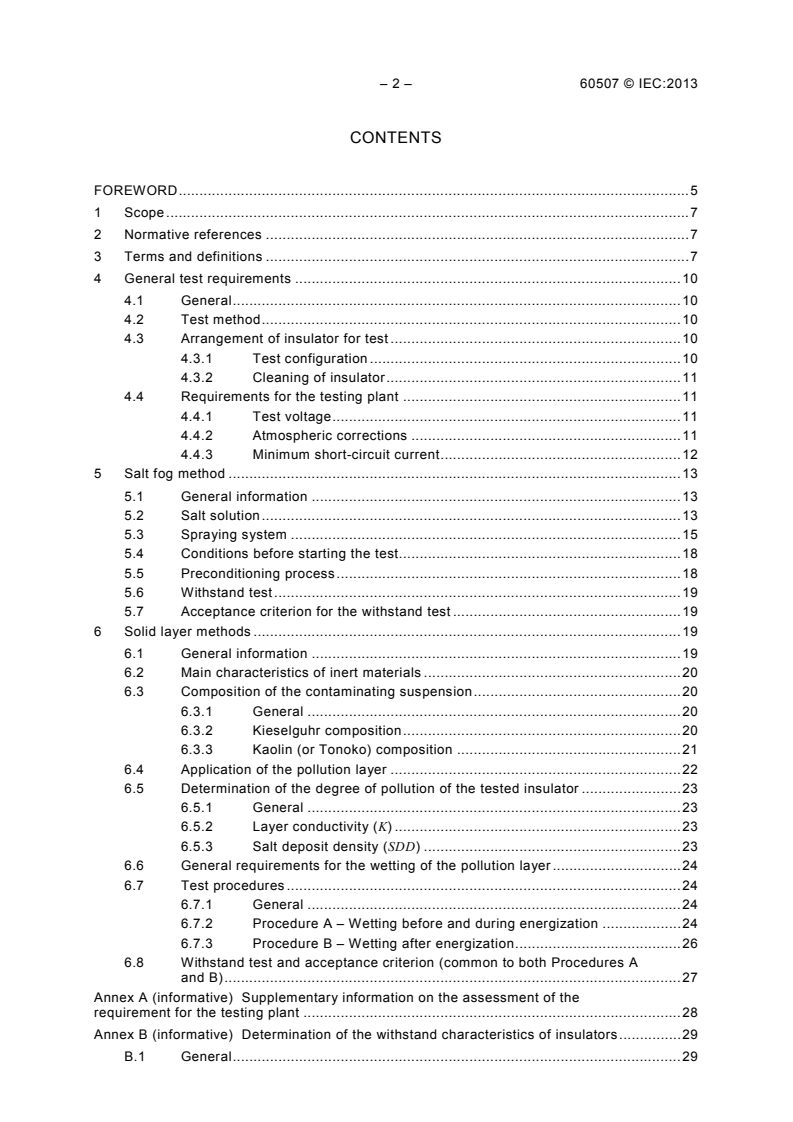
– 2 – 60507 © IEC:2013
CONTENTS
FOREWORD . 5
1 Scope . 7
2 Normative references . 7
3 Terms and definitions . 7
4 General test requirements . 10
4.1 General . 10
4.2 Test method . 10
4.3 Arrangement of insulator for test . 10
4.3.1 Test configuration . 10
4.3.2 Cleaning of insulator . 11
4.4 Requirements for the testing plant . 11
4.4.1 Test voltage . 11
4.4.2 Atmospheric corrections . 11
4.4.3 Minimum short-circuit current . 12
5 Salt fog method . 13
5.1 General information . 13
5.2 Salt solution . 13
5.3 Spraying system . 15
5.4 Conditions before starting the test. 18
5.5 Preconditioning process . 18
5.6 Withstand test . 19
5.7 Acceptance criterion for the withstand test . 19
6 Solid layer methods . 19
6.1 General information . 19
6.2 Main characteristics of inert materials . 20
6.3 Composition of the contaminating suspension . 20
6.3.1 General . 20
6.3.2 Kieselguhr composition . 20
6.3.3 Kaolin (or Tonoko) composition . 21
6.4 Application of the pollution layer . 22
6.5 Determination of the degree of pollution of the tested insulator . 23
6.5.1 General . 23
6.5.2 Layer conductivity (K) . 23
6.5.3 Salt deposit density (SDD) . 23
6.6 General requirements for the wetting of the pollution layer . 24
6.7 Test procedures . 24
6.7.1 General . 24
6.7.2 Procedure A – Wetting before and during energization . 24
6.7.3 Procedure B – Wetting after energization . 26
6.8 Withstand test and acceptance criterion (common to both Procedures A
and B) . 27
Annex A (informative) Supplementary information on the assessment of the
requirement for the testing plant . 28
Annex B (informative) Determination of the withstand characteristics of insulators . 29
B.1 General . 29
60507 © IEC:2013 – 3 –
B.2 Determination of the maximum withstand salinity at a given test voltage . 29
B.3 Determination of the maximum withstand voltage, or of the 50 %
withstand voltage, at a given reference layer conductivity, or at a given
reference salt deposit density . 29
B.3.1 Maximum withstand voltage . 29
B.3.2 50 % withstand voltage . 30
B.4 Withstand values of reference suspension insulators . 30
Annex C (informative) Measurement of layer conductivity for checking the uniformity of
the layer . 32
Annex D (informative) Additional recommendations concerning the solid layer method
procedures. 34
D.1 General . 34
D.2 Contamination practice . 34
D.3 Drying of the pollution layer . 34
D.4 Check of the wetting action of the fog . 34
D.5 Checking fog uniformity for large or complex test objects . 35
D.6 Fog input in the test chamber . 35
D.7 Minimum duration of the withstand test . 35
D.8 Evaluation of the reference salt deposit density (SDD) . 36
Annex E (informative) Supplementary information on artificial pollution tests on
insulators for voltage systems of 800 kV and above (solid layer method procedure B) . 37
E.1 Introduction . 37
E.2 Test chamber . 37
E.3 Fog generator . 37
E.4 Wetting action and uniformity of fog density . 37
Bibliography . 38
Figure 1 – Minimum short-circuit current, I , required for the testing plant as a
sc min
function of the unified specific creepage distance (USCD) of the insulator under test . 13
Figure 2 – Value of factor b as a function of solution temperature . 15
Figure 3 – Typical construction of fog spray nozzle . 17
Figure 4 – Test layout for inclined insulators . 18
Figure 5 – Typical arrangement of steam-fog generator . 26
Figure C.1 – Arrangement of the probe electrodes (all dimensions in mm) . 32
Figure C.2 – Circuit diagram of the meter . 33
Figure D.1 – Control of the wetting action of the steam fog: Layer conductance
recording during the test on the chosen dummy insulator (standard type of Table B.1) . 36
Table 1 – Salt-fog method: correspondence between the value of salinity, volume
conductivity and density of the solution at a temperature of 20 °C . 14
Table 2 – Main characteristics of the inert materials used in solid layer suspensions . 20
Table 3 – Kieselguhr composition: approximate correspondence between the
reference degrees of pollution on the insulator and the volume conductivity of the
suspension at a temperature of 20 °C . 21
Table 4 – Kaolin (or Tonoko) composition: approximate correspondence between the
reference degrees of pollution on the insulator and the volume conductivity of the
suspension at a temperature of 20 °C . 22
Table A.1 – Expected I values related to different USCD values . 28
h max
– 4 – 60507 © IEC:2013
Table B.1 – Ranges of values of withstand characteristics of reference suspension
insulators in artificial pollution tests . 31
60507 © IEC:2013 – 5 –
INTERNATIONAL ELECTROTECHNICAL COMMISSION
______________
ARTIFICIAL POLLUTION TESTS ON HIGH-VOLTAGE CERAMIC
AND GLASS INSULATORS TO BE USED ON A.C. SYSTEMS
FOREWORD
1) The International Electrotechnical Commission (IEC) is a worldwide organization for standardization comprising
all national electrotechnical committees (IEC National Committees). The object of IEC is to promote
international co-operation on all questions concerning standardization in the electrical and electronic fields. To
this end and in addition to other activities, IEC publishes International Standards, Technical Specifications,
Technical Reports, Publicly Available Specifications (PAS) and Guides (hereafter referred to as “IEC
Publication(s)”). Their preparation is entrusted to technical committees; any IEC National Committee interested
in the subject dealt with may participate in this preparatory work. International, governmental and non-
governmental organizations liaising with the IEC also participate in this preparation. IEC collaborates closely
with the International Organization for Standardization (ISO) in accordance with conditions determined by
agreement between the two organizations.
2) The formal decisions or agreements of IEC on technical matters express, as nearly as possible, an international
consensus of opinion on the relevant subjects since each technical committee has representation from all
interested IEC National Committees.
3) IEC Publications have the form of recommendations for international use and are accepted by IEC National
Committees in that sense. While all reasonable efforts are made to ensure that the technical content of IEC
Publications is accurate, IEC cannot be held responsible for the way in which they are used or for any
misinterpretation by any end user.
4) In order to promote international uniformity, IEC National Committees undertake to apply IEC Publications
transparently to the maximum extent possible in their national and regional publications. Any divergence
between any IEC Publication and the corresponding national or regional publication shall be clearly indicated in
the latter.
5) IEC itself does not provide any attestation of conformity. Independent certification bodies provide conformity
assessment services and, in some areas, access to IEC marks of conformity. IEC is not responsible for any
services carried out by independent certification bodies.
6) All users should ensure that they have the latest edition of this publication.
7) No liability shall attach to IEC or its directors, employees, servants or agents including individual experts and
members of its technical committees and IEC National Committees for any personal injury, property damage or
other damage of any nature whatsoever, whether direct or indirect, or for costs (including legal fees) and
expenses arising out of the publication, use of, or reliance upon, this IEC Publication or any other IEC
Publications.
8) Attention is drawn to the Normative references cited in this publication. Use of the referenced publications is
indispensable for the correct application of this publication.
9) Attention is drawn to the possibility that some of the elements of this IEC Publication may be the subject of
patent rights. IEC shall not be held responsible for identifying any or all such patent rights.
International Standard IEC 60507 has been prepared by IEC technical committee 36:
Insulators.
This third edition cancels and replaces the second edition published in 1991. This third edition
constitutes a technical revision.
This edition includes the following significant technical changes with respect to the previous
edition:
a) Corrections and the addition of explanatory material;
b) The addition of Clause 4.3.2 on atmospheric correction;
c) The change of the upper limit of conductivity of water to 0.1 S/m; and
d) The extension to UHV voltages.
– 6 – 60507 © IEC:2013
The text of this standard is based on the following documents:
FDIS Report on voting
36/337/FDIS 36/342/RVD
Full information on the voting for the approval of this standard can be found in the report on
voting indicated in the above table.
This publication has been drafted in accordance with the ISO/IEC Directives, Part 2.The
committee has decided that the contents of this publication will remain unchanged until the
stability date indicated on the IEC web site under "http://webstore.iec.ch" in the data related
to the specific publication. At this date, the publication will be
• reconfirmed,
• withdrawn,
• replaced by a revised edition, or
• amended.
The contents of the corrigendum of August 2018 have been included in this copy.
60507 © IEC:2013 – 7 –
ARTIFICIAL POLLUTION TESTS ON HIGH-VOLTAGE CERAMIC
AND GLASS INSULATORS TO BE USED ON A.C. SYSTEMS
1 Scope
This International Standard is applicable for the determination of the power frequency
withstand characteristics of ceramic and glass insulators to be used outdoors and exposed to
polluted atmospheres, on a.c. systems with the highest voltage of the system greater than
1 000 V.
These tests are not directly applicable to polymeric insulators, to greased insulators or to
special types of insulators (insulators with semiconducting glaze or covered with any organic
insulating material).
The object of this International Standard is to prescribe procedures for artificial pollution tests
applicable to insulators for overhead lines, substations and traction lines and to bushings
It may also be applied to hollow insulators with suitable precautions to avoid internal flashover.
In applying these procedures to apparatus incorporating hollow insulators, the relevant
technical committees should consider their effect on any internal equipment and the special
precautions which may be necessary.
2 Normative references
The following documents, in whole or in part, are normatively referenced in this document and
are indispensable for its application. For dated references, only the edition cited applies. For
undated references, the latest edition of the referenced document (including any
amendments) applies.
IEC 60071-1, Insulation co-ordination – Part 1: Definitions, principles and rules
IEC/TS 60815-1, Selection and dimensioning of high-voltage insulators intended for use in
polluted conditions – Part 1: Definitions, information and general principles
IEC/TS 60815-2, Selection and dimensioning of high-voltage insulators intended for use in
polluted conditions – Part 2: Ceramic and glass insulators for a.c. systems
IEC 60060-1, High-voltage test techniques – Part 1: General definitions and test requirements
3 Terms and definitions
For the purpose of this standard, the following terms and definitions apply.
3.1
test voltage
the r.m.s. value of the voltage with which the insulator is continuously energized throughout
the test
3.2
short-circuit current (I ) of the testing plant
sc
the r.m.s. value of the current delivered by the testing plant when the test object is short-
circuited at the test voltage
– 8 – 60507 © IEC:2013
3.3
unified specific creepage distance
USCD
the creepage distance of an insulator divided by the maximum operating voltage across the
insulator (for a.c. systems usually U /√3)
m
Note 1 to entry: This is generally expressed in mm/kV.
Note 2 to entry: This definition differs from that of Specific Creepage Distance where the phase-to-phase value of
the highest voltage for the equipment is used. For phase-to-earth insulation, this definition will result in a value that
is √3 times that given by the definition of Specific Creepage Distance in IEC/TS 60815 (1986). See Annex J of
IEC 60815-1:2008 for details.
3.4
form factor of an insulator
Ff
dimensionless number that presents the length (l) of the partial creepage distance divided by
the integrated width (p)
Note 1 to entry: For insulators, the length is in the direction of the creepage distance and the width is the
circumference of the insulator.
Note 2 to entry: The form factor is calculated by the formula
L
dl
Ff=
∫
p(l)
where
L is the total creepage distance
p(l) = 2π.r(l)
For graphical estimation of the form factor, the reciprocal value of the insulator circumference ( ) is plotted
p
versus the partial creepage distance l counted from the end of the insulator up to the point reckoned. The form
factor is given by the area under this curve.
3.5
salinity
S
a
concentration of the solution of salt in tap water, expressed by the amount of salt divided by
the volume of solution
Note 1 to entry: This is generally expressed in kg/m .
3.6
pollution layer
a conducting electrolytic layer on the insulator surface, composed of salt plus inert materials
Note 1 to entry: The conductance of the pollution layer on the insulator is measured in accordance with 6.5.1.
3.7
layer conductivity (K)
the conductance of the pollution layer multiplied by the form factor
Note 1 to entry: This is generally expressed in µS.
60507 © IEC:2013 – 9 –
3.8
salt deposit density
SDD
amount of sodium chloride in an artificial deposit on a given surface of the insulator (metal
parts and assembling materials are not to be included in this surface) divided by the area of
this surface
Note 1 to entry: This is generally expressed in mg/cm .
3.9
degree of pollution
the value of the quantity (salinity, layer conductivity, salt deposit density) which characterizes
the artificial pollution applied to the tested insulator
3.10
reference salinity
the value of the salinity used to characterize a test
3.11
reference layer conductivity
the value of the layer conductivity used to characterize a test
Note 1 to entry: This is defined as the maximum value of the conductivity of the wetted layer of an insulator
energized only for performing the conductance measurements.
3.12
reference salt deposit density
the value of the salt deposit density used to characterize a test
Note 1 to entry: This is defined as the average of the salt deposit density values measured on a few insulators (or
on parts of them), which are chosen for this purpose from among the contaminated ones prior to their submission
to any test.
3.13
specified withstand degree of pollution
the reference degree of pollution at which an insulator shall withstand the specified test
voltage in at least three tests out of four, under the conditions described in the relevant
Clauses 5.6 or 6.8
3.14
maximum withstand degree of pollution
the highest degree of pollution at which at least three withstand tests out of four can be
obtained at the specified test voltage, under the conditions described in the relevant clauses
5.6 or 6.8.
3.15
specified withstand voltage
the test voltage at which an insulator shall withstand the specified degree of pollution in at
least three tests out of four, under the conditions described in the relevant 5.6 or 6.8
3.16
maximum withstand voltage
the highest test voltage at which at least three withstand tests out of four can be obtained at
the specified degree of pollution, under the conditions described in the relevant 5.6 or 6.8
3.17
non-soluble deposit density
NSDD
amount of non-soluble residue removed from a given surface of the insulator, divided by the
area of this surface
– 10 – 60507 © IEC:2013
Note 1 to entry: This is generally expressed in mg/cm .
4 General test requirements
4.1 General
Pollution tests can be carried out for two main objectives:
• to obtain information about the pollution performance of insulators e.g. for comparison of
different insulator types/profile
• to check the performance in a configuration as close as possible to the in-service one.
To reach the first objective, tests on relatively short insulator sets – if representative of the full
set in terms of radial geometry and profile – may be sufficient. Results of such tests on
insulators with an arcing length higher than 1 m can be linearly extrapolated up to and
including the UHV range, at least for pollution ranging from medium to very heavy.
Tests to reach the second objective may be agreed between the manufacturer and the user
whenever optimisation of the design is necessary and/or whenever it is expected that the
mounting condition or the inner active parts in apparatus can affect the performance. Such
tests shall be made simulating the relevant service conditions as closely as possible. In
particular tests in other positions from the vertical (inclined, horizontal) duplicating actual
service conditions may be agreed between the supplier and the user.
Tests at higher system voltages (800 kV and above) may present particular requirements as
reported in Annex E.
4.2 Test method
The two following categories of pollution test methods are recommended for standard tests:
– the salt fog method (Clause 5) in which the insulator is subjected to a defined ambient
pollution;
– the solid layer method (Clause 6) in which a fairly uniform layer of a defined solid pollution
is deposited on the insulator surface;
NOTE 1 In these test methods the voltage is held constant for a period of at least several minutes. Variants in
which the voltage is raised continuously to flashover are not standardized but may be used for special purposes.
NOTE 2 In testing of full scale insulators for system voltages above 800 kV, the solid layer method may be the
preferred choice because of lack of experiences and possible difficulties for the salt fog method. More information
on the solid layer method for such insulators is given in Annex E.
4.3 Arrangement of insulator for test
4.3.1 Test configuration
The insulator shall be erected in the test chamber, complete with the metal fittings which are
invariably associated with it. The vertical position is in general suggested for comparison of
different insulator types. Tests in other positions (inclined, horizontal) duplicating actual
service conditions may be carried out when agreed between the manufacturer and the user.
When there are special reasons not to test insulators in the vertical position (e.g. wall
bushings and circuit-breaker longitudinal insulation), only the service position shall be
considered.
The minimum clearances between any part of the insulator and any earthed object other than
the structure which supports the insulator and the columns of the nozzles, when used, shall
be not less than 0,5 m per 100 kV of the test voltage and in any case not less than 1,5 m.
The configurations of the supporting structure and the energized metal parts, at least within
their minimum clearance from the insulator, shall reproduce those expected in service.
60507 © IEC:2013 – 11 –
As regards the influence of capacitive effects on the test results, the following considerations
can be drawn from the available experience:
– fittings are deemed not to affect the results significantly, at least for test voltages up to
450 kV;
– internal high capacitance can have some effect on the external surface behaviour,
particularly in tests with solid layer methods at low pollution severity values.
4.3.2 Cleaning of insulator
The insulator shall be carefully cleaned so that all traces of dirt and grease are removed. After
cleaning, the insulating parts of the insulator shall not be touched by hand.
The surface of the insulator is deemed to be sufficiently clean and free from any grease if
large continuous wet areas are observed after rinsing.
In the case of the solid-layer method, before the first contamination, scrubbing with a slurry of
water and inert material such as kaolin shall be done, after which the insulator shall be
thoroughly rinsed with tap water. A detergent may be added to the slurry.
Before every subsequent contamination, the insulator shall again be thoroughly washed with
tap water only. Hand wiping might be necessary, if either the SDD-levels or the test results
become inconsistent.
In the case of the salt-fog method, water, preferably heated to about 50 °C, with the addition
of trisodium phosphate or other detergent, shall be used, after which the insulator shall be
thoroughly rinsed with tap water. Before this final treatment, scrubbing as for the solid-layer
method may be done if necessary.
NOTE 1 When the volume conductivity of tap water is higher than 0,1 S/m, the use of demineralized water is
recommended.
NOTE 2 If necessary, the metal parts and the assembling materials can be painted with a salt-water resistant
paint to ensure that no corrosion products wash down on to the insulating surface during a test.
4.4 Requirements for the testing plant
4.4.1 Test voltage
The frequency of the test voltage shall be between 48 Hz and 62 Hz.
In general the test voltage coincides with the highest voltage (phase to earth value) the
insulator is required to withstand under normal operating conditions. For equipment, it is
equal to U /√3,U being the highest voltage for equipment (see IEC 60071-1). It is higher
m m
than this value when testing insulators for phase to phase configurations or for isolated
neutral systems.
4.4.2 Atmospheric corrections
No humidity correction factor shall be applied. Test voltages shall be corrected for air density
according to IEC 60060-1. The coefficient m is however still under investigation.
NOTE 1 The temperature in the test chamber for relative air density calculation is the temperature measured at
the height of the test object prior to the test.
NOTE 2 The coefficient m depends on many factors such as pollution severity and insulator characteristics. For
the time being provisionally reference can be made to value m=0,5 [1].
NOTE 3 Atmospheric correction factors for polluted insulators are presently under consideration by CIGRE SC D1.
– 12 – 60507 © IEC:2013
4.4.3 Minimum short-circuit current
In the artificial pollution tests, the testing plant needs a short-circuit current (I ) higher than
sc
in other types of insulator tests to ensure that the voltage drop during the test is small and
has no influence on test results. This means that I must have a minimum value which varies
sc
with the test conditions; moreover there are also requirements on other parameters of the
testing plant.
The minimum value of I (I ) is given in Figure 1 as a function of the electrical surface
sc sc min
stress of the insulator under test, expressed in terms of its unified specific creepage distance.
Besides the above requirement of I value, the testing plant shall comply with the two
sc min
following conditions:
– resistance/reactance ratio (R/X) equal to or higher than 0,1;
IC
– capacitive current/short-circuit current ratio ( ) within the range 0,001 – 0,1.
ISC
More information on the criteria followed to assess the above requirements is given in
Annex A.
When the value of I of the testing plant, although higher than 6 A, does not comply with the
sc
limits given in Figure 1, the verification of a specified withstand characteristic of a polluted
insulator (see 5.6 and 6.8) or the determination of its maximum withstand characteristic (see
Annex B) can still be performed, provided that the source validity is directly ascertained by the
following check.
In each individual test of this investigation, the highest leakage current pulse amplitude is
recorded and its maximum value (I ) determined considering the three tests resulting in
h max
withstand, in the withstand conditions.
The I value shall comply with the expression below:
h max
ISC
≥ 11
Ihmax
I being given in r.m.s. and I in peak value.
sc h max
More details are given in Annex A.
Since the leakage currents can be used for the interpretation of the results, it is recommended
that suitable devices be arranged in order to record these currents during artificial pollution
tests.
60507 © IEC:2013 – 13 –
10 15 20 25 30 35 40 45 50
USCD (mm/kV)
IEC 2985/13
mm/kV A
rms
I = 6
USCD < 28
sc min
I = |USCD/√3| – 10
28 ≤ USCD ≤ 45
sc min
Figure 1 – Minimum short-circuit current, I , required for the testing plant as a
sc min
function of the unified specific creepage distance (USCD) of the insulator under test
NOTE The available experience is deemed insufficient to give I values for tests at unified specific creepage
sc min
distances higher than 45 mm/kV.
5 Salt fog method
5.1 General information
The salt fog test procedure simulates type B pollution (see IEC 60815-1) where a liquid
conductive layer covers the insulator surface. In practice, this layer does not contain any
significant insoluble material.
The degree of pollution in a test is defined by the salinity of the salt fog expressed in kg of
salt (NaCl) per m of water.
The test consists of two parts – preconditioning process (the aim of which is cleaning of the
tested insulator surface) and withstand test. The detailed description of both procedures is
given in 5.5 and 5.6.
NOTE The salt fog test method is not recommended for tests of insulator configurations at higher system voltage
(800 kV and above). The main reason is that the specified distance between tested insulator and spraying nozzles
(5.3) may be not sufficient for higher test voltages; in the frame of the recent revision with respect to the extension
to the UVH range the specified distance between tested insulator and spraying nozzles was kept at 3 m in order to
maintain the validity of test results with previous version of this standard.
5.2 Salt solution
The salt solution shall be made of sodium chloride (NaCI) of commercial purity and tap water.
NOTE Tap water with high hardness, for example with a content of equivalent CaCO greater than 350 g/m , can
cause limestone deposits on the insulator surface. In this case the use of deionized water for preparation of the
salt solution is recommended. Hardness of tap water is measured in terms of content of equivalent CaCO ).
Minimum short-circuit current I min (A )
sc rms
– 14 – 60507 © IEC:2013
The salinity used shall have one of the following values: 2,5 – 3,5 – 5 – 7 – 10 – 14 – 20 – 28
– 40 – 56 – 80 – 112 – 160 and 224 kg/m .
The maximum permissible tolerance in salinity is 5 % of the specified value
It is recommended that the salinity be determined either by measuring the conductivity or by
measuring the density with a correction of temperature.
Table 1 gives the correspondence between the value of salinity, volume conductivity and
density of the solution at a temperature of 20 °C.
When the solution temperature is not at 20 °C, conductivity and density values shall be
corrected.
The temperature of the salt solution shall be between 5 °C and 30 °C, since no experience is
available to validate tests performed outside this range of solution temperature.
Table 1 – Salt-fog method: correspondence between the value of salinity,
volume conductivity and density of the solution at a temperature of 20 °C
Salinity Volume Density
conductivity
S
a 20 20
3 3
kg/m S/m kg/m
2,5 0,43 –
3,5 0,60 –
5 0,83 –
7 1,15 –
10 1,6 –
14 2,2 –
20 3,0 –
28 4,1 1 018,0
40 5,6 1 025,9
56 7,6 1 037,3
80 10 1 052,7
112 13 1 074,6
160 17 1 104,5
224 20 1 140,0
The conductivity correction shall be made using the following formula:
= [1 – b ( – 20)]
20
where:
is the solution temperature (°C)
is the volume conductivity at a temperature of °C (S/m)
is the volume conductivity at a temperature of 20 °C (S/m)
b is the factor depending on solution temperature , as obtained by the following equation,
and as shown in Figure 2:
-8 3 -5 2 -4 -2
b = –3,200 10 1,032 10 – 8,272 10 3,544 10
60507 © IEC:2013 – 15 –
Figure 2 – Value of factor b as a function of solution temperature
The density correction shall be made using the following formula:
–6
= [1 (200 1,3 S ) ( – 20) 10 ]
20 a
where:
is the solution temperature (°C)
is the density at a temperature of °C (kg/m )
is the density at a temperature of 20 °C (kg/m )
S is the salinity (kg/m )
a
This correction formula is only valid for salinities over 20 kg/m .
5.3 Spraying system
The fog is produced in the test chamber by means of the specified number of sprays which
atomize the solution by a stream of compressed air flowing at right angles to the solution
nozzle. The nozzles consist of corrosion resistant tubes, the internal diameter of the air
nozzles being 1,2 mm 0,02 mm and the internal diameter of the solution nozzle being
2,0 mm 0,02 mm. Both nozzles shall have an outside diameter of 3,0 mm 0,05 mm and the
ends of the nozzles shall be square-cut and polished.
The end of the solution nozzle shall lie on the axis of the air nozzle to within 0,05 mm. The
distance between the end of the compressed air nozzle and the central line of the solution
nozzle shall be 3,0 mm 0,05 mm. The axes of the two nozzles shall lie in the same plane to
within 0,05 mm.
Figure 3 shows a typical construction of the fog spray nozzle.
The sprays shall be in two columns parallel to and on opposite sides of the insulator which
shall have its axis in the same plane as the columns, i.e. a vertical insulator is tested with
vertical columns and a horizontal insulator with horizontal columns. In the case of an inclined
insulator (see Figure 4) the plane containing the insulator and the columns shall intersect the
horizontal plane in a line at right angles to the insulator axis; in this case, the axis of the
– 16 – 60507 © IEC:2013
solution nozzles is vertical. The distance between the solution nozzles and the insulator axis
shall be 3,0 m 0,05 m.
The sprays shall be spaced at 0,6 m intervals, each spray pointing at right angles to the
column axis towards its counterpart on the other column and within an angle of 1° to the plane
of the sprays. This alignment can be checked for vertical sprays by lowering the solution
nozzle, passing water through the air nozzle and directing it towards the opposing spray;
afterwards, raising the solution nozzle to the operating position. The midpoint of the insulator
shall preferably be in line with the mid-points of the columns of sprays. Both columns shall
extend beyond each end of the insulator by at least 0,6 m.
The minimum number N of sprays per column shall be, for a length H in metres of the
insulator:
H
N 3
0,6
The sprays shall be supplied with filtered, oil-free air at a relative pressure of
700 kPa 35 kPa.
3 3
The flow of solution to each spray shall be 0,5 dm /min 0,05 dm /min for the period of the
test, and the tolerance on the total flow to all sprays shall be 5 % of the nominal value.
60507 © IEC:2013 – 17 –
All dimensions in millimetres
30 13,2 ± 0,05
A
See NOTE 3
3 ± 0,05 ref.
Compressed
air nozzle
Salt water
nozzle
Block
Mounting holes
See NOTE 5
Tapped holes for
locking screws
Both nozzles to have a close
62 38
sliding fit within block
See NOTE 4
Section A-A showing nozzles in position
A
Drill and tap ¼ NTP
Drill and tap ¼ NTP
10,2
14,2
Drill ∅1,2 thru’
Drill ∅2 thru’
60° inclusive angle 60° inclusive angle
Compressed air nozzle Salt water nozzle
IEC 2987/13
NOTES:
1 Machine all over ± 0,1 mm, unless stated otherwise
2 Concentricity of nozzles within 0,1 mm
3 Outer face both nozzles to be square and polished
4 Finishing of holes in block with a sized milling cutter is suggested to achieve best fit
5 Remove all sharp edges except as NOTE 3 above
6 Mounting holes should be drilled thru’ to allow unit to be positioned from either side
7 Unit should be initially be assembled with nozzle shoulders flush with inboard surfaces of block as shown above
if required, small adjustments in the positioning of the nozzles can be made to optimize spray properties
Hardware requirements: Material requirements:
2 off stainless steel fitting with hose barb Salt water nozzle: Stainless steel Type 303
Swagelok number SS-4-HC-1-4
Compressed
...