

IEC TS 62282-7-1:2025
(Main)Fuel cell technologies - Part 7-1: Test methods - Single cell performance tests for polymer electrolyte fuel cells (PEFC)
General Information
- Abstract
IEC TS 62282-7-1:2025 covers cell assemblies, test station setup, measuring instruments and measuring methods, performance test methods, and test reports for PEFC single cells.
This document is used for evaluating:
a) the performance and durability of membrane electrode assemblies (MEAs) for PEFCs in a single cell configuration;
b) materials or structures of PEFCs in a single cell configuration; or,
c) the influence of impurities in fuel and/or in air on the fuel cell performance and durability.
This document is for proton exchange membrane fuel cells (PEMFC) basically having flow field configurations and using hydrogen or hydrogen containing gas as fuel. It excludes from the scope fuel cells based on anion exchange membranes, bipolar membranes, and phosphoric acid doped polybenzimidazole membranes.
- Status
- Published
- Publication Date
- 15-Oct-2025
- Technical Committee
- TC 105 - Fuel cell technologies
- Drafting Committee
- MT 103 - TC 105/MT 103
- Current Stage
- PPUB - Publication issued
- Start Date
- 16-Oct-2025
- Completion Date
- 12-Sep-2025
Overview
IEC TS 62282-7-1:2025 is an internationally recognized technical specification developed by the International Electrotechnical Commission (IEC) Technical Committee 105 for fuel cell technologies. This standard provides a comprehensive framework for conducting single cell performance tests on polymer electrolyte fuel cells (PEFC), also known as proton exchange membrane fuel cells (PEMFC). It focuses on the evaluation of membrane electrode assemblies (MEAs), cell materials and structures, and examines the effects impurities in fuel or air may have on fuel cell performance and durability. The document applies specifically to cells utilizing flow field configurations and hydrogen or hydrogen-containing gas as fuel.
Key Topics
IEC TS 62282-7-1:2025 covers a range of technical aspects essential for accurate and repeatable fuel cell single cell measurement, including:
- Cell Assembly: Detailed requirements for assembling PEFC single cells, encompassing MEA, gaskets, flow plates, current collectors, and other critical components.
- Test Station Setup: Specifications for test equipment, control mechanisms, and test station schematic diagrams to ensure consistent and accurate measurement conditions.
- Measuring Instruments & Methods: Guidelines for the selection, calibration, and use of instruments measuring voltage, current, internal resistance, gas flow rates, temperature, pressure, and humidity.
- Performance Test Methods: Standardized procedures for tests such as polarization curves, steady-state performance, hydrogen crossover, short-circuit, impedance spectroscopy, and tests evaluating the impact of environmental factors (temperature, pressure, humidity).
- Durability Measurements: Protocols for assessing long-term durability through load cycling, start/stop cycles, sub-zero startup/storage, humidity cycling, membrane swelling, and potential cycling.
- Impurity Influence Measurements: Methods for testing how impurities in hydrogen fuel or oxidant air can affect both the performance and the longevity of the PEFC single cell.
- Test Reports: Structure and mandatory content for documenting results, including operating conditions, test procedures, deviations, and acceptance criteria.
Applications
The practical value of IEC TS 62282-7-1:2025 is significant for stakeholders throughout the fuel cell community:
- R&D Laboratories: Researchers use these standardized test methods to evaluate and compare PEFC MEAs, investigate new materials, or benchmark novel flow field designs.
- Quality Control: Manufacturers adopt the standard for rigorous single cell performance validation and quality assurance of fuel cell materials or subcomponents before stack integration.
- Material Developers: Providers of membranes, catalysts, or gas diffusion layers utilize the protocols to measure and report the performance impact of their innovations in a consistent and comparable manner.
- System Integrators and OEMs: Organizations across automotive, stationary, and portable fuel cell applications can rely on reproducible test data to inform system design and deployment.
- Regulatory and Certification Bodies: Adoption of the standard supports the development of global certification schemes and regulatory compliance for PEMFC technology.
Related Standards
Several international standards complement and support the use of IEC TS 62282-7-1:2025 within the broader context of fuel cell testing and evaluation:
- IEC 62282-2 - Fuel cell technologies – Part 2: Fuel cell modules – Test methods
- IEC 62282-3 Series - Stationary and portable fuel cell power systems – Safety and performance standards
- ISO 14687 - Hydrogen fuel quality – Product specification
- EU Harmonised Test Protocols for PEMFC-MEA Testing (JRC) – Referenced for harmonization of PEFC single cell testing methodologies
By following IEC TS 62282-7-1:2025, organizations ensure the consistency, reliability, and international comparability of single cell PEFC performance measurements, enabling robust innovation and market development in clean energy solutions.
Relations
- Effective Date
- 05-Sep-2023
Get Certified
Connect with accredited certification bodies for this standard

DNV
DNV is an independent assurance and risk management provider.

Lloyd's Register
Lloyd's Register is a global professional services organisation specialising in engineering and technology.
DNV Energy Systems
Energy and renewable energy certification.
Sponsored listings
Frequently Asked Questions
IEC TS 62282-7-1:2025 is a technical specification published by the International Electrotechnical Commission (IEC). Its full title is "Fuel cell technologies - Part 7-1: Test methods - Single cell performance tests for polymer electrolyte fuel cells (PEFC)". This standard covers: IEC TS 62282-7-1:2025 covers cell assemblies, test station setup, measuring instruments and measuring methods, performance test methods, and test reports for PEFC single cells. This document is used for evaluating: a) the performance and durability of membrane electrode assemblies (MEAs) for PEFCs in a single cell configuration; b) materials or structures of PEFCs in a single cell configuration; or, c) the influence of impurities in fuel and/or in air on the fuel cell performance and durability. This document is for proton exchange membrane fuel cells (PEMFC) basically having flow field configurations and using hydrogen or hydrogen containing gas as fuel. It excludes from the scope fuel cells based on anion exchange membranes, bipolar membranes, and phosphoric acid doped polybenzimidazole membranes.
IEC TS 62282-7-1:2025 covers cell assemblies, test station setup, measuring instruments and measuring methods, performance test methods, and test reports for PEFC single cells. This document is used for evaluating: a) the performance and durability of membrane electrode assemblies (MEAs) for PEFCs in a single cell configuration; b) materials or structures of PEFCs in a single cell configuration; or, c) the influence of impurities in fuel and/or in air on the fuel cell performance and durability. This document is for proton exchange membrane fuel cells (PEMFC) basically having flow field configurations and using hydrogen or hydrogen containing gas as fuel. It excludes from the scope fuel cells based on anion exchange membranes, bipolar membranes, and phosphoric acid doped polybenzimidazole membranes.
IEC TS 62282-7-1:2025 is classified under the following ICS (International Classification for Standards) categories: 27.070 - Fuel cells. The ICS classification helps identify the subject area and facilitates finding related standards.
IEC TS 62282-7-1:2025 has the following relationships with other standards: It is inter standard links to IEC TS 62282-7-1:2017. Understanding these relationships helps ensure you are using the most current and applicable version of the standard.
IEC TS 62282-7-1:2025 is available in PDF format for immediate download after purchase. The document can be added to your cart and obtained through the secure checkout process. Digital delivery ensures instant access to the complete standard document.
Standards Content (Sample)
IEC TS 62282-7-1 ®
Edition 3.0 2025-10
TECHNICAL
SPECIFICATION
Fuel cell technologies -
Part 7-1: Test methods - Single cell performance tests for polymer electrolyte
fuel cells (PEFC)
ICS 27.070 ISBN 978-2-8327-0646-6
All rights reserved. Unless otherwise specified, no part of this publication may be reproduced or utilized in any form or
by any means, electronic or mechanical, including photocopying and microfilm, without permission in writing from either
IEC or IEC's member National Committee in the country of the requester. If you have any questions about IEC copyright
or have an enquiry about obtaining additional rights to this publication, please contact the address below or your local
IEC member National Committee for further information.
IEC Secretariat Tel.: +41 22 919 02 11
3, rue de Varembé info@iec.ch
CH-1211 Geneva 20 www.iec.ch
Switzerland
About the IEC
The International Electrotechnical Commission (IEC) is the leading global organization that prepares and publishes
International Standards for all electrical, electronic and related technologies.
About IEC publications
The technical content of IEC publications is kept under constant review by the IEC. Please make sure that you have the
latest edition, a corrigendum or an amendment might have been published.
IEC publications search - IEC Products & Services Portal - products.iec.ch
webstore.iec.ch/advsearchform Discover our powerful search engine and read freely all the
The advanced search enables to find IEC publications by a publications previews, graphical symbols and the glossary.
variety of criteria (reference number, text, technical With a subscription you will always have access to up to date
committee, …). It also gives information on projects, content tailored to your needs.
replaced and withdrawn publications.
Electropedia - www.electropedia.org
The world's leading online dictionary on electrotechnology,
IEC Just Published - webstore.iec.ch/justpublished
Stay up to date on all new IEC publications. Just Published containing more than 22 500 terminological entries in English
details all new publications released. Available online and and French, with equivalent terms in 25 additional languages.
once a month by email. Also known as the International Electrotechnical Vocabulary
(IEV) online.
IEC Customer Service Centre - webstore.iec.ch/csc
If you wish to give us your feedback on this publication or
need further assistance, please contact the Customer
Service Centre: sales@iec.ch.
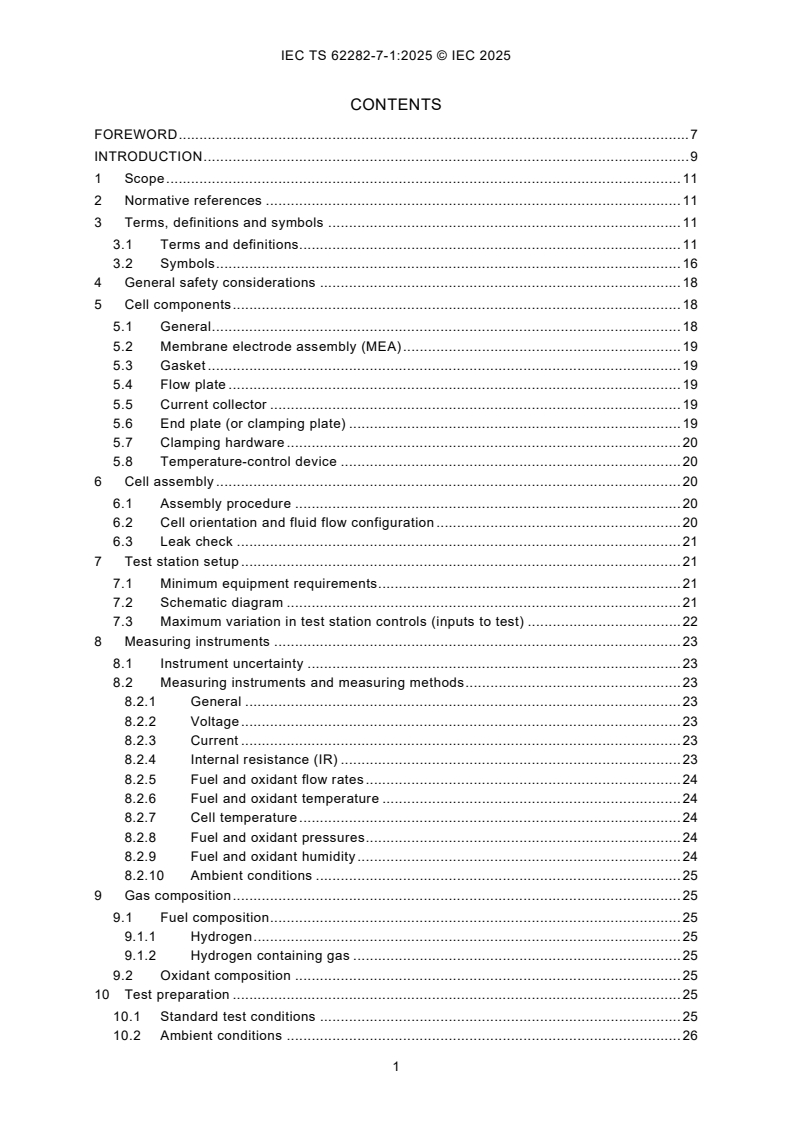
CONTENTS
FOREWORD . 7
INTRODUCTION . 9
1 Scope . 11
2 Normative references . 11
3 Terms, definitions and symbols . 11
3.1 Terms and definitions. 11
3.2 Symbols . 16
4 General safety considerations . 18
5 Cell components . 18
5.1 General . 18
5.2 Membrane electrode assembly (MEA) . 19
5.3 Gasket . 19
5.4 Flow plate . 19
5.5 Current collector . 19
5.6 End plate (or clamping plate) . 19
5.7 Clamping hardware . 20
5.8 Temperature-control device . 20
6 Cell assembly . 20
6.1 Assembly procedure . 20
6.2 Cell orientation and fluid flow configuration . 20
6.3 Leak check . 21
7 Test station setup . 21
7.1 Minimum equipment requirements . 21
7.2 Schematic diagram . 21
7.3 Maximum variation in test station controls (inputs to test) . 22
8 Measuring instruments . 23
8.1 Instrument uncertainty . 23
8.2 Measuring instruments and measuring methods . 23
8.2.1 General . 23
8.2.2 Voltage . 23
8.2.3 Current . 23
8.2.4 Internal resistance (IR) . 23
8.2.5 Fuel and oxidant flow rates . 24
8.2.6 Fuel and oxidant temperature . 24
8.2.7 Cell temperature . 24
8.2.8 Fuel and oxidant pressures . 24
8.2.9 Fuel and oxidant humidity . 24
8.2.10 Ambient conditions . 25
9 Gas composition . 25
9.1 Fuel composition . 25
9.1.1 Hydrogen . 25
9.1.2 Hydrogen containing gas . 25
9.2 Oxidant composition . 25
10 Test preparation . 25
10.1 Standard test conditions . 25
10.2 Ambient conditions . 26
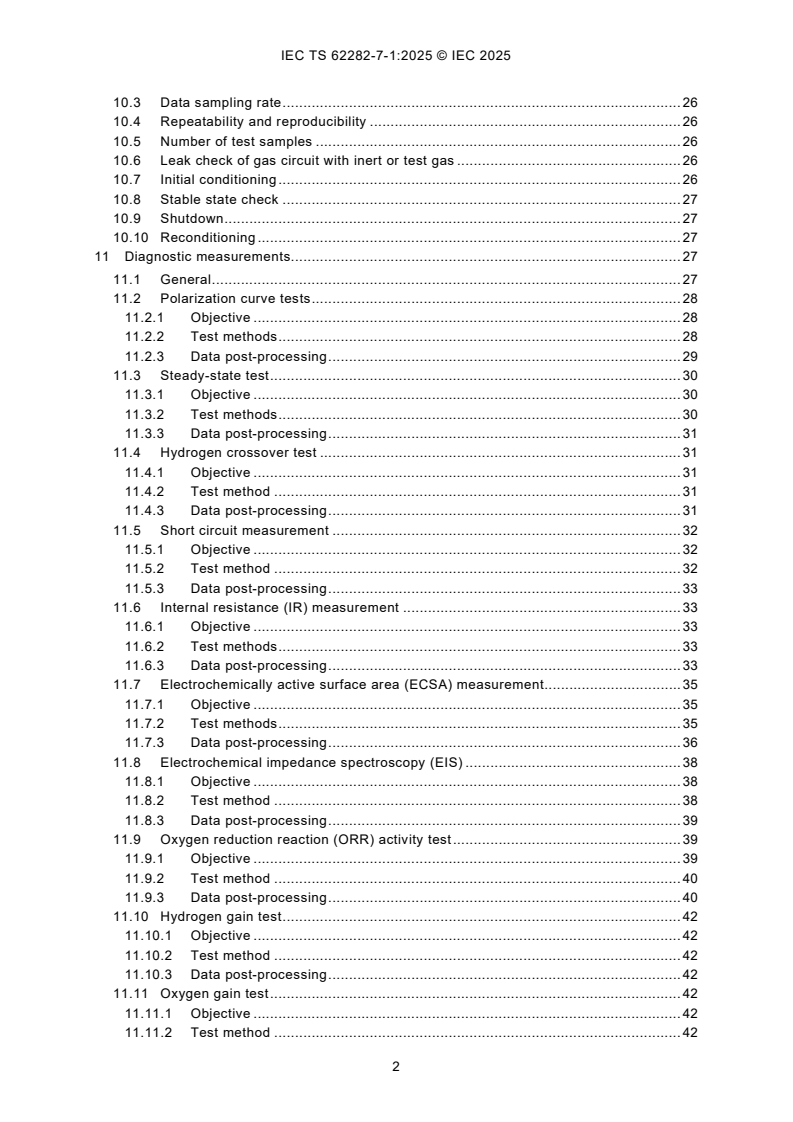
10.3 Data sampling rate . 26
10.4 Repeatability and reproducibility . 26
10.5 Number of test samples . 26
10.6 Leak check of gas circuit with inert or test gas . 26
10.7 Initial conditioning . 26
10.8 Stable state check . 27
10.9 Shutdown . 27
10.10 Reconditioning . 27
11 Diagnostic measurements. 27
11.1 General . 27
11.2 Polarization curve tests . 28
11.2.1 Objective . 28
11.2.2 Test methods . 28
11.2.3 Data post-processing . 29
11.3 Steady-state test . 30
11.3.1 Objective . 30
11.3.2 Test methods . 30
11.3.3 Data post-processing . 31
11.4 Hydrogen crossover test . 31
11.4.1 Objective . 31
11.4.2 Test method . 31
11.4.3 Data post-processing . 31
11.5 Short circuit measurement . 32
11.5.1 Objective . 32
11.5.2 Test method . 32
11.5.3 Data post-processing . 33
11.6 Internal resistance (IR) measurement . 33
11.6.1 Objective . 33
11.6.2 Test methods . 33
11.6.3 Data post-processing . 33
11.7 Electrochemically active surface area (ECSA) measurement. 35
11.7.1 Objective . 35
11.7.2 Test methods . 35
11.7.3 Data post-processing . 36
11.8 Electrochemical impedance spectroscopy (EIS) . 38
11.8.1 Objective . 38
11.8.2 Test method . 38
11.8.3 Data post-processing . 39
11.9 Oxygen reduction reaction (ORR) activity test . 39
11.9.1 Objective . 39
11.9.2 Test method . 40
11.9.3 Data post-processing . 40
11.10 Hydrogen gain test . 42
11.10.1 Objective . 42
11.10.2 Test method . 42
11.10.3 Data post-processing . 42
11.11 Oxygen gain test . 42
11.11.1 Objective . 42
11.11.2 Test method . 42
11.11.3 Data post-processing . 43
11.12 Gas stoichiometry effect tests . 43
11.12.1 Objective . 43
11.12.2 Test methods . 43
11.13 Temperature effect test . 43
11.13.1 Objective . 43
11.13.2 Test method . 43
11.13.3 Data post-processing . 43
11.14 Pressure effect test . 43
11.14.1 Objective . 43
11.14.2 Test method . 44
11.14.3 Data post-processing . 44
11.15 Humidity effect tests . 44
11.15.1 Objective . 44
11.15.2 Test methods . 44
11.15.3 Data post-processing . 44
11.16 Limiting current test . 44
11.16.1 Objective . 44
11.16.2 Test method . 44
11.16.3 Data post-processing . 45
11.17 Overload test . 45
11.17.1 Objective . 45
11.17.2 Test method . 45
11.17.3 Data post-processing . 45
12 Durability measurements . 45
12.1 General . 45
12.2 Long-term operation test . 46
12.2.1 Objective . 46
12.2.2 Test method . 46
12.2.3 Data post-processing . 46
12.3 Start/stop cycling test . 47
12.3.1 Objective . 47
12.3.2 Test method . 47
12.3.3 Data post-processing . 47
12.4 Load cycling test . 47
12.4.1 Objective . 47
12.4.2 Test methods . 47
12.4.3 Data post-processing . 48
12.5 Sub-zero storage test. 48
12.5.1 Objective . 48
12.5.2 Test method . 48
12.5.3 Data post-processing . 48
12.6 Sub-zero start test . 48
12.6.1 Objective . 48
12.6.2 Test method . 48
12.6.3 Data post-processing . 49
12.7 Membrane swelling test (humidity cycle test) . 49
12.7.1 Objective . 49
12.7.2 Test method . 49
12.7.3 Data post-processing . 49
12.8 Potential cycle test . 49
12.8.1 Objective . 49
12.8.2 Test methods . 49
12.8.3 Data post-processing . 50
12.9 Open circuit voltage (OCV) test . 50
12.9.1 Objective . 50
12.9.2 Test method . 50
12.9.3 Data post-processing . 50
13 Impurity influence measurements . 50
13.1 General . 50
13.2 Influence at rated current density . 51
13.2.1 Objective . 51
13.2.2 Test method . 51
13.2.3 Data post-processing . 51
13.3 Influence on polarization curves . 51
13.3.1 Objective . 51
13.3.2 Test method . 52
13.3.3 Data post-processing . 52
13.4 Long-term impurity influence test . 52
13.4.1 Objective . 52
13.4.2 Test method . 52
13.4.3 Data post-processing . 52
13.5 Oxygen concentration test . 52
13.5.1 Objective . 52
13.5.2 Test method . 53
13.5.3 Data post-processing . 53
14 Test report . 53
14.1 General . 53
14.2 Report items . 53
14.3 Test data description . 53
14.4 Description of measurement conditions . 53
14.5 Test cell parameter description . 54
Annex A (informative) Flow plates . 55
Annex B (informative) Cell component alignment . 63
Annex C (informative) Stressor tests . 65
Annex D (informative) Leak test . 67
D.1 Purpose . 67
D.2 Test procedures . 67
Annex E (informative) Initial conditioning . 69
Annex F (informative) Shutdown . 70
Annex G (informative) Reconditioning protocols . 71
Annex H (informative) Polarization curve test supplement . 72
Annex I (informative) Test report for polarization curve tests. 74
I.1 General . 74
I.2 General information . 74
I.2.1 General information on the test report . 74
I.2.2 General information concerning the test . 74
I.3 Introductory remarks . 74
I.4 Objective and scope of the test . 74
I.5 Description of cell components . 75
I.6 Background . 76
I.7 Description of the test setup . 76
I.8 Description of operating conditions, inputs and outputs . 76
I.9 Test procedure and results . 78
I.9.1 Description of start up and conditioning . 78
I.9.2 Description of shutdown (when relevant) . 78
I.9.3 Description of measurement and results . 78
I.9.4 Deviation from test procedures . 79
I.10 Data post-processing . 79
I.11 Conclusion and acceptance criteria . 79
Annex J (informative) Polarization curves in helox . 80
Annex K (informative) Test report for sub-zero start test . 81
Annex L (informative) Start/stop cycling test supplement . 82
Annex M (informative) Load cycling test supplement . 83
Annex N (informative) Test conditions . 85
N.1 Oxygen reduction reaction (ORR) activity test . 85
N.2 Membrane swelling test (humidity cycle test) . 85
N.3 OCV test . 85
Annex O (informative) Potential cycling test conditions . 86
Annex P (informative) Polarization curve analysis . 88
Annex Q (informative) The expression of the stoichiometry . 90
Bibliography . 91
Figure 1 – Test station schematic diagram for single cell testing . 22
Figure 2 – Typical testing flowchart . 26
Figure 3 – Hydrogen crossover test . 32
Figure 4 – Measurement of ΔV . 34
CI
Figure 5 – Determination of adsorption/desorption charge (q ) . 37
h
Figure 6 – Determination of CO oxidation charge (q ) . 38
co
Figure 7 – Typical diagram of a complex impedance plot . 39
Figure 8 – ORR activity test procedure . 40
Figure 9 – Example of Tafel plot . 41
Figure A.1 – Single-serpentine flow channel for an active area of 25 (5 × 5) cm . 57
Figure A.2 – Double-serpentine flow channel for an active area of 25 (5 × 5) cm . 57
Figure A.3 – Quintuple-serpentine flow channel for an active area of 1 (1 × 1) cm . 58
Figure A.4 – Parallel flow channel for an active area of 1 (1 × 1) cm . 58
Figure A.5 – Parallel flow channel for an active area of 3 (1 × 3) cm . 59
Figure A.6 – Design for flow plate (triple-serpentine flow channel) . 59
Figure A.7 – Parallel flow channel for Type 2 cell . 60
Figure A.8 – MEA alignment for Type 2 cell . 61
Figure A.9 – Parallel flow channel for Type 3 cell . 62
Figure B.1 – Single cell assembly (Type 1) . 63
Figure B.2 – Single cell assembly (Type 2) . 63
Figure B.3 – Single cell assembly (Type 3) . 64
Figure J.1 – Illustration of losses identified by comparison of polarization curves in
oxygen, helox and air . 80
Figure M.1 – Dynamic load cycling profile . 83
Figure M.2 – Second dynamic load cycling profile . 83
Figure M.3 – Dynamic load cycling based on road vehicle driving . 84
Figure O.1 – Potential cycle test (start up shutdown) . 86
Figure O.2 – Potential cycle test (load cycle durability) . 87
Table 1 – Symbols . 16
Table C.1 – Stress tests based on operating conditions . 66
Table H.1 – Current density increments if maximum current density is known . 72
Table H.2 – Current density increments if maximum current density is not specified by
the manufactures . 72
Table I.1 – Test input parameters . 76
Table I.2 – Test output parameters . 77
Table I.3 – Cell performance during start up and conditioning . 78
Table I.4 – Cell performance during test . 78
Table K.1 – Energy consumption, gas consumption and heat balance data during sub-
zero start up . 81
Table K.2 – Cell characteristics comparison before and after sub-zero testing . 81
INTERNATIONAL ELECTROTECHNICAL COMMISSION
____________
Fuel cell technologies -
Part 7-1: Test methods - Single cell performance tests for polymer
electrolyte fuel cells (PEFC)
FOREWORD
1) The International Electrotechnical Commission (IEC) is a worldwide organization for
standardization comprising all national electrotechnical committees (IEC National Committees).
The object of IEC is to promote international co-operation on all questions concerning
standardization in the electrical and electronic fields. To this end and in addition to other
activities, IEC publishes International Standards, Technical Specifications, Technical Reports,
Publicly Available Specifications (PAS) and Guides (hereafter referred to as “IEC
Publication(s)”). Their preparation is entrusted to technical committees; any IEC National
Committee interested in the subject dealt with may participate in this preparatory work.
International, governmental and non-governmental organizations liaising with the IEC also
participate in this preparation. IEC collaborates closely with the International Organization for
Standardization (ISO) in accordance with conditions determined by agreement between the two
organizations.
2) The formal decisions or agreements of IEC on technical matters express, as nearly as
possible, an international consensus of opinion on the relevant subjects since each technical
committee has representation from all interested IEC National Committees.
3) IEC Publications have the form of recommendations for international use and are accepted
by IEC National Committees in that sense. While all reasonable efforts are made to ensure that
the technical content of IEC Publications is accurate, IEC cannot be held responsible for the
way in which they are used or for any misinterpretation by any end user.
4) In order to promote international uniformity, IEC National Committees undertake to apply IEC
Publications transparently to the maximum extent possible in their national and regional
publications. Any divergence between any IEC Publication and the corresponding national or
regional publication shall be clearly indicated in the latter.
5) IEC itself does not provide any attestation of conformity. Independent certification bodies
provide conformity assessment services and, in some areas, access to IEC marks of conformity.
IEC is not responsible for any services carried out by independent certification bodies.
6) All users should ensure that they have the latest edition of this publication.
7) No liability shall attach to IEC or its directors, employees, servants or agents including
individual experts and members of its technical committees and IEC National Committees for
any personal injury, property damage or other damage of any nature whatsoever, whether direct
or indirect, or for costs (including legal fees) and expenses arising out of the publication, use
of, or reliance upon, this IEC Publication or any other IEC Publications.
8) Attention is drawn to the Normative references cited in this publication. Use of the referenced
publications is indispensable for the correct application of this publication.
9) IEC draws attention to the possibility that the implementation of this document may involve
the use of (a) patent(s). IEC takes no position concerning the evidence, validity or applicability
of any claimed patent rights in respect thereof. As of the date of publication of this document,
IEC had not received notice of (a) patent(s), which may be required to implement this document.
However, implementers are cautioned that this may not represent the latest information, which
may be obtained from the patent database available at https://patents.iec.ch. IEC shall not be
held responsible for identifying any or all such patent rights.
IEC TS 62282-7-1 has been prepared by IEC technical committee 105: Fuel cell technologies.
It is a Technical Specification.
This third edition cancels and replaces the second edition published in 2017. This edition
constitutes a technical revision.
This edition includes the following significant technical changes with respect to the previous
edition:
a) the harmonization with the “EU Harmonised Test Protocols for PEMFC-MEA Testing in
Single Cell Configuration for Automotive Applications” published by Joint Research Centre
(JRC) of European Commission;
b) restructuring of the format: move the applied performance test methods in Annex H (Edition
2) to the main body and restructure the clause of testing and measurements;
c) add new example single cell designs to Annex A and Annex B.
The text of this Technical Specification is based on the following documents:
Draft Report on voting
105/1120/DTS 105/1138/RVDTS
Full information on the voting for its approval can be found in the report on voting indicated in
the above table.
The language used for the development of this Technical Specification is English.
This document was drafted in accordance with ISO/IEC Directives, Part 2, and developed in
accordance with ISO/IEC Directives, Part 1 and ISO/IEC Directives, IEC Supplement, available
at www.iec.ch/members_experts/refdocs. The main document types developed by IEC are
described in greater detail at www.iec.ch/publications.
A list of all parts of the IEC 62282 series, published under the general title Fuel cell
technologies, can be found on the IEC website.
The committee has decided that the contents of this document will remain unchanged until the
stability date indicated on the IEC website under webstore.iec.ch in the data related to the
specific document. At this date, the document will be
– reconfirmed,
– withdrawn, or
– revised.
INTRODUCTION
This part of IEC 62282 describes standard single-cell test methods for polymer electrolyte fuel
cells (PEFCs). This document has been mainly based on the research and development of
PEFCs [1], [2], [3], [4], [5], [6], [7], [8], [9], and provides consistent and repeatable methods to
test the performance of single cells. This document should be used by component
manufacturers or stack manufacturers who assemble components in order to evaluate the
performance of cell components, including membrane electrode assemblies (MEAs) and flow
plates. This document is also available for fuel suppliers to determine the maximum allowable
impurities in fuels.
Users of this document can selectively execute test items suitable for their purposes from those
described in this document. This document is not intended to exclude any other methods.
Although this document is for proton exchange membrane fuel cells (PEMFCs) as stated in the
scope, users can use this document as a reference to other types of electrolyte membrane fuel
cells because they have a certain similarity to PEMFC in test items and test methods.
Further reading
IEC 60688, Electrical measuring transducers for converting A.C. and D.C. electrical quantities
to analogue or digital signals
IEC 61882, Hazard and operability studies (HAZOP studies) - Application Guide
IEC 60051-2, Direct acting indicating analogue electrical measuring instruments and their
accessories - Part 2: Special requirements for ammeters and voltmeters
ISO 5167-1:2022, Measurement of fluid flow by means of pressure differential devices inserted
in circular cross-section conduits running full - Part 1: General principles and requirements
ISO 5167-2:2022, Measurement of fluid flow by means of pressure differential devices inserted
in circular cross-section conduits running full - Part 2: Orifice plates
ISO 5167-3:2022, Measurement of fluid flow by means of pressure differential devices inserted
in circular cross-section conduits running full - Part 3: Nozzles and Venturi nozzles
ISO 5167-4:2022, Measurement of fluid flow by means of pressure differential devices inserted
in circular cross-section conduits running full - Part 4: Venturi tubes
Other publications
Taylor, B. N., and Kuyatt, C. E., 1994, “Guidelines for Evaluating and Expressing the
Uncertainty of NIST Measurement Results,” National Institute of Standards and Technology,
NIST Technical Note 1297
Fuel Cell Handbook (7th Ed.), EG&G Technical Services, US DOE Report, 2004
FCTESTNET Fuel Cells Glossary, EUR22295 EN (June 2006)
G. Tsotridis, A. Pilenga, G. De Marco, T. Malkow, EU harmonised test protocols for PEMFC
MEA testing in single cell configuration for automotive applications; JRC Science for Policy
report, 2015; EUR 27632 EN; doi 10.2790/5465
T. Bednarek, G. Tsotridis, Development of reference hardware for a harmonised testing of PEM
single fuel cells, EUR 30592 EN, Publication Office of the European Union, Luxembourg, 2021,
ISBN 978-92-76-30231-5 (online), doi:10.2760/83818, JRC123219
1 Scope
This document covers cell assemblies, test station setup, measuring instruments and
measuring methods, performance test methods, and test reports for PEFC single cells.
This document is used for evaluating:
a) the performance and durability of membrane electrode assemblies (MEAs) for PEFCs in a
single cell configuration;
b) materials or structures of PEFCs in a single cell configuration; or,
c) the influence of impurities in fuel and/or in air on the fuel cell performance and durability.
This document is for proton exchange membrane fuel cells (PEMFC) basically having flow field
configurations and using hydrogen or hydrogen containing gas as fuel. It excludes from the
scope fuel cells based on anion exchange membranes, bipolar membranes, and phosphoric
acid doped polybenzimidazole membranes.
2 Normative references
The following documents are referred to in the text in such a way that some or all of their content
constitutes requirements of this document. For dated references, only the edition cited applies.
For undated references, the latest edition of the referenced document (including any
amendments) applies.
ISO 14687, Hy
...