


IEC 61241-4:2001
(Main)Electrical apparatus for use in the presence of combustible dust - Part 4: Type of protection "pD"
General Information
- Abstract
Gives requirements on the design, construction, testing and marking of electrical apparatus for use in combustible dust atmospheres in which a protective gas (air or inert gas), maintained at a pressure above that of the external atmosphere, is used to prevent the entry of dust which might otherwise lead to the formation of a combustible mixture within enclosures which do not contain a source of combustible dust.
- Status
- Replaced
- Publication Date
- 06-Mar-2001
- Technical Committee
- TC 31 - Equipment for explosive atmospheres
- Current Stage
- DELPUB - Deleted Publication
- Start Date
- 21-Jul-2014
- Completion Date
- 28-Aug-2026
Buy Documents
IEC 61241-4:2001 - Electrical apparatus for use in the presence of combustible dust - Part 4: Type of protection "pD" Released:3/7/2001
IEC 61241-4:2001 - Electrical apparatus for use in the presence of combustible dust - Part 4: Type of protection "pD" Released:3/7/2001
Relations
- Replaced By
IEC 60079-2:2014 - Explosive atmospheres - Part 2: Equipment protection by pressurized enclosure "p" - Effective Date
- 05-Sep-2023
Buy Documents
IEC 61241-4:2001 - Electrical apparatus for use in the presence of combustible dust - Part 4: Type of protection "pD" Released:3/7/2001
IEC 61241-4:2001 - Electrical apparatus for use in the presence of combustible dust - Part 4: Type of protection "pD" Released:3/7/2001
Get Certified
Connect with accredited certification bodies for this standard

IMQ S.p.A. (Certification)
Italian electrical product certification.

SLG Prüf- und Zertifizierungs GmbH
German testing and certification body.

UL Solutions
Global safety science company with testing, inspection and certification.
Sponsored listings
Frequently Asked Questions
IEC 61241-4:2001 is a standard published by the International Electrotechnical Commission (IEC). Its full title is "Electrical apparatus for use in the presence of combustible dust - Part 4: Type of protection "pD"". This standard covers: Gives requirements on the design, construction, testing and marking of electrical apparatus for use in combustible dust atmospheres in which a protective gas (air or inert gas), maintained at a pressure above that of the external atmosphere, is used to prevent the entry of dust which might otherwise lead to the formation of a combustible mixture within enclosures which do not contain a source of combustible dust.
Gives requirements on the design, construction, testing and marking of electrical apparatus for use in combustible dust atmospheres in which a protective gas (air or inert gas), maintained at a pressure above that of the external atmosphere, is used to prevent the entry of dust which might otherwise lead to the formation of a combustible mixture within enclosures which do not contain a source of combustible dust.
IEC 61241-4:2001 is classified under the following ICS (International Classification for Standards) categories: 29.260.20 - Electrical apparatus for explosive atmospheres. The ICS classification helps identify the subject area and facilitates finding related standards.
IEC 61241-4:2001 has the following relationships with other standards: It is inter standard links to IEC 60079-2:2014. Understanding these relationships helps ensure you are using the most current and applicable version of the standard.
IEC 61241-4:2001 is available in PDF format for immediate download after purchase. The document can be added to your cart and obtained through the secure checkout process. Digital delivery ensures instant access to the complete standard document.
Standards Content (Sample)
INTERNATIONAL IEC
STANDARD
61241-4
First edition
2001-03
Electrical apparatus for use in presence
of combustible dust –
Part 4:
Type of protection "pD"
Matériels électriques destinés à être utilisés
en présence de poussières combustibles –
Partie 4:
Type de protection «p»
Reference number
Publication numbering
As from 1 January 1997 all IEC publications are issued with a designation in the
60000 series. For example, IEC 34-1 is now referred to as IEC 60034-1.
Consolidated editions
The IEC is now publishing consolidated versions of its publications. For example,
edition numbers 1.0, 1.1 and 1.2 refer, respectively, to the base publication, the
base publication incorporating amendment 1 and the base publication incorporating
amendments 1 and 2.
Further information on IEC publications
The technical content of IEC publications is kept under constant review by the IEC,
thus ensuring that the content reflects current technology. Information relating to
this publication, including its validity, is available in the IEC Catalogue of
publications (see below) in addition to new editions, amendments and corrigenda.
Information on the subjects under consideration and work in progress undertaken
by the technical committee which has prepared this publication, as well as the list
of publications issued, is also available from the following:
• IEC Web Site (www.iec.ch)
• Catalogue of IEC publications
The on-line catalogue on the IEC web site (www.iec.ch/catlg-e.htm) enables
you to search by a variety of criteria including text searches, technical
committees and date of publication. On-line information is also available on
recently issued publications, withdrawn and replaced publications, as well as
corrigenda.
• IEC Just Published
This summary of recently issued publications (www.iec.ch/JP.htm) is also
available by email. Please contact the Customer Service Centre (see below) for
further information.
• Customer Service Centre
If you have any questions regarding this publication or need further assistance,
please contact the Customer Service Centre:
Email: custserv@iec.ch
Tel: +41 22 919 02 11
Fax: +41 22 919 03 00
INTERNATIONAL IEC
STANDARD
61241-4
First edition
2001-03
Electrical apparatus for use in presence
of combustible dust –
Part 4:
Type of protection "pD"
Matériels électriques destinés à être utilisés
en présence de poussières combustibles –
Partie 4:
Type de protection «p»
IEC 2001 Copyright - all rights reserved
No part of this publication may be reproduced or utilized in any form or by any means, electronic or
mechanical, including photocopying and microfilm, without permission in writing from the publisher.
International Electrotechnical Commission 3, rue de Varembé Geneva, Switzerland
Telefax: +41 22 919 0300 e-mail: inmail@iec.ch IEC web site http://www.iec.ch
Commission Electrotechnique Internationale
PRICE CODE
S
International Electrotechnical Commission
For price, see current catalogue
– 2 – 61241-4 IEC:2001(E)
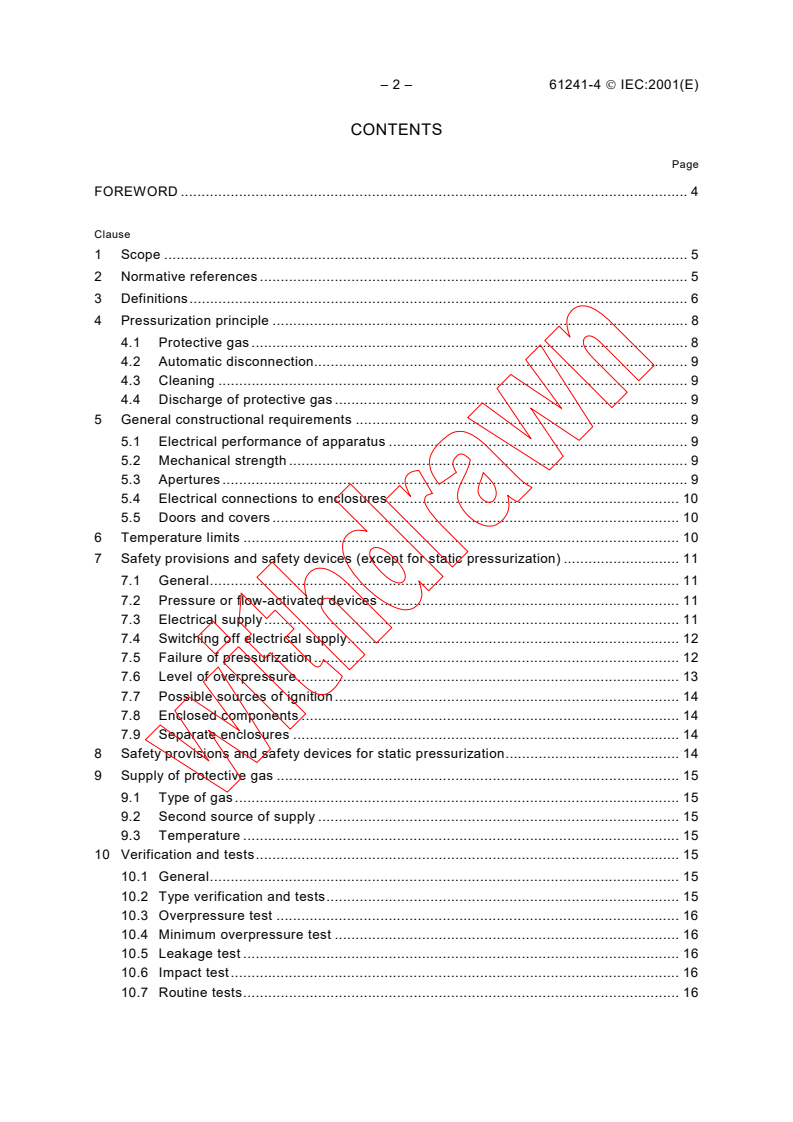
CONTENTS
Page
FOREWORD . 4
Clause
1 Scope . 5
2 Normative references . 5
3 Definitions. 6
4 Pressurization principle . 8
4.1 Protective gas . 8
4.2 Automatic disconnection. 9
4.3 Cleaning . 9
4.4 Discharge of protective gas . 9
5 General constructional requirements . 9
5.1 Electrical performance of apparatus . 9
5.2 Mechanical strength . 9
5.3 Apertures . 9
5.4 Electrical connections to enclosures . 10
5.5 Doors and covers . 10
6 Temperature limits . 10
7 Safety provisions and safety devices (except for static pressurization) . 11
7.1 General. 11
7.2 Pressure or flow-activated devices . 11
7.3 Electrical supply. 11
7.4 Switching off electrical supply. 12
7.5 Failure of pressurization. 12
7.6 Level of overpressure. 13
7.7 Possible sources of ignition. 14
7.8 Enclosed components . 14
7.9 Separate enclosures . 14
8 Safety provisions and safety devices for static pressurization. 14
9 Supply of protective gas . 15
9.1 Type of gas. 15
9.2 Second source of supply . 15
9.3 Temperature . 15
10 Verification and tests. 15
10.1 General. 15
10.2 Type verification and tests. 15
10.3 Overpressure test . 16
10.4 Minimum overpressure test . 16
10.5 Leakage test . 16
10.6 Impact test. 16
10.7 Routine tests. 16
61241-4 IEC:2001(E) – 3 –
11 Marking. 17
11.1 Pressurized enclosure. 17
11.2 Additional marking . 17
11.3 Pressurized enclosures protected by static pressurization. 17
11.4 Any other marking required . 17
Annex A (normative) Ducts for protective gas supply. 18
Annex B (normative) Installation requirements for pressurization. 21
Figure A.1 – Examples of the static overpressure along the ducts and through a
pressurized enclosure.19
Figure A.2 – Example of the static overpressure in a pressurized electric rotating
machine with fan . 20
Table 1 – Requirements on failure of pressurization . 12
Table B.1 – Summary of protection requirements for enclosures . 21
– 4 – 61241-4 © IEC:2001(E)
INTERNATIONAL ELECTROTECHNICAL COMMISSION
___________
ELECTRICAL APPARATUS FOR USE IN THE PRESENCE OF
COMBUSTIBLE DUST –
Part 4: Type of protection "pD"
FOREWORD
1) The International Electrotechnical Commission (IEC) is a worldwide organization for standardization comprising
all national electrotechnical committees (IEC National Committees). The object of IEC is to promote
international co-operation on all questions concerning standardization in the electrical and electronic fields. To
this end and in addition to other activities, IEC publishes International Standards, Technical Specifications,
Technical Reports, Publicly Available Specifications (PAS) and Guides (hereafter referred to as “IEC
Publication(s)”). Their preparation is entrusted to technical committees; any IEC National Committee interested
in the subject dealt with may participate in this preparatory work. International, governmental and non-
governmental organizations liaising with the IEC also participate in this preparation. IEC collaborates closely
with the International Organization for Standardization (ISO) in accordance with conditions determined by
agreement between the two organizations.
2) The formal decisions or agreements of IEC on technical matters express, as nearly as possible, an international
consensus of opinion on the relevant subjects since each technical committee has representation from all
interested IEC National Committees.
3) IEC Publications have the form of recommendations for international use and are accepted by IEC National
Committees in that sense. While all reasonable efforts are made to ensure that the technical content of IEC
Publications is accurate, IEC cannot be held responsible for the way in which they are used or for any
misinterpretation by any end user.
4) In order to promote international uniformity, IEC National Committees undertake to apply IEC Publications
transparently to the maximum extent possible in their national and regional publications. Any divergence between
any IEC Publication and the corresponding national or regional publication shall be clearly indicated in the latter.
5) IEC itself does not provide any attestation of conformity. Independent certification bodies provide conformity
assessment services and, in some areas, access to IEC marks of conformity. IEC is not responsible for any
services carried out by independent certification bodies.
6) All users should ensure that they have the latest edition of this publication.
7) No liability shall attach to IEC or its directors, employees, servants or agents including individual experts and
members of its technical committees and IEC National Committees for any personal injury, property damage or
other damage of any nature whatsoever, whether direct or indirect, or for costs (including legal fees) and
expenses arising out of the publication, use of, or reliance upon, this IEC Publication or any other IEC
Publications.
8) Attention is drawn to the Normative references cited in this publication. Use of the referenced publications is
indispensable for the correct application of this publication.
9) Attention is drawn to the possibility that some of the elements of this IEC Publication may be the subject of
patent rights. IEC shall not be held responsible for identifying any or all such patent rights.
International Standard IEC 61241-4 has been prepared by subcommittee 31H: Apparatus for
use in the presence of combustible dust, of IEC technical committee 31: Electrical apparatus
for explosive atmospheres.
The text of this standard is based on the following documents:
FDIS Report on voting
31H/117/FDIS 31H/127/RVD
Full information on the voting for the approval of this standard can be found in the report on
voting indicated in the above table.
This publication has been drafted in accordance with the ISO/IEC Directives, Part 3.
Annexes A and B form an integral part of this standard.
The committee has decided that the contents of this publication will remain unchanged
until 2005. At this date, the publication will be
• reconfirmed;
• withdrawn;
• replaced by a revised edition, or
• amended.
61241-4 IEC:2001(E) – 5 –
ELECTRICAL APPARATUS FOR COMBUSTIBLE DUST ATMOSPHERES –
Part 4: Type of protection “pD”
1 Scope
This part of IEC 61241, gives requirements on the design, construction, testing and marking of
electrical apparatus for use in combustible dust atmospheres in which a protective gas (air or
inert gas), maintained at a pressure above that of the external atmosphere, is used to prevent
the entry of dust which might otherwise lead to the formation of a combustible mixture within
enclosures which do not contain a source of combustible dust.
This standard contains the specific requirements for construction and testing, including
protective requirements that apply to electrical apparatus with type of protection pressurization
“pD” intended for use in potentially combustible dust atmospheres.
This standard includes the requirements for the construction of the enclosure and its
associated components, including, if any, the inlet and outlet ducts for the protective gas, and
for the safety provisions and devices necessary to ensure that pressurization is established
and maintained for type of protection pressurization “pD”.
Requirements for pressurized enclosures with an internal source of dust release are not
included in this standard.
This standard does not cover the requirements for pressurized rooms with or without internal
sources of dust release.
This standard does not apply to dusts of explosives which do not require atmospheric oxygen
for combustion or to pyrophoric substances.
This standard does not cover combined gas and dust hazard. Those requirements are under
consideration.
The requirements contained in this standard are supplementary to those in IEC 61241-1-1.
2 Normative references
The following normative documents contain provisions which, through reference in this text,
constitute provisions of this part of IEC 61241. For dated references, subsequent amendments
to, or revisions of, any of these publications do not apply. However, parties to agreements
based on this part of IEC 61241 are encouraged to investigate the possibility of applying the
most recent editions of the normative documents listed below. For undated references, the
latest edition of the normative document referred to applies. Members of IEC and ISO maintain
registers of currently valid International Standards.
IEC 60034-1:1996, Rotating electrical machines – Part 1: Rating and performance
IEC 61241 (all parts), Electrical apparatus for use in the presence of combustible dust
___________
"A consolidated edition 10.2 exists (1999) that includes IEC 60034-1 (1996), its amendment 1 (1997) and its
amendment 2 (1999).
– 6 – 61241-4 IEC:2001(E)
IEC 61241-1-1:1999, Electrical apparatus for use in the presence of combustible dust –
Part 1-1: Electrical apparatus protected by enclosures and surface temperature limitation –
Specification for apparatus
IEC 61241-1-2:1999, Electrical apparatus for use in the presence of combustible dust –
Part 1-2: Electrical apparatus protected by enclosures and surface temperature limitation –
Selection, installation and maintenance
IEC 61241-3:1997, Electrical apparatus for use in the presence of combustible dust – Part 3:
Classification of areas where combustible dusts are or may be present
3 Definitions
For the purpose of this part of IEC 61241, the definitions from IEC 61241-1-1 and the following
apply.
3.1
type of protection ‘pD’
technique of applying a protective gas to an enclosure in order to prevent the formation of an
explosive dust atmosphere inside the enclosure by maintaining an overpressure against the
surrounding atmosphere
3.2
overpressure
pressure above ambient pressure within a pressurized enclosure
3.3
pressurization
technique of guarding against the ingress of the external dust atmosphere, which may be
explosive, into an enclosure by maintaining a protective gas therein at a pressure above that of
the external atmosphere
3.4
protective gas
air or inert gas used for maintaining an overpressure
NOTE For the purpose of this document inert gas means nitrogen, carbon dioxide, argon or any gas which, when
mixed with oxygen in the ratio of 4:1 as found in air, does not make the ignition and combustible properties, such as
combustible limits, more onerous.
3.5
enclosure
all the walls which surround the live parts of electrical apparatus including doors, covers, cable
entries, rods, spindles and shafts and which ensure the protection of the electrical apparatus
3.6
pressurized enclosure
enclosure in which protective gas is maintained at a pressure greater than that of the external
atmosphere
NOTE The pressurized enclosure may or may not also be the enclosure surrounding the live parts and ensuring
the protection in other respects of the electrical apparatus.
3.7
static pressurization
maintenance of an overpressure within a pressurized enclosure without the addition of
protective gas in a hazardous area
61241-4 IEC:2001(E) – 7 –
3.8
pressurization with leakage compensation
maintenance of an overpressure within a pressurized enclosure so that, when the outlet
apertures – if any – are closed, the supply of protective gas is sufficient to compensate for any
leakage from the pressurized enclosure and its ducts
3.9
pressurization with continuous flow of the protective gas
maintenance of an overpressure within a pressurized enclosure with continuous flow of the
protective gas through the enclosure
3.10
electrical apparatus
items applied as a whole or in part for the utilization of electrical energy. These include, among
others, items for the generation, transmission, distribution, storage, measurement, regulation,
conversion, and consumption of electrical energy and items for telecommunications
3.11
ignition-capable apparatus
apparatus which, in normal operation, constitutes a source of ignition for a specified
combustible dust atmosphere. This includes electrical apparatus not protected by a type of
protection listed in IEC 61241-1-2
3.12
self-revealing fault
fault which would cause a malfunction of the apparatus necessitating correction before
proceeding with further operation of the apparatus and which may be indicated, for example, by
an audible or visible signal
3.13
opening
aperture, door, window or non-airtight fixed panel
3.14
protective device
device provided to protect a system against conditions which could result in a fire or explosion
3.15
alarm
piece of apparatus that generates a visual or audible signal that is intended to attract attention
3.16
indicator
piece of apparatus that shows flow or pressure and is monitored periodically, consistent with
the requirement of the application
3.17
protected apparatus
electrical apparatus internal to the pressurized enclosure
3.18
pressurization system
grouping of components used to pressurize and monitor a pressurized enclosure
3.19
alternate (or auxiliary) source of supply of protective gas
second source of protective gas that may take over in the event of failure of the primary source
– 8 – 61241-4 IEC:2001(E)
3.20
zones
classified areas are divided into zones based upon the frequence and duration of the
occurrence of explosive dust/air mixtures. Dust layers should also be taken into consideration
[IEC 61241-3, definition 2.10]
3.21
zone 20
area in which combustible dust, as a cloud, is present continuously or frequently, during normal
operation, in sufficient quantity to be capable of producing an explosive concentration of
combustible dust mixed with air, and/or where layers of dust of uncontrollable and excessive
thickness can be formed.
This can be the case inside dust containment areas where dust can form explosive mixtures
frequently or for long periods of time. This occurs typically inside equipment
[IEC 61241-3, definition 2.11]
3.22
zone 21
area not classified as zone 20 in which combustible dust, as a cloud, is likely to occur during
normal operation, in sufficient quantities to be capable of producing an explosive concentration
of combustible dust mixed with air.
This zone can include, among others, areas in the immediate vicinity of powder filling or
emptying points and areas where dust layers occur and are likely, in normal operation, to give
rise to an explosive concentration of combustible dust mixed with air
[IEC 61241-3, definition 2.12]
3.23
zone 22
areas not classified as zone 21 in which combustible dust clouds may occur infrequently, and
persist for only a short period, or in which accumulations or layers of combustible dust may be
present under abnormal conditions and give rise to combustible mixtures of dust in air. Where,
following an abnormal condition, the removal of dust accumulations or layers cannot be
assured, then the area is to be classified zone 21.
This zone can include, among others, areas in the vicinity of equipment containing dust, where
dust can escape from leaks and form deposits (such as milling rooms in which dust can escape
from the mills and then settle)
IEC 61241-3, definition 2.13]
4 Pressurization principle
Protection by pressurization is a type of protection that relies upon the interior of the enclosure
being subjected to a continuous overpressure from a supply of protective gas while electrical
equipment within the enclosure is energized.
In designing a pressurization system, the following basic principles apply.
4.1 Protective gas
There is a suitable supply of protective gas capable of maintaining the pressure above a
predetermined level except for static pressurization as given in clause 7.
61241-4 IEC:2001(E) – 9 –
4.2 Automatic disconnection
Pressurization failure automatically disconnects the system from the electricity supply and/or
initiates alarms.
4.3 Cleaning
The enclosure is cleaned before the electrical supply can be connected, in order to remove any
accumulated combustible dust left in the enclosure, either accidentally following failure of the
pressurization system, or following normal shutdown.
4.4 Discharge of protective gas
Preferably, the protective gas may be discharged into a non-hazardous area. In the case of
pressurization with continuous flow, and where the protective gas is discharged into the
hazardous area, means are to be provided to prevent hot particles or other ignition sources
from equipment under normal or fault conditions entering the hazardous area.
5 General constructional requirements
5.1 Electrical performance of apparatus
The electrical performance of apparatus contained within the enclosure shall be such that the
apparatus is capable of functioning up to its full rating and recognized overloads, if any, without
detriment to the enclosure or rise in surface temperature in excess of the specified limits.
NOTE Safeguarding against potential arcing faults that might lead to the failure of an enclosure should be
considered, taking into account fault levels together with protection and safety devices fitted.
5.2 Mechanical strength
The pressurized enclosure ducts, if any, and their connecting parts, shall withstand a pressure
equal to 1,5 times the maximum overpressure specified by the manufacturer for normal service
with all outlets closed with a minimum of 200 Pa (2 mbar).
If a pressure can occur in service that can cause a deformation of the enclosure ducts, if any,
or connecting parts, a safety device shall be fitted by the manufacturer to limit the maximum
internal overpressure to a level below that which could adversely affect the type of protection.
NOTE Equipment with large surface areas, which are subjected to pressures in excess of 1 kPa (for example,
sheet metal enclosures), may require approval from the relevant authority responsible for pressure vessel
legislation.
5.3 Apertures
5.3.1 In the case of static pressurization the enclosure shall have one or more apertures.
After filling and pressurization all apertures shall be closed.
5.3.2 In the case of pressurization with leakage compensation the enclosure shall have one or
more inlet apertures.
5.3.3 In the case of pressurization with continuous flow of protective gas, the enclosure shall
have one or more inlet apertures and one or more outlet apertures for the connection of the
inlet and outlet ducts for the protective gas.
– 10 – 61241-4 IEC:2001(E)
5.4 Electrical connections to enclosures
The entry of electrical conductors shall be by means of a cable gland or conduit directly into the
enclosure such that the method of protection is maintained, or by means of a separate terminal
box which is protected by one of the types of protection for electrical equipment in combustible
dust atmospheres in accordance with IEC 61241-1-2.
5.5 Doors and covers
When it is necessary to delay the opening of an enclosure due to a risk of explosion because
of the existence of an external explosive dust atmosphere, and due, for example, to the
surface temperature of internal parts of that equipment or to residual charge on components,
the doors and covers shall carry a warning giving the delay to be observed after switching off
the electrical supply.
Doors and covers, which can be opened without the use of tools or keys, shall be interlocked
with the electrical supply to disconnect all power to the electrical apparatus.
In the case of static pressurization, doors and covers shall only be opened by the use of a tool,
and shall carry the following warning:
REMOVE TO A NON-HAZARDOUS AREA BEFORE OPENING
Where doors and covers are provided to permit inspection in service, they shall carry the
following or equivalent warning:
DO NOT OPEN WHILE ENERGIZED
except where provision is made for adjustment during operation, in which case the warning
shall indicate
SEE INSTRUCTIONS BEFORE OPENING
A suitable number of doors or covers shall be provided for effective cleaning. The number of
doors and covers are to be chosen with regard to the design and disposition of the apparatus,
particular consideration being given to the needs of subcompartments into which the apparatus
might be divided.
6 Temperature limits
The equipment shall be classified in accordance with IEC 61241-1-1. The classification shall be
determined by the higher of the following temperatures.
a) The maximum external surface temperature of the enclosure.
b) The maximum surface temperatures of internal parts that are protected by a type of
protection in accordance with IEC 61241-1-2 and which remain energized when the supply
of protective gas for pressurization is removed or fails, for example, electric heaters.
If
...
IEC 61241-4
Edition 1.0 2001-03
INTERNATIONAL
STANDARD
NORME
INTERNATIONALE
Electrical apparatus for use in the presence of combustible dust –
Part 4: Type of protection ″pD″
Matériels électriques destinés à être utilisés en présence de poussières
combustibles –
Partie 4: Type de protection «pD»
All rights reserved. Unless otherwise specified, no part of this publication may be reproduced or utilized in any form or by
any means, electronic or mechanical, including photocopying and microfilm, without permission in writing from either IEC or
IEC's member National Committee in the country of the requester.
If you have any questions about IEC copyright or have an enquiry about obtaining additional rights to this publication,
please contact the address below or your local IEC member National Committee for further information.
Droits de reproduction réservés. Sauf indication contraire, aucune partie de cette publication ne peut être reproduite
ni utilisée sous quelque forme que ce soit et par aucun procédé, électronique ou mécanique, y compris la photocopie
et les microfilms, sans l'accord écrit de la CEI ou du Comité national de la CEI du pays du demandeur.
Si vous avez des questions sur le copyright de la CEI ou si vous désirez obtenir des droits supplémentaires sur cette
publication, utilisez les coordonnées ci-après ou contactez le Comité national de la CEI de votre pays de résidence.
IEC Central Office
3, rue de Varembé
CH-1211 Geneva 20
Switzerland
Email: inmail@iec.ch
Web: www.iec.ch
About the IEC
The International Electrotechnical Commission (IEC) is the leading global organization that prepares and publishes
International Standards for all electrical, electronic and related technologies.
About IEC publications
The technical content of IEC publications is kept under constant review by the IEC. Please make sure that you have the
latest edition, a corrigenda or an amendment might have been published.
ƒ Catalogue of IEC publications: www.iec.ch/searchpub
The IEC on-line Catalogue enables you to search by a variety of criteria (reference number, text, technical committee,…).
It also gives information on projects, withdrawn and replaced publications.
ƒ IEC Just Published: www.iec.ch/online_news/justpub
Stay up to date on all new IEC publications. Just Published details twice a month all new publications released. Available
on-line and also by email.
ƒ Electropedia: www.electropedia.org
The world's leading online dictionary of electronic and electrical terms containing more than 20 000 terms and definitions
in English and French, with equivalent terms in additional languages. Also known as the International Electrotechnical
Vocabulary online.
ƒ Customer Service Centre: www.iec.ch/webstore/custserv
If you wish to give us your feedback on this publication or need further assistance, please visit the Customer Service
Centre FAQ or contact us:
Email: csc@iec.ch
Tel.: +41 22 919 02 11
Fax: +41 22 919 03 00
A propos de la CEI
La Commission Electrotechnique Internationale (CEI) est la première organisation mondiale qui élabore et publie des
normes internationales pour tout ce qui a trait à l'électricité, à l'électronique et aux technologies apparentées.
A propos des publications CEI
Le contenu technique des publications de la CEI est constamment revu. Veuillez vous assurer que vous possédez
l’édition la plus récente, un corrigendum ou amendement peut avoir été publié.
ƒ Catalogue des publications de la CEI: www.iec.ch/searchpub/cur_fut-f.htm
Le Catalogue en-ligne de la CEI vous permet d’effectuer des recherches en utilisant différents critères (numéro de référence,
texte, comité d’études,…). Il donne aussi des informations sur les projets et les publications retirées ou remplacées.
ƒ Just Published CEI: www.iec.ch/online_news/justpub
Restez informé sur les nouvelles publications de la CEI. Just Published détaille deux fois par mois les nouvelles
publications parues. Disponible en-ligne et aussi par email.
ƒ Electropedia: www.electropedia.org
Le premier dictionnaire en ligne au monde de termes électroniques et électriques. Il contient plus de 20 000 termes et
définitions en anglais et en français, ainsi que les termes équivalents dans les langues additionnelles. Egalement appelé
Vocabulaire Electrotechnique International en ligne.
ƒ Service Clients: www.iec.ch/webstore/custserv/custserv_entry-f.htm
Si vous désirez nous donner des commentaires sur cette publication ou si vous avez des questions, visitez le FAQ du
Service clients ou contactez-nous:
Email: csc@iec.ch
Tél.: +41 22 919 02 11
Fax: +41 22 919 03 00
IEC 61241-4
Edition 1.0 2001-03
INTERNATIONAL
STANDARD
NORME
INTERNATIONALE
Electrical apparatus for use in the presence of combustible dust –
Part 4: Type of protection ″pD″
Matériels électriques destinés à être utilisés en présence de poussières
combustibles –
Partie 4: Type de protection «pD»
INTERNATIONAL
ELECTROTECHNICAL
COMMISSION
COMMISSION
ELECTROTECHNIQUE
PRICE CODE
INTERNATIONALE
S
CODE PRIX
ICS 29.260.20 ISBN 2-8318-5585-3
– 2 – 61241-4 © CEI:2001
SOMMAIRE
AVANT-PROPOS . 6
1 Domaine d'application. 8
2 Références normatives . 8
3 Définitions. 10
4 Principe de la pressurisation . 16
4.1 Gaz protecteur. 16
4.2 Déconnexion automatique. 16
4.3 Nettoyage . 16
4.4 Rejet du gaz protecteur. 16
5 Exigences générales en matière de construction. 16
5.1 Performances électriques de l'appareil. 16
5.2 Résistance mécanique. 16
5.3 Ouvertures. 18
5.4 Raccordements électriques aux enceintes . 18
5.5 Portes et capots. 18
6 Limites de température . 20
7 Mesures et dispositifs de sécurité (sauf pressurisation statique) . 20
7.1 Généralités . 20
7.2 Dispositifs sensibles à la pression ou au débit . 22
7.3 Alimentation électrique . 22
7.4 Coupure de l'alimentation électrique . 22
7.5 Panne de la pressurisation. 22
7.6 Niveau de surpression . 26
7.7 Sources d'inflammation possibles . 26
7.8 Composants internes . 26
7.9 Enceintes séparées . 26
8 Mesures et dispositifs de sécurité pour la pressurisation statique . 28
9 Alimentation en gaz protecteur. 28
9.1 Type de gaz. 28
9.2 Deuxième source d'alimentation . 30
9.3 Température . 30
10 Vérification et essais. 30
10.1 Généralités . 30
10.2 Vérification de type et essais . 30
10.3 Essai de surpression. 30
10.4 Essai de surpression minimale. 32
10.5 Essai de fuites . 32
10.6 Essai au choc . 32
10.7 Essais de routine . 32
61241-4 © IEC:2001 – 3 –
CONTENTS
FOREWORD . 7
1 Scope . 9
2 Normative references . 9
3 Definitions. 11
4 Pressurization principle . 17
4.1 Protective gas . 17
4.2 Automatic disconnection. 17
4.3 Cleaning . 17
4.4 Discharge of protective gas . 17
5 General constructional requirements . 17
5.1 Electrical performance of apparatus . 17
5.2 Mechanical strength . 17
5.3 Apertures . 19
5.4 Electrical connections to enclosures . 19
5.5 Doors and covers . 19
6 Temperature limits . 21
7 Safety provisions and safety devices (except for static pressurization) . 21
7.1 General. 21
7.2 Pressure- or flow-activated devices . 23
7.3 Electrical supply. 23
7.4 Switching off electrical supply. 23
7.5 Failure of pressurization. 23
7.6 Level of overpressure. 27
7.7 Possible sources of ignition. 27
7.8 Enclosed components . 27
7.9 Separate enclosures . 27
8 Safety provisions and safety devices for static pressurization. 29
9 Supply of protective gas . 29
9.1 Type of gas. 29
9.2 Second source of supply . 31
9.3 Temperature . 31
10 Verification and tests. 31
10.1 General. 31
10.2 Type verification and tests. 31
10.3 Overpressure test . 31
10.4 Minimum overpressure test . 33
10.5 Leakage test . 33
10.6 Impact test. 33
10.7 Routine tests. 33
– 4 – 61241-4 © CEI:2001
11 Marquage .34
11.1 Enceinte pressurisée . 34
11.2 Marquages supplémentaires . 34
11.3 Enceintes pressurisées protégées par pressurisation statique . 34
11.4 Tout autre marquage exigé . 34
Annexe A (normative) Conduites d'alimentation en gaz protecteur . 36
Annexe B (normative) Exigences en matière d'installation pour la pressurisation . 42
Figure A.1 – Diagramme de surpression statique le long des canalisations et dans
l'enveloppe à surpression interne . 38
Figure A.2 – Exemple de surpression statique dans une machine électrique tournante
à surpression interne, équipée d'un ventilateur. 40
Tableau 1 – Exigences en cas de panne de la pressurisation . 24
Tableau B.1 – Récapitulatif des exigences de protection pour les enceintes. 42
61241-4 © IEC:2001 – 5 –
11 Marking. 35
11.1 Pressurized enclosure. 35
11.2 Additional marking . 35
11.3 Pressurized enclosures protected by static pressurization. 35
11.4 Any other marking required . 35
Annex A (normative) Ducts for protective gas supply. 37
Annex B (normative) Installation requirements for pressurization. 43
Figure A.1 – Examples of the static overpressure along the ducts and through a
pressurized enclosure.39
Figure A.2 – Example of the static overpressure in a pressurized electric rotating
machine with fan . 41
Table 1 – Requirements on failure of pressurization . 25
Table B.1 – Summary of protection requirements for enclosures . 43
– 6 – 61241-4 © CEI:2001
COMMISSION ÉLECTROTECHNIQUE INTERNATIONALE
____________
MATÉRIELS ÉLECTRIQUES DESTINÉS À ÊTRE UTILISÉS
EN PRÉSENCE DE POUSSIÈRES COMBUSTIBLES –
Partie 4: Type de protection «pD»
AVANT-PROPOS
1) La Commission Electrotechnique Internationale (CEI) est une organisation mondiale de normalisation
composée de l'ensemble des comités électrotechniques nationaux (Comités nationaux de la CEI). La CEI a
pour objet de favoriser la coopération internationale pour toutes les questions de normalisation dans les
domaines de l'électricité et de l'électronique. A cet effet, la CEI – entre autres activités – publie des Normes
internationales, des Spécifications techniques, des Rapports techniques, des Spécifications accessibles au
public (PAS) et des Guides (ci-après dénommés "Publication(s) de la CEI"). Leur élaboration est confiée à des
comités d'études, aux travaux desquels tout Comité national intéressé par le sujet traité peut participer. Les
organisations internationales, gouvernementales et non gouvernementales, en liaison avec la CEI, participent
également aux travaux. La CEI collabore étroitement avec l'Organisation Internationale de Normalisation (ISO),
selon des conditions fixées par accord entre les deux organisations.
2) Les décisions ou accords officiels de la CEI concernant les questions techniques représentent, dans la mesure
du possible, un accord international sur les sujets étudiés, étant donné que les Comités nationaux de la CEI
intéressés sont représentés dans chaque comité d’études.
3) Les Publications de la CEI se présentent sous la forme de recommandations internationales et sont agréées
comme telles par les Comités nationaux de la CEI. Tous les efforts raisonnables sont entrepris afin que la CEI
s'assure de l'exactitude du contenu technique de ses publications; la CEI ne peut pas être tenue responsable
de l'éventuelle mauvaise utilisation ou interprétation qui en est faite par un quelconque utilisateur final.
4) Dans le but d'encourager l'uniformité internationale, les Comités nationaux de la CEI s'engagent, dans toute la
mesure possible, à appliquer de façon transparente les Publications de la CEI dans leurs publications
nationales et régionales. Toutes divergences entre toutes Publications de la CEI et toutes publications
nationales ou régionales correspondantes doivent être indiquées en termes clairs dans ces dernières.
5) La CEI elle-même ne fournit aucune attestation de conformité. Des organismes de certification indépendants
fournissent des services d'évaluation de conformité et, dans certains secteurs, accèdent aux marques de
conformité de la CEI. La CEI n'est responsable d'aucun des services effectués par les organismes de
certification indépendants.
6) Tous les utilisateurs doivent s'assurer qu'ils sont en possession de la dernière édition de cette publication.
7) Aucune responsabilité ne doit être imputée à la CEI, à ses administrateurs, employés, auxiliaires ou
mandataires, y compris ses experts particuliers et les membres de ses comités d'études et des Comités
nationaux de la CEI, pour tout préjudice causé en cas de dommages corporels et matériels, ou de tout autre
dommage de quelque nature que ce soit, directe ou indirecte, ou pour supporter les coûts (y compris les frais
de justice) et les dépenses découlant de la publication ou de l'utilisation de cette Publication de la CEI ou de
toute autre Publication de la CEI, ou au crédit qui lui est accordé.
8) L'attention est attirée sur les références normatives citées dans cette publication. L'utilisation de publications
référencées est obligatoire pour une application correcte de la présente publication.
9) L’attention est attirée sur le fait que certains des éléments de la présente Publication de la CEI peuvent faire
l’objet de droits de propriété intellectuelle ou de droits analogues. La CEI ne saurait être tenue pour
responsable de ne pas avoir identifié de tels droits de propriété et de ne pas avoir signalé leur existence.
La Norme internationale CEI 61241-4 a été établie par le sous-comité 31H: Matériels destinés
à être utilisés en présence de poussières inflammables, du comité d'études 31 de la CEI:
Matériel électrique pour atmosphères explosives.
La présente version bilingue, publiée en 2001-07, correspond à la version anglaise.
Le texte anglais de cette norme est basé sur les documents 31H/117/FDIS et 31H/127/RVD.
Le rapport de vote 31H/127/RVD donne toute information sur le vote ayant abouti à
l'approbation de cette norme.
La version française de cette norme n'a pas été soumise au vote.
Cette publication a été rédigée selon les Directives ISO/CEI, Partie 3.
Les annexes A et B font partie intégrante de cette norme.
Le comité a décidé que le contenu de cette publication ne sera pas modifié avant 2005.
A cette date, la publication sera
• reconduite;
• supprimée;
• remplacée par une édition révisée, ou
• amendée.
61241-4 © IEC:2001 – 7 –
INTERNATIONAL ELECTROTECHNICAL COMMISSION
___________
ELECTRICAL APPARATUS FOR USE IN THE PRESENCE OF
COMBUSTIBLE DUST –
Part 4: Type of protection "pD"
FOREWORD
1) The International Electrotechnical Commission (IEC) is a worldwide organization for standardization comprising
all national electrotechnical committees (IEC National Committees). The object of IEC is to promote
international co-operation on all questions concerning standardization in the electrical and electronic fields. To
this end and in addition to other activities, IEC publishes International Standards, Technical Specifications,
Technical Reports, Publicly Available Specifications (PAS) and Guides (hereafter referred to as “IEC
Publication(s)”). Their preparation is entrusted to technical committees; any IEC National Committee interested
in the subject dealt with may participate in this preparatory work. International, governmental and non-
governmental organizations liaising with the IEC also participate in this preparation. IEC collaborates closely
with the International Organization for Standardization (ISO) in accordance with conditions determined by
agreement between the two organizations.
2) The formal decisions or agreements of IEC on technical matters express, as nearly as possible, an international
consensus of opinion on the relevant subjects since each technical committee has representation from all
interested IEC National Committees.
3) IEC Publications have the form of recommendations for international use and are accepted by IEC National
Committees in that sense. While all reasonable efforts are made to ensure that the technical content of IEC
Publications is accurate, IEC cannot be held responsible for the way in which they are used or for any
misinterpretation by any end user.
4) In order to promote international uniformity, IEC National Committees undertake to apply IEC Publications
transparently to the maximum extent possible in their national and regional publications. Any divergence between
any IEC Publication and the corresponding national or regional publication shall be clearly indicated in the latter.
5) IEC itself does not provide any attestation of conformity. Independent certification bodies provide conformity
assessment services and, in some areas, access to IEC marks of conformity. IEC is not responsible for any
services carried out by independent certification bodies.
6) All users should ensure that they have the latest edition of this publication.
7) No liability shall attach to IEC or its directors, employees, servants or agents including individual experts and
members of its technical committees and IEC National Committees for any personal injury, property damage or
other damage of any nature whatsoever, whether direct or indirect, or for costs (including legal fees) and
expenses arising out of the publication, use of, or reliance upon, this IEC Publication or any other IEC
Publications.
8) Attention is drawn to the Normative references cited in this publication. Use of the referenced publications is
indispensable for the correct application of this publication.
9) Attention is drawn to the possibility that some of the elements of this IEC Publication may be the subject of
patent rights. IEC shall not be held responsible for identifying any or all such patent rights.
International Standard IEC 61241-4 has been prepared by subcommittee 31H: Apparatus for
use in the presence of combustible dust, of IEC technical committee 31: Electrical apparatus
for explosive atmospheres.
This bilingual version, published in 2001-07, corresponds to the English version.
The text of this standard is based on the following documents:
FDIS Report on voting
31H/117/FDIS 31H/127/RVD
Full information on the voting for the approval of this standard can be found in the report on
voting indicated in the above table.
This publication has been drafted in accordance with the ISO/IEC Directives, Part 3.
Annexes A and B form an integral part of this standard.
The committee has decided that the contents of this publication will remain unchanged
until 2005. At this date, the publication will be
• reconfirmed;
• withdrawn;
• replaced by a revised edition, or
• amended.
– 8 – 61241-4 © CEI:2001
MATÉRIELS ÉLECTRIQUES DESTINÉS À ÊTRE UTILISÉS
EN PRÉSENCE DE POUSSIÈRES COMBUSTIBLES –
Partie 4: Type de protection «pD»
1 Domaine d'application
La présente partie de la CEI 61241 expose les exigences en matière de conception, de
construction, d'essais et de marquage des appareils électriques destinés à être utilisés au
sein d'atmosphères de poussières combustibles dans lesquelles un gaz protecteur (air ou gaz
inerte), maintenu à une pression supérieure à celle de l'atmosphère extérieure, sert à
empêcher la pénétration de poussière, qui conduirait, sans cette précaution, à la formation
d'un mélange combustible à l'intérieur d'enceintes ne contenant pas elles-mêmes de source
de poussière combustible.
La présente norme inclut les exigences spécifiques de construction et d'essais, y compris les
exigences en matière de protection, applicables aux appareils électriques protégés par
pressurisation «pD» et destinés à être utilisés dans des atmosphères susceptibles de contenir
des poussières potentiellement combustibles.
La présente norme inclut les exigences de construction de l'enceinte et des composants
associés, y compris les éventuelles conduites d'entrée et de sortie du gaz protecteur, ainsi
que les mesures et dispositifs de sécurité nécessaires pour garantir l'établissement et le
maintien de la pressurisation de protection «pD».
Les exigences concernant les enceintes pressurisées contenant une source interne
d'émission de poussière ne sont pas traitées dans la présente norme.
La présente norme ne traite pas des exigences relatives aux salles pressurisées, avec ou
sans sources internes d'émission de poussière.
La présente norme ne s'applique ni aux poussières d'explosives qui n'ont pas besoin de
l'oxygène atmosphérique pour brûler, ni aux substances pyrophores.
La présente norme ne traite pas des dangers liés aux combinaisons de gaz et de poussière.
Les exigences à cet égard sont à l'étude.
Les exigences contenues dans la présente norme complètent celles de la CEI 61241-1-1.
2 Références normatives
Les documents normatifs suivants contiennent des dispositions qui, par suite de la référence
qui y est faite, constituent des dispositions valables pour la présente partie de la CEI 61241.
Pour les références datées, les amendements ultérieurs ou les révisions de ces publications
ne s’appliquent pas. Toutefois, les parties prenantes aux accords fondés sur la présente
partie de la CEI 61241 sont invitées à rechercher la possibilité d'appliquer les éditions les
plus récentes des documents normatifs indiqués ci-après. Pour les références non datées, la
dernière édition du document normatif en référence s’applique. Les membres de la CEI et de
l'ISO possèdent le registre des Normes internationales en vigueur.
CEI 60034-1:1996, Machines électriques tournantes – Partie 1: Caractéristiques assignées
1)
et caractéristiques de fonctionnement
––––––––
1)
Il existe une édition consolidée 10.2 (1999) comprenant l'édition 10.0 et ses amendements.
61241-4 © IEC:2001 – 9 –
ELECTRICAL APPARATUS FOR USE IN THE PRESENCE OF
COMBUSTIBLE DUST –
Part 4: Type of protection "pD"
1 Scope
This part of IEC 61241 gives requirements on the design, construction, testing and marking of
electrical apparatus for use in combustible dust atmospheres in which a protective gas (air or
inert gas), maintained at a pressure above that of the external atmosphere, is used to prevent
the entry of dust which might otherwise lead to the formation of a combustible mixture within
enclosures which do not contain a source of combustible dust.
This standard contains the specific requirements for construction and testing, including
protective requirements that apply to electrical apparatus with type of protection pressurization
"pD" intended for use in potentially combustible dust atmospheres.
This standard includes the requirements for the construction of the enclosure and its
associated components, including, if any, the inlet and outlet ducts for the protective gas, and
for the safety provisions and devices necessary to ensure that pressurization is established
and maintained for type of protection pressurization "pD".
Requirements for pressurized enclosures with an internal source of dust release are not
included in this standard.
This standard does not cover the requirements for pressurized rooms with or without internal
sources of dust release.
This standard does not apply to dusts of explosives which do not require atmospheric oxygen
for combustion or to pyrophoric substances.
This standard does not cover combined gas and dust hazard. Those requirements are under
consideration.
The requirements contained in this standard are supplementary to those in IEC 61241-1-1.
2 Normative references
The following normative documents contain provisions which, through reference in this text,
constitute provisions of this part of IEC 61241. For dated references, subsequent amendments
to, or revisions of, any of these publications do not apply. However, parties to agreements
based on this part of IEC 61241 are encouraged to investigate the possibility of applying the
most recent editions of the normative documents listed below. For undated references, the
latest edition of the normative document referred to applies. Members of IEC and ISO maintain
registers of currently valid International Standards.
1)
IEC 60034-1:1996, Rotating electrical machines – Part 1: Rating and performance
___________
1)
There exists a consolidated edition 10.2 (1999) that includes edition 10.0 and its amendments.
– 10 – 61241-4 © CEI:2001
CEI 61241 (toutes les parties), Matériels électriques destinés à être utilisés en présence de
poussières combustibles
CEI 61241-1-1:1999, Matériels électriques destinés à être utilisés en présence de poussières
combustibles – Partie 1-1: Matériels électriques protégés par enveloppes et limitation de la
température de surface – Spécification pour les matériels
CEI 61241-1-2:1999, Matériels électriques destinés à être utilisés en présence de poussières
combustibles – Partie 1-2: Matériels électriques protégés par enveloppes et limitation de la
température de surface – Sélection, installation et maintenance
CEI 61241-3:1997, Matériels électriques destinés à être utilisés en présence de poussières
combustibles – Partie 3: Classification des emplacements où des poussières combustibles
sont ou peuvent être présentes
3 Définitions
Pour les besoins de la présente partie de la CEI 61241, les définitions de la CEI 61241-1-1,
ainsi que les définitions suivantes sont applicables.
3.1
type de protection «pD»
technique consistant à entretenir, dans une enceinte, une surpression d'un gaz protecteur par
rapport à la pression atmosphérique environnante afin d'empêcher la formation d'une
atmosphère de poussière explosive à l'intérieur de l'enceinte
3.2
surpression
pression supérieure à la pression ambiante dans une enceinte pressurisée
3.3
pressurisation
technique empêchant la pénétration, dans une enceinte, de l'atmosphère poussiéreuse
extérieure, potentiellement explosive, par maintien à l'intérieur d'un gaz protecteur à une
pression supérieure à celle de l'atmosphère extérieure
3.4
gaz protecteur
air ou gaz inerte utilisé pour entretenir une surpression.
NOTE Pour les besoins de la présente norme, on entend par gaz inerte l'azote, le dioxyde de carbone, l'argon ou
tout autre gaz qui, lorsque mélangé à l'oxygène dans une proportion de 4 pour 1 telle que celle de l'air, n'aggrave
pas les propriétés d'allumage et de combustion telles que les limites de la combustibilité.
3.5
enceinte
ensemble des parois entourant les parties sous tension des appareils électriques, y compris
portes, capots, et traversées de câbles, de tiges, de pivots et d'arbres, assurant la protection
de l'appareil
3.6
enceinte pressurisée
enceinte dans laquelle un gaz protecteur est maintenu à une pression supérieure à celle de
l'atmosphère extérieure
NOTE L'enceinte pressurisée peut également être ou non l'enceinte entourant les parties sous tension et
assurant la protection de l'appareil électrique contre d'autres risques.
61241-4 © IEC:2001 – 11 –
IEC 61241 (all parts), Electrical apparatus for use in the presence of combustible dust
IEC 61241-1-1:1999, Electrical apparatus for use in the presence of combustible dust –
Part 1-1: Electrical apparatus protected by enclosures and surface temperature limitation –
Specification for apparatus
IEC 61241-1-2:1999, Electrical apparatus for use in the presence of combustible dust –
Part 1-2: Electrical apparatus protected by enclosures and surface temperature limitation –
Selection, installation and maintenance
IEC 61241-3:1997, Electrical apparatus for use in the presence of combustible dust – Part 3:
Classification of areas where combustible dusts are or may be present
3 Definitions
For the purpose of this part of IEC 61241, the definitions from IEC 61241-1-1 and the following
apply.
3.1
type of protection "pD"
technique of applying a protective gas to an enclosure in order to prevent the formation of an
explosive dust atmosphere inside the enclosure by maintaining an overpressure against the
surrounding atmosphere
3.2
overpressure
pressure above ambient pressure within a pressurized enclosure
3.3
pressurization
technique of guarding against the ingress of the external dust atmosphere, which may be
explosive, into an enclosure by maintaining a protective gas therein at a pressure above that of
the external atmosphere
3.4
protective gas
air or inert gas used for maintaining an overpressure
NOTE For the purpose of this standard inert gas means nitrogen, carbon dioxide, argon or any gas which, when
mixed with oxygen in the ratio of 4:1 as found in air, does not make the ignition and combustible properties, such as
combustible limits, more onerous.
3.5
enclosure
all the walls which surround the live parts of electrical apparatus including doors, covers, cable
entries, rods, spindles and shafts and which ensure the protection of the electrical apparatus
3.6
pressurized enclosure
enclosure in which protective gas is maintained at a pressure greater than that of the external
atmosphere
NOTE The pressurized enclosure may or may not also be the enclosure surrounding the live parts and ensuring
the protection in other respects of the electrical apparatus.
– 12 – 61241-4 © CEI:2001
3.7
pressurisation statique
maintien d'une surpression à l'intérieur d'une enceinte pressurisée sans ajout de gaz
protecteur dans une zone dangereuse
3.8
pressurisation avec compensation des fuites
maintien d'une surpression à l'intérieur d'une enceinte pressurisée de telle façon que, lorsque
les éventuelles ouvertures de sortie sont fermées, l'alimentation en gaz protecteur soit
suffisante pour compenser d'éventuelles fuites par l'enceinte pressurisée et ses conduites
3.9
pressurisation avec circulation continue du gaz protecteur
maintien d'une surpression à l'intérieur d'une enceinte pressurisée, avec circulation continue
du gaz protecteur dans cette dernière
3.10
appareil électrique
tout appareil servant en tout ou en partie à utiliser de l'énergie électrique. Ce terme regroupe,
entre autres, les appareils de production, de transport, de distribution, de stockage, de
mesure, de régulation, de conversion et de consommation de l'énergie électrique, et les
appareils de télécommunications
3.11
appareil à risque d'inflammation
appareil susceptible de constituer, en fonctionnement normal, une source d'inflammation
d'une atmosphère de poussière combustible spécifique. Ce terme englobe tous les appareils
électriques non protégés par un des types de protection cités dans la CEI 61241-1-2
3.12
défaut se révélant de lui-même
défaut susceptible de provoquer un dysfonctionnement de l'appareil et nécessitant une
correction avant de poursuivre l'utilisation de l'appareil, et qui peut être indiqué, par exemple,
par un signal sonore ou visuel
3.13
ouverture
tout passage, porte, fenêtre ou panneau fixe non étanche à l'air
3.14
dispositif de protection
tout dispositif destiné à protéger un système contre des conditions susceptibles de conduire à
un incendie ou une explosion
3.15
alarme
élément d'un appareil produisant un signal sonore ou visuel destiné à attirer l'attention
3.16
indicateur
élément d'un appareil indiquant un débit ou une pression et contrôlé périodiquement en
fonction des exigences de l'application
3.17
appareil protégé
appareil électrique logé dans l'enceinte pressurisée
61241-4 © IEC:2001 – 13 –
3.7
static pressurization
maintenance of an overpressure within a pressurized enclosure without the addition of
protective gas in a hazardous area
3.8
pressurization with leakage compensation
maintenance of an overpressure within a pressurized enclosure so that, when the outlet
apertures – if any – are closed, the supply of protective gas is sufficient to compensate for any
leakage from the pressurized enclosure and its ducts
3.9
pressurization with continuous flow of the protective gas
maintenance of an overpressure within a pressurized enclosure with continuous flow of the
protective gas through the enclosure
3.10
electrical apparatus
items applied as a whole or in part for the utilization of electrical energy. These include, among
others, items for the generation, transmission, distribution, storage, measurement, regulation,
conversion, and consumption of electrical energy and items for telecommunications
3.11
ignition-capable apparatus
apparatus which, in normal operation, constitutes a source of ignition for a specified
combustible dust atmosphere. This includes electrical apparatus not protected by a type of
protection listed in IEC 61241-1-2
3.12
self-revealing fault
fault which would cause a malfunction of the apparatus necessitating correction before
proceeding with further operation of the apparatus and which may be indicated, for example, by
an audible or visible signal
3.13
opening
aperture, door, window or non-airtight fixed panel
3.14
protective device
device provided to protect a system against conditions which could result in a fire or explosion
3.15
alarm
piece of apparatus that generates a visual or audible signal that is intended to attract attention
3.16
indicator
piece of apparatus that shows flow or pressure and is monitored periodically, consistent with
the requirement of the application
3.17
protected apparatus
electrical apparatus internal to the pressurized enclosure
– 14 – 61241-4 © CEI:2001
3.18
système de pressurisation
ensemble de composants servant à pressuriser et à contrôler une enceinte pressurisée
3.19
source d'alimentation de secours (ou auxiliaire) en gaz protecteur
deuxième source de gaz protecteur capable de prendre le relais en cas de défaillance de la
première source
3.20
zones
les emplacements classés sont divisés en zones reposant sur la fréquence et la durée
d'apparition de mélanges poussières/air explosifs. Il convient que les couches de poussières
soient également prises en considération
[CEI 61241-3, définition 2.10]
3.21
zone 20
emplacement dans lequel pendant le fonctionnement normal, des poussières combustibles,
sous forme de nuage, sont présentes en permanence ou fréquemment en mélange avec l'air,
et/ou dans lequel des couches de poussières d'épaisseur excessive et non maîtrisable
peuvent se former
Cela peut être le cas à l'intérieur d'un confinement de poussières où la poussière peut former
des mélanges explosifs, fréquemment ou pendant de longues périodes. Cela survient typique-
ment à l'intérieur de l'équipement
[CEI 61241-3, définition 2.11]
3.22
zone 21
emplacement non classé comme zone 20 dans lequel, pendant le fonctionnement normal, des
poussières combustibles, sous forme de nuage, sont susceptibles d'apparaître en quantité
suffisante pour être capable de produire une concentration explosible de poussières
combustibles en mélange avec l'air
Cette zone peut comprendre, entre autres, des emplacements à proximité immédiate de
points de remplissage ou de vidage de produits pulvérulents, et des emplacements où des
couches de poussières se forment et sont susceptibles de donner lieu, pendant le
fonctionnement normal, à une concentration explosive de poussières combustibles en
mélange avec l'air
[CEI 61241-3, définition 2.12]
3.23
zone 22
emplacement non classé comme zone 21 dans lequel, des nuages de poussières peuvent
apparaître rarement et subsister seulement pendant de courtes périodes, ou dans lequel des
accumulations ou des couches de poussières combustibles ou inflammables peuven
...