

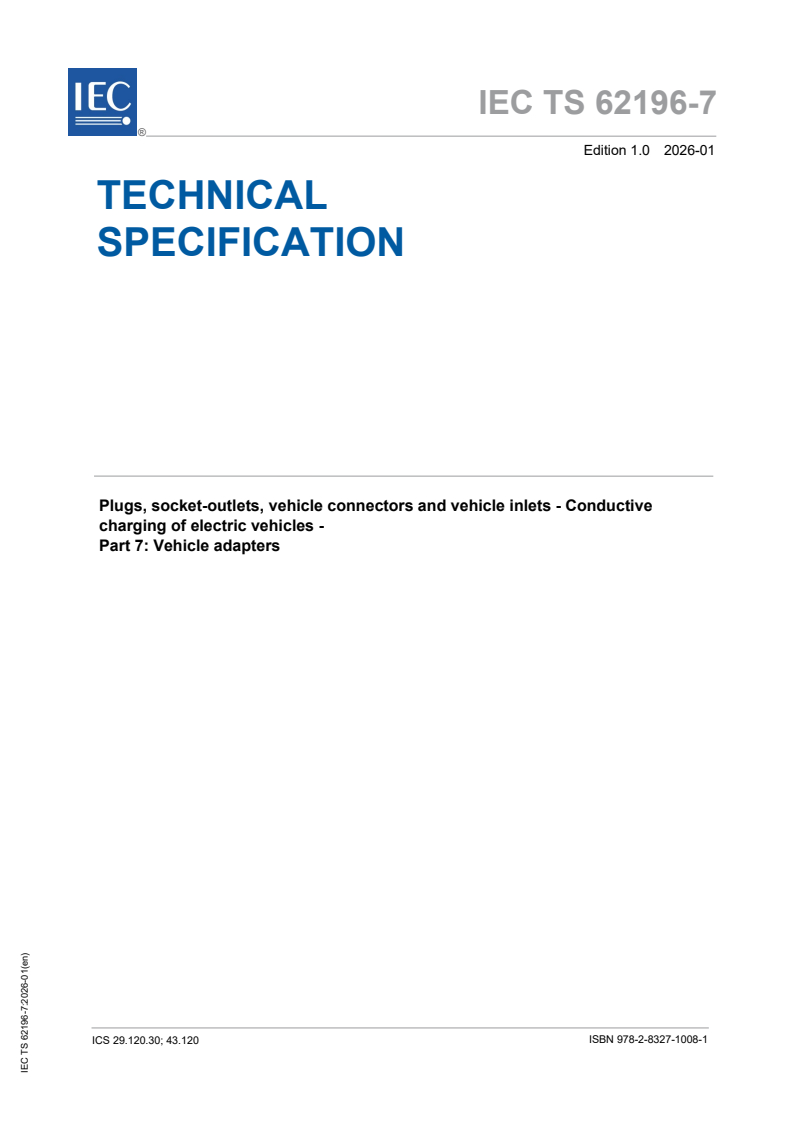
IEC TS 62196-7:2026
(Main)Plugs, socket-outlets, vehicle connectors and vehicle inlets - Conductive charging of electric vehicles - Part 7: Vehicle adapters
General Information
- Abstract
IEC TS 62196-7:2026 specifies the safety, interoperability, compatibility requirements and the configuration standard sheets for DC charging vehicle adapters
- with a rated voltage up to 1 500 V DC;
- between vehicle connector and vehicle inlet according to IEC 62196-3;
- used to adapt configuration GG vehicle inlet to configuration AA, BB vehicle connector as specified in the IEC 62196-3:20─.
NOTE DC vehicle adapters for other configuration combinations are under consideration.
This document is not applicable to:
- the adapter between the EV socket-outlet and the EV plug;
- the adapter between the AC vehicle connector and the AC vehicle inlet.
This document does not cover all safety aspects related to maintenance.
- Status
- Published
- Publication Date
- 28-Jan-2026
- Technical Committee
- SC 23H - Plugs, Socket-outlets and Couplers for industrial and similar applications, and for Electric Vehicles
- Drafting Committee
- PT 62196-7 - TC 23/SC 23H/PT 62196-7
- Current Stage
- PPUB - Publication issued
- Start Date
- 29-Jan-2026
- Completion Date
- 12-Dec-2025
Overview
IEC TS 62196-7:2026 is a technical specification published by the International Electrotechnical Commission (IEC). The standard establishes the critical safety, interoperability, and compatibility requirements for DC charging vehicle adapters used in electric vehicle (EV) conductive charging systems. Specifically, it addresses adapters that connect configuration GG vehicle inlets to configuration AA or BB vehicle connectors, as defined in IEC 62196-3. Covering voltages up to 1,500 V DC, this standard is a key reference for manufacturers, automotive engineers, and infrastructure providers involved in high-voltage DC charging technologies for EVs.
Key Topics
- Scope: Applies to DC charging vehicle adapters between vehicle connectors and vehicle inlets in accordance with IEC 62196-3 configuration sheets (GG to AA/BB).
- Safety Requirements: Specifies mandated protection against electric shock, physical configuration compliance, and mechanisms to prevent misassembly and unintended separation.
- Adapter Classification:
- By Construction:
- Type A (single housing, integrated connector/inlet)
- Type B (connected via a cable)
- Type C (part fixed to EV supply equipment)
- By Function:
- General adapter (without built-in thermal monitoring)
- Advanced adapter (with built-in thermal monitoring)
- By Construction:
- Performance Ratings: Sets requirements for operating voltages (up to 1,500 V DC) and preferred rated currents (up to 600 A).
- Interface Compatibility: Ensures adapters maintain standardized physical and signaling compatibility according to IEC 62196-3.
- Marking and Identification: Outlines visible manufacturer and electrical rating markings for user safety and traceability.
- Interlocks and Mechanisms: Details specifications for proper latching and mechanical security to assure safe connections.
- Testing Requirements: Describes mechanical, electrical, and thermal endurance and compliance tests, including those for temperature rise and mechanical impact.
Applications
IEC TS 62196-7:2026 is essential for:
- Electric Vehicle OEMs: For designing vehicle charging interfaces that require the use of DC vehicle adapters to enable interoperability between different connector configurations (e.g., GG inlets to AA/BB connectors).
- Charging Equipment Manufacturers: Provides the basis for designing safe and compatible adapters as part of public or fleet high-power DC fast charging infrastructure.
- Infrastructure Providers: Ensures charging stations deployed in diverse geographic regions can accommodate vehicles using multiple interface standards, supporting smooth adoption and user-friendly charging experiences.
- Certification and Regulatory Bodies: Assists in conformity assessment and regulatory approval processes for the safety and interoperability of DC charging adapters.
- Fleet Operators and End Users: Facilitates charging accessibility and compatibility across evolving EV ecosystems worldwide, reducing charging anxiety for operators and drivers.
Related Standards
When implementing or referencing IEC TS 62196-7:2026, the following standards should also be considered for complete system compatibility and safety:
- IEC 62196-1: General requirements for plugs, socket-outlets, vehicle connectors, and inlets for EV charging.
- IEC 62196-3: Dimensional compatibility and requirements for DC charging connectors and inlets, including standardized configuration sheets (AA, BB, GG, etc.).
- IEC 62893 Series: Specifications for EV charging cables, including requirements for both AC and DC charging applications.
- IEC 61851-1 and IEC 61851-23: General and DC-specific charging system requirements, including communication and safety protocols.
By conforming to IEC TS 62196-7:2026 and its related standards, stakeholders can ensure that electric vehicle DC charging adapters are safe, interoperable, and suitable for international markets, supporting the global growth of sustainable transportation.
Get Certified
Connect with accredited certification bodies for this standard

TÜV Rheinland
TÜV Rheinland is a leading international provider of technical services.

TÜV SÜD
TÜV SÜD is a trusted partner of choice for safety, security and sustainability solutions.

DEKRA Certification Inc.
DEKRA US certification services.
Sponsored listings
Frequently Asked Questions
IEC TS 62196-7:2026 is a technical specification published by the International Electrotechnical Commission (IEC). Its full title is "Plugs, socket-outlets, vehicle connectors and vehicle inlets - Conductive charging of electric vehicles - Part 7: Vehicle adapters". This standard covers: IEC TS 62196-7:2026 specifies the safety, interoperability, compatibility requirements and the configuration standard sheets for DC charging vehicle adapters - with a rated voltage up to 1 500 V DC; - between vehicle connector and vehicle inlet according to IEC 62196-3; - used to adapt configuration GG vehicle inlet to configuration AA, BB vehicle connector as specified in the IEC 62196-3:20─. NOTE DC vehicle adapters for other configuration combinations are under consideration. This document is not applicable to: - the adapter between the EV socket-outlet and the EV plug; - the adapter between the AC vehicle connector and the AC vehicle inlet. This document does not cover all safety aspects related to maintenance.
IEC TS 62196-7:2026 specifies the safety, interoperability, compatibility requirements and the configuration standard sheets for DC charging vehicle adapters - with a rated voltage up to 1 500 V DC; - between vehicle connector and vehicle inlet according to IEC 62196-3; - used to adapt configuration GG vehicle inlet to configuration AA, BB vehicle connector as specified in the IEC 62196-3:20─. NOTE DC vehicle adapters for other configuration combinations are under consideration. This document is not applicable to: - the adapter between the EV socket-outlet and the EV plug; - the adapter between the AC vehicle connector and the AC vehicle inlet. This document does not cover all safety aspects related to maintenance.
IEC TS 62196-7:2026 is classified under the following ICS (International Classification for Standards) categories: 29.120.30 - Plugs, socket-outlets, couplers; 43.120 - Electric road vehicles. The ICS classification helps identify the subject area and facilitates finding related standards.
IEC TS 62196-7:2026 is available in PDF format for immediate download after purchase. The document can be added to your cart and obtained through the secure checkout process. Digital delivery ensures instant access to the complete standard document.
Standards Content (Sample)
IEC TS 62196-7 ®
Edition 1.0 2026-01
TECHNICAL
SPECIFICATION
Plugs, socket-outlets, vehicle connectors and vehicle inlets - Conductive
charging of electric vehicles -
Part 7: Vehicle adapters
ICS 29.120.30; 43.120 ISBN 978-2-8327-1008-1
All rights reserved. Unless otherwise specified, no part of this publication may be reproduced or utilized in any form or
by any means, electronic or mechanical, including photocopying and microfilm, without permission in writing from either
IEC or IEC's member National Committee in the country of the requester. If you have any questions about IEC copyright
or have an enquiry about obtaining additional rights to this publication, please contact the address below or your local
IEC member National Committee for further information.
IEC Secretariat Tel.: +41 22 919 02 11
3, rue de Varembé info@iec.ch
CH-1211 Geneva 20 www.iec.ch
Switzerland
About the IEC
The International Electrotechnical Commission (IEC) is the leading global organization that prepares and publishes
International Standards for all electrical, electronic and related technologies.
About IEC publications
The technical content of IEC publications is kept under constant review by the IEC. Please make sure that you have the
latest edition, a corrigendum or an amendment might have been published.
IEC publications search - IEC Products & Services Portal - products.iec.ch
webstore.iec.ch/advsearchform Discover our powerful search engine and read freely all the
The advanced search enables to find IEC publications by a publications previews, graphical symbols and the glossary.
variety of criteria (reference number, text, technical With a subscription you will always have access to up to date
committee, …). It also gives information on projects, content tailored to your needs.
replaced and withdrawn publications.
Electropedia - www.electropedia.org
The world's leading online dictionary on electrotechnology,
IEC Just Published - webstore.iec.ch/justpublished
Stay up to date on all new IEC publications. Just Published containing more than 22 500 terminological entries in English
details all new publications released. Available online and and French, with equivalent terms in 25 additional languages.
once a month by email. Also known as the International Electrotechnical Vocabulary
(IEV) online.
IEC Customer Service Centre - webstore.iec.ch/csc
If you wish to give us your feedback on this publication or
need further assistance, please contact the Customer
Service Centre: sales@iec.ch.
CONTENTS
FOREWORD . 4
INTRODUCTION . 6
1 Scope . 7
2 Normative references . 7
3 Terms and definitions . 8
4 General . 10
4.1 General requirements . 10
4.3 General notes on tests . 11
5 Ratings . 11
5.1 Preferred rated operating voltage ranges . 11
5.2 Preferred rated currents . 12
5.2.1 General . 12
5.2.3 Accessories not suitable for making and breaking an electric circuit
under load . 12
5.2.4 Accessories suitable for, or not suitable for, making and breaking an
electrical circuit under load . 12
6 Connection between the power supply and the electric vehicle . 12
6.1 Interfaces. 12
6.2 Basic interface . 12
6.3 DC interface. 12
6.4 Combined interface . 12
6.701 Inlet interface . 12
6.702 Connector interface . 13
7 Classification of accessories. 13
7.1 According to the construction of adapter . 13
7.2 According to function . 13
8 Marking . 13
9 Dimensions . 13
10 Protection against electric shock . 14
10.1 General . 14
10.2 Accessories with shutters . 14
10.3 Contact sequencing and order of contact insertion and withdrawal . 14
10.4 Misassembly . 14
11 Size and color of protective earthing and neutral conductors . 14
12 Provision for earthing . 15
13 Terminal . 15
14 Interlocks. 15
15 Resistance to aging of rubber and thermoplastic material . 15
16 General construction . 16
17 Construction of socket-outlets . 18
18 Construction of plugs and vehicle connectors . 18
19 Construction of vehicle inlets . 18
20 Degrees of protection . 18
21 Insulation resistance and dielectric strength . 20
22 Breaking capacity . 20
23 Normal operation . 20
23.1 Mechanical, electrical, and thermal stresses and contaminants . 20
23.2 Load endurance test . 20
23.3 No-load endurance test . 20
23.4 Lid springs . 21
24 Temperature rise . 21
24.1 According to GG-AA/GG-BB adapter . 21
25 Flexible cables and their connection . 21
26 Mechanical strength . 23
26.1 General . 23
26.2 Ball impact . 23
26.3 Drop test . 25
26.4 Flexing test . 25
26.5 Cable gland test . 27
26.6 Shutters . 27
26.7 Insulated end caps . 28
27 Screws, current-carrying parts and connections . 28
28 Creepage distances, clearances and distances through sealing compound . 28
29 Resistance to heat and to fire . 28
30 Corrosion and resistance to rusting . 28
31 Conditional short-circuit current . 28
32 Electromagnetic compatibility . 28
33 Vehicle drive-over . 29
34 Thermal cycling . 29
35 Humidity exposure . 29
36 Misalignment . 30
36.1 General . 30
36.2 Samples . 30
36.3 Misalignment test . 30
37 Contact endurance test . 32
701 Construction of the adapter connector . 32
702 Construction of the adapter inlet . 33
703 Thermal protection requirements for a general adapter . 34
703.1 General . 34
703.2 Thermal protective device . 34
Annex AA (normative) Temperature rise test for a AA-GG/BB-GG general adapter . 36
AA.1 General test conditions . 36
AA.2 Temperature rise test for a general adapter . 36
Annex BB (informative) Thermal management requirements for an advanced adapter . 40
BB.1 General . 40
BB.2 Temperature monitoring . 40
BB.3 Temperature rise test for advanced adapters . 40
BB.4 Thermal sensing device test for advanced adapters . 41
BB.4.1 Thermal sensing device test for the adapter connector . 42
BB.4.2 Thermal sensing device test for the adapter inlet . 42
Annex CC (informative) Hardware coding solutions . 44
Annex DD (informative) Required structure on vehicle adapters . 46
Bibliography . 47
Figure 701 – Type A adapter. 9
Figure 702 – Type B adapter. 9
Figure 703 – Type C adapter . 10
Figure 704 – Diagram showing the protection degree requirement of Type A adapter . 18
Figure 705 – Apparatus for testing the cable anchorage . 22
Figure 706 – Ball impact test . 24
Figure 707 – Apparatus for flexing test . 27
Figure 708 – Overview of the mechanical load test for Type A vehicle adapter . 31
Figure 709 – Application of external mechanical load (mounted according to Figure 708) . 31
Figure 710 – Temperature rise criteria under external mechanical load . 32
Figure 711 – Schematic diagram for thermal protection . 34
Figure AA.1 – Reference device 1 . 36
Figure AA.2 – Reference device 2 . 37
Figure AA.3 – Test setup . 38
Figure BB.1 – Schematic diagram for thermal management . 40
Figure BB.2 –Test setup . 41
Figure CC.1 – Control pilot circuit of AA-GG vehicle adapter . 44
Figure CC.2 – Control pilot circuit of BB-GG vehicle adapter . 44
Table 701 – Conductor cross-sections for the cables of Type B and Type C adapters . 10
Table 702 – Pull force and torque test values for cable anchorage . 23
Table 703 – Impact energy for ball impact test . 24
Table 704 – Mechanical load flexing test . 26
Table AA.1 – Maximum contact resistance and dimensions of Reference device 1 . 37
Table AA.2 – Maximum contact resistance and dimensions of Reference device 2 . 38
Table CC.1 – Hardware code combinations . 45
Table DD.1 – Required structure on a vehicle adapter . 46
INTERNATIONAL ELECTROTECHNICAL COMMISSION
____________
Plugs, socket-outlets, vehicle connectors and vehicle inlets -
Conductive charging of electric vehicles -
Part 7: Vehicle adapters
FOREWORD
1) The International Electrotechnical Commission (IEC) is a worldwide organization for standardization comprising
all national electrotechnical committees (IEC National Committees). The object of IEC is to promote international
co-operation on all questions concerning standardization in the electrical and electronic fields. To this end and
in addition to other activities, IEC publishes International Standards, Technical Specifications, Technical Reports,
Publicly Available Specifications (PAS) and Guides (hereafter referred to as “IEC Publication(s)”). Their
preparation is entrusted to technical committees; any IEC National Committee interested in the subject dealt with
may participate in this preparatory work. International, governmental and non-governmental organizations liaising
with the IEC also participate in this preparation. IEC collaborates closely with the International Organization for
Standardization (ISO) in accordance with conditions determined by agreement between the two organizations.
2) The formal decisions or agreements of IEC on technical matters express, as nearly as possible, an international
consensus of opinion on the relevant subjects since each technical committee has representation from all
interested IEC National Committees.
3) IEC Publications have the form of recommendations for international use and are accepted by IEC National
Committees in that sense. While all reasonable efforts are made to ensure that the technical content of IEC
Publications is accurate, IEC cannot be held responsible for the way in which they are used or for any
misinterpretation by any end user.
4) In order to promote international uniformity, IEC National Committees undertake to apply IEC Publications
transparently to the maximum extent possible in their national and regional publications. Any divergence between
any IEC Publication and the corresponding national or regional publication shall be clearly indicated in the latter.
5) IEC itself does not provide any attestation of conformity. Independent certification bodies provide conformity
assessment services and, in some areas, access to IEC marks of conformity. IEC is not responsible for any
services carried out by independent certification bodies.
6) All users should ensure that they have the latest edition of this publication.
7) No liability shall attach to IEC or its directors, employees, servants or agents including individual experts and
members of its technical committees and IEC National Committees for any personal injury, property damage or
other damage of any nature whatsoever, whether direct or indirect, or for costs (including legal fees) and
expenses arising out of the publication, use of, or reliance upon, this IEC Publication or any other IEC
Publications.
8) Attention is drawn to the Normative references cited in this publication. Use of the referenced publications is
indispensable for the correct application of this publication.
9) IEC draws attention to the possibility that the implementation of this document may involve the use of (a)
patent(s). IEC takes no position concerning the evidence, validity or applicability of any claimed patent rights in
respect thereof. As of the date of publication of this document, IEC had not received notice of (a) patent(s), which
may be required to implement this document. However, implementers are cautioned that this may not represent
the latest information, which may be obtained from the patent database available at https://patents.iec.ch. IEC
shall not be held responsible for identifying any or all such patent rights.
IEC TS 62196-7 has been prepared by subcommittee 23H: Plugs, socket-outlets and couplers
for industrial and similar applications, and for electric vehicles, of IEC technical committee
TC 23: Electrical accessories. It is a Technical Specification.
The text of this Technical Specification is based on the following documents:
Draft Report on voting
23H/563/DTS 23H/576A/RVDTS
Full information on the voting for its approval can be found in the report on voting indicated in
the above table.
The language used for the development of this Technical Specification is English.
This document was drafted in accordance with ISO/IEC Directives, Part 2, and developed in
accordance with ISO/IEC Directives, Part 1 and ISO/IEC Directives, IEC Supplement, available
at www.iec.ch/members_experts/refdocs. The main document types developed by IEC are
described in greater detail at www.iec.ch/publications.
A list of all parts in the IEC 62196 series, published under the general title Plugs, socket-outlets,
vehicle connectors and vehicle inlets - Conductive charging of electric vehicles, can be found
on the IEC website.
This document is to be read in conjunction with IEC 62196-1:2022 and IEC 62196-3:20─. The
clauses of the particular requirements in IEC 62196-7 supplement or modify the corresponding
clauses in IEC 62196-1 and IEC 62196-3. Where the text indicates "addition" to or
"replacement" of the relevant requirement, test specification or explanation of IEC 62196-1 and
IEC 62196-3, these changes are made to the relevant text of IEC 62196-1 and IEC 62196-3,
which then becomes part of this document. Where no change is necessary, the words "Clause
X of IEC 62196-1:2022 is applicable" are used.
Subclauses, figures or tables which are additional to those in IEC 62196-1:2022 are numbered
starting from 701.
In this document, the following print types are used:
– requirements proper: in roman type;
– test specifications: in italic type;
– notes: in smaller roman type.
The committee has decided that the contents of this document will remain unchanged until the
stability date indicated on the IEC website under webstore.iec.ch in the data related to the
specific document. At this date, the document will be
– reconfirmed,
– withdrawn, or
– revised.
INTRODUCTION
There are currently four different charging interfaces specified in IEC 62196-3:20─,
configuration AA, BB, EE, FF. In addition, some companies have introduced their own charging
interfaces with different specifications. Various charging interfaces with similar functions but
different shapes cause troubles for electric vehicle users. The application of adapters is
necessary to solve the interoperability problem between different interfaces for the purposes of
safety. Also, having reliable safety and interoperable adapters is a prerequisite for unifying the
global charging interface in the future.
1 Scope
This part of IEC 62196, which is a Technical Specification, specifies the safety, interoperability,
compatibility requirements and the configuration standard sheets for DC charging vehicle
adapters
– with a rated voltage up to 1 500 V DC;
– between vehicle connector and vehicle inlet according to IEC 62196-3;
– used to adapt configuration GG vehicle inlet to configuration AA, BB vehicle connector as
specified in the IEC 62196-3:20─.
NOTE DC vehicle adapters for other configuration combinations are under consideration.
This document is not applicable to:
– the adapter between the EV socket-outlet and the EV plug;
– the adapter between the AC vehicle connector and the AC vehicle inlet.
This document does not cover all safety aspects related to maintenance.
2 Normative references
Clause 2 of IEC 62196-1:2022 applies, except as follows.
Addition:
IEC 62196-1:2022, Plugs, socket-outlets, vehicle connectors and vehicle inlets - Conductive
charging of electric vehicles - Part 1: General requirements
IEC 62196-3:20─, Plugs, socket-outlets, vehicle connectors and vehicle inlets - Conductive
charging of electric vehicles - Part 3: Dimensional compatibility requirements for DC and AC/DC
pin and contact-tube vehicle couplers
IEC 62893-1, Charging cables for electric vehicles for rated voltages up to and including
0,6/1 kV - Part 1: General requirements
IEC 62893-2, Charging cables for electric vehicles for rated voltages up to and including
0,6/1 kV - Part 2: Test methods
IEC 62893-4-1, Charging cables for electric vehicles of rated voltages up to and including
0,6/1 kV - Part 4-1: Cables for DC charging according to mode 4 of IEC 61851-1 - DC charging
without use of a thermal management system
___________
Under preparation. Stage at the time of publication: IEC PRVD 62196-3:2026.
3 Terms and definitions
Clause 3 of IEC 62196-1:2022 applies, except as follows:
Additional terms and definitions:
3.701
vehicle adapter
accessory unit incorporating adapter inlet and adapter connector, either integrated or wired
together, providing sole conversion of physical dimensions and signalling between charger and
electric vehicle with different proto interfaces
Note 1 to entry: In this document, vehicle adapter is also abbreviated as adapter.
3.702
adapter connector
part of the vehicle adapter that matches with the vehicle inlet configuration
3.703
adapter inlet
part of the vehicle adapter that matches with the vehicle connector configuration
3.704
proto interface
opposite interface connected to the adapter interface
3.705
vehicle adapter cable
cable between the adapter connector and adapter inlet
3.706
general adapter
adapter without built-in thermal monitoring function, but complying with thermal protection
requirements as defined in Clause 703
3.707
advanced adapter
vehicle adapter with built-in thermal monitoring function
Note 1 to entry: A reference of such device is shown in Annex BB.
3.708
Type A adapter
portable vehicle adapter containing an adapter inlet and an adapter connector in the same
housing
Note 1 to entry: See Figure 701.
Key
D Vehicle connector
E Adapter inlet
F Adapter connector
G Vehicle inlet
Figure 701 – Type A adapter
3.709
Type B adapter
portable vehicle adapter containing an adapter inlet and an adapter connector in different
housings, wired/connected together by an adapter cable
Note 1 to entry: See Figure 702.
Key
D Vehicle connector
E Adapter inlet
F Adapter connector
G Vehicle inlet
Figure 702 – Type B adapter
3.710
Type C adapter
vehicle adapter containing an adapter inlet and an adapter connector in different housings wired
by an adapter cable, with the housing of the adapter inlet fixed to an EV supply equipment
Note 1 to entry: See Figure 703.
Key
D Vehicle connector
E Adapter inlet
F Adapter connector
G Vehicle inlet
Figure 703 – Type C adapter
4 General
Clause 4 of IEC 62196-1:2022 applies, except as follows:
4.1 General requirements
Add the following text at the end of Subclause 4.1:
In case a vehicle adapter is used, a system design shall be provided on the vehicle to ensure
that the adapter inlet and the adapter connector are engaged with the vehicle connector and
the vehicle inlet respectively before the energy transfer process started.
When the voltage ratings of the adapter inlet interface and the adapter connector interface are
different, the adapter shall be designed to meet the higher voltage rating of the two interfaces
involved. The compatibility with hardware coded resistors is described in Annex CC.
The conductor cross-sections of the cables of Type B and Type C adapters shall comply with
Table 701.
Table 701 – Conductor cross-sections for the cables of Type B and Type C adapters
Minimum conductor
Rated current
cross-sections
Adapter type
A
mm
80 10
General adapter 125 25
200 70
250 70
Advanced adapter
400 95
The current request to the EV supply equipment, based on the adapter rating, shall be sent by
the vehicle after determining the type of the adapter.
The total length of the Type B adapter shall not exceed 800 mm, the vehicle adapter cable
length of the Type C adapter is determined by the EV supply equipment manufacturer according
to the requirement in 11.7 of IEC 61851-1:2017.
NOTE The manufacturer of the adapter takes into consideration that the part of the adapter inlet does not touch the
ground when the adapter is mated to the vehicle and to the EV supply equipment.
For all systems, the separation of the vehicle connector and the adapter inlet can happen before
the separation of the adapter connector from the vehicle inlet.
4.3 General notes on tests
Clause 4.3 of IEC 62196-1:2022 applies, except as follows:
Replace the fourth paragraph of IEC 62196-1:2022, 4.3 with the following:
Three samples shall be subjected to all the tests.
Replace the sixth paragraph of IEC 62196-1:2022, 4.3 with the following:
It is only necessary to repeat the test that caused the failure, unless the failed sample is part
of the tests described in Clause 23 and Clause 24, in which case the tests shall be repeated
from Clause 23 onwards. The applicant can submit, together with the first set of samples, an
additional set to be used in case one sample fails. In that particular case, the testing station
then uses the additional samples and only rejects them if another failure occurs. If the additional
set of samples is not submitted at the same time, the failure of one sample entails a rejection.
The thermal tests for general adapters and advanced adapters are given in Annex AA and
Annex BB.
NOTE The above paragraph does not apply to the following country: KR.
5 Ratings
Clause 5 of IEC 62196-1:2022 applies, except as follows:
5.1 Preferred rated operating voltage ranges
Replacement:
The preferred rated operating voltage ranges are:
0 V to 30 V (signal or control purposes only)
450 V DC
480 V DC
600 V DC
750 V DC
1 000 V DC
1 500 V DC
5.2 Preferred rated currents
5.2.1 General
Replacement:
The preferred rated currents are:
80 A
125 A
200 A
500 A
600 A
5.2.3 Accessories not suitable for making and breaking an electrical circuit under
load
Replacement:
A vehicle adapter shall be classified as not suitable for making and breaking an electrical circuit
under load.
5.2.4 Accessories suitable for, or not suitable for, making and breaking an electrical
circuit under load
Not applicable.
6 Connection between the power supply and the electric vehicle
Clause 6 of IEC 62196-1:2022 applies, except as follows:
6.1 Interfaces
Replacement:
This clause provides a description of the physical conductive electrical interface requirements
between the vehicle connector and the vehicle inlet, which allows the following design at the
vehicle adapter interface:
– the adapter connector is given in configuration GG in IEC 62196-3:20─;
– the adapter inlet is given in configuration AA or BB in IEC 62196-3:20─.
6.2 Basic interface
Not applicable.
6.3 DC interface
Not applicable.
6.4 Combined interface
Not applicable.
6.701 Inlet interface
Descriptions and requirements for adapter inlet interface are given in configuration GG
described in IEC 62196-3:20─.
6.702 Connector interface
Descriptions and requirements for adapter connector interface are given in configuration AA
and configuration BB described in IEC 62196-3:20─.
7 Classification of accessories
Clause 7 of IEC 62196-1:2022 is replaced with the following:
7.1 According to the construction of adapter
– Type A adapter;
– Type B adapter;
– Type C adapter.
7.2 According to function
– General adapter;
– Advanced adapter.
8 Marking
Clause 8 of IEC 62196-1:2022 applies, except as follows:
8.3 Replace with the following:
For adapters, the marking for either the name or trademark of the manufacturer or the
responsible vendor and the reference type, catalogue number or designation, shall be on the
outside of the adapter, visible to the user.
8.4 Replace with the following:
For adapters, the marking for the maximum rated operating voltage range and the rated current
shall be in a place visible to the user.
8.5 Not applicable.
8.6 Not applicable.
8.8 Not applicable.
9 Dimensions
Clause 9 of IEC 62196-1:2022 applies, except as follows:
Replace the first two paragraphs of Clause 9 of IEC 62196-1:2022 with the following:
Adapters shall comply with the appropriate standard sheets for the given configuration used.
Adapters shall be compatible only with other standardized configurations of the same type.
10 Protection against electric shock
Clause 10 of IEC 62196-1:2022 applies, except as follows:
10.1 General
Replacement:
Adapters shall be so designed that live parts when they are wired as in normal use and in partial
or complete engagement with the complementary accessories, are not accessible to the user.
NOTE 1 IPXXD shutters are compulsory on live (phase and neutral) contact holes of vehicle adapters when these
vehicle adapters are permanently wired to the fixed installation and are accessible to uninstructed persons (ordinary
persons BA1, handicapped persons BA2 or children BA3): FR, PT.
NOTE 2 In the following country, in locations where access is restricted to skilled persons, EV socket-outlets and
vehicle adapters without shutters can be accepted: PT.
Subclause 10.1 does not apply to contacts and conductors used for signal, data,
communications, and control circuits.
The standard test finger, probe B according to IEC 61032, is applied in every possible position,
with an electrical indicator at a voltage not less than 40 V, used to show contact with the relevant
part.
NOTE 3 In the following country, the standard test finger probe defined in UL 2251 is also used: US.
Compliance is checked by inspection and, if necessary, by a test on the sample wired as in
normal use.
When the adapter connector and adapter inlet interfaces’ degrees of protection are different,
the degree of protection of the proto interface on each side shall be applied.
10.2 Accessories with shutters
Subclause 10.2 of IEC 62196-1:2022 applies.
10.3 Contact sequencing and order of contact insertion and withdrawal
Subclause 10.3 of IEC 62196-3:20─ applies.
10.4 Misassembly
Subclause 10.4 of IEC 62196-1:2022 does not apply.
It shall not be possible to inadvertently assemble the part carrying adapter connector contacts
into the enclosure of an adapter inlet, or the part carrying the adapter inlet contacts into the
enclosure of an adapter connector.
11 Size and color of protective earthing and neutral conductors
Clause 11 of IEC 62196-1:2022 is replaced by the following:
The protective earthing conductor shall be of sufficient cross-sectional area calculated by the
I t-methodology according to the formula in IEC 62196-3:20─, 11.301. The cross-section of the
protective conductors shall not be smaller than the size defined for proto interface. Extra system
protection measures shall be applied when the protective conductor size of the adapter
interfaces are not the same. Also, the colour combination requirement does not apply to this
adapter.
The I t-values for the respective system, used in the calculation above, shall be according to
the manufacturer’s data sheet.
For the adapter designed to connect to a system A EV supply equipment in IEC 61851-23, the
cross-section of the protective conductor shall not be smaller than the size defined in the
standard for the smaller side of each proto interface. Also, the colour combination requirement
does not apply to this adapter.
12 Provision for earthing
Clause 12 of IEC 62196-3:20─ applies.
13 Terminal
Clause 13 of IEC 62196-1:2022 applies, except as follows:
Replace the existing text of IEC 62196-1:2022, 13.1.1 with the following:
13.1.1 Adapters shall be provided with soldered, welded, crimped or equally effective
permanent connections (terminations).
14 Interlocks
Clause 14 of IEC 62196-1:2022 applies, except as follows:
Additional subclauses:
14.701 Specification and dimensions of latch(es) in adapter, if any, shall be in accordance
with the requirements specified in IEC 62196-3:20─ standard sheets. The retaining and latching
structure on vehicle adapter is described in Annex DD.
14.702 For adapter that is used with configuration AA or BB vehicle connector, the adapter
inlet of the adapter shall be equipped with a relevant mechanical structure to match the latching
device on the vehicle connector to prevent the unintended separation of the adapter from the
vehicle connector when the adapter is powered.
In all cases, a means shall be provided
– to indicate that the latching hold is properly engaged;
– or prohibit the start of charging/discharging process or, to initiate error or emergency
shutdown according to IEC 61851-23:2023 in case of a failure of the latching device e.g.,
a latching hold interlocked with the continuity of the CP signal.
Compliance is checked by inspection or design review.
15 Resistance to aging of rubber and thermoplastic material
Clause 15 of IEC 62196-1:2022 applies.
16 General construction
Clause 16 of IEC 62196-1:2022 applies, except as follows:
16.2 Replace with the following:
Screws or other means for securing the part carrying the adapter connector contacts or the part
carrying the adapter inlet contacts to its mounting surface, in a box or in an enclosure, shall be
easily accessible.
These securement means and those which secure the enclosure shall not serve any other
purpose except in the case whereby an internal protective earthing connection is established
automatically and in a reliable way by such a securement means.
Compliance is checked by inspection.
16.4 Replace with the following:
For Type B and Type C adapters, adapter inlet and adapter connector when mounted as in
normal use and without vehicle connector and vehicle inlet respectively in position shall ensure
the degree of protection specified on its marking.
In addition, when adapter inlet or adapter connector is fully engaged with the vehicle connector
or vehicle inlet, the lower degree of protection of the two accessories shall be ensured.
Compliance is checked by inspection and by the tests of Clause 20 and Clause 21.
16.5 Replace with the following:
The maximum permissible temperature of those parts of the adapter connector and the adapter
inlet that can be grasped during normal operation, when tested with the accessory carrying the
maximum rated current, shall not exceed:
• 50 °C for metal parts,
• 60 °C for non-metal parts.
For parts which can be touched but cannot be grasped the permissible temperatures are:
• 60 °C for metal parts,
• 85 °C for non-metal parts.
For parts that are only grasped for a short time during normal operation, the methods of
IEC Guide 117 should be applied. In this case, the permissible temperatures should be
determined as follows:
• according to A.2.1 of IEC Guide 117:2010 for times up to 10 s with the characteristic of no
burn
• for times between 10 s and 1 min a logarithmic interpolation between the specification of
A.2.1 and A.2.2 of IEC Guide 117:2010 should be applied.
NOTE For cables, see 25.4 of IEC 62196-1:2022.
Compliance is checked by the test of Annex AA performed at an ambient temperature of
(25 ± 5) °C and the results obtained corrected to an ambient of 40 °C.
16.9 Replace with the following:
With the retaining means of a vehicle connector in place, a vehicle connector shall be pulled
with a force equal to the sum of the weight of the vehicle connector and the weight of a length
of 1,5 m of the maximum size cable used with the accessory. The retaining means shall not
release from the adapter.
Additionally, with the retaining means in place, the vehicle adapters shall be pulled with a force
equal to the weight of the vehicle connector, length of 1,5 m of the maximum size cable used
with the vehicle connector, and the weight of the vehicle adapter. The retaining means shall not
release.
Compliance is checked by inspection and test.
16.11 Not applicable.
16.12 Not applicable.
16.14 Replace with the following:
Cable entries shall allow the introduction of the conduit or the protective covering of the cable
to afford complete mechanical protection.
Compliance is checked by inspection and by an installation test with conductors of the largest
cross-sectional area specified in Table 701.
16.16 Replace with the following:
The force to insert and withdraw a vehicle connector from the adapter, or the adapter from a
vehicle inlet, shall be less than 100 N. Means to facilitate the insertion and withdrawal of the
vehicle connector from the adapter or the adapter from the vehicle inlet can be provided. If the
accessories are equipped with an assist device to reduce this force (e.g. mechanical assist
device), the operating force of the assist device shall be less than 100 N.
The movement of any of these accessories need not necessarily be a single linear movement.
The insertion force shall be applied as required by each stage (including opening of shutters)
of the insertion movement.
Compliance shall be checked by the following test:
The vehicle connector or vehicle inlet is the fixed accessory. The moving accessory is the
adapter inlet or adapter connector. The forces shall be applied to the adapter inlet or adapter
connector grasping area in the axial direction perpendicular to the fixed accessory mating face.
The accessory contacts are wiped free from grease before the test.
For insertion measurements the moving accessory shall enter the fixed accessory to the
position required to properly engage the contacts and the retaining means and the latching
device, if any.
For withdrawal measurements, the moving accessory retaining means and the latching device,
if any, shall be released and the moving accessory disconnected from the fixed accessory to
the position required to disengage the contacts properly.
Additional subclause:
16.701 The adapter cable shall comply with one of the following standards:
– IEC 60227(all parts);
– IEC 60245-4;
– IEC 62893-1, IEC 62893
...