

IEC 61811-1:2015
(Main)Electromechanical telecom elementary relays of assessed quality - Part 1: Generic specification and blank detail specification
General Information
- Abstract
IEC 61811-1:2015 applies to electromechanical telecom elementary relays. Relays according to this standard are provided for the operation in telecommunication applications. However, as electromechanical elementary relays, they are also suitable for particular industrial and other applications. This standard selects from IEC 61810 series and other sources the appropriate methods of test to be used in detail specifications derived from this specification, and contains basic test schedules to be used in the preparation of such specifications in accordance with this standard. Detailed test schedules are contained in the detail specifications. This second edition of IEC 61811-1 cancels and replaces IEC 61811-1 published in 1999, IEC 61811-10 published in 2002, IEC 61811-11 published in 2002, IEC 61811-50 published in 2002, IEC 61811-51 published in 2002, IEC 61811-52 published in 2002, IEC 61811-53 published in 2002, IEC 61811-54 published in 2002, IEC 61811-55 published in 2002, and constitutes a technical revision. This edition includes the following significant technical changes with respect to the previous editions:
a) to get one document for telecom relays;
b) update all relevant references.
- Status
- Published
- Publication Date
- 09-Jul-2026
- Technical Committee
- TC 94 - Electrical relays
- Drafting Committee
- MT 5 - TC 94/MT 5
- Current Stage
- PPUB - Publication issued
- Start Date
- 28-Jan-2015
- Completion Date
- 15-Feb-2015
Buy Documents
IEC 61811-1:2015+AMD1:2025 CSV - Electromechanical telecom elementary relays of assessed quality - Part 1: Generic specification and blank detail specification Released:12/15/2025
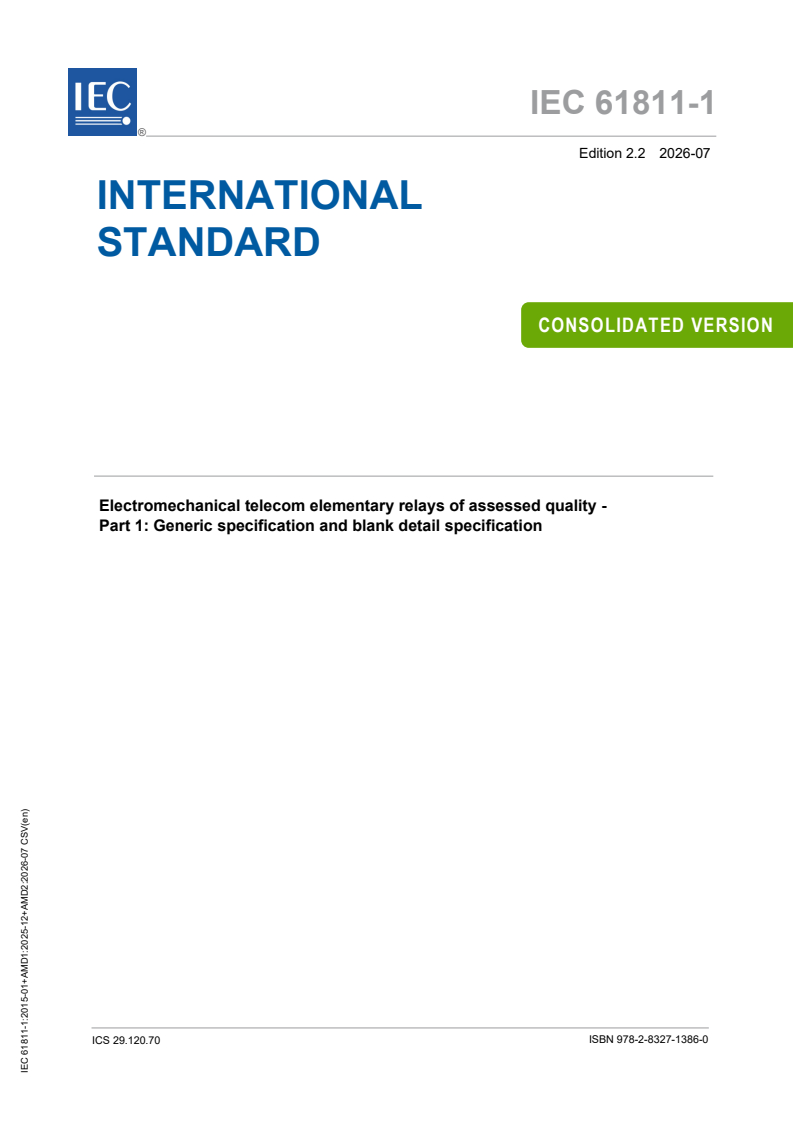
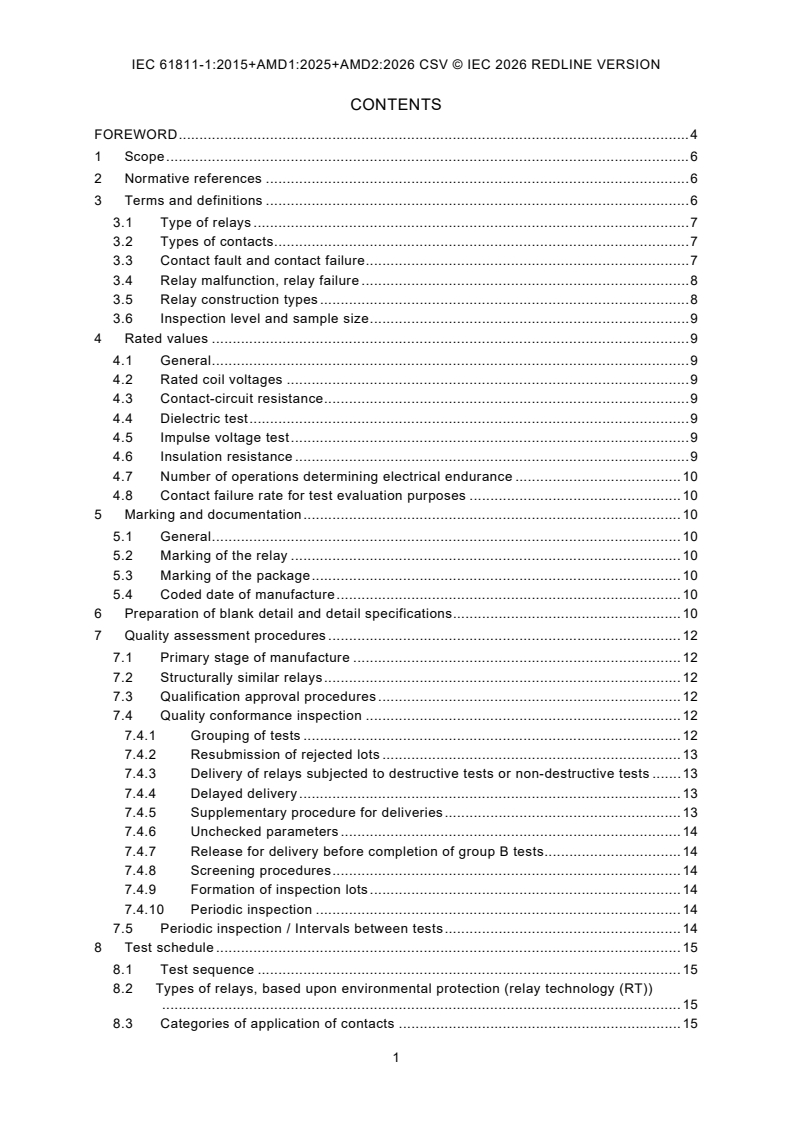
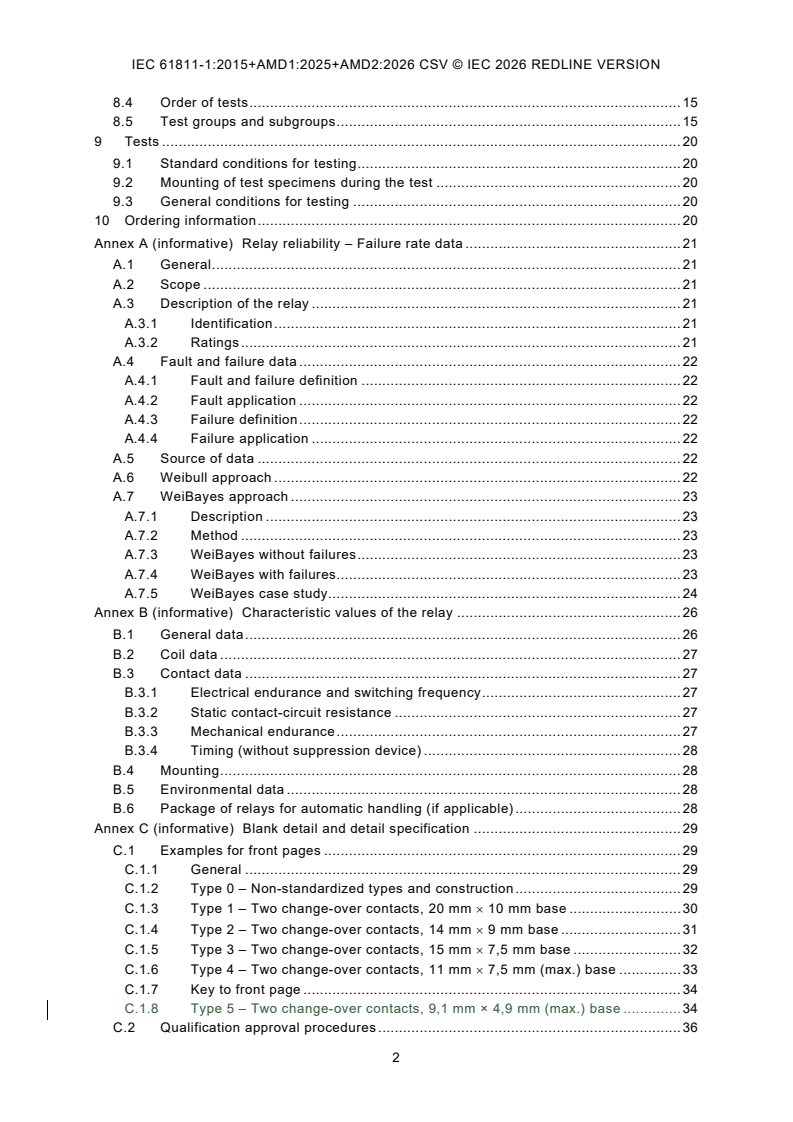
IEC 61811-1:2015+AMD1:2025+AMD2:2026 CSV - Electromechanical telecom elementary relays of assessed quality - Part 1: Generic specification and blank detail specification
IEC 61811-1:2015 - Electromechanical telecom elementary relays of assessed quality - Part 1: Generic specification and blank detail specification Released:1/28/2015
Overview
IEC 61811-1:2015 - Electromechanical telecom elementary relays of assessed quality - Part 1: Generic specification and blank detail specification - is the generic IEC standard that defines the structure, test methods and quality-assessment procedures for electromechanical relays intended for telecommunication applications. The standard consolidates requirements for telecom relays, selects appropriate test methods (from the IEC 61810 series and other sources), and provides blank detail-specification templates and basic test schedules to be used when preparing device-specific detail specifications.
This second edition cancels earlier IEC 61811 parts and constitutes a technical revision to create a single document for telecom relays and to update relevant normative references.
Key topics and technical requirements
The standard covers technical and quality topics including:
- Rated values and electrical characteristics: rated coil voltages, contact-circuit resistance, insulation and dielectric requirements, impulse-voltage tests and insulation resistance.
- Marking and documentation: relay and package marking, coded manufacture date and required documentation for ordering and certification.
- Test methods and schedules: selection and sequencing of tests, groupings (Group A, B, C), order of tests and standard test conditions.
- Quality assessment procedures: primary manufacture controls, qualification approval, quality conformance inspection, periodic inspection, sampling, lot formation and screening procedures.
- Endurance and reliability: electrical and mechanical endurance testing, number of operations for endurance classifications, contact failure-rate definitions and reliability data analysis (Annex A describes Weibull and WeiBayes approaches).
- Specification templates and characteristic data: blank detail-specification templates (Annex C) and recommended characteristic values for coil, contacts, mounting and environmental performance (Annex B).
Practical applications and who uses this standard
IEC 61811-1 is primarily aimed at:
- Relay manufacturers - to prepare product detail specifications, qualify relay designs and implement standardized test schedules.
- Telecom equipment designers and procurement teams - to select relays with assessed quality and ensure suppliers meet defined test and marking requirements.
- Test laboratories and quality-assurance engineers - to perform standardized tests, sample inspection and reliability assessments.
- Industrial users - where telecom-grade electromechanical relays are applied in control systems and require traceable quality and endurance data.
Using IEC 61811-1 helps reduce variability between suppliers, speeds qualification and supports consistent reliability and traceability in telecom and related industrial applications.
Related standards
- IEC 61810 series (relay general test methods and requirements) - IEC 61811-1 selects appropriate methods from these documents.
- Other referenced IEC normative documents (updated in this edition) as listed in the standard’s normative references.
Keywords: IEC 61811-1, electromechanical telecom relays, telecom relays, relay testing, relay quality assessment, IEC standards, generic specification, detail specification, relay reliability, WeiBayes, Weibull.
Relations
- Effective Date
- 05-Sep-2023
- Effective Date
- 05-Sep-2023
- Effective Date
- 05-Sep-2023
- Effective Date
- 05-Sep-2023
- Effective Date
- 05-Sep-2023
- Effective Date
- 05-Sep-2023
- Effective Date
- 05-Sep-2023
- Effective Date
- 05-Sep-2023
- Effective Date
- 05-Sep-2023
- Effective Date
- 26-Oct-2025
- Effective Date
- 15-Nov-2024
- Effective Date
- 05-Sep-2023
Buy Documents
IEC 61811-1:2015+AMD1:2025 CSV - Electromechanical telecom elementary relays of assessed quality - Part 1: Generic specification and blank detail specification Released:12/15/2025
IEC 61811-1:2015+AMD1:2025+AMD2:2026 CSV - Electromechanical telecom elementary relays of assessed quality - Part 1: Generic specification and blank detail specification
IEC 61811-1:2015 - Electromechanical telecom elementary relays of assessed quality - Part 1: Generic specification and blank detail specification Released:1/28/2015
Get Certified
Connect with accredited certification bodies for this standard

IMQ S.p.A. (Certification)
Italian electrical product certification.

SLG Prüf- und Zertifizierungs GmbH
German testing and certification body.

UL Solutions
Global safety science company with testing, inspection and certification.
Sponsored listings
Frequently Asked Questions
IEC 61811-1:2015 is a standard published by the International Electrotechnical Commission (IEC). Its full title is "Electromechanical telecom elementary relays of assessed quality - Part 1: Generic specification and blank detail specification". This standard covers: IEC 61811-1:2015 applies to electromechanical telecom elementary relays. Relays according to this standard are provided for the operation in telecommunication applications. However, as electromechanical elementary relays, they are also suitable for particular industrial and other applications. This standard selects from IEC 61810 series and other sources the appropriate methods of test to be used in detail specifications derived from this specification, and contains basic test schedules to be used in the preparation of such specifications in accordance with this standard. Detailed test schedules are contained in the detail specifications. This second edition of IEC 61811-1 cancels and replaces IEC 61811-1 published in 1999, IEC 61811-10 published in 2002, IEC 61811-11 published in 2002, IEC 61811-50 published in 2002, IEC 61811-51 published in 2002, IEC 61811-52 published in 2002, IEC 61811-53 published in 2002, IEC 61811-54 published in 2002, IEC 61811-55 published in 2002, and constitutes a technical revision. This edition includes the following significant technical changes with respect to the previous editions: a) to get one document for telecom relays; b) update all relevant references.
IEC 61811-1:2015 applies to electromechanical telecom elementary relays. Relays according to this standard are provided for the operation in telecommunication applications. However, as electromechanical elementary relays, they are also suitable for particular industrial and other applications. This standard selects from IEC 61810 series and other sources the appropriate methods of test to be used in detail specifications derived from this specification, and contains basic test schedules to be used in the preparation of such specifications in accordance with this standard. Detailed test schedules are contained in the detail specifications. This second edition of IEC 61811-1 cancels and replaces IEC 61811-1 published in 1999, IEC 61811-10 published in 2002, IEC 61811-11 published in 2002, IEC 61811-50 published in 2002, IEC 61811-51 published in 2002, IEC 61811-52 published in 2002, IEC 61811-53 published in 2002, IEC 61811-54 published in 2002, IEC 61811-55 published in 2002, and constitutes a technical revision. This edition includes the following significant technical changes with respect to the previous editions: a) to get one document for telecom relays; b) update all relevant references.
IEC 61811-1:2015 is classified under the following ICS (International Classification for Standards) categories: 29.120.70 - Relays. The ICS classification helps identify the subject area and facilitates finding related standards.
IEC 61811-1:2015 has the following relationships with other standards: It is inter standard links to IEC 61811-10:2002, IEC 61811-11:2002, IEC 61811-52:2002, IEC 61811-55:2002, IEC 61811-55:2002/COR1:2002, IEC 61811-50:2002, IEC 61811-53:2002, IEC 61811-51:2002, IEC 61811-54:2002, IEC 61811-1:2015/AMD2:2026, IEC 61811-1:2015/AMD1:2025, IEC 61811-1:1999. Understanding these relationships helps ensure you are using the most current and applicable version of the standard.
IEC 61811-1:2015 is available in PDF format for immediate download after purchase. The document can be added to your cart and obtained through the secure checkout process. Digital delivery ensures instant access to the complete standard document.
Standards Content (Sample)
IEC 61811-1 ®
Edition 2.1 2025-12
INTERNATIONAL
STANDARD
CONSOLIDATED VERSION
Electromechanical telecom elementary relays of assessed quality -
Part 1: Generic specification and blank detail specification
ICS 29.120.70 ISBN 978-2-8327-0956-6
All rights reserved. Unless otherwise specified, no part of this publication may be reproduced or utilized in any form or
by any means, electronic or mechanical, including photocopying and microfilm, without permission in writing from either
IEC or IEC's member National Committee in the country of the requester. If you have any questions about IEC copyright
or have an enquiry about obtaining additional rights to this publication, please contact the address below or your local
IEC member National Committee for further information.
IEC Secretariat Tel.: +41 22 919 02 11
3, rue de Varembé info@iec.ch
CH-1211 Geneva 20 www.iec.ch
Switzerland
About the IEC
The International Electrotechnical Commission (IEC) is the leading global organization that prepares and publishes
International Standards for all electrical, electronic and related technologies.
About IEC publications
The technical content of IEC publications is kept under constant review by the IEC. Please make sure that you have the
latest edition, a corrigendum or an amendment might have been published.
IEC publications search - IEC Products & Services Portal - products.iec.ch
webstore.iec.ch/advsearchform Discover our powerful search engine and read freely all the
The advanced search enables to find IEC publications by a publications previews, graphical symbols and the glossary.
variety of criteria (reference number, text, technical With a subscription you will always have access to up to date
committee, …). It also gives information on projects, content tailored to your needs.
replaced and withdrawn publications.
Electropedia - www.electropedia.org
The world's leading online dictionary on electrotechnology,
IEC Just Published - webstore.iec.ch/justpublished
Stay up to date on all new IEC publications. Just Published containing more than 22 500 terminological entries in English
details all new publications released. Available online and and French, with equivalent terms in 25 additional languages.
once a month by email. Also known as the International Electrotechnical Vocabulary
(IEV) online.
IEC Customer Service Centre - webstore.iec.ch/csc
If you wish to give us your feedback on this publication or
need further assistance, please contact the Customer
Service Centre: sales@iec.ch.
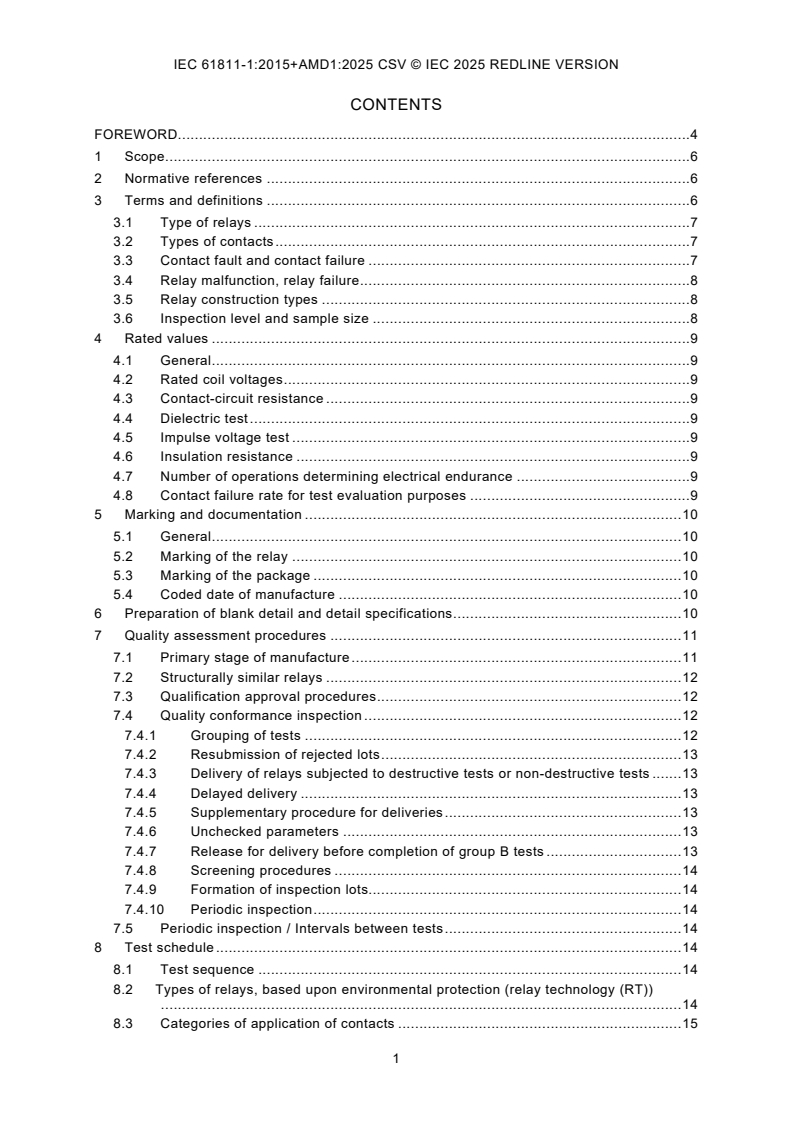
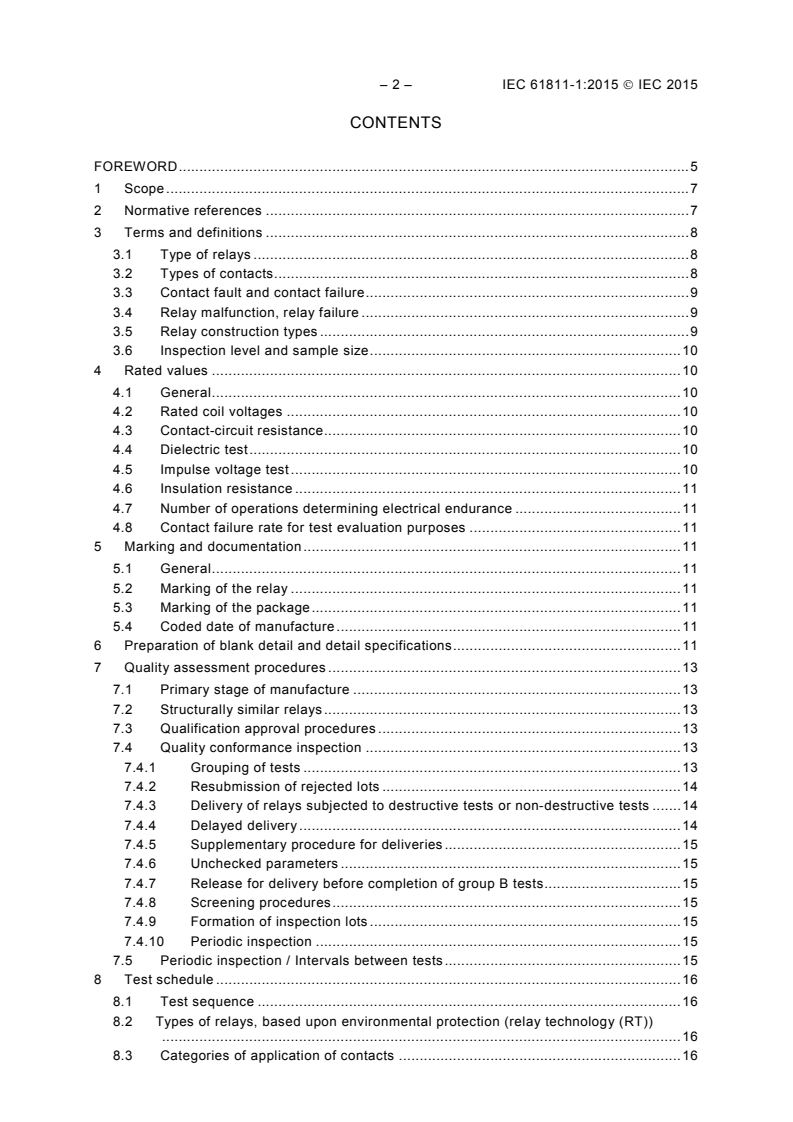
CONTENTS
FOREWORD. 4
1 Scope . 6
2 Normative references . 6
3 Terms and definitions . 6
3.1 Type of relays . 7
3.2 Types of contacts . 7
3.3 Contact fault and contact failure . 7
3.4 Relay malfunction, relay failure . 8
3.5 Relay construction types . 8
3.6 Inspection level and sample size . 8
4 Rated values . 9
4.1 General . 9
4.2 Rated coil voltages . 9
4.3 Contact-circuit resistance . 9
4.4 Dielectric test . 9
4.5 Impulse voltage test . 9
4.6 Insulation resistance . 9
4.7 Number of operations determining electrical endurance . 9
4.8 Contact failure rate for test evaluation purposes . 9
5 Marking and documentation . 10
5.1 General . 10
5.2 Marking of the relay . 10
5.3 Marking of the package . 10
5.4 Coded date of manufacture . 10
6 Preparation of blank detail and detail specifications . 10
7 Quality assessment procedures . 11
7.1 Primary stage of manufacture . 11
7.2 Structurally similar relays . 12
7.3 Qualification approval procedures . 12
7.4 Quality conformance inspection . 12
7.4.1 Grouping of tests . 12
7.4.2 Resubmission of rejected lots . 13
7.4.3 Delivery of relays subjected to destructive tests or non-destructive tests . 13
7.4.4 Delayed delivery . 13
7.4.5 Supplementary procedure for deliveries . 13
7.4.6 Unchecked parameters . 13
7.4.7 Release for delivery before completion of group B tests . 13
7.4.8 Screening procedures . 14
7.4.9 Formation of inspection lots. 14
7.4.10 Periodic inspection . 14
7.5 Periodic inspection / Intervals between tests . 14
8 Test schedule . 14
8.1 Test sequence . 14
8.2 Types of relays, based upon environmental protection (relay technology (RT))
........................................................................................................................... 14
8.3 Categories of application of contacts . 15
8.4 Order of tests . 15
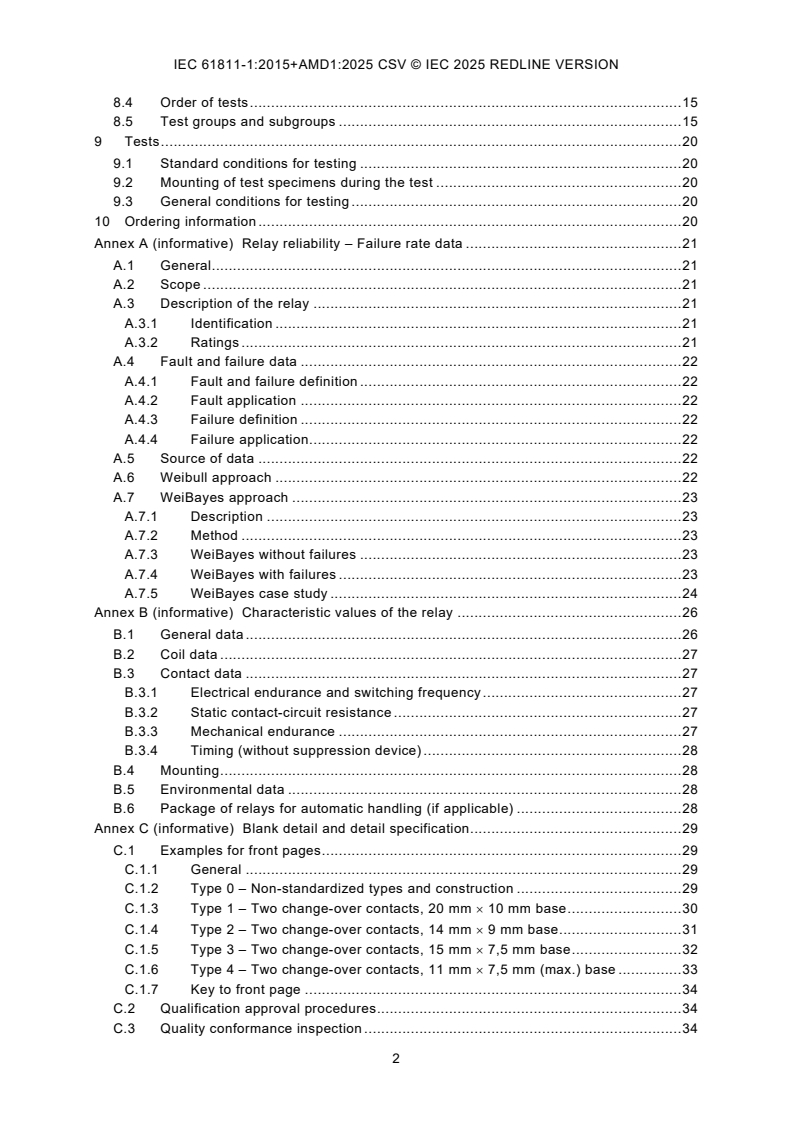
8.5 Test groups and subgroups . 15
9 Tests . 20
9.1 Standard conditions for testing . 20
9.2 Mounting of test specimens during the test . 20
9.3 General conditions for testing . 20
10 Ordering information . 20
Annex A (informative) Relay reliability – Failure rate data . 21
A.1 General . 21
A.2 Scope . 21
A.3 Description of the relay . 21
A.3.1 Identification . 21
A.3.2 Ratings . 21
A.4 Fault and failure data . 22
A.4.1 Fault and failure definition . 22
A.4.2 Fault application . 22
A.4.3 Failure definition . 22
A.4.4 Failure application . 22
A.5 Source of data . 22
A.6 Weibull approach . 22
A.7 WeiBayes approach . 23
A.7.1 Description . 23
A.7.2 Method . 23
A.7.3 WeiBayes without failures . 23
A.7.4 WeiBayes with failures . 23
A.7.5 WeiBayes case study . 24
Annex B (informative) Characteristic values of the relay . 26
B.1 General data . 26
B.2 Coil data . 27
B.3 Contact data . 27
B.3.1 Electrical endurance and switching frequency . 27
B.3.2 Static contact-circuit resistance . 27
B.3.3 Mechanical endurance . 27
B.3.4 Timing (without suppression device) . 28
B.4 Mounting . 28
B.5 Environmental data . 28
B.6 Package of relays for automatic handling (if applicable) . 28
Annex C (informative) Blank detail and detail specification . 29
C.1 Examples for front pages . 29
C.1.1 General . 29
C.1.2 Type 0 – Non-standardized types and construction . 29
C.1.3 Type 1 – Two change-over contacts, 20 mm × 10 mm base . 30
C.1.4 Type 2 – Two change-over contacts, 14 mm × 9 mm base . 31
C.1.5 Type 3 – Two change-over contacts, 15 mm × 7,5 mm base . 32
C.1.6 Type 4 – Two change-over contacts, 11 mm × 7,5 mm (max.) base . 33
C.1.7 Key to front page . 34
C.2 Qualification approval procedures . 34
C.3 Quality conformance inspection . 34
C.4 Formation of inspection lots . 35
Annex D (informative) Definition of subgroups . 53
Bibliography . 54
Figure A.1 – New compressor design WeiBayes versus old design . 25
Table 1 – Group A . 16
Table 2 – Group B . 17
Table 3 – Group C . 18
Table B.1 – Dielectric test voltages . 26
Table B.2 – Impulse test voltages . 26
Table B.3 – Coil data . 27
Table B.4 – Loads, contact-circuit resistance limits, switching cycles and frequencies
for electrical endurance and overload tests . 27
Table C.1 – Quality conformance inspection . 35
Table C.2 – Qualification approval . 50
Table C.3 – Industrial qualification . 52
INTERNATIONAL ELECTROTECHNICAL COMMISSION
______________
Electromechanical telecom elementary relays of assessed quality -
Part 1: Generic specification and blank detail specification
FOREWORD
1) The International Electrotechnical Commission (IEC) is a worldwide organization for standardization comprising
all national electrotechnical committees (IEC National Committees). The object of IEC is to promote
international co-operation on all questions concerning standardization in the electrical and electronic fields. To
this end and in addition to other activities, IEC publishes International Standards, Technical Specifications,
Technical Reports, Publicly Available Specifications (PAS) and Guides (hereafter referred to as “IEC
Publication(s)”). Their preparation is entrusted to technical committees; any IEC National Committee interested
in the subject dealt with may participate in this preparatory work. International, governmental and non-
governmental organizations liaising with the IEC also participate in this preparation. IEC collaborates closely
with the International Organization for Standardization (ISO) in accordance with conditions determined by
agreement between the two organizations.
2) The formal decisions or agreements of IEC on technical matters express, as nearly as possible, an international
consensus of opinion on the relevant subjects since each technical committee has representation from all
interested IEC National Committees.
3) IEC Publications have the form of recommendations for international use and are accepted by IEC National
Committees in that sense. While all reasonable efforts are made to ensure that the technical content of IEC
Publications is accurate, IEC cannot be held responsible for the way in which they are used or for any
misinterpretation by any end user.
4) In order to promote international uniformity, IEC National Committees undertake to apply IEC Publications
transparently to the maximum extent possible in their national and regional publications. Any divergence
between any IEC Publication and the corresponding national or regional publication shall be clearly indicated in
the latter.
5) IEC itself does not provide any attestation of conformity. Independent certification bodies provide conformity
assessment services and, in some areas, access to IEC marks of conformity. IEC is not responsible for any
services carried out by independent certification bodies.
6) All users should ensure that they have the latest edition of this publication.
7) No liability shall attach to IEC or its directors, employees, servants or agents including individual experts and
members of its technical committees and IEC National Committees for any personal injury, property damage or
other damage of any nature whatsoever, whether direct or indirect, or for costs (including legal fees) and
expenses arising out of the publication, use of, or reliance upon, this IEC Publication or any other IEC
Publications.
8) Attention is drawn to the Normative references cited in this publication. Use of the referenced publications is
indispensable for the correct application of this publication.
9) IEC draws attention to the possibility that the implementation of this document may involve the use of (a)
patent(s). IEC takes no position concerning the evidence, validity or applicability of any claimed patent rights in
respect thereof. As of the date of publication of this document, IEC had not received notice of (a) patent(s),
which may be required to implement this document. However, implementers are cautioned that this may not
represent the latest information, which may be obtained from the patent database available at
https://patents.iec.ch. IEC shall not be held responsible for identifying any or all such patent rights.
This consolidated version of the official IEC Standard and its amendment has been prepared
for user convenience.
IEC 61811-1 edition 2.1 contains the second edition (2015-01) [documents 94/379/FDIS and
94/383/RVD] and its amendment 1 (2025-12) [documents 94/1172/FDIS and 94/1180/RVD].
In this Redline version, a vertical line in the margin shows where the technical content is
modified by amendment 1. Additions are in green text, deletions are in strikethrough red text.
A separate Final version with all changes accepted is available in this publication.
International Standard IEC 61811-1 has been prepared by IEC technical committee 94: All-or-
nothing electrical relays.
This second edition of IEC 61811-1 cancels and replaces
• IEC 61811-1 published in 1999,
• IEC 61811-10 published in 2002,
• IEC 61811-11 published in 2002,
• IEC 61811-50 published in 2002,
• IEC 61811-51 published in 2002,
• IEC 61811-52 published in 2002,
• IEC 61811-53 published in 2002,
• IEC 61811-54 published in 2002,
• IEC 61811-55 published in 2002,
and constitutes a technical revision. This edition includes the following significant technical
changes with respect to the previous editions:
a) to get one document for telecom relays;
b) update all relevant references;
The text of this standard is based on the following documents:
FDIS Report on voting
94/379/FDIS 94/383/RVD
Full information on the voting for the approval of this standard can be found in the report on
voting indicated in the above table.
A list of all parts in the IEC 61811 series, published under the general title Electromechanical
telecom elementary relays of assessed quality, can be found on the IEC website.
Future standards in this series will carry the new general title as cited above. Titles of existing
standards in this series will be updated at the time of the next edition.
This publication was drafted in accordance with ISO/IEC Directives, Part 2.
The committee has decided that the contents of this document and its amendment will remain
unchanged until the stability date indicated on the IEC website under webstore.iec.ch in the
data related to the specific document. At this date, the document will be
– reconfirmed,
– withdrawn, or
– revised.
1 Scope
This part of IEC 61811 applies to electromechanical telecom elementary relays. Relays
according to this standard are provided for the operation in telecommunication applications.
However, as electromechanical elementary relays, they are also suitable for particular
industrial and other applications.
This standard selects from IEC 61810 series and other sources the appropriate methods of test to
be used in detail specifications derived from this specification, and contains basic test
schedules to be used in the preparation of such specifications in accordance with this standard.
Detailed test schedules are contained in the detail specifications.
2 Normative references
The following documents, in whole or in part, are normatively referenced in this document and
are indispensable for its application. For dated references, only the edition cited applies. For
undated references, the latest edition of the referenced document (including any
amendments) applies.
IEC 60062:2004, Marking codes for resistors and capacitors
IEC 60068-1:2013, Environmental testing – Part 1: General and guidance
IEC 60068-2-17:1994, Basic environmental testing procedures – Part 2-17: Tests – Test Q:
Sealing
IEC 60068-2-20:2008, Environmental testing – Part 2-20: Tests – Test T: Test methods for
solderability and resistance to soldering heat of devices with leads
IEC 60068-2-58:2004, Environmental testing – Part 2-58: Tests – Test Td: Test methods for
solderability, resistance to dissolution of metallization and to soldering heat of surface
mounting devices (SMD)
IEC 60410:1973, Sampling plans and procedures for inspection by attributes
IEC 60695-11-5:2004, Fire hazard testing – Test flames – Needle-flame test method –
Apparatus, confirmatory test arrangement and guidance
IEC 61810 (all parts), Electromechanical elementary relays
IEC 61810-1:2008, Electromechanical elementary relays – Part 1: General requirements
IEC 61810-2:2011, Electromechanical elementary relays – Part 2: Reliability
IEC 61810-7:2006, Electromechanical elementary relays – Part 7: Test and measurement
procedures
ISO 2859 (all parts), Sampling procedures for inspection by attributes
3 Terms and definitions
For the purposes of this document, the terms and definitions given in IEC 61810 series, as
well as the following apply.
3.1 Type of relays
The most frequent types of electromechanical telecom elementary relays are defined in 3.1.1,
3.1.2, 3.1.3 and 3.1.4.
3.1.1
bistable relay
electrical relay which, having responded to an energizing quantity and having changed its
condition, remains in that condition after the quantity has been removed; a further appropriate
energization is required to make it change its condition.
[SOURCE:IEC 60050-444:2002, 444-01-08]
3.1.2
monostable relay
electrical relay which, having responded to an energizing quantity and having changed its
condition, returns to its previous condition when that quantity is removed
[SOURCE: IEC 60050-444:2002, 444-01-07]
3.1.3
non-polarized relay
electrical relay, the change of condition of which does not depend upon the polarity of its
energizing quantity
[SOURCE: IEC 60050-444:2002, 444-01-10]
3.1.4
polarized relay
polarized elementary relay
electrical relay, the change of condition of which depends upon the polarity of its d.c.
energizing quantity
[SOURCE: IEC 60050-444:2002, 444-01-09; modified – In the definition, "elementary relay"
has been replaced by "electrical relay".]
3.2 Types of contacts
3.2.1
change-over break-before-make contact
change-over contact, one contact circuit of which breaks before the other makes
[SOURCE: IEC 60050-444:2002,444-04-21, modified – The definition has been reworded.]
3.2.2
change-over make-before-break contact
change-over contact, one contact circuit of which makes before the other breaks
[SOURCE: IEC 60050-444:2002, 444-04-20, modified – The definition has been reworded.]
3.3 Contact fault and contact failure
3.3.1
failure to make
failure caused when no sufficient contact is ensured
Note 1 to entry: This could be a not acceptable or excessive contact resistance exceeds the maximum value
stated in the detail specification as well a bouncing of the contact due to the lost of overtravel.
3.3.2
failure to break
failure caused when the current flows although it should not
Note 1 to entry: For example, This could be a contact welding/sticking as well as a delayed contact operate or
release contact. Also, it is assumed that the contact does not open, when the resistance of an open contact
assembly falls below the specified minimum value stated in the detail specification
3.3.3
malfunction
single event when an item does not perform a required function
3.3.4
contact failure
occurrence of break and/or make malfunctions of a contact under test, exceeding a specified
number
3.4 Relay malfunction, relay failure
3.4.1
relay malfunction
the state of a relay characterized by the inability to perform a required function
Note 1 to entry: A fault persists for a limited time after which the relay recovers the ability to perform a required
function without being subjected to any corrective maintenance.
3.4.2
failure
termination of the ability of an item to perform a required function
[SOURCE:IEC 60050-191:1990, 191-04-01]
3.5 Relay construction types
3.5.1
type 0
non-standardized types and construction
3.5.2
type 1
two change-over contacts, 20 mm × 10 mm base
3.5.3
type 2
two change-over contacts, 14 mm × 9 mm base
3.5.4
type 3
two change-over contacts, 15 mm × 7,5 mm base
3.5.5
type 4
two change-over contacts, 11 mm × 7,5 mm (max.) base
3.6 Inspection level and sample size
3.6.1
IL
Special Inspection Level in accordance to the ISO 2859 series
3.6.2
AQL
Acceptance Quality Limit in accordance to the ISO 2859 series
3.6.3
Lot-by-lot
Period: inspection lot refers to the production volume of not more than one week
4 Rated values
4.1 General
The following subclauses contain preferred values applicable to electromechanical telecom
elementary relays.
4.2 Rated coil voltages
Preferred values d.c.: 1,5 V; 3 V; 4,5 V; 5 V; 6 V; 9 V; 12 V; 24 V; 48 V or 60 V.
4.3 Contact-circuit resistance
a) Preferred values in initial condition: maximum 50 mΩ; 100 mΩ or 200 mΩ.
b) Preferred values during/after tests: maximum 0,5 Ω; 1 Ω; 5 Ω; 10 Ω; 20 Ω or 100 Ω.
c) Preferred value for detecting faults due to non-opening of the contact circuit during tests:
minimum 100 kΩ.
d) Voltage for detecting faults due to non-opening of the contact circuit during tests;
preferred maximum values: 0,03 V; 5 V; 6 V; 12 V; 24 V; 48 V or 60 V d.c.
e) Difference of contact-circuit resistance between different contact circuits in the same relay,
preferred value: maximum 100 mΩ (initial condition).
4.4 Dielectric test
Preferred values in initial condition between opened contact circuits, between separate
contact circuits, between contact circuits and coil(s), between all conductive parts and mass
(if applicable) in accordance with IEC 61810-1.
a) Preferred voltages: 0,5 kV; 0,8 kV; 1,5 kV; 2,5 kV a.c.
b) Preferred duration: 1 s or 60 s
4.5 Impulse voltage test
a) Preferred voltages: 0,5 kV; 1,0 kV; 1,5 kV; 2 kV or 2,5 kV.
b) Preferred waveform: 0,5 µs/700 µs, 1,2 µs/50 µs or 10 µs/700 µs.
c) Preferred number of pulses (alternate positive and negative pulses): 10.
d) Preferred frequency of pulses: 2 pulses/min or 4 pulses/min.
4.6 Insulation resistance
Preferred value: 1 000 MΩ at 500 V d.c. initial value.
4.7 Number of operations determining electrical endurance
Preferred values: 10 000; 20 000; 50 000; 100 000; 200 000; 500 000; 700 000; 1 000 000;
1 600 000; 2 000 000; 5 000 000; 10 000 000; 20 000 000 or 30 000 000.
4.8 Contact failure rate for test evaluation purposes
–5 –6 –7 –8
Preferred values: maximum 10 , 10 , 10 , 10 /contact/cycle.
5 Marking and documentation
5.1 General
Relays and their package supplied in accordance with detail specifications covered by this
sectional specification shall be marked as follows:
5.2 Marking of the relay
a) Manufacturer's name, logo or trade mark.
b) Relay type and variant code.
c) Coded date of manufacture, in terms of year/week according to 5.4.
5.3 Marking of the package
a) Manufacturer's name, logo or trade mark.
b) Relay type and variant code.
c) Manufacturer's batch identification code.
d) Detail specification reference if not marked on the relay.
e) Quantity.
5.4 Coded date of manufacture
The marking system shall use four figures as specified in 6.2 of IEC 60062:2004. The first two
figures shall be the last two figures of the year and the last two figures the numbering of the
week.
EXAMPLE Fifth week of 1994 = 9405.
If stated in the detail specification only, the first two figures shall be the last two figures of the
year, the month is represented by the next two figures and the day of the month is
represented by the last two figures.
EXAMPLE 20th June 1994 = 940620.
6 Preparation of blank detail and detail specifications
Blank detail specifications shall conform to the test schedules given in Table 1 of this
specification and the related explanations.
The blank specification as given in Annex C shall be used for the preparation and
characteristic values of the relay shall be included as given in Annex B. The values shall be
adjusted by the manufacturer as appropriate.
Blank detail specifications shall give the following information or call for its inclusion in the
detail specification:
a) Identification of the detail specification.
b) Identification of the relay and information on its applications; identification shall be
provided by such properties as size, sealing, whether monostable or bistable, polarized or
not, or other characteristics required for identification, contact operating range and
temperature range.
c) Outline drawing of the relay and key dimensions; variants, such as for terminals, may be
given in an annex to the detail specification.
Customer packaging requirements for automatic handling.
d) Reference data of the relay.
1) A limited number of values is required on the front page to describe the overall
performance of the relay.
2) Full information in conformance with Clause 4 and IEC 61810-1 shall be added on one
of the subsequent pages. Rated values preferably should be those listed therein.
Where tests refer to rated values, this shall be indicated with each test. Where tests
are to be performed at other than rated values, the test values shall be indicated and
clearly distinguished from the rated values.
e) Normative references.
Reference shall be made to IEC 61810 series. When reference to further documents is
necessary, such documents shall be listed with their full titles, year of edition and, unless
common knowledge, the source from which they can be obtained.
f) Assessment level.
Table 1 of this specification contains one test schedule. If additional tests not listed there
have been added, this shall be stated.
g) Periodicity of tests.
h) Formation of inspection lots, if predictable in the sense of 7.4.9 and 8.1.
i) Order of tests, if deviating from 8.4.
j) General test conditions, if deviating from 4.5 of IEC 61810-7:2006.
k) Qualification approval test schedule.
l) Quality conformance test schedule.
For each group of tests, the final measurements and post-test requirements specified in
each of them may be summarized and stated at the end of the subgroup.
It shall be stated that samples subjected to destructive tests (D) shall not be released for
delivery.
If application of SPC or ppm approach is required, this should be provided the
manufacturer.
m) Specification of IL numbers (groups A and B) and sample sizes (group C).
n) Specification of AQL numbers (groups A and B) and acceptable numbers of defectives
(group C).
o) Marking of package and/or relays beyond those listed in this specification, if necessary.
p) Ordering information
Additional information such as curves and drawings may be given in an annex to the detail
specification. Such information is not required to be verified for test purposes.
When preparing blank detail or detail specifications, the following procedures should be
followed:
– select the tests to be performed from Table 1 of this sectional specification;
– if necessary, add any other necessary tests, required or not specified in IEC 61810-7.
Examples for front pages of detail specifications are given in Annex C.
7 Quality assessment procedures
7.1 Primary stage of manufacture
The primary stage of manufacture is the first process subsequent to the manufacture of
finished parts and subassemblies of the relay.
NOTE A subassembly is understood to mean here the permanent assembly of two or more piece parts.
Important manufacturing steps are as follows:
a) fabrication, heat treatment and plating of the component parts of the relay;
b) coil winding;
c) assembling of the electrical and electromechanical parts;
d) adjustment of the relay contacts, if applicable;
e) high-temperature drying, gas backfilling and sealing of the relay, if applicable;
f) final measurements and periodic inspection of test groups A to C.
7.2 Structurally similar relays
Relays are considered structurally similar if they have no differences in design other than:
a) wire diameter and of windings;
b) types, numbers and material of contacts;
c) rated coil and/or contact voltage(s);
d) mounting and terminal variants within the limits prescribed in the data sheet or
specification.
e) biasing of the input circuit parts.
7.3 Qualification approval procedures
Qualification approval tests shall include all the tests prescribed in the detail specification and
shall be performed by a schedule specifically prescribed in the detail specification.
The number of specimens for each subgroup is specified in the blank detail specification. As a
general rule, a minimum of five specimens are required for each group of tests.
7.4 Quality conformance inspection
7.4.1 Grouping of tests
7.4.1.1 General
The purpose of grouping tests is to combine in one group all those tests which are of equal
importance to the assessment of the usefulness of the relay. Therefore, each test in the same
subgroup gets the same inspection level and acceptable quality level range, and therefore
further criteria for the allocation of tests to a group are the destructiveness of the test, the
duration of the test and the relation to the fabrication or design.
The frequency of testing takes account of the complexity, duration and overall cost of the test,
and the effect of releasing non-conforming relays.
Characteristics tested at the same frequency and having similar importance to the function of
the relay are combined into the same subgroup.
7.4.1.2 Division into groups (see Annex D)
Lot-by-lot tests are divided into two groups.
a) Group A, covering the visual and dimensional inspection of the relays and non-destructive
short-duration electrical and mechanical test procedures which are employed to assess
the principal characteristics of the relays determined mainly by the fabrication process, as
those which are of a design nature and of vital importance.
b) Group B, covering both destructive and non-destructive test procedures, with a duration of
up to about one week, which are employed to assess the characteristics of the relays
determined mainly by the fabrication process, as those which are of a design nature and
of vital or major importance.
The periodic tests are generally brought together and designated group C tests. Tests in this
group comprise both destructive and non-destructive test procedures that are applied
periodically to confirm that certain characteristics, in addition to those already included in
groups A and B, are being maintained. These characteristics may be related either to design
or to the fabrication process and can be of vital, major and minor importance to the function of
the relay.
If appropriate, a group D may be included containing additional tests required for the
maintenance of qualification approval.
7.4.1.3 Division into subgroups
Groups can be further subdivided into subgroups (see Annex D). Division is made according
to the relative importance (vital, major, minor) of the feature to the overall function of the relay
and the frequency of testing; thus the subgroup to which the test should be allocated is
determined.
The sectional and/or blank detail specification shall show the order in which the tests or
conditions in the subgroup shall be carried out where this order may affect the test results.
The blank detail specification shall also indicate wherever any particular order of testing in
any subgroup is to be observed. Where a subgroup contains a destructive test, this shall
either be stated in full or the symbol "D" shall be placed alongside the title of the subgroup in
the schedule of inspection requirements in the blank detail specification.
7.4.2 Resubmission of rejected lots
No requirements at present.
7.4.3 Delivery of relays subjected to destructive tests or non-destructive tests
Relays subjected to destructive tests shall not be included in the lot for delivery. Relays
subjected to non-destructive tests may be delivered provided they are re-tested to group A
requirements and satisfy them.
7.4.4 Delayed delivery
Relays which have been held by the manufacturer for a period exceeding 12 months following
acceptance inspection, shall be re-inspected as prescribed in the detail specification, unless a
different period is specified therein.
If this has been done for the complete lot, no further retesting before delivery is needed for
another period of one year or as otherwise specified in the detail specification.
7.4.5 Supplementary procedure for deliveries
When this has been nationally recognized, manufacturers may, at their discretion, supply
relays that have met a higher assessment level against orders for a lower assessment level.
7.4.6 Unchecked parameters
When supplementary information is given in detail specifications, this shall not be the subject
of inspection.
7.4.7 Release for delivery before completion of group B tests
When the conditions of IEC 60410 for reduced inspection have been satisfied for all group B
tests, the manufacturer is permitted to release the relays before the completion of such tests.
7.4.8 Screening procedures
When screening is specified in the detail specification or the purchase order, it is to be
applied to all devices in the production lot prior to the formation of samples for quality
conformance testing (lot-by-lot and periodic).
The test shall be performed in the given order. When, however, part of the screening
sequence is already performed during production and in the same sequence, it need not be
repeated.
Any device found defective during any of the tests shall be removed and not considered as
part of the production lot for subsequent sampling purposes.
When the number of defectives at the end of the screening exceeds 10 % of the size of the
production lot, this lot shall be rejected for the intended application of the appropriate test
schedule. If not contradictory, the lot may be used for a lower specified application.
7.4.9 Formation of inspection lots
Inspection lots submitted to groups A and B acceptance tests shall be formed in accordance
with 8.5 and with the sampling plans and procedures given in IEC 60410, except where
production is too infrequent or too small for sampling plans to apply; in these cases inspection
shall be 100 %.
When sampling is carried out in accordance with IEC 60410, the percent defective concept
only shall be used. Stratified or representative sampling shall always be used to include all
production lines and structurally similar relays in proportion to their respective quantities in
the lot. Exceptions from proportionality may become necessary and shall be stated in the
detail specification. Specimens shall be as representative as possible of the production.
The determination basis for the sample sizes from continuous production lines shall be stated
in the blank detail specification.
7.4.10 Periodic inspection
Fixed sample sizes for group C inspection shall be taken from a lot (or lots) which has (have)
passed groups A and B inspection during or at the end of the specified reference period.
7.5 Periodic inspection / Intervals between tests
– Subgroups A4, B1 and B2: minimum once a week.
– Subgroups C1 and C2: at least once a year.
– Subgroups C4 to C6: at least once every two years.
8 Test schedule
8.1 Test sequence
The order of tests in each subgroup of Table 1, and in the derived schedule in any
corresponding blank detail specification, is mandatory unless a specific statement to the
contrary is given. The sealing test shall always be the final test.
8.2 Types of relays, based upon environmental protection (relay technology (RT))
RT 0 unenclosed relay
RT I dust-protected relay
RT II flux-proof relay
RT III wash-tight relay
RT IV sealed relay
RT V hermetically sealed relay
The definitions of p
...
IEC 61811-1 ®
Edition 2.2 2026-07
INTERNATIONAL
STANDARD
CONSOLIDATED VERSION
Electromechanical telecom elementary relays of assessed quality -
Part 1: Generic specification and blank detail specification
ICS 29.120.70 ISBN 978-2-8327-1386-0
All rights reserved. Unless otherwise specified, no part of this publication may be reproduced or utilized in any form or
by any means, electronic or mechanical, including photocopying and microfilm, without permission in writing from either
IEC or IEC's member National Committee in the country of the requester. If you have any questions about IEC copyright
or have an enquiry about obtaining additional rights to this publication, please contact the address below or your local
IEC member National Committee for further information.
IEC Secretariat Tel.: +41 22 919 02 11
3, rue de Varembé info@iec.ch
CH-1211 Geneva 20 www.iec.ch
Switzerland
About the IEC
The International Electrotechnical Commission (IEC) is the leading global organization that prepares and publishes
International Standards for all electrical, electronic and related technologies.
About IEC publications
The technical content of IEC publications is kept under constant review by the IEC. Please make sure that you have the
latest edition, a corrigendum or an amendment might have been published.
IEC publications search - IEC Products & Services Portal - products.iec.ch
webstore.iec.ch/advsearchform Discover our powerful search engine and read freely all the
The advanced search enables to find IEC publications by a publications previews, graphical symbols and the glossary.
variety of criteria (reference number, text, technical With a subscription you will always have access to up to date
committee, …). It also gives information on projects, content tailored to your needs.
replaced and withdrawn publications.
Electropedia - www.electropedia.org
The world's leading online dictionary on electrotechnology,
IEC Just Published - webstore.iec.ch/justpublished
Stay up to date on all new IEC publications. Just Published containing more than 22 500 terminological entries in English
details all new publications released. Available online and and French, with equivalent terms in 25 additional languages.
once a month by email. Also known as the International Electrotechnical Vocabulary
(IEV) online.
IEC Customer Service Centre - webstore.iec.ch/csc
If you wish to give us your feedback on this publication or
need further assistance, please contact the Customer
Service Centre: sales@iec.ch.
CONTENTS
FOREWORD . 4
1 Scope . 6
2 Normative references . 6
3 Terms and definitions . 6
3.1 Type of relays . 7
3.2 Types of contacts . 7
3.3 Contact fault and contact failure . 7
3.4 Relay malfunction, relay failure . 8
3.5 Relay construction types . 8
3.6 Inspection level and sample size . 9
4 Rated values . 9
4.1 General . 9
4.2 Rated coil voltages . 9
4.3 Contact-circuit resistance . 9
4.4 Dielectric test . 9
4.5 Impulse voltage test . 9
4.6 Insulation resistance . 9
4.7 Number of operations determining electrical endurance . 10
4.8 Contact failure rate for test evaluation purposes . 10
5 Marking and documentation . 10
5.1 General . 10
5.2 Marking of the relay . 10
5.3 Marking of the package . 10
5.4 Coded date of manufacture . 10
6 Preparation of blank detail and detail specifications . 10
7 Quality assessment procedures . 12
7.1 Primary stage of manufacture . 12
7.2 Structurally similar relays . 12
7.3 Qualification approval procedures . 12
7.4 Quality conformance inspection . 12
7.4.1 Grouping of tests . 12
7.4.2 Resubmission of rejected lots . 13
7.4.3 Delivery of relays subjected to destructive tests or non-destructive tests . 13
7.4.4 Delayed delivery . 13
7.4.5 Supplementary procedure for deliveries . 13
7.4.6 Unchecked parameters . 14
7.4.7 Release for delivery before completion of group B tests. 14
7.4.8 Screening procedures . 14
7.4.9 Formation of inspection lots . 14
7.4.10 Periodic inspection . 14
7.5 Periodic inspection / Intervals between tests . 14
8 Test schedule . 15
8.1 Test sequence . 15
8.2 Types of relays, based upon environmental protection (relay technology (RT))
............................................................................................................................. 15
8.3 Categories of application of contacts . 15
8.4 Order of tests . 15
8.5 Test groups and subgroups . 15
9 Tests . 20
9.1 Standard conditions for testing . 20
9.2 Mounting of test specimens during the test . 20
9.3 General conditions for testing . 20
10 Ordering information . 20
Annex A (informative) Relay reliability – Failure rate data . 21
A.1 General . 21
A.2 Scope . 21
A.3 Description of the relay . 21
A.3.1 Identification . 21
A.3.2 Ratings . 21
A.4 Fault and failure data . 22
A.4.1 Fault and failure definition . 22
A.4.2 Fault application . 22
A.4.3 Failure definition . 22
A.4.4 Failure application . 22
A.5 Source of data . 22
A.6 Weibull approach . 22
A.7 WeiBayes approach . 23
A.7.1 Description . 23
A.7.2 Method . 23
A.7.3 WeiBayes without failures . 23
A.7.4 WeiBayes with failures. 23
A.7.5 WeiBayes case study. 24
Annex B (informative) Characteristic values of the relay . 26
B.1 General data . 26
B.2 Coil data . 27
B.3 Contact data . 27
B.3.1 Electrical endurance and switching frequency . 27
B.3.2 Static contact-circuit resistance . 27
B.3.3 Mechanical endurance . 27
B.3.4 Timing (without suppression device) . 28
B.4 Mounting . 28
B.5 Environmental data . 28
B.6 Package of relays for automatic handling (if applicable) . 28
Annex C (informative) Blank detail and detail specification . 29
C.1 Examples for front pages . 29
C.1.1 General . 29
C.1.2 Type 0 – Non-standardized types and construction . 29
C.1.3 Type 1 – Two change-over contacts, 20 mm × 10 mm base . 30
C.1.4 Type 2 – Two change-over contacts, 14 mm × 9 mm base . 31
C.1.5 Type 3 – Two change-over contacts, 15 mm × 7,5 mm base . 32
C.1.6 Type 4 – Two change-over contacts, 11 mm × 7,5 mm (max.) base . 33
C.1.7 Key to front page . 34
C.1.8 Type 5 – Two change-over contacts, 9,1 mm × 4,9 mm (max.) base . 34
C.2 Qualification approval procedures . 36
C.3 Quality conformance inspection . 36
C.4 Formation of inspection lots . 36
Annex D (informative) Definition of subgroups . 55
Bibliography . 56
Figure A.1 – New compressor design WeiBayes versus old design . 25
Table 1 – Group A . 16
Table 2 – Group B . 17
Table 3 – Group C . 18
Table B.1 – Dielectric test voltages . 26
Table B.2 – Impulse test voltages . 26
Table B.3 – Coil data . 27
Table B.4 – Loads, contact-circuit resistance limits, switching cycles and frequencies
for electrical endurance and overload tests . 27
Table C.1 – Quality conformance inspection . 37
Table C.2 – Qualification approval . 52
Table C.3 – Industrial qualification . 54
INTERNATIONAL ELECTROTECHNICAL COMMISSION
______________
Electromechanical telecom elementary relays of assessed quality -
Part 1: Generic specification and blank detail specification
FOREWORD
1) The International Electrotechnical Commission (IEC) is a worldwide organization for standardization comprising
all national electrotechnical committees (IEC National Committees). The object of IEC is to promote
international co-operation on all questions concerning standardization in the electrical and electronic fields. To
this end and in addition to other activities, IEC publishes International Standards, Technical Specifications,
Technical Reports, Publicly Available Specifications (PAS) and Guides (hereafter referred to as “IEC
Publication(s)”). Their preparation is entrusted to technical committees; any IEC National Committee interested
in the subject dealt with may participate in this preparatory work. International, governmental and non-
governmental organizations liaising with the IEC also participate in this preparation. IEC collaborates closely
with the International Organization for Standardization (ISO) in accordance with conditions determined by
agreement between the two organizations.
2) The formal decisions or agreements of IEC on technical matters express, as nearly as possible, an international
consensus of opinion on the relevant subjects since each technical committee has representation from all
interested IEC National Committees.
3) IEC Publications have the form of recommendations for international use and are accepted by IEC National
Committees in that sense. While all reasonable efforts are made to ensure that the technical content of IEC
Publications is accurate, IEC cannot be held responsible for the way in which they are used or for any
misinterpretation by any end user.
4) In order to promote international uniformity, IEC National Committees undertake to apply IEC Publications
transparently to the maximum extent possible in their national and regional publications. Any divergence
between any IEC Publication and the corresponding national or regional publication shall be clearly indicated in
the latter.
5) IEC itself does not provide any attestation of conformity. Independent certification bodies provide conformity
assessment services and, in some areas, access to IEC marks of conformity. IEC is not responsible for any
services carried out by independent certification bodies.
6) All users should ensure that they have the latest edition of this publication.
7) No liability shall attach to IEC or its directors, employees, servants or agents including individual experts and
members of its technical committees and IEC National Committees for any personal injury, property damage or
other damage of any nature whatsoever, whether direct or indirect, or for costs (including legal fees) and
expenses arising out of the publication, use of, or reliance upon, this IEC Publication or any other IEC
Publications.
8) Attention is drawn to the Normative references cited in this publication. Use of the referenced publications is
indispensable for the correct application of this publication.
9) IEC draws attention to the possibility that the implementation of this document may involve the use of (a)
patent(s). IEC takes no position concerning the evidence, validity or applicability of any claimed patent rights in
respect thereof. As of the date of publication of this document, IEC had not received notice of (a) patent(s),
which may be required to implement this document. However, implementers are cautioned that this may not
represent the latest information, which may be obtained from the patent database available at
https://patents.iec.ch. IEC shall not be held responsible for identifying any or all such patent rights.
This consolidated version of the official IEC Standard and its amendments has been prepared
for user convenience.
IEC 61811-1 edition 2.2 contains the second edition (2015-01) [documents 94/379/FDIS and
94/383/RVD], its amendment 1 (2025-12) [documents 94/1172/FDIS and 94/1180/RVD] and
its amendment 2 (2026-07) [documents 94/1175/CDV and 94/1207A/RVC].
In this Redline version, a vertical line in the margin shows where the technical content is
modified by amendments 1 and 2. Additions are in green text, deletions are in strikethrough
red text. A separate Final version with all changes accepted is available in this publication.
International Standard IEC 61811-1 has been prepared by IEC technical committee 94: All-or-
nothing electrical relays.
This second edition of IEC 61811-1 cancels and replaces
• IEC 61811-1 published in 1999,
• IEC 61811-10 published in 2002,
• IEC 61811-11 published in 2002,
• IEC 61811-50 published in 2002,
• IEC 61811-51 published in 2002,
• IEC 61811-52 published in 2002,
• IEC 61811-53 published in 2002,
• IEC 61811-54 published in 2002,
• IEC 61811-55 published in 2002,
and constitutes a technical revision. This edition includes the following significant technical
changes with respect to the previous editions:
a) to get one document for telecom relays;
b) update all relevant references;
The text of this standard is based on the following documents:
FDIS Report on voting
94/379/FDIS 94/383/RVD
Full information on the voting for the approval of this standard can be found in the report on
voting indicated in the above table.
A list of all parts in the IEC 61811 series, published under the general title Electromechanical
telecom elementary relays of assessed quality, can be found on the IEC website.
Future standards in this series will carry the new general title as cited above. Titles of existing
standards in this series will be updated at the time of the next edition.
This publication was drafted in accordance with ISO/IEC Directives, Part 2.
The committee has decided that the contents of this document and its amendments will
remain unchanged until the stability date indicated on the IEC website under webstore.iec.ch
in the data related to the specific document. At this date, the document will be
– reconfirmed,
– withdrawn, or
– revised.
1 Scope
This part of IEC 61811 applies to electromechanical telecom elementary relays. Relays
according to this standard are provided for the operation in telecommunication applications.
However, as electromechanical elementary relays, they are also suitable for particular
industrial and other applications.
This standard selects from IEC 61810 series and other sources the appropriate methods of test to
be used in detail specifications derived from this specification, and contains basic test
schedules to be used in the preparation of such specifications in accordance with this standard.
Detailed test schedules are contained in the detail specifications.
2 Normative references
The following documents, in whole or in part, are normatively referenced in this document and
are indispensable for its application. For dated references, only the edition cited applies. For
undated references, the latest edition of the referenced document (including any
amendments) applies.
IEC 60062:2004, Marking codes for resistors and capacitors
IEC 60068-1:2013, Environmental testing – Part 1: General and guidance
IEC 60068-2-17:1994, Basic environmental testing procedures – Part 2-17: Tests – Test Q:
Sealing
IEC 60068-2-20:2008, Environmental testing – Part 2-20: Tests – Test T: Test methods for
solderability and resistance to soldering heat of devices with leads
IEC 60068-2-58:2004, Environmental testing – Part 2-58: Tests – Test Td: Test methods for
solderability, resistance to dissolution of metallization and to soldering heat of surface
mounting devices (SMD)
IEC 60410:1973, Sampling plans and procedures for inspection by attributes
IEC 60695-11-5:2004, Fire hazard testing – Test flames – Needle-flame test method –
Apparatus, confirmatory test arrangement and guidance
IEC 61810 (all parts), Electromechanical elementary relays
IEC 61810-1:2008, Electromechanical elementary relays – Part 1: General requirements
IEC 61810-2:2011, Electromechanical elementary relays – Part 2: Reliability
IEC 61810-7:2006, Electromechanical elementary relays – Part 7: Test and measurement
procedures
ISO 2859 (all parts), Sampling procedures for inspection by attributes
3 Terms and definitions
For the purposes of this document, the terms and definitions given in IEC 61810 series, as
well as the following apply.
3.1 Type of relays
The most frequent types of electromechanical telecom elementary relays are defined in 3.1.1,
3.1.2, 3.1.3 and 3.1.4.
3.1.1
bistable relay
electrical relay which, having responded to an energizing quantity and having changed its
condition, remains in that condition after the quantity has been removed; a further appropriate
energization is required to make it change its condition.
[SOURCE:IEC 60050-444:2002, 444-01-08]
3.1.2
monostable relay
electrical relay which, having responded to an energizing quantity and having changed its
condition, returns to its previous condition when that quantity is removed
[SOURCE: IEC 60050-444:2002, 444-01-07]
3.1.3
non-polarized relay
electrical relay, the change of condition of which does not depend upon the polarity of its
energizing quantity
[SOURCE: IEC 60050-444:2002, 444-01-10]
3.1.4
polarized relay
polarized elementary relay
electrical relay, the change of condition of which depends upon the polarity of its d.c.
energizing quantity
[SOURCE: IEC 60050-444:2002, 444-01-09; modified – In the definition, "elementary relay"
has been replaced by "electrical relay".]
3.2 Types of contacts
3.2.1
change-over break-before-make contact
change-over contact, one contact circuit of which breaks before the other makes
[SOURCE: IEC 60050-444:2002,444-04-21, modified – The definition has been reworded.]
3.2.2
change-over make-before-break contact
change-over contact, one contact circuit of which makes before the other breaks
[SOURCE: IEC 60050-444:2002, 444-04-20, modified – The definition has been reworded.]
3.3 Contact fault and contact failure
3.3.1
failure to make
failure caused when no sufficient contact is ensured
Note 1 to entry: This could be a not acceptable or excessive contact resistance exceeds the maximum value
stated in the detail specification as well a bouncing of the contact due to the lost of overtravel.
3.3.2
failure to break
failure caused when the current flows although it should not
Note 1 to entry: For example, This could be a contact welding/sticking as well as a delayed contact operate or
release contact. Also, it is assumed that the contact does not open, when the resistance of an open contact
assembly falls below the specified minimum value stated in the detail specification
3.3.3
malfunction
single event when an item does not perform a required function
3.3.4
contact failure
occurrence of break and/or make malfunctions of a contact under test, exceeding a specified
number
3.4 Relay malfunction, relay failure
3.4.1
relay malfunction
the state of a relay characterized by the inability to perform a required function
Note 1 to entry: A fault persists for a limited time after which the relay recovers the ability to perform a required
function without being subjected to any corrective maintenance.
3.4.2
failure
termination of the ability of an item to perform a required function
[SOURCE:IEC 60050-191:1990, 191-04-01]
3.5 Relay construction types
3.5.1
type 0
non-standardized types and construction
3.5.2
type 1
two change-over contacts, 20 mm × 10 mm base
3.5.3
type 2
two change-over contacts, 14 mm × 9 mm base
3.5.4
type 3
two change-over contacts, 15 mm × 7,5 mm base
3.5.5
type 4
two change-over contacts, 11 mm × 7,5 mm (max.) base
3.5.6
type 5
two change-over contacts, 9,1 mm × 4,9 mm (max.) base
3.6 Inspection level and sample size
3.6.1
IL
Special Inspection Level in accordance to the ISO 2859 series
3.6.2
AQL
Acceptance Quality Limit in accordance to the ISO 2859 series
3.6.3
Lot-by-lot
Period: inspection lot refers to the production volume of not more than one week
4 Rated values
4.1 General
The following subclauses contain preferred values applicable to electromechanical telecom
elementary relays.
4.2 Rated coil voltages
Preferred values d.c.: 1,5 V; 3 V; 4,5 V; 5 V; 6 V; 9 V; 12 V; 24 V; 48 V or 60 V.
4.3 Contact-circuit resistance
a) Preferred values in initial condition: maximum 50 mΩ; 100 mΩ or 200 mΩ.
b) Preferred values during/after tests: maximum 0,5 Ω; 1 Ω; 5 Ω; 10 Ω; 20 Ω or 100 Ω.
c) Preferred value for detecting faults due to non-opening of the contact circuit during tests:
minimum 100 kΩ.
d) Voltage for detecting faults due to non-opening of the contact circuit during tests;
preferred maximum values: 0,03 V; 5 V; 6 V; 12 V; 24 V; 48 V or 60 V d.c.
e) Difference of contact-circuit resistance between different contact circuits in the same relay,
preferred value: maximum 100 mΩ (initial condition).
4.4 Dielectric test
Preferred values in initial condition between opened contact circuits, between separate
contact circuits, between contact circuits and coil(s), between all conductive parts and mass
(if applicable) in accordance with IEC 61810-1.
a) Preferred voltages: 0,5 kV; 0,8 kV; 1,5 kV; 2,5 kV a.c.
b) Preferred duration: 1 s or 60 s
4.5 Impulse voltage test
a) Preferred voltages: 0,5 kV; 1,0 kV; 1,5 kV; 2 kV or 2,5 kV.
b) Preferred waveform: 0,5 µs/700 µs, 1,2 µs/50 µs or 10 µs/700 µs.
c) Preferred number of pulses (alternate positive and negative pulses): 10.
d) Preferred frequency of pulses: 2 pulses/min or 4 pulses/min.
4.6 Insulation resistance
Preferred value: 1 000 MΩ at 500 V d.c. initial value.
4.7 Number of operations determining electrical endurance
Preferred values: 10 000; 20 000; 50 000; 100 000; 200 000; 500 000; 700 000; 1 000 000;
1 600 000; 2 000 000; 5 000 000; 10 000 000; 20 000 000 or 30 000 000.
4.8 Contact failure rate for test evaluation purposes
–5 –6 –7 –8
Preferred values: maximum 10 , 10 , 10 , 10 /contact/cycle.
5 Marking and documentation
5.1 General
Relays and their package supplied in accordance with detail specifications covered by this
sectional specification shall be marked as follows:
5.2 Marking of the relay
a) Manufacturer's name, logo or trade mark.
b) Relay type and variant code.
c) Coded date of manufacture, in terms of year/week according to 5.4.
5.3 Marking of the package
a) Manufacturer's name, logo or trade mark.
b) Relay type and variant code.
c) Manufacturer's batch identification code.
d) Detail specification reference if not marked on the relay.
e) Quantity.
5.4 Coded date of manufacture
The marking system shall use four figures as specified in 6.2 of IEC 60062:2004. The first two
figures shall be the last two figures of the year and the last two figures the numbering of the
week.
EXAMPLE Fifth week of 1994 = 9405.
If stated in the detail specification only, the first two figures shall be the last two figures of the
year, the month is represented by the next two figures and the day of the month is
represented by the last two figures.
EXAMPLE 20th June 1994 = 940620.
6 Preparation of blank detail and detail specifications
Blank detail specifications shall conform to the test schedules given in Table 1 of this
specification and the related explanations.
The blank specification as given in Annex C shall be used for the preparation and
characteristic values of the relay shall be included as given in Annex B. The values shall be
adjusted by the manufacturer as appropriate.
Blank detail specifications shall give the following information or call for its inclusion in the
detail specification:
a) Identification of the detail specification.
b) Identification of the relay and information on its applications; identification shall be
provided by such properties as size, sealing, whether monostable or bistable, polarized or
not, or other characteristics required for identification, contact operating range and
temperature range.
c) Outline drawing of the relay and key dimensions; variants, such as for terminals, may be
given in an annex to the detail specification.
Customer packaging requirements for automatic handling.
d) Reference data of the relay.
1) A limited number of values is required on the front page to describe the overall
performance of the relay.
2) Full information in conformance with Clause 4 and IEC 61810-1 shall be added on one
of the subsequent pages. Rated values preferably should be those listed therein.
Where tests refer to rated values, this shall be indicated with each test. Where tests
are to be performed at other than rated values, the test values shall be indicated and
clearly distinguished from the rated values.
e) Normative references.
Reference shall be made to IEC 61810 series. When reference to further documents is
necessary, such documents shall be listed with their full titles, year of edition and, unless
common knowledge, the source from which they can be obtained.
f) Assessment level.
Table 1 of this specification contains one test schedule. If additional tests not listed there
have been added, this shall be stated.
g) Periodicity of tests.
h) Formation of inspection lots, if predictable in the sense of 7.4.9 and 8.1.
i) Order of tests, if deviating from 8.4.
j) General test conditions, if deviating from 4.5 of IEC 61810-7:2006.
k) Qualification approval test schedule.
l) Quality conformance test schedule.
For each group of tests, the final measurements and post-test requirements specified in
each of them may be summarized and stated at the end of the subgroup.
It shall be stated that samples subjected to destructive tests (D) shall not be released for
delivery.
If application of SPC or ppm approach is required, this should be provided the
manufacturer.
m) Specification of IL numbers (groups A and B) and sample sizes (group C).
n) Specification of AQL numbers (groups A and B) and acceptable numbers of defectives
(group C).
o) Marking of package and/or relays beyond those listed in this specification, if necessary.
p) Ordering information
Additional information such as curves and drawings may be given in an annex to the detail
specification. Such information is not required to be verified for test purposes.
When preparing blank detail or detail specifications, the following procedures should be
followed:
– select the tests to be performed from Table 1 of this sectional specification;
– if necessary, add any other necessary tests, required or not specified in IEC 61810-7.
Examples for front pages of detail specifications are given in Annex C.
7 Quality assessment procedures
7.1 Primary stage of manufacture
The primary stage of manufacture is the first process subsequent to the manufacture of
finished parts and subassemblies of the relay.
NOTE A subassembly is understood to mean here the permanent assembly of two or more piece parts.
Important manufacturing steps are as follows:
a) fabrication, heat treatment and plating of the component parts of the relay;
b) coil winding;
c) assembling of the electrical and electromechanical parts;
d) adjustment of the relay contacts, if applicable;
e) high-temperature drying, gas backfilling and sealing of the relay, if applicable;
f) final measurements and periodic inspection of test groups A to C.
7.2 Structurally similar relays
Relays are considered structurally similar if they have no differences in design other than:
a) wire diameter and of windings;
b) types, numbers and material of contacts;
c) rated coil and/or contact voltage(s);
d) mounting and terminal variants within the limits prescribed in the data sheet or
specification.
e) biasing of the input circuit parts.
7.3 Qualification approval procedures
Qualification approval tests shall include all the tests prescribed in the detail specification and
shall be performed by a schedule specifically prescribed in the detail specification.
The number of specimens for each subgroup is specified in the blank detail specification. As a
general rule, a minimum of five specimens are required for each group of tests.
7.4 Quality conformance inspection
7.4.1 Grouping of tests
7.4.1.1 General
The purpose of grouping tests is to combine in one group all those tests which are of equal
importance to the assessment of the usefulness of the relay. Therefore, each test in the same
subgroup gets the same inspection level and acceptable quality level range, and therefore
further criteria for the allocation of tests to a group are the destructiveness of the test, the
duration of the test and the relation to the fabrication or design.
The frequency of testing takes account of the complexity, duration and overall cost of the test,
and the effect of releasing non-conforming relays.
Characteristics tested at the same frequency and having similar importance to the function of
the relay are combined into the same subgroup.
7.4.1.2 Division into groups (see Annex D)
Lot-by-lot tests are divided into two groups.
a) Group A, covering the visual and dimensional inspection of the relays and non-destructive
short-duration electrical and mechanical test procedures which are employed to assess
the principal characteristics of the relays determined mainly by the fabrication process, as
those which are of a design nature and of vital importance.
b) Group B, covering both destructive and non-destructive test procedures, with a duration of
up to about one week, which are employed to assess the characteristics of the relays
determined mainly by the fabrication process, as those which are of a design nature and
of vital or major importance.
The periodic tests are generally brought together and designated group C tests. Tests in this
group comprise both destructive and non-destructive test procedures that are applied
periodically to confirm that certain characteristics, in addition to those already included in
groups A and B, are being maintained. These characteristics may be related either to design
or to the fabrication process and can be of vital, major and minor importance to the function of
the relay.
If appropriate, a group D may be included containing additional tests required for the
maintenance of qualification approval.
7.4.1.3 Division into subgroups
Groups can be further subdivided into subgroups (see Annex D). Division is made according
to the relative importance (vital, major, minor) of the feature to the overall function of the relay
and the frequency of testing; thus the subgroup to which the test should be allocated is
determined.
The sectional and/or blank detail specification shall show the order in which the tests or
conditions in the subgroup shall be carried out where this order may affect the test results.
The blank detail specification shall also indicate wherever any particular order of testing in
any subgroup is to be observed. Where a subgroup contains a destructive test, this shall
either be stated in full or the symbol "D" shall be placed alongside the title of the subgroup in
the schedule of inspection requirements in the blank detail specification.
7.4.2 Resubmission of rejected lots
No requirements at present.
7.4.3 Delivery of relays subjected to destructive tests or non-destructive tests
Relays subjected to destructive tests shall not be included in the lot for delivery. Relays
subjected to non-destructive tests may be delivered provided they are re-tested to group A
requirements and satisfy them.
7.4.4 Delayed delivery
Relays which have been held by the manufacturer for a period exceeding 12 months following
acceptance inspection, shall be re-inspected as prescribed in the detail specification, unless a
different period is specified therein.
If this has been done for the complete lot, no further retesting before delivery is needed for
another period of one year or as otherwise specified in the detail specification.
7.4.5 Supplementary procedure for deliveries
When this has been nationally recognized, manufacturers may, at their discretion, supply
relays that have met a higher assessment level against orders for a lower assessment level.
7.4.6 Unchecked parameters
When supplementary information is given in detail specifications, this shall not be the subject
of inspection.
7.4.7 Release for delivery before completion of group B tests
When the conditions of IEC 60410 for reduced inspection have been satisfied for all group B
tests, the manufacturer is permitted to release the relays before the completion of such tests.
7.4.8 Screening procedures
When screening is specified in the detail specification or the purchase order, it is to be
applied to all devices in the production lot prior to the formation of samples for quality
conformance testing (lot-by-lot and periodic).
The test shall be performed in the given order. When, however, part of the screening
sequence is already performed during production and in the same sequence, it need not be
repeated.
Any device found defective during any of the tests shall be removed and not considered as
part of the production lot for subsequent sampling purposes.
When the number of defectives at the end of the screening exceeds 10 % of the size of the
production lot, this lot shall be rejected for the intended application of the appropriate test
schedule. If not contradictory, the lot may be used for a lower specified application.
7.4.9 Formation of inspection lots
Inspection lots submitted to groups A and B acceptance tests shall be formed in accordance
with 8.5 and with the sampling plans and procedures given in IEC 60410, except where
production is too infrequent or too small for sampling plans to apply; in these cases inspection
shall be 100 %.
When sampling is carried out in accordance with IEC 60410, the percent defective concept
only shall be used. Stratified or representative sampling shall always be used to include all
production lines and structurally similar relays in proportion to their respective quantities in
the lot. Exceptions from proportionality may become necessary and shall be stated in the
detail specification. Specimens shall be as representative as possible of the production.
The determination basis for the sample sizes from continuous production lines shall be stated
in the blank detail specification.
7.4.10 Periodic inspection
Fixed sample sizes for group C inspection shall be taken from a lot (or lots) which has (have)
passed groups A and B inspection during or at the end of the specified reference period.
7.5 Periodic inspection / Intervals between tests
– Subgroups A4, B1 and B2: minimum once a week.
– Subgroups C1 and C2: at least once a year.
– Subgroups C4 to C6: at least once every two years.
...
IEC 61811-1 ®
Edition 2.0 2015-01
INTERNATIONAL
STANDARD
NORME
INTERNATIONALE
Electromechanical telecom elementary relays of assessed quality –
Part 1: Generic specification and blank detail specification
Relais télécom électromécaniques élémentaires soumis au régime d’assurance
qualité –
Partie 1: Spécification générique et spécification particulière cadre
All rights reserved. Unless otherwise specified, no part of this publication may be reproduced or utilized in any form
or by any means, electronic or mechanical, including photocopying and microfilm, without permission in writing from
either IEC or IEC's member National Committee in the country of the requester. If you have any questions about IEC
copyright or have an enquiry about obtaining additional rights to this publication, please contact the address below or
your local IEC member National Committee for further information.
Droits de reproduction réservés. Sauf indication contraire, aucune partie de cette publication ne peut être reproduite
ni utilisée sous quelque forme que ce soit et par aucun procédé, électronique ou mécanique, y compris la photocopie
et les microfilms, sans l'accord écrit de l'IEC ou du Comité national de l'IEC du pays du demandeur. Si vous avez des
questions sur le copyright de l'IEC ou si vous désirez obtenir des droits supplémentaires sur cette publication, utilisez
les coordonnées ci-après ou contactez le Comité national de l'IEC de votre pays de résidence.
IEC Central Office Tel.: +41 22 919 02 11
3, rue de Varembé Fax: +41 22 919 03 00
CH-1211 Geneva 20 info@iec.ch
Switzerland www.iec.ch
About the IEC
The International Electrotechnical Commission (IEC) is the leading global organization that prepares and publishes
International Standards for all electrical, electronic and related technologies.
About IEC publications
The technical content of IEC publications is kept under constant review by the IEC. Please make sure that you have the
latest edition, a corrigenda or an amendment might have been published.
IEC Catalogue - webstore.iec.ch/catalogue Electropedia - www.electropedia.org
The stand-alone application for consulting the entire The world's leading online dictionary of electronic and
bibliographical information on IEC International Standards, electrical terms containing more than 30 000 terms and
Technical Specifications, Technical Reports and other definitions in English and French, with equivalent terms in 15
documents. Available for PC, Mac OS, Android Tablets and additional languages. Also known as the International
iPad. Electrotechnical Vocabulary (IEV) online.
IEC publications search - www.iec.ch/searchpub IEC Glossary - std.iec.ch/glossary
The advanced search enables to find IEC publications by a More than 60 000 electrotechnical terminology entries in
variety of criteria (reference number, text, technical English and French extracted from the Terms and Definitions
committee,…). It also gives information on projects, replaced clause of IEC publications issued since 2002. Some entries
and withdrawn publications. have been collected from earlier publications of IEC TC 37,
77, 86 and CISPR.
IEC Just Published - webstore.iec.ch/justpublished
Stay up to date on all new IEC publications. Just Published IEC Customer Service Centre - webstore.iec.ch/csc
details all new publications released. Available online and If you wish to give us your feedback on this publication or
also once a month by email. need further assistance, please contact the Customer Service
Centre: csc@iec.ch.
A propos de l'IEC
La Commission Electrotechnique Internationale (IEC) est la première organisation mondiale qui élabore et publie des
Normes internationales pour tout ce qui a trait à l'électricité, à l'électronique et aux technologies apparentées.
A propos des publications IEC
Le contenu technique des publications IEC est constamment revu. Veuillez vous assurer que vous possédez l’édition la
plus récente, un corrigendum ou amendement peut avoir été publié.
Catalogue IEC - webstore.iec.ch/catalogue Electropedia - www.electropedia.org
Application autonome pour consulter tous les renseignements
Le premier dictionnaire en ligne de termes électroniques et
bibliographiques sur les Normes internationales,
électriques. Il contient plus de 30 000 termes et définitions en
Spécifications techniques, Rapports techniques et autres
anglais et en français, ainsi que les termes équivalents dans
documents de l'IEC. Disponible pour PC, Mac OS, tablettes
15 langues additionnelles. Egalement appelé Vocabulaire
Android et iPad.
Electrotechnique International (IEV) en ligne.
Recherche de publications IEC - www.iec.ch/searchpub
Glossaire IEC - std.iec.ch/glossary
Plus de 60 000 entrées terminologiques électrotechniques, en
La recherche avancée permet de trouver des publications IEC
en utilisant différents critères (numéro de référence, texte, anglais et en français, extraites des articles Termes et
comité d’études,…). Elle donne aussi des informations sur les Définitions des publications IEC parues depuis 2002. Plus
projets et les publications remplacées ou retirées. certaines entrées antérieures extraites des publications des
CE 37, 77, 86 et CISPR de l'IEC.
IEC Just Published - webstore.iec.ch/justpublished
Service Clients - webstore.iec.ch/csc
Restez informé sur les nouvelles publications IEC. Just
Published détaille les nouvelles publications parues. Si vous désirez nous donner des commentaires sur cette
Disponible en ligne et aussi une fois par mois par email. publication ou si vous avez des questions contactez-nous:
csc@iec.ch.
IEC 61811-1 ®
Edition 2.0 2015-01
INTERNATIONAL
STANDARD
NORME
INTERNATIONALE
Electromechanical telecom elementary relays of assessed quality –
Part 1: Generic specification and blank detail specification
Relais télécom électromécaniques élémentaires soumis au régime d’assurance
qualité –
Partie 1: Spécification générique et spécification particulière cadre
INTERNATIONAL
ELECTROTECHNICAL
COMMISSION
COMMISSION
ELECTROTECHNIQUE
INTERNATIONALE
ICS 29.120.70 ISBN 978-2-8322-2235-5
– 2 – IEC 61811-1:2015 IEC 2015
CONTENTS
FOREWORD . 5
1 Scope . 7
2 Normative references . 7
3 Terms and definitions . 8
3.1 Type of relays . 8
3.2 Types of contacts . 8
3.3 Contact fault and contact failure . 9
3.4 Relay malfunction, relay failure . 9
3.5 Relay construction types . 9
3.6 Inspection level and sample size . 10
4 Rated values . 10
4.1 General . 10
4.2 Rated coil voltages . 10
4.3 Contact-circuit resistance . 10
4.4 Dielectric test . 10
4.5 Impulse voltage test . 10
4.6 Insulation resistance . 11
4.7 Number of operations determining electrical endurance . 11
4.8 Contact failure rate for test evaluation purposes . 11
5 Marking and documentation . 11
5.1 General . 11
5.2 Marking of the relay . 11
5.3 Marking of the package . 11
5.4 Coded date of manufacture . 11
6 Preparation of blank detail and detail specifications . 11
7 Quality assessment procedures . 13
7.1 Primary stage of manufacture . 13
7.2 Structurally similar relays . 13
7.3 Qualification approval procedures . 13
7.4 Quality conformance inspection . 13
7.4.1 Grouping of tests . 13
7.4.2 Resubmission of rejected lots . 14
7.4.3 Delivery of relays subjected to destructive tests or non-destructive tests . 14
7.4.4 Delayed delivery . 14
7.4.5 Supplementary procedure for deliveries . 15
7.4.6 Unchecked parameters . 15
7.4.7 Release for delivery before completion of group B tests . 15
7.4.8 Screening procedures . 15
7.4.9 Formation of inspection lots . 15
7.4.10 Periodic inspection . 15
7.5 Periodic inspection / Intervals between tests . 15
8 Test schedule . 16
8.1 Test sequence . 16
8.2 Types of relays, based upon environmental protection (relay technology (RT))
............................................................................................................................. 16
8.3 Categories of application of contacts . 16
8.4 Order of tests . 16
8.5 Test groups and subgroups . 16
9 Tests . 21
9.1 Standard conditions for testing . 21
9.2 Mounting of test specimens during the test . 21
9.3 General conditions for testing . 21
10 Ordering information . 21
Annex A (informative) Relay reliability – Failure rate data . 22
A.1 General . 22
A.2 Scope . 22
A.3 Description of the relay . 22
A.3.1 Identification . 22
A.3.2 Ratings . 22
A.4 Fault and failure data . 23
A.4.1 Fault and failure definition . 23
A.4.2 Fault application . 23
A.4.3 Failure definition . 23
A.4.4 Failure application . 23
A.5 Source of data . 23
A.6 Weibull approach . 23
A.7 WeiBayes approach . 24
A.7.1 Description . 24
A.7.2 Method . 24
A.7.3 WeiBayes without failures . 24
A.7.4 WeiBayes with failures . 24
A.7.5 WeiBayes case study . 25
Annex B (informative) Characteristic values of the relay . 27
B.1 General data . 27
B.2 Coil data . 28
B.3 Contact data . 28
B.3.1 Electrical endurance and switching frequency . 28
B.3.2 Static contact-circuit resistance . 28
B.3.3 Mechanical endurance . 28
B.3.4 Timing (without suppression device) . 29
B.4 Mounting . 29
B.5 Environmental data . 29
B.6 Package of relays for automatic handling (if applicable) . 29
Annex C (informative) Blank detail and detail specification . 30
C.1 Examples for front pages . 30
C.1.1 General . 30
C.1.2 Type 0 – Non-standardized types and construction . 30
C.1.3 Type 1 – Two change-over contacts, 20 mm × 10 mm base . 31
C.1.4 Type 2 – Two change-over contacts, 14 mm × 9 mm base . 32
C.1.5 Type 3 – Two change-over contacts, 15 mm × 7,5 mm base . 33
C.1.6 Type 4 – Two change-over contacts, 11 mm × 7,5 mm (max.) base . 34
C.1.7 Key to front page . 35
C.2 Qualification approval procedures . 35
C.3 Quality conformance inspection . 35
– 4 – IEC 61811-1:2015 IEC 2015
C.4 Formation of inspection lots . 36
Annex D (informative) Definition of subgroups . 53
Bibliography . 54
Figure A.1 – New compressor design WeiBayes versus old design . 26
Table 1 – Group A . 17
Table 2 – Group B . 18
Table 3 – Group C . 19
Table B.1 – Dielectric test voltages . 27
Table B.2 – Impulse test voltages . 27
Table B.3 – Coil data . 28
Table B.4 – Loads, contact-circuit resistance limits, switching cycles and frequencies
for electrical endurance and overload tests . 28
Table C.1 – Quality conformance inspection . 36
Table C.2 – Qualification approval . 50
Table C.3 – Industrial qualification . 52
INTERNATIONAL ELECTROTECHNICAL COMMISSION
______________
ELECTROMECHANICAL TELECOM ELEMENTARY
RELAYS OF ASSESSED QUALITY –
Part 1: Generic specification and blank detail specification
FOREWORD
1) The International Electrotechnical Commission (IEC) is a worldwide organization for standardization comprising
all national electrotechnical committees (IEC National Committees). The object of IEC is to promote
international co-operation on all questions concerning standardization in the electrical and electronic fields. To
this end and in addition to other activities, IEC publishes International Standards, Technical Specifications,
Technical Reports, Publicly Available Specifications (PAS) and Guides (hereafter referred to as “IEC
Publication(s)”). Their preparation is entrusted to technical committees; any IEC National Committee interested
in the subject dealt with may participate in this preparatory work. International, governmental and non-
governmental organizations liaising with the IEC also participate in this preparation. IEC collaborates closely
with the International Organization for Standardization (ISO) in accordance with conditions determined by
agreement between the two organizations.
2) The formal decisions or agreements of IEC on technical matters express, as nearly as possible, an international
consensus of opinion on the relevant subjects since each technical committee has representation from all
interested IEC National Committees.
3) IEC Publications have the form of recommendations for international use and are accepted by IEC National
Committees in that sense. While all reasonable efforts are made to ensure that the technical content of IEC
Publications is accurate, IEC cannot be held responsible for the way in which they are used or for any
misinterpretation by any end user.
4) In order to promote international uniformity, IEC National Committees undertake to apply IEC Publications
transparently to the maximum extent possible in their national and regional publications. Any divergence
between any IEC Publication and the corresponding national or regional publication shall be clearly indicated in
the latter.
5) IEC itself does not provide any attestation of conformity. Independent certification bodies provide conformity
assessment services and, in some areas, access to IEC marks of conformity. IEC is not responsible for any
services carried out by independent certification bodies.
6) All users should ensure that they have the latest edition of this publication.
7) No liability shall attach to IEC or its directors, employees, servants or agents including individual experts and
members of its technical committees and IEC National Committees for any personal injury, property damage or
other damage of any nature whatsoever, whether direct or indirect, or for costs (including legal fees) and
expenses arising out of the publication, use of, or reliance upon, this IEC Publication or any other IEC
Publications.
8) Attention is drawn to the Normative references cited in this publication. Use of the referenced publications is
indispensable for the correct application of this publication.
9) Attention is drawn to the possibility that some of the elements of this IEC Publication may be the subject of
patent rights. IEC shall not be held responsible for identifying any or all such patent rights.
International Standard IEC 61811-1 has been prepared by IEC technical committee 94: All-or-
nothing electrical relays.
This second edition of IEC 61811-1 cancels and replaces
• IEC 61811-1 published in 1999,
• IEC 61811-10 published in 2002,
• IEC 61811-11 published in 2002,
• IEC 61811-50 published in 2002,
• IEC 61811-51 published in 2002,
• IEC 61811-52 published in 2002,
• IEC 61811-53 published in 2002,
• IEC 61811-54 published in 2002,
– 6 – IEC 61811-1:2015 IEC 2015
• IEC 61811-55 published in 2002,
and constitutes a technical revision. This edition includes the following significant technical
changes with respect to the previous editions:
a) to get one document for telecom relays;
b) update all relevant references;
The text of this standard is based on the following documents:
FDIS Report on voting
94/379/FDIS 94/383/RVD
Full information on the voting for the approval of this standard can be found in the report on
voting indicated in the above table.
A list of all parts in the IEC 61811 series, published under the general title Electromechanical
telecom elementary relays of assessed quality, can be found on the IEC website.
Future standards in this series will carry the new general title as cited above. Titles of existing
standards in this series will be updated at the time of the next edition.
This publication was drafted in accordance with ISO/IEC Directives, Part 2.
The committee has decided that the contents of this publication will remain unchanged until
the stability date indicated on the IEC website under "http://webstore.iec.ch" in the data
related to the specific publication. At this date, the publication will be
• reconfirmed,
• withdrawn,
• replaced by a revised edition, or
• amended.
ELECTROMECHANICAL TELECOM ELEMENTARY
RELAYS OF ASSESSED QUALITY –
Part 1: Generic specification and blank detail specification
1 Scope
This part of IEC 61811 applies to electromechanical telecom elementary relays. Relays
according to this standard are provided for the operation in telecommunication applications.
However, as electromechanical elementary relays, they are also suitable for particular
industrial and other applications.
This standard selects from IEC 61810 series and other sources the appropriate methods of test to
be used in detail specifications derived from this specification, and contains basic test
schedules to be used in the preparation of such specifications in accordance with this standard.
Detailed test schedules are contained in the detail specifications.
2 Normative references
The following documents, in whole or in part, are normatively referenced in this document and
are indispensable for its application. For dated references, only the edition cited applies. For
undated references, the latest edition of the referenced document (including any
amendments) applies.
IEC 60062:2004, Marking codes for resistors and capacitors
IEC 60068-1:2013, Environmental testing – Part 1: General and guidance
IEC 60068-2-17:1994, Basic environmental testing procedures – Part 2-17: Tests – Test Q:
Sealing
IEC 60068-2-20:2008, Environmental testing – Part 2-20: Tests – Test T: Test methods for
solderability and resistance to soldering heat of devices with leads
IEC 60068-2-58:2004, Environmental testing – Part 2-58: Tests – Test Td: Test methods for
solderability, resistance to dissolution of metallization and to soldering heat of surface
mounting devices (SMD)
IEC 60410:1973, Sampling plans and procedures for inspection by attributes
IEC 60695-11-5:2004, Fire hazard testing – Test flames – Needle-flame test method –
Apparatus, confirmatory test arrangement and guidance
IEC 61810 (all parts), Electromechanical elementary relays
IEC 61810-1:2008, Electromechanical elementary relays – Part 1: General requirements
IEC 61810-2:2011, Electromechanical elementary relays – Part 2: Reliability
IEC 61810-7:2006, Electromechanical elementary relays – Part 7: Test and measurement
procedures
– 8 – IEC 61811-1:2015 IEC 2015
ISO 2859 (all parts), Sampling procedures for inspection by attributes
3 Terms and definitions
For the purposes of this document, the terms and definitions given in IEC 61810 series, as
well as the following apply.
3.1 Type of relays
The most frequent types of electromechanical telecom elementary relays are defined in 3.1.1,
3.1.2, 3.1.3 and 3.1.4.
3.1.1
bistable relay
electrical relay which, having responded to an energizing quantity and having changed its
condition, remains in that condition after the quantity has been removed; a further appropriate
energization is required to make it change its condition.
[SOURCE:IEC 60050-444:2002, 444-01-08]
3.1.2
monostable relay
electrical relay which, having responded to an energizing quantity and having changed its
condition, returns to its previous condition when that quantity is removed
[SOURCE: IEC 60050-444:2002, 444-01-07]
3.1.3
non-polarized relay
electrical relay, the change of condition of which does not depend upon the polarity of its
energizing quantity
[SOURCE: IEC 60050-444:2002, 444-01-10]
3.1.4
polarized relay
polarized elementary relay
electrical relay, the change of condition of which depends upon the polarity of its d.c.
energizing quantity
[SOURCE: IEC 60050-444:2002, 444-01-09; modified – In the definition, "elementary relay"
has been replaced by "electrical relay".]
3.2 Types of contacts
3.2.1
change-over break-before-make contact
change-over contact, one contact circuit of which breaks before the other makes
[SOURCE: IEC 60050-444:2002,444-04-21, modified – The definition has been reworded.]
3.2.2
change-over make-before-break contact
change-over contact, one contact circuit of which makes before the other breaks
[SOURCE: IEC 60050-444:2002, 444-04-20, modified – The definition has been reworded.]
3.3 Contact fault and contact failure
3.3.1
failure to make
failure caused when no sufficient contact is ensured
Note 1 to entry: This could be a not acceptable or excessive contact resistance exceeds the maximum value
stated in the detail specification as well a bouncing of the contact due to the lost of overtravel.
3.3.2
failure to break
failure caused when the current flows although it should not
Note 1 to entry: For example, This could be a contact welding/sticking as well as a delayed contact operate or
release contact. Also, it is assumed that the contact does not open, when the resistance of an open contact
assembly falls below the specified minimum value stated in the detail specification
3.3.3
malfunction
single event when an item does not perform a required function
3.3.4
contact failure
occurrence of break and/or make malfunctions of a contact under test, exceeding a specified
number
3.4 Relay malfunction, relay failure
3.4.1
relay malfunction
the state of a relay characterized by the inability to perform a required function
Note 1 to entry: A fault persists for a limited time after which the relay recovers the ability to perform a required
function without being subjected to any corrective maintenance.
3.4.2
failure
termination of the ability of an item to perform a required function
[SOURCE:IEC 60050-191:1990, 191-04-01]
3.5 Relay construction types
3.5.1
type 0
non-standardized types and construction
3.5.2
type 1
two change-over contacts, 20 mm × 10 mm base
3.5.3
type 2
two change-over contacts, 14 mm × 9 mm base
3.5.4
type 3
two change-over contacts, 15 mm × 7,5 mm base
– 10 – IEC 61811-1:2015 IEC 2015
3.5.5
type 4
two change-over contacts, 11 mm × 7,5 mm (max.) base
3.6 Inspection level and sample size
3.6.1
IL
Special Inspection Level in accordance to the ISO 2859 series
3.6.2
AQL
Acceptance Quality Limit in accordance to the ISO 2859 series
3.6.3
Lot-by-lot
Period: inspection lot refers to the production volume of not more than one week
4 Rated values
4.1 General
The following subclauses contain preferred values applicable to electromechanical telecom
elementary relays.
4.2 Rated coil voltages
Preferred values d.c.: 1,5 V; 3 V; 4,5 V; 5 V; 6 V; 9 V; 12 V; 24 V; 48 V or 60 V.
4.3 Contact-circuit resistance
a) Preferred values in initial condition: maximum 50 mΩ; 100 mΩ or 200 mΩ.
b) Preferred values during/after tests: maximum 0,5 Ω; 1 Ω; 5 Ω; 10 Ω; 20 Ω or 100 Ω.
c) Preferred value for detecting faults due to non-opening of the contact circuit during tests:
minimum 100 kΩ.
d) Voltage for detecting faults due to non-opening of the contact circuit during tests;
preferred maximum values: 0,03 V; 5 V; 6 V; 12 V; 24 V; 48 V or 60 V d.c.
e) Difference of contact-circuit resistance between different contact circuits in the same relay,
preferred value: maximum 100 mΩ (initial condition).
4.4 Dielectric test
Preferred values in initial condition between opened contact circuits, between separate
contact circuits, between contact circuits and coil(s), between all conductive parts and mass
(if applicable) in accordance with IEC 61810-1.
a) Preferred voltages: 0,5 kV; 0,8 kV; 1,5 kV; 2,5 kV a.c.
b) Preferred duration: 1 s or 60 s
4.5 Impulse voltage test
a) Preferred voltages: 0,5 kV; 1,0 kV; 1,5 kV; 2 kV or 2,5 kV.
b) Preferred waveform: 0,5 µs/700 µs, 1,2 µs/50 µs or 10 µs/700 µs.
c) Preferred number of pulses (alternate positive and negative pulses): 10.
d) Preferred frequency of pulses: 2 pulses/min or 4 pulses/min.
4.6 Insulation resistance
Preferred value: 1 000 MΩ at 500 V d.c. initial value.
4.7 Number of operations determining electrical endurance
Preferred values: 10 000; 20 000; 50 000; 100 000; 200 000; 500 000; 700 000; 1 000 000;
1 600 000; 2 000 000; 5 000 000; 10 000 000; 20 000 000 or 30 000 000.
4.8 Contact failure rate for test evaluation purposes
–5 –6 –7 –8
Preferred values: maximum 10 , 10 , 10 , 10 /contact/cycle.
5 Marking and documentation
5.1 General
Relays and their package supplied in accordance with detail specifications covered by this
sectional specification shall be marked as follows:
5.2 Marking of the relay
a) Manufacturer's name, logo or trade mark.
b) Relay type and variant code.
c) Coded date of manufacture, in terms of year/week according to 5.4.
5.3 Marking of the package
a) Manufacturer's name, logo or trade mark.
b) Relay type and variant code.
c) Manufacturer's batch identification code.
d) Detail specification reference if not marked on the relay.
e) Quantity.
5.4 Coded date of manufacture
The marking system shall use four figures as specified in 6.2 of IEC 60062:2004. The first two
figures shall be the last two figures of the year and the last two figures the numbering of the
week.
EXAMPLE Fifth week of 1994 = 9405.
If stated in the detail specification only, the first two figures shall be the last two figures of the
year, the month is represented by the next two figures and the day of the month is
represented by the last two figures.
EXAMPLE 20th June 1994 = 940620.
6 Preparation of blank detail and detail specifications
Blank detail specifications shall conform to the test schedules given in Table 1 of this
specification and the related explanations.
The blank specification as given in Annex C shall be used for the preparation and
characteristic values of the relay shall be included as given in Annex B. The values shall be
adjusted by the manufacturer as appropriate.
– 12 – IEC 61811-1:2015 IEC 2015
Blank detail specifications shall give the following information or call for its inclusion in the
detail specification:
a) Identification of the detail specification.
b) Identification of the relay and information on its applications; identification shall be
provided by such properties as size, sealing, whether monostable or bistable, polarized or
not, or other characteristics required for identification, contact operating range and
temperature range.
c) Outline drawing of the relay and key dimensions; variants, such as for terminals, may be
given in an annex to the detail specification.
Customer packaging requirements for automatic handling.
d) Reference data of the relay.
1) A limited number of values is required on the front page to describe the overall
performance of the relay.
2) Full information in conformance with Clause 4 and IEC 61810-1 shall be added on one
of the subsequent pages. Rated values preferably should be those listed therein.
Where tests refer to rated values, this shall be indicated with each test. Where tests
are to be performed at other than rated values, the test values shall be indicated and
clearly distinguished from the rated values.
e) Normative references.
Reference shall be made to IEC 61810 series. When reference to further documents is
necessary, such documents shall be listed with their full titles, year of edition and, unless
common knowledge, the source from which they can be obtained.
f) Assessment level.
Table 1 of this specification contains one test schedule. If additional tests not listed there
have been added, this shall be stated.
g) Periodicity of tests.
h) Formation of inspection lots, if predictable in the sense of 7.4.9 and 8.1.
i) Order of tests, if deviating from 8.4.
j) General test conditions, if deviating from 4.5 of IEC 61810-7:2006.
k) Qualification approval test schedule.
l) Quality conformance test schedule.
For each group of tests, the final measurements and post-test requirements specified in
each of them may be summarized and stated at the end of the subgroup.
It shall be stated that samples subjected to destructive tests (D) shall not be released for
delivery.
If application of SPC or ppm approach is required, this should be provided the
manufacturer.
m) Specification of IL numbers (groups A and B) and sample sizes (group C).
n) Specification of AQL numbers (groups A and B) and acceptable numbers of defectives
(group C).
o) Marking of package and/or relays beyond those listed in this specification, if necessary.
p) Ordering information
Additional information such as curves and drawings may be given in an annex to the detail
specification. Such information is not required to be verified for test purposes.
When preparing blank detail or detail specifications, the following procedures should be
followed:
– select the tests to be performed from Table 1 of this sectional specification;
– if necessary, add any other necessary tests, required or not specified in IEC 61810-7.
Examples for front pages of detail specifications are given in Annex C.
7 Quality assessment procedures
7.1 Primary stage of manufacture
The primary stage of manufacture is the first process subsequent to the manufacture of
finished parts and subassemblies of the relay.
NOTE A subassembly is understood to mean here the permanent assembly of two or more piece parts.
Important manufacturing steps are as follows:
a) fabrication, heat treatment and plating of the component parts of the relay;
b) coil winding;
c) assembling of the electrical and electromechanical parts;
d) adjustment of the relay contacts, if applicable;
e) high-temperature drying, gas backfilling and sealing of the relay, if applicable;
f) final measurements and periodic inspection of test groups A to C.
7.2 Structurally similar relays
Relays are considered structurally similar if they have no differences in design other than:
a) wire diameter and of windings;
b) types, numbers and material of contacts;
c) rated coil and/or contact voltage(s);
d) mounting and terminal variants within the limits prescribed in the data sheet or
specification.
e) biasing of the input circuit parts.
7.3 Qualification approval procedures
Qualification approval tests shall include all the tests prescribed in the detail specification and
shall be performed by a schedule specifically prescribed in the detail specification.
The number of specimens for each subgroup is specified in the blank detail specification. As a
general rule, a minimum of five specimens are required for each group of tests.
7.4 Quality conformance inspection
7.4.1 Grouping of tests
7.4.1.1 General
The purpose of grouping tests is to combine in one group all those tests which are of equal
importance to the assessment of the usefulness of the relay. Therefore, each test in the same
subgroup gets the same inspection level and acceptable quality level range, and therefore
further criteria for the allocation of tests to a group are the destructiveness of the test, the
duration of the test and the relation to the fabrication or design.
The frequency of testing takes account of the complexity, duration and overall cost of the test,
and the effect of releasing non-conforming relays.
– 14 – IEC 61811-1:2015 IEC 2015
Characteristics tested at the same frequency and having similar importance to the function of
the relay are combined into the same subgroup.
7.4.1.2 Division into groups (see Annex D)
Lot-by-lot tests are divided into two groups.
a) Group A, covering the visual and dimensional inspection of the relays and non-destructive
short-duration electrical and mechanical test procedures which are employed to assess
the principal characteristics of the relays determined mainly by the fabrication process, as
those which are of a design nature and of vital importance.
b) Group B, covering both destructive and non-destructive test procedures, with a duration of
up to about one week, which are employed to assess the characteristics of the relays
determined mainly by the fabrication process, as those which are of a design nature and
of vital or major importance.
The periodic tests are generally brought together and designated group C tests. Tests in this
group comprise both destructive and non-destructive test procedures that are applied
periodically to confirm that certain characteristics, in addition to those already included in
groups A and B, are being maintained. These characteristics may be related either to design
or to the fabrication process and can be of vital, major and minor importance to the function of
the relay.
If appropriate, a group D may be included containing additional tests required for the
maintenance of qualification approval.
7.4.1.3 Division into subgroups
Groups can be further subdivided into subgroups (see Annex D). Division is made according
to the relative importance (vital, major, minor) of the feature to the overall function of the relay
and the frequency of testing; thus the subgroup to which the test should be allocated is
determined.
The sectional and/or blank detail specification shall show the order in which the tests or
conditions in the subgroup shall be carried out where this order may affect the test results.
The blank detail specification shall also indicate wherever any particular order of testing in
any subgroup is to be observed. Where a subgroup contains a destructive test, this shall
either be stated in full or the symbol "D" shall be placed alongside the title of the subgroup in
the schedule of inspection requirements in the blank detail specification.
7.4.2 Resubmission of rejected lots
No requirements at present.
7.4.3 Delivery of relays subjected to destructive tests or non-destructive tests
Relays subjected to destructive tests shall not be included in the lot for delivery. Relays
subjected to non-destructive tests may be delivered provided they are re-tested to group A
requirements and satisfy them.
7.4.4 Delayed delivery
Relays which have been held by the manufacturer for a period exceeding 12 months following
acceptance inspection, shall be re-inspected as prescribed in the detail specification, unless a
different period is specified therein.
If this has been done for the complete lot, no further retesting before delivery is needed for
another period of one year or as otherwise specified in the detail specification.
7.4.5 Supplementary procedure for deliveries
When this has been nationally recognized, manufacturers may, at their discretion, supply
relays that have met a higher assessment level against orders for a lower assessment level.
7.4.6 Unchecked parameters
When supplementary information is given in detail specifications, this shall not be the subject
of inspection.
7.4.7 Release for delivery before completion of group B tests
When the conditions of IEC 60410 for reduced inspection have been satisfied for al
...