

IEC 61184:1997/AMD2:2004
(Amendment)Amendment 2 - Bayonet lampholders
General Information
- Abstract
- Status
- Published
- Publication Date
- 06-Oct-2004
- Technical Committee
- SC 34B - Fit systems for light sources
- Current Stage
- DELPUB - Deleted Publication
- Start Date
- 15-Jul-2008
- Completion Date
- 28-Aug-2026
Overview
IEC 61184:1997/AMD2:2004 is the second amendment to the international standard defining specifications for bayonet lampholders. Published by the International Electrotechnical Commission (IEC), this amendment updates requirements relevant to the safety, construction, and testing of bayonet lampholders used primarily by manufacturers of luminaires. The document ensures these electrical components comply with modern insulation coordination, impulse withstand capabilities, and performance criteria.
Bayonet lampholders are critical components in lighting equipment, providing secure mechanical and electrical connections to light bulbs. This amendment refines technical definitions, test methods, marking requirements, and dimensional standards to align with evolving electrical safety regulations and technology advancements.
Key Topics
Scope and Application
Bayonet lampholders covered by this amendment are intended mainly for use by luminaire manufacturers and are not for retail sale. The focus is on components integrated within lighting fixtures rather than end-user replacement parts.Impulse Withstand Categories
New definitions introduce impulse withstand categories (I, II, III, IV) which classify lampholders based on their ability to withstand transient overvoltages.- Category II applies to equipment connected directly to fixed electrical installations in buildings, reflecting moderate protection requirements.
- Higher categories indicate greater resistance to transient voltage events and are critical for coordination of insulation and overvoltage control.
Test Methods and Conditions
The amendment references updated international standards for testing safety and fire hazards, including:- IEC 60664-1 for insulation coordination in low-voltage systems.
- IEC 60695-2-11 for glow-wire flammability testing of end-products.
- IEC 60529 for moisture resistance and insulation resistance testing with an emphasis on creepage and clearance distances.
Creepage Distances and Clearances
Specifies minimum creepage (surface tracking) and clearance distances for impulse withstand category II at a working voltage of 250 V. For example, minimum creepage distances are 1.5 mm (for insulation PTI ≥ 600) and clearances of 3.6 mm for backplate lampholders between live parts and mounting surfaces to maintain electrical safety and durability.Marking Requirements
Manufacturers must indicate the impulse withstand category (category II distances apply) in product catalogs or equivalent documentation to ensure clients can select appropriate lampholders matching their installation needs.
Applications
Lighting Fixture Manufacturing
Lampholders conforming to IEC 61184 Amendment 2 are designed specifically for installation within luminaires. Proper compliance ensures reliable mechanical support and safe electrical connection for bayonet-based light bulbs in residential, commercial, and industrial lighting solutions.Electrical Safety and Quality Assurance
By adhering to defined impulse withstand categories and test procedures, manufacturers reduce risk of electrical failures due to surges, insulation breakdown, or environmental moisture, enhancing product longevity and user safety.Product Certification and Compliance
This amendment supports conformity assessment procedures by clarifying test methods and marking protocols, which facilitates easier certification and market acceptance of lighting components worldwide.
Related Standards
IEC 60664-1 – Insulation coordination for equipment within low-voltage systems including principles, requirements, and testing approaches applicable to lampholder insulation.
IEC 60695-2-11 – Fire hazard testing utilizing glow-wire methods, critical for evaluating the flammability resistance of lampholder materials and ensuring product safety in fire scenarios.
IEC 60529 – Degrees of protection provided by enclosures (IP Code), referenced here for moisture resistance and insulation resistance test methods relevant to lampholder durability.
IEC 60061-4 – Lamp caps and holders including gauges for interchangeability and safety, providing guidelines complementary to IEC 61184 for conformity testing and quality control.
Keywords: IEC 61184 amendment, bayonet lampholders, impulse withstand category, insulation coordination, creepage distance, clearance standards, lamp holder safety, IEC lampholder testing, electrical lighting components, surge protection in lampholders, IEC electrical standards.
Relations
- Effective Date
- 05-Sep-2023
Get Certified
Connect with accredited certification bodies for this standard

IMQ S.p.A. (Certification)
Italian electrical product certification.

SLG Prüf- und Zertifizierungs GmbH
German testing and certification body.

UL Solutions
Global safety science company with testing, inspection and certification.
Sponsored listings
Frequently Asked Questions
IEC 61184:1997/AMD2:2004 is a standard published by the International Electrotechnical Commission (IEC). Its full title is "Amendment 2 - Bayonet lampholders". This standard covers: Amendment 2 - Bayonet lampholders
Amendment 2 - Bayonet lampholders
IEC 61184:1997/AMD2:2004 is classified under the following ICS (International Classification for Standards) categories: 29.140.10 - Lamp caps and holders. The ICS classification helps identify the subject area and facilitates finding related standards.
IEC 61184:1997/AMD2:2004 has the following relationships with other standards: It is inter standard links to IEC 61184:2008. Understanding these relationships helps ensure you are using the most current and applicable version of the standard.
IEC 61184:1997/AMD2:2004 is available in PDF format for immediate download after purchase. The document can be added to your cart and obtained through the secure checkout process. Digital delivery ensures instant access to the complete standard document.
Standards Content (Sample)
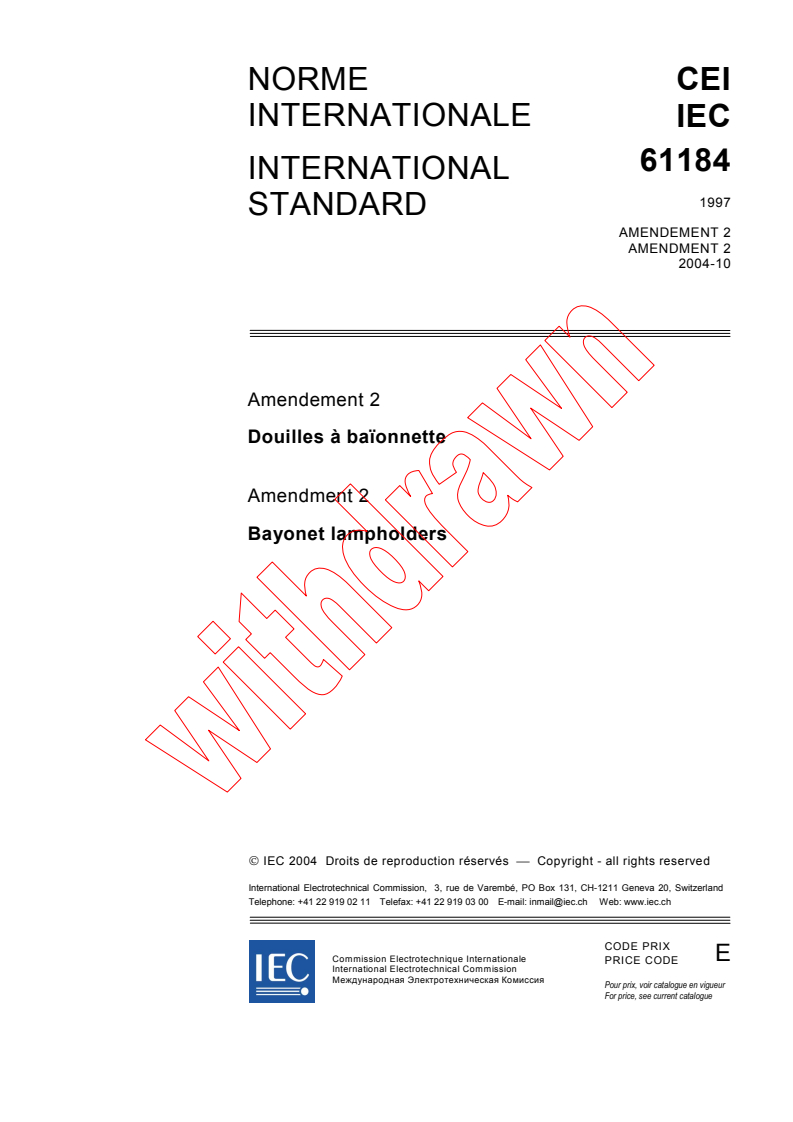
NORME CEI
INTERNATIONALE
IEC
INTERNATIONAL
STANDARD
AMENDEMENT 2
AMENDMENT 2
2004-10
Amendement 2
Douilles à baïonnette
Amendment 2
Bayonet lampholders
IEC 2004 Droits de reproduction réservés Copyright - all rights reserved
International Electrotechnical Commission, 3, rue de Varembé, PO Box 131, CH-1211 Geneva 20, Switzerland
Telephone: +41 22 919 02 11 Telefax: +41 22 919 03 00 E-mail: inmail@iec.ch Web: www.iec.ch
CODE PRIX
E
Commission Electrotechnique Internationale
PRICE CODE
International Electrotechnical Commission
МеждународнаяЭлектротехническаяКомиссия
Pour prix, voir catalogue en vigueur
For price, see current catalogue
– 2 – 61184 amend.2 CEI:2004
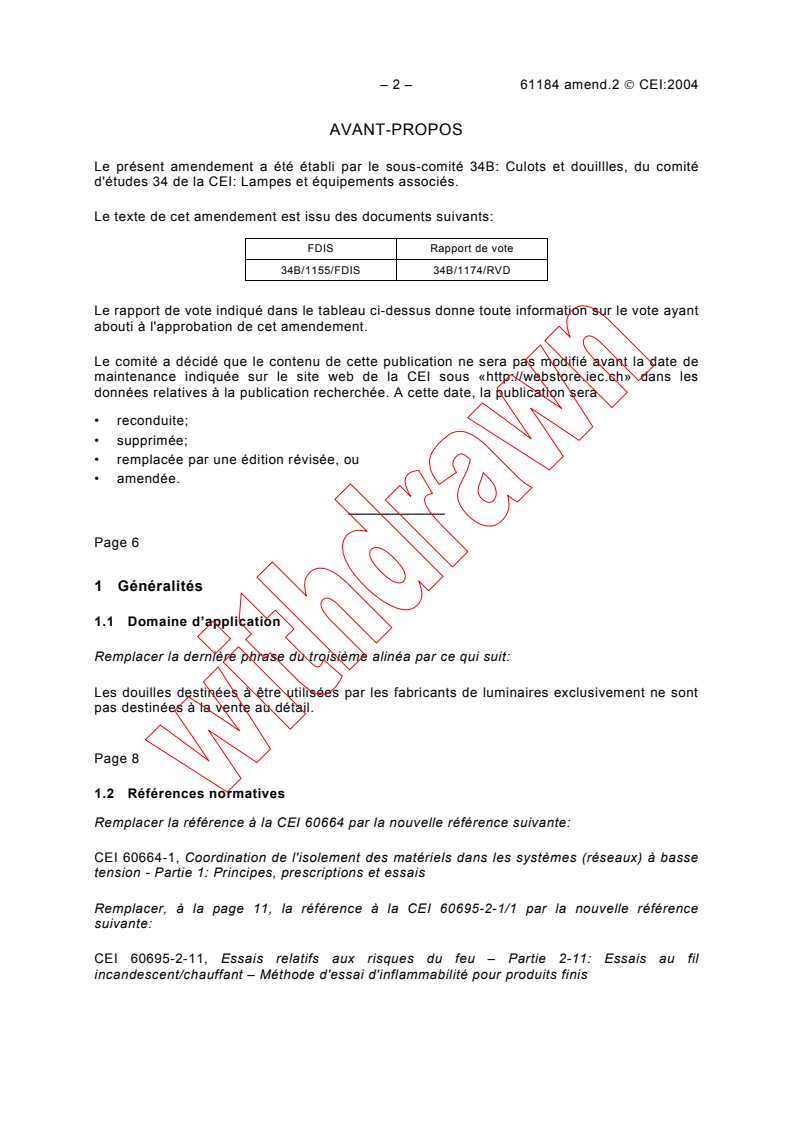
AVANT-PROPOS
Le présent amendement a été établi par le sous-comité 34B: Culots et douillles, du comité
d'études 34 de la CEI: Lampes et équipements associés.
Le texte de cet amendement est issu des documents suivants:
FDIS Rapport de vote
34B/1155/FDIS 34B/1174/RVD
Le rapport de vote indiqué dans le tableau ci-dessus donne toute information sur le vote ayant
abouti à l'approbation de cet amendement.
Le comité a décidé que le contenu de cette publication ne sera pas modifié avant la date de
maintenance indiquée sur le site web de la CEI sous «http://webstore.iec.ch» dans les
données relatives à la publication recherchée. A cette date, la publication sera
• reconduite;
• supprimée;
• remplacée par une édition révisée, ou
• amendée.
_____________
Page 6
1 Généralités
1.1 Domaine d’application
Remplacer la dernière phrase du troisième alinéa par ce qui suit:
Les douilles destinées à être utilisées par les fabricants de luminaires exclusivement ne sont
pas destinées à la vente au détail.
Page 8
1.2 Références normatives
Remplacer la référence à la CEI 60664 par la nouvelle référence suivante:
CEI 60664-1, Coordination de l'isolement des matériels dans les systèmes (réseaux) à basse
tension - Partie 1: Principes, prescriptions et essais
Remplacer, à la page 11, la référence à la CEI 60695-2-1/1 par la nouvelle référence
suivante:
CEI 60695-2-11, Essais relatifs aux risques du feu – Partie 2-11: Essais au fil
incandescent/chauffant – Méthode d'essai d'inflammabilité pour produits finis
61184 amend.2 IEC:2004 – 3 –
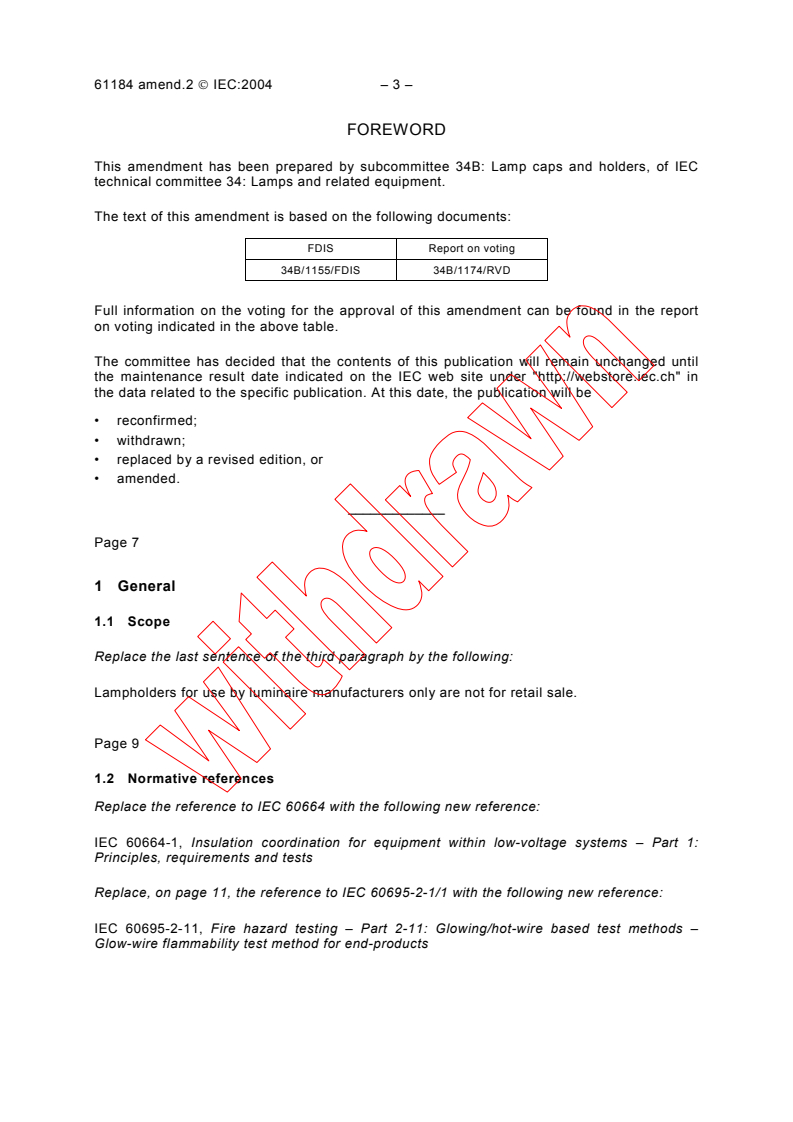
FOREWORD
This amendment has been prepared by subcommittee 34B: Lamp caps and holders, of IEC
technical committee 34: Lamps and related equipment.
The text of this amendment is based on the following documents:
FDIS Report on voting
34B/1155/FDIS 34B/1174/RVD
Full information on the voting for the approval of this amendment can be found in the report
on voting indicated in the above table.
The committee has decided that the contents of this publication will remain unchanged until
the maintenance result date indicated on the IEC web site under "http://webstore.iec.ch" in
the data related to the specific publication. At this date, the publication will be
• reconfirmed;
• withdrawn;
• replaced by a revised edition, or
• amended.
_____________
Page 7
1 General
1.1 Scope
Replace the last sentence of the third paragraph by the following:
Lampholders for use by luminaire manufacturers only are not for retail sale.
Page 9
1.2 Normative references
Replace the reference to IEC 60664 with the following new reference:
IEC 60664-1, Insulation coordination for equipment within low-voltage systems – Part 1:
Principles, requirements and tests
Replace, on page 11, the reference to IEC 60695-2-1/1 with the following new reference:
IEC 60695-2-11, Fire hazard testing – Part 2-11: Glowing/hot-wire based test methods –
Glow-wire flammability test method for end-products
– 4 – 61184 amend.2 CEI:2004
Page 10
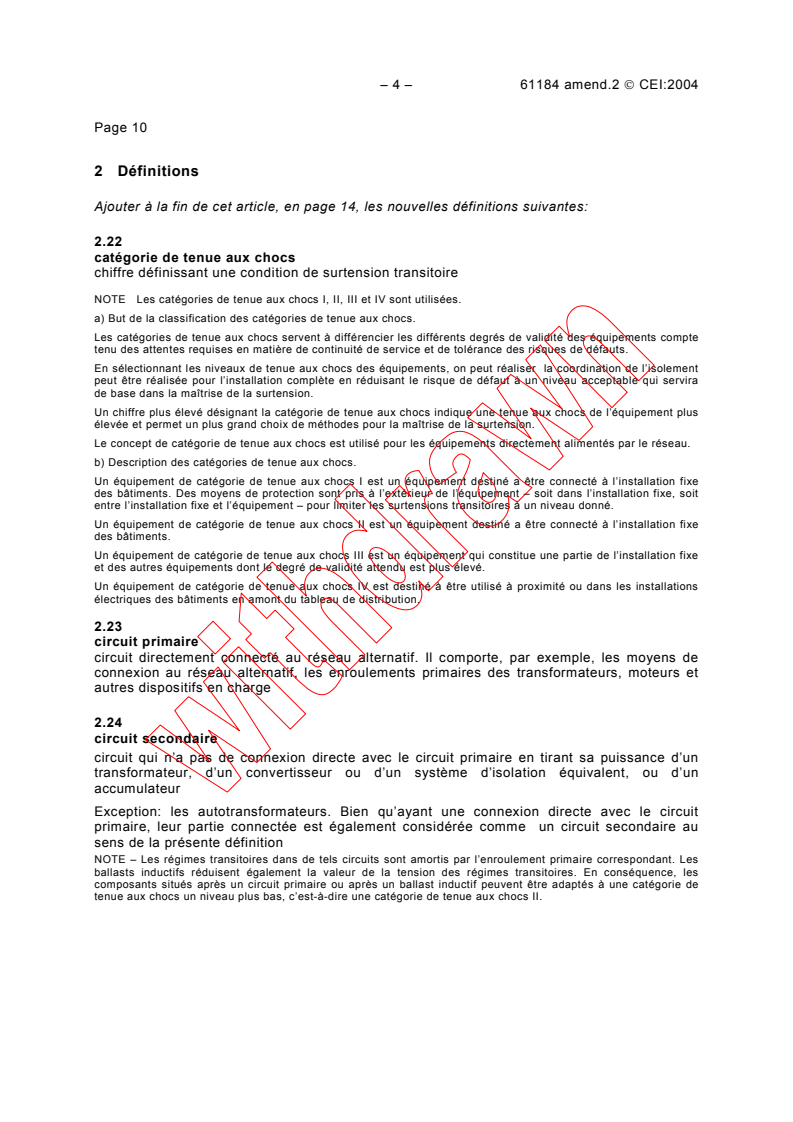
2 Définitions
Ajouter à la fin de cet article, en page 14, les nouvelles définitions suivantes:
2.22
catégorie de tenue aux chocs
chiffre définissant une condition de surtension transitoire
NOTE Les catégories de tenue aux chocs I, II, III et IV sont utilisées.
a) But de la classification des catégories de tenue aux chocs.
Les catégories de tenue aux chocs servent à différencier les différents degrés de validité des équipements compte
tenu des attentes requises en matière de continuité de service et de tolérance des risques de défauts.
En sélectionnant les niveaux de tenue aux chocs des équipements, on peut réaliser la coordination de l’isolement
peut être réalisée pour l’installation complète en réduisant le risque de défaut à un niveau acceptable qui servira
de base dans la maîtrise de la surtension.
Un chiffre plus élevé désignant la catégorie de tenue aux chocs indique une tenue aux chocs de l’équipement plus
élevée et permet un plus grand choix de méthodes pour la maîtrise de la surtension.
Le concept de catégorie de tenue aux chocs est utilisé pour les équipements directement alimentés par le réseau.
b) Description des catégories de tenue aux chocs.
Un équipement de catégorie de tenue aux chocs I est un équipement destiné a être connecté à l’installation fixe
des bâtiments. Des moyens de protection sont pris à l’extérieur de l’équipement – soit dans l’installation fixe, soit
entre l’installation fixe et l’équipement – pour limiter les surtensions transitoires à un niveau donné.
Un équipement de catégorie de tenue aux chocs II est un équipement destiné a être connecté à l’installation fixe
des bâtiments.
Un équipement de catégorie de tenue aux chocs III est un équipement qui constitue une partie de l’installation fixe
et des autres équipements dont le degré de validité attendu est plus élevé.
Un équipement de catégorie de tenue aux chocs IV est destiné à être utilisé à proximité ou dans les installations
électriques des bâtiments en amont du tableau de distribution.
2.23
circuit primaire
circuit directement connecté au réseau alternatif. Il comporte, par exemple, les moyens de
connexion au réseau alternatif, les enroulements primaires des transformateurs, moteurs et
autres dispositifs en charge
2.24
circuit secondaire
circuit qui n’a pas de connexion directe avec le circuit primaire en tirant sa puissance d’un
transformateur, d’un convertisseur ou d’un système d’isolation équivalent, ou d’un
accumulateur
Exception: les autotransformateurs. Bien qu’ayant une connexion directe avec le circuit
primaire, leur partie connectée est également considérée comme un circuit secondaire au
sens de la présente définition
NOTE – Les régimes transitoires dans de tels circuits sont amortis par l’enroulement primaire correspondant. Les
ballasts inductifs réduisent également la valeur de la tension des régimes transitoires. En conséquence, les
composants situés après un circuit primaire ou après un ballast inductif peuvent être adaptés à une catégorie de
tenue aux chocs un niveau plus bas, c’est-à-dire une catégorie de tenue aux chocs II.
61184 amend.2 IEC:2004 – 5 –
Page 11
2 Definitions
Add, at the end of this clause, on page 15, the following new definitions:
2.22
impulse withstand category
numeral defining a transient overvoltage condition
NOTE Impulse withstand categories I, II, III and IV are used.
a) Purpose of classification of impulse withstand categories
Impulse withstand categories are to distinguish different degrees of availability of equipment with regard to
required expectations on continuity of service and on an acceptable risk of failure.
By selection of impulse withstand levels of equipment, insulation co-ordination can be achieved in the whole
installation reducing the risk of failure to an acceptable level providing a basis for overvoltage control.
A higher characteristic numeral of an impulse withstand category indicates a higher specific impulse withstand of
the equipment and offers a wider choice of methods for overvoltage control.
The concept of impulse withstand categories is used for equipment energized directly from the mains.
b) Description of impulse withstand categories
Equipment of impulse withstand category I is equipment which is intended to be connected to the fixed electrical
installations of buildings. Protective means are taken outside the equipment - either in the fixed installation or
between the fixed installation and the equipment - to limit transient overvoltages to the specific level.
Equipment of impulse withstand category II
...