

IEC TR 62284:2025
(Main)Effective area measurements of single-mode optical fibres - Guidance
General Information
- Abstract
IEC TR 62284:2025 which is a Technical Report, applies to single-mode optical fibres. Its object is to document the methods for measuring the effective area (Aeff) of these fibres. It defines three methods of measuring Aeff. Information common to all the methods is found in the body of this document. Information specific to each method is found in the annexes. The three methods are:
a) direct far-field (DFF);
b) variable aperture in the far-field (VAMFF);
c) near-field (NF).
The reference method, used to resolve disputes, is method A, direct far-field.
Effective area is an optical attribute that is specified for single-mode fibres and used in system designs probably affected by the non-linear refractive index coefficient, n2. There is agreement in both national and international standards bodies concerning the definition used in this document. Methods A, B, and C have been recognised as providing equivalent results, provided that good engineering is used in implementation.
The direct far-field is the reference method because it is the most direct method and is named as the reference method for mode field diameter in IEC 60793-1-45 and ITU-T Recommendation G.650.1.
A mapping function is a formula by which the measured results of one attribute are used to predict the value of another attribute on a given fibre. For a given fibre type and design, the mode field diameter (MFD) (IEC 60793-1-45) can be used to predict the effective area with a mapping function. A mapping function is specific to a particular fibre type and design. Mapping functions are generated by doing an experiment in which a sample of fibre is chosen to represent the spectrum of values of MFD and in which the fibres in the sample are measured for both MFD and Aeff. Linear regression can be used to determine the fitting coefficient, k, as defined by the following:
NOTE 1 Other mathematical models can be used if they are generally more accurate.
NOTE 2 See Annex E for more information.
This second edition cancels and replaces the first edition published in 2003. This edition constitutes a technical revision.
This edition includes the following significant technical changes with respect to the previous edition:
a) improvement of the description of measurement details for B-657 fibre;
b) modification of the minimum distance between the fibre end and the detector for the direct far field scan (Annex A);
c) deletion of Annex H.
- Status
- Published
- Publication Date
- 01-Dec-2025
- Technical Committee
- SC 86A - Fibres and cables
- Drafting Committee
- WG 1 - TC 86/SC 86A/WG 1
- Current Stage
- PPUB - Publication issued
- Start Date
- 02-Dec-2025
- Completion Date
- 26-Dec-2025
Overview
IEC TR 62284:2025 provides comprehensive guidance on the measurement of the effective area (Aeff) of single-mode optical fibres. This IEC Technical Report applies to all single-mode fibres and aims to harmonize test methods internationally. The effective area is a key optical parameter used in fibre system design, closely related to non-linear effects in optical networks. This document defines and compares three established measurement methods, ensuring reliable results across a range of fibre types. The direct far-field (DFF) method is designated as the reference for resolving disputes.
Key Topics
Measurement Methods for Effective Area
- Direct Far-Field (DFF): The primary (reference) method for accurate measurement of effective area, recommended for dispute resolution. Recognized for its direct approach and alignment with other international standards, such as IEC 60793-1-45 and ITU-T G.650.1.
- Variable Aperture in the Far-Field (VAMFF): A practical approach using variable apertures to measure power distribution. Typically used when DFF is not feasible, offering equivalent accuracy with proper execution.
- Near-Field (NF): Uses intensity profiling directly at the fibre end. This method is particularly useful for certain fibre types or installation constraints.
Common and Specific Guidance
- Common equipment recommendations, specimen preparation (such as fibre length and end-face quality), and procedures ensure consistency across all three methods.
- Details specific to each method are found in annexes, assisting users in selecting and applying the most appropriate technique for their needs.
Mapping Functions
- Guidance on predicting the effective area from mode field diameter (MFD) measurements using mapping functions. This supports fibre manufacturers and network designers in linking related optical attributes.
Technical Updates
- Enhanced instructions for measurement details, especially for B-657 fibres.
- Revised requirements for the minimum distance between the fibre end and detector in DFF method to improve measurement accuracy.
- Removal of obsolete annexes to streamline the document.
Applications
IEC TR 62284:2025 is essential for:
- Fibre Manufacturers: Ensuring product compliance and quality control by providing standardized methods for effective area measurement.
- Test Laboratories: Performing consistent optical fibre characterization across global markets.
- System Designers and Network Engineers: Incorporating accurate effective area data for modelling system performance and managing non-linear effects in high-speed optical communications.
- Standardization Bodies: Harmonizing measurement practices within the industry, supporting interoperability and reliability for single-mode fibre networks.
This guidance is valuable for all organizations involved in the development, testing, or application of single-mode optical fibres. The document encourages best practices and underpins confidence in measurement results, crucial for both research and commercial deployment.
Related Standards
For further alignment and technical depth, refer to:
- IEC 60793-1-45: Optical fibres - Measurement methods for mode field diameter.
- ITU-T Recommendation G.650.1: Definitions and test methods for single-mode fibre geometrical and transmission attributes.
- IEC 60793 Series: General test methods and specifications for optical fibre cables.
These documents, alongside IEC TR 62284:2025, form a robust framework for the measurement and specification of critical single-mode fibre parameters, supporting high-performance and standardized optical communication systems.
Keywords: IEC TR 62284:2025, effective area measurement, single-mode optical fibres, direct far-field, variable aperture method, near-field measurement, optical fibre standards, mode field diameter, fibre characterization, optical network design.
Relations
- Effective Date
- 05-Sep-2023
Get Certified
Connect with accredited certification bodies for this standard

ANCE
Mexican certification and testing association.

Intertek Slovenia
Intertek testing, inspection, and certification services in Slovenia.

LNE (Laboratoire National de Métrologie et d'Essais)
French national laboratory for metrology and testing.
Sponsored listings
Frequently Asked Questions
IEC TR 62284:2025 is a technical report published by the International Electrotechnical Commission (IEC). Its full title is "Effective area measurements of single-mode optical fibres - Guidance". This standard covers: IEC TR 62284:2025 which is a Technical Report, applies to single-mode optical fibres. Its object is to document the methods for measuring the effective area (Aeff) of these fibres. It defines three methods of measuring Aeff. Information common to all the methods is found in the body of this document. Information specific to each method is found in the annexes. The three methods are: a) direct far-field (DFF); b) variable aperture in the far-field (VAMFF); c) near-field (NF). The reference method, used to resolve disputes, is method A, direct far-field. Effective area is an optical attribute that is specified for single-mode fibres and used in system designs probably affected by the non-linear refractive index coefficient, n2. There is agreement in both national and international standards bodies concerning the definition used in this document. Methods A, B, and C have been recognised as providing equivalent results, provided that good engineering is used in implementation. The direct far-field is the reference method because it is the most direct method and is named as the reference method for mode field diameter in IEC 60793-1-45 and ITU-T Recommendation G.650.1. A mapping function is a formula by which the measured results of one attribute are used to predict the value of another attribute on a given fibre. For a given fibre type and design, the mode field diameter (MFD) (IEC 60793-1-45) can be used to predict the effective area with a mapping function. A mapping function is specific to a particular fibre type and design. Mapping functions are generated by doing an experiment in which a sample of fibre is chosen to represent the spectrum of values of MFD and in which the fibres in the sample are measured for both MFD and Aeff. Linear regression can be used to determine the fitting coefficient, k, as defined by the following: NOTE 1 Other mathematical models can be used if they are generally more accurate. NOTE 2 See Annex E for more information. This second edition cancels and replaces the first edition published in 2003. This edition constitutes a technical revision. This edition includes the following significant technical changes with respect to the previous edition: a) improvement of the description of measurement details for B-657 fibre; b) modification of the minimum distance between the fibre end and the detector for the direct far field scan (Annex A); c) deletion of Annex H.
IEC TR 62284:2025 which is a Technical Report, applies to single-mode optical fibres. Its object is to document the methods for measuring the effective area (Aeff) of these fibres. It defines three methods of measuring Aeff. Information common to all the methods is found in the body of this document. Information specific to each method is found in the annexes. The three methods are: a) direct far-field (DFF); b) variable aperture in the far-field (VAMFF); c) near-field (NF). The reference method, used to resolve disputes, is method A, direct far-field. Effective area is an optical attribute that is specified for single-mode fibres and used in system designs probably affected by the non-linear refractive index coefficient, n2. There is agreement in both national and international standards bodies concerning the definition used in this document. Methods A, B, and C have been recognised as providing equivalent results, provided that good engineering is used in implementation. The direct far-field is the reference method because it is the most direct method and is named as the reference method for mode field diameter in IEC 60793-1-45 and ITU-T Recommendation G.650.1. A mapping function is a formula by which the measured results of one attribute are used to predict the value of another attribute on a given fibre. For a given fibre type and design, the mode field diameter (MFD) (IEC 60793-1-45) can be used to predict the effective area with a mapping function. A mapping function is specific to a particular fibre type and design. Mapping functions are generated by doing an experiment in which a sample of fibre is chosen to represent the spectrum of values of MFD and in which the fibres in the sample are measured for both MFD and Aeff. Linear regression can be used to determine the fitting coefficient, k, as defined by the following: NOTE 1 Other mathematical models can be used if they are generally more accurate. NOTE 2 See Annex E for more information. This second edition cancels and replaces the first edition published in 2003. This edition constitutes a technical revision. This edition includes the following significant technical changes with respect to the previous edition: a) improvement of the description of measurement details for B-657 fibre; b) modification of the minimum distance between the fibre end and the detector for the direct far field scan (Annex A); c) deletion of Annex H.
IEC TR 62284:2025 is classified under the following ICS (International Classification for Standards) categories: 33.180.10 - Fibres and cables. The ICS classification helps identify the subject area and facilitates finding related standards.
IEC TR 62284:2025 has the following relationships with other standards: It is inter standard links to IEC TR 62284:2003. Understanding these relationships helps ensure you are using the most current and applicable version of the standard.
IEC TR 62284:2025 is available in PDF format for immediate download after purchase. The document can be added to your cart and obtained through the secure checkout process. Digital delivery ensures instant access to the complete standard document.
Standards Content (Sample)
IEC TR 62284 ®
Edition 2.0 2025-12
TECHNICAL
REPORT
Effective area measurements of single-mode optical fibres - Guidance
ICS 33.180.10 ISBN 978-2-8327-0896-5
All rights reserved. Unless otherwise specified, no part of this publication may be reproduced or utilized in any form or
by any means, electronic or mechanical, including photocopying and microfilm, without permission in writing from either
IEC or IEC's member National Committee in the country of the requester. If you have any questions about IEC copyright
or have an enquiry about obtaining additional rights to this publication, please contact the address below or your local
IEC member National Committee for further information.
IEC Secretariat Tel.: +41 22 919 02 11
3, rue de Varembé info@iec.ch
CH-1211 Geneva 20 www.iec.ch
Switzerland
About the IEC
The International Electrotechnical Commission (IEC) is the leading global organization that prepares and publishes
International Standards for all electrical, electronic and related technologies.
About IEC publications
The technical content of IEC publications is kept under constant review by the IEC. Please make sure that you have the
latest edition, a corrigendum or an amendment might have been published.
IEC publications search - IEC Products & Services Portal - products.iec.ch
webstore.iec.ch/advsearchform Discover our powerful search engine and read freely all the
The advanced search enables to find IEC publications by a publications previews, graphical symbols and the glossary.
variety of criteria (reference number, text, technical With a subscription you will always have access to up to date
committee, …). It also gives information on projects, content tailored to your needs.
replaced and withdrawn publications.
Electropedia - www.electropedia.org
The world's leading online dictionary on electrotechnology,
IEC Just Published - webstore.iec.ch/justpublished
Stay up to date on all new IEC publications. Just Published containing more than 22 500 terminological entries in English
details all new publications released. Available online and and French, with equivalent terms in 25 additional languages.
once a month by email. Also known as the International Electrotechnical Vocabulary
(IEV) online.
IEC Customer Service Centre - webstore.iec.ch/csc
If you wish to give us your feedback on this publication or
need further assistance, please contact the Customer
Service Centre: sales@iec.ch.
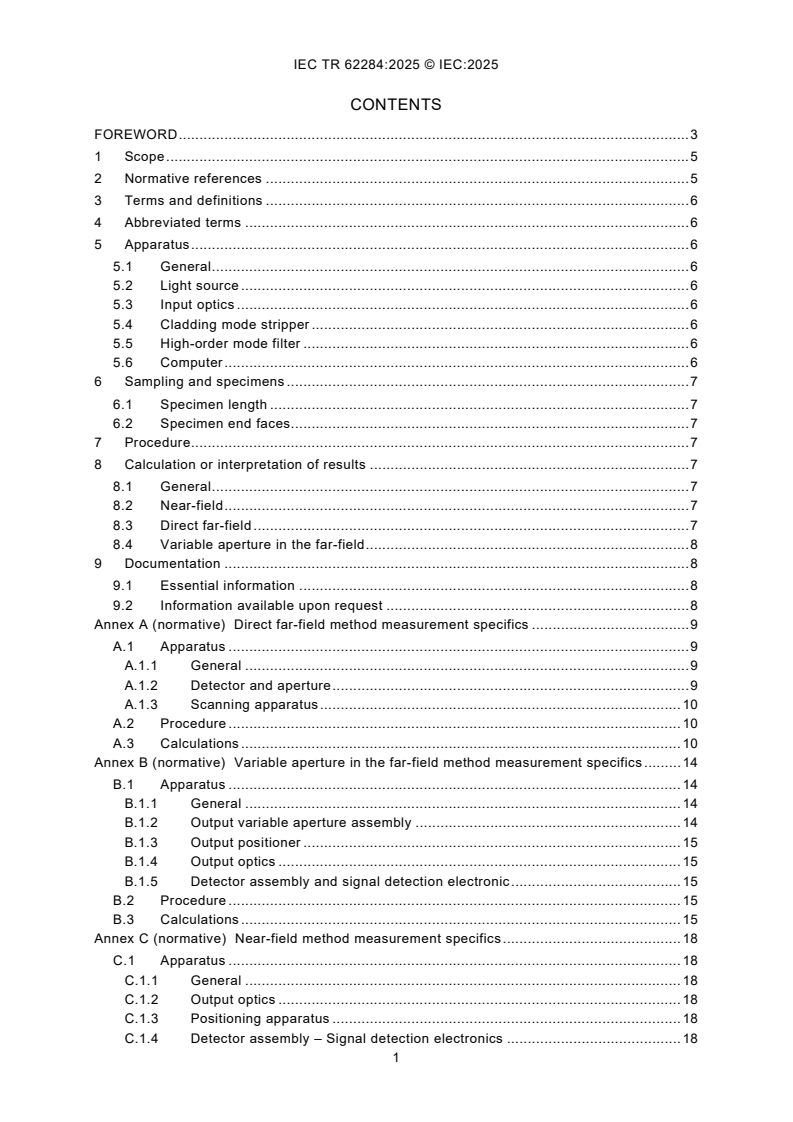
CONTENTS
FOREWORD . 3
1 Scope . 5
2 Normative references . 5
3 Terms and definitions . 6
4 Abbreviated terms . 6
5 Apparatus . 6
5.1 General . 6
5.2 Light source . 6
5.3 Input optics . 6
5.4 Cladding mode stripper . 6
5.5 High-order mode filter . 6
5.6 Computer . 6
6 Sampling and specimens . 7
6.1 Specimen length . 7
6.2 Specimen end faces. 7
7 Procedure . 7
8 Calculation or interpretation of results . 7
8.1 General . 7
8.2 Near-field . 7
8.3 Direct far-field . 7
8.4 Variable aperture in the far-field . 8
9 Documentation . 8
9.1 Essential information . 8
9.2 Information available upon request . 8
Annex A (normative) Direct far-field method measurement specifics . 9
A.1 Apparatus . 9
A.1.1 General . 9
A.1.2 Detector and aperture . 9
A.1.3 Scanning apparatus . 10
A.2 Procedure . 10
A.3 Calculations . 10
Annex B (normative) Variable aperture in the far-field method measurement specifics . 14
B.1 Apparatus . 14
B.1.1 General . 14
B.1.2 Output variable aperture assembly . 14
B.1.3 Output positioner . 15
B.1.4 Output optics . 15
B.1.5 Detector assembly and signal detection electronic . 15
B.2 Procedure . 15
B.3 Calculations . 15
Annex C (normative) Near-field method measurement specifics . 18
C.1 Apparatus . 18
C.1.1 General . 18
C.1.2 Output optics . 18
C.1.3 Positioning apparatus . 18
C.1.4 Detector assembly – Signal detection electronics . 18
C.2 Procedure . 18
C.2.1 Specimen alignment . 18
C.2.2 Power level adjustment . 19
C.2.3 Signal acquisition . 19
C.3 Calculation . 19
C.3.1 General . 19
C.3.2 Calculate the centroid . 19
C.3.3 Fold the intensity profile . 19
C.3.4 Compute the integrals from Formula (2) . 19
C.3.5 Complete the calculation . 20
Annex D (informative) Sample data and calculations . 21
D.1 Data from method A . 21
D.2 Data from method B . 23
Annex E (informative) Comparison between this document and ITU recommendations . 24
Annex F (informative) Treatment of side lobes in far-field data . 25
Annex G (informative) Method for computing effective area from variable aperture
data . 26
G.1 General . 26
G.2 Relationship between the fundamental mode field and the aperture power
flow . 26
G.3 Numerical approximation of the fundamental mode field. 31
G.4 Computation of effective area . 36
G.5 Summary . 38
Bibliography . 39
Figure A.1 – Test set-up for the direct far-field measurement . 9
Figure B.1 – Test set-up for the variable aperture in the far-field measurement . 14
Figure B.2 – Apparatus set-up measurements . 15
Figure C.1 – Near-field method test set-up . 18
Figure D.1 – Far-field intensity . 21
Figure D.2 – Near-field intensity . 21
Figure F.1 – Typical far-field plot displaying side lobes . 25
Figure G.1 – Measurement geometry of the variable aperture method . 27
Figure G.2 – Co-ordinate system used to evaluate the diffraction field . 27
Figure G.3 – Polar co-ordinates of r . 28
Figure G.4 – Geometry for the evaluation of Formula (G.12) . 30
Figure G.5 – Example of the fit to aperture power flow data . 34
Figure G.6 – Fit in the presence of decreasing data . 35
Figure G.7 – Mode field from the data in Figure G.5. 36
Figure G.8 – Change in A with r , from the data in Figure G.6 . 37
eff max
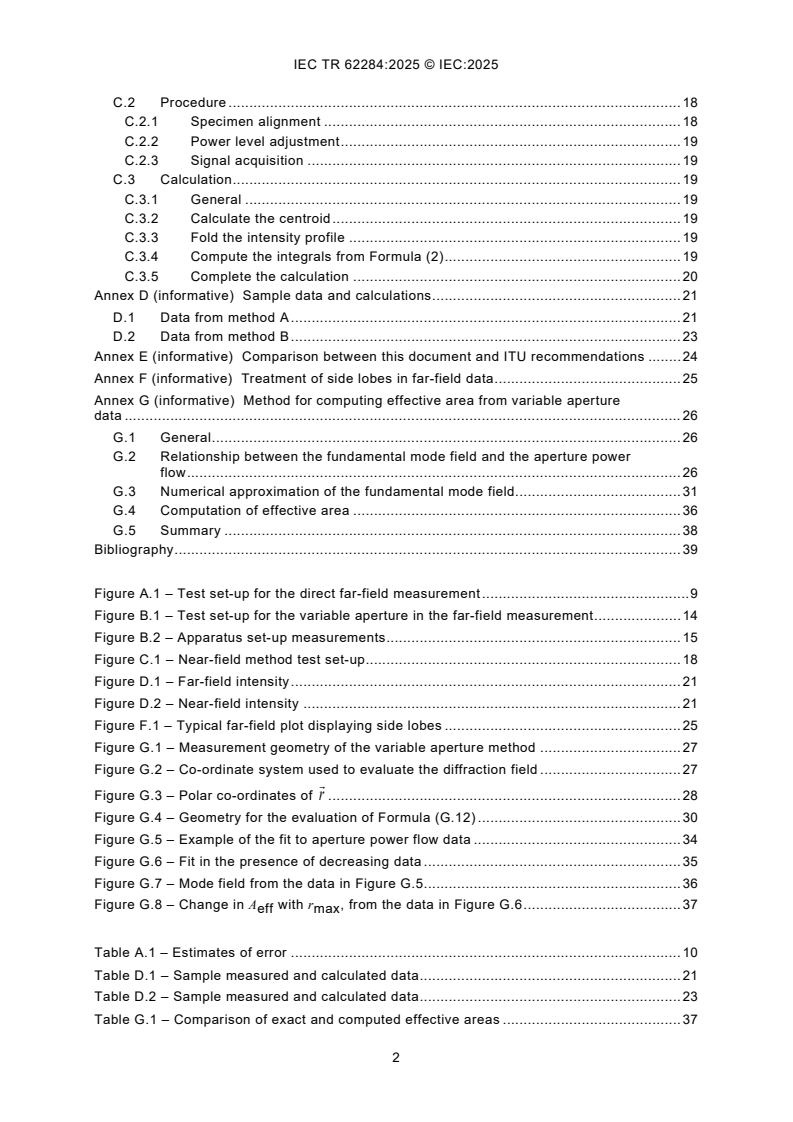
Table A.1 – Estimates of error . 10
Table D.1 – Sample measured and calculated data . 21
Table D.2 – Sample measured and calculated data . 23
Table G.1 – Comparison of exact and computed effective areas . 37
INTERNATIONAL ELECTROTECHNICAL COMMISSION
____________
Effective area measurements of single-mode optical fibres -
Guidance
FOREWORD
1) The International Electrotechnical Commission (IEC) is a worldwide organization for standardization comprising
all national electrotechnical committees (IEC National Committees). The object of IEC is to promote international
co-operation on all questions concerning standardization in the electrical and electronic fields. To this end and
in addition to other activities, IEC publishes International Standards, Technical Specifications, Technical Reports,
Publicly Available Specifications (PAS) and Guides (hereafter referred to as "IEC Publication(s)"). Their
preparation is entrusted to technical committees; any IEC National Committee interested in the subject dealt with
may participate in this preparatory work. International, governmental and non-governmental organizations liaising
with the IEC also participate in this preparation. IEC collaborates closely with the International Organization for
Standardization (ISO) in accordance with conditions determined by agreement between the two organizations.
2) The formal decisions or agreements of IEC on technical matters express, as nearly as possible, an international
consensus of opinion on the relevant subjects since each technical committee has representation from all
interested IEC National Committees.
3) IEC Publications have the form of recommendations for international use and are accepted by IEC National
Committees in that sense. While all reasonable efforts are made to ensure that the technical content of IEC
Publications is accurate, IEC cannot be held responsible for the way in which they are used or for any
misinterpretation by any end user.
4) In order to promote international uniformity, IEC National Committees undertake to apply IEC Publications
transparently to the maximum extent possible in their national and regional publications. Any divergence between
any IEC Publication and the corresponding national or regional publication shall be clearly indicated in the latter.
5) IEC itself does not provide any attestation of conformity. Independent certification bodies provide conformity
assessment services and, in some areas, access to IEC marks of conformity. IEC is not responsible for any
services carried out by independent certification bodies.
6) All users should ensure that they have the latest edition of this publication.
7) No liability shall attach to IEC or its directors, employees, servants or agents including individual experts and
members of its technical committees and IEC National Committees for any personal injury, property damage or
other damage of any nature whatsoever, whether direct or indirect, or for costs (including legal fees) and
expenses arising out of the publication, use of, or reliance upon, this IEC Publication or any other IEC
Publications.
8) Attention is drawn to the Normative references cited in this publication. Use of the referenced publications is
indispensable for the correct application of this publication.
9) IEC draws attention to the possibility that the implementation of this document may involve the use of (a)
patent(s). IEC takes no position concerning the evidence, validity or applicability of any claimed patent rights in
respect thereof. As of the date of publication of this document, IEC had not received notice of (a) patent(s), which
may be required to implement this document. However, implementers are cautioned that this may not represent
the latest information, which may be obtained from the patent database available at https://patents.iec.ch. IEC
shall not be held responsible for identifying any or all such patent rights.
IEC TR 62284 has been prepared by subcommittee 86A: Fibres and cables, of IEC technical
committee 86: Fibre optics. It is a Technical Report.
This second edition cancels and replaces the first edition published in 2003. This edition
constitutes a technical revision.
This edition includes the following significant technical changes with respect to the previous
edition:
a) improvement of the description of measurement details for B-657 fibre;
b) modification of the minimum distance between the fibre end and the detector for the direct
far field scan (Annex A);
c) deletion of Annex H.
The text of this Technical Report is based on the following documents:
Draft Report on voting
86A/2619/DTR 86A/2641/RVDTR
Full information on the voting for its approval can be found in the report on voting indicated in
the above table.
The language used for the development of this Technical Report is English.
This document was drafted in accordance with ISO/IEC Directives, Part 2, and developed in
accordance with ISO/IEC Directives, Part 1 and ISO/IEC Directives, IEC Supplement, available
at www.iec.ch/members_experts/refdocs. The main document types developed by IEC are
described in greater detail at www.iec.ch/publications.
The committee has decided that the contents of this document will remain unchanged until the
stability date indicated on the IEC website under webstore.iec.ch in the data related to the
specific document. At this date, the document will be
– reconfirmed,
– withdrawn, or
– revised.
1 Scope
This document applies to single-mode optical fibres. Its object is to document the methods for
measuring the effective area (A ) of these fibres.
eff
It defines three methods of measuring A . Information common to all the methods is found in
eff
the body of this document. Information specific to each method is found in the annexes. The
three methods are:
a) direct far-field (DFF);
b) variable aperture in the far-field (VAMFF);
c) near-field (NF).
The reference method, used to resolve disputes, is method A, direct far-field.
Effective area is an optical attribute that is specified for single-mode fibres and used in system
designs probably affected by the non-linear refractive index coefficient, n . There is agreement
in both national and international standards bodies concerning the definition used in this
document. Methods A, B, and C have been recognised as providing equivalent results, provided
that good engineering is used in implementation.
The direct far-field is the reference method because it is the most direct method and is named
as the reference method for mode field diameter in IEC 60793-1-45 and ITU-T Recommendation
G.650.1.
A mapping function is a formula by which the measured results of one attribute are used to
predict the value of another attribute on a given fibre. For a given fibre type and design, the
mode field diameter (MFD) (IEC 60793-1-45) can be used to predict the effective area with a
mapping function. A mapping function is specific to a particular fibre type and design. Mapping
functions are generated by doing an experiment in which a sample of fibre is chosen to
represent the spectrum of values of MFD and in which the fibres in the sample are measured
for both MFD and A . Linear regression can be used to determine the fitting coefficient, k, as
eff
defined by the following:
MFD
Ak= π (1)
eff
NOTE 1 Other mathematical models can be used if they are generally more accurate.
NOTE 2 See Annex E for more information.
2 Normative references
There are no normative references in this document.
3 Terms and definitions
No terms and definitions are listed in this document.
ISO and IEC maintain terminology databases for use in standardization at the following
addresses:
– IEC Electropedia: available at https://www.electropedia.org/
– ISO Online browsing platform: available at https://www.iso.org/obp
4 Abbreviated terms
FWHM full width at half maximum
LED light emitting diode
MFD mode field diameter
5 Apparatus
5.1 General
Annex A, Annex B, and Annex C include schematics for each method.
5.2 Light source
Use a suitable coherent or non-coherent light source, such as a semiconductor laser or a
sufficiently powerful filtered white light or LED source. It is good practice to check whether the
source is stable in intensity and wavelength over a time period sufficient to perform the
measurement. The wavelength of the source is included in the detail specification. Unless
otherwise specified in the detail specification, a spectral line width of less than or equal to
10 nm full width at half-maximum (FWHM) is advisable.
5.3 Input optics
Use an optical lens system or fibre pigtail to excite the test fibre. Couple the power into the test
fibre so it is insensitive to the position of the input end face. This can be done with a launch
beam that spatially and angularly overfills the test fibre. If a butt splice is used, use index-
matching fluid to avoid interference effects. Ensure the coupling remains stable for the duration
of the test.
5.4 Cladding mode stripper
Use a device that extracts cladding modes. The fibre coating will typically perform this function.
5.5 High-order mode filter
Use a means to remove high-order propagating modes in the wavelength range that is greater
than or equal to the cut-off wavelength of the specimen. For example, a one-turn bend with a
radius of 30 mm on the fibre is generally sufficient for most B-652, B-653, B-654, B-655, B-656,
and B-657 fibres. For some B-657 fibres, smaller radius, multiple bends or longer specimen
length can be applied to remove high-order propagating modes.
5.6 Computer
Optionally, use a computer to control the apparatus, take intensity measurements and compute
the final result.
6 Sampling and specimens
6.1 Specimen length
Prepare the single-mode fibre test specimen to a length of, typically, 2,0 m ± 0,2 m for most
B-652, B-653, B-654, B-655, B-656, and B-657 fibres. For some B-657 fibres, longer specimen
length can be used to avoid high-order propagating modes, 22 m for example.
6.2 Specimen end faces
Prepare flat end faces at the input and output ends of the specimen.
Poor output end quality can produce erroneous measurements.
7 Procedure
See Annex A, Annex B, and Annex C for methods A, B, and C, respectively.
8 Calculation or interpretation of results
8.1 General
Formula (1) to (6) define the A for the methods in terms of the electromagnetic field emitted
eff
from the end of the specimen. Calculation procedures are given in the annexes.
8.2 Near-field
Effective area, A , is defined from the near-field intensity distribution, I(r), r being the radial
eff
distance from the centre of the mode field profile, through Formula (2):
∞
2π I(r)rdr
∫
0
(2)
A =
eff
∞
I(r) rdr
∫
8.3 Direct far-field
The zero-order Bessel function, J , is used to determine the near-field intensity distribution
pattern, I(r), from the far-field power distribution, P (θ):
ff
2πrsin(θ)
1/2
I(r)= (±)P (θ)J sin(θ)dθ (3)
ff 0
∫
λ
NOTE 1 The units of the measured wavelength, λ, are the same as those of the radial co-ordinate, r. Typically,
these are measured in μm.
NOTE 2 If side lobes are observed, odd lobes are changed in sign (reference to ± sign in formula) before integration
(see Annex F for more information).
The resultant near-field intensity distribution derived from Formula (3) is then used with
Formula (2) to determine A .
eff
8.4 Variable aperture in the far-field
The power detected through an aperture of radius r is P (r).The wavelength of light from the
ν
source is λ. The subtended half angle of the aperture is θ. The distance from the output end of
the test fibre to the aperture is D. The direct far field power P is related to the aperture power
ff
as:
r
−1
θ= tan
(4)
D
Define
2π
ρ= sin(θ) (5)
λ
dP (ρ)
v
P (ρ)=
ff (6)
2πρdρ
Use Formula (6) to convert P (r) to P (ρ). Use Formula (3) to convert to the near-field intensity
ν ff
pattern and then Formula (2) to calculate the effective area.
9 Documentation
9.1 Essential information
a) Identification for each test specimen.
b) Effective area (A ), in squared micrometers (μm ).
eff
c) Wavelength.
9.2 Information available upon request
a) Measurement method used.
b) Description of the test equipment, including light sources, scanning or translation method,
launch optics, cladding mode stripper, detection optics, and recording techniques.
c) Date and results for the most recent instrument calibration.
d) Data on measurement reproducibility.
Annex A
(normative)
Direct far-field method measurement specifics
A.1 Apparatus
A.1.1 General
A schematic of the apparatus is given in Figure A.1.
Figure A.1 – Test set-up for the direct far-field measurement
A.1.2 Detector and aperture
Use a detector, such as a PIN diode, that has enough dynamic range, that is, 50 dB down from
the maximum power at zero degrees, and that is linear over the range of intensities that are
encountered. Minimize the "detection floor" or "baseline noise" of the detector to maximise the
usable dynamic range of the system. A minimum of 50 dB of usable dynamic range is
recommended. Place the detector at a distance of at least 10 mm from the test fibre end face
(to ensure the detector to scan the far field) and ensure the detector's active area does not
subtend an angle too large in the far field. To ensure this, place the detector at a distance d
from the fibre end with
2wb⋅
dK⋅
(A.1)
λ
where
2w is the expected mode field diameter of the specimen;
b is the diameter of the active area of the detector;
λ is the wavelength;
K is the resolution factor which value is large enough to prevent the degradation of the far
field scan and its impact on the calculation of the mode field diameter. Basically, smaller
effective area requires large K for the same calculation error.
A value of K greater than 20 is suitable for most fibre types and guarantees less than 0,2 % of
error in the effective area calculation.
=
A.1.3 Scanning apparatus
Either scan the far-field radiation pattern by rotating the detector about an arc that is centred
on the fibre end face or by rotating the fibre end face in front of a fixed detector. Make sure the
scanning apparatus can perform steps of 0,5° or finer. The scan covers an entire diameter of
the far-field pattern. Typically, make the scanning apparatus capable of scanning an arc radius
of at least ± 23,5°.
NOTE Multiple measurements, with the fibre rotated relative to the scanning plane, will result in improved accuracy.
A.2 Procedure
a) Prepare the test fibre.
b) Prepare the test fibre and align it in the system so the power on the centred detector (angle
θ = 0) is maximum.
c) Scan the detector.
d) Scan the detector over the arc radius specified in A.1.3, in increments of equal angle. For
,
each position,θ record the detected power, P(θ ). The maximum detector angle used is
i i
θ at index i = n, the number of positive angular positions. For θ < 0, the index, i,
max
is defined with negative values.
NOTE θ = 0.
e) Complete the calculations.
f) Complete the calculations defined in Clause A.3 to determine the effective area.
A.3 Calculations
The following calculations are one means of completing the integrations given in Clause 8.
Other methods can be used if they are at least as accurate as the following. Instead of folding
the data, for example, a separate mode field diameter calculation for positive and negative
angular data sets can be completed and then averaged for the final result.
a) Fold the far-field radiation power data
Let P(θ ) be the measured power as a function of angular position, θ indexed by i. The
i i
(θ ), for 0 ≤ θ ≤ θ is:
folded power curve, P
f i i max
P()θ +−Pθ( )
ii
P ()θ = (A.2)
f i
If the far-field data is not centred about θ = 0, then the data around this point will cause
errors to occur. Table A.1 presents estimates of the error resulting from folding around θ = 0
of non-centred data.
Table A.1 – Estimates of error
Centre of symmetry A error
eff
error
° 2
μm
0 0,0 %
0,2 −0,4 %
0,4 −1,7 %
To avoid this folding error, the far-field data can be folded around the centroid of the far-
field pattern.
Calculate the centroid of the peak region of the far-field data by Formula (A.3):
θ
right
θ⋅Pθ dθ
( )
i
∫
θ
left
θ =
(A.3)
centroid
θ
right
P θθ d
( )
∫ i
θ
left
where
θ is the angle that corresponds to the left-hand data point (negative θ equal to 10 %
left
of the peak power;
θ is the angle that corresponds to the right-hand data point (positive θ) equal to 10 %
right
(−10 dB) of the peak power.
Numerical integration schemes described in Clause A.3 b) can be used.
The folded power curve, P (θ ), for 0 ≤ θ ≤ θ is expressed by Formula (A.4):
fold i i max
P θ +iθΔΔ+P θ −iθ
( ) ( )
interp centroid interp centroid
(A.4)
P θ =
( )
fold i
where
P is the cubic spline interpolation at the indicated angle;
interp
∆θ is the angle step size of the originally measured data.
Alternatively, the far field profile can be separated into left and right sides, each processed
independently to give two results, A and A , with the average being reported. The
eff left eff right
left and right far field profiles can be defined by Formulas (A.5) and (A.6):
P θ P θ−iθΔ
( ) ( )
left i interp centre (A.5)
P (θ) P (θ+iθΔ )
(A.6)
right i interp centre
where
θ is either θ = 0 (if folding about θ = 0) or θ (if folding about the centroid).
centre centroid
Also, the "as measured" data points can be used directly if the non-uniform step between
θ and the first measured data point is taken into account in the subsequent integration
centroid
steps.
=
=
b) Compute the near-field intensity pattern
Use an appropriate numerical integration method to compute the integrals of Formula (3).
The following is an example. Other integration methods can be used if at least as accurate.
Calculate the near-field values for a range of radii, r , values ranging from zero to a value
j
large enough that the computed intensity at the maximum radius is less than 0,01 % of the
maximum intensity.
2πr sin(θ )
n
j i
1/2
(A.7)
I(r)= (±)P (θ )J sin(θ )∆θ
j ∑ f i 0 i
λ
where
∆θ = θ − θ ;
1 0
n is the number of angles measured, determined by the number of iterations of ∆θ to
generate the largest angle where the measured power exceeds the detection floor
of the system.
NOTE 1 If side lobes are observed, odd lobes are changed in sign (reference to ± sign in formula) before
integration (see Annex F for more information).
The error induced by using rectangular integration can be greatly reduced by using a higher
order integration scheme such as an extended 1/N rule or Simpson's rule. The generalised
forms are shown below for uniform step size h.
Extended 1/N rule:
xn
5 13 13 5
f (x)dx= h f + f + f + f + .+ f + f + f
(A.8)
1 2 3 4 n−2 n−1 n
∫
x1
12 12 12 12
Simpson's rule:
xn
1 4 2 4 2 4 1
f (x)dx= h f + f + f + f + .+ f + f + f
(A.9)
1 2 3 4 n−2 n−1 n
∫
x1
3 3 3 3 3 3 3
c) Compute the integrals of Formula (2)
Use an appropriate numerical integration method to compute the integrals of Formula (2).
The following is an example, assuming equally spaced measurement positions. Other
integration methods can be used if at least as accurate.
m
(A.10)
T= I(r)r∆r
∑ j j
0
m
B= I (r)r∆r
(A.11)
j j
∑
where
∆r = r − r ;
1 0
m is the number of positions measured, determined by the radius at which the
calculated near-field intensity is below 0,01 % (−20 dB) of the maximum near-field
intensity power.
NOTE 2 Take caution when determining the maximum radius, r , since errors in the calculated near-field
m
intensity at large radii tend to be quite significant. Using a maximum radius, r , corresponding to a near-field
m
intensity of 0,01 % has been shown to produce A values with error below 0,1 %. If r is chosen too large, then
eff
m
significant errors in the A result will occur.
eff
The error induced by using rectangular integration can be greatly reduced by using a higher
order integration scheme such as an extended 1/N rule or Simpson's rule.
See Clause A.3 b) for more details.
d) Complete the calculation:
2πT
A = (A.12)
eff
B
Sample data and calculated values are provided in Annex D.
Annex B
(normative)
Variable aperture in the far-field method measurement specifics
B.1 Apparatus
B.1.1 General
A schematic of the test set-up is given in Figure B.1.
Figure B.1 – Test set-up for the variable aperture in the far-field measurement
B.1.2 Output variable aperture assembly
A device consisting of round transmitting apertures of various sizes (such as an aperture wheel),
is placed at a distance, D, of at least 100 from the fibre end, and is used to vary the
w /λ
power collected from the fibre output pattern. Typically, 12 to 20 apertures are used and are
located about 20 mm to 50 mm away from the fibre end. The maximum numerical aperture of
the test set is typically ≥ 0,40. Employ means of centring the apertures with respect to the
pattern to decrease sensitivity to fibre end-angle.
As part of equipment set-up, carefully measure and record the longitudinal distance, D, between
the fibre output end position and the aperture plane and the diameters, x , of each aperture.
i
Determine the half-angle subtended by each aperture in the wheel and record these θ (i = 1 to
i
n in order of increasing aperture size) values for future calculations. These values are
independent of test wavelength.
Figure B.2 – Apparatus set-up measurements
B.1.3 Output positioner
Provide a means to locate the fibre at a fixed distance from the apertures with a device such
as a side-viewing microscope or camera with a crosshair. If the fibre is constrained in the lateral
plane by a device such as a vacuum chuck, providing only longitudinal adjustment is sufficient.
B.1.4 Output optics
Use an optical system, such as a pair of lenses, mirrors or other suitable arrangement, to collect
all the light transmitted through the apertures, and to couple it to the detector. If a mirror is used
to pass the light back through the aperture to the detector, correct for any vignetting effects.
B.1.5 Detector assembly and signal detection electronic
Use a detector that is sensitive to the output radiation pattern over the range of wavelengths to
be measured and that is linear over the range of intensities encountered. A typical system can
include a germanium or GaInAsP photodiode operating in the photovoltaic mode, and a current-
sensitive preamplifier with synchronous detection by a lock-in amplifier.
B.2 Procedure
a) Place the test fibre in the input and output alignment apparatus and adjust for correct
distance to the aperture assembly (as recorded during the equipment set-up, see B.1.2).
b) Select a small aperture in the aperture assembly and adjust the far-field-to-aperture
transverse alignment for maximum detected power. Measure and record this detected power
as P(θ ).
i
c) Select each of the larger apertures in the aperture assembly and, for each, measure and
record the detected power, P(θ ).
i
d) Repeat Clause B.2 c) for each specified measurement wavelength.
e) Calculate the effective area for each measurement wavelength according to Clause B.3.
B.3 Calculations
The following calculations are one means of completing the integrations given in Clause 8.
Other methods can be used if at least as accurate as the following.
Calculate intermediate values for each aperture.
Define value for aperture zero:
, ,
v = 0 P (v )= 0 ρ(v )= 0
0 0 (B.1)
ff 0
Compute the following for apertures i = 1 to n:
x
i x
−1 i
v = D tan(θ )= ;
(B.2)
θ = tan
i i
i
2D
2π
ρ = sin(θ ) (B.3)
i i
λ
P(v)− P(v )
i i−1
P =
ff (B.4)
i
2 2
ρ −ρ
i i−1
NOTE 1 This discrete derivative can be replaced by fitting the data to a differentiable curve. Annex G contains an
example of one such fitting routine.
Calculate the near-field intensity pattern.
Use an appropriate numerical integration method to compute the integrals of Formula (B.3).
The following is an example. Other integration methods can be used if at least as accurate.
I(r ) r
Calculate the near-field intensity, , for a range of radii, , values ranging from zero to a
j j
value large enough that the computed intensity at the maximum radius is less than 0,01 % of
the maximum intensity.
If FF(ρ) is determined by calculating the discrete derivative (Formula (B.4)), use this form:
n 2 2
1 ρ +ρ (ρ −ρ )
i i−1 i i−1
I(r)= ⋅ FF(ρ )⋅ J r ⋅ ⋅
(B.5)
∑ i 0 j
k 2 2
i=1
ρ +ρ
i i−1
1− k
If FF(ρ) is determined by fitting the raw data, P(ν), to a differentiable curve, then use this form:
n 2 2
FF(ρ )+ FF(ρ )
1 ρ +ρ (ρ −ρ )
i i−1
i i−1 i i−1
I(r) J r ⋅
= ⋅ ⋅ ⋅ (B.6)
∑ 0 j
k 2 2 2
i=1
ρ +ρ
i i−1
1− k
2
where
ρ = k sin θ, and k = 2π/λ.
NOTE 2 If side lobes are observed, odd lobes are changed in sign (reference to ± sign in formula) before integration
(see Annex F for more information).
Compute the integrals of Formula (2).
Use an appropriate numerical integration method to compute the integrals of Formula (2). The
following is an example. Other integration methods can be used if at least as accurate.
m
(B.7)
T= I(r )r∆r
j j
∑
m
B= I (r )r∆r
(B.8)
∑ j j
where
− r .
∆r = r
1 0
NOTE 3 Take caution when determining the maximum radius, r , since errors in the calculated near-field intensity
m
at large radii tend to be quite significant. Using a maximum radius, r , corresponding to a near-field intensity of
m
0,01 % has been shown to produce A values with error below 0,1 %. If r is chosen too large, then significant
eff m
errors in the A result can occur.
eff
Complete the calculation:
2πT
A = (B.9)
eff
B
Sample data and calculated values are provided in Annex D.
Annex C
(normative)
Near-field method measurement specifics
C.1 Apparatus
C.1.1 General
Figure C.1 shows a typical test set-up.
Figure C.1 – Near-field method test set-up
C.1.2 Output optics
Use a flat field lens which has a single uniform magnification factor, for example 40×, across
its field of view.
C.1.3 Positioning apparatus
Securely mount the output fibre end on a 3-axis micropositioner stage. Make sure the stage has
sufficient travel to allow the output end of the test fibre to be aligned in the output optics.
C.1.4 Detector assembly – Signal detection electronics
Use an infrared vidicon tube, linear array or translating single element detector that is sensitive
to infrared radiation from the test fibre. Ensure the detection device is sufficiently linear to obtain
accurate results independent of the power levels measured. Also, use a conventional TV
monitor or oscilloscope to aid in the alignment and focusing of the near-field pattern. A typical
system also includes a device to digitise video data together with a computer to process it.
C.2 Procedure
C.2.1 Specimen alignment
Align the test fibre in the system with its output end focused onto the detector assembly.
C.2.2 Power level adjustment
Adjust the power level from the optical source to ensure a linear response of the detector.
C.2.3 Signal acquisition
The near field of the fibre is enlarged and focused onto the plane of the detector. Then digitise
the detected signal or the scanning detector output in equally separated positions and process
it, following the procedure described in Clause C.3.
C.3 Calculation
C.3.1 General
The calculations in C.3.2 to C.3.5 are one means of completing the integrations given in
Clause 8. Other methods can be used if they are at least as accurate as the following. Instead
of folding the data, for example, a separate MFD calculation for positive and negative angular
data sets can be completed and then averaged for the final result.
C.3.2 Calculate the centroid
For a given cross-section of the near-field pattern that is of maximum extent, with position
values given by r and intensity values given as I(r ), the centroid position, r , is given as:
i i c
r I(r )
i i
∑
r =
(C.1)
c
I(r )
i
∑
C.3.3 Fold the intensity profile
Re-index the position and intensity data around the position r so that positions above have
c
index values greater than zero and positions below have index values less than zero. The
maximum index is given as n. The folded intensity profile is:
I ()r (Ir( ) + Ir( )) /2
fi i −i (C.2)
C.3.4 Compute the integrals from Formula (2)
Use an appropriate numerical integration method to compute the integrals of Formula (C.2).
The following is an example. Other integration methods can be used if at least as accurate.
m
(C.3)
T= I(r )r∆r
j j
∑
0
m
B= I (r )r∆r
(C.4)
∑ j j
=
where
∆r = r − r ;
1 0
m is the number of positions measured, determined by the radius at which the calculated
near-field intensity is below 0,01 % (−20 dB) of the maximum near-field intensity power.
NOTE Take caution when determining the maximum radius, r , since errors in the calculated near-field intensity at
m
large radii tend to be quite significant. Using a maximum radius, r , corresponding to a near-field intensity is of
m
0,01 % has been shown to produce A values with error below 0,1 %.
eff
C.3.5 Complete the calculation
2πT
A = (C.5)
eff
B
-----------
...