

IEC 60728-9:2000/AMD1:2005
(Amendment)Amendment 1 - Cabled distribution systems for television and sound signals - Part 9: Interfaces of cables distribution systems for digitally modulated signals
General Information
- Abstract
- Status
- Published
- Publication Date
- 26-Jun-2005
- Technical Committee
- TA 5 - Cable networks for television signals, sound signals and interactive services
- Drafting Committee
- WG 1 - TC 100/TA 5/WG 1
- Current Stage
- PPUB - Publication issued
- Start Date
- 27-Jun-2005
- Completion Date
- 15-Oct-2005
Buy Documents
IEC 60728-9:2000/AMD1:2005 - Amendment 1 - Cabled distribution systems for television and sound signals - Part 9: Interfaces of cables distribution systems for digitally modulated signals Released:6/27/2005
Overview
IEC 60728-9:2000/AMD1:2005 is an amendment to the international standard governing cabled distribution systems for television and sound signals, specifically addressing the interfaces for digitally modulated signals. This amendment enhances Part 9 of the IEC 60728 series, focusing on interfaces for CATV/SMATV headends and similar professional equipment for DVB/MPEG-2 transport streams. The amendment introduces practical guidelines to improve interoperability between equipment from different vendors, addressing key issues faced by system integrators and equipment designers in digital video broadcasting environments.
Key Topics
DVB Asynchronous Serial Interface (ASI):
- The amendment provides guidelines for the implementation and usage of the DVB ASI, a standard interface for transmitting MPEG-2 transport streams between professional equipment.
- It highlights typical interoperability problems, such as loss of signal lock or incompatible data rates between transmitting and receiving devices.
- Key design considerations include managing buffer sizes in ASI receivers and transmitters, handling aperiodic data transport, and ensuring synchronization between devices.
Buffer Management and Interoperability:
- Recommendations on specifying ASI receiver buffer sizes are given to counteract transmission aperiodicity.
- The amendment suggests equipment manufacturers clearly state the buffer size in terms of transport packets on product data sheets, facilitating interoperability.
- The importance of “playing well” with both large and small ASI receiver buffers is emphasized.
Data Rate Measurement:
- References to established DVB measurement techniques, such as those described in ETSI ETR 290, help standardize the calculation of data rates in ASI transmission.
- The standard demonstrates calculation methods using time slices and fixed time windows to average data rates, critical for accurate buffer sizing.
Clarifications and Best Practices:
- Guidance is offered for supporting both 188-byte and 204-byte MPEG-2 transport packets, with implications for buffer sizing and equipment compatibility.
- The amendment points out that different equipment functions (e.g., decoder vs. remultiplexer) may require different ASI input capabilities.
Applications
Professional Broadcast and Cable Headends:
- The standard is essential for designers and operators of CATV/SMATV headends distributing DVB/MPEG-2 streams over cabled networks.
- It increases confidence in interoperability when integrating equipment from multiple vendors.
System Integrators and Equipment Manufacturers:
- Provides vital guidelines for product documentation, helping manufacturers specify buffer requirements to support reliable interoperability with other ASI-compliant equipment.
- Facilitates troubleshooting and system improvement by outlining common failure points, such as buffer underflow/overflow and mismatched packet sizes.
DVB System Implementation:
- Supports implementation of robust, standards-compliant cable distribution systems for digital television and audio, reducing the risk of data loss or signal disruption.
Related Standards
- IEC 60728 Series: Covers the broader scope of cable networks for television, sound, and interactive services.
- ETSI ETR 290:1997: Digital Video Broadcasting (DVB); Measurement guidelines for DVB systems, referenced in this amendment for ASI data rate calculations.
- IEC Technical Committee 100: The body responsible for audio, video, and multimedia systems and equipment, ensuring ongoing compatibility and industry alignment.
- DVB/MPEG-2 Standards: International standards for digital video broadcasting and transport streams, directly supported by IEC 60728-9 and its amendments.
This amendment to IEC 60728-9 enhances the standard’s practical value for designing, implementing, and operating digital cable distribution systems, providing actionable guidelines for ensuring system reliability and compatibility across the global broadcast and cable industry.
Relations
- Effective Date
- 05-Sep-2023
Buy Documents
IEC 60728-9:2000/AMD1:2005 - Amendment 1 - Cabled distribution systems for television and sound signals - Part 9: Interfaces of cables distribution systems for digitally modulated signals Released:6/27/2005
Get Certified
Connect with accredited certification bodies for this standard

BSI Group
BSI (British Standards Institution) is the business standards company that helps organizations make excellence a habit.

NYCE
Mexican standards and certification body.

ANCE
Mexican certification and testing association.
Sponsored listings
Frequently Asked Questions
IEC 60728-9:2000/AMD1:2005 is a standard published by the International Electrotechnical Commission (IEC). Its full title is "Amendment 1 - Cabled distribution systems for television and sound signals - Part 9: Interfaces of cables distribution systems for digitally modulated signals". This standard covers: Amendment 1 - Cabled distribution systems for television and sound signals - Part 9: Interfaces of cables distribution systems for digitally modulated signals
Amendment 1 - Cabled distribution systems for television and sound signals - Part 9: Interfaces of cables distribution systems for digitally modulated signals
IEC 60728-9:2000/AMD1:2005 is classified under the following ICS (International Classification for Standards) categories: 33.040.40 - Data communication networks; 33.060.40 - Cabled distribution systems; 35.110 - Networking. The ICS classification helps identify the subject area and facilitates finding related standards.
IEC 60728-9:2000/AMD1:2005 has the following relationships with other standards: It is inter standard links to IEC 60728-9:2000. Understanding these relationships helps ensure you are using the most current and applicable version of the standard.
IEC 60728-9:2000/AMD1:2005 is available in PDF format for immediate download after purchase. The document can be added to your cart and obtained through the secure checkout process. Digital delivery ensures instant access to the complete standard document.
Standards Content (Sample)
INTERNATIONAL IEC
STANDARD 60728-9
AMENDMENT 1
2005-06
Amendment 1
Cabled distribution systems for television
and sound signals –
Part 9:
Interfaces of cables distribution systems
for digitally modulated signals
IEC 2005 Droits de reproduction réservés Copyright - all rights reserved
International Electrotechnical Commission, 3, rue de Varembé, PO Box 131, CH-1211 Geneva 20, Switzerland
Telephone: +41 22 919 02 11 Telefax: +41 22 919 03 00 E-mail: inmail@iec.ch Web: www.iec.ch
PRICE CODE
Commission Electrotechnique Internationale H
International Electrotechnical Commission
МеждународнаяЭлектротехническаяКомиссия
For price, see current catalogue
– 2 – 60728-9 Amend. 1 IEC:2005(E)
FOREWORD
This amendment has been prepared by technical area 5: Cable networks for television
signals, sound signals and interactive services of IEC technical committee 100: Audio, video
and multimedia systems and equipment.
The text of this amendment is based on the following documents:
FDIS Report on voting
100/947/FDIS 100/977/RVD
Full information on the voting for the approval of this amendment can be found in the report
on voting indicated in the above table.
The committee has decided that the contents of this amendment and the base publication will
remain unchanged until the maintenance result date indicated on the IEC web site under
"http://webstore.iec.ch" in the data related to the specific publication. At this date, the
publication will be
• reconfirmed,
• withdrawn,
• replaced by a revised edition, or
• amended.
_____________
Amend the title of this standard on the cover page, the title page and on pages 3 and 6 as
follows:
Cable networks for television signals, sound signals and interactive services – Part 9:
Interfaces for CATV/SMATV headends and similar professional equipment for DVB/MPEG-2
transport streams
Page 2
CONTENTS
Rename the existing Annex F, Annex G.
Add the title of new Annex F as follows:
Annex F (informative) Guidelines for the implementation and usage of the DVB Asynchronous
Serial Interface (ASI)
Page 6
2 Normative references
Add the following new ETSI technical report:
ETR 290:1997, Digital Video Broadcasting (DVB); Measurement guidelines for DVB systems
Page 9
60728-9 Amend. 1 IEC:2005(E) – 3 –
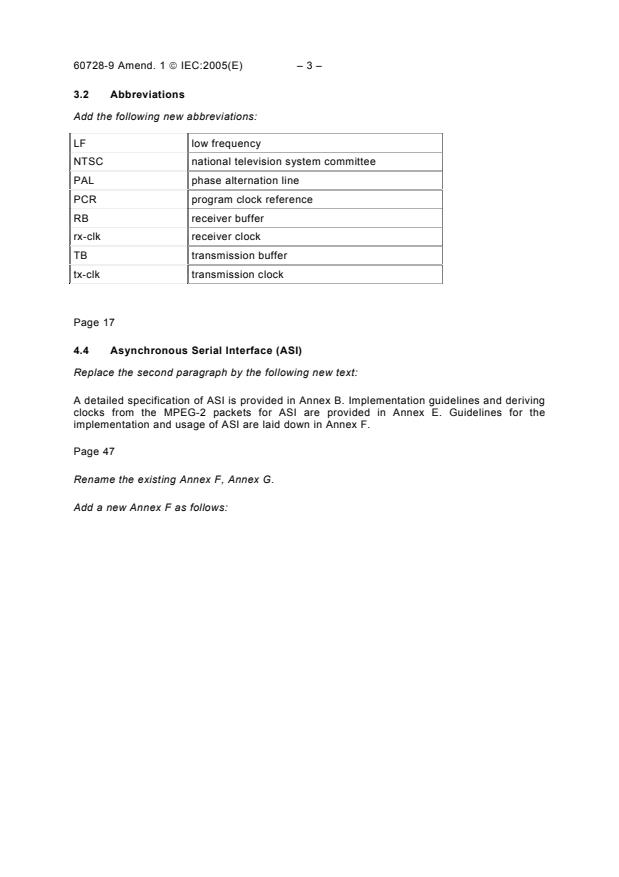
3.2 Abbreviations
Add the following new abbreviations:
LF low frequency
NTSC national television system committee
PAL phase alternation line
PCR program clock reference
RB receiver buffer
rx-clk receiver clock
TB transmission buffer
tx-clk transmission clock
Page 17
4.4 Asynchronous Serial Interface (ASI)
Replace the second paragraph by the following new text:
A detailed specification of ASI is provided in Annex B. Implementation guidelines and deriving
clocks from the MPEG-2 packets for ASI are provided in Annex E. Guidelines for the
implementation and usage of ASI are laid down in Annex F.
Page 47
Rename the existing Annex F, Annex G.
Add a new Annex F as follows:
– 4 – 60728-9 Amend. 1 IEC:2005(E)
Annex F
(informative)
Guidelines for the implementation and usage of
the DVB Asynchronous Serial Interface
F.1 General
The DVB Asynchronous Serial Interface (ASI) is a very popular standard interface for
conveying MPEG-2 transport streams between professional equipment. However, there are
concerns over interoperability in the market place, based on system integrators’ experiences
with available equipment from multiple suppliers. This note is intended to explain some of the
causes of problems and to offer guidelines to ASI implementers that will encourage maximum
interoperability.
This annex addresses interoperability issues specific to ASI data transmission links, and
explicitly is not concerned with general MPEG-2 interoperability issues.
An example of an ASI interoperability problem is where equipment receiving an ASI data
stream occasionally drops out of lock, or never achieves lock at all.
An example of a problem not addressed by these guidelines is where the video and audio on
the output of a decoder have poor clock stability, because of PCR clock recovery problems at
some point in the end-to-end equipment chain, for example resulting in LF wander in a
regenerated PAL/NTSC subcarrier.
This annex contains a clause providing a description of the design issues confronting ASI
equipment designers (Clause F.2). This annex also contains a recommendation clause, which
provides simple measures to improve interoperability between ASI equipment. There may be
situations where systems will work outside these recommendations, depending on precise
system and equipment implementation.
F.2 ASI transmission links
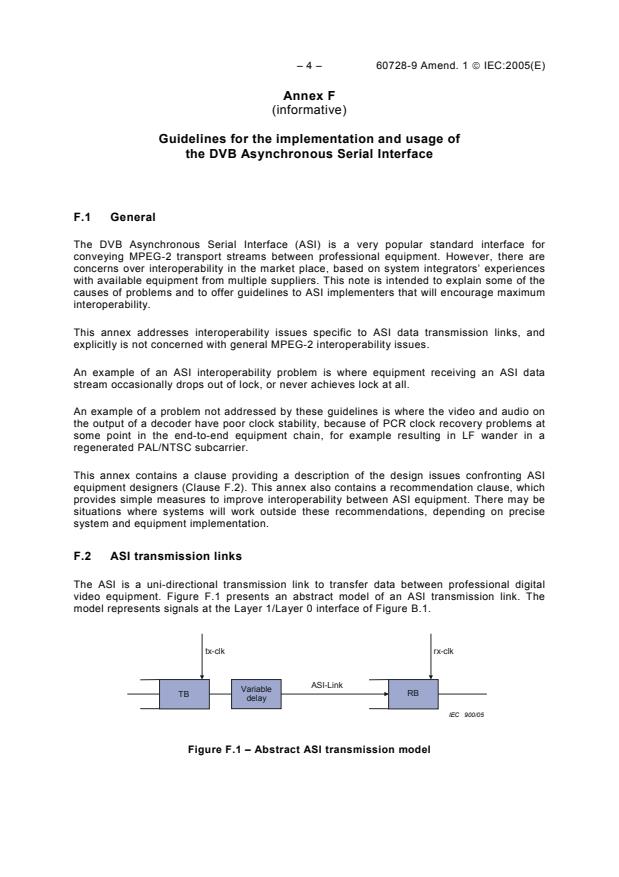
The ASI is a uni-directional transmission link to transfer data between professional digital
video equipment. Figure F.1 presents an abstract model of an ASI transmission link. The
model represents signals at the Layer 1/Layer 0 interface of Figure B.1.
tx-clk rx-clk
ASI-Link
Variable
TB RB
delay
IEC 900/05
Figure F.1 – Abstract ASI transmission model
60728-9 Amend. 1 IEC:2005(E) – 5 –
The diagram contains an ASI transmission node, where data are held in a transmission buffer
TB. Data are read from this buffer at a constant rate determined by the transmission clock
(tx-clk). This generates an isochronous data stream. One should keep in mind that the ASI is
asynchronous. This gives implementers the freedom to deviate from isochronous data
delivery. The diagram models this explicitly by including a “variable delay” function. The
modified stream is transported over the ASI link to arrive at the receiver buffer RB. Data are
removed from this buffer at a constant rate, determined by the receiver clock (rx-clk).
The abstract ASI delivery model is used to make sure that the isochronous output stream from
the receiver buffer is similar to the isochronous input stream to the variable delay function.
A design issue in this transmission model is that bytes need to be removed from the receiver
buffer at a high enough data rate. To achieve this, the receiver clock frequency needs to be
equal to or greater than the transmission clock frequency. If this is not the case, the receiver
buffer will overflow.
It is assumed that the receiver clock is linked to the transmission clock, but is silent about
how to achieve this in practice.
When the receiver clock is linked to the transmission clock, the remaining design issue is to
remove any aperiodicity introduced in the isochronous data stream. On the ASI link, the bytes
can be displaced in time with respect to their isochronous position. This displacement can
occur for a variety of reasons, for example technical convenience at the generating end of the
link. The ASI specification allows for unlimited time displacement of data bytes. To improve
interoperability, ASI implementations need to be sub
...