

IEC/IEEE 61886-1:2021
(Main)Subsea equipment - Part 1: Power connectors, penetrators and jumper assemblies with rated voltage from 3 kV (Umax = 3,6 kV) to 30 kV (Umax = 36 kV)
General Information
- Abstract
IEC/IEEE 61886-1:2021 is applicable to single and three-phase wet-mateable and dry-mateable AC connectors, penetrators and jumper assemblies with rated voltages from 3 kV (Umax = 3,6 kV) to 30 kV (Umax = 36 kV). This document relates to the requirements and tests for products in the "as manufactured and supplied" condition. This document is not applicable to requirements and tests for products that have been subsequently installed, deployed or retrieved.
- Status
- Published
- Publication Date
- 19-Apr-2021
- Drafting Committee
- JWG 31 - TC 18/JWG 31
- Current Stage
- PPUB - Publication issued
- Start Date
- 20-Apr-2021
- Completion Date
- 28-Aug-2026
Buy Documents
IEC/IEEE 61886-1:2021 - Subsea equipment - Part 1: Power connectors, penetrators and jumper assemblies with rated voltage from 3 kV (U<sub>max</sub> = 3,6 kV) to 30 kV (U<sub>max</sub> = 36 kV) Released:4/20/2021
Overview
IEC/IEEE 61886-1:2021 provides standardized requirements for subsea equipment, specifically focusing on power connectors, penetrators, and jumper assemblies intended for electrically connecting various components in subsea environments. The standard covers both single-phase and three-phase wet-mateable and dry-mateable AC connectors, penetrators, and jumper assemblies with rated voltages from 3 kV (Umax = 3.6 kV) to 30 kV (Umax = 36 kV). It addresses the requirements and testing methodologies for these products in their "as manufactured and supplied" state, ensuring reliability and safety prior to installation or deployment.
Key benefits of adopting IEC/IEEE 61886-1:2021 include enhanced interoperability, safety, and performance of critical subsea power distribution systems, crucial in offshore oil and gas, renewable energy, and other underwater applications.
Key Topics
This international standard covers several important topics related to subsea power equipment:
Design and Construction Requirements
- General and specific design criteria for connectors, penetrators, and jumper assemblies
- Electrical and mechanical performance characteristics
- Pressure classes and rapid gas decompression considerations
- Material selection and certification processes
- Requirements for wet-mateable and dry-mateable connectors
Documentation and Marking
- Design, type, and routine test documentation
- Equipment marking for traceability and proper identification
Testing and Verification
- Routine, sample, type, and special tests ensuring conformance to safety and performance benchmarks
- Electrical, mechanical, environmental, and endurance testing to confirm robustness under subsea conditions
- Hyperbaric, thermal, and pressure cycling tests replicating operational environments
Sealing and Pressure Integrity
- Specific criteria for water seals and pressure integrity seals
- Tests for primary and secondary pressure seals to prevent leakage and ensure long-term system reliability
Applications
The standard is highly relevant for organizations involved in the design, manufacture, and deployment of subsea power systems, including:
Offshore Oil & Gas Platforms
- Ensuring safe and reliable electrical connections between subsea production equipment such as pumps, valves, and control systems
Renewable Marine Energy
- Establishing durable connections in offshore wind farms, wave and tidal energy generators
Subsea Infrastructure
- Powering remotely operated vehicles (ROVs), communication nodes, and autonomous underwater systems
Marine Research and Defense
- Supporting subsea electrical distribution for scientific equipment and naval installations
IEC/IEEE 61886-1:2021 helps ensure that subsea power connections maintain high performance and safety over their service life, reducing risks of failure and unscheduled maintenance in challenging underwater settings.
Related Standards
For comprehensive system compatibility and regulatory alignment, consider these related standards:
- IEC 60502 - Power cables with extruded insulation and their accessories for rated voltages
- IEC 60840 - Power cables with extruded insulation and their accessories for rated voltages above 30 kV
- ISO 13628 (API 17F) - Design and operation of subsea production systems
- IEEE 1580 - Marine cable standards for shipboard and offshore applications
Adhering to IEC/IEEE 61886-1:2021 can assist manufacturers and operators in meeting global industry requirements for subsea electrical equipment, promoting safe, reliable, and efficient underwater energy delivery solutions.
Buy Documents
IEC/IEEE 61886-1:2021 - Subsea equipment - Part 1: Power connectors, penetrators and jumper assemblies with rated voltage from 3 kV (U<sub>max</sub> = 3,6 kV) to 30 kV (U<sub>max</sub> = 36 kV) Released:4/20/2021
Get Certified
Connect with accredited certification bodies for this standard

DNV
DNV is an independent assurance and risk management provider.

Lloyd's Register
Lloyd's Register is a global professional services organisation specialising in engineering and technology.

FSC International
Forest Stewardship Council certification.
Sponsored listings
Frequently Asked Questions
IEC/IEEE 61886-1:2021 is a standard published by the International Electrotechnical Commission (IEC). Its full title is "Subsea equipment - Part 1: Power connectors, penetrators and jumper assemblies with rated voltage from 3 kV (U<sub>max</sub> = 3,6 kV) to 30 kV (U<sub>max</sub> = 36 kV)". This standard covers: IEC/IEEE 61886-1:2021 is applicable to single and three-phase wet-mateable and dry-mateable AC connectors, penetrators and jumper assemblies with rated voltages from 3 kV (Umax = 3,6 kV) to 30 kV (Umax = 36 kV). This document relates to the requirements and tests for products in the "as manufactured and supplied" condition. This document is not applicable to requirements and tests for products that have been subsequently installed, deployed or retrieved.
IEC/IEEE 61886-1:2021 is applicable to single and three-phase wet-mateable and dry-mateable AC connectors, penetrators and jumper assemblies with rated voltages from 3 kV (Umax = 3,6 kV) to 30 kV (Umax = 36 kV). This document relates to the requirements and tests for products in the "as manufactured and supplied" condition. This document is not applicable to requirements and tests for products that have been subsequently installed, deployed or retrieved.
IEC/IEEE 61886-1:2021 is classified under the following ICS (International Classification for Standards) categories: 47.020.60 - Electrical equipment of ships and of marine structures. The ICS classification helps identify the subject area and facilitates finding related standards.
IEC/IEEE 61886-1:2021 is available in PDF format for immediate download after purchase. The document can be added to your cart and obtained through the secure checkout process. Digital delivery ensures instant access to the complete standard document.
Standards Content (Sample)
IEC/IEEE 61886-1 ®
Edition 1.0 2021-04
INTERNATIONAL
STANDARD
colour
inside
Subsea equipment –
Part 1: Power connectors, penetrators and jumper assemblies with rated voltage
from 3 kV (U = 3,6 kV) to 30 kV (U = 36 kV)
max max
All rights reserved. Unless otherwise specified, no part of this publication may be reproduced or utilized in any form or
by any means, electronic or mechanical, including photocopying and microfilm, without permission in writing being
secured. Requests for permission to reproduce should be addressed to either IEC at the address below or IEC’s
member National Committee in the country of the requester or from IEEE.
IEC Central Office Institute of Electrical and Electronics Engineers, Inc.
3, rue de Varembé 3 Park Avenue
CH-1211 Geneva 20 New York, NY 10016-5997
Switzerland United States of America
Tel.: +41 22 919 02 11 stds.ipr@ieee.org
info@iec.ch www.ieee.org
www.iec.ch
About the IEC
The International Electrotechnical Commission (IEC) is the leading global organization that prepares and publishes
International Standards for all electrical, electronic and related technologies.
About the IEEE
IEEE is the world’s largest professional association dedicated to advancing technological innovation and excellence for the
benefit of humanity. IEEE and its members inspire a global community through its highly cited publications, conferences,
technology standards, and professional and educational activities.
About IEC/IEEE publications
The technical content of IEC/IEEE publications is kept under constant review by the IEC and IEEE. Please make sure that
you have the latest edition, a corrigendum or an amendment might have been published.
IEC publications search - webstore.iec.ch/advsearchform IEC online collection - oc.iec.ch
The advanced search enables to find IEC publications by a Discover our powerful search engine and read freely all the
variety of criteria (reference number, text, technical publications previews. With a subscription you will always have
committee, …). It also gives information on projects, replaced access to up to date content tailored to your needs.
and withdrawn publications.
Electropedia - www.electropedia.org
IEC Just Published - webstore.iec.ch/justpublished
The world's leading online dictionary on electrotechnology,
Stay up to date on all new IEC publications. Just Published
containing more than 22 000 terminological entries in English
details all new publications released. Available online and once
and French, with equivalent terms in 18 additional languages.
a month by email.
Also known as the International Electrotechnical Vocabulary
(IEV) online.
IEC Customer Service Centre - webstore.iec.ch/csc
If you wish to give us your feedback on this publication or need
further assistance, please contact the Customer Service
Centre: sales@iec.ch.
IEC/IEEE 61886-1 ®
Edition 1.0 2021-04
INTERNATIONAL
STANDARD
colour
inside
Subsea equipment –
Part 1: Power connectors, penetrators and jumper assemblies with rated
voltage from 3 kV (Umax = 3,6 kV) to 30 kV (Umax = 36 kV)
INTERNATIONAL
ELECTROTECHNICAL
COMMISSION
ICS 47.020.60 ISBN 978-2-8322-9623-3
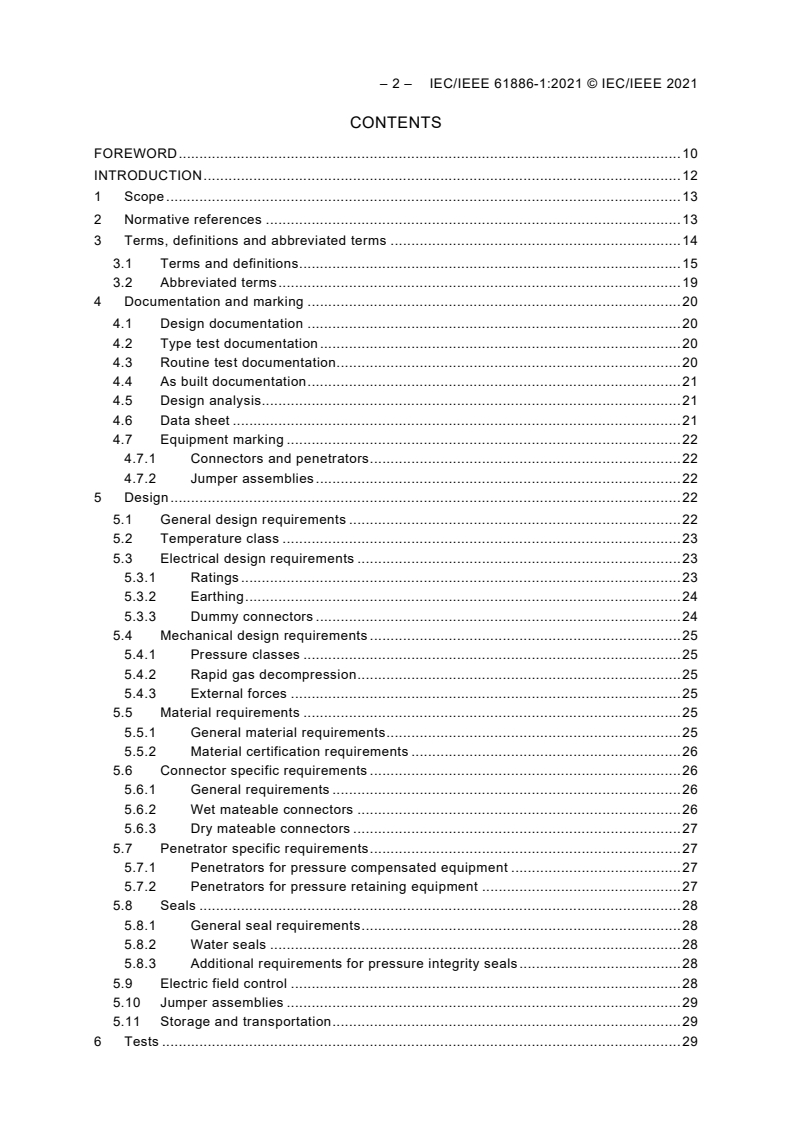
– 2 – IEC/IEEE 61886-1:2021 © IEC/IEEE 2021
CONTENTS
FOREWORD . 10
INTRODUCTION . 12
1 Scope . 13
2 Normative references . 13
3 Terms, definitions and abbreviated terms . 14
3.1 Terms and definitions . 15
3.2 Abbreviated terms . 19
4 Documentation and marking . 20
4.1 Design documentation . 20
4.2 Type test documentation . 20
4.3 Routine test documentation . 20
4.4 As built documentation . 21
4.5 Design analysis. 21
4.6 Data sheet . 21
4.7 Equipment marking . 22
4.7.1 Connectors and penetrators . 22
4.7.2 Jumper assemblies . 22
5 Design . 22
5.1 General design requirements . 22
5.2 Temperature class . 23
5.3 Electrical design requirements . 23
5.3.1 Ratings . 23
5.3.2 Earthing . 24
5.3.3 Dummy connectors . 24
5.4 Mechanical design requirements . 25
5.4.1 Pressure classes . 25
5.4.2 Rapid gas decompression . 25
5.4.3 External forces . 25
5.5 Material requirements . 25
5.5.1 General material requirements . 25
5.5.2 Material certification requirements . 26
5.6 Connector specific requirements . 26
5.6.1 General requirements . 26
5.6.2 Wet mateable connectors . 26
5.6.3 Dry mateable connectors . 27
5.7 Penetrator specific requirements . 27
5.7.1 Penetrators for pressure compensated equipment . 27
5.7.2 Penetrators for pressure retaining equipment . 27
5.8 Seals . 28
5.8.1 General seal requirements . 28
5.8.2 Water seals . 28
5.8.3 Additional requirements for pressure integrity seals . 28
5.9 Electric field control . 28
5.10 Jumper assemblies . 29
5.11 Storage and transportation . 29
6 Tests . 29
6.1 Structure of test clauses . 29
6.2 General test requirements . 29
6.3 Artificial sea water . 30
6.4 Test media . 30
7 Routine tests – Connectors and penetrators . 33
8 Routine tests – Dummy and test connectors . 34
9 Routine tests – Jumper assemblies . 34
10 Sample tests – Hoses . 35
11 Type and special tests – Connectors and penetrators . 35
11.1 Order of tests and type test requirements . 35
11.2 Type tests – Dummy and test connectors . 38
11.3 Type tests – New interface cable . 38
11.4 Prototype manufacturing acceptance test . 39
11.4.1 Objective . 39
11.4.2 Sequence . 39
11.4.3 Acceptance criteria . 39
11.5 Electrical and thermal tests . 40
11.5.1 Objective . 40
11.5.2 Sequence . 40
11.5.3 Acceptance criteria . 41
11.6 Electrical short circuit test . 42
11.6.1 Objective . 42
11.6.2 Sequence . 42
11.6.3 Acceptance criteria . 42
11.7 Hyperbaric test . 42
11.7.1 Objective . 42
11.7.2 Sequence . 42
11.7.3 Acceptance criteria . 44
11.8 Pressure cycling test – Penetrators . 44
11.8.1 Objective . 44
11.8.2 Sequence . 44
11.8.3 Acceptance criteria . 45
11.9 Combined pressure and temperature cycling test – Penetrators . 45
11.9.1 Objective . 45
11.9.2 Sequence . 45
11.9.3 Acceptance criteria . 46
11.10 Rapid gas decompression test . 46
11.10.1 Objective . 46
11.10.2 Sequence . 46
11.10.3 Acceptance criteria . 47
11.11 Mechanical and environmental stress test . 47
11.11.1 Objective . 47
11.11.2 Sequence . 47
11.11.3 Acceptance criteria . 48
11.12 Endurance test – Connectors . 48
11.12.1 Objective . 48
11.12.2 Sequence . 48
11.12.3 Acceptance criteria . 49
– 4 – IEC/IEEE 61886-1:2021 © IEC/IEEE 2021
11.13 Endurance test – Penetrators . 49
11.13.1 Objective . 49
11.13.2 Sequence . 49
11.13.3 Acceptance criteria . 50
11.14 Inner water seal hyperbaric test – Connectors . 51
11.14.1 Objective . 51
11.14.2 Sequence . 51
11.14.3 Acceptance criteria . 51
11.15 Inner water seal pressure cycling test – Penetrators . 51
11.15.1 Objective . 51
11.15.2 Sequence . 51
11.15.3 Acceptance criteria . 51
11.16 Outer water seal hyperbaric test – Connectors . 51
11.16.1 Objective . 51
11.16.2 Sequence . 51
11.16.3 Acceptance criteria . 51
11.17 Outer water seal pressure cycling test – Penetrators. 52
11.17.1 Objective . 52
11.17.2 Sequence . 52
11.17.3 Acceptance criteria . 52
11.18 Secondary pressure integrity seal test – Penetrators . 52
11.18.1 Objective . 52
11.18.2 Sequence . 52
11.18.3 Acceptance criteria . 52
11.19 Primary pressure integrity seal test – Penetrators . 52
11.19.1 Objective . 52
11.19.2 Sequence . 52
11.19.3 Acceptance criteria . 52
11.20 Secondary pressure integrity seal combined pressure and temperature
cycling test – Penetrators . 53
11.20.1 Objective . 53
11.20.2 Sequence . 53
11.20.3 Acceptance criteria . 53
11.21 Primary pressure integrity seal combined pressure and temperature cycling
test – Penetrators . 53
11.21.1 Objective . 53
11.21.2 Sequence . 53
11.21.3 Acceptance criteria . 53
11.22 Extended hyperbaric wet mate test . 53
11.22.1 Objective . 53
11.22.2 Sequence . 53
11.22.3 Acceptance criteria . 55
12 Type tests – Hose and hose terminations . 55
12.1 General . 55
12.2 Absorption/compensation test . 56
12.2.1 Objective . 56
12.2.2 Method . 56
12.2.3 Acceptance criteria . 56
12.3 Ozone resistance . 57
12.3.1 Objective . 57
12.3.2 Method . 57
12.3.3 Acceptance criteria . 57
12.4 Ultraviolet resistance . 57
12.4.1 Objective . 57
12.4.2 Method . 57
12.4.3 Acceptance criteria . 57
12.5 Thermal shock test. 58
12.5.1 Objective . 58
12.5.2 Method . 58
12.5.3 Acceptance criteria . 58
12.6 Destructive testing . 58
12.6.1 Tensile failure . 58
12.6.2 Burst pressure . 59
12.6.3 Crush resistance. 59
12.6.4 Outer sheath abrasion resistance . 60
12.6.5 Hose kink test . 60
13 Type tests – Jumper assemblies . 61
13.1 General . 61
13.2 Electrical and thermal type test – Jumper assemblies . 61
13.2.1 Objective . 61
13.2.2 Sequence . 61
13.2.3 Acceptance criteria . 62
13.3 Oscillating jumper test . 62
13.3.1 Objective . 62
13.3.2 Sequence . 62
13.3.3 Acceptance criteria . 63
13.4 Jumper pull test . 63
13.4.1 Objective . 63
13.4.2 Sequence . 63
13.4.3 Acceptance criteria . 64
13.5 Drop test . 64
13.5.1 Objective . 64
13.5.2 Sequence . 64
13.5.3 Acceptance criteria . 64
13.6 Jumper handling simulation test . 64
13.6.1 Objective . 64
13.6.2 Sequence . 64
13.6.3 Acceptance criteria . 66
13.7 Jumper simulated deployment test . 66
13.7.1 Objective . 66
13.7.2 Sequence . 66
13.7.3 Acceptance criteria . 67
14 Test procedures . 67
14.1 Helium leak test . 67
14.1.1 Objective . 67
14.1.2 Method . 68
14.1.3 Acceptance criteria . 68
14.2 Contact resistance test . 68
– 6 – IEC/IEEE 61886-1:2021 © IEC/IEEE 2021
14.2.1 Objective . 68
14.2.2 Method . 68
14.2.3 Acceptance criteria . 68
14.3 Shell continuity test . 69
14.3.1 Objective . 69
14.3.2 Method . 69
14.3.3 Acceptance criteria . 69
14.4 Screen continuity test . 69
14.4.1 Objective . 69
14.4.2 Method . 69
14.4.3 Acceptance criteria . 69
14.5 Partial discharge test . 69
14.5.1 Objective . 69
14.5.2 Method . 69
14.5.3 Acceptance criteria . 70
14.6 High voltage AC test . 70
14.6.1 Objective . 70
14.6.2 Method . 70
14.6.3 Acceptance criteria . 70
14.7 Impulse withstand voltage test . 70
14.7.1 Objective . 70
14.7.2 Method . 70
14.7.3 Acceptance criteria . 70
14.8 Insulation resistance test . 71
14.8.1 Objective . 71
14.8.2 Method . 71
14.8.3 Acceptance criteria . 71
14.9 Thermal shock test. 71
14.9.1 Objective . 71
14.9.2 Method . 71
14.9.3 Acceptance criteria . 72
14.10 Thermal short circuit test . 72
14.10.1 Objective . 72
14.10.2 Method . 72
14.10.3 Acceptance criteria . 72
14.11 Dynamic short circuit test . 72
14.11.1 Objective . 72
14.11.2 Method . 72
14.11.3 Acceptance criteria . 72
14.12 Temperature rise test . 73
14.12.1 Objective . 73
14.12.2 Method . 73
14.12.3 Acceptance criteria . 73
14.13 Extended temperature rise test . 74
14.13.1 Objective . 74
14.13.2 Method . 74
14.13.3 Acceptance criteria . 75
14.14 Thermal cycling. 75
14.14.1 Objective . 75
14.14.2 Method . 75
14.14.3 Acceptance criteria . 76
14.15 Bending moment and free fall tests . 76
14.15.1 Objective . 76
14.15.2 Method . 76
14.15.3 Acceptance criteria . 76
14.16 Static pressure test – Penetrators . 77
14.16.1 Objective . 77
14.16.2 Method . 77
14.16.3 Acceptance criteria . 77
14.17 Extended static pressure test – Penetrators . 78
14.17.1 Objective . 78
14.17.2 Method . 78
14.17.3 Acceptance criteria . 78
14.18 Combined pressure and temperature cycling test – Pressure retaining
penetrators . 78
14.18.1 Objective . 78
14.18.2 Method . 78
14.18.3 Acceptance criteria . 78
14.19 Shock and vibration test . 78
14.19.1 Objective . 78
14.19.2 Method . 78
14.19.3 Acceptance criteria . 79
14.20 Cleaning and spillage test . 79
14.20.1 Objective . 79
14.20.2 Method . 79
14.20.3 Acceptance criteria . 79
14.21 Conductor pull test . 79
14.21.1 Objective . 79
14.21.2 Method . 80
14.21.3 Acceptance criteria . 80
14.22 Cable pull test . 80
14.22.1 Objective . 80
14.22.2 Method . 80
14.22.3 Acceptance criteria . 80
14.23 Cable termination bending test . 80
14.23.1 Objective . 80
14.23.2 Method . 80
14.23.3 Acceptance criteria . 80
14.24 Mate/de-mate operation test . 81
14.24.1 Objective . 81
14.24.2 Method . 81
14.24.3 Acceptance criteria . 81
14.25 Dismantling and examination . 81
14.25.1 Objective . 81
14.25.2 Method . 81
14.25.3 Acceptance criteria . 81
14.26 High voltage breakdown test . 82
14.26.1 Objective . 82
– 8 – IEC/IEEE 61886-1:2021 © IEC/IEEE 2021
14.26.2 Method . 82
14.26.3 Acceptance criteria . 82
14.27 Rapid gas decompression (RGD) test – General . 82
14.27.1 Objective . 82
14.27.2 Method . 82
14.27.3 Acceptance criteria . 82
14.28 Material testing . 83
14.28.1 Objective . 83
14.28.2 General test requirements . 83
14.28.3 Polymeric materials test requirements . 83
14.28.4 Acceptance criteria . 84
Annex A (informative) Connector assembly data sheet . 85
Annex B (informative) Penetrator figures . 88
Bibliography . 96
Figure 1 – Jumper handling simulation test . 66
Figure 2 – Typical extended temperature test results, method 1 . 74
Figure 3 – Typical extended temperature test results, method 2 . 75
Figure 4 – Bending moment test . 76
Figure B.1 – Penetrator flange view . 88
Figure B.2 – Pressure retaining penetrator – Definitions . 89
Figure B.3 – Test set-up, pressure retaining penetrator – Direction 1 . 90
Figure B.4 – Test set-up, pressure retaining penetrator – Direction 2 . 91
Figure B.5 – Penetrator for pressure balanced conditions – Definitions . 92
Figure B.6 – Test set-up, penetrator for pressure balanced conditions – Test of
absolute pressure . 93
Figure B.7 – Test set-up, penetrator for pressure balanced conditions – Direction 1 . 94
Figure B.8 – Test set-up, penetrator for pressure balanced conditions – Direction 2 . 95
Table 1 – Design documentation . 20
Table 2 – Routine test documentation . 20
Table 3 – As built documentation . 21
Table 4 – Temperature classes . 23
Table 5 – Voltage ratings . 23
Table 6 – Current ratings . 24
Table 7 – Pressure classes . 25
Table 8 – Test media . 31
Table 9 – Electrical routine tests . 33
Table 10 – Routine test sequence – Connectors and penetrators . 33
Table 11 – Routine test sequence – Complete jumper assemblies . 34
Table 12 – Type test sequence . 36
Table 13 – Intermediate electrical tests . 37
Table 14 – Type test sequence – New interface cable . 38
Table 15 – Prototype manufacturing acceptance test sequence . 39
Table 16 – Electrical and thermal test sequence – Connectors . 40
---------------------- Page
...