

IEC 63098-4:2023
(Main)Transmitting and receiving equipment for radiocommunication - Radio-over-fibre technologies and their performance standard - Part 4: Radio-over-fibre-based indoor distributed antenna system (DAS) for 5G
General Information
- Abstract
IEC 63098-4:2023 provides the performance standards of the RoF-based 5G indoor distributed antenna system (DAS) network for cost-effectively offering quality of service (QoS) guaranteed 5G mobile communication services with high bandwidth and low-latency characteristics without radio shadowing in an indoor environment. First of all, the system overview, system configurations, and the elements of the system are presented and then the electrical and optical interfaces for each system element are defined. Finally, the detail system performance specifications of each element are described for downlink and uplink configurations.
- Status
- Published
- Publication Date
- 22-May-2023
- Technical Committee
- TC 103 - Transmitting and receiving equipment for radiocommunication
- Drafting Committee
- WG 6 - TC 103/WG 6
- Current Stage
- PPUB - Publication issued
- Start Date
- 23-May-2023
- Completion Date
- 16-Jun-2023
Buy Documents
IEC 63098-4:2023 - Transmitting and receiving equipment for radiocommunication - Radio-over-fibre technologies and their performance standard - Part 4: Radio-over-fibre-based indoor distributed antenna system (DAS) for 5G Released:5/23/2023
Overview
IEC 63098-4:2023 is an international performance standard developed by the International Electrotechnical Commission (IEC) for radio-over-fibre (RoF) based indoor distributed antenna systems (DAS) designed specifically for 5G wireless networks. This standard provides essential guidelines and requirements for achieving robust, high-bandwidth, and low-latency 5G mobile communication services indoors, effectively eliminating issues such as radio shadowing that often occur in complex environments.
The document outlines the system overview, configurations, key components, and electrical and optical interfaces of RoF-based DAS for 5G, as well as performance specifications for both uplink and downlink operation. IEC 63098-4:2023 aims to support cost-effective network deployment, ensuring quality of service (QoS) for advanced indoor 5G applications.
Keywords: IEC 63098-4, radio-over-fibre, 5G DAS, indoor wireless, distributed antenna systems, QoS, high bandwidth, low latency, performance standard.
Key Topics
System Architecture:
IEC 63098-4 details the RoF-based DAS structure, consisting primarily of the Main Hub Unit (MHU) and Remote Antenna Units (RAUs). The MHU serves as the link between the 5G base station and multiple RAUs distributed throughout the indoor environment.Configurations:
The standard describes two primary system configurations:- Point-to-Point: Each MHU connects directly to a single RAU, suitable for smaller coverage areas.
- Point-to-Multipoint: One MHU connects to multiple RAUs through distribution points, enabling broad and seamless network coverage across larger venues.
Interfaces:
- Electrical Interfaces: Defined for 5G signal transport, synchronization, TDD operation, and system management.
- Optical Interfaces: Utilized for the transmission of IF-based data signals and digital-based auxiliary signals (e.g., control/management, synchronization) via Coarse Wavelength Division Multiplexing (CWDM).
Performance Specifications:
System performance criteria, including frequency bands, bandwidth, gain, noise floor, and maximum optical link loss, are established for both downlink (MHU to RAU) and uplink (RAU to MHU) signal paths, ensuring reliable and high-quality 5G mobile service.Environmental and Safety Requirements:
The standard incorporates provisions for device safety, laser operation (IEC 60825-1), and operating temperature ranges to assure robust, compliant installations.
Applications
Implementing IEC 63098-4:2023 enables network operators, system integrators, and facility managers to:
- Enhance Indoor 5G Coverage: Overcome the challenges of high-frequency signal penetration loss, providing uninterrupted 5G connectivity in buildings such as offices, airports, hospitals, shopping malls, and stadiums.
- Support High-Density Environments: Guarantee high bandwidth and low-latency performance, essential for venues with a high concentration of users and data demands.
- Ensure QoS for 5G Services: Maintain seamless connectivity for advanced wireless applications (e.g., IoT, augmented/virtual reality, real-time communications) by upholding defined quality of service parameters.
- Facilitate Scalable and Flexible Deployments: Utilize point-to-point or point-to-multipoint configurations to adapt to coverage needs and accommodate network expansion as user demand increases.
- Promote Cost-Effective Solutions: Leverage RoF technology to reduce redundancy and optimize network resources, simplifying deployment and maintenance in complex indoor environments.
Related Standards
For comprehensive implementation of indoor 5G DAS solutions, consider the following related international standards:
- IEC 60825-1: Safety of laser products - Requirements for equipment classification and operation
- IEC 60950-1: General safety requirements for information technology equipment
- IEC 62149-10:2018: Performance standards for Radio-over-Fibre transceivers for mobile fronthaul
- IEC 62803:2016: Frequency response measurement for optical-to-electric conversion in high-frequency RoF systems
- 3GPP TS 38.104: 5G NR base station radio transmission and reception specifications
- ITU-T G.9803: Radio-over-fibre systems standard
By aligning with IEC 63098-4:2023 and its related standards, stakeholders support the reliable delivery of next-generation indoor 5G wireless communication services, meeting both today’s and tomorrow’s connectivity demands.
Buy Documents
IEC 63098-4:2023 - Transmitting and receiving equipment for radiocommunication - Radio-over-fibre technologies and their performance standard - Part 4: Radio-over-fibre-based indoor distributed antenna system (DAS) for 5G Released:5/23/2023
Frequently Asked Questions
IEC 63098-4:2023 is a standard published by the International Electrotechnical Commission (IEC). Its full title is "Transmitting and receiving equipment for radiocommunication - Radio-over-fibre technologies and their performance standard - Part 4: Radio-over-fibre-based indoor distributed antenna system (DAS) for 5G". This standard covers: IEC 63098-4:2023 provides the performance standards of the RoF-based 5G indoor distributed antenna system (DAS) network for cost-effectively offering quality of service (QoS) guaranteed 5G mobile communication services with high bandwidth and low-latency characteristics without radio shadowing in an indoor environment. First of all, the system overview, system configurations, and the elements of the system are presented and then the electrical and optical interfaces for each system element are defined. Finally, the detail system performance specifications of each element are described for downlink and uplink configurations.
IEC 63098-4:2023 provides the performance standards of the RoF-based 5G indoor distributed antenna system (DAS) network for cost-effectively offering quality of service (QoS) guaranteed 5G mobile communication services with high bandwidth and low-latency characteristics without radio shadowing in an indoor environment. First of all, the system overview, system configurations, and the elements of the system are presented and then the electrical and optical interfaces for each system element are defined. Finally, the detail system performance specifications of each element are described for downlink and uplink configurations.
IEC 63098-4:2023 is classified under the following ICS (International Classification for Standards) categories: 31.240 - Mechanical structures for electronic equipment. The ICS classification helps identify the subject area and facilitates finding related standards.
IEC 63098-4:2023 is available in PDF format for immediate download after purchase. The document can be added to your cart and obtained through the secure checkout process. Digital delivery ensures instant access to the complete standard document.
Standards Content (Sample)
IEC 63098-4 ®
Edition 1.0 2023-05
INTERNATIONAL
STANDARD
colour
inside
Transmitting and receiving equipment for radiocommunication –
Radio‑over‑fibre technologies and their performance standard –
Part 4: Radio‑over‑fibre-based indoor distributed antenna system (DAS) for 5G
All rights reserved. Unless otherwise specified, no part of this publication may be reproduced or utilized in any form
or by any means, electronic or mechanical, including photocopying and microfilm, without permission in writing from
either IEC or IEC's member National Committee in the country of the requester. If you have any questions about IEC
copyright or have an enquiry about obtaining additional rights to this publication, please contact the address below or
your local IEC member National Committee for further information.
IEC Secretariat Tel.: +41 22 919 02 11
3, rue de Varembé info@iec.ch
CH-1211 Geneva 20 www.iec.ch
Switzerland
About the IEC
The International Electrotechnical Commission (IEC) is the leading global organization that prepares and publishes
International Standards for all electrical, electronic and related technologies.
About IEC publications
The technical content of IEC publications is kept under constant review by the IEC. Please make sure that you have the
latest edition, a corrigendum or an amendment might have been published.
IEC publications search - webstore.iec.ch/advsearchform IEC Products & Services Portal - products.iec.ch
The advanced search enables to find IEC publications by a Discover our powerful search engine and read freely all the
variety of criteria (reference number, text, technical publications previews. With a subscription you will always have
committee, …). It also gives information on projects, replaced access to up to date content tailored to your needs.
and withdrawn publications.
Electropedia - www.electropedia.org
IEC Just Published - webstore.iec.ch/justpublished
The world's leading online dictionary on electrotechnology,
Stay up to date on all new IEC publications. Just Published
containing more than 22 300 terminological entries in English
details all new publications released. Available online and once
and French, with equivalent terms in 19 additional languages.
a month by email.
Also known as the International Electrotechnical Vocabulary
(IEV) online.
IEC Customer Service Centre - webstore.iec.ch/csc
If you wish to give us your feedback on this publication or need
further assistance, please contact the Customer Service
Centre: sales@iec.ch.
IEC 63098-4 ®
Edition 1.0 2023-05
INTERNATIONAL
STANDARD
colour
inside
Transmitting and receiving equipment for radiocommunication –
Radio‑over‑fibre technologies and their performance standard –
Part 4: Radio‑over‑fibre-based indoor distributed antenna system (DAS) for 5G
INTERNATIONAL
ELECTROTECHNICAL
COMMISSION
ICS 31.240 ISBN 978-2-8322-6991-6
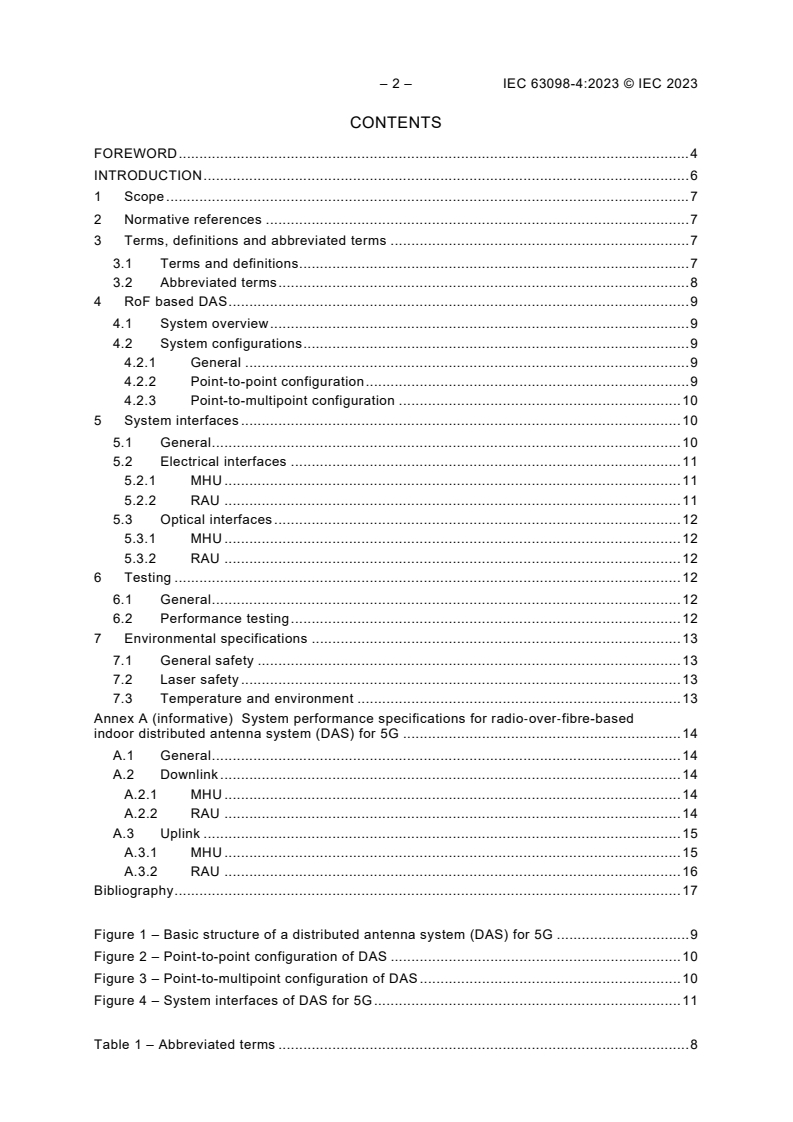
– 2 – IEC 63098-4:2023 © IEC 2023
CONTENTS
FOREWORD . 4
INTRODUCTION . 6
1 Scope . 7
2 Normative references . 7
3 Terms, definitions and abbreviated terms . 7
3.1 Terms and definitions . 7
3.2 Abbreviated terms . 8
4 RoF based DAS . 9
4.1 System overview . 9
4.2 System configurations . 9
4.2.1 General . 9
4.2.2 Point-to-point configuration . 9
4.2.3 Point-to-multipoint configuration . 10
5 System interfaces . 10
5.1 General . 10
5.2 Electrical interfaces . 11
5.2.1 MHU . 11
5.2.2 RAU . 11
5.3 Optical interfaces . 12
5.3.1 MHU . 12
5.3.2 RAU . 12
6 Testing . 12
6.1 General . 12
6.2 Performance testing . 12
7 Environmental specifications . 13
7.1 General safety . 13
7.2 Laser safety . 13
7.3 Temperature and environment . 13
Annex A (informative) System performance specifications for radio‑over‑fibre-based
indoor distributed antenna system (DAS) for 5G . 14
A.1 General . 14
A.2 Downlink . 14
A.2.1 MHU . 14
A.2.2 RAU . 14
A.3 Uplink . 15
A.3.1 MHU . 15
A.3.2 RAU . 16
Bibliography . 17
Figure 1 – Basic structure of a distributed antenna system (DAS) for 5G . 9
Figure 2 – Point-to-point configuration of DAS . 10
Figure 3 – Point-to-multipoint configuration of DAS . 10
Figure 4 – System interfaces of DAS for 5G . 11
Table 1 – Abbreviated terms . 8
Table 2 – Definitions and functions of the electrical interfaces of the MHU . 11
Table 3 – Definitions and functions of the electrical interfaces of the RAU . 11
Table 4 – Definitions and functions of the optical interfaces of the MHU . 12
Table 5 – Definitions and functions of the optical interfaces of the RAU . 12
Table A.1 – System performance specifications of the MHU for downlink . 14
Table A.2 – System performance specifications of the RAU for downlink . 15
Table A.3 – System performance specifications of the MHU for uplink . 15
Table A.4 – System performance specifications of the RAU for uplink . 16
– 4 – IEC 63098-4:2023 © IEC 2023
INTERNATIONAL ELECTROTECHNICAL COMMISSION
____________
TRANSMITTING AND RECEIVING EQUIPMENT
FOR RADIOCOMMUNICATION – RADIO‑OVER‑FIBRE
TECHNOLOGIES AND THEIR PERFORMANCE STANDARD –
Part 4: Radio‑over‑fibre-based indoor
distributed antenna system (DAS) for 5G
FOREWORD
1) The International Electrotechnical Commission (IEC) is a worldwide organization for standardization comprising
all national electrotechnical committees (IEC National Committees). The object of IEC is to promote international
co-operation on all questions concerning standardization in the electrical and electronic fields. To this end and
in addition to other activities, IEC publishes International Standards, Technical Specifications, Technical Reports,
Publicly Available Specifications (PAS) and Guides (hereafter referred to as “IEC Publication(s)”). Their
preparation is entrusted to technical committees; any IEC National Committee interested in the subject dealt with
may participate in this preparatory work. International, governmental and non-governmental organizations liaising
with the IEC also participate in this preparation. IEC collaborates closely with the International Organization for
Standardization (ISO) in accordance with conditions determined by agreement between the two organizations.
2) The formal decisions or agreements of IEC on technical matters express, as nearly as possible, an international
consensus of opinion on the relevant subjects since each technical committee has representation from all
interested IEC National Committees.
3) IEC Publications have the form of recommendations for international use and are accepted by IEC National
Committees in that sense. While all reasonable efforts are made to ensure that the technical content of IEC
Publications is accurate, IEC cannot be held responsible for the way in which they are used or for any
misinterpretation by any end user.
4) In order to promote international uniformity, IEC National Committees undertake to apply IEC Publications
transparently to the maximum extent possible in their national and regional publications. Any divergence between
any IEC Publication and the corresponding national or regional publication shall be clearly indicated in the latter.
5) IEC itself does not provide any attestation of conformity. Independent certification bodies provide conformity
assessment services and, in some areas, access to IEC marks of conformity. IEC is not responsible for any
services carried out by independent certification bodies.
6) All users should ensure that they have the latest edition of this publication.
7) No liability shall attach to IEC or its directors, employees, servants or agents including individual experts and
members of its technical committees and IEC National Committees for any personal injury, property damage or
other damage of any nature whatsoever, whether direct or indirect, or for costs (including legal fees) and
expenses arising out of the publication, use of, or reliance upon, this IEC Publication or any other IEC
Publications.
8) Attention is drawn to the Normative references cited in this publication. Use of the referenced publications is
indispensable for the correct application of this publication.
9) Attention is drawn to the possibility that some of the elements of this IEC Publication may be the subject of patent
rights. IEC shall not be held responsible for identifying any or all such patent rights.
IEC 63098-4 has been prepared by IEC technical committee 103: Transmitting and receiving
equipment for radiocommunication. It is an International Standard.
The text of this International Standard is based on the following documents:
Draft Report on voting
103/253/FDIS 103/254/RVD
Full information on the voting for its approval can be found in the report on voting indicated in
the above table.
The language used for the development of this International Standard is English.
This document was drafted in accordance with ISO/IEC Directives, Part 2, and developed in
accordance with ISO/IEC Directives, Part 1 and ISO/IEC Directives, IEC Supplement, available
at www.iec.ch/members_experts/refdocs. The main document types developed by IEC are
described in greater detail at www.iec.ch/publications.
A list of all parts in the IEC 63098 series, published under the general title Transmitting and
receiving equipment for radiocommunication – Radio‑over-fibre technologies and their
performance standard, can be found on the IEC website.
Future documents in this series will carry the new general title as cited above. Titles of existing
documents in this series will be updated at the time of the next edition.
The committee has decided that the contents of this document will remain unchanged until the
stability date indicated on the IEC website under webstore.iec.ch in the data related to the
specific document. At this date, the document will be
• reconfirmed,
• withdrawn,
• replaced by a revised edition, or
• amended.
IMPORTANT – The "colour inside" logo on the cover page of this document indicates that it
contains colours which are considered to be useful for the correct understanding of its
contents. Users should therefore print this document using a colour printer.
– 6 – IEC 63098-4:2023 © IEC 2023
INTRODUCTION
This document provides the performance standards of the RoF-based 5G indoor distributed
antenna system (DAS) network for cost-effectively offering quality of service (QoS) guaranteed
5G mobile communication services with high bandwidth and low-latency characteristics without
radio shadowing in an indoor environment. First of all, the system overview, system
configurations, and the elements of the system are presented and then the electrical and optical
interfaces for each system element are defined. Finally, the detail system performance
specifications of each element are described for downlink and uplink configurations.
TRANSMITTING AND RECEIVING EQUIPMENT
FOR RADIOCOMMUNICATION – RADIO‑OVER‑FIBRE
TECHNOLOGIES AND THEIR PERFORMANCE STANDARD –
Part 4: Radio‑over‑fibre-based indoor
distributed antenna system (DAS) for 5G
1 Scope
This part of IEC 63098 specifies a radio-over-fibre-based indoor distributed antenna system
(DAS) for fifth generation wireless technology 5G.
2 Normative references
The following documents are referred to in the text in such a way that some or all of their content
constitutes requirements of this document. For dated references, only the edition cited applies.
For undated references, the latest edition of the referenced document (including any
amendments) applies.
IEC 60825-1, Safety of laser products – Part 1: Equipment classification and requirements
IEC 60950-1, Information technology equipment – Safety – Part 1: General requirements
3GPP TS 38.104 V15.3.0 (2018-10), 5G; NR; Base Station (BS) radio transmission and
reception
3 Terms, definitions and abbreviated terms
3.1 Terms and definitions
For the purposes of this document, the following terms and definitions apply.
ISO and IEC maintain terminology databases for use in standardization at the following
addresses:
• IEC Electropedia: available at https://www.electropedia.org/
• ISO Onlin
...