

IEC 60079-2:2007
(Main)Explosive atmospheres - Part 2: Equipment protection by pressurized enclosures "p"
General Information
- Abstract
This part of IEC 60079 contains the specific requirements for the construction and testing of electrical apparatus with pressurized enclosures, of type of protection "p", intended for use in explosive gas atmospheres. It specifies requirements for pressurized enclosures containing a limited release of a flammable substance. The significant changes with respect to the previous edition is the introduction of the "Equipment protection level concept".
- Status
- Published
- Publication Date
- 21-Feb-2007
- Technical Committee
- TC 31 - Equipment for explosive atmospheres
- Current Stage
- DELPUB - Deleted Publication
- Start Date
- 21-Jul-2014
- Completion Date
- 28-Aug-2026
Overview
IEC 60079-2:2007 is an international standard developed by the International Electrotechnical Commission (IEC) dedicated to the safety of electrical equipment used in explosive gas atmospheres. This part 2 of the IEC 60079 series focuses specifically on equipment protection by pressurized enclosures, designated by the protection type "p". The standard outlines detailed construction and testing requirements for electrical apparatus enclosed within pressurized housings to prevent ignition of surrounding explosive environments.
A significant update in this edition was the introduction of the Equipment Protection Level (EPL) concept, aimed at aligning equipment design and testing with safety levels required by hazardous locations.
Key Topics
The standard covers a comprehensive range of technical requirements and safety considerations, including:
- Scope and Applicability: Defines use conditions for electrical devices with pressurized enclosures operating in explosive gas atmospheres.
- Constructional Requirements: Materials, mechanical strength, design of doors, covers, partitions, and sealing needed to maintain pressurization and prevent explosive ignition.
- Pressurization Modes: Distinguishes between static and dynamic pressurization techniques, including compensation of leaks and continuous purge flows.
- Temperature Limits: Specifies maximum allowable surface temperatures to avoid ignition risks.
- Safety Devices: Requirements for sensors and control systems to detect overpressure, maintain pressurization integrity, and manage potential internal flammable releases.
- Testing and Verification: Procedures for type testing, leak tests, overpressure testing, and functional checks on pressurized enclosures.
- Internal Sources of Flammable Substances: Guidelines for managing limited release of gases or vapors inside the enclosure to ensure no ignition hazards.
- Multiple Enclosure Pressurization: Considerations for systems involving multiple pressurized enclosures in proximity.
- Gas Protection: Selection and management of protective gases used for pressurizing enclosures safely.
Applications
IEC 60079-2:2007 is critical in industries where electrical equipment must operate safely in hazardous environments prone to explosive gas atmospheres. Typical applications include:
- Oil and Gas: Offshore platforms, refineries, and pipelines where methane, propane, or other flammable gases are present.
- Chemical and Petrochemical Plants: Facilities with processing equipment exposed to volatile solvents and flammable vapors.
- Pharmaceutical Manufacturing: Areas where explosive dust or gases could accumulate during production.
- Mining Operations: Underground equipment that requires protection from methane and coal dust explosions.
- Food Processing: Environments where dust or gaseous atmospheres might pose explosion risks.
- Power Generation: Gas turbines and auxiliary equipment located in hazardous zones.
Compliance with this standard ensures that pressurized enclosures maintain their integrity and prevent hazardous ignition, thereby protecting personnel, infrastructure, and the environment.
Related Standards
IEC 60079-2:2007 is part of the broader IEC 60079 series on explosive atmospheres and should be used alongside related standards for a comprehensive safety approach:
- IEC 60079-0: General requirements for electrical equipment in explosive atmospheres.
- IEC 60079-1: Flameproof enclosures "d".
- IEC 60079-7: Increased safety "e" protection type.
- IEC 60079-10: Classification of hazardous areas.
- IEC 60079-11: Intrinsic safety "i".
- IEC 60079-15: Type of protection "n" - non-sparking equipment.
- IEC 60079-14: Electrical installations design, selection, and erection.
Together, these standards provide a framework covering diverse protection concepts and installation requirements ensuring safety in explosive environments.
By applying the rigorous requirements of IEC 60079-2:2007 for pressurized enclosures, manufacturers and operators can achieve high levels of protection for electrical equipment, reduce risk of ignition sources in explosive atmospheres, and maintain compliance with global hazardous area safety regulations. This standard is essential for organizations prioritizing safety and reliability in hazardous industrial settings.
Relations
- Effective Date
- 25-Aug-2026
- Effective Date
- 25-Aug-2026
- Effective Date
- 25-Aug-2026
- Effective Date
- 25-Aug-2026
- Effective Date
- 25-Aug-2026
- Effective Date
- 10-Feb-2026
- Effective Date
- 05-Sep-2023
- Revised
IEC 60079-2:2014 - Explosive atmospheres - Part 2: Equipment protection by pressurized enclosure "p" - Effective Date
- 05-Sep-2023
Get Certified
Connect with accredited certification bodies for this standard

IMQ S.p.A. (Certification)
Italian electrical product certification.

SLG Prüf- und Zertifizierungs GmbH
German testing and certification body.

UL Solutions
Global safety science company with testing, inspection and certification.
Sponsored listings
Frequently Asked Questions
IEC 60079-2:2007 is a standard published by the International Electrotechnical Commission (IEC). Its full title is "Explosive atmospheres - Part 2: Equipment protection by pressurized enclosures "p"". This standard covers: This part of IEC 60079 contains the specific requirements for the construction and testing of electrical apparatus with pressurized enclosures, of type of protection "p", intended for use in explosive gas atmospheres. It specifies requirements for pressurized enclosures containing a limited release of a flammable substance. The significant changes with respect to the previous edition is the introduction of the "Equipment protection level concept".
This part of IEC 60079 contains the specific requirements for the construction and testing of electrical apparatus with pressurized enclosures, of type of protection "p", intended for use in explosive gas atmospheres. It specifies requirements for pressurized enclosures containing a limited release of a flammable substance. The significant changes with respect to the previous edition is the introduction of the "Equipment protection level concept".
IEC 60079-2:2007 is classified under the following ICS (International Classification for Standards) categories: 29.260.20 - Electrical apparatus for explosive atmospheres. The ICS classification helps identify the subject area and facilitates finding related standards.
IEC 60079-2:2007 has the following relationships with other standards: It is inter standard links to EN ISO 10438-1:2007, EN ISO 10440-1:2007, EN ISO 13705:2012, EN ISO 10437:2003, EN ISO 13631:2002, EN 61800-2:2015, IEC 60079-2:2001, IEC 60079-2:2014. Understanding these relationships helps ensure you are using the most current and applicable version of the standard.
IEC 60079-2:2007 is available in PDF format for immediate download after purchase. The document can be added to your cart and obtained through the secure checkout process. Digital delivery ensures instant access to the complete standard document.
Standards Content (Sample)
NORME CEI
INTERNATIONALE
IEC
60079-2
INTERNATIONAL
Cinquième édition
STANDARD
Fifth edition
2007-02
Atmosphères explosives –
Partie 2:
Protection du matériel par enveloppe à
surpression interne «p»
Explosive atmospheres –
Part 2:
Equipment protection by pressurized
enclosure «p»
Numéro de référence
Reference number
CEI/IEC 60079-2:2007
Numérotation des publications Publication numbering
Depuis le 1er janvier 1997, les publications de la CEI As from 1 January 1997 all IEC publications are
sont numérotées à partir de 60000. Ainsi, la CEI 34-1 issued with a designation in the 60000 series. For
devient la CEI 60034-1. example, IEC 34-1 is now referred to as IEC 60034-1.
Editions consolidées Consolidated editions
Les versions consolidées de certaines publications de la The IEC is now publishing consolidated versions of its
CEI incorporant les amendements sont disponibles. Par publications. For example, edition numbers 1.0, 1.1
exemple, les numéros d’édition 1.0, 1.1 et 1.2 indiquent and 1.2 refer, respectively, to the base publication,
respectivement la publication de base, la publication de the base publication incorporating amendment 1 and
base incorporant l’amendement 1, et la publication de the base publication incorporating amendments 1
base incorporant les amendements 1 et 2. and 2.
Informations supplémentaires Further information on IEC publications
sur les publications de la CEI
Le contenu technique des publications de la CEI est The technical content of IEC publications is kept
constamment revu par la CEI afin qu'il reflète l'état under constant review by the IEC, thus ensuring that
actuel de la technique. Des renseignements relatifs à the content reflects current technology. Information
cette publication, y compris sa validité, sont dispo- relating to this publication, including its validity, is
nibles dans le Catalogue des publications de la CEI available in the IEC Catalogue of publications
(voir ci-dessous) en plus des nouvelles éditions, (see below) in addition to new editions, amendments
amendements et corrigenda. Des informations sur les and corrigenda. Information on the subjects under
sujets à l’étude et l’avancement des travaux entrepris consideration and work in progress undertaken by the
par le comité d’études qui a élaboré cette publication, technical committee which has prepared this
ainsi que la liste des publications parues, sont publication, as well as the list of publications issued,
également disponibles par l’intermédiaire de: is also available from the following:
• Site web de la CEI (www.iec.ch) • IEC Web Site (www.iec.ch)
• Catalogue des publications de la CEI • Catalogue of IEC publications
Le catalogue en ligne sur le site web de la CEI The on-line catalogue on the IEC web site
(www.iec.ch/searchpub) vous permet de faire des (www.iec.ch/searchpub) enables you to search by a
recherches en utilisant de nombreux critères, variety of criteria including text searches,
comprenant des recherches textuelles, par comité technical committees and date of publication. On-
d’études ou date de publication. Des informations en line information is also available on recently
ligne sont également disponibles sur les nouvelles issued publications, withdrawn and replaced
publications, les publications remplacées ou retirées, publications, as well as corrigenda.
ainsi que sur les corrigenda.
• IEC Just Published • IEC Just Published
Ce résumé des dernières publications parues This summary of recently issued publications
(www.iec.ch/online_news/justpub) est aussi dispo- (www.iec.ch/online_news/justpub) is also available
nible par courrier électronique. Veuillez prendre by email. Please contact the Customer Service
contact avec le Service client (voir ci-dessous) Centre (see below) for further information.
pour plus d’informations.
• Service clients • Customer Service Centre
Si vous avez des questions au sujet de cette If you have any questions regarding this
publication ou avez besoin de renseignements publication or need further assistance, please
supplémentaires, prenez contact avec le Service contact the Customer Service Centre:
clients:
Email: custserv@iec.ch Email: custserv@iec.ch
Tél: +41 22 919 02 11 Tel: +41 22 919 02 11
Fax: +41 22 919 03 00 Fax: +41 22 919 03 00
.
NORME CEI
INTERNATIONALE
IEC
60079-2
INTERNATIONAL
Cinquième édition
STANDARD
Fifth edition
2007-02
Atmosphères explosives –
Partie 2:
Protection du matériel par enveloppe à
surpression interne «p»
Explosive atmospheres –
Part 2:
Equipment protection by pressurized
enclosure «p»
© IEC 2007 Droits de reproduction réservés ⎯ Copyright - all rights reserved
Aucune partie de cette publication ne peut être reproduite ni No part of this publication may be reproduced or utilized in any
utilisée sous quelque forme que ce soit et par aucun procédé, form or by any means, electronic or mechanical, including
électronique ou mécanique, y compris la photocopie et les photocopying and microfilm, without permission in writing from
microfilms, sans l'accord écrit de l'éditeur. the publisher.
International Electrotechnical Commission, 3, rue de Varembé, PO Box 131, CH-1211 Geneva 20, Switzerland
Telephone: +41 22 919 02 11 Telefax: +41 22 919 03 00 E-mail: inmail@iec.ch Web: www.iec.ch
CODE PRIX
XA
PRICE CODE
Commission Electrotechnique Internationale
International Electrotechnical Commission
МеждународнаяЭлектротехническаяКомиссия
Pour prix, voir catalogue en vigueur
For price, see current catalogue
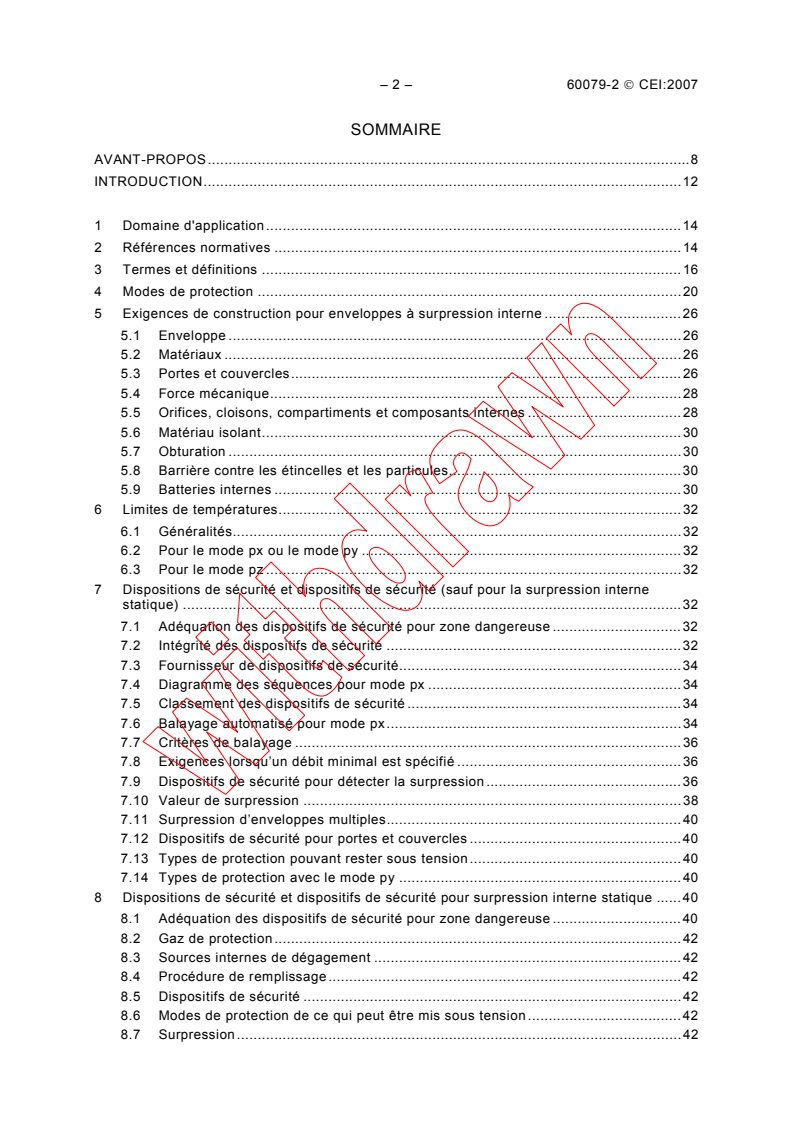
– 2 – 60079-2 © CEI:2007
SOMMAIRE
AVANT-PROPOS.8
INTRODUCTION.12
1 Domaine d'application.14
2 Références normatives .14
3 Termes et définitions .16
4 Modes de protection .20
5 Exigences de construction pour enveloppes à surpression interne .26
5.1 Enveloppe .26
5.2 Matériaux .26
5.3 Portes et couvercles.26
5.4 Force mécanique.28
5.5 Orifices, cloisons, compartiments et composants internes .28
5.6 Matériau isolant.30
5.7 Obturation .30
5.8 Barrière contre les étincelles et les particules.30
5.9 Batteries internes .30
6 Limites de températures.32
6.1 Généralités.32
6.2 Pour le mode px ou le mode py .32
6.3 Pour le mode pz .32
7 Dispositions de sécurité et dispositifs de sécurité (sauf pour la surpression interne
statique) .32
7.1 Adéquation des dispositifs de sécurité pour zone dangereuse .32
7.2 Intégrité des dispositifs de sécurité .32
7.3 Fournisseur de dispositifs de sécurité.34
7.4 Diagramme des séquences pour mode px .34
7.5 Classement des dispositifs de sécurité .34
7.6 Balayage automatisé pour mode px.34
7.7 Critères de balayage .36
7.8 Exigences lorsqu’un débit minimal est spécifié .36
7.9 Dispositifs de sécurité pour détecter la surpression.36
7.10 Valeur de surpression .38
7.11 Surpression d’enveloppes multiples.40
7.12 Dispositifs de sécurité pour portes et couvercles .40
7.13 Types de protection pouvant rester sous tension.40
7.14 Types de protection avec le mode py .40
8 Dispositions de sécurité et dispositifs de sécurité pour surpression interne statique .40
8.1 Adéquation des dispositifs de sécurité pour zone dangereuse .40
8.2 Gaz de protection.42
8.3 Sources internes de dégagement .42
8.4 Procédure de remplissage.42
8.5 Dispositifs de sécurité .42
8.6 Modes de protection de ce qui peut être mis sous tension.42
8.7 Surpression.42
60079-2 © IEC:2007 – 3 –
CONTENTS
FOREWORD.9
INTRODUCTION.13
1 Scope.15
2 Normative references .15
3 Terms and definitions .17
4 Protection types .21
5 Constructional requirements for pressurized enclosures .27
5.1 Enclosure .27
5.2 Materials .27
5.3 Doors and covers .27
5.4 Mechanical strength .29
5.5 Apertures, partitions, compartments and internal components .29
5.6 Insulating materials .31
5.7 Sealing.31
5.8 Spark and particle barriers .31
5.9 Internal batteries .31
6 Temperature limits.33
6.1 General .33
6.2 For type px or type py.33
6.3 For type pz.33
7 Safety provisions and safety devices (except for static pressurization) .33
7.1 Suitability of safety devices for hazardous area.33
7.2 Integrity of safety devices.33
7.3 Provider of safety devices .35
7.4 Sequence diagram for type px .35
7.5 Ratings for safety devices .35
7.6 Purging automated for type px.35
7.7 Purging criteria.37
7.8 Requirements when a minimum flow rate required.37
7.9 Safety devices to detect overpressure .37
7.10 Value of overpressure .39
7.11 Pressurizing multiple enclosures .41
7.12 Safety devices on doors and covers .41
7.13 Protection types that may remain energized .41
7.14 Protection types permitted within type py.41
8 Safety provisions and safety devices for static pressurization.41
8.1 Suitability of safety devices for hazardous area.41
8.2 Protective gas .43
8.3 Internal sources of release .43
8.4 Filling procedure .43
8.5 Safety devices.43
8.6 Protection types that may remain energized .43
8.7 Overpressure .43
– 4 – 60079-2 © CEI:2007
9 Alimentation en gaz de protection .42
9.1 Type de gaz .42
9.2 Température.44
10 Matériels à surpression interne avec une source interne de dégagement .44
11 Conditions de dégagement.44
11.1 Pas de dégagement .44
11.2 Dégagement limité de gaz ou vapeur.44
11.3 Dégagement limité de liquide .44
12 Exigences de conception pour le système de confinement .46
12.1 Exigences générales de conception.46
12.2 Système de confinement infaillible.46
12.3 Système de confinement à dégagement limité .46
13 Gaz de protection et techniques de surpression interne .48
13.1 Généralités.48
13.2 Surpression interne avec compensation de fuite.50
13.3 Surpression interne avec dilution.50
14 Matériels susceptibles de provoquer une inflammation.52
15 Surfaces internes chaudes.52
16 Vérification et essais de type .54
16.1 Essai de surpression maximale .54
16.2 Essai de fuite .54
16.3 Essai de balayage pour enveloppes à surpression interne sans source
interne de dégagement (la technique de surpression interne peut être la
compensation des fuites ou le débit continu) et essai de procédure de
remplissage pour surpression interne statique.54
16.4 Essais de balayage et de dilution pour une enveloppe à surpression interne
avec une source interne de dégagement .56
16.5 Vérification de la surpression minimale .60
16.6 Essais pour un système de confinement infaillible .60
16.7 Essai de surpression pour un système de confinement avec dégagement
limité .62
16.8 Capacité de vérification de l'enveloppe à surpression interne pour limiter la
pression interne .62
17 Essais individuels de série.64
17.1 Essais fonctionnels .64
17.2 Essai de fuite .64
17.3 Essais pour un système de confinement infaillible .64
17.4 Essai pour un système de confinement avec dégagement limité.64
18 Marquage .64
18.1 Identification de surpression.64
18.2 Avertissements.64
18.3 Marquage supplémentaire .64
18.4 Source interne de dégagement.66
18.5 Surpression interne statique.66
18.6 Systèmes de surpression interne.66
18.7 Avertissements exigés par d’autres articles.66
18.8 Surpression limitée par l’utilisateur.66
18.9 Gaz inerte .68
19 Instructions .68
60079-2 © IEC:2007 – 5 –
9 Supply of protective gas .43
9.1 Type of gas .43
9.2 Temperature.45
10 Pressurized equipment with an internal source of release.45
11 Release conditions .45
11.1 No release.45
11.2 Limited release of a gas or vapour.45
11.3 Limited release of a liquid.45
12 Design requirements for the containment system.47
12.1 General design requirements.47
12.2 Infallible containment system .47
12.3 Containment system with a limited release .47
13 Protective gas and pressurizing techniques .49
13.1 General .49
13.2 Pressurization with leakage compensation .51
13.3 Pressurization with dilution.51
14 Ignition-capable apparatus .53
15 Internal hot surfaces.53
16 Type verification and tests.55
16.1 Maximum overpressure test.55
16.2 Leakage test .55
16.3 Purging test for pressurized enclosures with no internal source of release
(pressurization technique may be leakage compensation or continuous flow)
and filling procedure test for static pressurization .55
16.4 Purging and dilution tests for a pressurized enclosure with an internal source
of release .57
16.5 Verification of minimum overpressure.61
16.6 Tests for an infallible containment system .61
16.7 Overpressure test for a containment system with a limited release .63
16.8 Verifying ability of the pressurized enclosure to limit internal pressure .63
17 Routine tests .65
17.1 Functional test.65
17.2 Leakage test .65
17.3 Tests for an infallible containment system .65
17.4 Test for a containment system with a limited release .65
18 Marking .65
18.1 Identifying as pressurized.65
18.2 Warnings.65
18.3 Supplementary marking.65
18.4 Internal source of release.67
18.5 Static pressurization.67
18.6 Pressurization systems.67
18.7 Warnings required in other clauses .67
18.8 Overpressure limited by user.67
18.9 Inert gas.69
19 Instructions.69
– 6 – 60079-2 © CEI:2007
Annexe A (normative) Essais de balayage et de dilution .70
Annexe B (informative) Exemples de diagramme de séquence fonctionnel .74
Annexe C (informative) Exemples de variations de pression dans les canalisations et
les enveloppes.78
Annexe D (informative) Information à fournir à l'utilisateur .88
Annexe E (normative) Classement des types de dégagement à l'intérieur d’enveloppes .92
Annexe F (informative) Exemples pour l’utilisation du concept de la zone de dilution.94
Annexe G (normative) Essai d’infaillibilité d’un système de confinement .98
Annexe H (informative) Introduction à une méthode alternative d’évaluation des
risques incluant les «niveaux de protection du matériel» pour les matériels Ex .100
Bibliographie.110
Figure B.1 – Diagramme d'état d'un système de commande de balayage pour
compensation de fuite.74
Figure C.1 a) – Sortie de gaz de protection sans barrière contre les étincelles et
particules.78
Figure C.1 b) – Sortie de gaz de protection avec une barrière contre les étincelles et
particules.80
Figure C.2 – Enveloppes à surpression interne avec compensation des fuites,
enveloppes sans parties mobiles .82
Figure C.3 – Enveloppes à surpression interne avec compensation des fuites, machine
électrique tournante avec un ventilateur interne de refroidissement .84
Figure C.4 – Enveloppe à surpression interne avec compensation des fuites, machine
électrique tournante avec un ventilateur externe de refroidissement .86
Figure F.1 – Schéma présentant l'utilisation du concept de la zone de dilution pour
simplifier les exigences d'essais de balayage et de dilution .94
Figure F.2 – Schéma présentant l'utilisation du concept de système de confinement
infaillible pour simplifier les exigences de balayage et de dilution autour de l'ICA .96
Figure F.3 – Schéma présentant l'utilisation de cloisons internes autour de la source
potentielle de dégagement pour simplifier les exigences de balayage et de dilution
autour de l'ICA situé à l'extérieur des cloisons .96
Figure G.1 – Schéma de principe de l'essai d'infaillibilité décrit en 16.6.2 a).98
Tableau 1 – Détermination du mode de protection .22
Tableau 2 – Critères de conception fondés sur le mode de protection.24
Tableau 3 – Dispositifs de sécurité fondés sur le mode de protection.34
Tableau 4 – Exigences du gaz de protection pour une enveloppe à surpression interne
avec un système de confinement .48
Tableau 5 – Modes de protection autorisés dans la zone de dilution .52
Tableau B.1 – Table de vérité d'un système de commande de balayage pour
compensation de fuite.74
Tableau H.1 – Relation traditionnelle entre EPLs et zones (sans évaluation de risque
complémentaire) .104
Tableau H.2 – Description de la protection contre le risque d’inflammabilité fournie.106
60079-2 © IEC:2007 – 7 –
Annex A (normative) Purging and dilution tests.71
Annex B (informative) Examples of functional sequence diagram.75
Annex C (informative) Examples of the changes in pressure in ducts and enclosures .79
Annex D (informative) Information to be provided to the user .89
Annex E (normative) Classification of the type of release within enclosures .93
Annex F (informative) Examples for the use of the dilution area concept.95
Annex G (normative) Infallibility test for containment system.99
Annex H (informative) Introduction of an alternative risk assessment method
encompassing “equipment protection levels” for Ex equipment .101
Bibliography.111
Figure B.1 – State diagram of a leakage-compensation purge control system .75
Figure C.1 a) – Protective gas outlet without a spark and particle barrier .79
Figure C.1 b) – Protective gas outlet with a spark and particle barrier.81
Figure C.2 – Pressurized enclosures with leakage compensation, enclosures without
moving parts .83
Figure C.3 – Pressurized enclosures with leakage compensation, rotating electrical
machine with an internal cooling fan .85
Figure C.4 – Pressurized enclosure with a leakage compensation, rotating electrical
machine with an external cooling fan .87
Figure F.1 – Diagram showing the use of the dilution area concept to simplify the purge
and dilution test requirements .95
Figure F.2 – Diagram showing the use of the infallible containment system concept to
simplify the purging and dilution requirements around ICA.97
Figure F.3 – Diagram showing the use of internal partitions around the potential source
of release to simplify the purging and dilution requirements around ICA located outside
the partitions.97
Figure G.1 – Schematic diagram of the infallibility test described in 16.6.2 a) .99
Table 1 – Determination of protection type.23
Table 2 – Design criteria based upon type of protection.25
Table 3 – Safety devices based upon protection type.35
Table 4 – Protective gas requirements for a pressurized enclosure with a containment
system .49
Table 5 – Protection types permitted within the dilution area.53
Table B.1 – Truth table of a leakage-compensation purge control system .75
Table H.1 – Traditional relationship of EPLs to zones (no additional risk assessment) .105
Table H.2 – Description of risk of ignition protection provided .107
– 8 – 60079-2 © CEI:2007
COMMISSION ÉLECTROTECHNIQUE INTERNATIONALE
____________
ATMOSPHÈRES EXPLOSIVES –
Partie 2: Protection du matériel par enveloppe à surpression interne «p»
AVANT-PROPOS
1) La Commission Electrotechnique Internationale (CEI) est une organisation mondiale de normalisation
composée de l'ensemble des comités électrotechniques nationaux (Comités nationaux de la CEI). La CEI a
pour objet de favoriser la coopération internationale pour toutes les questions de normalisation dans les
domaines de l'électricité et de l'électronique. A cet effet, la CEI – entre autres activités – publie des Normes
internationales, des Spécifications techniques, des Rapports techniques, des Spécifications accessibles au
public (PAS) et des Guides (ci-après dénommés "Publication(s) de la CEI"). Leur élaboration est confiée à des
comités d'études, aux travaux desquels tout Comité national intéressé par le sujet traité peut participer. Les
organisations internationales, gouvernementales et non gouvernementales, en liaison avec la CEI, participent
également aux travaux. La CEI collabore étroitement avec l'Organisation Internationale de Normalisation (ISO),
selon des conditions fixées par accord entre les deux organisations.
2) Les décisions ou accords officiels de la CEI concernant les questions techniques représentent, dans la mesure
du possible, un accord international sur les sujets étudiés, étant donné que les Comités nationaux de la CEI
intéressés sont représentés dans chaque comité d’études.
3) Les Publications de la CEI se présentent sous la forme de recommandations internationales et sont agréées
comme telles par les Comités nationaux de la CEI. Tous les efforts raisonnables sont entrepris afin que la CEI
s'assure de l'exactitude du contenu technique de ses publications; la CEI ne peut pas être tenue responsable
de l'éventuelle mauvaise utilisation ou interprétation qui en est faite par un quelconque utilisateur final.
4) Dans le but d'encourager l'uniformité internationale, les Comités nationaux de la CEI s'engagent, dans toute la
mesure possible, à appliquer de façon transparente les Publications de la CEI dans leurs publications
nationales et régionales. Toutes divergences entre toutes Publications de la CEI et toutes publications
nationales ou régionales correspondantes doivent être indiquées en termes clairs dans ces dernières.
5) La CEI elle-même ne fournit aucune attestation de conformité. Des organismes de certification indépendants
fournissent des services d'évaluation de conformité et, dans certains secteurs, accèdent aux marques de
conformité de la CEI. La CEI n'est responsable d'aucun des services effectués par les organismes de
certification indépendants.
6) Tous les utilisateurs doivent s'assurer qu'ils sont en possession de la dernière édition de cette publication.
7) Aucune responsabilité ne doit être imputée à la CEI, à ses administrateurs, employés, auxiliaires ou
mandataires, y compris ses experts particuliers et les membres de ses comités d'études et des Comités
nationaux de la CEI, pour tout préjudice causé en cas de dommages corporels et matériels, ou de tout autre
dommage de quelque nature que ce soit, directe ou indirecte, ou pour supporter les coûts (y compris les frais
de justice) et les dépenses découlant de la publication ou de l'utilisation de cette Publication de la CEI ou de
toute autre Publication de la CEI, ou au crédit qui lui est accordé.
8) L'attention est attirée sur les références normatives citées dans cette publication. L'utilisation de publications
référencées est obligatoire pour une application correcte de la présente publication.
9) L’attention est attirée sur le fait que certains des éléments de la présente Publication de la CEI peuvent faire
l’objet de droits de propriété intellectuelle ou de droits analogues. La CEI ne saurait être tenue pour
responsable de ne pas avoir identifié de tels droits de propriété et de ne pas avoir signalé leur existence.
La Norme internationale CEI 60079-2 a été établie par le comité d'études 31 de la CEI:
Equipements pour atmosphères explosives.
Cette cinquième édition annule et remplace la quatrième édition publiée en 2001. Elle
constitue une révision technique.
Les changements significatifs par rapport à l’édition précédente sont indiqués ci-dessous :
− Introduction du “Concept du niveau de protection des équipements » – Voir Annexe H.
– 3.13 Suppression d’une référence à « locaux » dans la définition de la surpression.
– 5.3.3 Restriction au type px.
– 5.3.3 Ajout d’un avertissement pour mode pz et mode py pour tout couvercle démontable
sans l’utilisation d’un outil.
60079-2 © IEC:2007 – 9 –
INTERNATIONAL ELECTROTECHNICAL COMMISSION
____________
EXPLOSIVE ATMOSPHERES –
Part 2: Equipment protection by pressurized enclosure "p"
FOREWORD
1) The International Electrotechnical Commission (IEC) is a worldwide organization for standardization comprising
all national electrotechnical committees (IEC National Committees). The object of IEC is to promote
international co-operation on all questions concerning standardization in the electrical and electronic fields. To
this end and in addition to other activities, IEC publishes International Standards, Technical Specifications,
Technical Reports, Publicly Available Specifications (PAS) and Guides (hereafter referred to as “IEC
Publication(s)”). Their preparation is entrusted to technical committees; any IEC National Committee interested
in the subject dealt with may participate in this preparatory work. International, governmental and non-
governmental organizations liaising with the IEC also participate in this preparation. IEC collaborates closely
with the International Organization for Standardization (ISO) in accordance with conditions determined by
agreement between the two organizations.
2) The formal decisions or agreements of IEC on technical matters express, as nearly as possible, an international
consensus of opinion on the relevant subjects since each technical committee has representation from all
interested IEC National Committees.
3) IEC Publications have the form of recommendations for international use and are accepted by IEC National
Committees in that sense. While all reasonable efforts are made to ensure that the technical content of IEC
Publications is accurate, IEC cannot be held responsible for the way in which they are used or for any
misinterpretation by any end user.
4) In order to promote international uniformity, IEC National Committees undertake to apply IEC Publications
transparently to the maximum extent possible in their national and regional publications. Any divergence
between any IEC Publication and the corresponding national or regional publication shall be clearly indicated in
the latter.
5) IEC itself does not provide any attestation of conformity. Independent certification bodies provide conformity
assessment services and, in some areas, access to IEC marks of conformity. IEC is not responsible for any
services carried out by independent certification bodies.
6) All users should ensure that they have the latest edition of this publication.
7) No liability shall attach to IEC or its directors, employees, servants or agents including individual experts and
members of its technical committees and IEC National Committees for any personal injury, property damage or
other damage of any nature whatsoever, whether direct or indirect, or for costs (including legal fees) and
expenses arising out of the publication, use of, or reliance upon, this IEC Publication or any other IEC
Publications.
8) Attention is drawn to the Normative references cited in this publication. Use of the referenced publications is
indispensable for the correct application of this publication.
9) Attention is drawn to the possibility that some of the elements of this IEC Publication may be the subject of
patent rights. IEC shall not be held responsible for identifying any or all such patent rights.
International Standard IEC 60079-2 has been prepared by technical committee 31: Explosive
atmospheres.
This fifth edition cancels and replaces the fourth edition published in 2001 and constitutes a
technical revision.
The significant changes with respect to the previous edition are listed below:
− Introduction of the “Equipment protection level concept” – See Annex H.
– 3.13 Eliminate reference to “room” in the definition of pressurization.
– 5.3.3 Restrict to type px.
– 5.3.3 Add warning for type pz and type py for any cover removable without the use
of a tool.
– 10 – 60079-2 © CEI:2007
– 7.6 Déplacement des mots « pour mode px » en tête de paragraphe pour clarifier 7.6,
seulement applicable au mode px.
– 7.7 c) Clarification de l'instruction qui spécifie les temps de balayage et pression/débit.
– 18.7 Regroupement des exigences de marquage dans l’article «Marquage».
Le
...