

IEC 60034-9:2003/AMD1:2007
(Amendment)Amendment 1 - Rotating electrical machines - Part 9: Noise limits
General Information
- Abstract
- Status
- Published
- Publication Date
- 06-Mar-2007
- Technical Committee
- TC 2 - Rotating machinery
- Drafting Committee
- MT 2 - TC 2/MT 2
- Current Stage
- DELPUB - Deleted Publication
- Start Date
- 14-Oct-2021
- Completion Date
- 28-Aug-2026
Buy Documents
IEC 60034-9:2003/AMD1:2007 - Amendment 1 - Rotating electrical machines - Part 9: Noise limits
IEC 60034-9:2003/AMD1:2007 - Amendment 1 - Rotating electrical machines - Part 9: Noise limits
Overview
IEC 60034-9:2003/AMD1:2007 is an important amendment to the international standard that focuses on noise limits for rotating electrical machines. Prepared by the IEC Technical Committee 2 on rotating machinery, this amendment updates test methods and noise level limits applicable to electric motors and generators. It primarily addresses the determination of sound power levels and specifies maximum allowable sound power levels for factory acceptance testing of standard design rotating electrical machines.
This amendment also introduces guidelines for assessing noise increments caused by converter-supplied alternating current (a.c.) machines, which often display different acoustic behavior due to their power electronic drives. The document details noise testing procedures and sound power level limits, supporting manufacturers and users to ensure machines meet sound emission requirements critical for health, safety, and environmental regulations.
Key Topics
Sound Power Level Measurement: Specifies standardized test methods for determining the sound power level of rotating electrical machines, ensuring consistent and reliable acoustic data for evaluation and comparison.
Maximum Noise Limits: Defines the maximum A-weighted sound power levels for electric rotating machines ranging from 1 kW to 5,500 kW with rated speeds up to 3,750 rpm, covering both a.c. and d.c. standard designs without special acoustic modifications.
Scope of Application: Covers machines compliant with IEC 60034-1, cooled per IEC 60034-6, and protected as per IEC 60034-5, highlighting factory acceptance testing conditions and exclusion clauses for converter-fed machines in conventional noise limits.
Noise from Converter Supplies: Introduces new provisions to evaluate noise increments induced by converter-fed motors, recognizing additional noise contributions beyond the fundamental frequency due to higher harmonic contents and electromagnetic interactions.
Frequency Spectrum Considerations: Identifies typical frequency spectra for various converter types (block-type current-source, type A and B voltage-source converters), analyzing how switching frequencies and harmonics influence vibration and noise.
Resonance and Vibration Modes: Details resonance frequencies and vibration modes linked to motor shaft heights that can amplify noise when excited by harmonic frequencies from converter output.
Expected Noise Increments: Provides quantitative expected noise increase values (in dB(A)) attributable to different converter types and load conditions, guiding practical noise assessment for converter-supplied machines.
Noise Declaration and Verification: Updates clauses on the declaration and verification procedures for sound power values to incorporate new testing and reporting requirements consistent with the amendment.
Applications
Manufacturing and Factory Testing: Enables electric motor manufacturers to perform standardized noise emission measurements aligned with IEC requirements, ensuring compliance with noise regulations and customer specifications.
Product Certification: Supports certification bodies in evaluating machine noise as part of conformity assessments under international or regional standards.
Industrial Equipment Design: Assists engineers and acoustic consultants in specifying motors with acceptable sound levels for various industrial and commercial applications, improving workplace noise conditions.
Converters and Variable Frequency Drives (VFDs): Offers guidance on estimating noise impacts from converter-driven motors, crucial for designing quieter electromagnetic drive systems in automation, HVAC, and renewable energy sectors.
Noise Impact Assessment: Provides sound power level limits and expected increments helpful for environmental noise assessments around motor installations, aiding in compliance with occupational health and safety laws.
Related Standards
IEC 60034-1: Defines rating and performance specifications for rotating electrical machines, referenced for electrical and mechanical machine characteristics.
IEC 60034-5: Specifies degrees of protection (IP codes) for electrical machines, a criterion for noise limit applicability.
IEC 60034-6: Covers methods of cooling for rotating electrical machines, relevant to acoustic performance and noise limits.
Standards on Sound Measurement: Complementary international standards on acoustics and sound power determination, such as ISO 3744 and ISO 3746, provide measurement methodologies used within IEC 60034-9.
Keywords: IEC 60034-9 Amendment 1, rotating electrical machines, noise limits, sound power level, factory acceptance testing, converter-supplied motors, acoustic emissions, electromagnetic noise, frequency spectrum, resonance frequencies, vibration modes, industrial motor noise, electrical machine standards, IEC standards, noise measurement methods.
Relations
- Effective Date
- 05-Sep-2023
- Effective Date
- 05-Sep-2023
Buy Documents
IEC 60034-9:2003/AMD1:2007 - Amendment 1 - Rotating electrical machines - Part 9: Noise limits
IEC 60034-9:2003/AMD1:2007 - Amendment 1 - Rotating electrical machines - Part 9: Noise limits
Get Certified
Connect with accredited certification bodies for this standard

IMQ S.p.A. (Certification)
Italian electrical product certification.

SLG Prüf- und Zertifizierungs GmbH
German testing and certification body.

UL Solutions
Global safety science company with testing, inspection and certification.
Sponsored listings
Frequently Asked Questions
IEC 60034-9:2003/AMD1:2007 is a standard published by the International Electrotechnical Commission (IEC). Its full title is "Amendment 1 - Rotating electrical machines - Part 9: Noise limits". This standard covers: Amendment 1 - Rotating electrical machines - Part 9: Noise limits
Amendment 1 - Rotating electrical machines - Part 9: Noise limits
IEC 60034-9:2003/AMD1:2007 is classified under the following ICS (International Classification for Standards) categories: 29.160.01 - Rotating machinery in general. The ICS classification helps identify the subject area and facilitates finding related standards.
IEC 60034-9:2003/AMD1:2007 has the following relationships with other standards: It is inter standard links to IEC 60034-9:2003, IEC 60034-9:2021. Understanding these relationships helps ensure you are using the most current and applicable version of the standard.
IEC 60034-9:2003/AMD1:2007 is available in PDF format for immediate download after purchase. The document can be added to your cart and obtained through the secure checkout process. Digital delivery ensures instant access to the complete standard document.
Standards Content (Sample)
NORME CEI
INTERNATIONALE
IEC
60034-9
INTERNATIONAL
STANDARD
AMENDEMENT 1
AMENDMENT 1
2007-03
Amendement 1
Machines électriques tournantes –
Partie 9:
Limites de bruit
Amendment 1
Rotating electrical machines –
Part 9:
Noise limits
© IEC 2007 Droits de reproduction réservés ⎯ Copyright - all rights reserved
International Electrotechnical Commission, 3, rue de Varembé, PO Box 131, CH-1211 Geneva 20, Switzerland
Telephone: +41 22 919 02 11 Telefax: +41 22 919 03 00 E-mail: inmail@iec.ch Web: www.iec.ch
CODE PRIX
G
Commission Electrotechnique Internationale
PRICE CODE
International Electrotechnical Commission
МеждународнаяЭлектротехническаяКомиссия
Pour prix, voir catalogue en vigueur
For price, see current catalogue
– 2 – 60034-9 Amend. 1 © CEI:2007
AVANT-PROPOS
Cet amendement a été établi par le comité d’études 2 de la CEI: Machines tournantes.
Le texte de cet amendement est issu des documents suivants:
CDV Rapport de vote
2/1383/CDV 2/1413/RVC
Le rapport de vote indiqué dans le tableau ci-dessus donne toute information sur le vote ayant
abouti à l'approbation de cet amendement.
Le comité a décidé que le contenu de cette publication ne sera pas modifié avant la date de
maintenance indiquée sur le site web de la CEI sous "http://webstore.iec.ch" dans les
données relatives à la publication recherchée. A cette date, la publication sera
• reconduite,
• supprimée,
• remplacée par une édition révisée, ou
• amendée.
_____________
Page 10
1 Domaine d’application
Remplacer le premier alinéa du domaine d’application par ce qui suit:
La présente partie de la CEI 60034:
– spécifie les méthodes d’essai pour la détermination du niveau de puissance acoustique
des machines électriques tournantes;
– spécifie les niveaux maximaux de puissance acoustique pondérée A pour les essais de
réception en usine des machines électriques tournantes alimentées par réseau conformes
à la CEI 60034-1, dont les modes de refroidissement sont conformes à la CEI 60034-6 et
les degrés de protection conformes à la CEI 60034-5, et qui présentent les
caractéristiques suivantes:
• conception normale, courant alternatif ou courant continu, sans modifications spéciales
électriques, mécaniques ou acoustiques destinées à réduire le niveau de bruit;
• puissance assignée de 1 kW (ou kVA) à 5 500 kW (ou kVA);
–1
• vitesse inférieure ou égale à 3 750 min .
– donne des lignes directrices pour la détermination des niveaux de bruit pour les moteurs à
induction à cage alimentés par convertisseurs.
Page 18
6 Limites des niveaux de puissance acoustique
Ajouter avant la NOTE 1 le nouveau texte suivant:
Les machines à courant alternatif alimentées par convertisseurs sont exclues des limites
spécifiées.
60034-9 Amend. 1 © IEC:2007 – 3 –
FOREWORD
This amendment has been prepared by IEC technical committee 2: Rotating machinery.
The text of this amendment is based on the following documents:
CDV Report on voting
2/1383/CDV 2/1413/RVC
Full information on the voting for the approval of this amendment can be found in the report
on voting indicated in the above table.
The committee has decided that the contents of this amendment and the base publication will
remain unchanged until the maintenance result date indicated on the IEC web site under
"http://webstore.iec.ch" in the data related to the specific publication. At this date, the
publication will be
• reconfirmed,
• withdrawn,
• replaced by a revised edition, or
• amended.
_____________
Page 11
1 Scope
Replace the first paragraph of the scope with the following:
This part of IEC 60034:
– specifies test methods for the determination of sound power level of rotating electrical
machines;
– specifies maximum A-weighted sound power levels for factory acceptance testing of
network-supplied, rotating electrical machines in accordance with lEC 60034-1, having
methods of cooling according to lEC 60034-6 and degrees of protection according to
lEC 60034-5, and having the following characteristics:
• standard design, either a.c. or d.c., without additional special electrical, mechanical, or
acoustical modifications intended to reduce the sound power level;
• rated output from 1 kW (or kVA) up to and including 5 500 kW (or kVA);
–1
• rated speed not greater than 3 750 min .
– provides guidance for the determination of noise levels for a.c. cage induction motors
supplied by converters.
Page 19
6 Sound power level limits
Add before NOTE 1 the following new text:
Converter-supplied a.c. machines are excluded from specified limits.
– 4 – 60034-9 Amend. 1 © CEI:2007
Ajouter un nouvel Article 7 comme suit:
7 Détermination de l’accroissement du bruit provoqué par l’alimentation du
convertisseur
Les émissions de bruit d’origine électromagnétique au niveau de l’alimentation du
convertisseur peuvent être considérées comme la superposition:
• du bruit généré par les tensions et les courants à la fréquence fondamentale qui est
identique au bruit des sources sinusoïdales de mêmes valeurs de tensions et
courants, et
• d'un accroissement causé par les tensions et courants à d’autres fréquences.
Deux caractéristiques influencent principalement cet accroissement:
a) Le spectre de fréquence aux bornes du convertisseur
Trois spectres de fréquence typiques peuvent être identifiés:
1) Spectre d’un convertisseur de source de courant de type bloc
120 %
100 %
80 %
Spectre de fréquence des courants aux
bornes de sortie d'un convertisseur de
60 %
source de courant à 6 impulsions
40 %
f = 50 Hz
20 %
0 %
0 300 600 900 1 200 1 500 1 800 2 100 2 400
Fréquence Hz
IEC 337/07
2) Spectre d’un convertisseur de source de tension de type A (caractérisé par des
transitoires prononcées aux ALENTOURS de la fréquence de commutation et aux
multiples de la fréquence de commutation)
120 %
100 %
80 %
Spectre de fréquence des tensions aux
bornes d'un convertisseur de source de
60 %
tension de type A
40 %
f = 50 Hz, f = 3 kHz
1 s
20 %
0 %
0 1 000 2 000 3 000 4 000 5 000
500 1 500 2 500 3 500 4 500
Fréquence Hz
IEC 338/07
Tension %
Courant %
60034-9 Amend. 1 © IEC:2007 – 5 –
Add a new Clause 7 as follows:
7 Determination of noise increments caused by converter supply
Noise emissions of electromagnetic origin at the converter supply can be considered as the
superposition of:
• the noise generated by the voltages and currents of fundamental frequency, which is
identical with the noise at sinusoidal supply of the same values, and
• an increment caused by voltages and currents at other frequencies.
Two features mainly influence this increment:
a) The frequency spectrum at the converter terminals
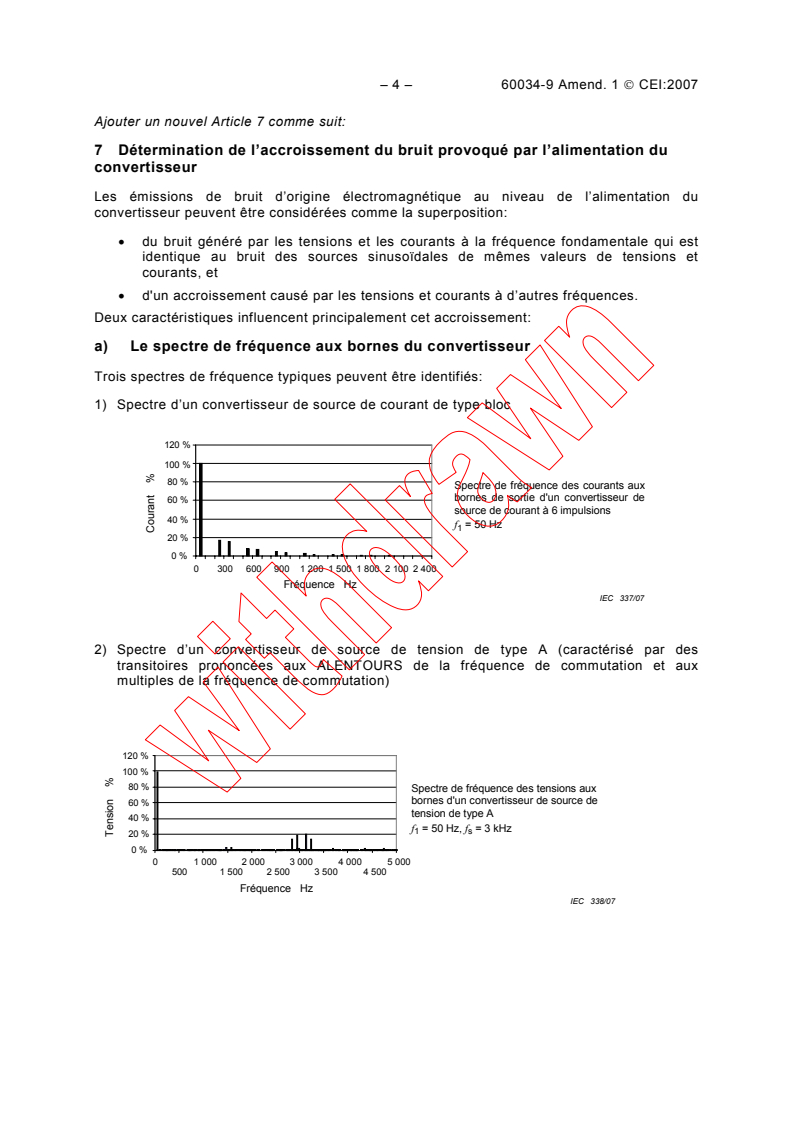
Three typical frequency spectra can be identified:
1) Spectrum of a block-type current-source converter
120 %
100 %
80 %
Frequency spectrum of the currents
60 %
at the output terminals of a 6-pulse
current-source converter
40 %
f = 50 Hz
20 %
0 %
0 300 600 900 1 200 1 500 1 800 2 100 2 400
Frequency Hz
IEC 337/07
2) Spectrum of type A voltage-source converter (characterized by pronounced spikes CLOSE
to the switching frequency and its multiples)
120 %
100 %
Frequency spectrum of the voltages
80 %
at the terminals of a type A voltage-source
60 %
converter
40 %
f = 50 Hz, f = 3 kHz
1 s
20 %
0 %
0 1 000 2 000 3 000 4 000 5 000
500 1 500 2 500 3 500 4 500
Frequency Hz
IEC 338/07
Voltage %
Current %
– 6 – 60034-9 Amend. 1 © CEI:2007
3) Spectre d’un convertisseur de source de tension de type B (caractérisé par un spectre
de tension étendu sans transitoires prononcés)
120 %
100 %
80 %
Spectre de fréquence des tensions
d'un convertisseur de source
60 %
de tension de type B
40 %
f = 50 Hz, f moyenne = 4,5 kHz
1 s
20 %
0 %
0 1 000 2 000 3 000 4 000 5 000
500 1 500 2 500 3 500 4 500
Fréquence Hz IEC 339/07
Des considérations spécifiques sont nécessaires quand le spectre dévie de façon significative
d’un spectre typique.
b) Les fréquences de résonance du moteur pour les modes vibratoires
provoqués par des harmoniques
Les fréquences de résonance correspondantes des moteurs peuvent être groupées
conformément au tableau suivant:
Hauteur d’arbre H Fréquence de résonance du mode vibratoire r
r = 0 r = 2 r = 4 r = 6
> 4 000 Hz > 600 Hz > 4 000 Hz > 5 000 Hz
H ≤ 200 mm
H ≥ 280 mm
< 3 000 Hz < 500 Hz < 2 500 Hz < 4 000 Hz
Une tonalité excitée magnétiquement est générée par l’interaction des champs fondamentaux
du nombre de paires de pôles p de la fréquence fondamentale f aux bornes du moteur et de
l’une des fréquences harmoniques n · f ,
...
NORME CEI
INTERNATIONALE
IEC
60034-9
INTERNATIONAL
STANDARD
AMENDEMENT 1
AMENDMENT 1
2007-03
Amendement 1
Machines électriques tournantes –
Partie 9:
Limites de bruit
Amendment 1
Rotating electrical machines –
Part 9:
Noise limits
© IEC 2007 Droits de reproduction réservés ⎯ Copyright - all rights reserved
International Electrotechnical Commission, 3, rue de Varembé, PO Box 131, CH-1211 Geneva 20, Switzerland
Telephone: +41 22 919 02 11 Telefax: +41 22 919 03 00 E-mail: inmail@iec.ch Web: www.iec.ch
CODE PRIX
G
Commission Electrotechnique Internationale
PRICE CODE
International Electrotechnical Commission
МеждународнаяЭлектротехническаяКомиссия
Pour prix, voir catalogue en vigueur
For price, see current catalogue
– 2 – 60034-9 Amend. 1 © CEI:2007
AVANT-PROPOS
Cet amendement a été établi par le comité d’études 2 de la CEI: Machines tournantes.
Le texte de cet amendement est issu des documents suivants:
CDV Rapport de vote
2/1383/CDV 2/1413/RVC
Le rapport de vote indiqué dans le tableau ci-dessus donne toute information sur le vote ayant
abouti à l'approbation de cet amendement.
Le comité a décidé que le contenu de cette publication ne sera pas modifié avant la date de
maintenance indiquée sur le site web de la CEI sous "http://webstore.iec.ch" dans les
données relatives à la publication recherchée. A cette date, la publication sera
• reconduite,
• supprimée,
• remplacée par une édition révisée, ou
• amendée.
_____________
Page 10
1 Domaine d’application
Remplacer le premier alinéa du domaine d’application par ce qui suit:
La présente partie de la CEI 60034:
– spécifie les méthodes d’essai pour la détermination du niveau de puissance acoustique
des machines électriques tournantes;
– spécifie les niveaux maximaux de puissance acoustique pondérée A pour les essais de
réception en usine des machines électriques tournantes alimentées par réseau conformes
à la CEI 60034-1, dont les modes de refroidissement sont conformes à la CEI 60034-6 et
les degrés de protection conformes à la CEI 60034-5, et qui présentent les
caractéristiques suivantes:
• conception normale, courant alternatif ou courant continu, sans modifications spéciales
électriques, mécaniques ou acoustiques destinées à réduire le niveau de bruit;
• puissance assignée de 1 kW (ou kVA) à 5 500 kW (ou kVA);
–1
• vitesse inférieure ou égale à 3 750 min .
– donne des lignes directrices pour la détermination des niveaux de bruit pour les moteurs à
induction à cage alimentés par convertisseurs.
Page 18
6 Limites des niveaux de puissance acoustique
Ajouter avant la NOTE 1 le nouveau texte suivant:
Les machines à courant alternatif alimentées par convertisseurs sont exclues des limites
spécifiées.
60034-9 Amend. 1 © IEC:2007 – 3 –
FOREWORD
This amendment has been prepared by IEC technical committee 2: Rotating machinery.
The text of this amendment is based on the following documents:
CDV Report on voting
2/1383/CDV 2/1413/RVC
Full information on the voting for the approval of this amendment can be found in the report
on voting indicated in the above table.
The committee has decided that the contents of this amendment and the base publication will
remain unchanged until the maintenance result date indicated on the IEC web site under
"http://webstore.iec.ch" in the data related to the specific publication. At this date, the
publication will be
• reconfirmed,
• withdrawn,
• replaced by a revised edition, or
• amended.
_____________
Page 11
1 Scope
Replace the first paragraph of the scope with the following:
This part of IEC 60034:
– specifies test methods for the determination of sound power level of rotating electrical
machines;
– specifies maximum A-weighted sound power levels for factory acceptance testing of
network-supplied, rotating electrical machines in accordance with lEC 60034-1, having
methods of cooling according to lEC 60034-6 and degrees of protection according to
lEC 60034-5, and having the following characteristics:
• standard design, either a.c. or d.c., without additional special electrical, mechanical, or
acoustical modifications intended to reduce the sound power level;
• rated output from 1 kW (or kVA) up to and including 5 500 kW (or kVA);
–1
• rated speed not greater than 3 750 min .
– provides guidance for the determination of noise levels for a.c. cage induction motors
supplied by converters.
Page 19
6 Sound power level limits
Add before NOTE 1 the following new text:
Converter-supplied a.c. machines are excluded from specified limits.
– 4 – 60034-9 Amend. 1 © CEI:2007
Ajouter un nouvel Article 7 comme suit:
7 Détermination de l’accroissement du bruit provoqué par l’alimentation du
convertisseur
Les émissions de bruit d’origine électromagnétique au niveau de l’alimentation du
convertisseur peuvent être considérées comme la superposition:
• du bruit généré par les tensions et les courants à la fréquence fondamentale qui est
identique au bruit des sources sinusoïdales de mêmes valeurs de tensions et
courants, et
• d'un accroissement causé par les tensions et courants à d’autres fréquences.
Deux caractéristiques influencent principalement cet accroissement:
a) Le spectre de fréquence aux bornes du convertisseur
Trois spectres de fréquence typiques peuvent être identifiés:
1) Spectre d’un convertisseur de source de courant de type bloc
120 %
100 %
80 %
Spectre de fréquence des courants aux
bornes de sortie d'un convertisseur de
60 %
source de courant à 6 impulsions
40 %
f = 50 Hz
20 %
0 %
0 300 600 900 1 200 1 500 1 800 2 100 2 400
Fréquence Hz
IEC 337/07
2) Spectre d’un convertisseur de source de tension de type A (caractérisé par des
transitoires prononcées aux ALENTOURS de la fréquence de commutation et aux
multiples de la fréquence de commutation)
120 %
100 %
80 %
Spectre de fréquence des tensions aux
bornes d'un convertisseur de source de
60 %
tension de type A
40 %
f = 50 Hz, f = 3 kHz
1 s
20 %
0 %
0 1 000 2 000 3 000 4 000 5 000
500 1 500 2 500 3 500 4 500
Fréquence Hz
IEC 338/07
Tension %
Courant %
60034-9 Amend. 1 © IEC:2007 – 5 –
Add a new Clause 7 as follows:
7 Determination of noise increments caused by converter supply
Noise emissions of electromagnetic origin at the converter supply can be considered as the
superposition of:
• the noise generated by the voltages and currents of fundamental frequency, which is
identical with the noise at sinusoidal supply of the same values, and
• an increment caused by voltages and currents at other frequencies.
Two features mainly influence this increment:
a) The frequency spectrum at the converter terminals
Three typical frequency spectra can be identified:
1) Spectrum of a block-type current-source converter
120 %
100 %
80 %
Frequency spectrum of the currents
60 %
at the output terminals of a 6-pulse
current-source converter
40 %
f = 50 Hz
20 %
0 %
0 300 600 900 1 200 1 500 1 800 2 100 2 400
Frequency Hz
IEC 337/07
2) Spectrum of type A voltage-source converter (characterized by pronounced spikes CLOSE
to the switching frequency and its multiples)
120 %
100 %
Frequency spectrum of the voltages
80 %
at the terminals of a type A voltage-source
60 %
converter
40 %
f = 50 Hz, f = 3 kHz
1 s
20 %
0 %
0 1 000 2 000 3 000 4 000 5 000
500 1 500 2 500 3 500 4 500
Frequency Hz
IEC 338/07
Voltage %
Current %
– 6 – 60034-9 Amend. 1 © CEI:2007
3) Spectre d’un convertisseur de source de tension de type B (caractérisé par un spectre
de tension étendu sans transitoires prononcés)
120 %
100 %
80 %
Spectre de fréquence des tensions
d'un convertisseur de source
60 %
de tension de type B
40 %
f = 50 Hz, f moyenne = 4,5 kHz
1 s
20 %
0 %
0 1 000 2 000 3 000 4 000 5 000
500 1 500 2 500 3 500 4 500
Fréquence Hz IEC 339/07
Des considérations spécifiques sont nécessaires quand le spectre dévie de façon significative
d’un spectre typique.
b) Les fréquences de résonance du moteur pour les modes vibratoires
provoqués par des harmoniques
Les fréquences de résonance correspondantes des moteurs peuvent être groupées
conformément au tableau suivant:
Hauteur d’arbre H Fréquence de résonance du mode vibratoire r
r = 0 r = 2 r = 4 r = 6
> 4 000 Hz > 600 Hz > 4 000 Hz > 5 000 Hz
H ≤ 200 mm
H ≥ 280 mm
< 3 000 Hz < 500 Hz < 2 500 Hz < 4 000 Hz
Une tonalité excitée magnétiquement est générée par l’interaction des champs fondamentaux
du nombre de paires de pôles p de la fréquence fondamentale f aux bornes du moteur et de
l’une des fréquences harmoniques n · f , comme ill
...