

IEC 61196-1-313:2009
(Main)Coaxial communication cables - Part 1-313: Mechanical test methods - Adhesion of dielectric and sheath
General Information
- Abstract
IEC 61196-1-313:2009(E) applies to coaxial communication cables. It specifies the test method to determine the adhesion of the dielectric to inner conductor and of the sheath to outer conductor of coaxial cables.
- Status
- Published
- Publication Date
- 10-Feb-2009
- Technical Committee
- SC 46A - Coaxial cables
- Drafting Committee
- WG 3 - TC 46/SC 46A/WG 3
- Current Stage
- PPUB - Publication issued
- Start Date
- 11-Feb-2009
- Completion Date
- 15-Feb-2009
Overview
IEC 61196-1-313:2009 is an international standard developed by the International Electrotechnical Commission (IEC) focusing on coaxial communication cables. This standard establishes a mechanical test method to determine the adhesion of the dielectric to the inner conductor and the adhesion of the sheath to the outer conductor in coaxial cables. As part of the IEC 61196 series, IEC 61196-1-313 plays a critical role in ensuring the mechanical integrity and long-term performance of coaxial cables used in a range of communication applications.
Key Topics
- Adhesion Test Methods: Provides standardized procedures to evaluate the bonding strength between the dielectric and inner conductor and between the sheath and outer conductor.
- Test Setup and Procedure: Details the preparation of cable specimens, application of tensile forces, and steps for performing the test to obtain reliable and repeatable results.
- Reporting Requirements: Specifies the metrics to be included in the test report, such as measured adhesion values, temperature, specimen lengths, number of samples, and pass/fail criteria.
- Normative References: Mandates alignment with IEC 61196-1 for generic definitions and requirements, ensuring coherence within the IEC 61196 family.
Applications
IEC 61196-1-313:2009 is essential for:
- Cable Manufacturers: Ensuring that coaxial communication cables meet international quality standards for mechanical durability and structural integrity.
- Testing Laboratories: Implementing a unified method for adhesion testing, allowing consistent quality control across the industry.
- Quality Assurance: Establishing reliable criteria for acceptance or rejection of cable batches based on adhesion performance.
- Product Development: Aiding in the design and refinement of new cable constructions by providing a benchmark for adhesion characteristics.
- Regulatory Compliance: Supporting manufacturers and suppliers in demonstrating adherence to internationally recognized testing protocols for coaxial cables used in telecommunications, broadcasting, and data transmission.
Related Standards
- IEC 61196-1: Coaxial communication cables - Part 1: Generic specification - General, definitions and requirements. foundational reference for terminology and general requirements related to coaxial cables.
- Other Parts of IEC 61196 Series: Addresses additional mechanical and electrical test methods, environmental testing, and performance specifications for coaxial communication cables.
- ISO/IEC Directives: Ensures consistency in international standardization procedures and terminology.
Practical Value
Implementing IEC 61196-1-313:2009 allows stakeholders to:
- Verify Cable Robustness: Ensure strong adhesion in critical components of coaxial cables, reducing the risk of mechanical failure during installation or operation.
- Compare Products: Provide a basis for objective comparison of different cable types and manufacturers within the communications sector.
- Enhance Product Reliability: Minimize signal loss, deterioration, or failures that may arise due to poor adhesion between cable elements.
- Improve Customer Confidence: Demonstrate adherence to rigorous international testing standards, facilitating market acceptance and regulatory approval.
IEC 61196-1-313 is an indispensable reference for all organizations that manufacture, test, specify, or utilize coaxial communication cables, promoting quality, durability, and consistency in modern communication infrastructure.
Relations
- Effective Date
- 10-Feb-2026
Get Certified
Connect with accredited certification bodies for this standard

ANCE
Mexican certification and testing association.

Intertek Slovenia
Intertek testing, inspection, and certification services in Slovenia.

LNE (Laboratoire National de Métrologie et d'Essais)
French national laboratory for metrology and testing.
Sponsored listings
Frequently Asked Questions
IEC 61196-1-313:2009 is a standard published by the International Electrotechnical Commission (IEC). Its full title is "Coaxial communication cables - Part 1-313: Mechanical test methods - Adhesion of dielectric and sheath". This standard covers: IEC 61196-1-313:2009(E) applies to coaxial communication cables. It specifies the test method to determine the adhesion of the dielectric to inner conductor and of the sheath to outer conductor of coaxial cables.
IEC 61196-1-313:2009(E) applies to coaxial communication cables. It specifies the test method to determine the adhesion of the dielectric to inner conductor and of the sheath to outer conductor of coaxial cables.
IEC 61196-1-313:2009 is classified under the following ICS (International Classification for Standards) categories: 33.120.10 - Coaxial cables. Waveguides. The ICS classification helps identify the subject area and facilitates finding related standards.
IEC 61196-1-313:2009 has the following relationships with other standards: It is inter standard links to EN 61196-10:2016. Understanding these relationships helps ensure you are using the most current and applicable version of the standard.
IEC 61196-1-313:2009 is available in PDF format for immediate download after purchase. The document can be added to your cart and obtained through the secure checkout process. Digital delivery ensures instant access to the complete standard document.
Standards Content (Sample)
IEC 61196-1-313 ®
Edition 1.0 2009-02
INTERNATIONAL
STANDARD
Coaxial communication cables –
Part 1-313: Mechanical test methods – Adhesion of dielectric and sheath
All rights reserved. Unless otherwise specified, no part of this publication may be reproduced or utilized in any form
or by any means, electronic or mechanical, including photocopying and microfilm, without permission in writing from
either IEC or IEC's member National Committee in the country of the requester.
If you have any questions about IEC copyright or have an enquiry about obtaining additional rights to this publication,
please contact the address below or your local IEC member National Committee for further information.
IEC Central Office
3, rue de Varembé
CH-1211 Geneva 20
Switzerland
Email: inmail@iec.ch
Web: www.iec.ch
About the IEC
The International Electrotechnical Commission (IEC) is the leading global organization that prepares and publishes
International Standards for all electrical, electronic and related technologies.
About IEC publications
The technical content of IEC publications is kept under constant review by the IEC. Please make sure that you have the
latest edition, a corrigenda or an amendment might have been published.
ƒ Catalogue of IEC publications: www.iec.ch/searchpub
The IEC on-line Catalogue enables you to search by a variety of criteria (reference number, text, technical committee,…).
It also gives information on projects, withdrawn and replaced publications.
ƒ IEC Just Published: www.iec.ch/online_news/justpub
Stay up to date on all new IEC publications. Just Published details twice a month all new publications released. Available
on-line and also by email.
ƒ Electropedia: www.electropedia.org
The world's leading online dictionary of electronic and electrical terms containing more than 20 000 terms and definitions
in English and French, with equivalent terms in additional languages. Also known as the International Electrotechnical
Vocabulary online.
ƒ Customer Service Centre: www.iec.ch/webstore/custserv
If you wish to give us your feedback on this publication or need further assistance, please visit the Customer Service
Centre FAQ or contact us:
Email: csc@iec.ch
Tel.: +41 22 919 02 11
Fax: +41 22 919 03 00
IEC 61196-1-313 ®
Edition 1.0 2009-02
INTERNATIONAL
STANDARD
Coaxial communication cables –
Part 1-313: Mechanical test methods – Adhesion of dielectric and sheath
INTERNATIONAL
ELECTROTECHNICAL
COMMISSION
PRICE CODE
H
ICS 33.120.10 ISBN 978-2-88910-443-7
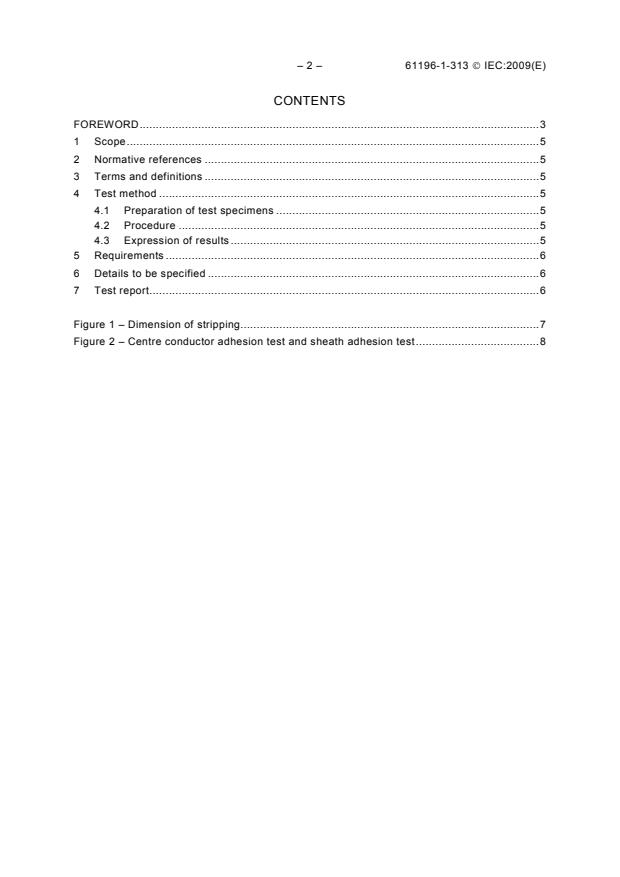
– 2 – 61196-1-313 © IEC:2009(E)
CONTENTS
FOREWORD.3
1 Scope.5
2 Normative references .5
3 Terms and definitions .5
4 Test method .5
4.1 Preparation of test specimens .5
4.2 Procedure .5
4.3 Expression of results.5
5 Requirements .6
6 Details to be specified .6
7 Test report.6
Figure 1 – Dimension of stripping.7
Figure 2 – Centre conductor adhesion test and sheath adhesion test.8
61196-1-313 © IEC:2009(E) – 3 –
INTERNATIONAL ELECTROTECHNICAL COMMISSION
____________
COAXIAL COMMUNICATION CABLES –
Part 1-313: Mechanical test methods –
Adhesion of dielectric and sheath
FOREWORD
1) The International Electrotechnical Commission (IEC) is a worldwide organization for standardization comprising
all national electrotechnical committees (IEC National Committees). The object of IEC is to promote
international co-operation on all questions concerning standardization in the electrical and electronic fields. To
this end and in addition to other activities, IEC publishes International Standards, Technical Specifications,
Technical Reports, Publicly Available Specifications (PAS) and Guides (hereafter referred to as “IEC
Publication(s)”). Their preparation is entrusted to technical committees; any IEC National Committee interested
in the subject dealt with may participate in this preparatory work. International, governmental and non-
governmental organizations liaising with the IEC also participate in this preparation. IEC collaborates closely
with the International Organization for Standardization (ISO) in accordance with conditions determined by
agreement between the two organizations.
2) The formal decisions or agreements of IEC on technical matters express, as nearly as possible, an international
consensus of opinion on the relevant subjects since each technical committee has representation from all
interested IEC National Committees.
3) IEC Publications have the form of recommendations for international use and are accepted by IEC National
Committees in that sense. While all reasonable efforts are made to ensure that the technical content of IEC
Publications is accurate, IEC cannot be held responsible for the way in which they are used or for any
misinterpretation by any end user.
4) In order to promote international uniformity, IEC National Committees undertake to a
...