

IEC 62899-403-2:2026
(Main)Printed electronics - Part 403-2: Printability - Requirements for reproducibility - Basic patterns for printing plate
General Information
- Abstract
IEC 62899-403-2:2026 specifies commonly utilized basic design patterns to evaluate the reproducibility of printed pattern from the viewpoint of the quality of printing plate for the printed electronics. Printing plates in this document include not only gravure, relief (flexo), and offset plates, but also a cylinder for rotary printing and mesh masks for screen printing. Inkjet printing is out of the scope of this document.
- Status
- Published
- Publication Date
- 12-Mar-2026
- Technical Committee
- TC 119 - Printed Electronics
- Drafting Committee
- WG 4 - TC 119/WG 4
- Current Stage
- PPUB - Publication issued
- Start Date
- 13-Mar-2026
- Completion Date
- 10-Apr-2026


Overview
IEC 62899-403-2:2026 is an international standard developed by the International Electrotechnical Commission (IEC) that defines the basic requirements for assessing the reproducibility of printed patterns in printed electronics by evaluating the quality of printing plates. This standard is especially relevant for industries involved in gravure, relief (flexo), offset, rotary printing cylinders, and screen printing mesh masks. It specifically excludes inkjet printing technologies from its scope.
IEC 62899-403-2:2026 details a set of standardized basic patterns that facilitate consistent evaluation of how well printing plates transfer high-precision micro-patterns required for the fabrication of electronic circuits and components. The adoption of this standard promotes international uniformity in printability assessments for printed electronics manufacturing.
Key Topics
Basic Patterns for Evaluation: The standard provides five series of two-dimensional graphical patterns designed for reproducibility testing:
- Lines with even width and space
- Lines with varying widths
- Lines with varying space between lines
- Radial lines pattern
- Tilted lines and space patterns
- Right-angled line patterns
Printing Plate Types: Covers all major traditional methods used in printed electronics, including gravure, flexography, offset printing, rotary cylinders, and screen printing masks.
Measurement and Reporting: Specifies parameters for pattern dimensions, layout, and reporting requirements, ensuring clear communication between suppliers and customers regarding the results of printability evaluations.
Use Cases: Includes practical examples and error analysis for identifying issues such as dimensional inconsistencies, ink pooling, and the relationships between printing plate quality and final printed results.
Agreement on Evaluation Methods: Emphasizes the importance of mutual agreement between suppliers and customers on the patterns, measurement methods, and evaluation criteria to ensure reliable and comparable assessment outcomes.
Applications
IEC 62899-403-2:2026 is vital for:
- Quality Control of Printed Electronics: By implementing standardized basic patterns, manufacturers can reliably assess the fidelity and reproducibility of fine patterns critical for components like sensors, circuits, and conductive traces.
- Printing Plate Evaluation: Enables engineers and inspection personnel to detect and analyze specific defects or inconsistencies linked to the design and manufacture of printing plates using a uniform approach.
- Process Optimization: Data collected using these patterns supports refinements in printing processes, ink formulations, and substrate compatibility to enhance overall printed electronics quality.
- Supplier-Customer Alignment: Clear measurement and reporting protocols help suppliers of printing plates and manufacturers align on quality expectations and troubleshooting procedures, supporting more efficient international trade and supply chain management.
By using the patterns and methodologies defined in this standard, organizations can establish traceable and repeatable quality assessments, reducing variability in high-volume production environments and ensuring compatibility with global supply chain requirements.
Related Standards
To support comprehensive printability and quality assessments in printed electronics, the following IEC standards are closely related:
- IEC 62899-401: Printed electronics - Printability - Overview
- IEC 62899-402 series: Printed electronics - Printability - Measurement of qualities (e.g., pattern widths, edge waviness, voids)
- IEC 62899-403-1: Printed electronics - Printability - Requirements for reproducibility - Basic patterns for evaluation of printing machine
- IEC 62899-101: Printed electronics - Terminology – Vocabulary
Adhering to IEC 62899-403-2:2026 and its related standards ensures a robust, internationally harmonized framework for quality assurance and process improvement within the fast-evolving printed electronics sector. For the latest updates and further technical details, consult the IEC website and the IEC Electropedia.
Frequently Asked Questions
IEC 62899-403-2:2026 is a standard published by the International Electrotechnical Commission (IEC). Its full title is "Printed electronics - Part 403-2: Printability - Requirements for reproducibility - Basic patterns for printing plate". This standard covers: IEC 62899-403-2:2026 specifies commonly utilized basic design patterns to evaluate the reproducibility of printed pattern from the viewpoint of the quality of printing plate for the printed electronics. Printing plates in this document include not only gravure, relief (flexo), and offset plates, but also a cylinder for rotary printing and mesh masks for screen printing. Inkjet printing is out of the scope of this document.
IEC 62899-403-2:2026 specifies commonly utilized basic design patterns to evaluate the reproducibility of printed pattern from the viewpoint of the quality of printing plate for the printed electronics. Printing plates in this document include not only gravure, relief (flexo), and offset plates, but also a cylinder for rotary printing and mesh masks for screen printing. Inkjet printing is out of the scope of this document.
IEC 62899-403-2:2026 is classified under the following ICS (International Classification for Standards) categories: 31.180 - Printed circuits and boards; 37.100.10 - Reproduction equipment. The ICS classification helps identify the subject area and facilitates finding related standards.
IEC 62899-403-2:2026 is available in PDF format for immediate download after purchase. The document can be added to your cart and obtained through the secure checkout process. Digital delivery ensures instant access to the complete standard document.
Standards Content (Sample)
IEC 62899-403-2 ®
Edition 1.0 2026-03
INTERNATIONAL
STANDARD
Printed electronics -
Part 403-2: Printability - Requirements for reproducibility - Basic patterns for
printing plate
ICS 31.180; 37.100.10 ISBN 978-2-8327-1128-6
All rights reserved. Unless otherwise specified, no part of this publication may be reproduced or utilized in any form or
by any means, electronic or mechanical, including photocopying and microfilm, without permission in writing from either
IEC or IEC's member National Committee in the country of the requester. If you have any questions about IEC copyright
or have an enquiry about obtaining additional rights to this publication, please contact the address below or your local
IEC member National Committee for further information.
IEC Secretariat Tel.: +41 22 919 02 11
3, rue de Varembé info@iec.ch
CH-1211 Geneva 20 www.iec.ch
Switzerland
About the IEC
The International Electrotechnical Commission (IEC) is the leading global organization that prepares and publishes
International Standards for all electrical, electronic and related technologies.
About IEC publications
The technical content of IEC publications is kept under constant review by the IEC. Please make sure that you have the
latest edition, a corrigendum or an amendment might have been published.
IEC publications search - IEC Products & Services Portal - products.iec.ch
webstore.iec.ch/advsearchform Discover our powerful search engine and read freely all the
The advanced search enables to find IEC publications by a
publications previews, graphical symbols and the glossary.
variety of criteria (reference number, text, technical With a subscription you will always have access to up to date
committee, …). It also gives information on projects, content tailored to your needs.
replaced and withdrawn publications.
Electropedia - www.electropedia.org
IEC Just Published - webstore.iec.ch/justpublished The world's leading online dictionary on electrotechnology,
Stay up to date on all new IEC publications. Just Published containing more than 22 500 terminological entries in English
details all new publications released. Available online and and French, with equivalent terms in 25 additional languages.
once a month by email. Also known as the International Electrotechnical Vocabulary
(IEV) online.
IEC Customer Service Centre - webstore.iec.ch/csc
If you wish to give us your feedback on this publication or
need further assistance, please contact the Customer
Service Centre: sales@iec.ch.
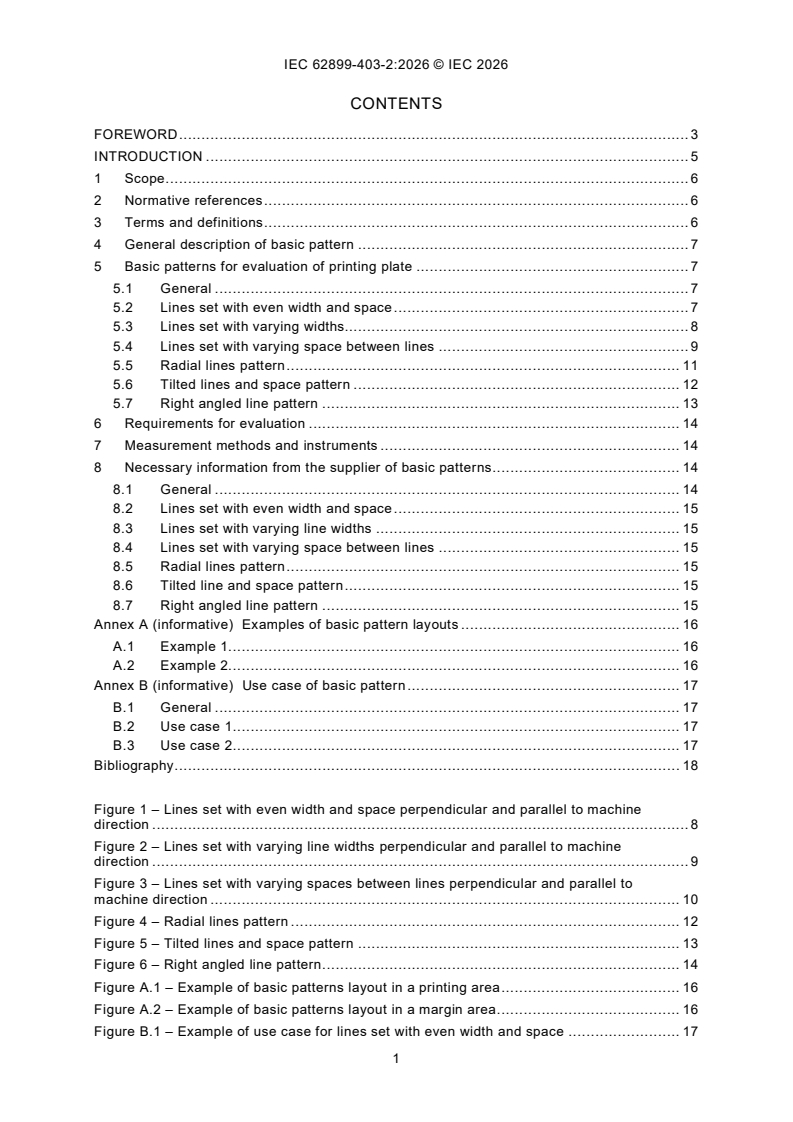
CONTENTS
FOREWORD . 3
INTRODUCTION . 5
1 Scope . 6
2 Normative references . 6
3 Terms and definitions . 6
4 General description of basic pattern . 7
5 Basic patterns for evaluation of printing plate . 7
5.1 General . 7
5.2 Lines set with even width and space . 7
5.3 Lines set with varying widths. 8
5.4 Lines set with varying space between lines . 9
5.5 Radial lines pattern . 11
5.6 Tilted lines and space pattern . 12
5.7 Right angled line pattern . 13
6 Requirements for evaluation . 14
7 Measurement methods and instruments . 14
8 Necessary information from the supplier of basic patterns . 14
8.1 General . 14
8.2 Lines set with even width and space . 15
8.3 Lines set with varying line widths . 15
8.4 Lines set with varying space between lines . 15
8.5 Radial lines pattern . 15
8.6 Tilted line and space pattern . 15
8.7 Right angled line pattern . 15
Annex A (informative) Examples of basic pattern layouts . 16
A.1 Example 1. 16
A.2 Example 2. 16
Annex B (informative) Use case of basic pattern . 17
B.1 General . 17
B.2 Use case 1 . 17
B.3 Use case 2 . 17
Bibliography . 18
Figure 1 – Lines set with even width and space perpendicular and parallel to machine
direction . 8
Figure 2 – Lines set with varying line widths perpendicular and parallel to machine
direction . 9
Figure 3 – Lines set with varying spaces between lines perpendicular and parallel to
machine direction . 10
Figure 4 – Radial lines pattern . 12
Figure 5 – Tilted lines and space pattern . 13
Figure 6 – Right angled line pattern . 14
Figure A.1 – Example of basic patterns layout in a printing area . 16
Figure A.2 – Example of basic patterns layout in a margin area . 16
Figure B.1 – Example of use case for lines set with even width and space . 17
Figure B.2 – Example of use case for right angled line pattern . 17
Table 1 – Series of lines sets with varying widths. 9
Table 2 – Series of lines sets with varying spaces between lines . 11
INTERNATIONAL ELECTROTECHNICAL COMMISSION
____________
Printed electronics -
Part 403-2: Printability - Requirements for reproducibility -
Basic patterns for printing plate
FOREWORD
1) The International Electrotechnical Commission (IEC) is a worldwide organization for standardization comprising
all national electrotechnical committees (IEC National Committees). The object of IEC is to promote international
co-operation on all questions concerning standardization in the electrical and electronic fields. To this end and
in addition to other activities, IEC publishes International Standards, Technical Specifications, Technical Reports,
Publicly Available Specifications (PAS) and Guides (hereafter referred to as “IEC Publication(s)”). Their
preparation is entrusted to technical committees; any IEC National Committee interested in the subject dealt with
may participate in this preparatory work. International, governmental and non-governmental organizations liaising
with the IEC also participate in this preparation. IEC collaborates closely with the International Organization for
Standardization (ISO) in accordance with conditions determined by agreement between the two organizations.
2) The formal decisions or agreements of IEC on technical matters express, as nearly as possible, an international
consensus of opinion on the relevant subjects since each technical committee has representation from all
interested IEC National Committees.
3) IEC Publications have the form of recommendations for international use and are accepted by IEC National
Committees in that sense. While all reasonable efforts are made to ensure that the technical content of IEC
Publications is accurate, IEC cannot be held responsible for the way in which they are used or for any
misinterpretation by any end user.
4) In order to promote international uniformity, IEC National Committees undertake to apply IEC Publications
transparently to the maximum extent possible in their national and regional publications. Any divergence between
any IEC Publication and the corresponding national or regional publication shall be clearly indicated in the latter.
5) IEC itself does not provide any attestation of conformity. Independent certification bodies provide conformity
assessment services and, in some areas, access to IEC marks of conformity. IEC is not responsible for any
services carried out by independent certification bodies.
6) All users should ensure that they have the latest edition of this publication.
7) No liability shall attach to IEC or its directors, employees, servants or agents including individual experts and
members of its technical committees and IEC National Committees for any personal injury, property damage or
other damage of any nature whatsoever, whether direct or indirect, or for costs (including legal fees) and
expenses arising out of the publication, use of, or reliance upon, this IEC Publication or any other IEC
Publications.
8) Attention is drawn to the Normative references cited in this publication. Use of the referenced publications is
indispensable for the correct application of this publication.
9) IEC draws attention to the possibility that the implementation of this document may involve the use of (a)
patent(s). IEC takes no position concerning the evidence, validity or applicability of any claimed patent rights in
respect thereof. As of the date of publication of this document, IEC had not received notice of (a) patent(s), which
may be required to implement this document. However, implementers are cautioned that this may not represent
the latest information, which may be obtained from the patent database available at https://patents.iec.ch. IEC
shall not be held responsible for identifying any or all such patent rights.
IEC 62899-403-2 has been prepared by IEC technical committee 119: Printed electronics. It is
an International Standard.
The text of this International Standard is based on the following documents:
Draft Report on voting
119/569/FDIS 119/577/RVD
Full information on the voting for its approval can be found in the report on voting indicated in
the above table.
The language used for the development of this International Standard is English.
This document was drafted in accordance with ISO/IEC Directives, Part 2, and developed in
accordance with ISO/IEC Directives, Part 1 and ISO/IEC Directives, IEC Supplement, available
at www.iec.ch/members_experts/refdocs. The main document types developed by IEC are
described in greater detail at www.iec.ch/publications.
A list of all parts in the IEC 62899 series, published under the general title Printed electronics,
can be found on the IEC website.
The committee has decided that the contents of this document will remain unchanged until the
stability date indicated on the IEC website under webstore.iec.ch in the data related to the
specific document. At this date, the document will be
– reconfirmed,
– withdrawn, or
– revised.
INTRODUCTION
This document provides commonly utilized design patterns for evaluating printability with focus
on printing plate micro pattern resolution. Reproducibility of micro patterns in printed electronics
is checked by the size and shape of line and space patterns affected by printing plate. Precision
quality of the high-resolution printing plate is key to the fabrication of the fine patterning that
makes up electronic circuits and components in the field of printed electronics manufacturing.
Quality and reproducibility of the printing technology in electronics manufacturing help to
facilitate international trade and enhanced user value in the field of printed electronics. The
IEC 62899-403 series contains basic patterns to evaluate the printability of patterns from the
viewpoint of printing machine, printing plate, and applications for printed electronics
manufacturing. The printability is estimated by both the quality of printed patterns and the
reproducibility of printing designs. On the other hand, the reproducibility of the printed pattern
is achieved by estimating the fidelity from the printing design date. IEC 62899-403-1 provides
commonly utilized design patterns for evaluating printability by the point of operation accuracy
of the printing machine.
The quality of printed patterns is ensured by accurate measurements of their size and
dimensions (2D and/or 3D). The printability of patterns can be measured with the methods
provided in the IEC 62899-402 series.
1 Scope
This part of IEC 62899 specifies commonly utilized basic design patterns to evaluate the
reproducibility of printed pattern from the viewpoint of the quality of printing plate for the printed
electronics. Printing plates in this document include not only gravure, relief (flexo), and offset
plates, but also a cylinder for rotary printing and m
...