

IEC 63297:2025
(Main)Sensing devices for non-intrusive load monitoring (NILM) systems
General Information
- Abstract
IEC 63297:2025 provides a classification of NILM sensing devices for use in NILM systems, according to the state of the art of NILM technologies.
- Status
- Published
- Publication Date
- 24-Jun-2025
- Technical Committee
- TC 85 - Measuring equipment for electrical and electromagnetic quantities
- Drafting Committee
- WG 20 - TC 85/WG 20
- Current Stage
- PPUB - Publication issued
- Start Date
- 25-Jun-2025
- Completion Date
- 16-Jul-2025
Overview
IEC 63297:2025 - "Sensing Devices for Non-Intrusive Load Monitoring (NILM) Systems" - is an international standard from the International Electrotechnical Commission (IEC) that classifies sensing devices deployed in NILM systems. NILM, or non-intrusive load monitoring, is an advanced technique used for estimating and disaggregating energy consumption across different appliances or usages from measurements taken at a single point in an electrical installation (such as a building or industrial site).
This standard provides guidance on classifying sensing devices according to key performance parameters aligned with state-of-the-art NILM technologies. It aims to facilitate comparison, selection, and deployment of NILM sensing devices in AC and, potentially, DC electrical distribution networks.
Key Topics
- NILM Sensing Device (NSD) Classification: IEC 63297:2025 introduces clear classes for NILM sensing devices (NSDs) based on three essential parameters:
- Sampling frequency (from <5 kHz up to ≥1 MHz and parameters-only devices)
- Output data rate (from >30 minutes per data set down to ≤0.1 seconds)
- Data bit rate (from <100 bit/s to ≥100 kbit/s)
- Documentation Requirements: Manufacturers are required to provide comprehensive specifications, including NSD classification codes, metrological data, connectivity, safety, EMC compliance, and environmental conditions.
- System Elements: The standard defines the essential components of a NILM system:
- NSD (sensing device)
- Data transmission layer
- NILM analytics (often using AI, machine learning, and pattern recognition)
- Presentation and reporting mechanisms for end users
- Types of Sensing Devices: Examples include smart meters, power metering devices (PMD), power quality instruments (PQI), and proprietary sensing hardware, each with different class profiles.
Applications
IEC 63297:2025 is highly relevant in sectors focused on energy management and efficiency:
- Commercial and Residential Energy Monitoring: Utilize NILM systems equipped with classified NSDs to audit and optimize energy use, enabling building managers and homeowners to make informed decisions about consumption and savings.
- Industrial Asset Management: Deploy NILM technologies with standardized sensing for process optimization, preventative maintenance, and detailed power quality monitoring.
- Utilities and Smart Grid: Integrate NSDs compliant with IEC 63297:2025 within grid infrastructure to support advanced metering, disaggregation of load profiles, and enhance demand response strategies.
- Product Development and Certification: Manufacturers designing NILM hardware can use the classification framework to ensure product comparability, interoperability, and regulatory compliance.
Related Standards
If you are working with NILM systems or electrical measurement devices, the following related standards may be relevant:
- IEC 61010-1: Safety requirements for electrical equipment for measurement, control, and laboratory use
- IEC 61557-12: Power metering and monitoring devices (PMD)
- IEC 62586-1: Power quality measurement instruments (PQI)
- IEC 62053 series: Static meters for electricity metering
- IEC TR 63213: Provides further context on electricity measurement in the grid and associated standards
Practical Value
By promoting a unified approach to NILM sensing device classification, IEC 63297:2025 adds significant value for:
- Manufacturers, by clarifying documentation and comparison requirements
- Systems Integrators, facilitating informed selection of NILM devices to match analytics requirements
- End Users, increasing transparency and confidence in NILM-based energy reporting and optimization solutions
Adhering to IEC 63297:2025 ensures greater interoperability, reliability, and up-to-date compliance with evolving NILM and smart grid technologies.
Relations
- Effective Date
- 01-Dec-2023
Get Certified
Connect with accredited certification bodies for this standard

BSMI (Bureau of Standards, Metrology and Inspection)
Taiwan's standards and inspection authority.
Sponsored listings
Frequently Asked Questions
IEC 63297:2025 is a standard published by the International Electrotechnical Commission (IEC). Its full title is "Sensing devices for non-intrusive load monitoring (NILM) systems". This standard covers: IEC 63297:2025 provides a classification of NILM sensing devices for use in NILM systems, according to the state of the art of NILM technologies.
IEC 63297:2025 provides a classification of NILM sensing devices for use in NILM systems, according to the state of the art of NILM technologies.
IEC 63297:2025 is classified under the following ICS (International Classification for Standards) categories: 17.220.20 - Measurement of electrical and magnetic quantities. The ICS classification helps identify the subject area and facilitates finding related standards.
IEC 63297:2025 has the following relationships with other standards: It is inter standard links to IEC TS 63297:2021. Understanding these relationships helps ensure you are using the most current and applicable version of the standard.
IEC 63297:2025 is available in PDF format for immediate download after purchase. The document can be added to your cart and obtained through the secure checkout process. Digital delivery ensures instant access to the complete standard document.
Standards Content (Sample)
IEC 63297 ®
Edition 1.0 2025-06
INTERNATIONAL
STANDARD
NORME
INTERNATIONALE
Sensing devices for non-intrusive load monitoring (NILM) systems
Dispositifs de détection pour les systèmes de surveillance non intrusive de la
charge (NILM)
ICS 17.220.20 ISBN 978-2-8327-0500-1
All rights reserved. Unless otherwise specified, no part of this publication may be reproduced or utilized in any form or
by any means, electronic or mechanical, including photocopying and microfilm, without permission in writing from either
IEC or IEC's member National Committee in the country of the requester. If you have any questions about IEC copyright
or have an enquiry about obtaining additional rights to this publication, please contact the address below or your local
IEC member National Committee for further information.
Droits de reproduction réservés. Sauf indication contraire, aucune partie de cette publication ne peut être reproduite ni
utilisée sous quelque forme que ce soit et par aucun procédé, électronique ou mécanique, y compris la photocopie et
les microfilms, sans l'accord écrit de l'IEC ou du Comité national de l'IEC du pays du demandeur. Si vous avez des
questions sur le copyright de l'IEC ou si vous désirez obtenir des droits supplémentaires sur cette publication, utilisez
les coordonnées ci-après ou contactez le Comité national de l'IEC de votre pays de résidence.
IEC Secretariat Tel.: +41 22 919 02 11
3, rue de Varembé info@iec.ch
CH-1211 Geneva 20 www.iec.ch
Switzerland
About the IEC
The International Electrotechnical Commission (IEC) is the leading global organization that prepares and publishes
International Standards for all electrical, electronic and related technologies.
About IEC publications
The technical content of IEC publications is kept under constant review by the IEC. Please make sure that you have the
latest edition, a corrigendum or an amendment might have been published.
IEC publications search - IEC Products & Services Portal - products.iec.ch
webstore.iec.ch/advsearchform Discover our powerful search engine and read freely all the
The advanced search enables to find IEC publications by a publications previews, graphical symbols and the glossary.
variety of criteria (reference number, text, technical With a subscription you will always have access to up to date
committee, …). It also gives information on projects, content tailored to your needs.
replaced and withdrawn publications.
Electropedia - www.electropedia.org
IEC Just Published - webstore.iec.ch/justpublished The world's leading online dictionary on electrotechnology,
Stay up to date on all new IEC publications. Just Published containing more than 22 500 terminological entries in English
details all new publications released. Available online and and French, with equivalent terms in 25 additional languages.
once a month by email. Also known as the International Electrotechnical Vocabulary
(IEV) online.
IEC Customer Service Centre - webstore.iec.ch/csc
If you wish to give us your feedback on this publication or
need further assistance, please contact the Customer
Service Centre: sales@iec.ch.
A propos de l'IEC
La Commission Electrotechnique Internationale (IEC) est la première organisation mondiale qui élabore et publie des
Normes internationales pour tout ce qui a trait à l'électricité, à l'électronique et aux technologies apparentées.
A propos des publications IEC
Le contenu technique des publications IEC est constamment revu. Veuillez vous assurer que vous possédez l’édition la
plus récente, un corrigendum ou amendement peut avoir été publié.
Recherche de publications IEC - IEC Products & Services Portal - products.iec.ch
webstore.iec.ch/advsearchform Découvrez notre puissant moteur de recherche et consultez
La recherche avancée permet de trouver des publications gratuitement tous les aperçus des publications, symboles
IEC en utilisant différents critères (numéro de référence, graphiques et le glossaire. Avec un abonnement, vous aurez
texte, comité d’études, …). Elle donne aussi des toujours accès à un contenu à jour adapté à vos besoins.
informations sur les projets et les publications remplacées
ou retirées. Electropedia - www.electropedia.org
Le premier dictionnaire d'électrotechnologie en ligne au
IEC Just Published - webstore.iec.ch/justpublished monde, avec plus de 22 500 articles terminologiques en
Restez informé sur les nouvelles publications IEC. Just anglais et en français, ainsi que les termes équivalents
Published détaille les nouvelles publications parues. dans 25 langues additionnelles. Egalement appelé
Disponible en ligne et une fois par mois par email. Vocabulaire Electrotechnique International (IEV) en ligne.
Service Clients - webstore.iec.ch/csc
Si vous désirez nous donner des commentaires sur cette
publication ou si vous avez des questions contactez-
nous: sales@iec.ch.
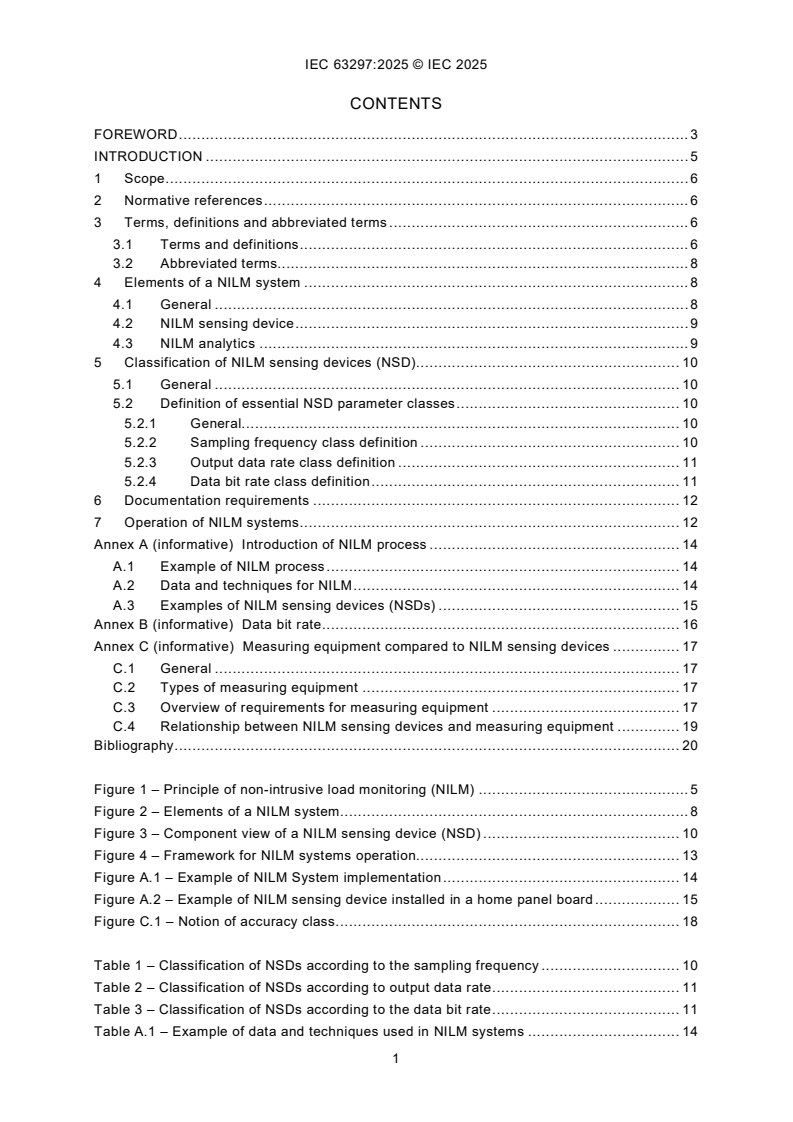
CONTENTS
FOREWORD . 3
INTRODUCTION . 5
1 Scope . 6
2 Normative references . 6
3 Terms, definitions and abbreviated terms . 6
3.1 Terms and definitions . 6
3.2 Abbreviated terms. 8
4 Elements of a NILM system . 8
4.1 General . 8
4.2 NILM sensing device . 9
4.3 NILM analytics . 9
5 Classification of NILM sensing devices (NSD) . 10
5.1 General . 10
5.2 Definition of essential NSD parameter classes . 10
5.2.1 General. 10
5.2.2 Sampling frequency class definition . 10
5.2.3 Output data rate class definition . 11
5.2.4 Data bit rate class definition . 11
6 Documentation requirements . 12
7 Operation of NILM systems . 12
Annex A (informative) Introduction of NILM process . 14
A.1 Example of NILM process . 14
A.2 Data and techniques for NILM . 14
A.3 Examples of NILM sensing devices (NSDs) . 15
Annex B (informative) Data bit rate . 16
Annex C (informative) Measuring equipment compared to NILM sensing devices . 17
C.1 General . 17
C.2 Types of measuring equipment . 17
C.3 Overview of requirements for measuring equipment . 17
C.4 Relationship between NILM sensing devices and measuring equipment . 19
Bibliography . 20
Figure 1 – Principle of non-intrusive load monitoring (NILM) . 5
Figure 2 – Elements of a NILM system . 8
Figure 3 – Component view of a NILM sensing device (NSD) . 10
Figure 4 – Framework for NILM systems operation. 13
Figure A.1 – Example of NILM System implementation . 14
Figure A.2 – Example of NILM sensing device installed in a home panel board . 15
Figure C.1 – Notion of accuracy class . 18
Table 1 – Classification of NSDs according to the sampling frequency . 10
Table 2 – Classification of NSDs according to output data rate . 11
Table 3 – Classification of NSDs according to the data bit rate . 11
Table A.1 – Example of data and techniques used in NILM systems . 14
Table A.2 – Examples of NILM sensing devices and typical specification. 15
Table B.1 – Examples of data bit rate calculation . 16
Table C.1 – Overview of measuring equipment . 17
INTERNATIONAL ELECTROTECHNICAL COMMISSION
____________
Sensing devices for non-intrusive load monitoring (NILM) systems
FOREWORD
1) The International Electrotechnical Commission (IEC) is a worldwide organization for standardization comprising
all national electrotechnical committees (IEC National Committees). The object of IEC is to promote international
co-operation on all questions concerning standardization in the electrical and electronic fields. To this end and
in addition to other activities, IEC publishes International Standards, Technical Specifications, Technical Reports,
Publicly Available Specifications (PAS) and Guides (hereafter referred to as “IEC Publication(s)”). Their
preparation is entrusted to technical committees; any IEC National Committee interested in the subject dealt with
may participate in this preparatory work. International, governmental and non-governmental organizations liaising
with the IEC also participate in this preparation. IEC collaborates closely with the International Organization for
Standardization (ISO) in accordance with conditions determined by agreement between the two organizations.
2) The formal decisions or agreements of IEC on technical matters express, as nearly as possible, an international
consensus of opinion on the relevant subjects since each technical committee has representation from all
interested IEC National Committees.
3) IEC Publications have the form of recommendations for international use and are accepted by IEC National
Committees in that sense. While all reasonable efforts are made to ensure that the technical content of IEC
Publications is accurate, IEC cannot be held responsible for the way in which they are used or for any
misinterpretation by any end user.
4) In order to promote international uniformity, IEC National Committees undertake to apply IEC Publications
transparently to the maximum extent possible in their national and regional publications. Any divergence between
any IEC Publication and the corresponding national or regional publication shall be clearly indicated in the latter.
5) IEC itself does not provide any attestation of conformity. Independent certification bodies provide conformity
assessment services and, in some areas, access to IEC marks of conformity. IEC is not responsible for any
services carried out by independent certification bodies.
6) All users should ensure that they have the latest edition of this publication.
7) No liability shall attach to IEC or its directors, employees, servants or agents including individual experts and
members of its technical committees and IEC National Committees for any personal injury, property damage or
other damage of any nature whatsoever, whether direct or indirect, or for costs (including legal fees) and
expenses arising out of the publication, use of, or reliance upon, this IEC Publication or any other IEC
Publications.
8) Attention is drawn to the Normative references cited in this publication. Use of the referenced publications is
indispensable for the correct application of this publication.
9) IEC draws attention to the possibility that the implementation of this document may involve the use of (a)
patent(s). IEC takes no position concerning the evidence, validity or applicability of any claimed patent rights in
respect thereof. As of the date of publication of this document, IEC had not received notice of (a) patent(s), which
may be required to implement this document. However, implementers are cautioned that this may not represent
the latest information, which may be obtained from the patent database available at https://patents.iec.ch. IEC
shall not be held responsible for identifying any or all such patent rights.
IEC 63297 has been prepared by IEC technical committee 85: Measuring equipment for
electrical and electromagnetic quantities. It is an International Standard.
The text of this International Standard is based on the following documents:
Draft Report on voting
85/933/CDV 85/953/RVC
Full information on the voting for its approval can be found in the report on voting indicated in
the above table.
The language used for the development of this International Standard is English.
This document was drafted in accordance with ISO/IEC Directives, Part 2, and developed in
accordance with ISO/IEC Directives, Part 1 and ISO/IEC Directives, IEC Supplement, available
at www.iec.ch/members_experts/refdocs. The main document types developed by IEC are
described in greater detail at www.iec.ch/publications.
The committee has decided that the contents of this document will remain unchanged until the
stability date indicated on the IEC website under webstore.iec.ch in the data related to the
specific document. At this date, the document will be
• reconfirmed,
• withdrawn, or
• revised.
INTRODUCTION
Non-intrusive load monitoring (NILM), or non-intrusive appliance and load monitoring (NIALM),
is a process for providing estimated energy usage, for example by type of use (heating, cooling,
etc.) or type of appliance (microwave, etc.) based on load signatures at a single point in the
installation.
NILM systems can be used to survey the specific uses of electrical power in homes, buildings
or industrial areas (see Figure 1).
Figure 1 – Principle of non-intrusive load monitoring (NILM)
At the moment, NILM systems are essentially used in AC distribution networks, but DC networks
are not excluded.
1 Scope
This document provides a classification of NILM sensing devices for use in NILM systems,
according to the state of the art of NILM technologies.
The classification of NILM analytics and NILM systems, as well as performance indicators for
NILM systems, can be considered in the future.
NILM systems produce estimated disaggregation into energy usages. When accurate
measurement and analysis of energy consumption or other electrical parameters, or both, are
necessary (e.g. for monitoring the electrical installation), systems based on standardized
measuring devices (e.g. power metering and monitoring devices (PMDs), power quality
instruments (PQIs) or meters) are used.
NOTE Standardized measuring devices have guaranteed accuracy over a specified range and have limited
deviations in presence of influence quantities (temperature, frequency deviations…) in addition to safety and
constructional requirements. See Annex C for more information.
2 Normative references
The following documents are referred to in the text in such a way that some or all of their content
constitutes requirements of this document. For dated references, only the edition cited applies.
For undated references, the latest edition of the referenced document (including any
amendments) applies.
IEC 61010-1, Safety requirements for electrical equipment for measurement, control, and
laboratory use – Part 1: General requirements
3 Terms, definitions and abbreviated terms
3.1 Terms and definitions
For the purposes of this document, the following terms and definitions apply.
ISO and IEC maintain terminology databases for use in standardization at the following
addresses:
• IEC Electropedia: available at https://www.electropedia.org/
• ISO Online browsing platform: available at https://www.iso.org/obp
3.1.1
electrical parameter
electrical quantity to be measured or estimated
EXAMPLE RMS value of current, RMS value of voltage, active power, reactive power, harmonics, power quality
related parameters, etc.
3.1.2
estimated value
value of an electrical parameter (e.g. current, power, energy related to a specific usage)
produced by a NILM sensing device or a NILM system
Note 1 to entry: Estimated values are typically less accurate than values measured with standardized measuring
devices (e.g. PMD, PQI, meters).
3.1.3
measured value
value of an electrical parameter (e.g. current, power, energy related to a specific usage)
produced by a measuring device complying with an electrical measurement standard
Note 1 to entry: Examples of measuring devices complying with an electrical measurement standard include PMDs,
PQIs and meters.
3.1.4
load signature
pattern in the data produced by a NILM sensing device that can be attributed to a specific type
of load or energy usage
3.1.5
non-intrusive load monitoring
NILM
process for providing estimated categorization of energy usage based on load signatures
obtained at a single point in the installation
3.1.6
NILM analytics
process for analyzing data produced by a NILM sensing device and providing information about
energy usage
Note 1 to entry: NILM analytics can be performed within the NILM sensing device and/or in the cloud.
3.1.7
NILM sensing device
NSD
device connected to the electrical installation and producing data to be used by NILM analytics
3.1.8
NILM system
combination of a NILM sensing device and NILM analytics
3.1.9
power metering and monitoring device
PMD
combination in one or more devices of several functional modules dedicated to metering and
monitoring electrical parameters in energy distribution systems or electrical installations, used
for applications such as energy efficiency, power monitoring and network performance
Note 1 to entry: Under the generic term “monitoring” are also included functions of recording, alarm management,
etc.
Note 2 to entry: PMDs have a known measurement uncertainty over a specified measurement range and are robust
to influence quantities and industrial environments
[SOURCE: IEC 61557-12:2018, 3.1.1, modified – Note 2 to entry has been modified and Note
3 to entry has been deleted.]
3.1.10
power quality instrument
PQI
instrument complying with IEC 62586-1 whose main function is to measure, record and possibly
monitor power quality parameters in power supply systems, and whose measuring methods
(class A or class S) are defined in IEC 61000-4-30
Note 1 to entry: PQIs have a known measurement uncertainty over a specified measurement range and are robust
to influence quantities and industrial environments. They often also have transient event detection and waveform
capture capabilities.
[SOURCE: IEC 62586-1:2017, 3.1.1, modified – A reference to IEC 62586-1 and Note 1 to entry
have been added.]
3.1.11
gapless measurement
measurement technique where the acquisition of data is performed continuously without
interruption, that is, using contiguous measurement windows
Note 1 to entry: For digital techniques and for a given sampling rate, no sample is missing in the measurement
processing.
Note 2 to entry: When gapless measurement techniques are used, no assumption is made regarding the stability of
the signal, as opposed to non-gapless measurement techniques, where the signal is considered to be stable during
the time where no measurement is done.
3.2 Abbreviated terms
CRM customer relations management
NIALM non-intrusive appliance and load monitoring
NILM non-intrusive load monitoring
NSD NILM sensing device
PMD power metering and monitoring device
PQI power quality instrument
4 Elements of a NILM system
4.1 General
An overview of NILM systems is presented in Annex A. A NILM system comprises (see Figure 2)
the following:
– a NILM sensing device (NSD) connected to the electrical installation and producing data
relevant for load signature identification;
– NILM analytics using the data output from the NSD and producing information to the users
about their energy usage.
Figure 2 – Elements of a NILM system
The performance of the NILM system depends on the characteristics of the NILM sensing device
(NSD) and on the characteristics of the NILM analytics. There are many differences between
the NILM systems available today. For example:
• NILM systems can use several types of NSD, for example:
– meter;
– power metering and monitoring devices (PMDs);
– power quality instrument (PQI);
– dedicated proprietary hardware.
• Some NILM systems produce energy usage information over one day, while others can show
results on a much shorter time scale.
• Some NILM systems disaggregate into types of usage, others disaggregate into types of
current using equipment (e.g. appliances), while others focus on providing behavioural
analysis.
NILM analytics can also use data produced by smart devices. Smart devices are devices
producing information not related to electrical quantities, for example position sensors, motion
sensors, temperature control equipment, etc.
4.2 NILM sensing device
A NILM sensing device (NSD) is a device connected to the electrical installation. It produces
data that can be used by NILM analytics. Examples of data that can be produced by an NSD
include:
– samples of current or voltage waveforms, or both;
– features characterizing the current or voltage waveforms, or both;
– features related to the high-frequency patterns in the electrical signals;
– estimated values of electrical parameters;
– measured values of electrical parameters.
4.3 NILM analytics
The value of NILM systems is essentially in the analytics and how well they are able to make
use of the data produced by the NSD.
NILM analytics are algorithms that analyze the data output by an NSD and produce estimated
disaggregated information that can help stakeholders make decisions. The techniques involved
in these analytics include artificial intelligence, machine learning, pattern matching, etc.
Examples of information that can be produced by NILM analytics are:
– estimated disaggregation of energy consumption into specific usages (heating, refrigeration,
entertainment);
– estimated disaggregation of energy consumption into specific types of appliances (ovens,
refrigerators, pumps).
NOTE NILM systems produce estimated disaggregation into energy usages. When accurate measurement and
analysis of energy consumption or other electrical parameters is necessary (e.g. for monitoring the electrical
installation), systems based on standardized measuring devices (e.g. PMDs or meters) are used.
5 Classification of NILM sensing devices (NSD)
5.1 General
A NILM sensing device (NSD) is a gateway between the physical electrical installation and the
world of analytics. In order to operate efficiently, NILM algorithms have to know the type of data
they are to process. The behaviour of the NSD depends on several characteristics (see
Figure 3).
Figure 3 – Component view of a NILM sensing device (NSD)
To facilitate the development of NILM analytics, it is useful to specify the characteristics of NILM
sensing devices, for easier selection and comparison.
5.2 Definition of essential NSD parameter classes
5.2.1 General
NILM sensing devices shall be classified according to three essential parameters, each
associated to a class characterized by a code number or letter:
– sampling frequency: see 5.2.2;
– output rate: see 5.2.3;
– data bit rate: see 5.2.4.
5.2.2 Sampling frequency class definition
The sampling frequency is the frequency at which the electrical signals are sampled by the NSD.
This frequency typically varies from a couple of kHz to the MHz range. The sampling process
can be gapless or not.
Table 1 provides a classification of NSDs according to the sampling frequency.
The sampling frequency is essential to characterize NSDs that produce samples of the electrical
waveforms. It is less relevant for NSDs producing estimated or measured values. Therefore a
separate class is specified for NSDs producing electrical parameters (class P as “parameters
only”).
Table 1 – Classification of NSDs according to the sampling frequency
Sampling
Parameters
frequency < 5 kHz 5 kHz ≤ f < 8 kHz 8 kHz ≤ f < 100 kHz 100 kHz ≤ f < 1 MHz ≥ 1 MHz
only
f
Class P 1 2 3 4 5
Class P in Table 1 is for NSDs that do not produce samples of the electrical waveforms. Instead,
they produce measurements or estimates of electrical parameters (e.g. active power, reactive
power, power factor, harmonic distortion).
– Classical measuring instruments such as power metering and monitoring devices (PMDs)
can be considered class-P NSDs as they produce measurements of electrical parameters.
– Power quality instruments (PQIs) also produce measurements of electrical parameters, but
also often have waveform capture capabilities. They can therefore be considered as class-P
NSDs and, typically, class 3 or 4 NSDs depending on their sampling properties.
5.2.3 Output data rate class definition
The output data rate is the rate at which the NSD produces data that can be used by NILM
analytics. This rate typically varies from one set of data per second to one set of data per 30 min.
Table 2 provides a classification of NSDs according to the output data rate.
Table 2 – Classification of NSDs according to output data rate
Output data
> 30 min 30 min ≥ d > 1 min 1 min ≥ d > 1 s 1 s ≥ d > 0,1 s ≤ 0,1 s
rate d
Class E D C B A
5.2.4 Data bit rate class definition
The data bit rate is the average bit-per-second (bit/s) at which the electrical signals are
quantified by the NSD. This data bit rate typically varies from a few bit/s to the Mbit/s range.
Table 3 provides a classification of NILM sensing devices according to the data bit rate.
Table 3 – Classification of NSDs according to the data bit rate
Data
bit rate < 100 bit/s 100 bit/s ≤ b < 1 kbit/s 1 kbit/s ≤ b < 10 kbit/s 10 kbit/s ≤ b < 100 kbit/s ≥ 100 kbit/s
b
Class L M H S X
The classes from Table 1, Table 2 and Table 3 shall be combined into a three-character code
characterizing the NSD, by assembling the class code defined in Table 1, Table 2 and Table 3.
For example,
– a NILM sensing device sampling the electrical signals at 7 kHz and producing data for NILM
analytics every second with an average data bit rate of 500 bit/s can be referred to as a
class 2BM NSD;
– a NILM sensing device sampling the electrical signals at 1 MHz and producing data for NILM
analytics every 0,02 s (50 Hz) with a data bit rate of 1 Mbit/s can be referred to as a class
5AX NSD;
– a PMD producing active power measurements every second can be referred to as a class
PBL NSD.
In case an NSD is able to have several sampling frequencies, manufacturers shall provide a
class for each sampling frequency.
In case an NSD is able to have several output data rates, manufacturers shall provide a class
for each output data rate.
In case an NSD is able to have several data bit rates, manufacturers shall provide a class for
each data bit rate.
For NSDs using information related to transient events, the data bit rate depends on the
occurrence of the transient events, and the rate of occurrence used for classification shall be
indicated.
Information and example regarding data bit rate are presented in Annex B.
6 Documentation requirements
The manufacturer shall provide the following information in the documentation:
– NSD class or classes;
– list of produced estimated values, for example active power values, RMS current values,
etc., with corresponding accuracy class, if any, for NSDs classified as P according to
Table 1;
– rated voltage;
– rated current;
– rated frequency;
– performance (resolution, range, operating conditions, etc.) of the estimated data produced,
as claimed by the NSD manufacturer;
– number of phases (typically one or three);
– number of acquisition channels;
– starting current or power (threshold for operation);
– network communication type, protocol and range (Wifi, 3G/4G/5G, PLC, Ethernet, etc.);
– memory storage capabilities in case of network failure;
– type of data compression (lossless or lossy);
– environmental conditions;
– safety data;
– EMC data;
– behaviour with generating devices (PV, batteries,etc.).
For safety and EMC aspects of NSDs, relevant references of EMC and safety standards shall
be provided, for example safety in accordance with IEC 61010-1. See also Annex C for more
information.
NOTE For devices with radio features, local regulations can also apply.
7 Operation of NILM systems
The operation of a NILM system can involve the following elements (see Figure 4):
– NILM sensing device (NSD);
– network transmission: means of transmitting the data produced by the NSD to the NILM
analytics, commonly to remote data storage via a could service;
– NILM analytics: processing the data through a set of algorithm calculations to estimate the
breakdown of power consumption usage;
– CRM: customer relations management to determine to which installation the data belongs;
– NILM reporting: the results from the NILM analytics are typically reported via mobile phones,
websites or paper reports.
Figure 4 – Framework for NILM systems operation
Annex A
(informative)
Introduction of NILM process
A.1 Example of NILM process
An example of implementation of a NILM system is shown in Figure A.1.
Figure A.1 – Example of NILM System implementation
A.2 Data and techniques for NILM
Table A.1 shows examples of data and techniques that can be used in NILM systems.
Table A.1 – Example of data and techniques used in NILM systems
Operation step Purpose of operation step Typical implementation
Analog measurement Sensing electrical signals Sensing current and voltage signals
Digital processing Computing features for NILM Computing basic electrical
analytics parameters: active power, other
powers (reactive, apparent,
fundamental), harmonic distortion,
etc.
Sample waveforms or computing
specific waveform parameters or
advanced parameters (e.g. high-
frequency content)
Data transmission to analytics Transmiting features to analytics Using GSM or HTTP network
Disaggregation analytics Disaggregating power consumption Machine learning algorithms,
supervised or unsupervised neutral
networks, nearest neighbours,
decision trees, etc.
Post-processing of results Transforming disaggregated Computing averages, detecting
consumption into valuable events, detecting trends and
information for end user abnormalities, deriving advice for
end user, etc.
Operation step Purpose of operation step Typical implementation
Presentation to end user Presenting valuable information to Web pages, phone applications,
end user for information and actions specific alarms and notifications, etc.
for energy savings, ambient assisted
living, etc.
A.3 Examples of NILM sensing devices (NSDs)
Figure A.2 shows an example of an NSD installed in a home panel board.
Figure A.2 – Example of NILM sensing device installed in a home panel board
Several types of devices can be considered as NILM sensing devices. Table A.2 shows several
such devices with typical characteristics.
Table A.2 – Examples of NILM sensing devices and typical specification
Type of NILM sensing Sampling frequency Output date rate class Data bit rate class
device class
Smart meter 1/2 C/D/E L
Smart meter with 2/3 B/C M/H
customized firmware
Power metering and 1/2/3 A/B/C L/M
monitoring device (PMD)
Power quality instrument 3/4/5 A/B/C M/X
(PQI)
Proprietary 2/3/4/5 A/B/C M/S/H/X
Annex B
(informative)
Data bit rate
The data bit rate is the average number of bits per second at which the electrical signals are
quantified by the NILM sensing device. It depends on:
– the size of the dataset produced by the NSD and used by NILM analytics;
– the number of channels considered by the device;
– the rate at which data are produced to be used by NILM analytics;
– the compression ratio, if a data compression algorithm is used
such as:
DBR = DS × DPH × CR / 3 600
where
DBR is the data bit rate in bits per second;
DS is the size of the dataset used for NILM in bits;
DPH is the number of datasets produced per hour;
CR is the maximum compression ratio (CR = 1 for no compression).
Table B.1 gives examples of data bit rate calculation and class according to Table 3 for a variety
of NILM sensing devices.
Table B.1 – Examples of data bit rate calculation
NSD DS DPH CR DBR DBR
example class
Proprietary 2 688 3 600 0,18 483 M
14 bit × 64 sample × 3 factors
(voltage + current x2)
Smart meter 96 6 1 0,16 L
(single-phase Current, voltage, active power over 32 bits
a
application)
PMD-II 96 3 600 1 96 L
(single-phase Current, voltage, active power over 32 bits
a
application)
PQI 160 18 000 1 800 M
(single-phase Current, voltage, active and reactive power,
a
harmonic distortion over 32 bits
application)
PQI with 12 288 18 000 1 6 1440 X
waveform
1 cycle × 128 samples × 6 channels × 16 bits
capture every
200 ms,
3-phase
application
a
For three-phase applications, DPH, CR and DBR have to be multiplied by 3 (the DBR class can change).
Annex C
(informative)
Measuring equipment compared to NILM sensing devices
C.1 General
Annex C provides information on the characteristics of measuring equipment for electrical
quantities, and how they compare to NILM sensing devices.
C.2 Types of measuring equipment
There are different types of devices designed for measuring electrical quantities. An overview
is presented in Table C.1.
Table C.1 – Overview of measuring equipment
Main reference product Name of equipment Typical usage
standard(s)
IEC 62053-21 Static meter for active energy Measuring active (or reactive)
power for the purpose of billing
IEC 62053-22 also called electricity meter
IEC 62053-23
IEC 62053-24 Static meter for reactive energy
IEC 62054-21 Time switch
IEC 61557-12 Power metering and monitoring Measuring powers and other
device (PMD) electrical quantities (voltage and
RMS, frequency, unbalance,
also called multifunction meters
harmonic distortion, etc.) for the
purpose of energy management or
cost allocation.
IEC 62586-1 Power quality instrument (PQI) Quantifying the quality of the
voltage waveform.
Assessing compliance of power
supply to regional quality standards
IEC TR 63213 provides information on the various electricity measurement applications made
in the grid (supply side) or in electrical installations (demand side), and on the related standards
covering these applications.
C.3 Overview of requirements for measuring equipment
Although the exact requirements can differ from one type of device to the other, any measuring
equipment listed in Table C.1 complies with a full set of requirements to ensure proper and safe
operation in real-world conditions.
Those requirements include, as applicable:
– accuracy (limited uncertainty);
– safety: protection against electric sho;ck, mechanical stresses, spread of fire, resistance to
heat, etc.;
– environmental conditions (temperature, humidity, vibration, etc.);
– mechanical construction;
– electro-magnetic compatibility;
– markings and documentation;
– transportation and storage;
– reliability;
– durability;
– clock synchronization and accuracy of time;
– anti-tampering.
Compliance with the requirements is verified by a number of tests:
• type tests (conducted on pre-series);
• routine tests (conducted on each produce device);
• sample tests (conducted on samples from time to time).
Audits of manufacturing plants are also organized to ensure that the manufacturers comply with
all their obligations.
The quantification of accuracy is typically expressed as a performance class (or accuracy class),
labelled as a number or a letter. The notion of accuracy class encompasses several
requirements (see Figure C.1):
a) specified accuracy (i.e. limited uncertainty) in specified conditions;
b) specified accuracy over a specified range of current, voltage, power factor, etc.;
c) limited deviation in the presence of influence quantities (EMC perturbations, high or low
temperatures, presence of harmonics, etc.);
d) specific approved measurement techniques (e.g. gapless measurement) when useful for the
most important electrical quantities (e.g. active power).
Figure C.1 – Notion of accuracy class
These requirements ensure that the device remains safe and produces reliable data, even in
the potentially harsh conditions of electrical switchboards or cabinets.
C.4 Relationship between NILM sensing devices and measuring equipment
Every measuring device listed in Table C.1 can be considered as at least a Class-P NILM
sensing device and be classified as specified in this document. The data they produce can be
used by certain NILM analytics.
On the other hand, NILM sensing devices cannot claim to be measuring instruments unless
they also comply with one or several measuring instrument standards such as those listed in
Table C.1. A NILM sensing device that does not comply with a measuring equipment standard
can claim an accuracy performance in certain conditions but cannot claim a class.
Manufacturers of NILM sensing devices should describe in which conditions the claimed
accuracy performance is achieved.
Bibliography
IEC 61000-4-30:2015, Electromagnetic compatibility (EMC) – Part 4-30: Testing and
measurement techniques – Power quality measurement methods
IEC 61557-12:2018, Electrical safety in low voltage distribution systems up to 1 000 V AC and
1 500 V DC – Equipment for testing, measuring or monitoring of protective measures – Part 12:
Power metering and monitoring devices (PMD)
IEC 61557-12:2018/AMD1:2021
IEC 62053-21:2020, Electricity metering equipment – Particular requirements – Part 21: Static
meters for AC active energy (classes 0,5, 1 and 2)
IEC 62053-22:2020, Electricity metering equipment – Particular requirements – Part 22: Static
meters for AC active energy (classes 0,1S, 0,2S and 0,5S)
IEC 62053-23:2020, Electricity metering equipment – Particular requirements – Part 23: Static
meters for reactive energy (classes 2 and 3)
IEC 62053-24:2020, Electricity metering equipment – Particular requirements – Part 24: Static
meters for fundamental component reactive energy (classes 0,5S, 1S, 1, 2 and 3)
IEC 62054-21:2004, Electricity metering (a.c.) – Tariff and load control – Part 21: Particular
requirements for time switches
IEC 62054-21:2004/AMD1:2017
IEC 62586-1:2017, Power quality measurement in power supply systems – Part 1: Power quality
instruments (PQI)
IEC TR 63213:2019, Power measurement applications within electrical distribution networks
and electrical installations
ISO/IEC 22123-1:2023, Information technology – Could computing – Part 1: Vocabulary
___________
SOMMAIRE
AVANT-PROPOS . 23
INTRODUCTION . 25
1 Domaine d'application . 26
2 Références normatives . 26
3 Termes, définitions et abréviations . 26
3.1 Termes et définitions. 26
3.2 Abréviations . 28
4 Éléments d'un système NILM . 28
4.1 Généralités . 28
4.2 Dispositif de détection NILM . 29
4.3 Analyse NILM . 29
5 Classification des dispositifs de détection NILM (NSD) . 30
5.1 Généralités . 30
5.2 Définition des classes de paramètres essentiels des NSD. 30
5.2.1 Généralités . 30
5.2.2 Définition de la classe de fréquence d'échantillonnage . 30
5.2.3 Définition de la classe de débit de sortie des données . 31
5.2.4 Définition de la classe de débit binaire . 31
6 Exigences relatives à la documentation. 32
7 Fonctionnement des systèmes NILM .
...