

IEC TR 62469:2007
(Main)Guidance for residual stress measurement of optical fibre
General Information
- Abstract
The optical polarimetric method is a well-established technique to measure the residual stress of an optical material. This technical report describes a transverse polarimetric method to measure the residual stress profile of any type of optical fibre.
- Status
- Published
- Publication Date
- 28-Aug-2007
- Technical Committee
- SC 86A - Fibres and cables
- Drafting Committee
- PT 1 - TC 86/SC 86A/PT 1
- Current Stage
- PPUB - Publication issued
- Start Date
- 29-Aug-2007
- Completion Date
- 15-Nov-2007
Overview
IEC TR 62469:2007 - Guidance for Residual Stress Measurement of Optical Fibre is a technical report published by the International Electrotechnical Commission (IEC). The standard provides guidance on using the optical polarimetric method-specifically, the transverse polarimetric method-for measuring the residual stress profile of optical fibres. Accurate measurement of residual stress is critical because it directly impacts the performance and reliability of optical fibres in applications such as telecommunications, sensor networks, and advanced photonic systems.
Residual stress can influence fibre parameters like refractive index, polarization mode dispersion, mode field diameter, and overall mechanical stability, making precise measurement essential for manufacturers and engineers working with optical fibres.
Key Topics
- Residual Stress in Optical Fibres: Understanding how fibre manufacturing and drawing processes introduce stress, which can affect key optical and mechanical properties.
- Polarimetric Measurement Techniques: Detailed guidance on the optical transverse phase retardation method using polarizers, analyzers, and phase compensators.
- 1D and 2D Stress Profiles:
- Procedures for measuring symmetrical (1D axial) and non-symmetrical (2D cross-sectional) stress distributions.
- Algorithms for data analysis, including Abel transformation for 1D profiles and inverse Radon transformation for 2D tomography.
- Apparatus and Setup: Recommendations for light sources (e.g., laser with narrow bandwidth), polarizers/analyzers with high contrast, sample preparation, and data acquisition systems.
- Measurement Procedure: Step-by-step process covering alignment and calibration of optics, mounting fibres, data collection, and stress calculation.
- Documentation and Reporting: Guidance on what information should be reported for traceability and quality control, such as specimen identification, measurement parameters, and calibration data.
Applications
IEC TR 62469:2007 is used by fibre optic manufacturers, quality control laboratories, and research and development teams in fields where optical fibre performance is paramount. Key applications include:
- Telecommunications: Ensuring stable chromatic dispersion and minimal polarization mode dispersion (PMD) in fibre optic cables for high-speed data transmission.
- Fibre Optic Sensors: Enhancing the reliability and consistency of fibre-based sensing elements in distributed sensing and structural monitoring.
- Component Manufacturing: Verifying stress profiles to predict long-term reliability of optical connectors, splices, and polarization-maintaining fibres.
- Research and Development: Supporting innovation by enabling precise characterization of new fibre designs, including those with specialized cladding or polarization properties.
- Failure Analysis: Identifying stress-related defects, such as core cracking or fibre curl, which can affect assembly and deployment.
By adopting the techniques outlined in this standard, organizations can improve manufacturing yields, reduce field failures, and optimize the optical performance of fibres in demanding environments.
Related Standards
For comprehensive quality assurance in optical fibre technology, consider using IEC TR 62469:2007 alongside the following related standards:
- IEC 60793 series: Optical Fibres - Basic test and measurement methods for optical fibres.
- IEC 60794 series: Optical Fibre Cables - Specifications for mechanical and environmental characteristics.
- IEC 61300 series: Test methods for fibre optic interconnecting devices and passive components.
- ISO/IEC 17025: General requirements for the competence of testing and calibration laboratories.
Consulting these standards, in addition to IEC TR 62469:2007, helps ensure robust optical fibre quality control, traceable measurement, and compliance with international best practices.
Get Certified
Connect with accredited certification bodies for this standard

ANCE
Mexican certification and testing association.

Intertek Slovenia
Intertek testing, inspection, and certification services in Slovenia.

LNE (Laboratoire National de Métrologie et d'Essais)
French national laboratory for metrology and testing.
Sponsored listings
Frequently Asked Questions
IEC TR 62469:2007 is a technical report published by the International Electrotechnical Commission (IEC). Its full title is "Guidance for residual stress measurement of optical fibre". This standard covers: The optical polarimetric method is a well-established technique to measure the residual stress of an optical material. This technical report describes a transverse polarimetric method to measure the residual stress profile of any type of optical fibre.
The optical polarimetric method is a well-established technique to measure the residual stress of an optical material. This technical report describes a transverse polarimetric method to measure the residual stress profile of any type of optical fibre.
IEC TR 62469:2007 is classified under the following ICS (International Classification for Standards) categories: 01 - GENERALITIES. TERMINOLOGY. STANDARDIZATION. DOCUMENTATION; 33.180.10 - Fibres and cables. The ICS classification helps identify the subject area and facilitates finding related standards.
IEC TR 62469:2007 is available in PDF format for immediate download after purchase. The document can be added to your cart and obtained through the secure checkout process. Digital delivery ensures instant access to the complete standard document.
Standards Content (Sample)
IEC/TR 62469
Edition 1.0 2007-08
TECHNICAL
REPORT
Guidance for residual stress measurement of optical fibre
IEC/TR 62469:2007(E)
All rights reserved. Unless otherwise specified, no part of this publication may be reproduced or utilized in any form
or by any means, electronic or mechanical, including photocopying and microfilm, without permission in writing from
either IEC or IEC's member National Committee in the country of the requester.
If you have any questions about IEC copyright or have an enquiry about obtaining additional rights to this publication,
please contact the address below or your local IEC member National Committee for further information.
IEC Central Office
3, rue de Varembé
CH-1211 Geneva 20
Switzerland
Email: inmail@iec.ch
Web: www.iec.ch
About the IEC
The International Electrotechnical Commission (IEC) is the leading global organization that prepares and publishes
International Standards for all electrical, electronic and related technologies.
About IEC publications
The technical content of IEC publications is kept under constant review by the IEC. Please make sure that you have the
latest edition, a corrigenda or an amendment might have been published.
ƒ Catalogue of IEC publications: www.iec.ch/searchpub
The IEC on-line Catalogue enables you to search by a variety of criteria (reference number, text, technical committee,…).
It also gives information on projects, withdrawn and replaced publications.
ƒ IEC Just Published: www.iec.ch/online_news/justpub
Stay up to date on all new IEC publications. Just Published details twice a month all new publications released. Available
on-line and also by email.
ƒ Electropedia: www.electropedia.org
The world's leading online dictionary of electronic and electrical terms containing more than 20 000 terms and definitions
in English and French, with equivalent terms in additional languages. Also known as the International Electrotechnical
Vocabulary online.
ƒ Customer Service Centre: www.iec.ch/webstore/custserv
If you wish to give us your feedback on this publication or need further assistance, please visit the Customer Service
Centre FAQ or contact us:
Email: csc@iec.ch
Tel.: +41 22 919 02 11
Fax: +41 22 919 03 00
IEC/TR 62469
Edition 1.0 2007-08
TECHNICAL
REPORT
Guidance for residual stress measurement of optical fibre
INTERNATIONAL
ELECTROTECHNICAL
COMMISSION
PRICE CODE
P
ICS 33.180.10 ISBN 2-8318-9301-1
– 2 – TR 62469 © IEC:2007(E)
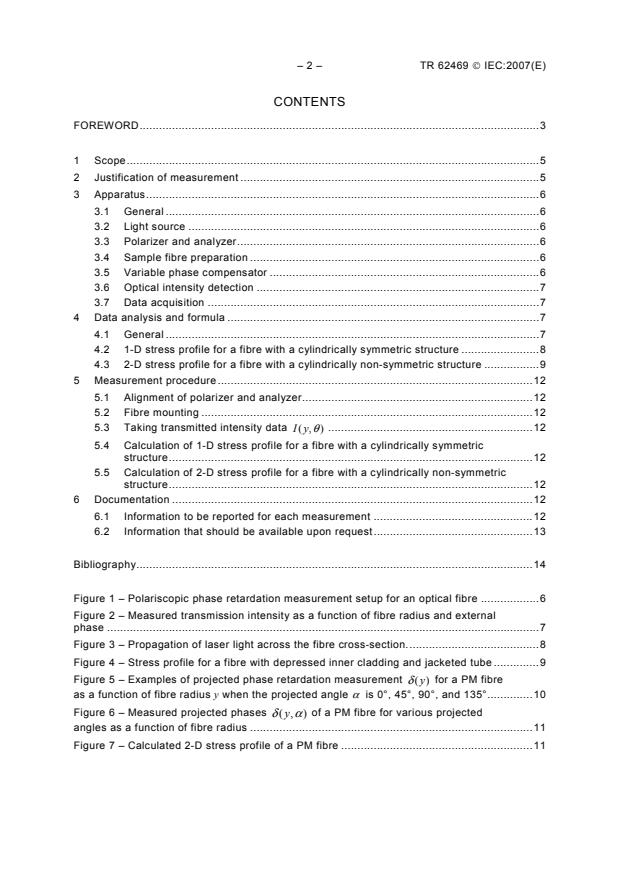
CONTENTS
FOREWORD.3
1 Scope.5
2 Justification of measurement .5
3 Apparatus.6
3.1 General .6
3.2 Light source .6
3.3 Polarizer and analyzer.6
3.4 Sample fibre preparation .6
3.5 Variable phase compensator .6
3.6 Optical intensity detection .7
3.7 Data acquisition .7
4 Data analysis and formula .7
4.1 General .7
4.2 1-D stress profile for a fibre with a cylindrically symmetric structure .8
4.3 2-D stress profile for a fibre with a cylindrically non-symmetric structure .9
5 Measurement procedure.12
5.1 Alignment of polarizer and analyzer.12
5.2 Fibre mounting .12
5.3 Taking transmitted intensity data .12
I ( y,θ )
5.4 Calculation of 1-D stress profile for a fibre with a cylindrically symmetric
structure.12
5.5 Calculation of 2-D stress profile for a fibre with a cylindrically non-symmetric
structure.12
6 Documentation .12
6.1 Information to be reported for each measurement .12
6.2 Information that should be available upon request.13
Bibliography.14
Figure 1 – Polariscopic phase retardation measurement setup for an optical fibre .6
Figure 2 – Measured transmission intensity as a function of fibre radius and external
phase .7
Figure 3 – Propagation of laser light across the fibre cross-section.8
Figure 4 – Stress profile for a fibre with depressed inner cladding and jacketed tube .9
Figure 5 – Examples of projected phase retardation measurement for a PM fibre
δ ( y)
as a function of fibre radius y when the projected angle α is 0°, 45°, 90°, and 135°.10
Figure 6 – Measured projected phases of a PM fibre for various projected
δ ( y,α)
angles as a function of fibre radius .11
Figure 7 – Calculated 2-D stress profile of a PM fibre .11
TR 62469 © IEC:2007(E) – 3 –
INTERNATIONAL ELECTROTECHNICAL COMMISSION
______________
GUIDANCE FOR RESIDUAL STRESS MEASUREMENT
OF OPTICAL FIBRE
FOREWORD
1) The International Electrotechnical Commission (IEC) is a worldwide organization for standardization comprising
all national electrotechnical committees (IEC National Committees). The object of IEC is to promote
international co-operation on all questions concerning standardization in the electrical and electronic fields. To
this end and in addition to other activities, IEC publishes International Standards, Technical Specifications,
Technical Reports, Publicly Available Specifications (PAS) and Guides (hereafter referred to as “IEC
Publication(s)”). Their preparation is entrusted to technical committees; any IEC National Committee interested
in the subject dealt with may participate in this preparatory work. International, governmental and non-
governmental organizations liaising with the IEC also participate in this preparation. IEC collaborates closely
with the International Organization for Standardization (ISO) in accordance with conditions determined by
agreement between the two organizations.
2) The formal decisions or agreements of IEC on technical matters express, as nearly as possible, an international
consensus of opinion on the relevant subjects since each technical committee has representation from all
interested IEC National Committees.
3) IEC Publications have the form of recommendations for international use and are accepted by IEC National
Committees in that sense. While all reasonable efforts are made to ensure that the technical content of IEC
Publications is accurate, IEC cannot be held responsible for the way in which they are used or for any
misinterpretation by any end user.
4) In order to promote international uniformity, IEC National Committees undertake to apply IEC Publications
transparently to the maximum extent possible in their national and regional publications. Any divergence
between any IEC Publication and the corresponding national or regional publication shall be clearly indicated in
the latter.
5) IEC provides no marking procedure to indicate its approval and cannot be rendered responsible for any
equipment declared to be in conformity with an IEC Publication.
6) All users should ensure that they have the latest edition of this publication.
7) No liability shall attach to IEC or its directors, employees, servants or agents including individual experts and
members of its technical committees and IEC National Committees for any personal injury, property damage or
other damage of any nature whatsoever, whether direct or indirect, or for costs (including legal fees) and
expenses arising out of the publication, use of, or reliance upon, this IEC Publication or any other IEC
Publications.
8) Attention is drawn to the Normative references cited in this publication. Use of the referenced publications is
indispensable for the correct application of this publication.
9) Attention is drawn to the possibility that some of the elements of this IEC Publication may be the subject of
patent rights. IEC shall not be held responsible for identifying any or all such patent rights.
The main task of IEC technical committees is to prepare International Standards. However, a
technical committee may propose the publication of a technical report when it has collected
data of a different kind from that which is normally published as an International Standard, for
example "state of the art".
IEC/TR 62469, which is a technical report, has been prepared by subcommittee 86A: Fibres
and cables, of IEC technical committee 86: Fibre optics.
The text of this technical report is based on the following documents:
Enquiry draft Report on voting
86A/1143/DTR 86A/1148/RVC
Full information on the voting for the approval of this technical report can be found in the
report on voting indicated in the above table.
This publication has been drafted in accordance with the ISO/IEC Directives, Part 2.
– 4 – TR 62469 © IEC:2007(E)
The committee has decided that the contents of this publication will remain unchanged until
the maintenance result date indicated on the IEC web site under "http://webstore.iec.ch" in
the data related to the specific publication. At this date, the publication will be
• reconfirmed,
• withdrawn,
• replaced by a revised edition, or
• amended.
A bilingual version of this publication may be issued at a later date.
TR 62469 © IEC:2007(E) – 5 –
GUIDANCE FOR RESIDUAL STRESS MEASUREMENT
OF OPTICAL FIBRE
1 Scope
The measurement of residual stress distribution in an uncoated glass optical fibre is
considered to be important as it affects critical fibre parameters such as refractive index,
intrinsic polarization mode dispersion, mode field diameter and dispersion. The optical
polarimetric method is a well-established technique to measure the residual stress of an
optical material. This technical report describes a transverse polarimetric method to measure
the residual stress profile of any type of optical fibre.
The principle and detailed procedure for measuring the optical transverse stress profile of a
fibre, which is cylindrically symmetric, is described in detail. It is based on a polariscope,
which is constructed with a fixed polarizer, a quarter-wave plate and an analyzer. An optical
tomographic technique is also described for measuring the stress profile of a fibre with a
cylindrically non-symmetric structure.
2 Justification of measurement
Residual stress in an optical fibre is induced by the combination of the fibre construction and
the drawing process. The stress information is important because it affects many important
parameters of an optical fibre due to the following reasons.
• Temperature dependent changes of fibre parameters are larger for a fibre with larger
residual stress, and these are responsible for the statistical behaviour of polarization
1)
mode dispersion (PMD) changes in deployed fibre links. (See references [10-12].)
• The variation of important fibre parameters such as chromatic dispersion, mode field
diameter, PMD depends on the intrinsic residual stress of an optical fibre. (See references
[13-17].)
• The asymmetric residual stress profile of a fibre causes fibre curl, which affects cleaving
quality for an optical fibre ribbon.
• The asymmetric residual stress of a fibre is a major cause of the intrinsic PMD of an
optical fibre. (See references [18-20].)
• Excessive residual stress can lead to core cracking that might be seen in, for example, the
preparation of the ends for connectors.
• The design of polarization retaining fibres normally involves inducing a non-symmetric
stress field. This measurement can be used to confirm these designs.
Much progress has been made in measuring the residual stress profile of an optical fibre (see
references [1-9]) such that spatial resolution can be as small as 0,6 µ and accuracy in
measuring stress can be as low as 0,4 MPa.
Depending on the application, either one- or two-dimensional stress data may be needed.
This document describes methods by measuring the polarization rotation of a transversely
exposed laser light across a fibre cross-section using a polarimetric method.
—————————
1)
Figures in square brackets refer to the Bibliography.
– 6 – TR 62469 © IEC:2007(E)
3 Apparatus
3.1 General
An optical transverse phase retardation measurement method is used to determine the
residual stresses in a fibre. Figure 1 shows a simple polariscopic phase retardation
measurement setup consisting of a polarizer, fibre sample, Babinet variable phase
compensator, and an analyzer. Stressed material shows stress-induced birefringence for light
propagating through the medium. By measuring the polarization dependent phase retardation
of light transmitted through a sample, the stress can be measured.
3.2 Light source
The light source shall be a laser with a specified optical wavelength and narrow optical
spectrum bandwidth (maximum 2 nm at FWHM [full width at half maximum]). A collimated
laser light source is recommended. When a laser is used, a rotating diffuser is recommended
in order to remov
...