

IEC TS 63487:2026
(Main)Joint commissioning for grid-connection of offshore wind farms using VSC HVDC transmission
General Information
- Abstract
IEC TS 63487:2026 serves as a specification for the joint commissioning of grid-connection of offshore wind farms (GCOWF) using the voltage source converter based high voltage direct current (VSC HVDC) transmission system.
This document provides the technical specification on the commissioning precondition, objectives, procedures, items, methods and requirements of grid-connection of offshore wind farms using the VSC HVDC power transmission, particularly focusing on the special test items of offshore wind farms.
This document covers the commissioning of offshore wind farms, testing of onshore DC energy dissipation device, special test items for transmission test, coordination function testing among VSC HVDC, DC energy dissipation device, offshore wind farm and automatic generation control (AGC). However, the conventional commissioning test items of the onshore VSC HVDC system are out of scope.
- Status
- Published
- Publication Date
- 11-Mar-2026
- Technical Committee
- SC 8A - Grid Integration of Renewable Energy Generation
- Drafting Committee
- WG 6 - TC 8/SC 8A/WG 6
- Current Stage
- PPUB - Publication issued
- Start Date
- 12-Mar-2026
- Completion Date
- 03-Apr-2026
Overview
IEC TS 63487:2026, published by the International Electrotechnical Commission (IEC), specifies technical requirements for the joint commissioning of grid-connection of offshore wind farms (GCOWF) using voltage source converter-based high voltage direct current (VSC HVDC) transmission systems. As offshore wind power continues to grow globally, VSC HVDC technology has become essential due to its suitability for long-distance, high-capacity, and flexible grid integration. This technical specification sets procedures, criteria, and methods to ensure the safe, reliable, and efficient commissioning of offshore wind farms connected to power grids via VSC HVDC. It covers unique tests for offshore environments, onshore DC energy dissipation devices, system coordination with automatic generation control (AGC), and focuses on aspects not included in conventional onshore HVDC commissioning.
Key Topics
- Commissioning Preconditions: Verification of all subsystems, successful completion of on-site equipment checks, and confirmation that grid interconnections and system components meet technical and safety requirements.
- Commissioning Objectives: To validate system performance under real-world operating conditions, ensure compliance with design specifications, and confirm readiness for commercial operation.
- Testing Procedures and Methods: Detailed guidance on necessary tests, including:
- On-site equipment and subsystem tests for all major components
- Pre-commissioning of offshore converter stations (transformer energization, converter deblocking, etc.)
- Functional testing for wind turbine generator systems and step-up stations
- System coordination and dynamic performance tests prior to energization
- Special Offshore Test Items: Emphasis on unique operational challenges, such as weather resilience, system recovery after faults, and performance monitoring of DC submarine cables and related devices.
- Coordination Function Testing: Validation of interactions between VSC HVDC systems, DC energy dissipation devices, offshore wind farms, and grid automatic generation control.
Applications
IEC TS 63487:2026 is critical for utility companies, transmission system operators, wind farm developers, and engineering firms involved in the deployment of large-scale offshore wind projects using advanced HVDC transmission. Key applications include:
- System Integration: Ensuring seamless and stable integration of offshore wind energy into national and international power grids.
- Operational Readiness: Providing all stakeholders with a validated pathway to bring assets safely online, minimizing project risk and downtime.
- Performance Optimization: Delivering methods for coordinated optimization among subsystems, collecting essential operational data for long-term economic and reliable operation.
- Regulatory and Contractual Compliance: Supporting adherence to grid codes, contractual requirements, and standardization best practices in renewable energy projects.
- Technology Advancement: Facilitating the adoption of cutting-edge VSC HVDC solutions necessary for the expansion of renewables in the global energy mix.
Related Standards
To fully apply IEC TS 63487:2026 and understand its terminology and context, reference the following IEC standards:
- IEC TS 63336: Commissioning of VSC HVDC systems
- IEC 60633: HVDC transmission vocabulary
- IEC 62747: Terminology for voltage-sourced converters (VSC) for HVDC systems
- IEC 61400-3-1: Design requirements for fixed offshore wind turbines
- IEC 61400-3-2: Design requirements for floating offshore wind turbines
- IEC 62934: Grid integration of renewable energy generation - Terms and definitions
Practical Value
Adoption of IEC TS 63487:2026 can:
- Improve the safety, reliability, and performance of offshore wind grid connections
- Support smooth project execution and reduce commissioning delays
- Ensure systems meet both technical and legal grid connection requirements
- Foster interoperable, future-focused solutions in the rapidly evolving offshore wind and HVDC sector
IEC TS 63487:2026 is an indispensable reference for project managers, engineers, and technical personnel seeking to guarantee best-practice commissioning of offshore wind farms using VSC HVDC transmission systems.
Get Certified
Connect with accredited certification bodies for this standard

IMQ S.p.A. (Certification)
Italian electrical product certification.

SLG Prüf- und Zertifizierungs GmbH
German testing and certification body.

UL Solutions
Global safety science company with testing, inspection and certification.
Sponsored listings
Frequently Asked Questions
IEC TS 63487:2026 is a technical specification published by the International Electrotechnical Commission (IEC). Its full title is "Joint commissioning for grid-connection of offshore wind farms using VSC HVDC transmission". This standard covers: IEC TS 63487:2026 serves as a specification for the joint commissioning of grid-connection of offshore wind farms (GCOWF) using the voltage source converter based high voltage direct current (VSC HVDC) transmission system. This document provides the technical specification on the commissioning precondition, objectives, procedures, items, methods and requirements of grid-connection of offshore wind farms using the VSC HVDC power transmission, particularly focusing on the special test items of offshore wind farms. This document covers the commissioning of offshore wind farms, testing of onshore DC energy dissipation device, special test items for transmission test, coordination function testing among VSC HVDC, DC energy dissipation device, offshore wind farm and automatic generation control (AGC). However, the conventional commissioning test items of the onshore VSC HVDC system are out of scope.
IEC TS 63487:2026 serves as a specification for the joint commissioning of grid-connection of offshore wind farms (GCOWF) using the voltage source converter based high voltage direct current (VSC HVDC) transmission system. This document provides the technical specification on the commissioning precondition, objectives, procedures, items, methods and requirements of grid-connection of offshore wind farms using the VSC HVDC power transmission, particularly focusing on the special test items of offshore wind farms. This document covers the commissioning of offshore wind farms, testing of onshore DC energy dissipation device, special test items for transmission test, coordination function testing among VSC HVDC, DC energy dissipation device, offshore wind farm and automatic generation control (AGC). However, the conventional commissioning test items of the onshore VSC HVDC system are out of scope.
IEC TS 63487:2026 is classified under the following ICS (International Classification for Standards) categories: 29.020 - Electrical engineering in general. The ICS classification helps identify the subject area and facilitates finding related standards.
IEC TS 63487:2026 is available in PDF format for immediate download after purchase. The document can be added to your cart and obtained through the secure checkout process. Digital delivery ensures instant access to the complete standard document.
Standards Content (Sample)
IEC TS 63487 ®
Edition 1.0 2026-03
TECHNICAL
SPECIFICATION
Joint commissioning for grid-connection of offshore wind farms using VSC
HVDC transmission
ICS 29.020 ISBN 978-2-8327-1127-9
All rights reserved. Unless otherwise specified, no part of this publication may be reproduced or utilized in any form or
by any means, electronic or mechanical, including photocopying and microfilm, without permission in writing from either
IEC or IEC's member National Committee in the country of the requester. If you have any questions about IEC copyright
or have an enquiry about obtaining additional rights to this publication, please contact the address below or your local
IEC member National Committee for further information.
IEC Secretariat Tel.: +41 22 919 02 11
3, rue de Varembé info@iec.ch
CH-1211 Geneva 20 www.iec.ch
Switzerland
About the IEC
The International Electrotechnical Commission (IEC) is the leading global organization that prepares and publishes
International Standards for all electrical, electronic and related technologies.
About IEC publications
The technical content of IEC publications is kept under constant review by the IEC. Please make sure that you have the
latest edition, a corrigendum or an amendment might have been published.
IEC publications search - IEC Products & Services Portal - products.iec.ch
webstore.iec.ch/advsearchform Discover our powerful search engine and read freely all the
The advanced search enables to find IEC publications by a publications previews, graphical symbols and the glossary.
variety of criteria (reference number, text, technical With a subscription you will always have access to up to date
committee, …). It also gives information on projects, content tailored to your needs.
replaced and withdrawn publications.
Electropedia - www.electropedia.org
The world's leading online dictionary on electrotechnology,
IEC Just Published - webstore.iec.ch/justpublished
Stay up to date on all new IEC publications. Just Published containing more than 22 500 terminological entries in English
details all new publications released. Available online and and French, with equivalent terms in 25 additional languages.
once a month by email. Also known as the International Electrotechnical Vocabulary
(IEV) online.
IEC Customer Service Centre - webstore.iec.ch/csc
If you wish to give us your feedback on this publication or
need further assistance, please contact the Customer
Service Centre: sales@iec.ch.
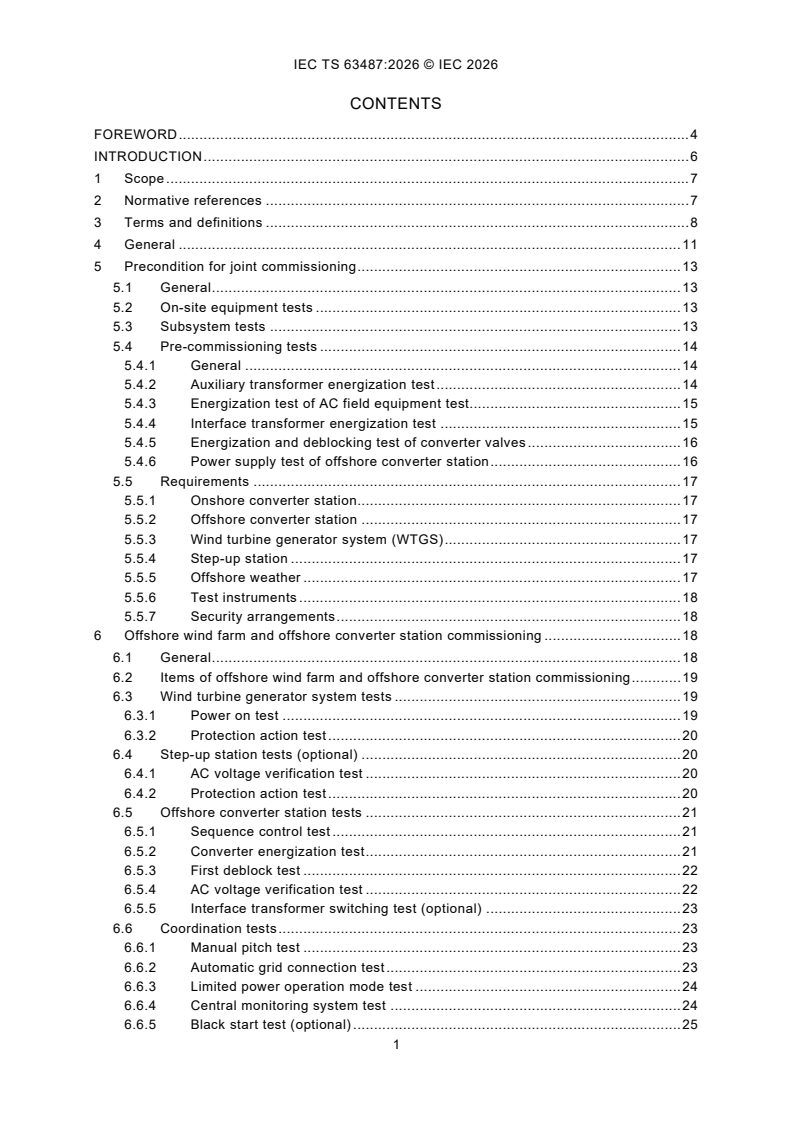
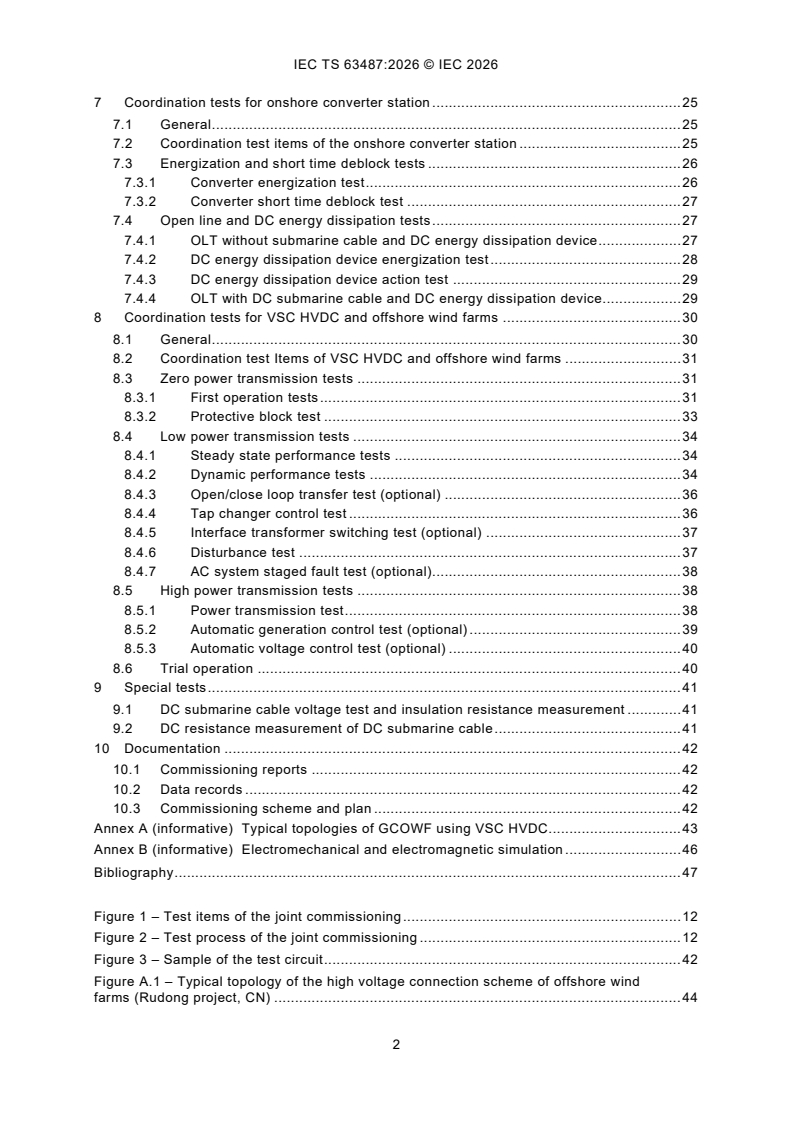
CONTENTS
FOREWORD . 4
INTRODUCTION . 6
1 Scope . 7
2 Normative references . 7
3 Terms and definitions . 8
4 General . 11
5 Precondition for joint commissioning . 13
5.1 General . 13
5.2 On-site equipment tests . 13
5.3 Subsystem tests . 13
5.4 Pre-commissioning tests . 14
5.4.1 General . 14
5.4.2 Auxiliary transformer energization test . 14
5.4.3 Energization test of AC field equipment test. 15
5.4.4 Interface transformer energization test . 15
5.4.5 Energization and deblocking test of converter valves . 16
5.4.6 Power supply test of offshore converter station . 16
5.5 Requirements . 17
5.5.1 Onshore converter station. 17
5.5.2 Offshore converter station . 17
5.5.3 Wind turbine generator system (WTGS) . 17
5.5.4 Step-up station . 17
5.5.5 Offshore weather . 17
5.5.6 Test instruments . 18
5.5.7 Security arrangements . 18
6 Offshore wind farm and offshore converter station commissioning . 18
6.1 General . 18
6.2 Items of offshore wind farm and offshore converter station commissioning . 19
6.3 Wind turbine generator system tests . 19
6.3.1 Power on test . 19
6.3.2 Protection action test . 20
6.4 Step-up station tests (optional) . 20
6.4.1 AC voltage verification test . 20
6.4.2 Protection action test . 20
6.5 Offshore converter station tests . 21
6.5.1 Sequence control test . 21
6.5.2 Converter energization test . 21
6.5.3 First deblock test . 22
6.5.4 AC voltage verification test . 22
6.5.5 Interface transformer switching test (optional) . 23
6.6 Coordination tests . 23
6.6.1 Manual pitch test . 23
6.6.2 Automatic grid connection test . 23
6.6.3 Limited power operation mode test . 24
6.6.4 Central monitoring system test . 24
6.6.5 Black start test (optional) . 25
7 Coordination tests for onshore converter station . 25
7.1 General . 25
7.2 Coordination test items of the onshore converter station . 25
7.3 Energization and short time deblock tests . 26
7.3.1 Converter energization test . 26
7.3.2 Converter short time deblock test . 27
7.4 Open line and DC energy dissipation tests . 27
7.4.1 OLT without submarine cable and DC energy dissipation device . 27
7.4.2 DC energy dissipation device energization test . 28
7.4.3 DC energy dissipation device action test . 29
7.4.4 OLT with DC submarine cable and DC energy dissipation device . 29
8 Coordination tests for VSC HVDC and offshore wind farms . 30
8.1 General . 30
8.2 Coordination test Items of VSC HVDC and offshore wind farms . 31
8.3 Zero power transmission tests . 31
8.3.1 First operation tests . 31
8.3.2 Protective block test . 33
8.4 Low power transmission tests . 34
8.4.1 Steady state performance tests . 34
8.4.2 Dynamic performance tests . 34
8.4.3 Open/close loop transfer test (optional) . 36
8.4.4 Tap changer control test . 36
8.4.5 Interface transformer switching test (optional) . 37
8.4.6 Disturbance test . 37
8.4.7 AC system staged fault test (optional). 38
8.5 High power transmission tests . 38
8.5.1 Power transmission test . 38
8.5.2 Automatic generation control test (optional) . 39
8.5.3 Automatic voltage control test (optional) . 40
8.6 Trial operation . 40
9 Special tests . 41
9.1 DC submarine cable voltage test and insulation resistance measurement . 41
9.2 DC resistance measurement of DC submarine cable . 41
10 Documentation . 42
10.1 Commissioning reports . 42
10.2 Data records . 42
10.3 Commissioning scheme and plan . 42
Annex A (informative) Typical topologies of GCOWF using VSC HVDC. 43
Annex B (informative) Electromechanical and electromagnetic simulation . 46
Bibliography . 47
Figure 1 – Test items of the joint commissioning . 12
Figure 2 – Test process of the joint commissioning . 12
Figure 3 – Sample of the test circuit . 42
Figure A.1 – Typical topology of the high voltage connection scheme of offshore wind
farms (Rudong project, CN) . 44
Figure A.2 – Typical topology of the middle voltage connection scheme of offshore
wind farms (Borwin 6 project, DE) . 45
Table 1 – The pre-commissioning test items of the offshore converter station . 14
Table 2 – Offshore wind farm and offshore converter station commissioning . 19
Table 3 – Coordination test items of onshore converter station . 26
Table 4 – Coordination test items of VSC HVDC and offshore wind farms . 31
INTERNATIONAL ELECTROTECHNICAL COMMISSION
____________
Joint commissioning for grid-connection of offshore wind farms using
VSC HVDC transmission
FOREWORD
1) The International Electrotechnical Commission (IEC) is a worldwide organization for standardization comprising
all national electrotechnical committees (IEC National Committees). The object of IEC is to promote international
co-operation on all questions concerning standardization in the electrical and electronic fields. To this end and
in addition to other activities, IEC publishes International Standards, Technical Specifications, Technical Reports,
Publicly Available Specifications (PAS) and Guides (hereafter referred to as “IEC Publication(s)”). Their
preparation is entrusted to technical committees; any IEC National Committee interested in the subject dealt with
may participate in this preparatory work. International, governmental and non-governmental organizations liaising
with the IEC also participate in this preparation. IEC collaborates closely with the International Organization for
Standardization (ISO) in accordance with conditions determined by agreement between the two organizations.
2) The formal decisions or agreements of IEC on technical matters express, as nearly as possible, an international
consensus of opinion on the relevant subjects since each technical committee has representation from all
interested IEC National Committees.
3) IEC Publications have the form of recommendations for international use and are accepted by IEC National
Committees in that sense. While all reasonable efforts are made to ensure that the technical content of IEC
Publications is accurate, IEC cannot be held responsible for the way in which they are used or for any
misinterpretation by any end user.
4) In order to promote international uniformity, IEC National Committees undertake to apply IEC Publications
transparently to the maximum extent possible in their national and regional publications. Any divergence between
any IEC Publication and the corresponding national or regional publication shall be clearly indicated in the latter.
5) IEC itself does not provide any attestation of conformity. Independent certification bodies provide conformity
assessment services and, in some areas, access to IEC marks of conformity. IEC is not responsible for any
services carried out by independent certification bodies.
6) All users should ensure that they have the latest edition of this publication.
7) No liability shall attach to IEC or its directors, employees, servants or agents including individual experts and
members of its technical committees and IEC National Committees for any personal injury, property damage or
other damage of any nature whatsoever, whether direct or indirect, or for costs (including legal fees) and
expenses arising out of the publication, use of, or reliance upon, this IEC Publication or any other IEC
Publications.
8) Attention is drawn to the Normative references cited in this publication. Use of the referenced publications is
indispensable for the correct application of this publication.
9) IEC draws attention to the possibility that the implementation of this document may involve the use of (a)
patent(s). IEC takes no position concerning the evidence, validity or applicability of any claimed patent rights in
respect thereof. As of the date of publication of this document, IEC had not received notice of (a) patent(s), which
may be required to implement this document. However, implementers are cautioned that this may not represent
the latest information, which may be obtained from the patent database available at https://patents.iec.ch. IEC
shall not be held responsible for identifying any or all such patent rights.
IEC TS 63487 has been prepared by subcommittee 8A: Grid integration of renewable energy
generation, of IEC technical committee 8: System aspects of electrical energy supply. It is a
Technical Specification.
The text of this Technical Specification is based on the following documents:
Draft Report on voting
8A/210/DTS 8A/223/RVDTS
Full information on the voting for its approval can be found in the report on voting indicated in
the above table.
The language used for the development of this Technical Specification is English.
This document was drafted in accordance with ISO/IEC Directives, Part 2, and developed in
accordance with ISO/IEC Directives, Part 1 and ISO/IEC Directives, IEC Supplement, available
at www.iec.ch/members_experts/refdocs. The main document types developed by IEC are
described in greater detail at www.iec.ch/publications.
The committee has decided that the contents of this document will remain unchanged until the
stability date indicated on the IEC website under webstore.iec.ch in the data related to the
specific document. At this date, the document will be
– reconfirmed,
– withdrawn, or
– revised.
INTRODUCTION
This document addresses the joint commissioning of grid-connection of offshore wind farms
(GCOWF) using the voltage source converter based high voltage direct current (VSC HVDC)
transmission system. The test purpose, test preconditions, test procedures and methods, and
test acceptance criteria for joint commissioning are introduced in this document. The scope of
the document covers the commissioning of offshore wind farms, testing of the onshore DC
energy dissipation device, special test items for transmission test, coordination function testing
among the VSC HVDC system, DC energy dissipation device, offshore wind farm and automatic
generation control (AGC). The conventional commissioning test items of the VSC HVDC system
are out of scope.
Due to the advantages of abundant and highly qualified wind resources, offshore wind farms
have become the development trend of wind power generation. Currently, the VSC HVDC power
transmission technology provides a solution for grid connection of the large-scale and long-
distance offshore wind power farms since it can achieve power supply for a passive system,
long-distance power transmission, and flexible and independent control for active and reactive
power. In this context, a number of large-scale and long-distance wind power farms, connected
with power grid using VSC HVDC power transmission, have been put into commercial operation
around the world, such as China, Germany, and the UK.
More and more offshore wind farms will be integrated into the onshore AC power grid using
VSC HVDC power transmission. The commissioning is the final on-site test for grid-connection
of offshore wind farms using VSC HVDC power transmission, to help ensure that the whole
system can safely and reliably operate, and meet the grid connection requirements, as well as
the relevant contracts and specifications.
Compared with the commissioning of conventional VSC HVDC projects, the joint commissioning
procedures, methods, and grid-connection requirements of the VSC HVDC projects with
integration of offshore wind farms are different, due to the special offshore operating conditions,
as well as the existence of onshore DC energy dissipation device and the offshore wind farms.
Therefore, it is important to draft a technical specification on joint commissioning for grid-
connection of offshore wind farms using VSC HVDC power transmission.
The purpose of this document is to elaborate on the commissioning procedures, test items,
conditions, methods, and special requirements of grid-connection of offshore wind farms to help
ensure the integrity and correctness of the commissioning. It is possible that the document is
not applicable to all projects but represents a range of possible system tests which should be
considered. The commissioning requirements and procedures provided in this document are
not for any specific project and these should be considered according to the agreement between
the purchaser and supplier and as applicable.
1 Scope
This document serves as a specification for the joint commissioning of grid-connection of
offshore wind farms (GCOWF) using the voltage source converter based high voltage direct
current (VSC HVDC) transmission system.
This document provides the technical specification on the commissioning precondition,
objectives, procedures, items, methods and requirements of grid-connection of offshore wind
farms using the VSC HVDC power transmission, particularly focusing on the special test items
of offshore wind farms.
This document covers the commissioning of offshore wind farms, testing of onshore DC energy
dissipation device, special test items for transmission test, coordination function testing among
VSC HVDC, DC energy dissipation device, offshore wind farm and automatic generation control
(AGC). However, the conventional commissioning test items of the onshore VSC HVDC system
are out of scope.
2 Normative references
The following documents are referred to in the text in such a way that some or all of their content
constitutes requirements of this document. For dated references, only the edition cited applies.
For undated references, the latest edition of the referenced document (including any
amendments) applies.
IEC 60050-811, International Electrotechnical Vocabulary - Part 811: Electric traction,
www.electropedia.org
IEC 60270, High-voltage test techniques - Charge-base measurement of partial discharges
IEC 60633:2019, High-voltage direct current (HVDC) transmission - Vocabulary
IEC 61400-3-1, Wind energy generation systems - Part 3-1: Design requirements for fixed
offshore wind turbines
IEC 61400-3-2, Wind energy generation systems - Part 3-2: Design requirements for floating
offshore wind turbines
IEC 62747:2014, Terminology for voltage-sourced converters (VSC) for high-voltage direct
current (HVDC) systems
IEC 62747:2014/AMD1:2019
IEC 62934, Grid integration of renewable energy generation - Terms and definitions
IEC TS 63336:2024, Commissioning of VSC HVDC systems
3 Terms and definitions
For the purposes of this document, the terms and definitions given in IEC 60050-811,
IEC 60270, IEC 60633, IEC 61400-3-1, IEC 61400-3-2, IEC 62747, IEC 62934, IEC TS 63336
and the following apply.
ISO and IEC maintain terminology databases for use in standardization at the following
addresses:
– IEC Electropedia: available at https://www.electropedia.org/
– ISO Online browsing platform: available at https://www.iso.org/obp
3.1
control mode
manner in which a converter unit, pole, or VSC HVDC converter station is controlled in order to
maintain one or more electrical quantities at desired values
[SOURCE: IEC 60633:2019, 10.1, modified - Updated to VSC HVDC transmission.]
3.2
converter station tests
tests verifying functions and performances of the converter unit disconnected from the VSC
HVDC transmission line on-site
[SOURCE: IEC TS 63336:2024]
3.3
converter starting resistor
resistor temporarily connected in series with the converter to vary the voltage applied and limit
the current during starting
[SOURCE: IEC 60050-811:2017, 811-27-01]
3.4
DC energy dissipation device
device used to achieve the conversion of electric energy into thermal energy non intended to
be used
Note 1 to entry: This is also referred to as a DC braking chopper.
3.5
on-site equipment tests
electrical and mechanical tests which are performed on-site on a single equipment to verify that
no equipment damage has occurred during transport and site assembly, and that installation
has been correctly performed
[SOURCE: IEC TS 63336:2024]
3.6
high power transmission tests
tests verifying functions and performances of the whole system at a high power transmission
level. The power value should be higher than 0.3 pu. Some test items can be carried out during
the trial operation
[SOURCE: IEC TS 63336:2024]
3.7
interface transformer
transformer (if any) through which power is transmitted between the AC system connection
point and one or more VSC units
[SOURCE: IEC 62747:2014]
3.8
joint commissioning
final test before putting into commercial operation, aimed at verifying that the functionality and
performance of the system meet the design requirements
3.9
low power transmission tests
tests verifying functions and performances of the offshore wind farms and VSC HVDC system
at a low power transmission level
Note 1 to entry: The power value depends on the grid connection and output conditions of offshore wind farms.
[SOURCE: IEC TS 63336:2024]
3.10
local workstation
LWS
local workstation near the control and protection devices of VSC HVDC, which can monitor,
control, and manage the system
3.11
offshore wind farm
sea-based renewable energy facility using wind turbine generator systems to generate
electricity for the grid
3.12
operator workstation
OWS
remote control centre where operators monitor, control, and manage the system
Note 1 to entry: The operator workstation provides a graphical interface for real-time data visualization and system
operation.
3.13
point of common coupling
PCC
point of interconnection of the onshore converter station to the adjacent AC system, or point of
interconnection of wind farms to the offshore converter station
3.14
reactive power control mode
control of the reactive power exchanged between a converter unit, or a HVDC substation, and
the connected AC network
[SOURCE: IEC 60633:2019, 10.5]
3.15
submodule
part of the VSC valve comprising controllable switches and diodes connected to a half bridge
or full bridge arrangement, together with their immediate auxiliaries, storage capacitors, if any,
where each controllable switch consists of only one switched valve device connected in series
[SOURCE: IEC 62501:2024, 3.4.7]
3.16
STATCOM operation
static synchronous compensator operation
operation mode of the converter that can continuously generate or absorb reactive power for
the power grid
3.17
subsystem test
test which is performed on-site to prove the correct interconnection and functioning of all
individual items of equipment within a functional group (or subsystem) and that these items
operate and interact correctly
[SOURCE: IEC TS 63336:2024, 3.1.3]
3.18
trial operation
period following the completion of the commissioning
[SOURCE: IEC TS 63336:2024, 4.4]
3.19
end-to-end tests
tests verifying functions and performances of the VSC HVDC system when transmitting power
between both converter stations on-site
[SOURCE: IEC TS 63336:2024, 3.1.6, modified - Term "transmission tests" removed,
abbreviated term "VSC" added, and note to entry removed.]
3.20
islanded network operation mode
control mode in which the VSC HVDC substation controls the frequency and the voltage of the
connected islanded AC network
[SOURCE: IEC 62747:2014, 11.6, modified - Abbreviated term "VSC" added.]
3.21
wind turbine generator system
WTGS
system which converts the kinetic wind energy into electric energy
[SOURCE: IEC 60050-415:1999, 415-01-02]
3.22
zero power transmission tests
tests verifying the functions and performance of the VSC HVDC system without transmitting
power
4 General
Joint commissioning consists of on-site tests for the grid connection of offshore wind farms
using VSC HVDC power transmission systems. This comprehensive assessment covers all
system aspects, including the control and protection system, converter valves with valve
controls, transformers, valve cooling systems, and equipment in the AC and DC fields. The
primary objective of joint commissioning is to validate subsystem coordination and help ensure
compliance with both design specifications and performance indicators defined in equipment
technical specifications. During commissioning, coordinated optimization among different
equipment and subsystems is performed to improve the overall operational performance of the
GCOWF using the VSC HVDC power transmission system. Additionally, essential data and
parameters are collected to help ensure the economic and stable operation of the system in the
future. Upon successful commissioning, the GCOWF using the VSC HVDC power transmission
system is validated for operational deployment. Typical topologies for GCOWF using the VSC
HVDC power transmission system can refer to APPENDIX A.
a) Joint commissioning for GCOWF using the VSC HVDC power transmission system begins
upon completion and verification of both on-site equipment tests and subsystem tests.
b) For different topologies or specialized equipment in GCOWF using the VSC HVDC power
transmission system, the special function/performance can be changed according to the
requirements of the engineering design specifications. For typical topologies of GCOWF
using VSC HVDC, refer to informative Annex A.
c) To protect the system against the potential risk of wide-band oscillation during the joint
commissioning process, impedance matching verification for offshore and onshore
transmission sections should be conducted based on accurate system simulation, including
representation of valve and control system time delays before the tests. For the introduction
to system simulation, refer to Annex B.
d) Joint commissioning should consider the black start capability of offshore wind farms. The
designs and procedures of tripping tests, disturbance tests, and dynamic performance tests
should fully consider the time required for recovery following the disconnection of offshore
wind farms.
e) It is advisable to conduct the offshore converter station system test via the DC submarine
cable power supply upon completion of the first part of the onshore converter station system
test.
f) During commissioning, all operational data (steady-state, dynamic, and transient) from
converter stations and offshore wind farms should be monitored and recorded by the
commissioning contractor. The functionality and performance of the overall system should
be verified and meet the design specifications, as much as possible.
g) The joint commissioning test items are listed in Figure 1, while the test process can be
referred to Figure 2.
Figure 1 – Test items of the joint commissioning
Figure 2 – Test process of the joint commissioning
5 Precondition for joint commissioning
5.1 General
Before the joint commissioning of GCOWF using the VSC HVDC power transmission system,
the preconditions of offshore wind farms, the VSC HVDC system, the offshore high-voltage AC
system, and the onshore grid interconnection should be verified. The on-site equipment test,
subsystem test, and pre-commissioning tests should be completed. Pre-commissioning tests
for the offshore converter station include transformer energization, converter deblocking, and
other essential on-site equipment tests that should be carried out in the factory or dock.
The completion and acceptance of the above tests should confirm that the entire system meets
all preconditions for the joint commissioning. The relevant joint commissioning tests should be
carried out under appropriate offshore weather conditions and permission from the onshore
power grid.
In addition, some general requirements of the joint commissioning should address the onshore
converter station, offshore converter station, wind turbine generator systems, step-up station,
offshore weather, and test instruments.
5.2 On-site equipment tests
All equipment and auxiliary devices should have been installed, and preliminary inspections
should have been completed. Incorrect installation, missing devices, or unexpected equipment
damage should have been resolved by the installation or supervision staff.
The required power supplies should be in place, stable and reliable during on-site equipment
tests, with power quality meeting the requirements of the equipment. Their supply systems
should have been verified and work correctly for equipment requiring other energy sources such
as wind, water, gas, or oil. The following equipment or subsystems should have been tested
and verified before joint commissioning.
a) Switchgear including circuit breakers, isolation switches, earth switches, high-voltage fuses,
GIS (gas-insulated switchgear), and other switchgear.
b) Electrical equipment, including interface transformers, reactors, auxiliary transformers,
earth electrodes, lightning arresters, low-voltage distribution devices, feeder lines, high-
voltage power lines, and submarine cables.
c) Control, protection, and automation equipment, including control and protection devices,
safety automatic devices, electric energy metering devices, and secondary circuits.
d) Non-electrical equipment, including insulator strings and insulating oil.
5.3 Subsystem tests
Subsystem tests are a critical stage in the integration and operation of the entire system, aimed
at conducting thorough validation and optimization of the subsystem to help ensure its optimal
performance within the broader engineering project or system while concurrently ensuring the
long-term stable operation of the system.
In the converter station, the subsystems include the converter valve subsystem, interface
transformer subsystem, AC field subsystem, DC field subsystem, station power supply
subsystem, auxiliary subsystem, and control and protection subsystem. The results of the
cabinet inspection, secondary circuit inspection, and primary current injection test should meet
the design specifications. The valve cooling system, fire protection system, air conditioning
system, protection information management substation system, synchronized clock system,
fault recording system, phasor measurement unit system, electric energy measurement system,
stability control system, fault distance measurement system, integrated power supply system,
integrated online monitoring system, and intelligent auxiliary system should work correctly, as
applicable. The subsystem test of the VSC HVDC system can refer to IEC TS 63336.
The subsystems of a GCOWF using a VSC HVDC power transmission system include the
generator system of each wind turbine, offshore power collection subsystems, and offshore
step-up stations as applicable to offshore wind farms. The above subsystem tests should be
completed with correct results. The complete and explicit test reports should be provided by
subsystem test contractors before the joint commissioning.
5.4 Pre-commissioning tests
5.4.1 General
The pre-commissioning test items of the offshore converter station are shown in Table 1.
Table 1 – The pre-commissioning test items of the offshore converter station
No. Item Index
1 Auxiliary transformer energization test See 5.4.2
2 Energization test of AC field equipment See 5.4.3
3 Interface transformer energization test See 5.4.4
4 Energization and deblocking test of the converter valves See 5.4.5
5 Power supply test of offshore converter station See 5.4.6
5.4.2 Auxiliary transformer energization test
a) Test purpose
The purpose of this test is to verify the electric strength and insulation withstand of the
auxiliary transformers installed in the offshore converter station. The test is required to be
carried out at the rated voltage.
b) Test preconditions
1) The on-site equipment test and the subsystem test of the offshore converter station have
been completed and accepted.
2) The earth electrode of the auxiliary transformer should be reliably connected to the
earthing network of the test site.
3) The test power supply at the dock or factory should have the ability to output a stable
rated voltage of the auxiliary transformer.
c) Test procedures and methods
The test should include the following steps.
1) Apply the voltage to the auxiliary transformer from zero to the rated value.
2) Check the status of the auxiliary transformer.
d) Test acceptance criteria
The test acceptance criteria should include the following requirements.
1) With the voltage rising from zero to the rated voltage, there are no abnormal discharges
or faults. During the test, the voltage and current measurements are correct.
2) When the voltage reaches the rated value and is maintained for a period of steady-state
operation time (reference duration: no less than 30 min), no abnormal noise,
overheating, or other faults occur.
5.4.3 Energization test of AC field equipment test
a) Test purpose
The purpose of this test is to verify the insulation withstand of AC field equipment installed
in the offshore converter station. The test is required to be carried out at the rated voltage.
b) Test preconditions
1) The equipment and subsystem tests of the offshore converter station AC field have been
completed and accepted.
2) Temporary earthing measures of the offshore converter station devices and systems
should be removed before the test. The offshore converter station earth electrode should
be reliably connected to the dock earthing network, and the dock earth resistance should
be sufficient to help ensure the safety of equipment and personnel (a recommended
reference value of the dock earth resistance is 0,5 Ω).
3) The test power supply at the dock or factory should have the ability to output a stable
rated voltage for the AC field equipment.
c) Test procedures and methods
The test should include the following steps.
1) The test voltage from zero to the rated voltage is applied to the AC field equipment.
2) Check the status of the AC field equipment.
d) Test acceptance criteria
The test acceptance criteria should include the following requirements.
1) The circuit breaker, isolation switch, earth switch, and other devices in the AC field
operate correctly.
2) With the voltage rising from zero to the rated voltage, there are no abnormal discharges
or faults. During the test, the voltage and current measurements are correct.
5.4.4 Interface transformer energization test
a) Test purpose
The purpose of this test is to verify the electric strength and insulation withstand of the
interface transformer of the offshore converter station. The test is required to be carried out
at the rated voltage.
b) Test preconditions
1) The preconditions of 5.4.2 have been satisfied.
2) Before the first charging operation of the interface transformers, demagnetization should
be carried out to reduce the impact of inrush current on the equipment and protection
system.
3) The tap position of interface transformers should be set to the lowest voltage on the
valve side.
c) Test procedures and methods
The test content of the interface transformer rated voltage test includes the following.
1) The rated voltage is applied to the interface transformers.
2) Check the excitation inrush currents of the interface transformers.
3) Check the status of the interface transformers.
4) For multi-branch interface transformer topologies, rated voltage tests should be carried
out for each interface transformer one by one.
d) Test acceptance criteria
The test acceptance criteria should include the following requirements.
1) The values of excitation inrush currents meet the design specifications.
2) No abnormal discharge, alarm, fault, protection action, or other unexpected events.
3) The voltage, current measurements, and waveform recordings are correct, and the
transformer oil indicators meet the design specifications.
5.4.5 Energization and deblocking test of converter valves
a) Test purpose
The purpose of this test is to verify the electric strength and insulation withstand of the
converter valves, as well as the correct triggering and deblocking of converter valves.
b) Test preconditions
1) The preconditions of 5.4.2 have been satisfied.
2) The rated voltage test of the interface transformer has been completed and accepted.
c) Test procedures and methods
1) Apply the rated voltage to the converter valves and check the status of the converter
valves.
2) After being energized by the test power supply, deblock the converter and check the
valve status of the converter and submodule voltages.
d) Test acceptance criteria
The test acceptance criteria should include the following requirements.
1) The converter valve and submodule communicate reliably, and the relevant electrical
variables are correct.
2) The voltages of the submodules are stable and balanced, meeting the design
specifications.
3) The insulation of the converter valve meets design specifications, and there is no
abnormal discharge.
4) The converter valve has no modules losing uplink communication with the valve control
system, abnormal alarm, abnormal block or other unexpected conditions.
5.4.6 Power supply test of offshore converter station
a) Test purpose
The purpose of this test is to verify the reliable power supply of diesel generators.
b) Test preconditions
1) The valve cooling system and secondary equipment of the station power supply system
are ready for operation.
2) The primary and standby diesel generators of the offshore converter station should meet
the operation conditions.
c) Test procedures and methods
1) Start the diesel generators.
2) Start the valve cooling system in the black start condition.
3) Switch the station power supply between diesel generators and external power.
d) Test acceptance criteria
The test acceptance criteria should include the following requirements.
1) The system is energized and starts correctly without abnormality.
2) During
...