


ETSI TS 104 143 V1.1.1 (2026-02)
SDN SBI Wireless Transport Profiles for Network Automation
SDN SBI Wireless Transport Profiles for Network Automation
DTS/ATTMTMmWT-0034
General Information
- Status
- Not Published
- Technical Committee
- ATTM TM_mWT - Millimeter Wave Transmission
- Current Stage
- 12 - Citation in the OJ (auto-insert)
- Due Date
- 18-Mar-2026
- Completion Date
- 17-Feb-2026

Frequently Asked Questions
ETSI TS 104 143 V1.1.1 (2026-02) is a standard published by the European Telecommunications Standards Institute (ETSI). Its full title is "SDN SBI Wireless Transport Profiles for Network Automation". This standard covers: DTS/ATTMTMmWT-0034
DTS/ATTMTMmWT-0034
ETSI TS 104 143 V1.1.1 (2026-02) is available in PDF format for immediate download after purchase. The document can be added to your cart and obtained through the secure checkout process. Digital delivery ensures instant access to the complete standard document.
Standards Content (Sample)
TECHNICAL SPECIFICATION
SDN SBI Wireless Transport
Profiles for Network Automation
2 ETSI TS 104 143 V1.1.1 (2026-02)
Reference
DTS/ATTMTMmWT-0034
Keywords
5G, 6G, automation, backhaul, microwave,
millimetre wave, modelling, mWT, SDN,
transmission, X-Haul, YANG
ETSI
650 Route des Lucioles
F-06921 Sophia Antipolis Cedex - FRANCE
Tel.: +33 4 92 94 42 00 Fax: +33 4 93 65 47 16
Siret N° 348 623 562 00017 - APE 7112B
Association à but non lucratif enregistrée à la
Sous-Préfecture de Grasse (06) N° w061004871
Important notice
The present document can be downloaded from the
ETSI Search & Browse Standards application.
The present document may be made available in electronic versions and/or in print. The content of any electronic and/or
print versions of the present document shall not be modified without the prior written authorization of ETSI. In case of any
existing or perceived difference in contents between such versions and/or in print, the prevailing version of an ETSI
deliverable is the one made publicly available in PDF format on ETSI deliver repository.
Users should be aware that the present document may be revised or have its status changed,
this information is available in the Milestones listing.
If you find errors in the present document, please send your comments to
the relevant service listed under Committee Support Staff.
If you find a security vulnerability in the present document, please report it through our
Coordinated Vulnerability Disclosure (CVD) program.
Notice of disclaimer & limitation of liability
The information provided in the present deliverable is directed solely to professionals who have the appropriate degree of
experience to understand and interpret its content in accordance with generally accepted engineering or
other professional standard and applicable regulations.
No recommendation as to products and services or vendors is made or should be implied.
No representation or warranty is made that this deliverable is technically accurate or sufficient or conforms to any law
and/or governmental rule and/or regulation and further, no representation or warranty is made of merchantability or fitness
for any particular purpose or against infringement of intellectual property rights.
In no event shall ETSI be held liable for loss of profits or any other incidental or consequential damages.
Any software contained in this deliverable is provided "AS IS" with no warranties, express or implied, including but not
limited to, the warranties of merchantability, fitness for a particular purpose and non-infringement of intellectual property
rights and ETSI shall not be held liable in any event for any damages whatsoever (including, without limitation, damages
for loss of profits, business interruption, loss of information, or any other pecuniary loss) arising out of or related to the use
of or inability to use the software.
Copyright Notification
No part may be reproduced or utilized in any form or by any means, electronic or mechanical, including photocopying and
microfilm except as authorized by written permission of ETSI.
The content of the PDF version shall not be modified without the written authorization of ETSI.
The copyright and the foregoing restriction extend to reproduction in all media.
© ETSI 2026.
All rights reserved.
ETSI
3 ETSI TS 104 143 V1.1.1 (2026-02)
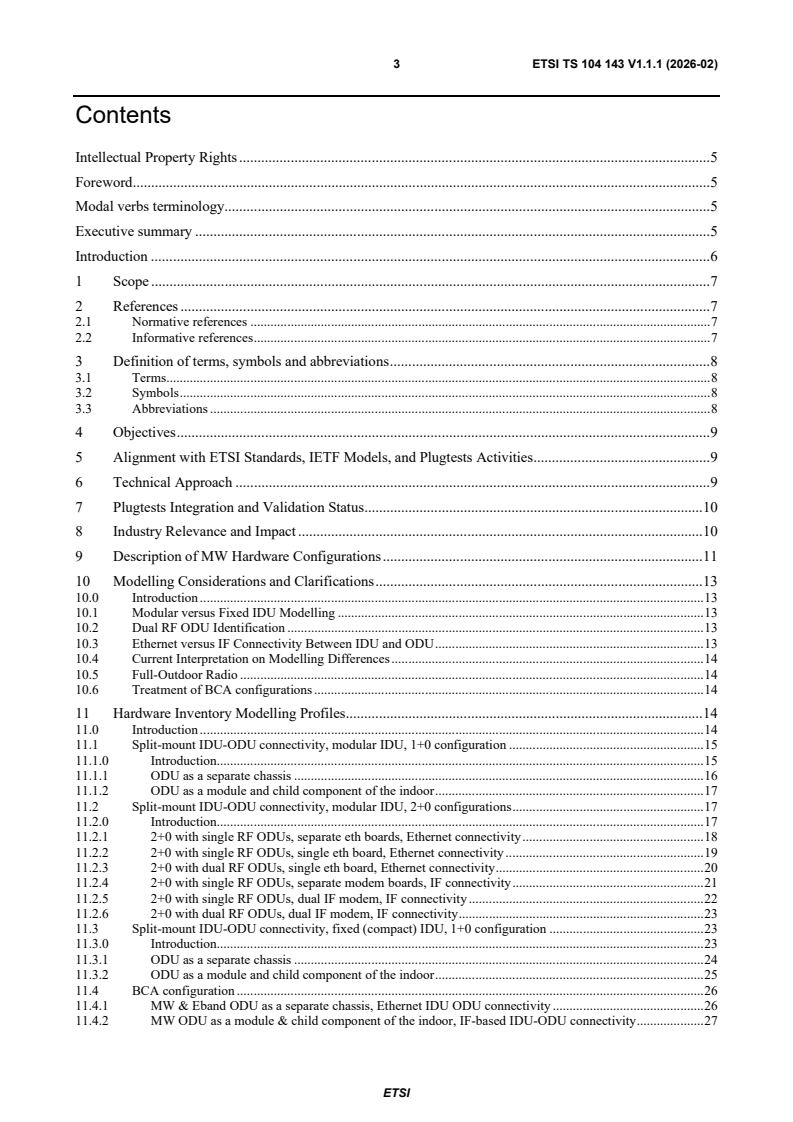
Contents
Intellectual Property Rights . 5
Foreword . 5
Modal verbs terminology . 5
Executive summary . 5
Introduction . 6
1 Scope . 7
2 References . 7
2.1 Normative references . 7
2.2 Informative references . 7
3 Definition of terms, symbols and abbreviations . 8
3.1 Terms . 8
3.2 Symbols . 8
3.3 Abbreviations . 8
4 Objectives . 9
5 Alignment with ETSI Standards, IETF Models, and Plugtests Activities . 9
6 Technical Approach . 9
7 Plugtests Integration and Validation Status . 10
8 Industry Relevance and Impact . 10
9 Description of MW Hardware Configurations . 11
10 Modelling Considerations and Clarifications . 13
10.0 Introduction . 13
10.1 Modular versus Fixed IDU Modelling . 13
10.2 Dual RF ODU Identification . 13
10.3 Ethernet versus IF Connectivity Between IDU and ODU . 13
10.4 Current Interpretation on Modelling Differences . 14
10.5 Full-Outdoor Radio . 14
10.6 Treatment of BCA configurations . 14
11 Hardware Inventory Modelling Profiles . 14
11.0 Introduction . 14
11.1 Split-mount IDU-ODU connectivity, modular IDU, 1+0 configuration . 15
11.1.0 Introduction. 15
11.1.1 ODU as a separate chassis . 16
11.1.2 ODU as a module and child component of the indoor . 17
11.2 Split-mount IDU-ODU connectivity, modular IDU, 2+0 configurations . 17
11.2.0 Introduction. 17
11.2.1 2+0 with single RF ODUs, separate eth boards, Ethernet connectivity . 18
11.2.2 2+0 with single RF ODUs, single eth board, Ethernet connectivity . 19
11.2.3 2+0 with dual RF ODUs, single eth board, Ethernet connectivity . 20
11.2.4 2+0 with single RF ODUs, separate modem boards, IF connectivity . 21
11.2.5 2+0 with single RF ODUs, dual IF modem, IF connectivity . 22
11.2.6 2+0 with dual RF ODUs, dual IF modem, IF connectivity . 23
11.3 Split-mount IDU-ODU connectivity, fixed (compact) IDU, 1+0 configuration . 23
11.3.0 Introduction. 23
11.3.1 ODU as a separate chassis . 24
11.3.2 ODU as a module and child component of the indoor . 25
11.4 BCA configuration . 26
11.4.1 MW & Eband ODU as a separate chassis, Ethernet IDU ODU connectivity . 26
11.4.2 MW ODU as a module & child component of the indoor, IF-based IDU-ODU connectivity . 27
ETSI
4 ETSI TS 104 143 V1.1.1 (2026-02)
th
Annex A (informative): Parameters used in the "5 mWT SDN Plugtests" . 28
Annex B (informative): Bibliography . 29
History . 30
ETSI
5 ETSI TS 104 143 V1.1.1 (2026-02)
Intellectual Property Rights
Essential patents
IPRs essential or potentially essential to normative deliverables may have been declared to ETSI. The declarations
pertaining to these essential IPRs, if any, are publicly available for ETSI members and non-members, and can be
found in ETSI SR 000 314: "Intellectual Property Rights (IPRs); Essential, or potentially Essential, IPRs notified to
ETSI in respect of ETSI standards", which is available from the ETSI Secretariat. Latest updates are available on the
ETSI IPR online database.
Pursuant to the ETSI Directives including the ETSI IPR Policy, no investigation regarding the essentiality of IPRs,
including IPR searches, has been carried out by ETSI. No guarantee can be given as to the existence of other IPRs not
referenced in ETSI SR 000 314 (or the updates on the ETSI Web server) which are, or may be, or may become,
essential to the present document.
Trademarks
The present document may include trademarks and/or tradenames which are asserted and/or registered by their owners.
ETSI claims no ownership of these except for any which are indicated as being the property of ETSI, and conveys no
right to use or reproduce any trademark and/or tradename. Mention of those trademarks in the present document does
not constitute an endorsement by ETSI of products, services or organizations associated with those trademarks.
DECT™, PLUGTESTS™, UMTS™ and the ETSI logo are trademarks of ETSI registered for the benefit of its
Members. 3GPP™, LTE™ and 5G™ logo are trademarks of ETSI registered for the benefit of its Members and of the
3GPP Organizational Partners. oneM2M™ logo is a trademark of ETSI registered for the benefit of its Members and of ®
the oneM2M Partners. GSM and the GSM logo are trademarks registered and owned by the GSM Association.
Foreword
This Technical Specification (TS) has been produced by ETSI Technical Committee Access, Terminals, Transmission
and Multiplexing (ATTM).
Modal verbs terminology
In the present document "shall", "shall not", "should", "should not", "may", "need not", "will", "will not", "can" and
"cannot" are to be interpreted as described in clause 3.2 of the ETSI Drafting Rules (Verbal forms for the expression of
provisions).
"must" and "must not" are NOT allowed in ETSI deliverables except when used in direct citation.
Executive summary
The aim of the present document is to provide a set of standardized, vendor-neutral attributes that can be uniformly
interpreted across different implementations for network automation in the wireless transport domain. The present
document defines a standard, common, and interoperable hardware inventory profile for microwave wireless backhaul
within SDN-based transport networks. It specifies how microwave Network Elements shall represent and expose
hardware inventory information using YANG data models, aligned with relevant IETF specifications, and exchanged
via NETCONF between SDN Controllers and microwave equipment. Service-layer, performance, and control-plane
aspects are referenced where necessary to support accurate and interoperable inventory representation.
The modelling approach profiles and uses IETF YANG modules, specifying the implementation guidelines to reflect
real-world microwave configurations and operational deployment scenarios. The inventory framework covers simple
1+0 topologies, protected and capacity-oriented 1+1 and 2+0 solutions, heterogeneous multi-band combinations
(microwave + E-band), XPIC-based architectures, and advanced multi-carrier or band and carrier aggregation
configurations. It also accounts for practical variations in Indoor Unit (IDU) and Outdoor Unit (ODU) design, such as
modular vs fixed IDUs, Ethernet vs IF-based ODU connectivity, and single vs dual RF ODUs, etc.
ETSI
6 ETSI TS 104 143 V1.1.1 (2026-02)
Validation activities associated with the present document are integrated into the ETSI SDN Plugtests Programme.
Participating vendors implement the -YANG model profiles on their Network Elements and expose inventory
information toward a multi-vendor SDN Controller for functional and interoperability testing. Plugtests-based feedback
ensures model accuracy, consistency, and practical applicability in real deployment environments.
Strategically, the present document establishes a foundational inventory layer required for open, programmable, and
disaggregated SDN transport architectures, in alignment with the framework defined in ETSI GR mWT 025 [i.2]. By
eliminating proprietary dependencies at the Southbound Interface and enabling standardized, structured inventory data,
the work in the present document supports large-scale automation, zero-touch provisioning, digital twin construction,
and AI-assisted network operation. The resulting standardized inventory framework provides long-term benefits across
operators, vendors, integrators, and the wider research and standardization community by reducing integration
complexity, enhancing interoperability, and supporting future innovation in automation and autonomous networking.
Introduction
Microwave wireless backhaul networks constitute a critical part of modern transport infrastructures. Their integration
into open SDN architectures has historically been constrained by the lack of standard, common, and interoperable -
models. As a consequence, SDN Controllers have been required to interpret vendor-specific and inconsistent data
structures, leading to increased integration effort, reduced automation potential, and limited portability of SDN
applications.
The present document addresses this limitation by defining standard, common hardware inventory profiles for the SDN
Southbound Interface, expressed through YANG models aligned with relevant IETF specifications. These profiles are
tailored to real microwave configurations and operational deployment scenarios. The objective is to ensure that the
microwave domain may be represented in a uniform, vendor-neutral, and interoperable manner within open,
programmable, multi-vendor SDN transport networks.
ETSI
7 ETSI TS 104 143 V1.1.1 (2026-02)
1 Scope
The present document specifies the principles, objectives, and technical framework, which addresses the definition of
standardized hardware inventory models for microwave wireless backhaul at the SDN Southbound Interface. It focuses
on the modelling of hardware inventory information for microwave Network Elements as exchanged between a
microwave SDN Controller and microwave Network Elements by means of standard, common YANG data model
profiles exposed over NETCONF. Service-layer abstractions, performance management, and control-plane behaviour
are present in the present document, when required to support accurate and interoperable hardware inventory
representation.
2 References
2.1 Normative references
References are either specific (identified by date of publication and/or edition number or version number) or
non-specific. For specific references, only the cited version applies. For non-specific references, the latest version of the
referenced document (including any amendments) applies.
Referenced documents which are not found to be publicly available in the expected location might be found in the
ETSI docbox.
NOTE: While any hyperlinks included in this clause were valid at the time of publication, ETSI cannot guarantee
their long-term validity.
The following referenced documents are necessary for the application of the present document.
[1] IETF RFC 8348 (March 2018): "A YANG Data Model for Hardware Management".
[2] IETF RFC 8561 (June 2019): "A YANG Data Model for Microwave Radio Link"
[3] IETF RFC 8343 (March 2018): "A YANG Data Model for Interface Management".
[4] IETF RFC 7950 (August 2016): "The YANG 1.1 Data Modeling Language".
[5] IETF RFC 6241 (June 2011): "Network Configuration Protocol (NETCONF)".
2.2 Informative references
References are either specific (identified by date of publication and/or edition number or version number) or
non-specific. For specific references, only the cited version applies. For non-specific references, the latest version of the
referenced document (including any amendments) applies.
NOTE: While any hyperlinks included in this clause were valid at the time of publication, ETSI cannot guarantee
their long-term validity.
The following referenced documents may be useful in implementing an ETSI deliverable or add to the reader's
understanding, but are not required for conformance to the present document.
[i.1] ETSI GR mWT 016 (V.1.1.1): "Applications and use cases of Software Defined Networking
(SDN) as related to microwave and millimetre wave transmission".
[i.2] ETSI GR mWT 025 (V1.1.1): "Wireless Backhaul Network and Services Automation: SDN SBI
YANG models".
th
[i.3] ETSI CTI 5 mWT SDN Plugtests Report V1.0 (2025-12).
th
[i.4] ETSI 5 mWT SDN Test Plan V1.0 (2025-12).
[i.5] ETSI GR mWT 025 (V1.1.1): "Wireless Backhaul Network and Services Automation: SDN SBI
YANG models".
ETSI
8 ETSI TS 104 143 V1.1.1 (2026-02)
3 Definition of terms, symbols and abbreviations
3.1 Terms
For the purposes of the present document, the following terms apply:
Band & Carrier Aggregation (BCA): typically referring to aggregating carriers in uniform or non-uniform bands
NOTE: In the present document, it is referring to aggregating Eband with traditional MW band.
Fixed (compact) IDU: IDU represented as a chassis, but with a predefined and fixed set of physical ports without
modular containerization
full-outdoor: single, outdoor unit in which the modem, network interfaces, and radio unit are integrated within the
same physical hardware
Modular IDU: IDU of modular design and may include one or more containers hosting pluggable functional boards
split-type (or split-mount) architecture: this configuration follows an architecture where the outdoor unit (MW ODU)
is physically separated from the Indoor Unit (IDU)
NOTE: There are two principal connectivity variants used in current microwave systems: Ethernet-based
IDU-ODU connectivity and IF-based IDU-ODU connectivity.
YANG model profile: standardized, vendor-neutral set of attributes, constraints and modelling guidelines applied to
existing IETF YANG modules to ensure interoperable implementation across multiple vendors
3.2 Symbols
Void.
3.3 Abbreviations
For the purposes of the present document, the following abbreviations apply:
AI Artificial Intelligence
BCA Band and Carrier Aggregation
ETH ETHernet
FW FirmWare
HW HardWare
ID IDentity
IDU Indoor Unit
IEEE™ Institute of Electrical and Electronics Engineers
IETF Internet Engineering Task Force
IF Intermediate Frequency
IP Internet Protocol
LLDP Link Layer Discovery Protocol
MODEM MOdulator/DEModulator
MW MicroWave
mWT millimetre-Wave Transmission
NE Network Element
NETCONF NETwork CONFiguration protocol
NMS Network Management System
ODU OutDoor Unit
PTP Precision Time Protocol
RF Radio Frequency
RFC Request For Comment
RO Read-Only
RSL Received Signal Level
RW Re-Write
ETSI
9 ETSI TS 104 143 V1.1.1 (2026-02)
SBI SouthBound Interface
SDN Software Defined Networking
SFP Small Form-factor Pluggable
SNMP Simple Network Management Protocol
SW SoftWare
XPIC Cross-Polarization Interference Cancelling
YANG Yet Another Next Generation
4 Objectives
The objectives of this new Profile are as follows:
• The new Profile shall define a standard, common, and interoperable YANG-based representation of
microwave hardware inventory suitable for use in open SDN environments.
• The new Profile shall specify a minimum and sufficient set of inventory parameters required for consistent
multi-vendor interpretation of microwave hardware.
• The new Profile shall reuse and profile relevant IETF YANG models and shall extend them where necessary
to accurately represent real microwave network configurations.
• The new Profile should provide a controller-consumable representation that enables automated discovery,
inventory synchronization, and lifecycle management of microwave Network Elements.
• The new Profile should establish a stable inventory foundation that enables zero-touch provisioning, software-
defined networking, and AI-assisted network operation.
5 Alignment with ETSI Standards, IETF Models, and
Plugtests Activities
The work specified in the present document is aligned with ETSI GR mWT 016 [i.1] as related to microwave and
millimetre wave transmission" and ETSI GR mWT 025 [i.2], which define the SDN applicability framework for
wireless transport networks. The present document extends this framework by introducing standard, common YANG-
based inventory model profiles required to enable practical and scalable interoperability at the SDN Southbound
Interface.
At the data modelling level, the new Profile shall be based on the use of relevant IETF YANG data models, including
the hardware, interface, and microwave radio link models defined in IETF RFC 8348 [1], IETF RFC 8561 [2], and
IETF RFC 8343 [3]. This use shall ensure alignment with global YANG modelling practices, compatibility with
existing SDN controller ecosystems, and long-term sustainability of the resulting models. The reused IETF models shall
be adapted and refined through explicit microwave-specific profiling rules to reflect the characteristics of microwave
transport hardware and real deployment scenarios.
The activity shall be tightly coupled with the ETSI SDN Plugtests™ Programme. The architectural principles and
multi-vendor environments validated across the ETSI mWT SDN Plugtests activities to date have been used as input to
the development of the present document. In particular, the methodologies, test scenarios, and multi-vendor
th
configurations documented in the 5 ETSI mWT SDN Plugtests report [i.3] have been used as a concrete validation
reference. In addition, the ETSI SDN Plugtests environment shall continue to be used to validate the YANG model
profiles defined in the present document in real multi-vendor SDN control scenarios and to refine the models based on
implementation feedback.
6 Technical Approach
The technical approach adopted in the present document follows the ETSI mWT SDN architectural framework and is
based on the use of standard, YANG data model profiles derived from relevant IETF specifications, specified using
YANG version 1.1 as defined in IETF RFC 7950 [4].
ETSI
10 ETSI TS 104 143 V1.1.1 (2026-02)
The IETF-originated YANG models have been refined and complemented, with microwave-specific usage profiles
defined to represent real hardware configurations. The resulting models remain globally aligned with IETF modelling
practices while providing operational accuracy for microwave transport equipment.
The YANG model profiles provide a shared, machine-readable, and extensible abstraction of microwave Network
Elements and are exposed via an open NETCONF interface between the microwave SDN Controller and the microwave
Network Elements according to IETF RFC 6241 [5]. This ensures that inventory information is exchanged in a
consistent, non-proprietary, and fully interoperable manner across vendors.
The modelling approach follows a minimum-parameter philosophy. Only those attributes strictly required to achieve
interoperability at the Southbound Interface are included, ensuring lightweight and practical implementations while
providing a stable foundation for future automation, orchestration, and network intelligence functions.
7 Plugtests Integration and Validation Status
The validation of the standard, YANG-based inventory model profiles derived from IETF specifications was carried out
th
within the ETSI SDN Plugtests Programme. As part of the ETSI 5 mWT SDN Test Plan V1.0 [i.4], participating
vendors implemented the YANG model profiles in their microwave Network Elements and exposed inventory
information via NETCONF toward a multi-vendor SDN Controller environment.
The Plugtests campaign successfully demonstrated uniform hardware discovery based on common models, consistent
inventory interpretation across different vendors, and interoperable SDN Controller behaviour using standardized
inventory data. The Plugtests framework therefore served as a critical maturity accelerator for the YANG model profiles
defined in the present document, providing practical implementation feedback and confirming their applicability in real
multi-vendor SDN control scenarios.
8 Industry Relevance and Impact
Industry relevance and impact are summarized in the following points:
• Multi-Vendor Interoperability: The absence of common YANG-based inventory models has historically forced
SDN Controllers to rely on vendor-specific adapters and proprietary data representations. By defining a
standard, common set of YANG models based on IETF specifications and specialized for microwave
backhaul, the present document shall enable true multi-vendor interoperability at the Southbound Interface.
Microwave Network Elements from different vendors shall be discoverable, identifiable, and manageable
using the same data structures and semantic interpretation.
• Open and Disaggregated Network Architectures: The introduction of common IETF-aligned YANG inventory
models shall eliminate proprietary dependencies at the Southbound Interface and shall enable microwave
backhaul to be integrated into open and disaggregated SDN transport architectures. This shall directly support
the architectural framework defined in ETSI GR mWT 025 [i.2].
• Automation and Zero-Touch Operations: Automation, zero-touch provisioning, and closed-loop control
depend on reliable, structured, and standardized inventory data. The common IETF-based YANG models
defined under the present document shall provide this essential data layer and shall enable large-scale,
AI-assisted network operations.
• Real-World Applicability: The YANG model profiles shall be explicitly derived from real microwave
configurations and deployment scenarios observed in operational networks. This shall ensure direct
applicability to commercial products without excessive abstraction.
• Validation Through Plugtests: Systematic multi-vendor validation within the ETSI SDN Plugtests Programme
shall continuously verify the correctness, completeness, and interoperability of the YANG model profiles. This
shall strengthen industry confidence and readiness for commercial deployment.
• AI and Autonomous Networks: Common, standardized, IETF-aligned YANG-based inventory model profiles
shall provide the trusted ground truth required for digital twins, predictive maintenance, AI-based fault
correlation, and autonomous optimization of microwave networks.
ETSI
11 ETSI TS 104 143 V1.1.1 (2026-02)
• Industry Ecosystem Benefits: The introduction of standard, common YANG inventory model profiles based on
IETF specifications and tailored for microwave backhaul shall deliver long-term benefits across the full
ecosystem. Operators shall gain reduced integration complexity, faster SDN adoption, and increased vendor
flexibility. Vendors shall benefit from a globally aligned implementation target and reduced proprietary
interface burden. System integrators shall experience reduced customization effort and improved
predictability. The research and standardization community shall benefit from a stable baseline for future
automation and AI-driven innovation.
• Strategic Importance: By establishing standard, common IETF-aligned YANG-based hardware inventory
models at the SDN Southbound Interface, the present document shall create a foundational pillar for the
long-term evolution of microwave wireless backhaul networks toward open, programmable, automated, and
ultimately autonomous operation. It shall ensure that the microwave domain evolves in full alignment with
cross-domain SDN control frameworks and global IETF data modelling practices, while preserving multi-
vendor interoperability and long-term operational efficiency.
9 Description of MW Hardware Configurations
Figure 1 illustrates two fundamental microwave hardware deployment configurations that serve as baseline reference
cases for the inventory profiling activity.
Figure 1: Type 1 1+0 & Type 2 2+0/1+1 configuration
The first configuration, ref
...
Questions, Comments and Discussion
Ask us and Technical Secretary will try to provide an answer. You can facilitate discussion about the standard in here.
Loading comments...