


EN IEC 61540:2025
(Main)Portable residual current devices (PRCDs) without integral overcurrent protection for household and similar use
Portable residual current devices (PRCDs) without integral overcurrent protection for household and similar use
This document applies to portable residual current devices (PRCDs) for household and similar uses, consisting of a plug, a residual current device (RCD) and one or more socket-outlets or a provision for connection. They do not incorporate overcurrent protection. They are intended for single- and two-phase systems for rated currents not exceeding 16 A for rated voltages not exceeding 250 V AC, or for rated current not exceeding 32 A for rated voltages not exceeding 130 V AC to earth. They are intended to provide protection against shock hazard in case of direct contact, in addition to the protection provided by the fixed installations for the circuit downstream. PRCDs have a rated residual operating current not exceeding 0,03 A. The plug and socket-outlet parts of a PRCD are covered by the national standard of the country where the PRCD is placed on the market. If no national requirements exist, IEC 60884 1 is used. This document applies to portable devices performing simultaneously the functions of detection of the residual current, of comparison of the value of this current with the residual operating value and of opening of the protected circuit when the residual current exceeds this value. PRCDs providing an additional function of detecting faults on the supply side with a defined behaviour in case of supply failures or miswiring (PRCD-S) are also covered by this document. PRCDs are not intended to be used as parts of fixed installations. Their connecting means can be plugs, socket-outlets, terminals or cords. NOTE 1 The requirements for PRCDs are in compliance with the general requirements of IEC 60755. PRCDs are essentially intended to be operated by ordinary persons and designed not to require maintenance. NOTE 2 An integral fuse is used, if necessary, for the relevant plug and socket-outlet system. The switching contacts of the PRCDs are not intended to provide isolation, as isolation can be ensured by disconnecting the plug. The requirements of this document apply for environmental conditions as defined in 7.1. Additional requirements can be necessary for PRCDs used in locations having more severe environmental conditions. PRCDs including batteries are not covered by this document. This document does not contain additional requirements for PRCDs without earthing contacts for which specific requirements can apply. This document can, however, be used as a guide for such devices which are intended to be used with Class II appliances only.
Elektrisches Installationsmaterial - Ortsveränderliche Fehlerstrom-Schutzeinrichtungen (PRCDs) ohne eingebauten Überstromschutz für Hausinstallationen und für ähnliche Anwendungen
Dispositifs différentiels portables à courant résiduel (PCDM) sans protection incorporée contre les surintensités pour usages domestiques et analogues
L'IEC 61540:2023 s'applique aux dispositifs différentiels portables à courant résiduel (PCDM) pour usages domestiques et analogues, qui comportent une fiche de prise de courant, un dispositif à courant différentiel résiduel (DDR), ainsi qu'un ou plusieurs socles de prises de courant ou un moyen de connexion. Ces dispositifs n'incorporent pas de protection contre les surintensités. Ils sont destinés à des systèmes monophasés et diphasés pour des courants assignés inférieurs à 16 A à des tensions assignées ne dépassant pas 250 V en courant alternatif, ou pour des courants assignés inférieurs à 32 A à des tensions assignées ne dépassant pas 130 V en courant alternatif à la terre. Ils sont destinés à procurer une protection contre le danger de choc électrique en cas de contact direct en complément à la protection procurée par les installations fixes situées en aval du circuit. Cette deuxième édition annule et remplace la première édition parue en 1997 et son Amendement 1:1998. Cette édition constitue une révision technique. Cette édition inclut les modifications techniques majeures suivantes par rapport à l'édition précédente: a) le contenu du présent document a été révisé et aligné sur l'IEC 60755 (publication groupée de sécurité relative aux dispositifs à courant différentiel résiduel) et sur la bibliothèque de normes "blocs et modules"; b) la classification "4.3 Selon le comportement après ouverture automatique en cas de défaillance de la tension d'alimentation" a été ajoutée; c) de nouvelles exigences et de nouveaux essais ont été ajoutés afin de couvrir la fonction de protection contre le danger de choc électrique mise en œuvre: - vérification du fonctionnement correct en cas d'absence du conducteur de protection; - vérification du fonctionnement correct en cas de conducteur de protection actif et donc dangereux; - vérification du fonctionnement correct en cas de perte du conducteur de protection; - vérification du comportement en cas de courant de défaut externe dans le conducteur de protection; d) les distances d'isolement dans l'air et les lignes de fuite ont été révisées et alignées sur l'IEC 62752 (IC-CPD); e) les valeurs des tensions minimales de fonctionnement ont été révisées; f) des exigences et un essai ont été ajoutés pour la température de l'air ambiant comprise entre –25 °C et +40 °C; g) l'essai des propriétés diélectriques a été révisé et aligné sur la bibliothèque de normes "blocs et modules"; h) les articles concernés ont été alignés sur l'IEC 62752 (IC-CPD); l'IC-CPD est une norme de produit qui décrit des produits/fonctions analogues; i) toutes les annexes ont été révisées et adaptées au contenu du document principal.
Prenosne naprave na preostali (PRCD) tok brez vgrajene nadtokovne zaščite pred prevelikim tokom za gospodinjsko in podobno uporabo (IEC 61540:2023)
General Information
Relations
Standards Content (Sample)
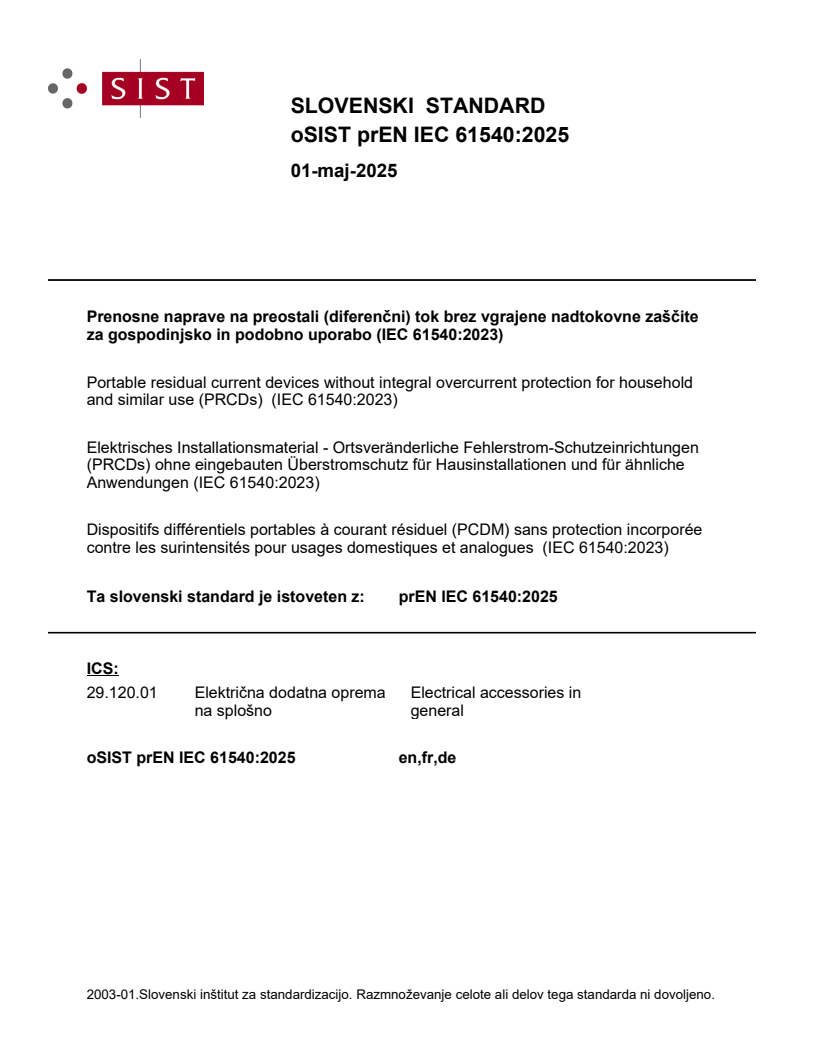
SLOVENSKI STANDARD
oSIST prEN IEC 61540:2025
01-maj-2025
Prenosne naprave na preostali (diferenčni) tok brez vgrajene nadtokovne zaščite
za gospodinjsko in podobno uporabo (IEC 61540:2023)
Portable residual current devices without integral overcurrent protection for household
and similar use (PRCDs) (IEC 61540:2023)
Elektrisches Installationsmaterial - Ortsveränderliche Fehlerstrom-Schutzeinrichtungen
(PRCDs) ohne eingebauten Überstromschutz für Hausinstallationen und für ähnliche
Anwendungen (IEC 61540:2023)
Dispositifs différentiels portables à courant résiduel (PCDM) sans protection incorporée
contre les surintensités pour usages domestiques et analogues (IEC 61540:2023)
Ta slovenski standard je istoveten z: prEN IEC 61540:2025
ICS:
29.120.01 Električna dodatna oprema Electrical accessories in
na splošno general
oSIST prEN IEC 61540:2025 en,fr,de
2003-01.Slovenski inštitut za standardizacijo. Razmnoževanje celote ali delov tega standarda ni dovoljeno.
oSIST prEN IEC 61540:2025
oSIST prEN IEC 61540:2025
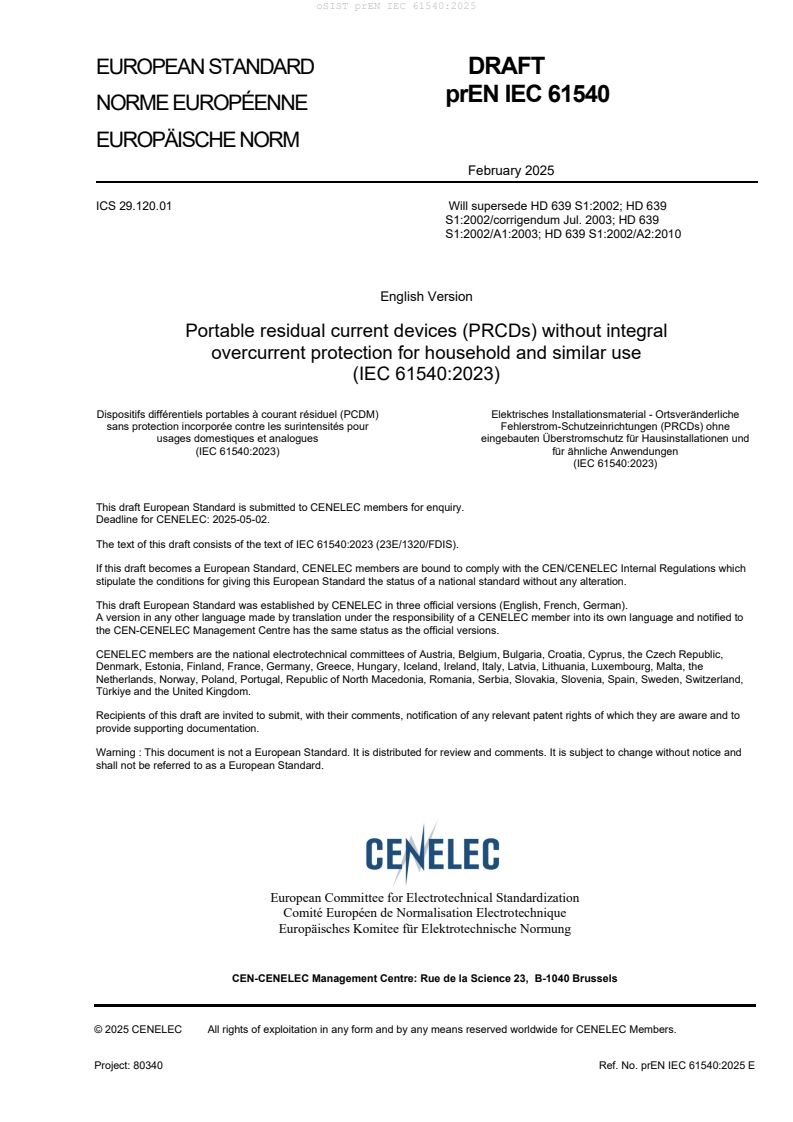
EUROPEAN STANDARD DRAFT
prEN IEC 61540
NORME EUROPÉENNE
EUROPÄISCHE NORM
February 2025
ICS 29.120.01 Will supersede HD 639 S1:2002; HD 639
S1:2002/corrigendum Jul. 2003; HD 639
S1:2002/A1:2003; HD 639 S1:2002/A2:2010
English Version
Portable residual current devices (PRCDs) without integral
overcurrent protection for household and similar use
(IEC 61540:2023)
Dispositifs différentiels portables à courant résiduel (PCDM) Elektrisches Installationsmaterial - Ortsveränderliche
sans protection incorporée contre les surintensités pour Fehlerstrom-Schutzeinrichtungen (PRCDs) ohne
usages domestiques et analogues eingebauten Überstromschutz für Hausinstallationen und
(IEC 61540:2023) für ähnliche Anwendungen
(IEC 61540:2023)
This draft European Standard is submitted to CENELEC members for enquiry.
Deadline for CENELEC: 2025-05-02.
The text of this draft consists of the text of IEC 61540:2023 (23E/1320/FDIS).
If this draft becomes a European Standard, CENELEC members are bound to comply with the CEN/CENELEC Internal Regulations which
stipulate the conditions for giving this European Standard the status of a national standard without any alteration.
This draft European Standard was established by CENELEC in three official versions (English, French, German).
A version in any other language made by translation under the responsibility of a CENELEC member into its own language and notified to
the CEN-CENELEC Management Centre has the same status as the official versions.
CENELEC members are the national electrotechnical committees of Austria, Belgium, Bulgaria, Croatia, Cyprus, the Czech Republic,
Denmark, Estonia, Finland, France, Germany, Greece, Hungary, Iceland, Ireland, Italy, Latvia, Lithuania, Luxembourg, Malta, the
Netherlands, Norway, Poland, Portugal, Republic of North Macedonia, Romania, Serbia, Slovakia, Slovenia, Spain, Sweden, Switzerland,
Türkiye and the United Kingdom.
Recipients of this draft are invited to submit, with their comments, notification of any relevant patent rights of which they are aware and to
provide supporting documentation.
Warning : This document is not a European Standard. It is distributed for review and comments. It is subject to change without notice and
shall not be referred to as a European Standard.
European Committee for Electrotechnical Standardization
Comité Européen de Normalisation Electrotechnique
Europäisches Komitee für Elektrotechnische Normung
CEN-CENELEC Management Centre: Rue de la Science 23, B-1040 Brussels
© 2025 CENELEC All rights of exploitation in any form and by any means reserved worldwide for CENELEC Members.
Project: 80340 Ref. No. prEN IEC 61540:2025 E
oSIST prEN IEC 61540:2025
prEN IEC 61540:2025 (E)
European foreword
This document (prEN IEC 61540:2025) consists of the text of IEC 61540:2023, prepared by
IEC/SC 23E “Circuit-breakers and similar equipment for household use” of IEC/TC 23 “Electrical
accessories”.
This document is currently submitted to the Enquiry.
The following dates are proposed:
• latest date by which the existence of (doa) dav + 6 months
this document has to be announced at national
level
• latest date by which this document has to be (dop) dav + 12 months
implemented at national level by publication of an
identical national standard or by endorsement
• latest date by which the national standards (dow) dav + 36 months
conflicting with this document have to be (to be confirmed or
withdrawn modified when voting)
This document will supersede HD 639 S1:2002 and all of its amendments and corrigenda (if any).
oSIST prEN IEC 61540:2025
IEC 61540 ®
Edition 2.0 2023-07
INTERNATIONAL
STANDARD
NORME
INTERNATIONALE
Portable residual current devices (PRCDs) without integral overcurrent
protection for household and similar use
Dispositifs différentiels portables à courant résiduel (PCDM) sans protection
incorporée contre les surintensités pour usages domestiques et analogues
INTERNATIONAL
ELECTROTECHNICAL
COMMISSION
COMMISSION
ELECTROTECHNIQUE
INTERNATIONALE
ICS 29.120.01 ISBN 978-2-8322-7185-8
oSIST prEN IEC 61540:2025
– 2 – IEC 61540:2023 © IEC 2023
CONTENTS
FOREWORD . 10
INTRODUCTION . 12
1 Scope . 13
2 Normative references . 14
3 Terms and definitions, symbols and abbreviated terms . 15
3.1 Definitions relating to plugs and socket-outlets . 15
3.2 Definitions relating to residual current devices (RCDs) . 16
3.2.1 Definitions relating to currents flowing from live parts to earth . 16
3.2.2 Definitions relating to the energization of a residual current device
(RCD) . 17
3.2.3 Definitions relating to the operation and to the functions of a residual
current device . 17
3.2.4 Definitions relating to values and ranges of energizing quantities . 18
4 Classification . 18
4.1 According to the type of connection . 18
4.1.1 PRCD intermediate adaptor . 18
4.1.2 Non-rewireable residual current-protected cord extension sets . 19
4.1.3 Residual current-protected plugs . 19
4.1.4 In-line PRCDs . 19
4.2 According to the type of terminals . 19
4.3 According to behaviour after opening automatically in case of failure of the
line voltage . 19
4.4 According to their operating characteristics and behaviour in presence of DC
components . 19
4.5 According to the ambient air temperature . 20
4.5.1 For use between −5 °C and +40 °C . 20
4.5.2 For use between −25 °C and +40 °C . 20
4.6 Classification according to the protective conductor path . 20
4.6.1 PRCDs with switched protective conductor . 20
4.6.2 PRCDs with non-switched protective conductor . 20
4.7 According to the supply . 20
4.7.1 PRCDs supplied from one phase and neutral (LNSE or LNE) . 20
4.7.2 PRCDs supplied from two phases (LLSE or LLE) . 20
4.8 According an additional function of detecting faults on the supply side . 20
4.8.1 PRCDs not providing an additional function of detecting faults on the
supply side . 20
4.8.2 PRCDs providing an additional function of detecting faults on the supply
side with a defined behaviour in case of supply failures or miswiring
(PRCD-S) . 20
5 Characteristics of PRCDs . 20
5.1 Summary of characteristics . 20
5.2 Rated quantities and other characteristics . 21
5.2.1 Rated voltage . 21
5.2.2 Rated current (I ) . 21
n
5.2.3 Rated residual operating current (I ) . 21
Δn
5.2.4 Rated residual non-operating current (I ) . 21
Δno
5.2.5 Rated frequency . 21
oSIST prEN IEC 61540:2025
IEC 61540:2023 © IEC 2023 – 3 –
5.2.6 Rated making and breaking capacity (I ) . 22
m
5.2.7 Rated residual making and breaking capacity (I ) . 22
Δm
5.2.8 Operating characteristics in case of residual currents comprising a DC
component . 22
5.3 Standard and preferred values . 22
5.3.1 Preferred values of rated operational voltage (U ) . 22
e
5.3.2 Standard values of rated current (I ) . 22
n
5.3.3 Standard values of rated residual operating current (I ) . 23
Δn
5.3.4 Standard value of residual non-operating current (I ) . 23
Δno
5.3.5 Standard minimum value of the non-operating overcurrent through the
PRCD . 23
5.3.6 Preferred values of rated frequency . 23
5.3.7 Minimum value of the rated making and breaking capacity (I ) . 23
m
5.3.8 Minimum value of the rated residual making and breaking capacity
(I ) . 23
Δm
5.3.9 Standard value of the rated conditional short-circuit current (I ) . 24
nc
5.3.10 Standard value of the rated conditional residual short-circuit current
(I ) . 24
Δc
5.3.11 Standard values of maximum break time. 24
5.4 Coordination with short-circuit protective devices (SCPDs) . 24
5.4.1 General . 24
5.4.2 Rated conditional short-circuit current (I ) . 24
nc
5.4.3 Rated conditional residual short-circuit current (I ) . 24
Δc
6 Marking and other product information . 24
6.1 Information and marking for PRCDs . 24
6.2 Information to be provided in an instruction sheet . 27
7 Standard conditions for operation in service and for installation . 27
7.1 Standard conditions . 27
7.2 Conditions for installations . 28
7.3 Pollution degree . 28
8 Requirements for construction and operation . 28
8.1 Mechanical design . 28
8.1.1 General . 28
8.1.2 Plug part, socket-outlet parts and RCD part(s) . 29
8.1.3 Mechanism . 34
8.1.4 Clearances and creepage distances (see Annex C) . 35
8.1.5 Screws, current-carrying parts and connections . 37
8.1.6 Terminals for external conductors for rewireable PRCDs . 37
8.1.7 Terminations for non-rewireable PRCDs . 39
8.1.8 Current-carrying parts . 39
8.2 Protection against electric shock . 40
8.2.1 General . 40
8.2.2 Requirements relating to plugs and socket-outlets, whether
incorporated or not in integral items . 40
8.3 Dielectric properties . 42
8.4 Temperature rise . 42
8.4.1 Temperature rise limits . 42
oSIST prEN IEC 61540:2025
– 4 – IEC 61540:2023 © IEC 2023
8.4.2 Ambient air temperature . 42
8.5 Operating characteristic . 42
8.6 Mechanical and electrical endurance . 42
8.7 Performance at short-circuit currents . 43
8.8 Resistance to mechanical shock and impact . 43
8.9 Resistance to heat . 43
8.10 Resistance to abnormal heat and to fire . 43
8.11 Test device . 43
8.11.1 General . 43
8.11.2 Test function . 43
8.12 Behaviour of PRCDs in case of failure of line voltage . 44
8.13 Behaviour of PRCDs in case of overcurrent in the main circuit . 44
8.14 Resistance of PRCDs against unwanted tripping due to surge currents to
earth resulting from impulse voltages . 44
8.15 Behaviour of PRCDs in case of an earth fault current comprising a DC
component . 44
8.16 Reliability . 44
8.17 Resistance to tracking . 44
8.18 Electromagnetic compatibility (EMC) . 44
8.19 Standing current in the protective conductor . 45
8.20 Electrical performance . 45
8.20.1 Protective conductor path . 45
8.20.2 Contact mechanism . 45
8.20.3 Operation with supply failure and hazardous live protective conductor
conditions . 46
8.20.4 Behaviour of PRCDs in case of external fault current in the protective
conductor . 46
9 Test . 46
9.1 General . 46
9.1.1 Characteristics of PRCDs checked by means of type tests . 46
9.1.2 For certification purposes, type tests to be carried out in test sequences . 47
9.1.3 Routine tests . 48
9.2 Test conditions . 48
9.3 Test of indelibility of marking . 48
9.4 Test of reliability of screws, current-carrying parts and connections . 49
9.5 Test of reliability of terminals for external conductors . 50
9.6 Verification of protection against electric shock . 51
9.6.1 Test with conductors of the smallest and largest cross-sections . 51
9.6.2 Test with plug completely withdrawn . 52
9.6.3 Test with engagement surface in horizontal position . 52
9.6.4 Verification of the resistance between the earthing terminal and the
accessible metal part . 52
9.6.5 Verification of the isolation between the earthing terminal and the
accessible metal part . 52
9.6.6 Stray wire test for rewireable PRCDs . 52
9.6.7 Stray wire verification for non-rewireable PRCDs . 53
9.6.8 Verification of high electrical resistance of the conductive operating
means . 53
9.7 Test of dielectric properties . 53
9.7.1 Resistance to humidity . 53
oSIST prEN IEC 61540:2025
IEC 61540:2023 © IEC 2023 – 5 –
9.7.2 Insulation resistance of the main circuit . 54
9.7.3 Dielectric strength of the main circuit . 54
9.7.4 Secondary circuit of detection transformers . 55
9.7.5 Verification of impulse withstand voltages . 55
9.8 Temperature-rise test . 58
9.8.1 Test conditions . 58
9.8.2 Ambient air temperature . 58
9.8.3 Test procedure . 59
9.8.4 Measurement of the temperature-rise of different parts . 59
9.8.5 Temperature-rise of a part . 59
9.9 Verification of the operating characteristic . 59
9.9.1 Test circuit . 59
9.9.2 Off-load tests with residual sinusoidal alternating currents at the
reference temperature of (20 ± 2) °C . 59
9.9.3 Verification of the correct operation with load at the reference
temperature . 60
9.9.4 Tests at the temperature limits . 61
9.9.5 Additional tests for PRCDs classified according to 4.8.2 . 61
9.9.6 Verification of protective conductor contact behaviour . 64
9.9.7 Verification of behaviour in case of external fault current in the
protective conductor . 64
9.9.8 Verification of standing current in the protective conductor . 65
9.10 Verification of mechanical and electrical endurance . 65
9.10.1 Normal operation of socket-outlets and plugs of the PRCD . 65
9.10.2 Test of the RCD part of the PRCD . 66
9.11 Verification of the behaviour of the PRCD under overcurrent conditions . 67
9.11.1 List of the overcurrent tests . 67
9.11.2 Short-circuit tests . 67
9.11.3 Verification of the making and breaking capacity of the plug and socket-
outlet(s) of the PRCD, separate or incorporated in integral items . 72
9.12 Verification of resistance to mechanical shock and impact . 72
9.12.1 General . 72
9.13 Test of resistance to heat . 75
9.14 Resistance of insulating material to abnormal heat and to fire . 76
9.14.1 General . 76
9.14.2 Glow-wire test. 76
9.15 Verification of the trip-free mechanism . 77
9.15.1 General test conditions . 77
9.15.2 Test procedure . 77
9.16 Verification of the test device . 77
9.16.1 Verification of the operation of the test device to disconnect the load . 77
9.16.2 Verification of the ampere-turns . 77
9.17 Verification of the behaviour of PRCDs in case of failure of the line voltage . 77
9.17.1 Determination of the limiting value of the line voltage (U ) . 77
x
9.17.2 Verification of the behaviour in case of failure of the line voltage . 78
9.17.3 Verification of the re-closing of PRCDs classified according to 4.3.2 at
restoration of the line voltage after automatic opening on failure of the
line voltage . 79
9.18 Verification of limiting values of the non-operating current under overcurrent
conditions . 79
oSIST prEN IEC 61540:2025
– 6 – IEC 61540:2023 © IEC 2023
9.19 Verification of resistance against unwanted tripping due to surge currents to
earth resulting from impulse voltages for PRCDs of I ≥ 0,010 A . 79
Δn
9.20 Verification of the correct operation with residual currents having a DC
component for PRCDs according to 4.4.2 . 79
9.20.1 General . 79
9.20.2 Verification of the correct operation in case of a continuous rise of a
residual pulsating direct current . 79
9.20.3 Verification of the correct operation in case of suddenly appearing
residual pulsating direct currents . 80
9.20.4 Verification at the reference temperature of the correct operation with
load . 80
9.20.5 Verification of the correct operation in case of residual pulsating direct
currents superimposed by a smooth direct current of 0,006 A . 80
9.21 Verification of reliability . 81
9.21.1 Climatic test. 81
9.21.2 Test with temperature of 40 °C . 82
9.22 Verification of ageing . 83
9.23 Resistance to tracking . 84
9.24 Test on pins provided with insulating sleeves . 84
9.25 Test of mechanical strength of non-solid pins of plugs and portable socket-
outlets . 84
9.26 Verification of the effects of strain on the conductors . 84
9.27 Checking of the torque exerted by plug-in PRCDs on fixed socket-outlets . 85
9.28 Tests of the cord anchorage. 85
9.29 Flexing test of non-rewireable PRCDs . 86
9.30 Verification of the electromagnetic compatibility (EMC) . 87
9.31 Tests replacing verifications of creepage distances and clearances for
electronic circuits connected between live conductors (phases and neutral)
and/or between live conductors and the earth circuit when the contacts are
in the closed position . 87
9.31.1 PRCDs shall not create fire and/or shock hazards under abnormal
conditions likely to occur in service. . 87
9.31.2 When PRCDs are exposed to abnormal conditions, no part shall reach
temperatures likely to cause danger of fire to the surroundings of the
PRCDs and no live parts shall become accessible. . 87
9.31.3 Unless otherwise specified, the tests are made on PRCDs while they
are mounted, connected and loaded as specified in 9.8. . 88
9.32 Requirements for capacitors and specific resistors and inductors used in
electronic circuits connected between live conductors (phases and neutral)
and/or between live conductors and the earth circuit when the contacts are
in the closed position . 90
9.32.1 Capacitors . 90
9.32.2 Resistors and inductors . 90
9.33 Verification of the behaviour of the PRCD under temporary over voltage
(TOV) conditions . 90
9.33.1 General . 90
9.33.2 Test for all PRCDs . 90
9.33.3 Verification after the tests . 91
Annex A (normative) Test sequences and number of samples to be submitted for
verification of conformity to this document . 119
A.1 Verification of conformity . 119
A.2 Test sequences . 119
A.3 Number of samples to be submitted for full test procedure . 121
oSIST prEN IEC 61540:2025
IEC 61540:2023 © IEC 2023 – 7 –
A.4 Number of samples to be submitted for simplified test procedures in case of
submitting simultaneously a range of PRCDs of the same fundamental
design . 121
Annex B (normative) Routine tests . 126
B.1 General . 126
B.2 Tripping test . 126
B.3 Dielectric strength test . 126
B.4 Performance of the test device . 126
B.5 Stray wire test . 126
B.6 Correct continuity test . 127
Annex C (normative) Determination of clearances and creepage distances . 128
C.1 General . 128
C.2 Orientation and location of a creepage distance . 128
C.3 Creepage distances where more than one material is used . 128
C.4 Creepage distances split by floating conductive part . 128
C.5 Measurement of creepage distances and clearances . 128
Annex D (normative) List of tests, additional test sequences and numbers of samples
for verification of compliance of PRCDs with the requirements of electromagnetic
compatibility (EMC) . 132
D.1 General . 132
D.2 EMC tests already included in the product standard . 132
D.3 Additional tests of IEC 61543 to be applied . 132
Annex E (informative) Application of PRCD according to 4.8.2 (PRCD-S) . 134
E.1 Explanation of switched protective conductor function and application . 134
E.2 Examples of incorrect supply wiring . 135
Annex F (informative) Examples of terminal designs . 138
Annex G (informative) Correspondence between ISO and AWG copper conductors . 141
Annex H (informative) Methods for determination of short-circuit power-factor . 142
Bibliography . 143
Figure 1 – Examples of types of connection classified according to 4.1 . 92
Figure 2 – Standard test wire 1,0 mm . 93
Figure 3 – Gauge for checking non-accessibility of live parts through shutters and of
live parts of socket-outlets with increased protection. 94
Figure 4 – Test circuit for the verification of the correct operation of PRCDs, in the
case of residual pulsating direct currents . 95
Figure 5 – Test circuit for the verification of the correct operation of PRCDs, in the
case of residual pulsating direct currents superimposed by a smooth direct current . 96
Figure 6 – Verification of behaviour in case of external fault current in the protective
conductor . 97
Figure 7 – Test circuit for the verification of the rated making and breaking capacity
and of the coordination . 98
Figure 8 – Tumbling barrel . 99
Figure 9 – Arrangement for compression test . 99
Figure 10 – Ball-pressure test apparatus. 100
Figure 11 – Arrangement and dimensions of the electrodes for the tracking test . 100
Figure 12 – Apparatus for testing the cord retention . 101
Figure 13 – Apparatus for flexing test . 102
oSIST prEN IEC 61540:2025
– 8 – IEC 61540:2023 © IEC 2023
Figure 14 – Arrangement for mechanical strength test on PRCDs provided with cords
(9.12.6) . 103
Figure 15 – Test apparatus for the verification of the minimum I t and I values to be
p
withstood by the PRCD (9.11.2.1 a)) . 104
Figure 16 – Stabilizing period for reliability test (9.21.1.4) . 105
Figure 17 – Reliability test cycle (9.21.1.4) . 106
Figure 18 – Example for test circuit for verification of ageing of electronic components
(9.22) . 107
Figure 19 – Current ring wave 0,5 µs/100 kHz . 107
Figure 20 – Example of test circuit for the verification of resistance to unwanted
tripping . 108
Figure 21 – Minimum creepage distances and clearances as a function of peak value
of voltage . 109
Figure 22 – Minimum creepage distances and clearances as a function of peak value
of operating voltage . 110
Figure 23 – Test cycle for low temperature test (9.9.4). 111
Figure 24 – Test circuit for the verification of operating characteristic (9.9), endurance
test (9.10), trip-free mechanism (9.15) and behaviour in case of failure of line voltage
(9.17) . 112
Figure 25 – Test circuit for the verification of PRCD when plugged into incompatible
supply systems (9.9.5.4) . 113
Figure 26 – Verification of correct operation for hazardous live PE (see Table 15) . 114
Figure 27 – Verification of open neutral for LNSE types, and open line for LLSE types . 115
Figure 28 – Verification of a standing current in the protective conductor in normal
service (9.9.8) . 116
Figure 29 – Verification of open protective conductor (see 9.9.5.5) . 117
Figure 30 – Standard test finger . 118
Figure C.1 – Examples of methods of measuring creepage distances and clearances . 131
Figure E.1 – Examples of incorrect supply wirings for LLSE types. 136
Figure E.2 – Examples of incorrect supply wirings for LNSE types . 137
Figure F.1 – Examples of pillar terminals . 138
Figure F.2 – Examples of screw terminals and stud terminals . 139
Figure F.3 – Examples of saddle terminals. 140
Figure F.4 – Examples of lug terminals . 140
Table 1 – Standard values of rated current and corresponding preferred values of rated
operational voltages . 23
Table 2 – Standard values of maximum break time for AC residual currents . 24
Table 3 – Marking or information item . 25
Table 4 – Standard conditions for operation in service . 27
Table 5 – Minimum cross-sectional area of flexible cable or cord suitable for non-
rewireable plugs and non-rewireable socket-outlets of PRCDs . 33
Table 6 – Clearances and creepage distances . 36
Table 7 – Connectable cross-sections of copper conductors for screw-type terminals . 38
Table 8 – Degree of protection of PRCD parts . 41
Table 9 – Temperature-rise values . 42
oSIST prEN IEC 61540:2025
IEC 61540:2023 © IEC 2023 – 9 –
Table 10 – List of type tests . 47
Table 11 – Cross-sectional area for test conductors . 48
Table 12 – Screw thread diameters and applied torques . 49
Table 13 – Conductor composition . 51
Table 14 – Test voltage for verification of impulse withstand voltage . 57
Table 15 – Supply failure and hazardous live protective conductor (PE) connections for
test with reference to correct supply connections for LNSE and LLSE types . 62
Table 16 – Tests to verify the behaviour of PRCDs under overcurrent conditions . 67
Table 17 – List of tests of resistance to mechanical shock and impact . 73
Table 18 – Torque applied to the spanner for the test of 9.12.3. 74
Table 19 – Tripping current ranges for PRCDs in case of pulsating DC current . 80
Table 20 – Make-up of cables suitable for the retention test of rewireable PRCDs . 85
Table 21 – Maximum permissible temperatures under abnormal conditions. 89
Table A.1 – Test sequences .
...
Questions, Comments and Discussion
Ask us and Technical Secretary will try to provide an answer. You can facilitate discussion about the standard in here.