


FprEN IEC 62351-7:2025
(Main)Power systems management and associated information exchange - Data and communications security - Part 7: Network and System Management (NSM) data object models
Power systems management and associated information exchange - Data and communications security - Part 7: Network and System Management (NSM) data object models
IEC 62351-7:2025 defines network and system management (NSM) data object models that are specific to power system operations. These NSM data objects will be used to monitor the health of networks and systems, to detect possible security intrusions, and to manage the performance and reliability of the information infrastructure. The goal is to define a set of abstract objects that will allow the remote monitoring of the health and condition of IEDs (Intelligent Electronic Devices), RTUs (Remote Terminal Units), DERs (Distributed Energy Resources) systems and other systems that are important to power system operations. Power systems operations are increasingly reliant on information infrastructures, including communication networks, IEDs, and self-defining communication protocols. Therefore, management of the information infrastructure has become crucial to providing the necessary high levels of security and reliability in power system operations. The telecommunication infrastructure that is in use for the transport of telecontrol and automation protocols is already subject to health and condition monitoring control, using the concepts developed in the IETF Simple Network Management Protocol (SNMP) standards for network management. However, power system specific devices (like teleprotection, telecontrol, substation automation, synchrophasors, inverters and protections) need instead a specific solution for monitoring their health. The NSM objects provide monitoring data for IEC protocols used for power systems (IEC 61850, IEC 60870-5-104) and device specific environmental and security status. As a derivative of IEC 60870-5-104, IEEE 1815 DNP3 is also included in the list of monitored protocols. The NSM data objects use the naming conventions developed for IEC 61850, expanded to address NSM issues. For the sake of generality these data objects, and the data types of which they are comprised, are defined as abstract models of data objects. In addition to the abstract model, in order to allow the integration of the monitoring of power system devices within the NSM environment in this part of IEC 62351, a mapping of objects to the SNMP protocol of Management Information Base (MIBs) is provided. The objects that are already covered by existing MIBs are not defined here but are expected to be compliant with existing MIB standards. For example protocols including EST, SCEP, RADIUS, LDAP, GDOI are not in scope. This edition of IEC 62351-7 cancels and replaces IEC 62351-7 published in 2017. This new edition constitutes a technical revision and includes the following significant technical changes with respect to IEC 62351-7: a) Reviewed and enriched the NSM object data model; b) UML model adopted for NSM objects description; c) SNMP protocol MIBs translation included as Code Components
Datenmodelle, Schnittstellen und Informationsaustausch für Planung und Betrieb von Energieversorgungsunternehmen – Daten- und Kommunikationssicherheit - Teil 7: Datenobjektmodelle für Netzwerk- und Systemmanagement (NSM)
Gestion des systèmes de puissance et échanges d'informations associés - Sécurité des communications et des données - Partie 7: Modèles d’objets de données de gestion de réseaux et de systèmes (NSM)
IEC 62351-7:2025 définit des modèles d'objets de données de gestion de réseaux et de systèmes (NSM) spécifiques aux opérations des systèmes de puissance. Ces objets de données NSM servent à surveiller la bonne santé des réseaux et des systèmes afin de détecter les intrusions de sécurité potentielles, et de gérer les performances et la fiabilité de l'infrastructure d'information. L'objectif est de définir un ensemble d'objets abstraits qui permet de surveiller à distance la bonne santé des appareils électroniques intelligents (IED), des terminaux à distance (RTU), des systèmes de ressources énergétiques décentralisées (DER) et des autres systèmes importants pour les opérations des systèmes de puissance. Les opérations des systèmes de puissance reposent de plus en plus sur les infrastructures d'information, y compris les réseaux de communication, les IED et les protocoles de communication autodéfinis. Par conséquent, la gestion de l'infrastructure d'information est essentielle pour fournir les niveaux élevés nécessaires de sécurité et de fiabilité dans les opérations des systèmes de puissance. L'infrastructure de télécommunication utilisée pour le transport des protocoles de téléconduite et d'automatisation est déjà soumise à la conduite de la surveillance de la bonne santé, en appliquant les concepts développés dans les normes de l'IETF concernant le protocole simple de gestion de réseau (SNMP, Simple Network Management Protocol), spécifiques à la gestion de réseau. Toutefois, une solution spécifique est nécessaire pour surveiller la bonne santé des dispositifs spécifiques aux systèmes de puissance (comme la téléprotection, la téléconduite, l'automatisation des postes, les synchrophaseurs, les onduleurs et les protections). Les objets NSM fournissent des données de surveillance pour les protocoles IEC utilisés pour les systèmes de puissance (IEC 61850, IEC 60870-5-104), ainsi que des données d'environnement et d'état de sécurité spécifiques aux dispositifs. Dérivée de l'IEC 60870 5 104, l'IEEE 1815 DNP3 est également intégrée dans la liste des protocoles surveillés. Les objets de données NSM utilisent les conventions d'appellation développées pour l'IEC 61850, étendues pour traiter les questions liées à la NSM. À des fins de généralité, ces objets de données et les types de données dont ils sont constitués, sont définis comme modèles abstraits d'objets de données. Outre le modèle abstrait, la présente partie de l'IEC 62351 fournit une mise en correspondance des objets pour la base d'informations de gestion (MIB) associée au protocole SNMP, afin de permettre l'intégration de la surveillance des dispositifs de puissance dans l'environnement NSM. Les objets déjà couverts par les MIB existantes ne sont pas définis ici, mais sont réputés être conformes aux normes MIB existantes. Par exemple, les protocoles comprenant EST, SCEP, RADIUS, LDAP, GDOI, ne relèvent pas du domaine d'application de la présente partie de l'IEC 62351 Cette édition de l'IEC 62351-7 annule et remplace l'IEC 62351-7 parue en 2017. Cette nouvelle édition constitue une révision technique et inclut les modifications techniques majeures suivantes par rapport à l'IEC 62351-7: a) revue et enrichissement du modèle de données d'objets NSM; b) adoption du modèle UML pour la description des objets NSM; c) traduction des MIB de protocole SNMP inclus comme composantes de code
Upravljanje elektroenergetskega sistema in pripadajoča izmenjava informacij - Varnost podatkov in komunikacij - 7. del: Podatkovni modeli pri upravljanju omrežij in sistemov (NSM)
General Information
Relations
Standards Content (Sample)
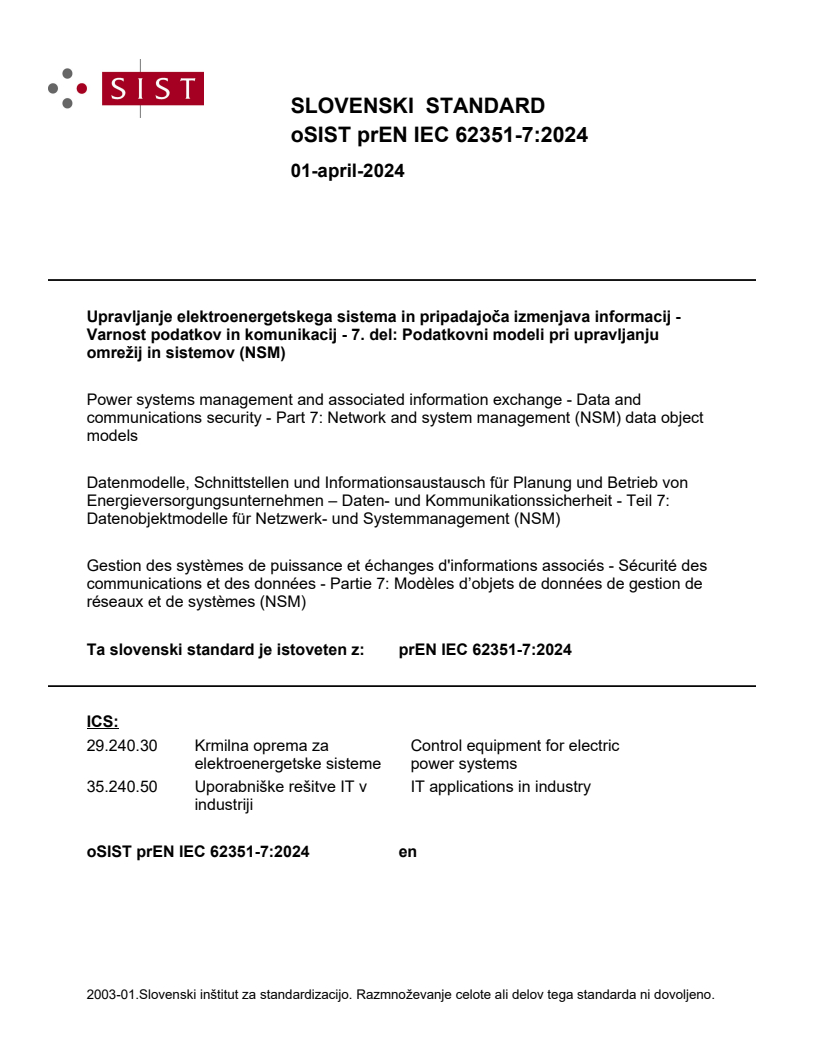
SLOVENSKI STANDARD
oSIST prEN IEC 62351-7:2024
01-april-2024
Upravljanje elektroenergetskega sistema in pripadajoča izmenjava informacij -
Varnost podatkov in komunikacij - 7. del: Podatkovni modeli pri upravljanju
omrežij in sistemov (NSM)
Power systems management and associated information exchange - Data and
communications security - Part 7: Network and system management (NSM) data object
models
Datenmodelle, Schnittstellen und Informationsaustausch für Planung und Betrieb von
Energieversorgungsunternehmen – Daten- und Kommunikationssicherheit - Teil 7:
Datenobjektmodelle für Netzwerk- und Systemmanagement (NSM)
Gestion des systèmes de puissance et échanges d'informations associés - Sécurité des
communications et des données - Partie 7: Modèles d’objets de données de gestion de
réseaux et de systèmes (NSM)
Ta slovenski standard je istoveten z: prEN IEC 62351-7:2024
ICS:
29.240.30 Krmilna oprema za Control equipment for electric
elektroenergetske sisteme power systems
35.240.50 Uporabniške rešitve IT v IT applications in industry
industriji
oSIST prEN IEC 62351-7:2024 en
2003-01.Slovenski inštitut za standardizacijo. Razmnoževanje celote ali delov tega standarda ni dovoljeno.
oSIST prEN IEC 62351-7:2024
oSIST prEN IEC 62351-7:2024
57/2639/CDV
COMMITTEE DRAFT FOR VOTE (CDV)
PROJECT NUMBER:
IEC 62351-7 ED2
DATE OF CIRCULATION: CLOSING DATE FOR VOTING:
2024-02-09 2024-05-03
SUPERSEDES DOCUMENTS:
57/2583/CD, 57/2604A/CC
IEC TC 57 : POWER SYSTEMS MANAGEMENT AND ASSOCIATED INFORMATION EXCHANGE
SECRETARIAT: SECRETARY:
Germany Mr Heiko Englert
OF INTEREST TO THE FOLLOWING COMMITTEES: PROPOSED HORIZONTAL STANDARD:
Other TC/SCs are requested to indicate their interest, if any, in
this CDV to the secretary.
FUNCTIONS CONCERNED:
EMC ENVIRONMENT QUALITY ASSURANCE SAFETY
SUBMITTED FOR CENELEC PARALLEL VOTING NOT SUBMITTED FOR CENELEC PARALLEL VOTING
Attention IEC-CENELEC parallel voting
The attention of IEC National Committees, members of CENELEC,
is drawn to the fact that this Committee Draft for Vote (CDV) is
submitted for parallel voting.
The CENELEC members are invited to vote through the CENELEC
online voting system.
This document is still under study and subject to change. It should not be used for reference purposes.
Recipients of this document are invited to submit, with their comments, notification of any relevant patent rights of which they are
aware and to provide supporting documentation.
Recipients of this document are invited to submit, with their comments, notification of any relevant “In Some Countries” clau ses to be
included should this proposal proceed. Recipients are reminded that the CDV stage is the final stage for submitting ISC c lauses.
(SEE AC/22/2007 OR NEW GUIDANCE DOC).
TITLE:
Power systems management and associated information exchange - Data and communications security - Part
7: Network and System Management (NSM) data object models
PROPOSED STABILITY DATE: 2025
NOTE FROM TC/SC OFFICERS:
electronic file, to make a copy and to print out the content for the sole purpose of preparing National Committee positions.
You may not copy or "mirror" the file or printed version of the document, or any part of it, for any other purpose without
permission in writing from IEC.
oSIST prEN IEC 62351-7:2024
57/2639/CDV – 2 – IEC CDV 62351-7© IEC: 2024
CONTENTS
FOREWORD . 9
1 Scope . 11
2 Normative references . 11
3 Terms and definitions . 13
4 Abbreviated terms and acronyms . 14
5 Overview of Network and System Management (NSM) . 14
5.1 Objectives . 14
5.2 NSM concepts. 16
5.2.1 Simple Network Management Protocol (SNMP) . 16
5.2.2 ISO NSM categories . 16
5.2.3 NSM “data objects” for power system operations . 17
5.2.4 Other NSM protocols . 17
5.3 Communication network management . 17
5.3.1 Network configuration . 17
5.3.2 Network backup . 18
5.3.3 Communications failures and degradation . 18
5.4 Communication protocols . 18
5.5 End systems management . 19
5.6 Intrusion detection systems (IDS) . 20
5.6.1 IDS guidelines . 20
5.6.2 IDS: Passive observation techniques . 21
5.6.3 IDS: Active security monitoring architecture with NSM data objects . 21
5.7 End-to-end security . 22
5.7.1 End-to-end security concepts. 22
5.7.2 Role of NSM in end-to-end security . 23
5.8 NSM requirements: detection functions . 25
5.8.1 Detecting unauthorized access . 25
5.8.2 Detecting resource exhaustion as a denial of service (DoS) attack . 25
5.8.3 Detecting invalid buffer access DoS attacks . 26
5.8.4 Detecting tampered/malformed PDUs . 26
5.8.5 Detecting physical access disruption . 26
5.8.6 Detecting invalid network access . 26
5.8.7 Detecting coordinated attacks . 27
5.9 Abstract object and agent UML descriptions. 27
5.9.1 Purpose of UML . 27
5.9.2 Abstract types and base types . 28
5.9.3 Enumerated Types. 28
5.9.4 Abstract agents . 29
5.9.5 Unsolicited Event Notification . 32
5.9.6 UML Model extension . 32
5.10 Abstract Object UML translation to SNMP . 32
5.10.1 Simple Network Management Protocol (SNMP) . 32
5.10.2 Management information bases (MIBs) . 32
5.11 SNMP mapping of UML model Objects . 33
5.12 SNMP Security. 35
oSIST prEN IEC 62351-7:2024
IEC CDV 62351-7© IEC: 2024 – 3 – 57/2639/CDV
6 Abstract objects . 37
6.1 General . 37
6.2 Package Abstract Types . 38
6.2.1 General . 38
6.2.2 BooleanValue . 38
6.2.3 BooleanValueTs . 38
6.2.4 CounterTs. 38
6.2.5 CntRs . 39
6.2.6 Floating . 39
6.2.7 FloatingTs . 39
6.2.8 EntityIndex . 40
6.2.9 Integer . 40
6.2.10 IntegerTs . 40
6.2.11 InetAddress . 41
6.2.12 InetAddressType . 41
6.2.13 MacAddress . 41
6.2.14 Selector . 41
6.2.15 Timestamp . 42
6.2.16 CharString . 42
6.2.17 CharStringTs . 42
6.2.18 AbstractBaseType root class . 43
6.2.19 AbstractAgent root class . 43
6.3 Package EnumeratedTypes . 43
6.3.1 General . 43
6.3.2 AppDatStKind enumeration . 43
6.3.3 PhyHealthKind enumeration. 43
6.3.4 ExtKind enumeration . 43
6.3.5 IntKind enumeration. 44
6.3.6 LnkKind enumeration . 44
6.3.7 PSPAccKind enumeration . 44
6.3.8 ProtIdKind enumeration . 44
6.3.9 EventKind enumeration . 45
6.3.10 TimSyncIssueKind enumeration . 45
6.3.11 SecurityProfileKind enumeration . 45
6.3.12 TimSyncSrcKind enumeration . 46
6.3.13 AppDatStType . 46
6.3.14 PhyHealthType . 47
6.3.15 ExtType . 47
6.3.16 IntType . 47
6.3.17 EventType . 47
6.3.18 PSPAccType . 48
6.3.19 ProtIdType . 48
6.3.20 TimSyncIssueType . 48
6.3.21 SecurityProfileType . 48
6.3.22 TimSyncSrcType . 49
6.3.23 LnkType . 49
7 Agents . 49
7.1 Package Overview . 49
oSIST prEN IEC 62351-7:2024
57/2639/CDV – 4 – IEC CDV 62351-7© IEC: 2024
7.2 Package Environmental Agent . 50
7.2.1 General . 50
7.2.2 (nsmAgent) Environmental . 51
7.2.3 (nsmEntry) PSUPEntry . 52
7.2.4 (nsmEvent) Notification . 52
7.2.5 (nsmEvent) SecurityNotification . 53
7.3 Package IED Agent . 53
7.3.1 General . 53
7.3.2 (nsmAgent) IED . 54
7.3.3 (nsmEntry) CPUEntry . 56
7.3.4 (nsmEntry) EXTEntry . 56
7.3.5 (nsmEntry) STOREEntry . 57
7.3.6 (nsmEvent) Notification . 57
7.3.7 (nsmEvent) SecurityNotification . 58
7.4 Package Application Protocols Agents . 58
7.4.1 General . 58
7.4.2 Package Common objects . 58
7.4.3 Package IEC62351-3 ed.2 Agent . 59
7.4.4 Package IEEE 1815 and IEC 60870-5 Agent. 68
7.4.5 Package IEEE 1815 and IEC 60870-5 Agent - ed2 . 79
7.4.6 Package IEC61850 Agent . 92
7.5 Package Interfaces Agent . 112
7.5.1 General . 112
7.5.2 Interface . 113
7.5.3 (nsmAgent) Interfaces . 114
7.5.4 (nsmEntry) ETHEntry . 115
7.5.5 (nsmEntry) KEYEntry . 115
7.5.6 (nsmEntry) SEREntry . 115
7.5.7 (nsmEntry) ALGEntry . 116
7.5.8 (nsmEntry) USBEntry . 116
7.5.9 (nsmEvent) Notification . 117
7.6 Package Clocks Agent . 117
7.6.1 General . 117
7.6.2 (nsmAgent) Clock . 118
7.6.3 (nsmEntry) ClockEntry . 119
7.6.4 (nsmEvent) SecurityNotification . 119
7.7 Network and Transport Agents . 120
7.7.1 TCP . 120
7.7.2 User Datagram Protocol (UDP) . 120
7.7.3 IP . 120
8 SNMP security . 120
9 Secured time synchronization . 121
Annex A (normative) SNMP MIB Mapping . 122
Annex B (informative) Mapping of relevant IEC 61850 Objects . 123
Bibliography . 124
Figure 1 – Example of a power system SCADA architecture extended with NSM Data
Objects . 16
oSIST prEN IEC 62351-7:2024
IEC CDV 62351-7© IEC: 2024 – 5 – 57/2639/CDV
Figure 2 – IDS Information exchange between applications: generic communication
topology . 20
Figure 3 – Active security monitoring architecture with NSM data objects . 22
Figure 4 – Comparison of NSM data objects with IEC 61850 objects . 24
Figure 5 – Management of both the power system infrastructure and the information
infrastructure . 24
Figure 6 – Abstract types . 28
Figure 7 – Enumerated types . 29
Figure 8 – Subagents . 30
Figure 9 – Environmental agent . 31
Figure 10 – Model stereotypes . 31
Figure 11 – Object identifier structure . 33
Figure 12 – SNMP table . 35
Figure 13 – SNMP RFCs map and security . 36
Figure 14 – SNMP Entity . 37
Figure 15 – Class diagram Overview::Part7 Classes Overview . 50
Figure 16 – Class diagram Environmental Agent::Environmental . 51
Figure 17 – Class diagram IED Agent::IED . 54
Figure 18 – Class diagram Common objects::Application Protocol common objects . 59
Figure 19 – Class diagram IEC62351-3 ed.2 Agent::IEC 62351-3 ed.2 Agent
Relationships . 60
Figure 20 – Class diagram IEEE 1815 and IEC 60870-5 Agent::IEEE 1815 and IEC
60870 Agent Relationships . 69
Figure 21 – Class diagram IEEE 1815 and IEC 60870-5 Agent - ed2::IEEE 1815 and
IEC 60870 Agent Relationships . 80
Figure 22 – Class diagram ACSI::ACSI . 93
Figure 23 – Class diagram MMS::MMS . 95
Figure 24 – Class diagram SV and GSE common objects::SV and GSE common
objects . 100
Figure 25 – Class diagram SV::SV . 102
Figure 26 – Class diagram GSE::GSE . 106
Figure 27 – Class diagram Interfaces Agent::Interfaces . 113
Figure 28 – Class diagram Clocks Agent::Clocks Agent . 118
Table 1 – Attributes of Abstract Types::BooleanValue . 38
Table 2 – Attributes of Abstract Types::BooleanValueTs . 38
Table 3 – Attributes of Abstract Types::CounterTs . 39
Table 4 – Attributes of Abstract Types::CntRs . 39
Table 5 – Attributes of Abstract Types::Floating . 39
Table 6 – Attributes of Abstract Types::FloatingTs . 39
Table 7 – Attributes of Abstract Types::EntityIndex . 40
Table 8 – Attributes of Abstract Types::Integer . 40
Table 9 – Attributes of Abstract Types::IntegerTs . 40
Table 10 – Attributes of Abstract Types::InetAddress . 41
Table 11 – Attributes of Abstract Types::InetAddressType . 41
oSIST prEN IEC 62351-7:2024
57/2639/CDV – 6 – IEC CDV 62351-7© IEC: 2024
Table 12 – Attributes of Abstract Types::MacAddress . 41
Table 13 – Attributes of Abstract Types::Selector . 42
Table 14 – Attributes of Abstract Types::Timestamp . 42
Table 15 – Attributes of Abstract Types::CharString . 42
Table 16 – Attributes of Abstract Types::CharStringTs . 42
Table 17 – Literals of EnumeratedTypes::AppDatStKind . 43
Table 18 – Literals of EnumeratedTypes::PhyHealthKind . 43
Table 19 – Literals of EnumeratedTypes::ExtKind . 43
Table 20 – Literals of EnumeratedTypes::IntKind . 44
Table 21 – Literals of EnumeratedTypes::LnkKind . 44
Table 22 – Literals of EnumeratedTypes::PSPAccKind . 44
Table 23 – Literals of EnumeratedTypes::ProtIdKind . 44
Table 24 – Literals of EnumeratedTypes::EventKind . 45
Table 25 – Literals of EnumeratedTypes::TimSyncIssueKind . 45
Table 26 – Literals of EnumeratedTypes::SecurityProfileKind . 46
Table 27 – Literals of EnumeratedTypes::TimSyncSrcKind . 46
Table 28 – Attributes of EnumeratedTypes::AppDatStType . 47
Table 29 – Attributes of EnumeratedTypes::PhyHealthType . 47
Table 30 – Attributes of EnumeratedTypes::ExtType . 47
Table 31 – Attributes of EnumeratedTypes::IntType . 47
Table 32 – Attributes of EnumeratedTypes::EventType . 48
Table 33 – Attributes of EnumeratedTypes::PSPAccType . 48
Table 34 – Attributes of EnumeratedTypes::ProtIdType . 48
Table 35 – Attributes of EnumeratedTypes::TimSyncIssueType . 48
Table 36 – Attributes of EnumeratedTypes::SecurityProfileType . 49
Table 37 – Attributes of EnumeratedTypes::TimSyncSrcType . 49
Table 38 – Attributes of EnumeratedTypes::LnkType . 49
Table 39 – Attributes of Environmental Agent::Environmental . 51
Table 40 – Attributes of Environmental Agent::PSUPEntry . 52
Table 41 – Attributes of Environmental Agent::Notification . 53
Table 42 – Attributes of Environmental Agent::SecurityNotification . 53
Table 43 – Attributes of IED Agent::IED . 55
Table 44 – Attributes of IED Agent::CPUEntry. 56
Table 45 – Attributes of IED Agent::EXTEntry . 57
Table 46 – Attributes of IED Agent::STOREEntry . 57
Table 47 – Attributes of IED Agent::Notification . 57
Table 48 – Attributes of IED Agent::SecurityNotification . 58
Table 49 – Attributes of Common objects::CommonProtocolInfo . 59
Table 50 – Attributes of IEC62351-3 ed.2 Agent::IEC62351-3ed2security . 61
Table 51 – Attributes of IEC62351-3 ed.2 Agent::TLSSession . 62
Table 52 – Attributes of IEC62351-3 ed.2 Agent::Summary . 64
Table 53 – Attributes of IEC62351-3 ed.2 Agent::IEC62351part3ed2SecurityNotification . 65
Table 54 – Attributes of IEC62351-3 ed.2 Agent::IEC62351part3edNotification . 65
oSIST prEN IEC 62351-7:2024
IEC CDV 62351-7© IEC: 2024 – 7 – 57/2639/CDV
Table 55 – Attributes of IEC62351-3 ed.2 Agent::ClientTLS . 65
Table 56 – Attributes of IEC62351-3 ed.2 Agent::ServerTLS . 67
Table 57 – Attributes of IEEE 1815 and IEC 60870-5 Agent::60870andDNPProtocolInfo . 70
Table 58 – Attributes of IEEE 1815 and IEC 60870-5 Agent::Association . 71
Table 59 – Attributes of IEEE 1815 and IEC 60870-5 Agent::Summary . 73
Table 60 – Attributes of IEEE 1815 and IEC 60870-5
Agent::60870andDNPSecurityNotification . 74
Table 61 – Attributes of IEEE 1815 and IEC 60870-5 Agent::60870andDNPNotification . 75
Table 62 – Attributes of IEEE 1815 and IEC 60870-5 Agent::MasterAssociation . 75
Table 63 – Attributes of IEEE 1815 and IEC 60870-5 Agent::OutstationAssociation . 77
Table 64 – Attributes of IEEE 1815 and IEC 60870-5 Agent -
ed2::60870andDNPProtocolInfoEd2 . 81
Table 65 – Attributes of IEEE 1815 and IEC 60870-5 Agent - ed2::IEC62351part5 . 82
Table 66 – Attributes of IEEE 1815 and IEC 60870-5 Agent - ed2::Association . 83
Table 67 – Attributes of IEEE 1815 and IEC 60870-5 Agent - ed2::Summary . 86
Table 68 – Attributes of IEEE 1815 and IEC 60870-5 Agent -
ed2::60870andDNPSecurityNotificationEd2. 87
Table 69 – Attributes of IEEE 1815 and IEC 60870-5 Agent -
ed2::60870andDNPNotificationEd2 . 88
Table 70 – Attributes of IEEE 1815 and IEC 60870-5 Agent - ed2::MasterAssociation. 88
Table 71 – Attributes of IEEE 1815 and IEC 60870-5 Agent -
ed2::OutstationAssociation . 90
Table 72 – Attributes of ACSI::ACSISummary . 93
Table 73 – Attributes of MMS::MMSProtocolInfo . 95
Table 74 – Attributes of MMS::MMSProvider . 97
Table 75 – Attributes of MMS::MMSAssociation . 98
Table 76 – Attributes of MMS::MMSSecurityNotification . 99
Table 77 – Attributes of MMS::MMSNotification . 99
Table 78 – Attributes of SV and GSE common objects::GSEandSVCommon . 100
Table 79 – Attributes of SV and GSE common
objects::GSEandSVPublisherAssociation . 101
Table 80 – Attributes of SV and GSE common
objects::GSEandSVSubscriberAssociation . 101
Table 81 – Attributes of SV::SVProvider. 102
Table 82 – Attributes of SV::SVPublisherAssociationIP . 103
Table 83 – Attributes of SV::SVPublisherAssociationL2 . 104
Table 84 – Attributes of SV::SVSubcriberAssociationIP. 104
Table 85 – Attributes of SV::SVSubcriberAssociationL2 . 105
Table 86 – Attributes of SV::SVNotification . 105
Table 87 – Attributes of GSE::GSESubscriberAssociation . 106
Table 88 – Attributes of GSE::GSEProvider . 108
Table 89 – Attributes of GSE::GSEPublisherAssociationIP . 108
Table 90 – Attributes of GSE::GSEPublisherAssociationL2 . 109
Table 91 – Attributes of GSE::GSESubcriberAssociationIP . 109
Table 92 – Attributes of GSE::GSESubcriberAssociationL2 . 111
oSIST prEN IEC 62351-7:2024
57/2639/CDV – 8 – IEC CDV 62351-7© IEC: 2024
Table 93 – Attributes of GSE::GSENotification . 112
Table 94 – Attributes of Interfaces Agent::Interface. 113
Table 95 – Attributes of Interfaces Agent::Interfaces . 114
Table 96 – Attributes of Interfaces Agent::ETHEntry . 115
Table 97 – Attributes of Interfaces Agent::KEYEntry . 115
Table 98 – Attributes of Interfaces Agent::SEREntry . 116
Table 99 – Attributes of Interfaces Agent::ALGEntry . 116
Table 100 – Attributes of Interfaces Agent::USBEntry . 116
Table 101 – Attributes of Interfaces Agent::Notification . 117
Table 102 – Attributes of Clocks Agent::Clock . 118
Table 103 – Attributes of Clocks Agent::ClockEntry . 119
Table 104 – Attributes of Clocks Agent::SecurityNotification . 120
Table B.1 – IEC 61850-7-4 objects mapping . 123
oSIST prEN IEC 62351-7:2024
IEC CDV 62351-7© IEC: 2024 – 9 – 57/2639/CDV
INTERNATIONAL ELECTROTECHNICAL COMMISSION
____________
POWER SYSTEMS MANAGEMENT AND
ASSOCIATED INFORMATION EXCHANGE –
DATA AND COMMUNICATIONS SECURITY –
Part 7: Network and System Management (NSM) data object models
FOREWORD
1) The International Electrotechnical Commission (IEC) is a worldwide organization for standardization comprising
all national electrotechnical committees (IEC National Committees). The object of IEC is to promote international
co-operation on all questions concerning standardization in the electrical and electronic fields. To this end and
in addition to other activities, IEC publishes International Standards, Technical Specifications, Technical Reports,
Publicly Available Specifications (PAS) and Guides (hereafter referred to as “IEC Publication(s)”). Their
preparation is entrusted to technical committees; any IEC National Committee interested in the subject dealt with
may participate in this preparatory work. International, governmental and non-governmental organizations liaising
with the IEC also participate in this preparation. IEC collaborates closely with the International Organization for
Standardization (ISO) in accordance with conditions determined by agreement between the two organizations.
2) The formal decisions or agreements of IEC on technical matters express, as nearly as possible, an international
consensus of opinion on the relevant subjects since each technical committee has representation from all
interested IEC National Committees.
3) IEC Publications have the form of recommendations for international use and are accepted by IEC National
Committees in that sense. While all reasonable efforts are made to ensure that the technical content of IEC
Publications is accurate, IEC cannot be held responsible for the way in which they are used or for any
misinterpretation by any end user.
4) In order to promote international uniformity, IEC National Committees undertake to apply IEC Publications
transparently to the maximum extent possible in their national and regional publications. Any divergence between
any IEC Publication and the corresponding national or regional publication shall be clearly indicated in the latter.
5) IEC itself does not provide any attestation of conformity. Independent certification bodies provide conformity
assessment services and, in some areas, access to IEC marks of conformity. IEC is not responsible for any
services carried out by independent certification bodies.
6) All users should ensure that they have the latest edition of this publication.
7) No liability shall attach to IEC or its directors, employees, servants or agents including individual experts and
members of its technical committees and IEC National Committees for any personal injury, property damage or
other damage of any nature whatsoever, whether direct or indirect, or for costs (including legal fees) and
expenses arising out of the publication, use of, or reliance upon, this IEC Publication or any other IEC
Publications.
8) Attention is drawn to the Normative references cited in this publication. Use of the referenced publications is
indispensable for the correct application of this publication.
9) Attention is drawn to the possibility that some of the elements of this IEC Publication may be the subject of patent
rights. IEC shall not be held responsible for identifying any or all such patent rights.
International Standard IEC 62351-7 has been prepared by IEC technical committee 57: Power
systems management and associated information exchange.
This edition of IEC 62351-7 cancels and replaces IEC TS 62351-7 published in 2017. This new
edition constitutes a technical revision and includes the following significant technical changes
with respect to IEC TS 62351-7 (2017):
a) Reviewed and enriched the NSM object data model
b) UML model adopted for NSM objects description
c) SNMP protocol MIBs translation included as Code Components.
The text of this International Standard is based on the following documents:
FDIS Report on voting
oSIST prEN IEC 62351-7:2024
57/2639/CDV – 10 – IEC CDV 62351-7© IEC: 2024
57/1857/FDIS 57/1885/RVD
Full information on the voting for the approval of this International Standard can be found in the
report on voting indicated in the above table.
This document has been drafted in accordance with the ISO/IEC Directives, Part 2.
A list of all parts of the IEC 62351 series, under the general title: Power systems management
and associated information exchange – Data and communications security, can be found on the
IEC website.
This IEC standard includes Code Components i.e components that are intended to be directly
processed by a computer. Such content is any text found between the markers
BEGINS> and , or otherwise is clearly labeled in this standard as a Code
Component.
The purchase of this IEC standard carries a copyright license for the purchaser to sell software
containing Code Components from this standard directly to end users and to end users via
distributors, subject to IEC software licensing conditions, which can be found at:
http://www.iec.ch/CCv1.
The Code Components included in this IEC standard are also available as electronic machine
readable file at: http://www.iec.ch/public/TC57/IEC_62351-7.MIBS.light.zip.
The committee has decided that the contents of this document will remain unchanged until the
stability date indicated on the IEC website under "http://webstore.iec.ch" in the data related to
the specific document. At this date, the document will be
• reconfirmed,
• withdrawn,
• replaced by a revised edition, or
• amended.
A bilingual version of this publication may be issued at a later date.
IMPORTANT – The 'colour inside' logo on the cover page of this publication indicates
that it contains colours which are considered to be useful for the correct understanding
of its contents. Users should therefore print this document using a colour printer.
oSIST prEN IEC 62351-7:2024
IEC CDV 62351-7© IEC: 2024 – 11 – 57/2639/CDV
2 POWER SYSTEMS MANAGEMENT AND
3 ASSOCIATED INFORMATION EXCHANGE –
4 DATA AND COMMUNICATIONS SECURITY –
6 Part 7: Network and System Management (NSM) data object models
10 1 Scope
11 This part of IEC 62351 defines network and system management (NSM) data object models
12 that are specific to power system operations. These NSM data objects will be used to monitor
13 the health of networks and systems, to detect possible security intrusions, and to manage the
14 performance and reliability of the information infrastructure. The goal is to define a set of
15 abstract objects that will allow the remote monitoring of the health and condition of IEDs
16 (Intelligent Electronic Devices), RTUs (Remote Terminal Units), DERs (Distributed Energy
17 Resources) systems and other systems that are important to power system operations.
18 Power systems operations are increasingly reliant on information infrastructures, including
19 communication networks, IEDs, and self-defining communication protocols. Therefore,
20 management of the information infrastructure has become crucial to providing the necessary
21 high levels of security and reliability in power system operations.
22 The telecommunication infrastructure that is in use for the transport of telecontrol and
23 automation protocols is already subject to health and condition monitoring control, using the
24 concepts developed in the IETF Simple Network Management Protocol (SNMP) standards for
25 network management. However, power system specific devices (like
...
Questions, Comments and Discussion
Ask us and Technical Secretary will try to provide an answer. You can facilitate discussion about the standard in here.