

prEN 50206-2:2025
(Main)Railway applications - Rolling stock - Pantographs: Characteristics and tests - Part 2: Pantographs for metros and light rail vehicles
General Information
- Abstract
To revise EN 50206-2:2010, to update the references, to update the technical content state of the art.
- Status
- Not Published
- Publication Date
- 06-Apr-2027
- Technical Committee
- CLC/TC 9X - Electrical and electronic applications for railways
- Drafting Committee
- CLC/SC 9XB - Electromechanical material on board rolling stock
- Current Stage
- 4060 - Enquiry results established and sent to TC, SR, BTTF - Enquiry
- Start Date
- 03-Oct-2025
- Due Date
- 14-May-2025
- Completion Date
- 03-Oct-2025


Overview
prEN 50206-2:2025 is the revision of the European Standard for railway applications, specifically addressing pantographs for metros and light rail vehicles. Developed by CENELEC (CLC), this draft standard updates EN 50206-2:2010 by incorporating the latest references and aligning with current state-of-the-art technical requirements. The document specifies assembly characteristics and mandatory tests for pantographs and their control units, ensuring safe and reliable current collection in urban rail environments. The standard is essential for manufacturers, system integrators, operators, and suppliers working with metro, tram, and light rail rolling stock.
Key Topics
Pantograph Assembly and Characteristics
- Defines dimensions, gauge, extension, electric values, and static contact force requirements applicable to metros and light rail vehicles.
- Includes requirements for pantograph head design, contact strips, operating systems, and protection against corrosion.
Automatic Dropping Device (ADD)
- Adds detailed requirements and new tests for ADD function: ensuring pantograph safety in case of entanglement or collision with the overhead line.
- Test methods for ADD activation include rotational, impact, and force-based triggers.
Testing Procedures
- Outlines categories of tests: type tests, routine tests, investigation tests, and combined tests.
- Covers visual inspections, weighing, functional checks, operating tests (including climatic and field tests), endurance, rigidity, vibration, shock, and air tightness tests.
- Specifies acceptance criteria, such as no permanent deformation under prescribed forces and successful ADD operation.
Control Units and Insulators
- Addresses requirements and test methods for electric, electro-pneumatic, or pneumatic control units, aiming to avoid pantograph or vehicle immobilisation.
- Provides guidelines for endurance and tightness tests specific to control units and related piping.
Customer Specification Items
- Lists all elements to be agreed upon between customer and supplier, including rated voltage, current, environment, static force, test conditions, and supplementary requirements.
Applications
prEN 50206-2:2025 is used in the design, manufacturing, testing, and commissioning of pantographs for urban rail vehicles, such as metros, trams, and light rail. Key applications include:
- Rolling Stock Production: Manufacturers apply this standard to ensure new pantographs are compliant with updated safety, reliability, and performance benchmarks for metros and light rail.
- System Integration: Rail system integrators specify compliant pantographs to match local infrastructure and operating conditions.
- Upgrades and Modernizations: Operators and maintainers use the standard during refurbishment or upgrade programs to incorporate the latest pantograph technology, including ADD.
- Procurement and Tendering: Provides a clear reference for procurement specifications, ensuring harmonization and interoperability across European and international projects.
- Verification and Certification: Supports independent testing and conformity assessment activities, including third-party certification and regulatory compliance.
Related Standards
Several standards are referenced or harmonized with prEN 50206-2:2025:
- EN 50206-1: Pantographs for main line vehicles
- EN 50119: Electric traction overhead contact lines
- EN 50317: Validation of the dynamic interaction between pantograph and overhead contact line
- EN 50405: Testing methods for pantograph contact strips
- EN 60077 series: Electric equipment for rolling stock
- EN 60529: IP code for protection against environmental factors
- EN 50702: Pantographs for third and fourth rail current collectors (for isolated metro or light rail systems)
- EN 50124-1: Insulation coordination for railway equipment
By adopting prEN 50206-2:2025, stakeholders ensure alignment with international best practices for urban railway rolling stock pantograph systems, enhancing safety, reliability, and operational efficiency.
Relations
- Effective Date
- 23-Jan-2024
Get Certified
Connect with accredited certification bodies for this standard

IRIS Certification (UNIFE)
International Railway Industry Standard certification.

TÜV SÜD Rail GmbH
TÜV SÜD railway certification services.

Bureau Veritas Railway Certification
Railway and transportation certification.
Sponsored listings
Frequently Asked Questions
prEN 50206-2:2025 is a draft published by CLC. Its full title is "Railway applications - Rolling stock - Pantographs: Characteristics and tests - Part 2: Pantographs for metros and light rail vehicles". This standard covers: To revise EN 50206-2:2010, to update the references, to update the technical content state of the art.
To revise EN 50206-2:2010, to update the references, to update the technical content state of the art.
prEN 50206-2:2025 is classified under the following ICS (International Classification for Standards) categories: 45.060.10 - Tractive stock; 45.140 - Metro, tram and light rail equipment. The ICS classification helps identify the subject area and facilitates finding related standards.
prEN 50206-2:2025 has the following relationships with other standards: It is inter standard links to EN 50206-2:2010. Understanding these relationships helps ensure you are using the most current and applicable version of the standard.
prEN 50206-2:2025 is available in PDF format for immediate download after purchase. The document can be added to your cart and obtained through the secure checkout process. Digital delivery ensures instant access to the complete standard document.
Standards Content (Sample)
SLOVENSKI STANDARD
01-september-2025
Železniške naprave - Vozna sredstva - Pantografi: karakteristike in preskusi - 2.
del: Pantografi za podzemno železnico in lahka železniška vozila
Railway applications - Rolling stock - Pantographs: Characteristics and tests - Part 2:
Pantographs for metros and light rail vehicles
Bahnanwendungen - Fahrzeuge - Teil 2: Dachstromabnehmer für Stadtbahnen und
Straßenbahnen, Merkmale und Prüfungen
Applications ferroviaires - Matériel roulant - Partie 2: Pantographes pour métros et
tramways, caractéristiques et essais
Ta slovenski standard je istoveten z: prEN 50206-2:2025
ICS:
45.140 Oprema za podzemne vlake, Metro, tram and light rail
tramvaje in lahka tirna vozila equipment
2003-01.Slovenski inštitut za standardizacijo. Razmnoževanje celote ali delov tega standarda ni dovoljeno.
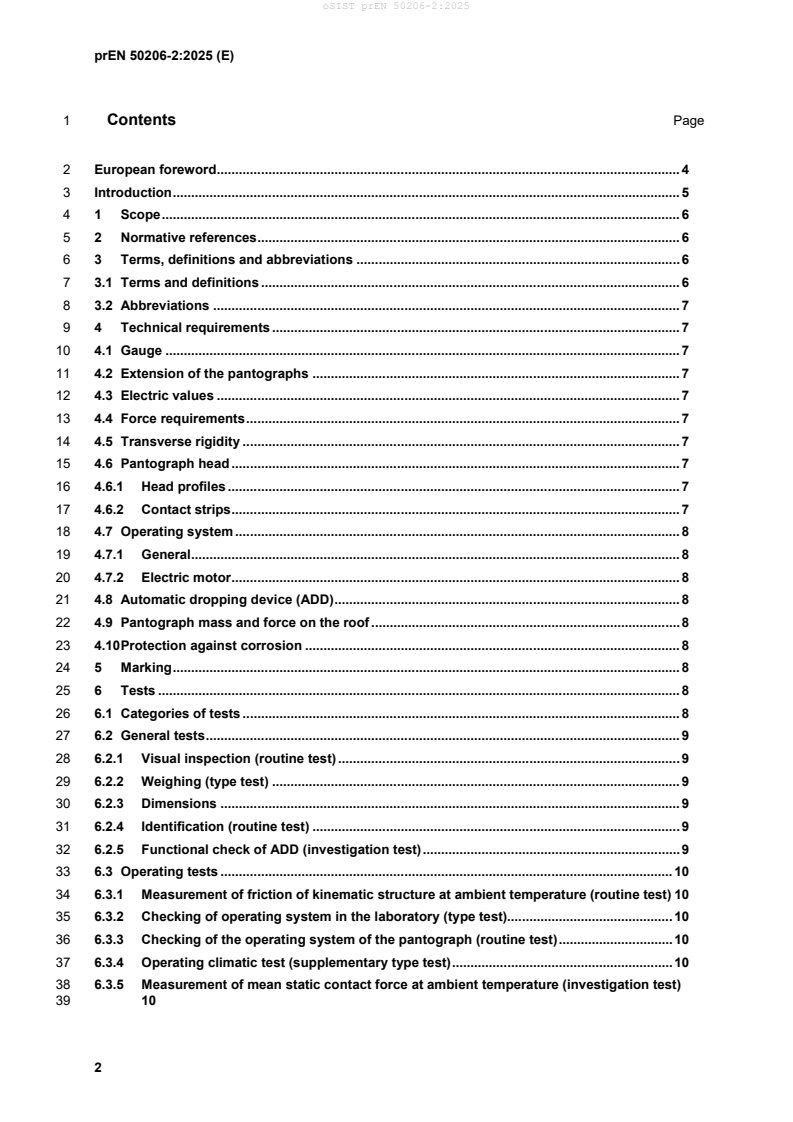
1 Contents Page
2 European foreword . 4
3 Introduction . 5
4 1 Scope . 6
5 2 Normative references . 6
6 3 Terms, definitions and abbreviations . 6
7 3.1 Terms and definitions . 6
8 3.2 Abbreviations . 7
9 4 Technical requirements . 7
10 4.1 Gauge . 7
11 4.2 Extension of the pantographs . 7
12 4.3 Electric values . 7
13 4.4 Force requirements . 7
14 4.5 Transverse rigidity . 7
15 4.6 Pantograph head . 7
16 4.6.1 Head profiles . 7
17 4.6.2 Contact strips . 7
18 4.7 Operating system . 8
19 4.7.1 General. 8
20 4.7.2 Electric motor . 8
21 4.8 Automatic dropping device (ADD) . 8
22 4.9 Pantograph mass and force on the roof . 8
23 4.10 Protection against corrosion . 8
24 5 Marking . 8
25 6 Tests . 8
26 6.1 Categories of tests . 8
27 6.2 General tests . 9
28 6.2.1 Visual inspection (routine test) . 9
29 6.2.2 Weighing (type test) . 9
30 6.2.3 Dimensions . 9
31 6.2.4 Identification (routine test) . 9
32 6.2.5 Functional check of ADD (investigation test) . 9
33 6.3 Operating tests . 10
34 6.3.1 Measurement of friction of kinematic structure at ambient temperature (routine test) 10
35 6.3.2 Checking of operating system in the laboratory (type test). 10
36 6.3.3 Checking of the operating system of the pantograph (routine test) . 10
37 6.3.4 Operating climatic test (supplementary type test) . 10
38 6.3.5 Measurement of mean static contact force at ambient temperature (investigation test)
39 10
40 6.3.6 Measurement of static contact force after installation of the pantograph on the vehicle
41 (combined test) . 10
42 6.4 Endurance tests . 10
43 6.4.1 Raising/lowering operations (type test) . 10
44 6.4.2 This section intentionally left blank . 10
45 6.4.3 Resistance to vibrations . 10
46 6.5 Resistance to shocks (type test) . 11
47 6.6 Transverse rigidity test (type test) . 11
48 6.7 Air tightness tests . 12
49 6.8 Measurement of degrees of freedom of pantograph head (routine test) . 12
50 6.9 Intentionally left blank . 13
51 6.10 Current collection tests (investigation test) . 13
52 6.11 Heating tests . 13
53 6.11.1 Rated and maximum current, vehicle at standstill (supplementary type test) . 13
54 6.11.2 Intentionally left blank . 13
55 6.11.3 Field tests (investigation test) . 13
56 Annex A (normative) Kinematic structure friction tolerances . 14
57 Annex B (normative) List of tests . 15
58 Annex C (informative) Items to be specified in customer specifications . 16
59 Annex D (informative) Additional requirements for Control Unit. 17
60 D.1 Purpose . 17
61 D.2 Type test with control unit and related pantograph . 17
62 D.2.1 Air tightness and consumption climatic test (type test) (addition to 6.7.3) . 17
63 D.2.2 Endurance test - Operation within working range (type test) (addition to 6.4.1.2) . 17
64 D.2.3 Refer to EN 50206-1:2025 D.2.2 if applicable. This paragraph intentionally left blank . 17
65 D.2.4 Checking of the operating system of the pantograph (type test) (addition to 6.3.3) . 17
66 D.2.5 Functional check of A.D.D. (addition to 6.2.5) . 17
67 D.3 Type tests for control unit . 17
68 D.3.1 Endurance test (supplementary type test) . 17
69 D.3.2 Other tests (supplementary type tests) . 17
70 Annex E (informative) Additional requirements for Insulators . 18
71 Bibliography . 19
72 Figures
73 Figure 1 — Visualization of the impact location the ADD is define for . 10
74 Figure 2 — Transversal rigidity according to the extension . 11
75 Tables
76 Table 1 — Transverse rigidity . 12
77 Table B.1 — Catalogue of tests . 15
79 European foreword
80 This document (prEN 50206-2:2025) has been prepared by CLC/SC 9XB, Electromechanical material on
81 board rolling stock, of Technical Committee CENELEC TC 9X, Electrical and electronic applications for
82 railways.
83 This document is currently submitted to the Enquiry.
84 The following dates are proposed:
• latest date by which the existence of this (doa) dav + 6 months
document has to be announced at national level
• latest date by which this document has to be (dop) dav + 12 months
implemented at national level by publication of
an identical national standard or by
endorsement
• latest date by which the national standards (dow) dav + 36 months
conflicting with this document have to be (to be confirmed or
withdrawn modified when voting)
85 This document will supersede EN 50206-2:2010.
86 The main changes brought by this revision are:
87 — update of normative references and definitions;
88 — definition of new tests for ADD, operating system and lateral stiffness;
89 — adjustment of terms to EN 50317 and EN 50367;
90 — deletion of Clauses 7, 8 and 9;
91 — update of normative references.
92 Introduction
93 The electrical power supply of an electric traction unit is achieved by the collection of current from the
94 contact wire by means of one or more roof-mounted pantograph(s), installed on the unit.
95 The contact strip of the pantograph which brushes along the contact wire accommodates the transmission
96 of power.
97 The pantograph and the overhead line equipment form two oscillating sub-systems which can be displaced.
98 There exists a unilateral contact brushing linkage between them, which ensure continuous contact. Their
99 design allow for minimum wear of both sub-systems when used.
100 1 Scope
101 This document defines the general assembly characteristics which are to be applied to pantographs and
102 their control unit, to enable current collection from the overhead line equipment. It also defines the tests the
103 pantographs and their control unit have to perform.
104 This document does not apply to pantograph dielectric tests, which are to be performed on the pantograph
105 installed on the vehicle roof. If no other requirement is agreed between customer and supplier, insulation
106 coordination according to EN 50124-1 is valid.
107 This document does not apply to pantographs used on main line vehicles: these pantographs are
108 considered in EN 50206-1.
109 This document relates to conventional suspended overhead line equipment and accessories. The systems
110 (or part of them) which are rigidly suspended will require special consideration between the customer and
111 the supplier.
112 This document is not applicable to third and fourth rail current collectors used on isolated metros and light
113 rail systems. These pantographs are considered in EN 50702.
114 2 Normative references
115 The following documents are referred to in the text in such a way that some or all of their content constitutes
116 requirements of this document. For dated references, only the edition cited applies. For undated references,
117 the latest edition of the referenced document (including any amendments) applies.
118 EN 50119:2020, Railway applications — Fixed installations — Electric traction overhead contact lines
119 prEN 50206-1:2025, Railway applications — Environmental conditions for equipment — Part 1: Rolling
120 stock and on-board equipment
121 EN 50206-1, Railway applications — Rolling stock — Pantographs: Characteristics and tests — Part 1:
122 Pantographs for main line vehicles
123 EN 50317, Railway applications — Current collection systems — Requirements for and validation of
124 measurements of the dynamic interaction between pantograph and overhead contact line
125 EN 50405, Railway applications — Current collection systems — Pantographs, testing methods for contact
126 strips
127 EN 60077-1, Railway applications — Electric equipment for rolling stock — Part 1: General service
128 conditions and general rules (IEC 60077-1)
129 EN 60077-2, Railway applications — Electric equipment for rolling stock — Part 2: Electrotechnical
130 components - General rules (IEC 60077-2)
131 EN 60529, Degrees of protection provided by enclosures (IP Code) (IEC 60529)
132 3 Terms, definitions and abbreviations
133 3.1 Terms and definitions
134 For the purposes of this document, the terms and definitions given in prEN 50206-1:2025 apply.
135 ISO and IEC maintain terminology databases for use in standardization at the following addresses:
136 • IEC Electropedia: available at https://www.electropedia.org/
137 • ISO Online browsing platform: available at https://www.iso.org/obp
138 3.2 Abbreviations
139 For the purpose of this document, the following symbols and abbreviations apply.
AC Alternating Current
ADD Automatic Dropping Device
CAD Computer Aided Design
DC Direct Current
EPCU Electro-Pneumatic Control Unit
Fo natural transverse frequency of the pantograph
PCU Pneumatic Control Unit
140 4 Technical requirements
141 4.1 General
142 Refer to prEN 50206-1:2025, Clause 4.
143 4.2 Gauge
144 The pantograph, at housed position and operating position, shall comply with the gauge specified in the
145 customer specifications.
146 4.3 Extension of the pantographs
147 Refer to prEN 50206-1:2025, 4.2.
148 4.4 Electric values
149 Refer to prEN 50206-1:2025, 4.3.
150 4.5 Force requirements
151 Static contact forces measured during raising and lowering shall lie within the boundaries defined in
152 Annex A.
153 For static contact force, preferred values are 70 N, 90 N or 110 N if not specified otherwise in customer
154 specification. In any case, the minimum static contact force shall be 60 N at least according to
155 EN 50119:2020, 5.2.5.2.
156 4.6 Transverse rigidity
157 Refer to prEN 50206-1:2025, 4.5.
158 4.7 Pantograph head
159 4.7.1 Head profiles
160 The customer specification shall give values in relationship with definition number 3.2.6, 3.2.7 and 3.2.8 of
161 Error! Reference source not found. of prEN 50206-1:2025, 3.2 and pantograph head outline profiles.
162 NOTE A typical value for the pantograph head length is 1 700 mm.
163 4.7.2 Contact strips
164 The wear strip material and/or the contact strip design may be defined in the customer specifications.
165 Applicable testing methods according to EN 50405 shall be used.
166 4.8 Operating system
167 4.8.1 General
168 The operating system shall be so designe
...