


FprEN IEC 63517:2026
(Main)Wearable electronic textiles - Test method for performance of heating products - Heating temperature and power consumption
Elektronische Textilien zum Tragen – Prüfverfahren für die Leistung von Heizprodukten – Heiztemperatur und Leistungsaufnahme
Textiles électroniques prêts-à-porter - Méthode d'essai de performance des produits chauffants - Température de chauffage et consommation de puissance
Nosljivi elektronski tekstil - Preskusne metode za učinkovitosti ogrevalnih izdelkov - Temperatura ogrevanja in poraba električne energije
General Information
- Status
- Not Published
- Publication Date
- 30-Jul-2026
- Technical Committee
- CLC/SR 124 - Wearable Electronic Devices and Technologies
- Current Stage
- 5060 - Voting results sent to TC, SR - Formal Approval
- Start Date
- 24-Apr-2026
- Completion Date
- 24-Apr-2026

Overview
FprEN IEC 63517:2026 is an international standard developed by the International Electrotechnical Commission (IEC) Technical Committee 124, in collaboration with CENELEC (CLC), focusing on wearable electronic textiles. Specifically, this standard defines test methods for evaluating the performance of heating products integrated into wearable electronic textiles, such as jackets and vests. The document provides procedures for measuring both heating temperature and power consumption to enable consistent and reliable assessment of these advanced textile products.
Wearable electronic textiles, or e-textiles, are increasingly used in applications requiring active heating, such as outdoor sports, military operations, healthcare, and industrial environments. Standardizing performance test methods ensures comparable product data, supporting quality assurance, regulatory compliance, and informed decision-making for manufacturers, researchers, and end users.
Key Topics
Heating Performance Evaluation
- Procedures to determine heating temperature and power usage over time
- Selection of measurement points using infrared thermography
- Use of specific test equipment, including thermometers, infrared cameras, and insulation materials
Test Environment and Specimen Preparation
- Standard atmosphere conditions: (20 ± 2) °C temperature and (65 ± 4)% relative humidity
- Conditioning and preparation of garments according to ISO 139 and manufacturer guidance
Testing Procedures
- Step-by-step method for attaching sensors, applying thermal insulation, and operating heating systems
- Requirements for measurement intervals and repetition to confirm consistency
- Analysis and documentation of average, maximum, and minimum temperatures and power readings
Test Reporting
- Detailed requirements for test documentation, covering sample identity, state, test conditions, results, deviations, and observations
Applications
FprEN IEC 63517:2026 is essential for stakeholders involved in wearable heating clothing and smart textile products. Key applications include:
Quality assurance and product development
- Enables manufacturers to reliably test and improve the efficiency and effectiveness of heated garments
- Supports comparison and verification of claims regarding temperature maintenance and battery life
Regulatory and certification processes
- Facilitates compliance with international and regional requirements for smart and heated textiles
- Assists third-party testing laboratories and certification bodies in providing standardized performance assessments
Procurement and market comparison
- Assists buyers, retailers, and end users in making informed selections based on consistent heating performance data
Research and innovation
- Provides researchers and development teams with standardized methods for benchmarking new heating textile technologies
It is important to note that the standard covers garments with electric heating elements (such as jackets and vests) and excludes gloves and footwear. Safety considerations for batteries and broader thermal risks are addressed in other referenced standards.
Related Standards
The following international standards are relevant for organizations implementing or referencing FprEN IEC 63517:2026:
- ISO 139: Textiles - Standard atmospheres for conditioning and testing
- ISO 10880:2017: Non-destructive testing - Infrared thermographic testing - General principles
- IEC 60335-2-17: Particular requirements for blankets, pads, clothing and similar flexible heated appliances (safety)
- IEC 62368-1: Audio/video, information and communication technology equipment - Safety requirements (battery safety)
These related standards complement FprEN IEC 63517:2026 by addressing safety, conditioning, testing environments, and measurement technologies critical for the comprehensive evaluation of e-textile heating products.
Using FprEN IEC 63517:2026 ensures reliable performance testing for wearable electronic textiles, helps advance smart textile innovation, and supports the growing demand for safe, energy-efficient heated garments across various industries.
Get Certified
Connect with accredited certification bodies for this standard

Control Union Certifications
Global certification for agriculture and sustainability.

Hohenstein Institut
Textile testing and certification.

Bureau Veritas Bangladesh
Bureau Veritas certification services in Bangladesh.
Sponsored listings
Frequently Asked Questions
FprEN IEC 63517:2026 is a draft published by CLC. Its full title is "Wearable electronic textiles - Test method for performance of heating products - Heating temperature and power consumption". This standard covers: Wearable electronic textiles - Test method for performance of heating products - Heating temperature and power consumption
Wearable electronic textiles - Test method for performance of heating products - Heating temperature and power consumption
FprEN IEC 63517:2026 is classified under the following ICS (International Classification for Standards) categories: 59.080.80 - Smart textiles. The ICS classification helps identify the subject area and facilitates finding related standards.
FprEN IEC 63517:2026 is available in PDF format for immediate download after purchase. The document can be added to your cart and obtained through the secure checkout process. Digital delivery ensures instant access to the complete standard document.
Standards Content (Sample)
SLOVENSKI STANDARD
oSIST prEN IEC 63517:2025
01-junij-2025
Nosljivi elektronski tekstil - Preskusne metode za učinkovitosti ogrevalnih
izdelkov - Temperatura ogrevanja in poraba električne energije
Wearable electronic textiles - Test methods for performance of heating products -
Heating temperature and power consumption
Textiles électroniques prêts-à-porter - Méthodes d'essai de performance des produits
chauffants - Température de chauffage et consommation de puissance
Ta slovenski standard je istoveten z: prEN IEC 63517:2025
ICS:
59.080.80 Inteligentne tekstilije Smart textiles
oSIST prEN IEC 63517:2025 en
2003-01.Slovenski inštitut za standardizacijo. Razmnoževanje celote ali delov tega standarda ni dovoljeno.
oSIST prEN IEC 63517:2025
oSIST prEN IEC 63517:2025
124/309/CDV
COMMITTEE DRAFT FOR VOTE (CDV)
PROJECT NUMBER:
IEC 63517 ED1
DATE OF CIRCULATION: CLOSING DATE FOR VOTING:
2025-04-11 2025-07-04
SUPERSEDES DOCUMENTS:
124/275/CD, 124/308/CC
IEC TC 124 : WEARABLE ELECTRONIC DEVICES AND TECHNOLOGIES
SECRETARIAT: SECRETARY:
Korea, Republic of Mr Jae Yeong Park
OF INTEREST TO THE FOLLOWING COMMITTEES: HORIZONTAL FUNCTION(S):
ASPECTS CONCERNED:
SUBMITTED FOR CENELEC PARALLEL VOTING NOT SUBMITTED FOR CENELEC PARALLEL VOTING
Attention IEC-CENELEC parallel voting
The attention of IEC National Committees, members of
CENELEC, is drawn to the fact that this Committee Draft
for Vote (CDV) is submitted for parallel voting.
The CENELEC members are invited to vote through the
CENELEC online voting system.
This document is still under study and subject to change. It should not be used for reference purposes.
Recipients of this document are invited to submit, with their comments, notification of any relevant patent rights of
which they are aware and to provide supporting documentation.
Recipients of this document are invited to submit, with their comments, notification of any relevant “In Some
Countries” clauses to be included should this proposal proceed. Recipients are reminded that the CDV stage is
the final stage for submitting ISC clauses. (SEE AC/22/2007 OR NEW GUIDANCE DOC).
TITLE:
Wearable electronic textiles - Test methods for performance of heating products - Heating
temperature and power consumption
PROPOSED STABILITY DATE: 2030
NOTE FROM TC/SC OFFICERS:
In accordance with 124/302/RM, Decision #3, TC 124 agreed to proceed this project to CDV for parallel
voting between IEC TC 124 and ISO TC 38.
download this electronic file, to make a copy and to print out the content for the sole purpose of preparing National
Committee positions. You may not copy or "mirror" the file or printed version of the document, or any part of it,
for any other purpose without permission in writing from IEC.
oSIST prEN IEC 63517:2025
IEC CDV 63517 © IEC 2025 – 2 – 124/309/CDV
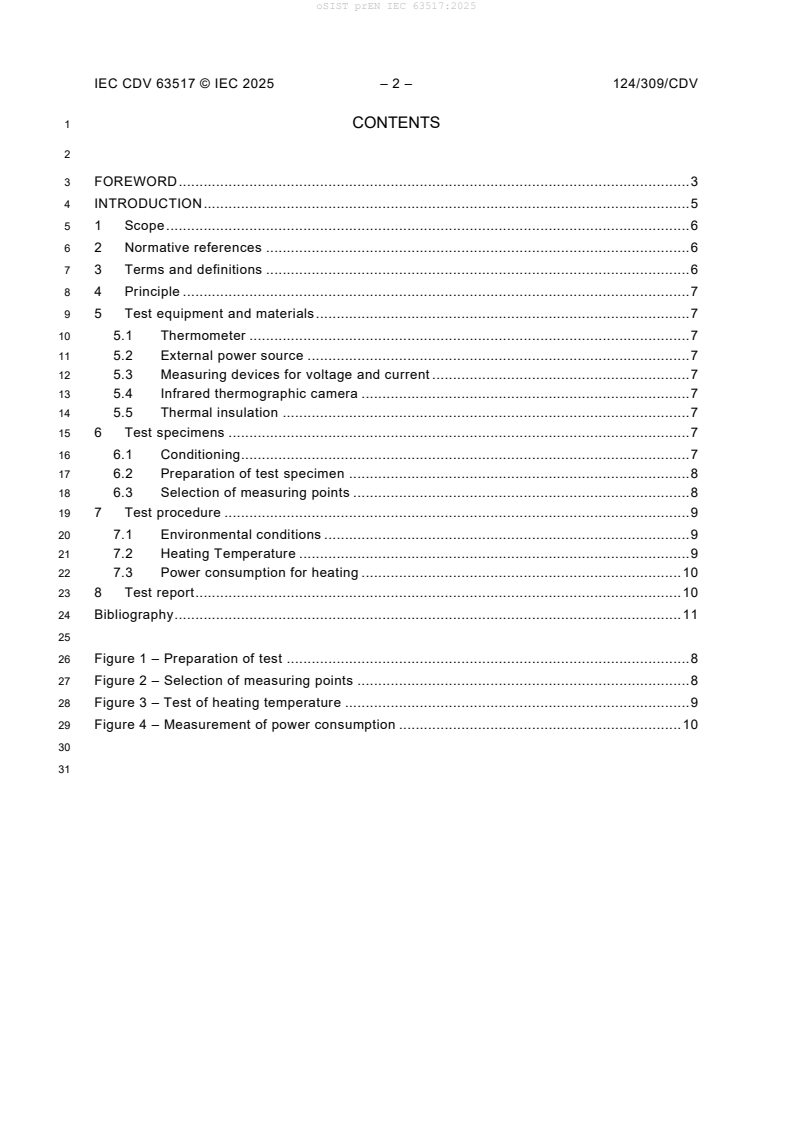
1 CONTENTS
3 FOREWORD . 3
4 INTRODUCTION . 5
5 1 Scope . 6
6 2 Normative references . 6
7 3 Terms and definitions . 6
8 4 Principle . 7
9 5 Test equipment and materials . 7
10 5.1 Thermometer . 7
11 5.2 External power source . 7
12 5.3 Measuring devices for voltage and current . 7
13 5.4 Infrared thermographic camera . 7
14 5.5 Thermal insulation . 7
15 6 Test specimens . 7
16 6.1 Conditioning. 7
17 6.2 Preparation of test specimen . 8
18 6.3 Selection of measuring points . 8
19 7 Test procedure . 9
20 7.1 Environmental conditions . 9
21 7.2 Heating Temperature . 9
22 7.3 Power consumption for heating . 10
23 8 Test report . 10
24 Bibliography . 11
26 Figure 1 – Preparation of test . 8
27 Figure 2 – Selection of measuring points . 8
28 Figure 3 – Test of heating temperature . 9
29 Figure 4 – Measurement of power consumption . 10
oSIST prEN IEC 63517:2025
IEC CDV 63517 © IEC 2025 – 3 – 124/309/CDV
32 INTERNATIONAL ELECTROTECHNICAL COMMISSION
33 ____________
35 WEARABLE ELECTRONIC TEXTILES –
37 Test methods for performance of heating products
38 – Heating temperature and power consumption
40 FOREWORD
41 1) The International Electrotechnical Commission (IEC) is a worldwide organization for standardization comprising
42 all national electrotechnical committees (IEC National Committees). The object of IEC is to promote international
43 co-operation on all questions concerning standardization in the electrical and electronic fields. To this end and
44 in addition to other activities, IEC publishes International Standards, Technical Specifications, Technical Reports,
45 Publicly Available Specifications (PAS) and Guides (hereafter referred to as “IEC Publication(s)”). Their
46 preparation is entrusted to technical committees; any IEC National Committee interested in the subject dealt with
47 may participate in this preparatory work. International, governmental and non-governmental organizations liaising
48 with the IEC also participate in this preparation. IEC collaborates closely with the International Organization for
49 Standardization (ISO) in accordance with conditions determined by agreement between the two organizations.
50 2) The formal decisions or agreements of IEC on technical matters express, as nearly as possible, an international
51 consensus of opinion on the relevant subjects since each technical committee has representation from all
52 interested IEC National Committees.
53 3) IEC Publications have the form of recommendations for international use and are accepted by IEC National
54 Committees in that sense. While all reasonable efforts are made to ensure that the technical content of IEC
55 Publications is accurate, IEC cannot be held responsible for the way in which they are used or for any
56 misinterpretation by any end user.
57 4) In order to promote international uniformity, IEC National Committees undertake to apply IEC Publications
58 transparently to the maximum extent possible in their national and regional publications. Any divergence between
59 any IEC Publication and the corresponding national or regional publication shall be clearly indicated in the latter.
60 5) IEC itself does not provide any attestation of conformity. Independent certification bodies provide conformity
61 assessment services and, in some areas, access to IEC marks of conformity. IEC is not responsible for any
62 services carried out by independent certification bodies.
63 6) All users should ensure that they have the latest edition of this publication.
64 7) No liability shall attach to IEC or its directors, employees, servants or agents including individual experts and
65 members of its technical committees and IEC National Committees for any personal injury, property damage or
66 other damage of any nature whatsoever, whether direct or indirect, or for costs (including legal fees) and
67 expenses arising out of the publication, use of, or reliance upon, this IEC Publication or any other IEC
68 Publications.
69 8) Attention is drawn to the Normative references cited in this publication. Use of the referenced publications is
70 indispensable for the correct application of this publication.
71 9) Attention is drawn to the possibility that some of the elements of this IEC Publication may be the subject of patent
72 rights. IEC shall not be held responsible for identifying any or all such patent rights.
73 IEC 6XXXX has been prepared by IEC technical committee 124: Wearable electronic devices
74 and technologies.
75 The text of this International Standard is based on the following documents:
Draft Report on voting
XX/XX/FDIS XX/XX/RVD
77 Full information on the voting for its approval can be found in the report on voting indicated in
78 the above table.
79 The language used for the development of this International Standard is English.
80 This document was drafted in accordance with ISO/IEC Directives, Part 2, and developed in
81 accordance with ISO/IEC Directives, Part 1 and ISO/IEC Directives, IEC Supplement, available
82 at https://www.iec.ch/members_experts/refdocs. The main document types developed by IEC
83 are described in greater detail at https://www.iec.ch/standardsdev/publications.
oSIST prEN IEC 63517:2025
IEC CDV 63517 © IEC 2025 – 4 – 124/309/CDV
84 The committee has decided that the contents of this document will remain unchanged until the
85 stability date indicated on the IEC website under webstore.iec.ch in the data related to the
86 specific document. At this date, the document will be
87 • reconfirmed,
88 • withdrawn,
89 • replaced by a revised edition, or
90 • amended.
oSIST prEN IEC 63517:2025
IEC CDV 63517 © IEC 2025 – 5 – 124/309/CDV
92 INTRODUCTION
93 Wearable heating e-textile products are designed for use in cold environments, such as winter
94 sports, military operations, COVID-19 healthcare settings, and cold storage facilities.
95 These products are composed of both e-textile and conventional textile materials. The e-textile
96 components generate electrical heat, while the conventional textiles help retain the warmth by
97 insulating against the cold.
98 This document specifies a test method for evaluating the heating performance of wearable
99 heating e-textile products. Heating performance, as defined in this document, includes heating
100 temperature and power consumption in relation to heating duration.
...