


EN 50083-10:1999
(Main)Cable networks for television signals, sound signals and interactive services - Part 10: System performance for return paths
General Information
- Abstract
This standard is dealing with the transparent return path of cable networks operated in the frequency range between 5 MHz and 65 MHz or parts thereof. Higher frequencies may be used in fibre based networks. NOTE: In addition it is possible to use the frequency range from 0 to 5 MHz for return path transmissions, e.g. for NMS or other control, monitoring and signaling purposes. Applications below 5 MHz are not covered by this standard. An active return path carries typically only return signals. A passive return path can be used for both return and forward signals. This standard lays down the basic methods of measurement for signals typically used in the return path of cable networks in order to assess the performance of those signals and their performance limits. All requirements refer to the performance limits which shall be obtained between the reference points (figure 1) of the return path system. One reference point is the network termination close to the subscriber. It is the last point where all forward and return signals are present and carried on the same cable. If no network termination point exists, the reference point is the system outlet. The other reference point is the input of the return signal receiver (or transceiver). At this point the transparent signal path ends and behind this point the signal is treated in a non-transparent way. The return signal receiver can be situated at the headend but can also be at the node of the coaxial cell or at any other point of the network.
- Status
- Withdrawn
- Publication Date
- 25-Mar-1999
- Withdrawal Date
- 31-Aug-1999
- Technical Committee
- CLC/TC 209 - Cable networks for television signals, sound signals and interactive services
- Drafting Committee
- IEC/TC 100 - IEC_TC_100
- Parallel Committee
- IEC/TC 100 - IEC_TC_100
- Current Stage
- 9960 - Withdrawal effective - Withdrawal
- Start Date
- 01-Oct-2004
- Completion Date
- 01-Oct-2004

Relations
- Effective Date
- 29-Jan-2023
Get Certified
Connect with accredited certification bodies for this standard

ANCE
Mexican certification and testing association.

Intertek Slovenia
Intertek testing, inspection, and certification services in Slovenia.

LNE (Laboratoire National de Métrologie et d'Essais)
French national laboratory for metrology and testing.
Sponsored listings
Frequently Asked Questions
EN 50083-10:1999 is a standard published by CLC. Its full title is "Cable networks for television signals, sound signals and interactive services - Part 10: System performance for return paths". This standard covers: This standard is dealing with the transparent return path of cable networks operated in the frequency range between 5 MHz and 65 MHz or parts thereof. Higher frequencies may be used in fibre based networks. NOTE: In addition it is possible to use the frequency range from 0 to 5 MHz for return path transmissions, e.g. for NMS or other control, monitoring and signaling purposes. Applications below 5 MHz are not covered by this standard. An active return path carries typically only return signals. A passive return path can be used for both return and forward signals. This standard lays down the basic methods of measurement for signals typically used in the return path of cable networks in order to assess the performance of those signals and their performance limits. All requirements refer to the performance limits which shall be obtained between the reference points (figure 1) of the return path system. One reference point is the network termination close to the subscriber. It is the last point where all forward and return signals are present and carried on the same cable. If no network termination point exists, the reference point is the system outlet. The other reference point is the input of the return signal receiver (or transceiver). At this point the transparent signal path ends and behind this point the signal is treated in a non-transparent way. The return signal receiver can be situated at the headend but can also be at the node of the coaxial cell or at any other point of the network.
This standard is dealing with the transparent return path of cable networks operated in the frequency range between 5 MHz and 65 MHz or parts thereof. Higher frequencies may be used in fibre based networks. NOTE: In addition it is possible to use the frequency range from 0 to 5 MHz for return path transmissions, e.g. for NMS or other control, monitoring and signaling purposes. Applications below 5 MHz are not covered by this standard. An active return path carries typically only return signals. A passive return path can be used for both return and forward signals. This standard lays down the basic methods of measurement for signals typically used in the return path of cable networks in order to assess the performance of those signals and their performance limits. All requirements refer to the performance limits which shall be obtained between the reference points (figure 1) of the return path system. One reference point is the network termination close to the subscriber. It is the last point where all forward and return signals are present and carried on the same cable. If no network termination point exists, the reference point is the system outlet. The other reference point is the input of the return signal receiver (or transceiver). At this point the transparent signal path ends and behind this point the signal is treated in a non-transparent way. The return signal receiver can be situated at the headend but can also be at the node of the coaxial cell or at any other point of the network.
EN 50083-10:1999 is classified under the following ICS (International Classification for Standards) categories: 33.060.40 - Cabled distribution systems. The ICS classification helps identify the subject area and facilitates finding related standards.
EN 50083-10:1999 has the following relationships with other standards: It is inter standard links to EN 50083-10:2002. Understanding these relationships helps ensure you are using the most current and applicable version of the standard.
EN 50083-10:1999 is available in PDF format for immediate download after purchase. The document can be added to your cart and obtained through the secure checkout process. Digital delivery ensures instant access to the complete standard document.
Standards Content (Sample)
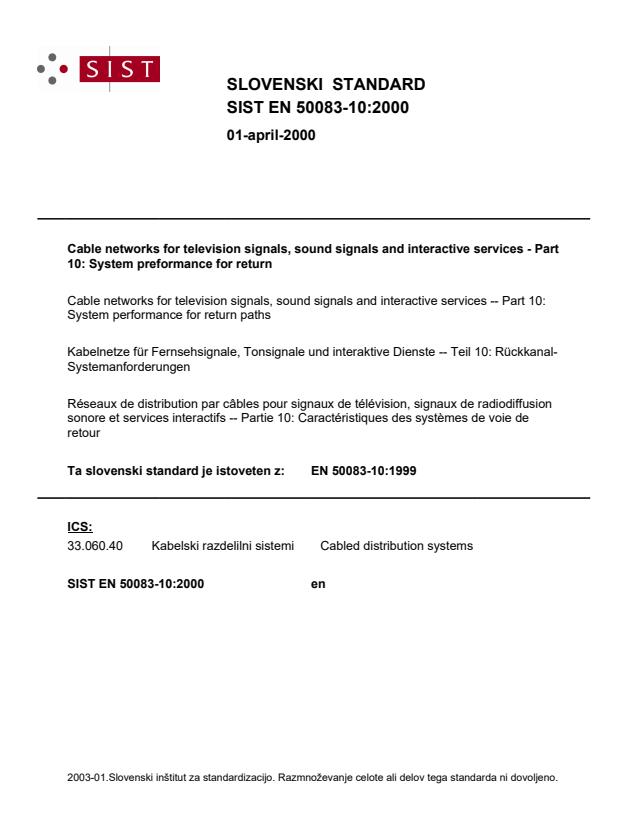
SLOVENSKI STANDARD
01-april-2000
Cable networks for television signals, sound signals and interactive services - Part
10: System preformance for return
Cable networks for television signals, sound signals and interactive services -- Part 10:
System performance for return paths
Kabelnetze für Fernsehsignale, Tonsignale und interaktive Dienste -- Teil 10: Rückkanal-
Systemanforderungen
Réseaux de distribution par câbles pour signaux de télévision, signaux de radiodiffusion
sonore et services interactifs -- Partie 10: Caractéristiques des systèmes de voie de
retour
Ta slovenski standard je istoveten z: EN 50083-10:1999
ICS:
33.060.40 Kabelski razdelilni sistemi Cabled distribution systems
2003-01.Slovenski inštitut za standardizacijo. Razmnoževanje celote ali delov tega standarda ni dovoljeno.
SI
...