

HD 381 S1:1979
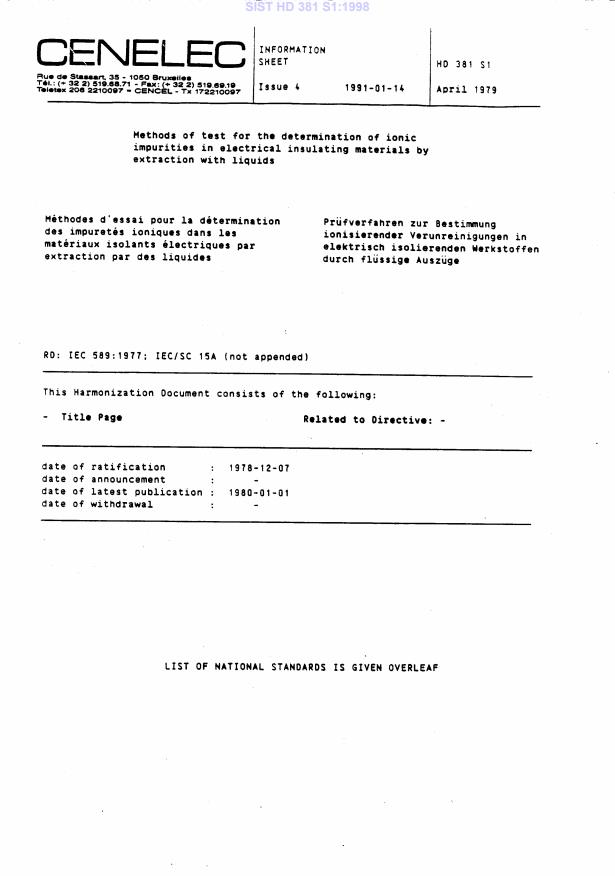
(Main)Methods of test for the determination of ionic impurities in electrical insulating materials by extraction with liquids
General Information
- Abstract
Applies to the determination of whether or not ionizable soluble organic and inorganic materials are present by measuring the increase in volume conductivity of a liquid extract.
- Status
- Published
- Publication Date
- 23-Apr-1979
- Withdrawal Date
- 23-Oct-1979
- Technical Committee
- CLC/SR 15 - Insulating materials
- Drafting Committee
- IEC/TC 15 - IEC_TC_15
- Parallel Committee
- IEC/SC 15C - IEC_SC_15C
- Current Stage
- 6060 - Document made available - Publishing
- Start Date
- 24-Apr-1979
- Completion Date
- 24-Apr-1979

Overview
HD 381 S1:1979, adopted by the Comité Européen de Normalisation (CLC), specifies internationally recognized methods for determining ionic impurities in electrical insulating materials via liquid extraction techniques. This standard is crucial for identifying the presence of ionizable soluble organic and inorganic substances that can affect the performance and reliability of insulating materials used in electrical applications.
The test confirms ionic contamination by measuring the increase in volume conductivity of a liquid extract taken from the insulating material. It is particularly relevant for materials intended to be immersed in coolants or impregnating agents, where ionic impurities can compromise dielectric properties.
Key Topics
- Purpose: To detect ionizable soluble contaminants in electrical insulating materials.
- Scope: Applies to both organic and inorganic ionizable impurities extractable by liquids.
- Test Principle: Measure volume conductivity change in the extraction liquid after contact with the sample.
Test Liquids and Extract Preparations
Aqueous Extracts:
- Use test water with a volume conductivity ≤ 2 × 10⁻⁴ S·m⁻¹ and pH 6.8-7.2.
- Test specimens (approx. 5 g) are boiled with 100 ml of test water for 60 ± 5 minutes under reflux.
- Carbon dioxide exposure is controlled to prevent conductivity variations.
Organic Extracts:
- Typically use purified trichloroethylene of low conductivity (~1 × 10⁻⁹ S·m⁻¹).
- Samples are pre-heated to remove moisture, then extracted by reflux boiling for 60 ± 5 minutes in the dark to avoid solvent degradation.
- Precautions are required due to solvent toxicity and sensitivity to light.
Measurement and Calculation
- Conductivity is measured using cells with known cell constants and precision resistance measuring instruments.
- The volume conductivity (S·m⁻¹) of the extract is calculated by comparing the resistance of the extract solution and the blank control.
- Conductivity measurements are typically performed at 23 ± 1 °C.
- Standard KCl solutions of known concentration are used to determine the cell constant for accurate conductivity measurement.
Apparatus and Electrode Preparation
- Use acid- and alkali-resistant glass Erlenmeyer flasks with reflux condensers.
- Conductivity cells with platinized platinum electrodes ensure reliable measurement.
- Procedures for electrode platinization and maintenance are specified to maintain measurement accuracy.
Applications
- Quality Control: Ensures electrical insulating materials meet impurity limits critical for dielectric performance.
- Material Qualification: Validates materials intended for use in coolant or impregnating fluids to avoid degradation caused by ionic contaminants.
- Research and Development: Enables development of new insulating materials with controlled impurity profiles.
- Electrical Equipment Manufacturing: Helps prevent insulation failures in transformers, capacitors, and electric motors by confirming material purity.
- Regulatory Compliance: Assists manufacturers in meeting national and international requirements for electrical insulation standards.
Related Standards
- IEC 60589:1977: The original international standard aligned with HD 381 S1:1979 for ionic impurity determination via liquid extraction.
- ISO standards on insulating materials: Various ISO standards correlate for broader environmental testing and chemical resistance.
- Testing standards for electrical insulating liquids: Standards covering the purity testing of coolant and impregnant liquids complement this material testing methodology.
- Standards for electrical insulation properties: Such as IEC 60243 series for electrical strength, which may be impacted by ionic contamination.
Keywords: ionic impurities, electrical insulating materials, liquid extraction, volume conductivity, trichloroethylene extraction, aqueous extract, electrical insulation testing, conductivity measurement, ionic contamination detection, IEC 60589, HD 381 S1:1979, electrical material quality control.
Relations
- Referred By
EN 60674-2:2017 - Specification for plastic films for electrical purposes - Part 2: Methods of test - Effective Date
- 03-Feb-2026
- Effective Date
- 03-Feb-2026
- Effective Date
- 03-Feb-2026
- Effective Date
- 03-Feb-2026
- Effective Date
- 03-Feb-2026
- Effective Date
- 03-Feb-2026
- Effective Date
- 03-Feb-2026
- Effective Date
- 03-Feb-2026
- Referred By
EN 60674-2:1998 - Specification for plastic films for electrical purposes - Part 2: Methods of test - Effective Date
- 03-Feb-2026
- Effective Date
- 03-Feb-2026
Get Certified
Connect with accredited certification bodies for this standard

IMQ S.p.A. (Certification)
Italian electrical product certification.

SLG Prüf- und Zertifizierungs GmbH
German testing and certification body.

UL Solutions
Global safety science company with testing, inspection and certification.
Sponsored listings
Frequently Asked Questions
HD 381 S1:1979 is a standardization document published by CLC. Its full title is "Methods of test for the determination of ionic impurities in electrical insulating materials by extraction with liquids". This standard covers: Applies to the determination of whether or not ionizable soluble organic and inorganic materials are present by measuring the increase in volume conductivity of a liquid extract.
Applies to the determination of whether or not ionizable soluble organic and inorganic materials are present by measuring the increase in volume conductivity of a liquid extract.
HD 381 S1:1979 is classified under the following ICS (International Classification for Standards) categories: 17.220.99 - Other standards related to electricity and magnetism; 29.035.01 - Insulating materials in general. The ICS classification helps identify the subject area and facilitates finding related standards.
HD 381 S1:1979 has the following relationships with other standards: It is inter standard links to EN 60674-2:2017, EN 60684-2:2011, EN 60684-2:1997, EN 60454-2:2007, EN 60371-3-2:1995, EN 60112:2003, EN IEC 60684-2:2025, EN 60371-3-2:2006, EN 60674-2:1998, EN 60454-2:1995. Understanding these relationships helps ensure you are using the most current and applicable version of the standard.
HD 381 S1:1979 is available in PDF format for immediate download after purchase. The document can be added to your cart and obtained through the secure checkout process. Digital delivery ensures instant access to the complete standard document.
Standards Content (Sample)
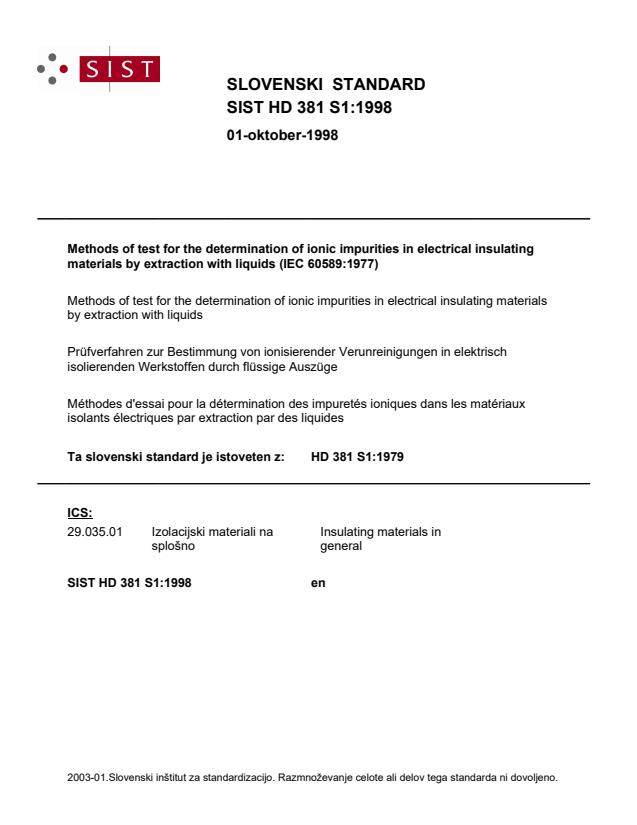
SLOVENSKI STANDARD
01-oktober-1998
Methods of test for the determination of ionic impurities in electrical insulating
materials by extraction with liquids (IEC 60589:1977)
Methods of test for the determination of ionic impurities in electrical insulating materials
by extraction with liquids
Prüfverfahren zur Bestimmung von ionisierender Verunreinigungen in elektrisch
isolierenden Werkstoffen durch flüssige Auszüge
Méthodes d'essai pour la détermination des impuretés ioniques dans les matériaux
isolants électriques par extraction par des liquides
Ta slovenski standard je istoveten z: HD 381 S1:1979
ICS:
29.035.01 Izolacijski materiali na Insulating materials in
splošno general
2003-01.Slovenski inštitut za standardizacijo. Razmnoževanje celote ali delov tega standarda ni dovoljeno.
NORME CEI
INTERNATIONALE IEC
INTERNATIONAL
Première édition
STAN DARD
First edition
1977-01
Méthodes d'essai pour la détermination des
impuretés ioniques dans les matériaux isolants
électriques par extraction par des liquides
Methods of test for the determination of ionic
impurities in electrical insulating materials
by extraction with liquids
© IEC 1977 Droits de reproduction réservés — Copyright - all rights reserved
Aucune partie de cette publication ne peut être reproduite ni No part of this publication may be reproduced or utilized in
sous
utilisée quelque forme que ce soit et par aucun any form or by any means, electronic or mechanical,
procédé, électronique ou mécanique, y compris la photo- including photocopying and microfilm, without permission in
copie et les microfilms, sans l'accord écrit de l'éditeur. writing from the publisher.
International Electrotechnical Commission 3, rue de Varembé Geneva, Switzerland
Telefax: +41 22 919 0300 e-mail: inmail@iec.ch IEC web site http: //www.iec.ch
CODE PRIX
Commission Electrotechnique Internationale
G
PRICE CODE
International Electrotechnical Commission
IEC Men ayHapoAHaR 3neKTpoTexHwiecKaR HOMHCCHA
Pour prix, voir catalogue en vigueur
• • For price, see current catalogue
Publication 589 de la CEI
IEC Publication 589
(Premiere édition - 1977)
(First edition - 1977)
Méthodes d'essai pour la détermination des impu-
Methods of test for the determination of ionic
retés ioniques dans les matériaux isolants élec-
impurities in electrical insulating materials by
triques par extraction par des liquides
extraction with liquids
CORRIGENDUM 1
Page 12
ANNEXE B — SOLUTIONS NORMALISÉES DE KC1
Quatrième paragraphe, au lieu de:
La conductivité des solutions normalisées à 23 °C est égale à:
solution 0,1 N
Ykci = 1,16 S•m1
solution 0,01 N
0,135 S•m1
Ykci =
solution 0,001 N 0,014
S m1
Ykci =
lire:
La conductivité des solutions normalisées à 23 °C est égale à:
solution 0,1 N
1,24
Ykci =
S•m-1
solution 0,01 N 0,136 S•m1
YxCl =
solution 0,001 N
Ykci = 0,0141 S•m1
Page 13
APPENDIX B — KC1 STANDARD SOLUTIONS
Fourth paragraph, instead of:
The conductivity of the standard solution at 23 °C is for:
S•m-1
0.1 N Ykci = 1.1'6
0.01 N 0.135
S•mi
Ykci =
0.001 N 0.014
Ykci =
read:
The conductivity of the standard solution at 23
•C is for:
0.1 N 1.24
=
YIiCi
0.01 N
= 0.136 S•ln i
YiiCi
0.001 N
0.0141 S•m1
Ykci =
Juin i978 June i978
— 3 —
INTERNATIONAL ELECTROTECHNICAL COMMISSION
METHODS OF TEST
FOR THE DETERMINATION OF IONIC IMPURITIES
IN ELECTRICAL INSULATING MATERIALS BY EXTRACTION
WITH LIQUIDS
FOREWORD
1) The formal decisions or agreements of the I EC on technical matters, prepared by Technical Committees on which all the
National Committees having a special interest therein are represented, express, as nearly as possible, an international
consensus of opinion on the subjects dealt with.
2)
They have the form of recommendations for international use and they are accepted by the National Committees in that
sense.
3) In order to promote international unification, the I E C expresses the wish that all National Committees should adopt
the text of the I EC recommendation for their national rules in so far as national conditions will permit. Any divergence
between the I EC recommendation and the corresponding national rules should, as far as possible, be clearly indicated
in the latter.
PREFACE
This standard has been prepared by Sub-Committee 15A, Short-time Tests, of I E C Technical Coin-
mittee No. 15, Insulating Materials.
A first draft was discussed at the meeting held in Bucharest in 1974. As a result of this meeting, a draft,
Document 15A(Central Office)31, was submitted to the National Committees for app royal under the
Six Months' Rule in August 1976.
The following countries voted explicitly in favour of publication:
Austria Japan
Belgium Norway
Canada Portugal
Czechoslovakia Turkey
Denmark Union of Soviet
Egypt
Socialist Republics
France
United Kingdom
Germany
United States of America
5—
METHODS OF TEST FOR THE DETERMINATION OF IONIC IMPURITIES
IN ELECTRICAL INSULATING MATERIALS BY EXTRACTION
WITH LIQUIDS
1. Scope and object
The purpose of this standard is to determine whether or not ionizable soluble organic and/or
inorganic materials are present in electrical insulating materials. Their presence is confirmed by
the increase in volume conductivity of the liquid extract and the test is considered to have particular
significance when applied to electrical insulating materials which are to be immersed in coolants
or impregnants.
2. Definitions and units
The volume conductivity of a liquid extract
is the difference between the volume conductivity
yex
of the extract solution and the volume conductivity of the control sample (blank sample). The
SI
unit of the volume conductivity is S m- 1. In practice, the unit S cm-
is often used.
3.
Apparatus
—
250 ml conical flasks (Erlenmeyer) with reflux condensers having acid resistant and alkali resis-
tant glass;
— conductivity cell with known cell constant (m-1
k ) or (cm-1);
—
a bridge or other measuring device capable of measuring resistances with an accuracy of 5%.
In the case of aqueous extracts, this measuring device shall permit the measurement of resistances
up to 1 MS2 at frequencies between 50 Hz and 3 000 Hz.
In the case of organic extracts, the measuring device shall permit the measurement of resistances
up to 1 TS2 using not more than 100 V. d.c.
Note. —
If unknown, the cell constant k is determined by means of a standard KC1 solution of known conductivity,
in accordance with Appendix B.
4. Procedure
4.1 Aqueous extract
4.1.1 Test water
The quality of the test water has a considerable influence on the result of the test. The volume
conductivity of the test water preparing the aqueous extracts shall be (2 . 10-4 S m- 1. The pH
value of the test water shall be between 6.8 and 7.2.
— 7 —
The test water can be made by means of an ion-exchanger or by using double distilled water
of the recommended pH value.
Note. — Attention is drawn to the effect of carbon dioxide. The pH of newly prepared water will change to between
5.7 and 5.9 after the water has been exposed to air for a short time. If the change due to carbon dioxide
has produced a pH of not less than 6.4, the water can be restored to pH = 7 by blowing pure nitrogen
thr
...