


FprEN IEC 62933-5-2:2025
(Main)Electrical energy storage (EES) systems - Part 5-2: Safety requirements for grid-integrated EES systems - Electrochemical-based systems
Electrical energy storage (EES) systems - Part 5-2: Safety requirements for grid-integrated EES systems - Electrochemical-based systems
IEC 62933-5-2:2025 primarily describes safety aspects for people and, where appropriate, safety matters related to the surroundings and living beings for grid-connected energy storage systems where an electrochemical storage subsystem is used. This document is applicable to the entire life cycle of BESS (from design to end of service life management). This document provides further safety provisions that arise due to the use of an electrochemical storage subsystem (e.g. battery system) in EES systems that are beyond the general safety considerations described in IEC 62933-5-1. This document specifies the safety requirements of an "electrochemical" energy storage system as a "system" to reduce the risk of harm or damage caused by the hazards of an electrochemical energy storage system due to interactions between the subsystems as presently understood.
Elektrische Energiespeichersysteme (EES-Systeme) - Teil 5-2: Sicherheitsanforderungen an netzintegrierte EES-Systeme - Elektrochemische Systeme
Systèmes de stockage de l'énergie électrique (EES) - Partie 5-2: Exigences de sécurité pour les systèmes EES intégrés dans un réseau - Systèmes électrochimiques
L’IEC 62933-5-2:2025 traite principalement des aspects liés à la sécurité des personnes et, le cas échéant, les questions de sécurité associées à l’environnement et aux êtres vivants pour les systèmes de stockage de l’énergie raccordés à un réseau qui utilisent un sous-système électrochimique de stockage. Le présent document est applicable au cycle de vie complet des BESS (de la conception à la gestion de la fin de durée de vie en service). Le présent document prévoit d’autres dispositions de sécurité résultant de l’utilisation d’un sous-système électrochimique de stockage (système de batteries, par exemple) dans les systèmes ESS qui ne relèvent pas des considérations générales de sécurité décrites dans l’IEC 62933-5-1. Le présent document spécifie les exigences de sécurité d’un système "électrochimique" de stockage de l’énergie en tant que "système" afin de réduire le risque de préjudice ou de dommage dû aux phénomènes dangereux associés à un système électrochimique de stockage de l’énergie et dus aux interactions entre les sous-systèmes telles qu’elles sont actuellement appréhendées.
Električne naprave za shranjevanje energije (EES) - 5-2. del: Varnostne zahteve za sisteme EES, integrirane v omrežje - Elektrokemični sistemi
General Information
- Status
- Not Published
- Publication Date
- 31-Aug-2025
- Technical Committee
- CLC/SR 120 - Electrical Energy Storage (EES) Systems
- Drafting Committee
- IEC/TC 120 - Electrical Energy Storage (EES) Systems
- Current Stage
- 5098 - Decision to drop project - Standstill maintained / released - Formal Approval
- Start Date
- 20-Jun-2025
- Completion Date
- 20-Feb-2026
Relations
- Effective Date
- 26-Jul-2022
Overview
FprEN IEC 62933-5-2:2025 is an international standard developed by CLC focusing on safety requirements for grid-integrated electrical energy storage (EES) systems that utilize electrochemical-based storage technologies, such as battery energy storage systems (BESS). This standard addresses safety considerations for people, surroundings, and living beings throughout the entire life cycle of these systems-from design to end-of-service life management.
The document is a specialized extension of IEC 62933-5-1, elaborating safety provisions unique to electrochemical storage subsystems. It provides comprehensive guidelines to mitigate risks arising from hazards related to electrical, mechanical, thermal, chemical, fire, explosion, and electromagnetic phenomena, as well as malfunction of control systems in grid-integrated electrochemical energy storage solutions.
Key Topics
Scope and Lifecycle Safety
Applies to grid-connected electrochemical energy storage systems, covering design, installation, operation, maintenance, and decommissioning to ensure ongoing safety.Risk Assessment and Hazard Identification
Includes systematic risk management for hazards such as electrical shock, fire, explosion, chemical leakage, thermal risks, and electromagnetic interference associated with battery storage subsystems.Safety Measures and Protective Design
Emphasis on inherently safe system design, incorporating:- Overcurrent protection
- Fire mitigation strategies
- Mechanical guards and enclosures
- Thermal and chemical hazard management
- Safeguards against electromagnetic hazards
- Emergency disconnection and shutdown procedures
Operational Safety and Maintenance
Guidelines on staff training, preventive maintenance, lifecycle safety management, and handling changes in ownership or system configuration.System Validation and Testing
Specifies validation methods and test procedures to verify protective measures for various hazards, including environment-specific tests such as moisture exposure and marine conditions.Informative Annexes
Detailed supplementary information covering:- Ownership models
- Hazard and risk breakdowns by battery technology (lithium-ion, lead-acid, nickel, flow batteries, etc.)
- Fire testing protocols
- Test methodologies for auxiliary and control systems
- Risk analysis procedures and access requirements
Applications
FprEN IEC 62933-5-2:2025 is essential for stakeholders involved in the design, manufacture, installation, and operation of grid-connected electrochemical energy storage systems, including:
- Renewable energy projects integrating battery energy storage
- Utility-scale grid stabilization and load management
- Industrial and commercial energy storage solutions
- Safety compliance and risk management for energy storage installations
- Component suppliers and system integrators focusing on electrochemical batteries
- Regulatory bodies and certification organizations ensuring adherence to international safety standards
By adopting this standard, organizations can significantly reduce hazards associated with electrochemical EES systems, promoting public safety and environmental protection while improving reliability and system performance.
Related Standards
- IEC 62933-5-1 - General safety requirements for grid-integrated energy storage systems
- IEC TC 120 Series - Technical committee standards on electrical energy storage systems
- IEC 61851 - Electric vehicle conductive charging systems (relevant for battery interfaces)
- ISO 45001 - Occupational health and safety management systems (complementing operational safety)
- IEC 61000 Series - Electromagnetic compatibility (EMC) standards relevant for EES system integration
- National and regional standards such as UL, NFPA, and CENELEC regulations addressing battery hazards and fire safety
Adhering to FprEN IEC 62933-5-2:2025 empowers the safe deployment of advanced electrochemical energy storage technologies in grid applications, fostering innovation while safeguarding people and environments. This standard is a key resource for engineering best practices and regulatory compliance in the evolving energy storage landscape.

Get Certified
Connect with accredited certification bodies for this standard

BSI Group
BSI (British Standards Institution) is the business standards company that helps organizations make excellence a habit.

Bureau Veritas
Bureau Veritas is a world leader in laboratory testing, inspection and certification services.

DNV
DNV is an independent assurance and risk management provider.
Sponsored listings
Frequently Asked Questions
FprEN IEC 62933-5-2:2025 is a draft published by CLC. Its full title is "Electrical energy storage (EES) systems - Part 5-2: Safety requirements for grid-integrated EES systems - Electrochemical-based systems". This standard covers: IEC 62933-5-2:2025 primarily describes safety aspects for people and, where appropriate, safety matters related to the surroundings and living beings for grid-connected energy storage systems where an electrochemical storage subsystem is used. This document is applicable to the entire life cycle of BESS (from design to end of service life management). This document provides further safety provisions that arise due to the use of an electrochemical storage subsystem (e.g. battery system) in EES systems that are beyond the general safety considerations described in IEC 62933-5-1. This document specifies the safety requirements of an "electrochemical" energy storage system as a "system" to reduce the risk of harm or damage caused by the hazards of an electrochemical energy storage system due to interactions between the subsystems as presently understood.
IEC 62933-5-2:2025 primarily describes safety aspects for people and, where appropriate, safety matters related to the surroundings and living beings for grid-connected energy storage systems where an electrochemical storage subsystem is used. This document is applicable to the entire life cycle of BESS (from design to end of service life management). This document provides further safety provisions that arise due to the use of an electrochemical storage subsystem (e.g. battery system) in EES systems that are beyond the general safety considerations described in IEC 62933-5-1. This document specifies the safety requirements of an "electrochemical" energy storage system as a "system" to reduce the risk of harm or damage caused by the hazards of an electrochemical energy storage system due to interactions between the subsystems as presently understood.
FprEN IEC 62933-5-2:2025 is classified under the following ICS (International Classification for Standards) categories: 13.020.30 - Environmental impact assessment. The ICS classification helps identify the subject area and facilitates finding related standards.
FprEN IEC 62933-5-2:2025 has the following relationships with other standards: It is inter standard links to EN IEC 62933-5-2:2020. Understanding these relationships helps ensure you are using the most current and applicable version of the standard.
FprEN IEC 62933-5-2:2025 is available in PDF format for immediate download after purchase. The document can be added to your cart and obtained through the secure checkout process. Digital delivery ensures instant access to the complete standard document.
Standards Content (Sample)
SLOVENSKI STANDARD
oSIST prEN IEC 62933-5-2:2024
01-maj-2024
Električne naprave za shranjevanje energije (EES) - 5-2. del: Varnostne zahteve za
sisteme EES, integrirane v omrežje - Elektrokemični sistemi
Electrical energy storage (EES) systems - Part 5-2: Safety requirements for grid-
integrated EES systems - Electrochemical-based systems
Elektrische Energiespeichersysteme (EES-Systeme) - Teil 5-2:
Sicherheitsanforderungen an netzintegrierte EES-Systeme - Elektrochemische Systeme
Systèmes de stockage de l'énergie électrique (EES) - Partie 5-2: Exigences de sécurité
pour les systèmes EES intégrés dans un réseau - Systèmes électrochimiques
Ta slovenski standard je istoveten z: prEN IEC 62933-5-2:2024
ICS:
27.010 Prenos energije in toplote na Energy and heat transfer
splošno engineering in general
oSIST prEN IEC 62933-5-2:2024 en
2003-01.Slovenski inštitut za standardizacijo. Razmnoževanje celote ali delov tega standarda ni dovoljeno.
oSIST prEN IEC 62933-5-2:2024
oSIST prEN IEC 62933-5-2:2024
120/353/CDV
COMMITTEE DRAFT FOR VOTE (CDV)
PROJECT NUMBER:
IEC 62933-5-2 ED2
DATE OF CIRCULATION: CLOSING DATE FOR VOTING:
2024-03-15 2024-06-07
SUPERSEDES DOCUMENTS:
120/326/CD, 120/348/CC
IEC TC 120 : ELECTRICAL ENERGY STORAGE (EES) SYSTEMS
SECRETARIAT: SECRETARY:
Japan Mr Masatake SAKUMA
OF INTEREST TO THE FOLLOWING COMMITTEES: PROPOSED HORIZONTAL STANDARD:
TC 8,TC 21,SC 21A,TC 22,SC 22E,TC 57,TC
64,TC 69,TC 82,TC 88,TC 105,CISPR
Other TC/SCs are requested to indicate their interest, if
any, in this CDV to the secretary.
FUNCTIONS CONCERNED:
EMC ENVIRONMENT QUALITY ASSURANCE SAFETY
SUBMITTED FOR CENELEC PARALLEL VOTING NOT SUBMITTED FOR CENELEC PARALLEL VOTING
Attention IEC-CENELEC parallel voting
The attention of IEC National Committees, members of
CENELEC, is drawn to the fact that this Committee Draft
for Vote (CDV) is submitted for parallel voting.
The CENELEC members are invited to vote through the
CENELEC online voting system.
This document is still under study and subject to change. It should not be used for reference purposes.
Recipients of this document are invited to submit, with their comments, notification of any relevant patent rights of
which they are aware and to provide supporting documentation.
Recipients of this document are invited to submit, with their comments, notification of any relevant “In Some
Countries” clauses to be included should this proposal proceed. Recipients are reminded that the CDV stage is
the final stage for submitting ISC clauses. (SEE AC/22/2007 OR NEW GUIDANCE DOC).
TITLE:
Electrical energy storage (EES) systems - Part 5-2: Safety requirements for grid-integrated EES
systems - Electrochemical-based systems
PROPOSED STABILITY DATE: 2029
NOTE FROM TC/SC OFFICERS:
This CDV reflects the observations made in 120/348/CC.
download this electronic file, to make a copy and to print out the content for the sole purpose of preparing National
Committee positions. You may not copy or "mirror" the file or printed version of the document, or any part of it,
for any other purpose without permission in writing from IEC.
oSIST prEN IEC 62933-5-2:2024
IEC CDV 62933-5-2 © IEC 2024 2 120/353/CDV
1 CONTENTS
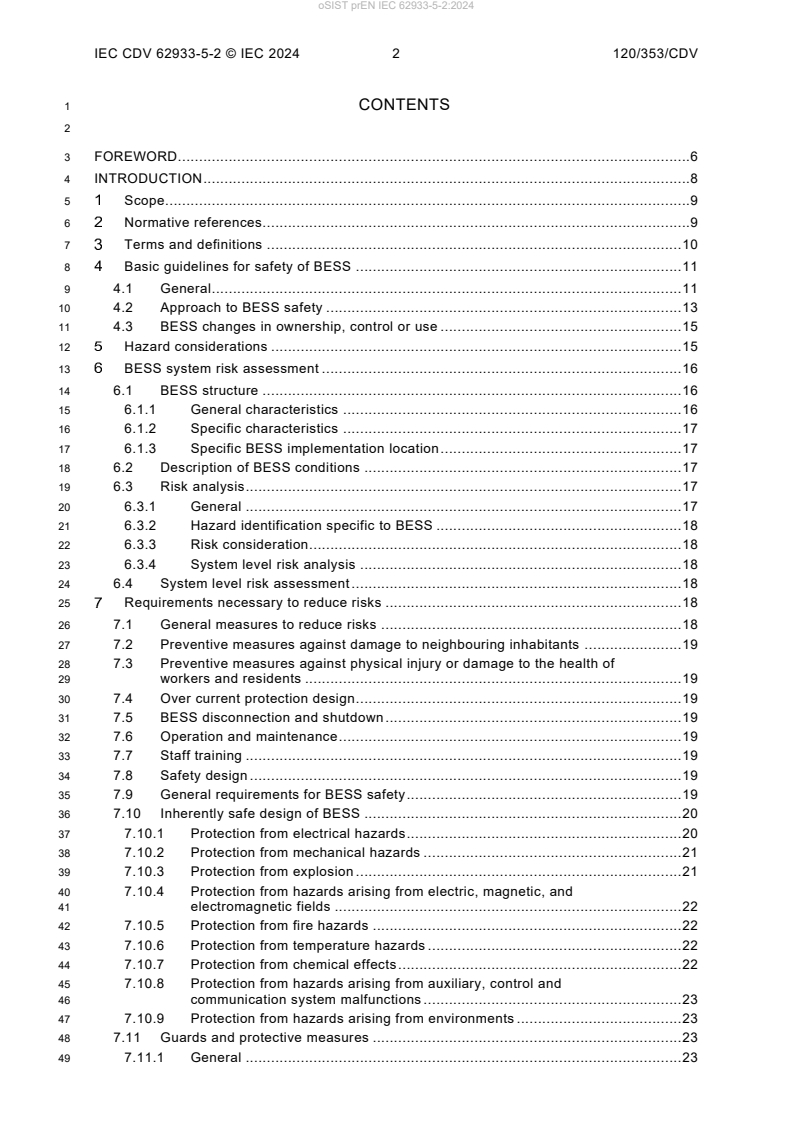
3 FOREWORD . 6
4 INTRODUCTION . 8
5 Scope . 9
6 Normative references. 9
7 Terms and definitions . 10
8 Basic guidelines for safety of BESS . 11
9 4.1 General . 11
10 4.2 Approach to BESS safety . 13
11 4.3 BESS changes in ownership, control or use . 15
12 Hazard considerations . 15
13 BESS system risk assessment . 16
14 6.1 BESS structure . 16
15 6.1.1 General characteristics . 16
16 6.1.2 Specific characteristics . 17
17 6.1.3 Specific BESS implementation location . 17
18 6.2 Description of BESS conditions . 17
19 6.3 Risk analysis . 17
20 6.3.1 General . 17
21 6.3.2 Hazard identification specific to BESS . 18
22 6.3.3 Risk consideration . 18
23 6.3.4 System level risk analysis . 18
24 6.4 System level risk assessment . 18
25 Requirements necessary to reduce risks . 18
26 7.1 General measures to reduce risks . 18
27 7.2 Preventive measures against damage to neighbouring inhabitants . 19
28 7.3 Preventive measures against physical injury or damage to the health of
29 workers and residents . 19
30 7.4 Over current protection design . 19
31 7.5 BESS disconnection and shutdown . 19
32 7.6 Operation and maintenance . 19
33 7.7 Staff training . 19
34 7.8 Safety design . 19
35 7.9 General requirements for BESS safety . 19
36 7.10 Inherently safe design of BESS . 20
37 7.10.1 Protection from electrical hazards . 20
38 7.10.2 Protection from mechanical hazards . 21
39 7.10.3 Protection from explosion . 21
40 7.10.4 Protection from hazards arising from electric, magnetic, and
41 electromagnetic fields . 22
42 7.10.5 Protection from fire hazards . 22
43 7.10.6 Protection from temperature hazards . 22
44 7.10.7 Protection from chemical effects . 22
45 7.10.8 Protection from hazards arising from auxiliary, control and
46 communication system malfunctions . 23
47 7.10.9 Protection from hazards arising from environments . 23
48 7.11 Guards and protective measures . 23
49 7.11.1 General . 23
oSIST prEN IEC 62933-5-2:2024
IEC CDV 62933-5-2 © IEC 2024 3 120/353/CDV
50 7.11.2 BESS disconnection and shutdown . 24
51 7.11.3 Other guards and protective functions of BESS . 25
52 7.12 Information for end users . 29
53 7.13 Life cycle safety management . 30
54 7.13.1 Operation and maintenance . 30
55 7.13.2 Partial system change . 33
56 7.13.3 Design revision . 33
57 7.13.4 End of service life management . 33
58 7.13.5 Measures for validating life cycle safety management . 33
59 System validation and testing . 33
60 8.1 General . 33
61 8.2 Validation and testing of BESS . 37
62 8.2.1 Electrical hazards . 37
63 8.2.2 Mechanical hazards . 42
64 8.2.3 Explosion . 42
65 8.2.4 Hazards arising from electric, magnetic, and electromagnetic fields . 45
66 8.2.5 Fire hazards (propagation) . 45
67 8.2.6 Temperature hazards . 46
68 8.2.7 Chemical effects . 48
69 8.2.8 Hazards arising from auxiliary, control and communication system
70 malfunctions . 48
71 8.2.9 Hazards arising from environments . 48
72 8.2.10 IP rating of BESS enclosure and protective guards . 49
73 Guidelines and manuals . 49
74 Annex A (informative) Ownership models of BESS . 50
75 Annex B (informative) BESS hazards and risks . 51
76 B.1 General introduction . 51
77 B.2 Hazards to be addressed . 57
78 B.2.1 General . 57
79 B.2.2 Fire hazards. 57
80 B.2.3 Chemical hazards . 57
81 B.2.4 Electrical hazards . 57
82 B.2.5 Stored electrical energy hazards . 57
83 B.2.6 Physical hazards . 58
84 B.2.7 High-pressure hazards . 58
85 B.3 Hazard considerations under normal operating conditions . 58
86 B.3.1 Fire and explosive hazards . 58
87 B.3.2 Chemical hazards . 58
88 B.3.3 Electrical hazards . 59
89 B.3.4 Physical hazards . 59
90 B.4 Hazard considerations under emergency/abnormal conditions . 59
91 B.4.1 Fire hazards. 59
92 B.4.2 Chemical hazards . 60
93 B.4.3 Electrical hazards . 61
94 B.4.4 Physical hazards . 61
95 B.5 Commercially available battery technologies . 61
96 B.5.1 Lithium ion (Li-ion) batteries (C-A) . 61
97 B.5.2 Lead-acid batteries (C-B) . 62
98 B.5.3 Nickel batteries (C-B) . 63
99 B.5.4 High-temperature sodium batteries (C-C) . 65
oSIST prEN IEC 62933-5-2:2024
IEC CDV 62933-5-2 © IEC 2024 4 120/353/CDV
100 B.5.5 Flow batteries (C-D) . 66
101 B.5.6 Lithium metal solid state batteries (C-Z) . 68
102 B.6 Other technologies . 68
103 Annex C (informative) Large scale fire testing on BESS . 69
104 Annex D (informative) Test methods for protection from hazards arising from
105 environments . 70
106 D.1 General . 70
107 D.2 Outdoor installations subject to moisture exposure . 70
108 D.3 Outdoor installation near marine environments . 70
109 Annex E (informative) Information required for BESS life cycle safety management . 71
110 E.1 Overview. 71
111 E.2 General introduction . 71
112 E.3 Operation and maintenance process . 71
113 E.4 Preventive maintenance . 71
114 E.5 Measuring and monitoring of system soundness . 72
115 E.6 Staff training . 72
116 E.7 Partial system change . 72
117 E.8 Design revision . 72
118 Annex F (informative) BESS safety signage . 73
119 Annex G (informative) Example of testing for verification of thermal control operation . 74
120 Annex H (informative) Examples of test procedures and methods that can be
121 applicable to BESS . 75
122 H.1 Overview. 75
123 H.2 Examples of testing procedures . 75
124 H.2.1 Electrical hazards test procedure and test method in subclause 8.2.1. 75
125 H.2.2 Mechanical hazards test procedures and test methods in subclause
126 8.2.2 . 82
127 H.2.3 Explosion hazards test procedure and test method in subclause 8.2.3 . 86
128 H.2.4 Hazards arising from electric, magnetic, and electromagnetic fields test
129 procedure and test method in subclause 8.2.4 . 89
130 H.2.5 Fire hazards test procedure and test method in subclause 8.2.5 . 91
131 H.2.6 Temperature hazards test procedure and test method in subclause
132 8.2.6 . 91
133 H.2.7 Explosion hazards test procedure and test method in subclause 8.2.7 . 93
134 H.2.8 Hazards arising from auxiliary, control and communication system
135 malfunctions test procedure and test method in subclause 8.2.8 . 94
136 H.2.9 Hazards arising from environments test procedure and test method in
137 subclause 8.2.9 . 95
138 H.2.10 IP rating of BESS enclosure and protective guards test procedure and
139 test method in subclause 8.2.10 . 97
140 Annex I (informative) Risk analysis . 98
141 I.1 Methodology (example of method to perform a What-If Risk Analysis) . 98
142 Annex J (informative) Aisle and access requirements . 100
143 J.1 Aisles and Access Areas . 100
144 Bibliography . 102
146 Figure 1 – General description for risk assessment and reduction of BESS . 12
147 Figure 2 – An example of BESS architecture . 16
148 Figure 3 – Example of isolated condition (whole isolation of BESS) . 25
oSIST prEN IEC 62933-5-2:2024
IEC CDV 62933-5-2 © IEC 2024 5 120/353/CDV
149 Figure 4 – Scheme for dielectric voltage test and Insulation resistance test .Error! Bookmark
150 not defined.
151 Figure H.1 – Impulse withstand voltage test points . 80
152 Figure H.2 – Dielectric test points. 81
153 Figure H.3 – Insulation resistance test points . 81
154 Figure H.4 – Impact test using a steel ball . 83
155 Figure H.5 – Test probe A . 84
156 Figure H.6 – Test probe B . 85
157 Figure H.7 – Gas release profile of an overheated NMC pouch cell 100% SOC . 86
158 Figure H.8– Diagram of the abuse chamber used for signal cell testing . 87
159 Figure H.9 – example on the gas sample emission position . 88
160 Figure H.10 – Circuit composition for communication error test . 95
162 Table 1 – BESS categories . 14
163 Table 2 – Examples of BESS application . 15
164 Table 3 – Examples of components within subsystems of a BESS . 17
165 Table 4 – Overviewed of validation and testing for BESS . 35
166 Table B.1 – Hazards of BESS in common . 53
167 Table B.2 – Hazards of BESS using non-aqueous electrolyte battery (category “C-A”) . 54
168 Table B.3 – Hazards of BESS using aqueous electrolyte battery (category “C-B”) . 55
169 Table B.4 – Hazards of BESS using high temperature battery (category “C-C”) . 56
170 Table B.5 – Hazards of BESS using flow battery (category “C-D”) . 57
171 Table H.1 – Composition of circuits for short-circuit test . 75
172 Table H.2 – Criteria for judgment of short-circuit test (secondary) . 76
173 Table H.3 – Composition of circuits for earth fault test . 78
174 Table H.4 – Rated impulse withstand voltage for equipment energized directly from
175 mains supply . 78
176 Table H.5 – Minimum values of insulation resistance . 81
177 Table H.6 – Limits for electromagnetic conductive radiation from DC voltage ports . 89
178 Table H.7 – Electromagnetic wave tolerance performance evaluation standards . 90
179 Table H.8 – IP rate of BESS installed locations. . 95
oSIST prEN IEC 62933-5-2:2024
IEC CDV 62933-5-2 © IEC 2024 6 120/353/CDV
183 INTERNATIONAL ELECTROTECHNICAL COMMISSION
184 ____________
186 ELECTRICAL ENERGY STORAGE (EES) SYSTEMS
188 Part 5-2: Safety requirements for grid-integrated EES systems
189 – Electrochemical-based systems
191 FOREWORD
192 1) The International Electrotechnical Commission (IEC) is a worldwide organization for standardization comprising
193 all national electrotechnical committees (IEC National Committees). The object of IEC is to promote international
194 co-operation on all questions concerning standardization in the electrical and electronic fields. To this end and
195 in addition to other activities, IEC publishes International Standards, Technical Specifications, Technical Reports,
196 Publicly Available Specifications (PAS) and Guides (hereafter referred to as “IEC Publication(s)”). Their
197 preparation is entrusted to technical committees; any IEC National Committee interested in the subject dealt with
198 may participate in this preparatory work. International, governmental and non-governmental organizations liaising
199 with the IEC also participate in this preparation. IEC collaborates closely with the International Organization for
200 Standardization (ISO) in accordance with conditions determined by agreement between the two organizations.
201 2) The formal decisions or agreements of IEC on technical matters express, as nearly as possible, an international
202 consensus of opinion on the relevant subjects since each technical committee has representation from all
203 interested IEC National Committees.
204 3) IEC Publications have the form of recommendations for international use and are accepted by IEC National
205 Committees in that sense. While all reasonable efforts are made to ensure that the technical content of IEC
206 Publications is accurate, IEC cannot be held responsible for the way in which they are used or for any
207 misinterpretation by any end user.
208 4) In order to promote international uniformity, IEC National Committees undertake to apply IEC Publications
209 transparently to the maximum extent possible in their national and regional publications. Any divergence between
210 any IEC Publication and the corresponding national or regional publication shall be clearly indicated in the latter.
211 5) IEC itself does not provide any attestation of conformity. Independent certification bodies provide conformity
212 assessment services and, in some areas, access to IEC marks of conformity. IEC is not responsible for any
213 services carried out by independent certification bodies.
214 6) All users should ensure that they have the latest edition of this publication.
215 7) No liability shall attach to IEC or its directors, employees, servants or agents including individual experts and
216 members of its technical committees and IEC National Committees for any personal injury, property damage or
217 other damage of any nature whatsoever, whether direct or indirect, or for costs (including legal fees) and
218 expenses arising out of the publication, use of, or reliance upon, this IEC Publication or any other IEC Publications.
219 8) Attention is drawn to the Normative references cited in this publication. Use of the referenced publications is
220 indispensable for the correct application of this publication.
221 9) Attention is drawn to the possibility that some of the elements of this IEC Publication may be the subject of patent
222 rights. IEC shall not be held responsible for identifying any or all such patent rights.
223 International Standard IEC 62933-5-2 has been prepared by IEC technical committee 120:
224 Electrical Energy Storage (EES) Systems.
225 This International Standard is to be used in conjunction with IEC 62933-5-1(Future):20xx.
226 The text of this International Standard is based on the following documents:
FDIS Report on voting
120/XX/FDIS 120/XX/RVD
228 Full information on the voting for the approval of this International Standard can be found in the
229 report on voting indicated in the above table.
230 This document has been drafted in accordance with the ISO/IEC Directives, Part 2.
231 A list of all parts in the IEC 62933 series, published under the general title Electrical energy
232 storage (EES) systems, can be found on the IEC website.
oSIST prEN IEC 62933-5-2:2024
IEC CDV 62933-5-2 © IEC 2024 7 120/353/CDV
233 The committee has decided that the contents of this document will remain unchanged until the
234 stability date indicated on the IEC website under "http://webstore.iec.ch" in the data related to
235 the specific document. At this date, the document will be
236 • reconfirmed,
237 • withdrawn,
238 • replaced by a revised edition, or
239 • amended.
IMPORTANT – The 'colour inside' logo on the cover page of this publication indicates
that it contains colours which are considered to be useful for the correct understanding
of its contents. Users should therefore print this document using a colour printer.
oSIST prEN IEC 62933-5-2:2024
IEC CDV 62933-5-2 © IEC 2024 8 120/353/CDV
243 INTRODUCTION
244 All the electrical energy storage systems (EESS) follow the general safety requirements as
245 described in IEC 62933-5-1(Future), which is based on a system approach. IEC 62933-5-2
246 follows the same structure as IEC 62933-5-1(Future) and provides additional requirements for
247 battery energy storage systems (BESS). The additional requirements are provided for the
248 following reasons:
249 BESS can be integrated into a significant range of electrical grids.
250 The level of safety requirements awareness can vary between utilities, system integrators,
251 operators and end-users.
252 Although the safety of individual subsystems is generally covered by international standards at
253 ISO and IEC levels, the safety matters that arise due the combination of electrochemical
254 accumulation subsystems and any electrical subsystems are not always considered. BESS are
255 complex at the systems level due to the variety of potential battery options and configurations,
256 including the combination of subsystems (e.g. control systems for electrochemical accumulation
257 subsystems, electrochemical accumulation subsystems, power conversion subsystems and
258 auxiliary subsystems). Compliance with standards and related material produced specifically
259 for the safety of subsystems cannot be sufficient to reach an acceptable level of safety for the
260 overall system.
261 BESS can have additional safety hazards, due, for example, to the presence of chemicals, the
262 emission of toxic gases, chemicals spilt around the electrochemical accumulation subsystems
263 and to events critical for safety from electrochemical accumulation subsystems that cause
264 safety issues for the entire BESS. They can cause loss of power at any part of the systems and
265 buildings that can result in additional threats to safety. From a systems perspective, these
266 individual hazards can have a system wide impact.
oSIST prEN IEC 62933-5-2:2024
IEC CDV 62933-5-2 © IEC 2024 9 120/353/CDV
268 ELECTRICAL ENERGY STORAGE (EES) SYSTEMS
270 Part 5-2: Safety requirements for grid integrated EES systems
271 – Electrochemical based systems
275 Scope
276 This part of IEC 62933 primarily describes safety aspects for people and, where appropriate,
277 safety matters related to the surroundings and living beings for grid-connected energy storage
278 systems where an electrochemical storage subsystem is used.
279 This safety standard is applicable to the entire life cycle of BESS (from design to end of service
280 life management).
281 This document provides further safety provisions that arise due to the use of an electrochemical
282 storage subsystem (e.g. battery system) in EES systems that are beyond the general safety
283 considerations described in IEC 62933-5-1(Future).
284 This document specifies the safety requirements of an “electrochemical” energy storage system
285 as a "system" to reduce the risk of harm or damage caused by the hazards of an electrochemical
286 energy storage system due to interactions between the subsystems as presently understood.
287 Normative references
288 The following documents are referred to in the text in such a way that some or all of their content
289 constitute requirements of this document. For dated references, only the edition cited applies.
290 For undated references, the latest edition of the referenced document (including any
291 amendments) applies.
292 ISO/IEC 31010, Risk management — Risk assessment techniques
293 IEC 60068-2-52, Environmental testing – Part 2-52: Tests – Test Kb: Salt mist, cyclic (sodium
294 chloride solution)
295 IEC 60079-7:2015, Explosive atmospheres – Part 7: Equipment protection by increased safety
296 "e"
297 IEC 60079-7:2015/AMD1:2017
298 IEC 60079-13, Explosive atmospheres – Part 13: Equipment protection by pressurized room "p"
299 and artificially ventilated room "v"
300 IEC 60079-29 (all parts), Explosive atmospheres – Gas detectors
301 IEC 60364-4-44, Low-voltage electrical installations – Part 4-44: Protection for safety –
302 Protection against voltage disturbances and electromagnetic disturbances
303 IEC 60364-6:2016, Low voltage electrical installations – Part 6: Verification
304 IEC 60529, Degrees of protection provided by enclosures (IP Code)
305 IEC 60664-1:2020, Insulation coordination for equipment within low-voltage systems – Part 1:
306 Principles, requirements and tests
307 IEC 60812, Failure modes and effects analysis (FMEA and FMECA)
308 IEC 61000-1-2, Electromagnetic compatibility (EMC) – Part 1-2: General – Methodology for the
309 achievement of functional safety of electrical and electronic systems including equipment with
310 regard to electromagnetic phenomena
oSIST prEN IEC 62933-5-2:2024
IEC CDV 62933-5-2 © IEC 2024 10 120/353/CDV
311 IEC 61000-6-7, Electromagnetic compatibility (EMC) – Part 6-7: Generic standards – Immunity
312 requirements for equipment intended to perform functions in a safety-related system (functional
313 safety) in industrial locations
314 IEC 61025, Fault tree analysis (FTA)
315 IEC 61660-1, Short-circuit currents in d.c. auxiliary installations in power plants and substations
316 – Part 1: Calculation of short-circuit currents
317 IEC 61660-2, Short-circuit currents in d.c. auxiliary installations in power plants and substations
318 – Part 2: Calculation of effects
319 IEC 61882, Hazard and operability studies (HAZOP studies) – Application guide
320 IEC 61936-1:2010, Power installations exceeding 1 kV a.c. – Part 1: Common rules
321 IEC 61936-1:2010/AMD1:2014
322 IEC 62305-2, Protection against lightning – Part 2: Risk management
323 IEC 62368-1, Audio/video, information and communication technology equipment - Part 1:
324 Safety requirements
325 IEC 62477-1:2022, Safety requirements for power electronic converter systems and equipment
326 – Part 1: General
327 IEC 62485-2, Safety requirements for secondary batteries and battery installations – Part 2:
328 Stationary batteries
329 IEC 62619:2022, Secondary cells and batteries containing alkaline or other non-acid
330 electrolytes – Safety requirements for secondary lithium cells and batteries, for use in industrial
331 applications
332 IEC 62933-1, Electrical energy storage (EES) systems – Part 1: Vocabulary
333 IEC 62933-5-1: (Future), Electrical Energy Storage (EES) systems – Part 5-1: Safety
334 considerations for grid integrated EES systems – General specification
335 IEC 62933-5-3, Electrical energy storage (EES) systems Part 5-3: Safety requirements for
336 electrochemical based EES systems considering initially non-anticipated modifications - partial
337 replacement, changing application, relocation and loading reused battery -
338 ISO/IEC Guide 51:2014, Safety aspects – Guidelines for their inclusion in standards
339 Terms and definitions
340 For the purposes of this document, the terms and definitions given in IEC 62933-1 and IEC
341 62933-5-1(Future) and the following apply.
342 ISO and IEC maintain terminological databases for use in standardization at the following
343 addresses:
344 IEC Electropedia: available at http://www.electropedia.org/
345 ISO Online browsing platform: available at http://www.iso.org/obp
346 NOTE Where differences in definitions appearing in IEC 62933-1 and IEC 62933-5-1(Future) exist, the definition
347 given in IEC 62933-1 prevail, unless otherwise specified here.
348 3.1
349 type test
350 conformity test made on one or more items representative of the production
351 [SOURCE: IEC 60050-151:2001, 151-16-16]
352 3.2
353 routine test
354 conformity test made on each individual item during or after manufacture
oSIST prEN IEC 62933-5-2:2024
IEC CDV 62933-5-2 © IEC 2024 11 120/353/CDV
355 [SOURCE: IEC 60050-151:2001, 151-16-17]
356 3.3
357 battery management system
358 BMS
359 electronic system associated with a battery which has functions to controlling current in case of
360 overcharge, overcurrent, over discharge, and overheating and which monitors and/or manages
361 its state, calculates secondary data, reports that data and/or controls its environment to
362 influence the battery’s safety, performance and/or service life
363 [SOURCE:IEC 62619:2022,3.12, ]
364 [SOURCE: IEC 60050-617:2009, 617-04-01, modified – the original definition has been
365 particularized for the EES system and notes to entry have been added.]
366 3.4
367 system integrator
368 the manufacturer who integrates the individual subsystem and completes functions properly as
369 a single system.
370 Basic guidelines for safety of BESS
371 4.1 General
372 An assessment and reduction of risk associated with the BESS as manufactured and as
373 intended to be installed shall be conducted according to the sequence shown in Figure 1.
oSIST prEN IEC 62933-5-2:2024
IEC CDV 62933-5-2 © IEC 2024 12 120/353/CDV
375 Figure 1 – General description for risk assessment and reduction of BESS
376 Risks can depend on many factors including location, chemistry and the size/scale (e.g. power)
377 of the BESS and need to be assessed accordingly. The location of BESS can range from single
378 domestic situations, commercial and industrial applications to utility scale systems ; and risks
379 need to be assessed accordingly. Selection of chemistry for the electrochemical accumulation
380 subsystem of the BESS can depend on the environment, performance characteristics and any
381 associated costs and benefits.
382 As described in ISO/IEC Guide 51, risk reduction measures taken during design are “inherently
383 safe design”, “guards and protective devices”, and “information for end users”. Additional
384 measures at the use phase (life cycle safety management) are also described in ISO/IEC Guide
385 51.
oSIST prEN IEC 62933-5-2:2024
IEC CDV 62933-5-2 © IEC 2024 13 120/353/CDV
386 4.2 Approach to BESS safety
387 The design of the BESS and its intended installation and integration within the built environment
388 shall accommodate the specific risks that arise during each phase of the BESS life cycle. These
389 life cycle phases typically include, but are not limited to:
390 manufacturing/final assembly and factory acceptance testing (see 7.10, 7.11, and 8.2)
391 transport (see 7.10, 7.11, and 8.2)
392 installation, commissioning and site acceptance testing (see 7.10, 7.11, 7.12 and 8.2)
393 operation (see 7.13)
394 maintenance and repair (see 7.13)
395 repurposing or decommissioning (see 7.13)
396 During the installation process, soundness of communication among subsystems, which are
397 critical to minimizing risk and facilitating incident response shall be ensured to avoid any
398 malfunctions of the protection subsystems. After the installation of the BESS, these subsystems
399 shall be verified by inspection or other suitable means so that their proper functions are assured
400 before the BESS is placed into service.
401 All health, safety and environment (HSE) requirements applicable to the BESS as installed shall
402 be satisfied during system maintenance and repair.
403 The safety design considerations and risk analysis for each identified life cycle phase shall be
404 documented and supplied in accordance with Clause 6 and 7.13.
405 A BESS that is designed and constructed to provide a specified level of reliability and durability
406 shall include not only the levels of safety as a design feature of the overall system but also
407 subsystem safety level which is necessary to achieve the specified level. At the subsystem level,
408 all integrated electrochemical energy storage subsystems shall comply with appropriate safety
409 standards (e.g. IEC 62477-1, IEC 62619).
410 Safety measures for interactions between subsystems shall be consistent with the result of the
411 system level safety risk assessment.
412 Common BESS POC (point of connection) voltages, energy capacity, site occupancy and
413 chemistry of electrochemical accumulation subsystem are distinguished as listed in Table 1.
414 Detailed implementation of safety measures required in Clauses 7 and 8 can be optimized in
415 accordance with the result of the system risk assessment of BESS (see Clause 6) using the
416 basic conditions in Table 1.
417 NOTE 1 Chemistries that are not in common widespread use for stationary applications are not considered in this
418 document but can be considered in future editions
419 NOTE 2 ““Energy capacity” of BESS” means total energy capacity of electrochemical accumulation subsystems
420 which are equipped behind one POC.
421 .
oSIST prEN IEC 62933-5-2:2024
IEC CDV 62933-5-2 © IEC 2024 14 120/353/CDV
422 Table 1 – BESS categories
Features for Category Explanation
categorization denominations
“POC voltage” V-L Low: V ≤ 1 kV AC or 1.5 kV DC
where BESS is
V-H High: V > 1 kV AC or 1.5 kV DC
connected
“Energy capacity” E-S Small: E ≤ 20kWh
of BESS
E-LI Large: E > 20kWh / Integrated within one enclosure
E-LS Large: E > 20kWh / Separated by two or more enclosures
“Site occupancy” S-O Occupied site (see IEC 62933-1)
in relation to
S-U Unoccupied site (see IEC 62933-1)
electrochemical
accumulation
subsystem
“Chemistry” of C-A BESS using non-aqueous electrolyte battery (e.g. Li-based)
electrochemical
C-B BESS using aqueous electrolyte battery (e.g. Lead acid, Ni-based)
accumulation
subsystem
C-C BESS using high temperature battery (e.g. NaS, NaNiCl)
C-D BESS using flow battery
C-Z Others
NOTE 1 Denominations of BESS categorization are described as "V-X / E-X / S-X / C-X" in any requirements of
this document (e.g. V-H / /E-LI / S-U / C-C). Some characteristics can be omitted if any limitation of category does
not apply.
NOTE 2 To apply this document to both BESS and other electrochemical based EESS including chemical based
super-capacitors, the latter EESS are included in category “C-Z”.
NOTE 3 Combinations of two or more electrochemical accumulation chemistries are included in category “C -Z”.
NOTE 4 Li-based batteries are categorized as C-A, no matter whether those electrolytes are non-aqueous liquids
or solid electrolytes (typically referred to as solid state).
424 Example of BESS use can be described as shown in Table 2.
oSIST prEN IEC 62933-5-2:2024
IEC CDV 62933-5-2 © IEC 2024 15 120/353/CDV
426 Table 2 – Examples of BESS application
Application Site Access restrictions/conditions during operation and maintenance
environment
installed in individual can be placed in a location that is not accessible for regular
Residential
homes or shared by a maintenance without cooperation of the inhabitants of the home and is
small number of not part of a professional operating and maintenance regime.
homes, apartments
buildings or villas.
An example of using Table 1 in this BESS application environment can be as follows: “V-L
/ E-S or LI /S-O or U / C-A or B”.
Commercial placed in a location that is accessible for regular maintenance during
installed in small
business hours and is usually part of a professional operating and
businesses, shared by
maintenance regime.
a l
...
Questions, Comments and Discussion
Ask us and Technical Secretary will try to provide an answer. You can facilitate discussion about the standard in here.
Loading comments...