


EN IEC 55014-2:2021/prA1:2026
(Amendment)Electromagnetic compatibility - Requirements for household appliances, electric tools and similar apparatus - Part 2: Immunity - Product family standard
Electromagnetic compatibility - Requirements for household appliances, electric tools and similar apparatus - Part 2: Immunity - Product family standard
Elektromagnetische Verträglichkeit - Anforderungen an Haushaltgeräte, Elektrowerkzeuge und ähnliche Elektrogeräte - Teil 2: Störfestigkeit - Produktfamiliennorm
Compatibilité électromagnétique - Exigences relatives aux appareils électrodomestiques, aux outils électriques et aux appareils analogues - Partie 2: Immunité - Norme de famille de produits
Elektromagnetna združljivost - Zahteve za gospodinjske aparate, električna ročna orodja in podobne aparate - 2. del: Odpornost - Standard za družino izdelkov - Dopolnilo A1
General Information
- Status
- Not Published
- Publication Date
- 09-Aug-2027
- Technical Committee
- CLC/TC 210 - Electromagnetic Compatibility (EMC)
- Current Stage
- 4060 - Enquiry results established and sent to TC, SR, BTTF - Enquiry
- Start Date
- 10-Apr-2026
- Completion Date
- 10-Apr-2026
Relations
- Effective Date
- 06-Aug-2024
Overview
EN IEC 55014-2:2021/prA1:2026 is an important amendment published by CLC under the IEC framework. This standard focuses on electromagnetic compatibility (EMC) immunity requirements for household appliances, electric tools, and similar apparatus. As a product family standard, it specifies updated immunity test procedures and performance criteria to ensure that electrical products used in residential and similar environments can withstand electromagnetic disturbances without significant degradation of function.
EN IEC 55014-2:2021/prA1:2026 supersedes earlier versions, aiming to clarify and harmonize immunity requirements across European and global markets. The amendment supports manufacturers, product developers, and testing laboratories in complying with legislative EMC directives and maintaining product quality and safety.
Key Topics
The amendment introduces or updates several crucial areas, including:
- Clarification of radio functionality: Guidance on testing equipment with integrated or add-on radio modules.
- Consistent terminology: Improved definitions and clearer usage of key EMC terms.
- Updated test references: New references and alignment with the latest versions of core EMC test standards (such as IEC 61000-4-3, -4-6, -4-20, and -4-34).
- Revision of immunity test levels: Ensuring alignment with current basic standards for conducted and radiated immunity.
- Expanded test conditions: Clearer instructions for test set-ups, especially for robotic and battery-powered equipment.
- Simplified performance criteria: Introduction of levels A, B, and C to describe permissible performance during and after test events.
- Test applicability and documentation: Expanded guidance on when and how to conduct specific tests, and recording justifications for omitted tests.
Applications
EN IEC 55014-2:2021/prA1:2026 is relevant for:
- Manufacturers of household appliances: White goods, kitchen devices, personal care products, and more.
- Producers of electric tools and equipment: Drills, saws, blowers, and similar powered devices.
- Designers of apparatus with radio features: Products integrating Wi-Fi, Bluetooth, or remote control modules.
- Testing laboratories: Facilities responsible for confirming product compliance with the EMC immunity requirements.
- Regulatory and certification bodies: Organizations overseeing product approvals and market access within the EU and internationally.
Typical scenarios addressed include:
- Ensuring appliances do not malfunction or lose data during exposure to static discharges, fast transients, surges, radio-frequency fields, and voltage dips.
- Providing guidance for products operating above or below 16 A per phase.
- Testing both AC and DC power ports, wired network ports, and radio-functional variants.
- Documenting immunity test methods to facilitate reproducibility and traceability in compliance assessments.
Related Standards
EN IEC 55014-2:2021/prA1:2026 references and aligns with several key electromagnetic compatibility standards, including but not limited to:
- IEC 61000-4-2: Testing for electrostatic discharge immunity.
- IEC 61000-4-3: Testing for radiated radio-frequency electromagnetic field immunity.
- IEC 61000-4-4: Electrical fast transient/burst immunity test protocols.
- IEC 61000-4-5: Surge immunity tests.
- IEC 61000-4-6 and -4-20: Immunity to conducted disturbances and TEM waveguide methods.
- IEC 61000-4-11, -4-34: Voltage dips and short interruptions for standard and high-current equipment.
- CISPR 14-1: Related requirements for emission testing in appliances and similar apparatus.
- EN 301 489 series: Radio EMC standards for devices with wireless capabilities.
- IEC 60335-1: Household appliance safety.
- CISPR 32: Multimedia equipment EMC emissions requirements.
EN IEC 55014-2:2021/prA1:2026 offers manufacturers a robust, harmonized approach to managing EMC immunity, supporting compliance, market access, and product reliability in diverse environments.

Get Certified
Connect with accredited certification bodies for this standard

ANCE
Mexican certification and testing association.

Intertek Slovenia
Intertek testing, inspection, and certification services in Slovenia.

LNE (Laboratoire National de Métrologie et d'Essais)
French national laboratory for metrology and testing.
Sponsored listings
Frequently Asked Questions
EN IEC 55014-2:2021/prA1:2026 is a draft published by CLC. Its full title is "Electromagnetic compatibility - Requirements for household appliances, electric tools and similar apparatus - Part 2: Immunity - Product family standard". This standard covers: Electromagnetic compatibility - Requirements for household appliances, electric tools and similar apparatus - Part 2: Immunity - Product family standard
Electromagnetic compatibility - Requirements for household appliances, electric tools and similar apparatus - Part 2: Immunity - Product family standard
EN IEC 55014-2:2021/prA1:2026 is classified under the following ICS (International Classification for Standards) categories: 33.100.20 - Immunity. The ICS classification helps identify the subject area and facilitates finding related standards.
EN IEC 55014-2:2021/prA1:2026 has the following relationships with other standards: It is inter standard links to EN IEC 55014-2:2021. Understanding these relationships helps ensure you are using the most current and applicable version of the standard.
EN IEC 55014-2:2021/prA1:2026 is associated with the following European legislation: EU Directives/Regulations: 2014/30/EU, 2014/53/EU; Standardization Mandates: M/536, M/552. When a standard is cited in the Official Journal of the European Union, products manufactured in conformity with it benefit from a presumption of conformity with the essential requirements of the corresponding EU directive or regulation.
EN IEC 55014-2:2021/prA1:2026 is available in PDF format for immediate download after purchase. The document can be added to your cart and obtained through the secure checkout process. Digital delivery ensures instant access to the complete standard document.
Standards Content (Sample)
SLOVENSKI STANDARD
01-marec-2026
Elektromagnetna združljivost - Zahteve za gospodinjske aparate, električna ročna
orodja in podobne aparate - 2. del: Odpornost - Standard za družino izdelkov -
Dopolnilo A1
Amendment 1 - Electromagnetic compatibility - Requirements for household appliances,
electric tools and similar apparatus - Part 2: Immunity - Product family standard
Elektromagnetische Verträglichkeit - Anforderungen an Haushaltgeräte,
Elektrowerkzeuge und ähnliche Elektrogeräte - Teil 2: Störfestigkeit -
Produktfamiliennorm
Compatibilité électromagnétique - Exigences relatives aux appareils électrodomestiques,
aux outils électriques et aux appareils analogues - Partie 2: Immunité - Norme de famille
de produits
Ta slovenski standard je istoveten z: EN IEC 55014-2:2021/prA1:2026
ICS:
33.100.20 Imunost Immunity
2003-01.Slovenski inštitut za standardizacijo. Razmnoževanje celote ali delov tega standarda ni dovoljeno.
CIS/F/914/CDV
COMMITTEE DRAFT FOR VOTE (CDV)
PROJECT NUMBER:
CISPR 14-2/AMD1 ED3
DATE OF CIRCULATION: CLOSING DATE FOR VOTING:
2026-01-16 2026-04-10
SUPERSEDES DOCUMENTS:
CIS/F/886/CD, CIS/F/895A/CC
IEC CIS/F : INTERFERENCE RELATING TO HOUSEHOLD APPLIANCES, ELECTRIC TOOLS, ELECTRICAL LIGHTING EQUIPMENT,
AND SIMILAR APPARATUS
SECRETARIAT: SECRETARY:
Australia Ms Suba Ananth
OF INTEREST TO THE FOLLOWING COMMITTEES: HORIZONTAL FUNCTION(S):
TC 61,CISPR
ASPECTS CONCERNED:
Electromagnetic Compatibility
SUBMITTED FOR CENELEC PARALLEL VOTING NOT SUBMITTED FOR CENELEC PARALLEL VOTING
Attention IEC-CENELEC parallel voting
The attention of IEC National Committees, members
of CENELEC, is drawn to the fact that this
Committee Draft for Vote (CDV) is submitted for
parallel voting.
The CENELEC members are invited to vote through
the CENELEC online voting system.
This document is still under study and subject to change. It should not be used for reference purposes.
Recipients of this document are invited to submit, with their comments, notification of any relevant patent rights of
which they are aware and to provide supporting documentation.
Recipients of this document are invited to submit, with their comments, notification of any relevant “In Some
Countries” clauses to be included should this proposal proceed. Recipients are reminded that the CDV stage is the
final stage for submitting ISC clauses. (SEE AC/22/2007 OR NEW GUIDANCE DOC).
TITLE:
Amendment 1 - Electromagnetic compatibility - Requirements for household appliances, electric
tools and similar apparatus - Part 2: Immunity - Product family standard
PROPOSED STABILITY DATE: 2026
NOTE FROM TC/SC OFFICERS:
electronic file, to make a copy and to print out the content for the sole purpose of preparing National Committee positions.
You may not copy or "mirror" the file or printed version of the document, or any part of it, for any other purpose without
permission in writing from IEC.
CISPR CDV 14-2/AMD1 © IEC 2026
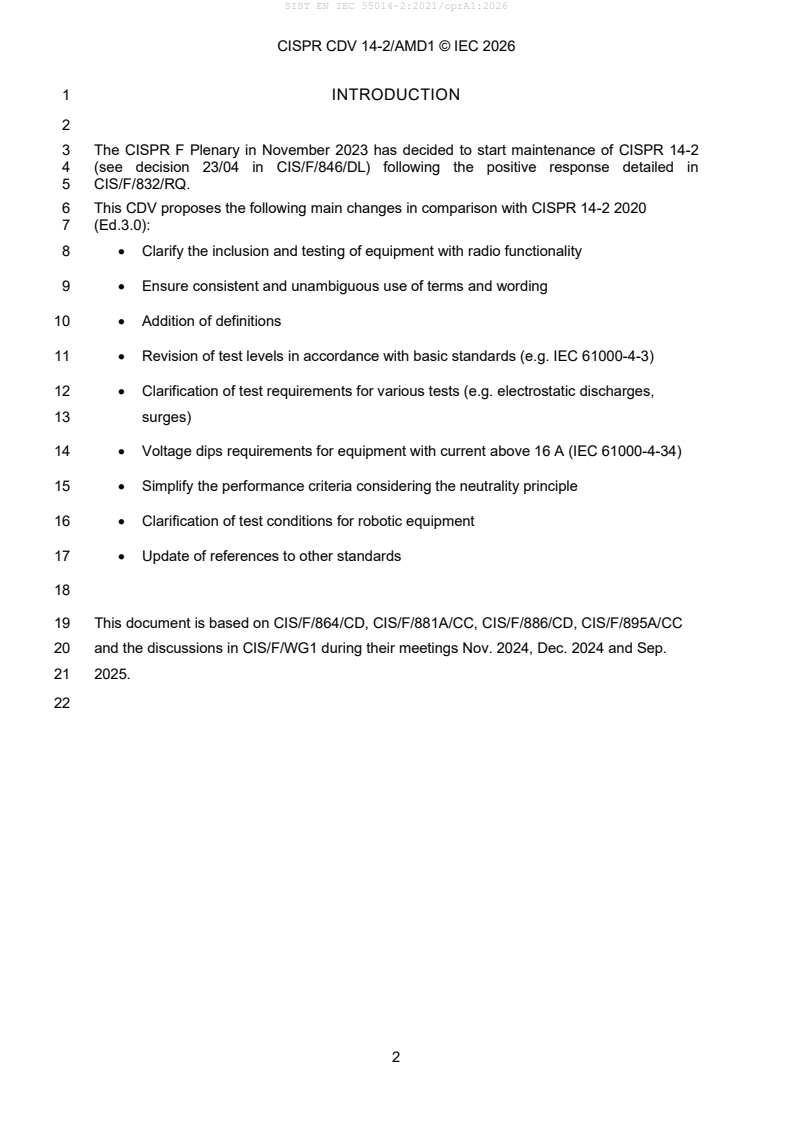
1 INTRODUCTION
3 The CISPR F Plenary in November 2023 has decided to start maintenance of CISPR 14-2
4 (see decision 23/04 in CIS/F/846/DL) following the positive response detailed in
5 CIS/F/832/RQ.
6 This CDV proposes the following main changes in comparison with CISPR 14-2 2020
7 (Ed.3.0):
8 • Clarify the inclusion and testing of equipment with radio functionality
9 • Ensure consistent and unambiguous use of terms and wording
10 • Addition of definitions
11 • Revision of test levels in accordance with basic standards (e.g. IEC 61000-4-3)
12 • Clarification of test requirements for various tests (e.g. electrostatic discharges,
13 surges)
14 • Voltage dips requirements for equipment with current above 16 A (IEC 61000-4-34)
15 • Simplify the performance criteria considering the neutrality principle
16 • Clarification of test conditions for robotic equipment
17 • Update of references to other standards
19 This document is based on CIS/F/864/CD, CIS/F/881A/CC, CIS/F/886/CD, CIS/F/895A/CC
20 and the discussions in CIS/F/WG1 during their meetings Nov. 2024, Dec. 2024 and Sep.
21 2025.
CISPR CDV 14-2/AMD1 © IEC 2026
23 ELECTROMAGNETIC COMPATIBILITY –
24 REQUIREMENTS FOR HOUSEHOLD APPLIANCES,
25 ELECTRIC TOOLS AND SIMILAR APPARATUS –
27 Part 2: Immunity – Product family standard
29 1 Scope
30 Replace the last paragraph with the following text:
31 Abnormal operation of the equipment, such as simulated faults in the electric circuitry, is not
32 taken into consideration.
33 2 Normative references
34 Update the references to the following standards and revise all the associated references in the
35 standard:
36 IEC 61000-4-3:2020, Electromagnetic compatibility (EMC) – Part 4-3: Testing and
37 measurement techniques – Radiated, radio-frequency, electromagnetic field immunity test
38 IEC 61000-4-6:2023, Electromagnetic compatibility (EMC) – Part 4-6: Testing and
39 measurement techniques – Immunity to conducted disturbances, induced by radio-frequency
40 fields
41 IEC 61000-4-20:2022, Electromagnetic compatibility (EMC) – Part 4-20: Testing and
42 measurement techniques – Emission and immunity testing in transverse electromagnetic
43 (TEM) waveguides
44 Add the following new reference:
45 IEC 61000-4-34:2005, Electromagnetic compatibility (EMC) – Part 4-34: Testing and
46 measurement techniques – Voltage dips, short interruptions and voltage variations immunity tests
47 for equipment with input current more than 16 A per phase IEC 61000-4-34:2005/AMD1:2009
48 3.2 General terms and definitions
49 3.2.13
50 enclosure port
51 Replace the word may with can.
52 3.2.16
53 wired network port
54 Replace the word may with can in Note 2 to entry.
55 3.2.27
56 extra low voltage
57 Delete term and definition 3.2.27.
58 Add the following new terms and definitions:
59 3.2.27
60 public mains network
61 electricity lines to which all categories of consumers have access and which are operated by
62 an electrical power supply and/or distribution organization for the purpose of supplying
63 electrical energy
64 [SOURCE: IEC 61000-6-1:2016, 3.5]
65 3.2.29
66 DC power port
67 port used to connect to a low voltage DC power generating system, local energy storage or
68 local DC distribution network
CISPR CDV 14-2/AMD1 © IEC 2026
69 Note 1 to Entry A battery is an example of local energy storage.
70 Note 2 to Entry: The conventionally adopted limit for a low DC voltage is 1500 V.
71 [SOURCE: IEC ref. 195-05-25]
73 3.2.30
74 equipment with radio functionality
75 non-radio equipment (host equipment) including one or more radio devices or radio modules
76 that can use host control function(s) and/or power supply
77 Note 1 to entry: The use of the included radio equipment can be for remote control (of the host equipment by an
78 external equipment or vice versa) or for data exchange with external equipment.
79 Note 2 to entry: A radio device or radio module can be plugged-in, built-in or external.
80 [SOURCE: CISPR 11:2024, 3.1.12]
81 3.2.31
82 AC power port
83 Port used to connect equipment to the low voltage AC mains supply network
84 Note to entry: The low voltage AC mains supply could be public or non-public
85 3.3 Abbreviated terms
86 Add the following abbreviation in the alphabetical order:
87 AM Amplitude Modulation
88 4 Classification of apparatus
89 Replace the text of 4.1 with the following text:
90 4.1 Equipment in the scope of this document is subdivided into categories. For each
91 category, specific requirements are formulated.
92 In 4.4 replace the paragraph after the Note with the following text:
93 This category also includes equipment provided with rechargeable batteries, which can be
94 charged, directly or indirectly, from the mains. Accordingly, this equipment shall also be
95 subjected to the test requirements for the appropriate category of mains operated equipment
96 but only when testing the charging function.
97 5.1 Electrostatic discharges
98 Replace the content of 5.1 with the following text:
99 Electrostatic discharge tests (air discharges, contact discharges direct and indirect, as
100 appropriate) shall be carried out according to IEC 61000-4-2:2008, with test signals and
101 conditions as given in Table 1.
102 Table 1 – Enclosure port
Environmental phenomenon Test specification Test set-up
Electrostatic discharge 8 kV air discharge IEC 61000-4-2:2008
4 kV contact discharge
104 20 discharges (10 with positive and 10 with negative polarity) shall be applied to each
105 selected discharging point. Tests with other (lower) voltages than those given in Table 1 are
106 not required.
107 IEC 61000-4-2:2008 shall be followed to identify the points for applying the discharges.
108 5.2 Fast transients
109 Replace the content of the first paragraph with the following text:
CISPR CDV 14-2/AMD1 © IEC 2026
110 Fast transient tests shall be carried out according to IEC 61000-4-4:2012, for 2 min with a
111 positive polarity and for 2 min with a negative polarity, according to Table 2, Table 3 and
112 Table 4.
113 Delete the paragraph after Table 3.
114 Table 4 – Input and output AC power ports
115 In the third row, replace the first paragraph with the following text:
116 This testing is only applicable to ports connected to the public mains network, as well as to other AC power ports
117 interfacing with cables whose total length can exceed 3 m according to the instructions for use.
118 Delete the paragraph after Table 4.
119 5.3 Injected currents, 0,15 MHz to 230 MHz
120 Replace the text before Table 5 with the following text:
121 Injected current tests shall be carried out according to IEC 61000-4-6:2023, and according to
122 Table 5, Table 6 and Table 7.
123 For large EUT having only one AC mains cable and no other cable leaving the EUT, and
124 where the AC mains cable leaves the EUT at a height of more than 1 m from its base, the
125 following test set-up shall be used:
126 – the AC mains cable is routed along the enclosure of the EUT straight down to the support
127 and then according to the basic standard horizontally to the CDN or clamp;
128 – the CDN or clamp shall be placed at a distance of (20 cm ± 10 cm) from the boundary of
129 the EUT.
130 NOTE 1 Some refrigerators are an example of large EUT. See Figure 2 for an example of set-up.
131 Test conditions and testing arrangements, especially for measurements from 80 MHz to
132 230 MHz, shall be clearly specified in the test report.
133 Replace Table 5 with the following:
134 Table 5 – Signal ports, control ports and wired network ports
a
Environmental phenomenon Test specifications Test set-up
RF current common mode 0,15 MHz to 80 MHz IEC 61000-4-6:2023
1 kHz, 80 % AM 3 V (RMS) (unmodulated)
150 Ω source impedance
80 MHz to 230 MHz
1 V (RMS) (unmodulated)
150 Ω source impedance
Applicable only to ports interfacing with cables whose total length may exceed 3 m according to the instructions
for use.
a
At the transition frequency the higher test level applies.
136 Replace Table 6 with the following:
CISPR CDV 14-2/AMD1 © IEC 2026
137 Table 6 – Input and output DC power ports
a
Environmental phenomenon Test specifications Test set-up
RF current common mode 0,15 MHz to 80 MHz IEC 61000-4-6:2013
1 kHz, 80 %AM 3 V (RMS) (unmodulated)
150 Ω source impedance
80 MHz to 230 MHz
1 V (RMS) (unmodulated)
150 Ω source impedance
Not applicable to battery operated appliances that cannot be connected to the mains while in use.
Not applicable to input ports intended for connection to a battery or a rechargeable battery which shall be
removed or disconnected from the apparatus for recharging. Apparatus with a DC power input port intended for
use with an AC − DC power adaptor shall be tested on the AC power input of the AC - DC power adaptor
specified in the instructions for use or, where none is specified, using an AC - DC power adaptor that meets the
apparatus specifications. For DC input and output ports intended to be connected permanently, the test is only
applicable to cables longer than 3 m.
Wired network ports, which also provide DC power (e.g. Power Over Ethernet) shall be treated as wired network
ports only.
a
At the transition frequency the higher test level applies.
139 Delete the paragraph after Table 6.
140 Table 7 – Input and output AC power ports
141 In the third row, replace the first paragraph with the following text:
142 This testing is only applicable to ports connected to the public mains network, as well as to other AC power ports
143 interfacing with cables whose total length can exceed 3 m according to the instructions for use.
144 Delete the paragraph after Table 7.
145 Replace Figure 2 and its title with the following:
147 E EUT
148 C mains cable
149 CP CDN or clamp
150 I Insulating support
151 G Reference ground plane
152 Dimensions in centimeters
CISPR CDV 14-2/AMD1 © IEC 2026
154 Figure 2 – Example for a test set-up for large EUTs (e.g. refrigerators) where
155 the cable leaves the EUT on a height of more than 1 m from its base
156 5.4 Injected currents, 0,15 MHz to 80 MHz
157 Replace the text before Table 8 with the following text:
158 Injected current tests shall be carried out according to IEC 61000-4-6:2023, and according to
159 Table 8, Table 9 and Table 10.
160 Large EUT shall be tested in the same way as described in 5.3.
161 In Table 8 and Table 9 replace the Test specifications with the following text:
162 0,15 MHz to 80 MHz, 3 V (RMS) (unmodulated), 150 Ω source impedance
163 In Table 8 and Table 9 replace the Test setup with the following text:
164 IEC 61000-4-6:2023
165 Delete the paragraph after Table 9.
166 Table 10 – Input and output AC power ports
167 In the third row, replace the first paragraph with the following text:
168 This testing is only applicable to ports connected to the public mains network, as well as to other AC power ports
169 interfacing with cables whose total length can exceed 3 m according to the instructions for use.
170 In the third column, replace the Test set-up with the following text:
171 IEC 61000-4-6:2023
172 Delete the paragraph after Table 10.
173 5.5 Radio frequency electromagnetic fields, 80 MHz to 6 GHz
174 Replace the content of 5.5 with the following text:
175 Radio frequency electromagnetic field tests shall be carried out according to IEC 61000-4-
176 3:2020, or IEC 61000-4-22:2010 or IEC 61000-4-20:2022, and according to Table 11.
177 Table 11 – Enclosure ports
Environmental phenomenon Test specifications Test set-up
a
Radio-frequency electromagnetic IEC
...
Questions, Comments and Discussion
Ask us and Technical Secretary will try to provide an answer. You can facilitate discussion about the standard in here.
Loading comments...