


FprEN IEC 62820-1-1:2025
(Main)Building intercom systems - Part 1-1: System requirements - General
Building intercom systems - Part 1-1: System requirements - General
IEC 62820-1-1:2026 specifies the technical requirements for building intercom systems and equipment used for building entry.
Gebäude-Sprechanlagen - Teil 1-1: Generelle Systemanaforderungen
Systèmes d'interphone de bâtiment - Partie 1-1: Exigences du système - Généralités
L’IEC 62820-1-1:2026 spécifie les exigences techniques relatives aux systèmes et équipements d’interphone installés dans les entrées de bâtiment.
Notranja komunikacija v stavbah - 1-1. del: Splošne zahteve
General Information
- Status
- Not Published
- Publication Date
- 07-May-2026
- Technical Committee
- CLC/TC 79 - Alarm systems
- Drafting Committee
- IEC/TC 79 - IEC_TC_79
- Current Stage
- 5060 - Voting results sent to TC, SR - Formal Approval
- Start Date
- 23-Jan-2026
- Completion Date
- 23-Jan-2026
Relations
- Revises
EN 62820-1-1:2016/A11:2021 - Building intercom systems - Part 1-1: System requirements - General - Effective Date
- 30-Nov-2021
- Effective Date
- 30-Nov-2021
Overview
prEN IEC 62820-1-1:2025 (IEC 62820-1-1 ED2) - titled Building intercom systems - Part 1-1: System requirements – General - is a CLC/IEC committee draft that defines general system-level requirements and test methods for building intercom systems. Published as a CDV in 2025 by IEC TC 79 (Alarm and electronic security systems), the document covers functional, performance, environmental, safety and electromagnetic compatibility (EMC) aspects and provides normative test annexes for audio and video characteristics. Note: this CDV is still under study and subject to change.
Key topics and technical requirements
The standard focuses on system requirements and measurable performance metrics for intercom systems, including:
- Functional requirements
- Basic system functions and optional/additional features, including building intercom systems with System Master Units (SMU).
- Audio performance
- Measured parameters such as overall loudness rating (OLR), overall sensitivity, frequency response, acoustic distortion, channel signal-to-noise (S/N) ratio, sidetone masking rating (STMR), idle channel noise, ringtone sound pressure, acoustic stability (Larsen effect) and acoustic safety.
- Video performance
- Image resolution, greyscale, focus distance, color reproduction and adaptability to environmental illumination.
- Environmental adaptability
- Environmental classes and adaptability requirements for operation in different conditions.
- Safety, EMC and robustness
- Electrical safety, additional protection under fault conditions, EMC immunity and emission requirements, markings, mechanical structure, enclosure protection and anti-vandalism measures.
- Test methods and documentation
- Detailed test conditions, function tests, audio/video test methods, environmental and safety tests and normative annexes (A: audio tests, B: video tests, C: grade differences, D: safety correspondence).
Practical applications and who uses it
This standard is intended for organizations involved in the specification, design, manufacturing, installation and testing of building intercom systems, including:
- Manufacturers developing intercom hardware and integrated systems (audio/video entry units, SMUs).
- Security and access control integrators specifying system performance for residential, commercial and multi-occupancy buildings.
- Test laboratories executing audio, video, environmental and EMC tests per the normative annexes.
- Specifiers and consultants preparing procurement documents and compliance checklists.
- Building owners and facility managers assessing product suitability and durability.
Keywords: building intercom systems, IEC 62820-1-1, system requirements, audio characteristics, video characteristics, EMC, anti-vandalism, intercom testing.
Related standards
- IEC 60065, IEC 60950-1, IEC 62368-1 (see Annex D for safety requirement correspondence)
- IEC TC 79 guidance and regional CENELEC parallel voting procedures
For implementation, consult the final published standard once the CDV stage is complete.


Get Certified
Connect with accredited certification bodies for this standard

NSF International
Global independent organization facilitating standards development and certification.

CIS Institut d.o.o.
Personal Protective Equipment (PPE) certification body. Notified Body NB-2890 for EU Regulation 2016/425 PPE.

Kiwa BDA Testing
Building and construction product certification.
Sponsored listings
Frequently Asked Questions
FprEN IEC 62820-1-1:2025 is a draft published by CLC. Its full title is "Building intercom systems - Part 1-1: System requirements - General". This standard covers: IEC 62820-1-1:2026 specifies the technical requirements for building intercom systems and equipment used for building entry.
IEC 62820-1-1:2026 specifies the technical requirements for building intercom systems and equipment used for building entry.
FprEN IEC 62820-1-1:2025 is classified under the following ICS (International Classification for Standards) categories: 13.320 - Alarm and warning systems. The ICS classification helps identify the subject area and facilitates finding related standards.
FprEN IEC 62820-1-1:2025 has the following relationships with other standards: It is inter standard links to EN 62820-1-1:2016/A11:2021, EN 62820-1-1:2016. Understanding these relationships helps ensure you are using the most current and applicable version of the standard.
FprEN IEC 62820-1-1:2025 is available in PDF format for immediate download after purchase. The document can be added to your cart and obtained through the secure checkout process. Digital delivery ensures instant access to the complete standard document.
Standards Content (Sample)
SLOVENSKI STANDARD
oSIST prEN IEC 62820-1-1:2025
01-april-2025
Notranja komunikacija v stavbah - 1-1. del: Splošne zahteve
Building intercom systems - Part 1-1: General requirements
Gebäude-Sprechanlagen - Teil 1-1: Generelle Systemanaforderungen
Systèmes d'interphone de bâtiment - Partie 1-1: Exigences du système - Généralités
Ta slovenski standard je istoveten z: prEN IEC 62820-1-1:2025
ICS:
35.240.67 Uporabniške rešitve IT v IT applications in building
gradbeništvu and construction industry
97.120 Avtomatske krmilne naprave Automatic controls for
za dom household use
oSIST prEN IEC 62820-1-1:2025 en
2003-01.Slovenski inštitut za standardizacijo. Razmnoževanje celote ali delov tega standarda ni dovoljeno.
oSIST prEN IEC 62820-1-1:2025
oSIST prEN IEC 62820-1-1:2025
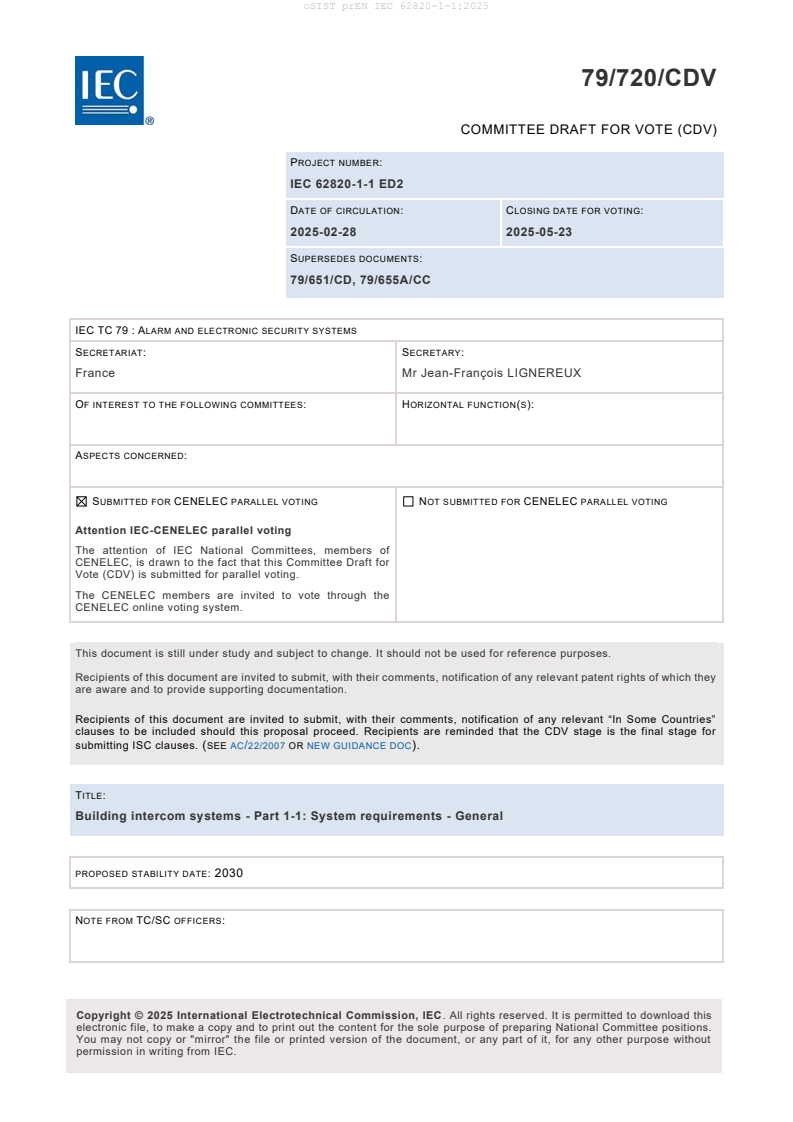
79/720/CDV
COMMITTEE DRAFT FOR VOTE (CDV)
PROJECT NUMBER:
IEC 62820-1-1 ED2
DATE OF CIRCULATION: CLOSING DATE FOR VOTING:
2025-02-28 2025-05-23
SUPERSEDES DOCUMENTS:
79/651/CD, 79/655A/CC
IEC TC 79 : ALARM AND ELECTRONIC SECURITY SYSTEMS
SECRETARIAT: SECRETARY:
France Mr Jean-François LIGNEREUX
OF INTEREST TO THE FOLLOWING COMMITTEES: HORIZONTAL FUNCTION(S):
ASPECTS CONCERNED:
SUBMITTED FOR CENELEC PARALLEL VOTING NOT SUBMITTED FOR CENELEC PARALLEL VOTING
Attention IEC-CENELEC parallel voting
The attention of IEC National Committees, members of
CENELEC, is drawn to the fact that this Committee Draft for
Vote (CDV) is submitted for parallel voting.
The CENELEC members are invited to vote through the
CENELEC online voting system.
This document is still under study and subject to change. It should not be used for reference purposes.
Recipients of this document are invited to submit, with their comments, notification of any relevant patent rights of which they
are aware and to provide supporting documentation.
Recipients of this document are invited to submit, with their comments, notification of any relevant “In Some Countries”
clauses to be included should this proposal proceed. Recipients are reminded that the CDV stage is the final stage for
submitting ISC clauses. (SEE AC/22/2007 OR NEW GUIDANCE DOC).
TITLE:
Building intercom systems - Part 1-1: System requirements - General
PROPOSED STABILITY DATE: 2030
NOTE FROM TC/SC OFFICERS:
electronic file, to make a copy and to print out the content for the sole purpose of preparing National Committee positions.
You may not copy or "mirror" the file or printed version of the document, or any part of it, for any other purpose without
permission in writing from IEC.
oSIST prEN IEC 62820-1-1:2025
79/720/CDV – 2 – IEC CDV 62820-1-1 ED2 © IEC 2025
1 CONTENTS
2 FOREWORD . 5
3 INTRODUCTION . 7
4 1 Scope . 8
5 2 Normative references . 8
6 3 Terms, definitions and abbreviations . 9
7 3.1 Terms and definitions . 9
8 3.2 Abbreviations . 11
9 4 Functional requirements . 11
10 4.1 Basic functional requirements . 11
11 4.1.1 General . 11
12 4.1.2 Requirements for building intercom system with SMU . 12
13 4.2 Additional functions . 13
14 5 Performance requirements. 13
15 5.1 Audio characteristics . 13
16 5.1.1 Acoustic pressure level . 13
17 5.1.2 Overall loudness rating (OLR). 13
18 5.1.3 Overall sensitivity . 13
19 5.1.4 Frequency response . 15
20 5.1.5 Acoustic distortion . 15
21 5.1.6 Channel S/N ratio . 15
22 5.1.7 Sidetone masking rating (STMR) . 15
23 5.1.8 Idle channel noise . 16
24 5.1.9 Ringtone sound pressure . 16
25 5.1.10 Acoustic stability (Larsen effect) . 16
26 5.1.11 Acoustic safety . 16
27 5.2 Video characteristics . 16
28 5.2.1 Image resolution . 16
29 5.2.2 Grey scale . 16
30 5.2.3 Focus distance . 16
31 5.2.4 Color reproduction . 16
32 5.2.5 Environmental illuminance adaptability . 16
33 5.3 Environmental adaptability requirements . 17
34 5.3.1 Environmental classes . 17
35 5.3.2 Environmental adaptability . 17
36 5.4 Safety requirements . 17
37 5.5 Additional protection under fault conditions . 18
38 5.6 Electromagnetic compatibility requirements . 18
39 5.6.1 Electromagnetic compatibility immunity requirements . 18
40 5.6.2 Additional electromagnetic compatibility immunity requirements . 18
41 5.6.3 Electromagnetic compatibility emission requirements . 19
42 5.7 Markings and mechanical structural requirements . 19
43 5.7.1 Markings . 19
44 5.7.2 Mechanical structure . 19
45 5.7.3 Enclosure protection capability . 19
46 5.7.4 Anti-vandalism . 19
oSIST prEN IEC 62820-1-1:2025
IEC CDV 62820-1-1 ED2 © IEC 2025 – 3 – 79/720/CDV
47 6 Test methods . 20
48 6.1 Test conditions . 20
49 6.1.1 Test environmental conditions . 20
50 6.1.2 Electrical connection . 20
51 6.2 Function test . 20
52 6.3 Audio characteristics test . 20
53 6.4 Video characteristics test . 20
54 6.5 Environmental adaptability test . 20
55 6.6 Safety test . 20
56 6.7 Additional protection under fault conditions test . 21
57 6.8 Electromagnetic compatibility test . 21
58 6.8.1 Electromagnetic compatibility immunity test . 21
59 6.8.2 Additional electromagnetic compatibility immunity test . 21
60 6.8.3 Electromagnetic compatibility emission test . 21
61 6.9 Markings and mechanical structure test . 21
62 6.9.1 Markings and scrub resistance test . 21
63 6.9.2 Mechanical structure test . 21
64 6.9.3 Enclosure protection capability test . 21
65 6.9.4 Anti-vandalism test . 22
66 7 Documentation . 22
67 Annex A (normative) Test of audio characteristics . 24
68 A.1 Test conditions . 24
69 A.2 Acoustic pressure level test . 24
70 A.2.1 Methods . 24
71 A.2.2 Calibration of test equipment . 25
72 A.2.3 Test of the acoustic pressure level. 25
73 A.3 Overall loudness rating (OLR) test . 26
74 A.3.1 Measurement of sound pressure P at the MRP . 26
m
75 A.3.2 Measurement of output sound pressure P of the hands-free EUT . 26
o
76 A.3.3 Measurement of output sound pressure P of the handset EUT . 27
e
77 A.3.4 Calculations of the OLR . 28
78 A.4 Overall sensitivity test . 29
79 A.4.1 Test of the overall sensitivity at the hands-free EUT . 29
80 A.4.2 Test of the overall sensitivity at the handset EUT . 29
81 A.5 Frequency response test . 29
82 A.6 Acoustic distortion test . 30
83 A.7 Channel S/N ratio test . 30
84 A.8 Sidetone masking rating (STMR) test . 30
85 A.9 Idle channel noise test . 31
86 A.10 Ringtone sound pressure test . 31
87 A.11 Acoustic stability (Larsen Effect) test . 31
88 A.12 Acoustic safety test . 32
89 Annex B (normative) Test of video characteristics. 34
90 B.1 Test conditions . 34
91 B.2 Connection of the tested system . 34
92 B.3 Image resolution test . 34
93 B.4 Grey scale test . 35
94 B.5 Focus distance test . 36
oSIST prEN IEC 62820-1-1:2025
79/720/CDV – 4 – IEC CDV 62820-1-1 ED2 © IEC 2025
95 B.6 Color reproduction test. 37
96 B.7 Environmental illumination adaptability test . 37
97 Annex C (normative) Different requirements between grade 1 and grade 2 . 38
98 Annex D (normative) Safety requirements correspondence in IEC 60065 or
99 IEC 60950-1 or IEC 62368-1 . 40
100 Bibliography . 42
102 Figure 1 – Overall sensitivity at the hands-free unit . 14
103 Figure 2 – Overall sensitivity at the handset unit . 15
104 Figure A.1 – Measurement of sound pressure P at the MRP . 26
m
105 Figure A.2 – Measurement of output sound pressure P when connected with the
o
106 handset unit . 26
107 Figure A.3 – Measurement of output sound pressure P when connected with the
o
108 hands-free unit. 27
109 Figure A.4 – Measurement of output sound pressure P when connected with the
e
110 handset unit . 27
111 Figure A.5 – Measurement of output sound pressure P when connected with the
e
112 hands-free unit. 28
113 Figure A.6 – Measurement of STMR at the handset EUT . 31
114 Figure A.7 – Measurement of ringtone sound pressure . 31
115 Figure A.8 – Acoustic stability test for handset EUT . 32
116 Figure A.9 – Acoustic stability test for hands-free EUT. 32
117 Figure A.10 – Acoustic safety test . 33
118 Figure B.1 – Connection diagram for test of video characteristics . 34
119 Figure B.2 – TE170 test chart . 35
120 Figure B.3 –TE83 and TE84 test charts . 36
121 Figure B.4 – Focus test chart . 36
122 Figure B.5 – Position of the external ring area . 37
123 Figure B.6 – TE106 test chart . 37
125 Table 1 – Environmental adaptability requirements . 17
126 Table A.1 – Factors for OLR . 29
127 Table C.1 – Requirements of grade 1 and grade 2 . 38
128 Table D.1 – Correspondence between IEC 60065 and IEC 60950-1 and IEC 62368-1 . 40
oSIST prEN IEC 62820-1-1:2025
IEC CDV 62820-1-1 ED2 © IEC 2025 – 5 – 79/720/CDV
131 INTERNATIONAL ELECTROTECHNICAL COMMISSION
132 ____________
134 BUILDING INTERCOM SYSTEMS –
136 Part 1-1: System requirements – General
138 FOREWORD
139 1) The International Electrotechnical Commission (IEC) is a worldwide organization for standardization comprising
140 all national electrotechnical committees (IEC National Committees). The object of IEC is to promote international
141 co-operation on all questions concerning standardization in the electrical and electronic fields. To this end and in
142 addition to other activities, IEC publishes International Standards, Technical Specifications, Technical Reports,
143 Publicly Available Specifications (PAS) and Guides (hereafter referred to as “IEC Publication(s)”). Their
144 preparation is entrusted to technical committees; any IEC National Committee interested in the subject dealt with
145 may participate in this preparatory work. International, governmental and non-governmental organizations liaising
146 with the IEC also participate in this preparation. IEC collaborates closely with the International Organization for
147 Standardization (ISO) in accordance with conditions determined by agreement between the two organizations.
148 2) The formal decisions or agreements of IEC on technical matters express, as nearly as possible, an international
149 consensus of opinion on the relevant subjects since each technical committee has representation from all
150 interested IEC National Committees.
151 3) IEC Publications have the form of recommendations for international use and are accepted by IEC National
152 Committees in that sense. While all reasonable efforts are made to ensure that the technical content of IEC
153 Publications is accurate, IEC cannot be held responsible for the way in which they are used or for any
154 misinterpretation by any end user.
155 4) In order to promote international uniformity, IEC National Committees undertake to apply IEC Publications
156 transparently to the maximum extent possible in their national and regional publications. Any divergence between
157 any IEC Publication and the corresponding national or regional publication shall be clearly indicated in the latter.
158 5) IEC itself does not provide any attestation of conformity. Independent certification bodies provide conformity
159 assessment services and, in some areas, access to IEC marks of conformity. IEC is not responsible for any
160 services carried out by independent certification bodies.
161 6) All users should ensure that they have the latest edition of this publication.
162 7) No liability shall attach to IEC or its directors, employees, servants or agents including individual experts and
163 members of its technical committees and IEC National Committees for any personal injury, property damage or
164 other damage of any nature whatsoever, whether direct or indirect, or for costs (including legal fees) and expenses
165 arising out of the publication, use of, or reliance upon, this IEC Publication or any other IEC Publications.
166 8) Attention is drawn to the Normative references cited in this publication. Use of the referenced publications is
167 indispensable for the correct application of this publication.
168 9) Attention is drawn to the possibility that some of the elements of this IEC Publication may be the subject of patent
169 rights. IEC shall not be held responsible for identifying any or all such patent rights.
170 International Standard IEC 62820-1-1 has been prepared by IEC technical committee 79: Alarm
171 and electronic security systems.
172 The text of this standard is based on the following documents:
FDIS Report on voting
174 Full information on the voting for the approval of this standard can be found in the report on
175 voting indicated in the above table.
176 This publication has been drafted in accordance with the ISO/IEC Directives, Part 2.
177 A list of all parts in the IEC 62820 series, published under the general title Building intercom
178 systems, can be found on the IEC website.
oSIST prEN IEC 62820-1-1:2025
79/720/CDV – 6 – IEC CDV 62820-1-1 ED2 © IEC 2025
179 The committee has decided that the contents of this publication will remain unchanged until the
180 stability date indicated on the IEC website under "http://webstore.iec.ch" in the data related to
181 the specific publication. At this date, the publication will be
182 • reconfirmed,
183 • withdrawn,
184 • replaced by a revised edition, or
185 • amended.
IMPORTANT – The 'colour inside' logo on the cover page of this publication indicates that it
contains colours which are considered to be useful for the correct understanding of its
contents. Users should therefore print this document using a colour printer.
oSIST prEN IEC 62820-1-1:2025
IEC CDV 62820-1-1 ED2 © IEC 2025 – 7 – 79/720/CDV
189 INTRODUCTION
190 This part of IEC 62820 specifies the technical requirements for building intercom systems and
191 equipment used for building entry. Building intercom systems can function independently and
192 may be extendable to support building security management functions, e.g. extendable with
193 security management unit (SMU) operated by security staff (door-man, concierge,
194 security-guard, porter, etc.), or in conjunction with other systems as per the security
195 requirements of the building. It may consist of: Visitor call unit (VCU), user receiver unit (URU),
196 SMU, power supply, auxiliary device as well as interface-unit to other security-systems.
197 The IEC 62820 series of standards set out the technical requirements for the composition,
198 functions, performance, test methods of building intercom systems for building entry and
199 application guidelines and consist of five parts:
200 Part 1-1: System requirements – General
201 Part 1-2: System requirements – Building intercom systems using the internet protocol (IP)
202 Part 2: Requirements for advanced security building intercom systems
203 Part 3-1: Application guidelines – General
204 Part 3-2: Application guidelines – Advanced security building intercom systems
205 The Part 1-1 of IEC 62820 is based on Chinese standard GB/T 31070.1-2014 and European
206 standard EN 50486:2008.
oSIST prEN IEC 62820-1-1:2025
79/720/CDV – 8 – IEC CDV 62820-1-1 ED2 © IEC 2025
209 BUILDING INTERCOM SYSTEMS –
211 Part 1-1: System requirements – General
215 1 Scope
216 This Part of IEC 62820 specifies the technical requirements for the composition, functions,
217 performance, and test methods of general building intercom systems.
218 This part is applicable to the general intercom systems for building entry in residential or
219 commercial buildings.
220 Door-Entry-System (DES) is a simple kind of convenient Building-Intercom-System (BIS) mainly
221 for user’s comfort. This document has classified the general building intercom systems into two
222 grades in Part 1-1. Grade 1 adopts lower requirements to cover DES not used for relevant
223 security applications while grade 2 adopts higher requirements for building intercom systems for
224 security applications. Each grade may adopt different functional and performance requirements,
225 test methods and normative references.
226 NOTE The different requirements between grade 1 and grade 2 are summarized in Table C.1.
227 2 Normative references
228 The following documents are referred to in the text in such a way that some or all of their content
229 constitutes requirements of this document. For dated references, only the edition cited applies.
230 For undated references, the latest edition of the referenced document (including any
231 amendments) applies.
232 IEC 60065:2014, Audio, video and similar electronic apparatus – Safety requirements
233 IEC 60529:1989, Degrees of protection provided by enclosures (IP Code)
234 IEC 60529:1989/AMD1:1999
235 IEC 60529:1989/AMD2:2013
236 IEC 60950-1:2005, Information technology equipment – Safety – Part 1: General requirements
237 IEC 61000-6-1, Electromagnetic compatibility (EMC) – Part 6-1: Generic standards – Immunity
238 for residential, commercial and light-industrial environments
239 IEC 61000-6-3, Electromagnetic compatibility (EMC) – Part 6-3: Generic standards – Emission
240 standard for residential, commercial and light-industrial environments
241 IEC 62262, Degrees of protection provided by enclosures for electrical equipment against
242 external mechanical impacts (IK code)
243 IEC 62368-1:2018, Audio/video, information and communication technology equipment – Part 1:
244 Safety requirements
245 IEC 62599-1, Alarm systems – Part 1: Environmental test methods
246 IEC 62599-2, Alarm systems – Part 2: Electromagnetic compatibility – Immunity requirements
247 for components of fire and security alarm systems
oSIST prEN IEC 62820-1-1:2025
IEC CDV 62820-1-1 ED2 © IEC 2025 – 9 – 79/720/CDV
248 ISO 12233:2017, Photography – Electronic still picture imaging – Resolution and spatial
249 frequency responses
250 ITU-T P.50, Artificial voices
251 ITU-T P.79-2007, Calculation of loudness ratings for telephone sets
252 ITU-T P.501, Test signals for use in telephonometry
253 3 Terms, definitions and abbreviations
254 3.1 Terms and definitions
255 For the purposes of this document, the following terms and definitions apply.
256 ISO and IEC maintain terminological databases for use in standardization at the following
257 addresses:
258 • IEC Electropedia: available at http://www.electropedia.org/
259 • ISO Online browsing platform: available at http://www.iso.org/obp
260 3.1.1
261 2-way speech
262 speech between any two units (VCU, URU or SMU) in each direction which may be simultaneous
263 or non-simultaneous
264 3.1.2
265 acoustic distortion
266 distortion of signals at the receiving terminal of the system as a result of system transmission
267 non-linearity and ground noise, expressed as a ratio percentage of the harmonic signal and
268 ground noise at the receiving terminal in proportion to the overall sound pressure
269 3.1.3
270 acoustic pressure level
271 measurement of the acoustic pressure level generated by the equipment under test (EUT) in
272 normal conditions
273 3.1.4
274 artificial ear
275 device used to calibrate the receiver and containing an acoustic coupler and a calibrated
276 microphone used to measure sound pressure
277 Note 1 to entry: Its overall acoustic impedance within a given frequency band is similar to that of the average human
278 ear, and its characteristics comply with the requirements of type 1 or type 3.2 provided by Article 5 of
279 ITU-T P.57-2011.
280 3.1.5
281 artificial mouth
282 analogue device the sound characteristics of which are similar to the directivity and radiation
283 pattern of the average human mouth
284 Note 1 to entry: It conforms to the requirements set forth in Article 5 of ITU-T P.51-1996.
285 3.1.6
286 auxiliary device
287 device which extends or facilitates additional functions and interfaces of a building intercom
rd
288 system, such as communications, remote control, 3 party devices interfaces etc.
oSIST prEN IEC 62820-1-1:2025
79/720/CDV – 10 – IEC CDV 62820-1-1 ED2 © IEC 2025
289 3.1.7
290 building intercom system
291 BIS
292 system designed for entry communication in residential or commercial buildings which provides
293 addressing calls, speech and optional video function and is equipped with an electronic
294 unlocking device
295 3.1.8
296 channel S/N
297 sound pressure ratio between signal and ground noise at the receiving terminal under excitation
298 of the nominal sound pressure at the transmitting terminal, expressed in dB
299 3.1.9
300 handset unit
301 device typically coupled to the ear by hand as can be a handset URU or handset SMU
302 3.1.10
303 hands-free unit
304 device that does not need to use the hand during the communication as can be a VCU,
305 hands-free URU or hands-free SMU
306 3.1.11
307 idle channel noise
308 noise expressed in dB(A) which is received in the terminal after the channel connection is
309 established when no signal is transferred
310 3.1.12
311 loudness rating guard-ring position
312 LRGP
313 fixed position in which the handset of the URU or SMU is used to measure the rating of system
314 loudness
315 [SOURCE: adapted from ITU-T P.64:2007]
316 3.1.13
317 overall loudness rating
318 OLR
319 measurement of the loudness in the entire channel from the reference point of the mouth at the
320 transmitting terminal to the ear reference point (ERP) at the receiving terminal, expressed in dB
321 [SOURCE: adapted from ITU-T P.79:2007]
322 3.1.14
323 overall sensitivity
324 gain of the sound pressure at the reference point of the ear at the reception terminal relative to
325 the excitation sound pressure at the mouth reference point (MRP) at the transmitting terminal,
326 expressed in dB
327 Note 1 to entry: It is a function of frequency.
328 3.1.15
329 security management unit
330 SMU
331 device which can be addressed from the call unit (VCU, URU or SMU), provides the means of
332 addressing the calling signal to the desired receiver unit(s) which can be URU or SMU, 2-way
333 speech, the activation of the audio and/or video connection with the VCU and the means to
334 initiate remote unlocking of the controlled entrance
oSIST prEN IEC 62820-1-1:2025
IEC CDV 62820-1-1 ED2 © IEC 2025 – 11 – 79/720/CDV
335 3.1.16
336 sidetone masking rating
337 STMR
338 measurement of sidetone loudness after factoring in the masking effects of the human head on
339 sidetone, expressed in dB
340 [SOURCE: adapted from ITU-T P.79:2007]
341 3.1.17
342 user receiver unit
343 URU
344 addressable user device which provides 2-way speech with optional video, and a means to
345 initiate remote unlocking of the controlled entrance
346 3.1.18
347 visitor call unit
348 VCU
349 device installed outside a controlled entrance which provides the means of addressing the
350 calling signal to the desired URU or SMU and 2-way speech with optional video capture
351 Note 1 to entry: The device can also provide the means of unlocking the controlled entrance and other function(s) or
352 these function(s) can be contained within a separate associated device normally located within the controlled
353 premises and which can also contain the system power supply.
354 3.2 Abbreviations
355 BIS building intercom system
356 DES door entry system
357 ERP ear reference point
358 EUT equipment under test
359 LRGP loudness rating guard-ring position
360 MRP mouth reference point
361 OLR overall loudness rating
362 PIN personal identification number
363 SMU security management unit
364 STMR sidetone masking rating
365 TVL television lines
366 URU user receiver unit
367 VCU visitor call unit
368 4 Functional requirements
369 4.1 Basic functional requirements
370 4.1.1 General
371 A building intercom system shall meet the following requirements:
372 a) Call function
373 The VCU shall be able to address the desired URU. The VCU shall be able to produce a
374 visible and/or audible call alert signal. The URU shall be able to produce a response prompt
375 signal that can be visible, audible, etc.
376 b) Speech function
oSIST prEN IEC 62820-1-1:2025
79/720/CDV – 12 – IEC CDV 62820-1-1 ED2 © IEC 2025
377 2-way speech shall be provided, which can be either non-simultaneous or simultaneous. It
378 may be of limited duration controlled by a system timer such that the speech channel cannot
379 be accidentally occupied for an unlimited time.
380 c) Unlocking function
381 The unlocking function shall be provided with an electric or electronic signal to an electric or
382 electronic locking device for securing a building entrance. This function shall be controlled
383 by URU at the user’s discretion. In grade 2 the URU shall be in communication with the VCU
384 to perform the unlocking function.
385 The unlocking function could also be activated by other means:
386 1) The VCU may be provided with a means for authorized users to directly activate the
387 unlocking function, such as by PIN code or secure proximity card or other security grade
388 dependent means.
389 2) Request to exit button or switch located inside the controlled area and normally adjacent
390 to the controlled entrance. According to the security requirements of the installation this
391 button or switch may be a simple switch or require a PIN or other secure means of
392 operation.
393 3) Other system signal such as an activated fire alarm signal, a building evacuation signal
394 etc.
395 d) Nighttime operability
396 Grade 1: No requirement;
397 Grade 2: The VCU shall provide illumination or visible prompts to facilitate the visitor’s
398 operations at night.
399 e) Video and image recording and replaying function
400 When a URU is equipped with a video function it shall be able to display images captured by
401 the VCU. The functions of storing, replaying the visitor’s images are optional.
402 f) Operational indication
403 The system shall provide the operating and operational information to the visitor. The VCU
404 should provide a comfort indication that the call is being processed, such as a low level
405 audible tone and/ or visible indication. The VCU should also give audio and/or visible
406 indication when the lock has been released and that entry to the premises is permitted.
407 NOTE The VCU can give clear indication or prompts to the visitor how to address the desired URU.
408 g) Anti listen-in
409 Grade 1: No requirement.
410 Grade 2: After connecting the VCU with the URU, the audio information shall not be
411 monitored by other URU connected to the system.
412 4.1.2 Requirements for building intercom system with SMU
413 A building intercom system with SMU shall meet the following requirements:
414 a) The SMU shall be able to address and initiate calls to selected URU. The VCU and the URU
415 shall be able to initiate calls to the SMU. If multiple SMU are connected to the system, they
416 shall be able to call each other. All the calls shall be able to produce call alert and response
417 prompt signals. The signals can be visible, audible, etc.
418 b) The SMU shall be capable of 2-way speech with the VCU or the URU. If multiple SMU are
419 connected to the system, they shall be capable of 2-way speech with each other.
420 c) The SMU shall be able to control the VCU or auxiliary device to perform electrical or
421 electronic unlocking.
422 d) When a SMU is equipped with a video function it shall be able to display images captured by
423 the VCU. The URU shall be able to display images captured by SMU equipped with a video
424 camera.
oSIST prEN IEC 62820-1-1:2025
IEC CDV 62820-1-1 ED2 © IEC 2025 – 13 – 79/720/CDV
425 e) For grade 2: After connecting the SMU with the VCU or the URU, the audio and video
426 information shall not be monitored by other URU connected to the system.
427 f) For grade 2: The SMU shall be able to address and communicate to selected VCU.
428 4.2 Additional functions
429 A building intercom system can also provide the following functions:
430 a) If the unsecured state of the controlled entrance lasts beyond the configured time, the SMU
431 may be able to receive a warning message.
432 NOTE Unsecured state: the door opened for too long, the tamper switch triggered, etc.
433 b) The system may have the possibility of transmitting images and texts to the URU.
434 c) The SMU may have a timed and dated event log with security graded access and recording
435 access events at the VCU.
436 1) URU’s called and if unlocking function operated by the URU.
437 2) VCU unlocking carried out directly at the VCU, identifying the authorized user.
438 3) Programming events such as adding or subtracting users and URU’s.
439 4) Identification of the operator accessing the event log.
440 d) SMU may intercept incoming calls from a VCU directed to an URU and then redirect the call
441 to desired URU.
442 e) If a SMU operator is not available, SMU may record details of URU which called the SMU in
443 order to allow the operator to call back the URU.
444 5 Performance requirements
445 5.1 Audio characteristics
446 5.1.1 Acoustic pressure level
447 Grade 1: Acoustic pressure level shall meet the following requirements:
448 a) Acoustic pressure level value generated by hands-free unit:
449 – For discrete measurement shall be 70 dBspl.
450 – For continue measurement shall be 70 dB(A).
451 b) Acoustic pressure level value generated by handset unit:
452 – For discrete measurement shall be 77 dBspl.
453 – For continue measurement shall be 77 dB(A).
454 Grade 2: Not applicable.
455 5.1.2 Overall loudness rating (OLR)
456 Grade 1: No requirement.
457 Grade 2: The OLR shall meet the following requirements:
458 a) At the VCU: dB.
459 b) At the hands-free URU and hands-free SMU: dB.
460 c) At the handset unit: (15 5) dB.
461 5.1.3 Overall sensitivity
462 Grade 1: No requirement.
oSIST prEN IEC 62820-1-1:2025
79/720/CDV – 14 – IEC CDV 62820-1-1 ED2 © IEC 2025
463 Grade 2: The typical curve and its tolerance range of overall sensitivity between 500 Hz and
464 3 400 Hz shall meet the following requirements:
465 At the hands-free unit: The typical curve is the dotted line shown in Figure 1 – Overall
466 sensitivity at the hands-free unit
467 and its tolerance range is the solid line shown in Figure 1 – Overall sensitivity at the
468 hands-free unit
469 a) .
470 At the handset unit: the typical curve is the dotted line shown in Figure 2 – Overall
471 sensitivity at the handset unit
472 and its tolerance range is the solid line shown in Figure 2 – Overall sensitivity at the
473 handset unit
474 b) .
475 NOTE Best fit or floating mask, refer to Figure 1 – Overall sensitivity at the hands-free
476 unit
477 and Figure 2 – Overall sensitivity at the handset unit
478 .
–4
–8
–12
–16
Frequency (Hz)
IEC
480 Figure 1 – Overall sensitivity at the hands-free unit
Relative sensitivity (dB)
1 000
1 250
1 600
2 000
23 dB
2 500
3 150
3 400
4 000
5 000
6 300
oSIST prEN IEC 62820-1-1:2025
IEC CDV 62820-1-1 ED2 © IEC 2025 – 15 – 79/720/CDV
–4
–8
–12
–16
Frequency (Hz)
IEC
483 Figure 2 – Overall sensitivity at the handset unit
484 5.1.4 Frequency response
485 Grade 1: Once the VCU, the URU and the SMU are connected for speech, the difference
486 between the higher and lower measurement of acoustic pressure level shall not be greater than
487 25 dB.
488 Grade 2: Not applicable.
489 5.1.5 Acoustic distortion
490 Grade 1: No requirement.
491 Grade 2: The acoustic distortion shall meet the following requirements when the excitation
492 sound pressure is 0 dBPa:
493 a) At the hands-free unit: shall not be greater than 10 %.
494 b) At the handset unit: shall not be greater than 7 %.
495 5.1.6 Channel S/N ratio
496 Grade 1: No requirement.
497 Grade 2: The channel S/N ratio shall meet the following requirements when the excitation sound
498 pressure is 0 dBPa:
499 a) At the hands-free unit: shall not be less than 25 dB.
500 b) At the handset unit: shall not be less than 30 dB.
501 5.1.7 Sidetone masking rating (STMR)
502 Grade 1: No requirement.
503 Grade 2: The STMR of the handset unit shall not be less than 5 dB.
Relative sensitivity (dB)
1 000
1 250
1 600
2 000
20 dB
2 500
3 150
3 400
4 000
5 000
6 300
oSIST prEN IEC 62820-1-1:2025
79/720/CDV – 16 – IEC CDV 62820-1-1 ED2 © IEC 2025
504 5.1.8 Idle channel noise
505 Grade 1: No requirement.
506 Grade 2: The idle channel noise shall meet the following requirements:
507 a) At the hands-free unit: shall not be greater than 45 dB(A).
508 b) At the handset unit: shall not be greater than 48 dB(A).
509 5.1.9 Ringtone sound pressure
510 The ringtone sound pressure shall not be less than 73 dB(A) and not greater than 106 dB(A).
511 5.1.10 Acoustic stability (Larsen effect)
512 Once the VCU, the URU and the SMU are connected for speech, there shall not be high pitched
513 whistling noise present.
514 5.1.11 Acoustic safety
515 In any operational state, the generated acoustic pressure level shall not exceed 120 dB(A).
516 5.2 Video characteristics
517 5.2.1 Image resolution
518 The image resolution (at the centre) shall not be less than 130 TVL for the visible area smaller
519 than 101,6 mm (4,0 inches), and shall not be less than 200 TVL for the visible area of 101,6 mm
520 (4,0 inches) or larger.
521 5.2.2 Grey scale
522 The grey scale shall not be less than 8 levels when using TE83 test chart.
523 The grey scale shall not be less than 6 levels when using TE84 test chart.
524 5.2.3 Focus distance
525 Minimum focus distance: 0,3 m.
526 The object that is more than 0,3 m away from the camera shall be clearly focused.
527 5.2.4 Color reproduction
528 This requirement applies to colour video BIS. No obvious chromatic aberration between the
529 colour of the displayed image and the actual object captured by camera should be distinguished.
530 5.2.5 Environmental illuminance adaptability
531 At an environmental illuminance of 0,5 lx, the image resolution (at the centre) shall meet the
532 requirements set forth in 5.2.1.
533 Select the test chart with proper size and adjust the distance between the camera of EUT and
534 the test chart from 0,3 m to 0,5 m, and make sure the image of the chart is fully displayed on the
535 monitor.
oSIST
...
Questions, Comments and Discussion
Ask us and Technical Secretary will try to provide an answer. You can facilitate discussion about the standard in here.
Loading comments...