


prEN IEC 61753-382-02:2026
(Main)Fibre optic interconnecting devices and passive components - Performance standard - Part 382-2: Non-connectorized single-mode bidirectional g-pon-nga WWDM devices for category c - Controlled environment
Fibre optic interconnecting devices and passive components - Performance standard - Part 382-2: Non-connectorized single-mode bidirectional g-pon-nga WWDM devices for category c - Controlled environment
Dispositifs d'interconnexion et composants passifs à fibres optiques - Norme de performance - Partie 382-2: Dispositifs WWDM g-pon-nga bidirectionnels unimodaux non connectorisés pour la catégorie c - Environnement contrôlé
Optični spojni elementi in pasivne komponente - Tehnični standard - 382-2. del: Enorodovne dvosmerne g-pon-nga naprave WWDM brez konektorjev za kategorijo c - Nadzorovano okolje
General Information
- Status
- Not Published
- Publication Date
- 25-Jul-2027
- Current Stage
- 4020 - Enquiry circulated - Enquiry
- Start Date
- 09-Jan-2026
- Due Date
- 31-Dec-2025
- Completion Date
- 09-Jan-2026
Relations
- Effective Date
- 26-Nov-2024
Overview
prEN IEC 61753-382-02:2026 is a performance standard developed by IEC and CLC for fibre optic interconnecting devices and passive components. This standard specifically addresses non-connectorized single-mode bidirectional G-PON-NGA WWDM devices intended for use in controlled (Category C) indoor environments. These devices are essential in combining and splitting signals in Gigabit-capable Passive Optical Networks (G-PON) and Next Generation Access (NGA) networks, ensuring efficient fibre optic communication where minimal physical connectors are preferred.
This second edition harmonizes its requirements and test conditions with related IEC standards, such as IEC 61753-1:2018 and IEC 61300-2-22, to provide updated and consistent testing protocols for manufacturers and system integrators.
Key Topics
- Scope and Application: Defines minimum performance criteria, test, and measurement methods for WWDM devices used in G-PON and NGA systems.
- Device Type: Addresses non-connectorized, single-mode optical WWDM devices for bidirectional signal operation.
- Controlled Environment Classification: Suited for Category C environments, typically meaning temperature- and humidity-controlled indoor settings.
- Performance and Testing: Includes initial performance metrics and environmental, mechanical, and optical tests aligned with basic and advanced IEC testing procedures.
- Normative References: Relies on multiple IEC standards, including those for optical fibre cables (IEC 60793, IEC 60794), test methods (IEC 61300 series), and WDM device specifications (IEC 62074-1).
- Wavelength Range: Specifies operational wavelength bands aligned with ITU-T Recommendations for G-PON and NGA coexistence, including defined ranges for upstream, downstream, and video services.
Applications
G-PON-NGA WWDM devices covered by this standard are critical for modern fibre optic access networks. Practical applications include:
- Telecommunications Access Networks: Combining and separating multiple data streams in FTTH (Fibre to the Home) deployments.
- High-Speed Internet Delivery: Supporting bidirectional data transmission for fast, reliable broadband in residential and commercial environments.
- Network Upgrades and Integration: Facilitating coexistence and migration from G-PON to NGA technologies by using wavelength division multiplexing, allowing both legacy and next-generation services over a single optical network.
- Video Distribution: Managing dedicated wavelength bands for video transmission, a key feature in modern triple-play network offerings.
- Indoor and Central Office Environments: Devices built to meet Category C controlled environment requirements ensure optimal and reliable performance in managed network spaces.
Related Standards
Conformance with prEN IEC 61753-382-02:2026 requires awareness of various related international standards, including:
- IEC 61753-1:2018 - General performance requirements and guidance for fibre optic interconnecting devices and passive components.
- IEC 61300 Series - Comprehensive test and measurement procedures for optical devices, including vibration, fibre retention, torsion, thermal, and optical power tests.
- IEC 62074-1 - Generic specification for wavelength division multiplexing (WDM) devices.
- IEC 60793-2-50 & IEC 60794-2-50 - Specifications for single-mode optical fibres and indoor fibre optic cables.
- ITU-T G.984.2 & G.984.5 - Recommendations for G-PON physical media and enhancement bands, crucial for defining wavelength allocation and operational interoperability.
Conclusion
The prEN IEC 61753-382-02:2026 standard ensures that non-connectorized, bidirectional WWDM devices for G-PON-NGA networks deliver consistent optical performance and reliability in controlled environments. By adhering to these guidelines and associated IEC standards, manufacturers can guarantee compatibility and network operators can deploy robust, scalable optical access solutions for current and future broadband demands.
Keywords: fibre optic, G-PON, NGA, WWDM, performance standard, single-mode, bidirectional, controlled environment, IEC 61753-382-02, passive components, optical network, telecommunication standards.


Frequently Asked Questions
prEN IEC 61753-382-02:2026 is a draft published by CLC. Its full title is "Fibre optic interconnecting devices and passive components - Performance standard - Part 382-2: Non-connectorized single-mode bidirectional g-pon-nga WWDM devices for category c - Controlled environment". This standard covers: Fibre optic interconnecting devices and passive components - Performance standard - Part 382-2: Non-connectorized single-mode bidirectional g-pon-nga WWDM devices for category c - Controlled environment
Fibre optic interconnecting devices and passive components - Performance standard - Part 382-2: Non-connectorized single-mode bidirectional g-pon-nga WWDM devices for category c - Controlled environment
prEN IEC 61753-382-02:2026 is classified under the following ICS (International Classification for Standards) categories: 33.180.20 - Fibre optic interconnecting devices. The ICS classification helps identify the subject area and facilitates finding related standards.
prEN IEC 61753-382-02:2026 has the following relationships with other standards: It is inter standard links to EN 61753-382-2:2016. Understanding these relationships helps ensure you are using the most current and applicable version of the standard.
prEN IEC 61753-382-02:2026 is available in PDF format for immediate download after purchase. The document can be added to your cart and obtained through the secure checkout process. Digital delivery ensures instant access to the complete standard document.
Standards Content (Sample)
SLOVENSKI STANDARD
01-februar-2026
Optični spojni elementi in pasivne komponente - Tehnični standard - 382-2. del:
Enorodovne dvosmerne g-pon-nga naprave WWDM brez konektorjev za kategorijo
c - Nadzorovano okolje
Fibre optic interconnecting devices and passive components - Performance standard -
Part 382-2: Non-connectorized single-mode bidirectional g-pon-nga WWDM devices for
category c - Controlled environment
Dispositifs d'interconnexion et composants passifs à fibres optiques - Norme de
performance - Partie 382-2: Dispositifs WWDM g-pon-nga bidirectionnels unimodaux
non connectorisés pour la catégorie c - Environnement contrôlé
Ta slovenski standard je istoveten z: prEN IEC 61753-382-02:2026
ICS:
33.180.20 Povezovalne naprave za Fibre optic interconnecting
optična vlakna devices
2003-01.Slovenski inštitut za standardizacijo. Razmnoževanje celote ali delov tega standarda ni dovoljeno.
86B/5152/CDV
COMMITTEE DRAFT FOR VOTE (CDV)
PROJECT NUMBER:
IEC 61753-382-02 ED2
DATE OF CIRCULATION: CLOSING DATE FOR VOTING:
2026-01-02 2026-03-27
SUPERSEDES DOCUMENTS:
86B/5071/CD, 86B/5104A/CC
IEC SC 86B : FIBRE OPTIC INTERCONNECTING DEVICES AND PASSIVE COMPONENTS
SECRETARIAT: SECRETARY:
Japan Mr Ryo Koyama
OF INTEREST TO THE FOLLOWING COMMITTEES: HORIZONTAL FUNCTION(S):
ASPECTS CONCERNED:
SUBMITTED FOR CENELEC PARALLEL VOTING NOT SUBMITTED FOR CENELEC PARALLEL VOTING
Attention IEC-CENELEC parallel voting
The attention of IEC National Committees, members of
CENELEC, is drawn to the fact that this Committee Draft for
Vote (CDV) is submitted for parallel voting.
The CENELEC members are invited to vote through the
CENELEC online voting system.
This document is still under study and subject to change. It should not be used for reference purposes.
Recipients of this document are invited to submit, with their comments, notification of any relevant patent rights of which
they are aware and to provide supporting documentation.
Recipients of this document are invited to submit, with their comments, notification of any relevant “In Some Countries”
clauses to be included should this proposal proceed. Recipients are reminded that the CDV stage is the final stage for
submitting ISC clauses. (SEE AC/22/2007 OR NEW GUIDANCE DOC).
TITLE:
Fibre optic interconnecting devices and passive components - Performance standard - Part 382-2:
Non-connectorized single-mode bidirectional G-PON-NGA WWDM devices for category C - Controlled
environment
PROPOSED STABILITY DATE: 2032
NOTE FROM TC/SC OFFICERS:
electronic file, to make a copy and to print out the content for the sole purpose of preparing National Committee positions.
You may not copy or "mirror" the file or printed version of the document, or any part of it, for any other purpose without
permission in writing from IEC.
IEC CDV 61753-382-02 © IEC 2026
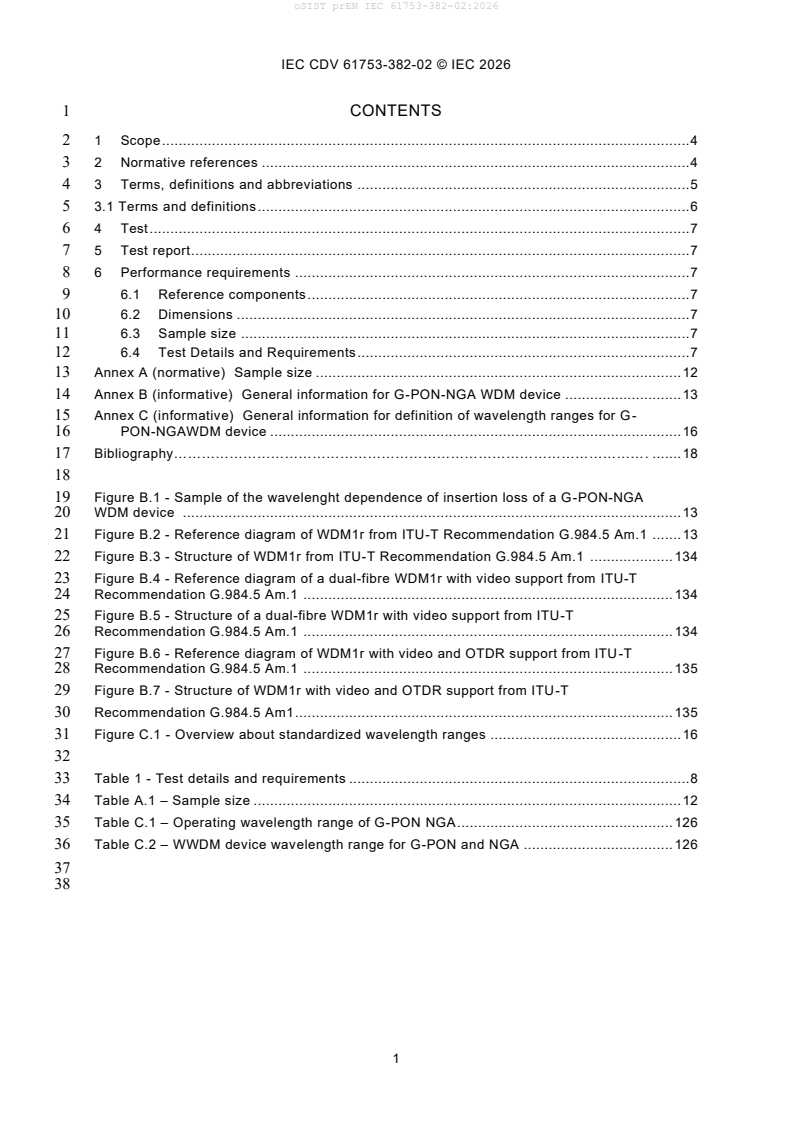
1 CONTENTS
2 1 Scope . 4
3 2 Normative references . 4
4 3 Terms, definitions and abbreviations . 5
5 3.1 Terms and definitions . 6
6 4 Test . 7
7 5 Test report . 7
8 6 Performance requirements . 7
9 6.1 Reference components . 7
10 6.2 Dimensions . 7
11 6.3 Sample size . 7
12 6.4 Test Details and Requirements . 7
13 Annex A (normative) Sample size . 12
14 Annex B (informative) General information for G-PON-NGA WDM device . 13
15 Annex C (informative) General information for definition of wavelength ranges for G-
16 PON-NGAWDM device . 16
17 Bibliography…………………………………………………………………………………………. . 18
19 Figure B.1 - Sample of the wavelenght dependence of insertion loss of a G-PON-NGA
20 WDM device . 13
21 Figure B.2 - Reference diagram of WDM1r from ITU-T Recommendation G.984.5 Am.1 . 13
22 Figure B.3 - Structure of WDM1r from ITU-T Recommendation G.984.5 Am.1 . 134
23 Figure B.4 - Reference diagram of a dual-fibre WDM1r with video support from ITU-T
24 Recommendation G.984.5 Am.1 . 134
25 Figure B.5 - Structure of a dual-fibre WDM1r with video support from ITU-T
26 Recommendation G.984.5 Am.1 . 134
27 Figure B.6 - Reference diagram of WDM1r with video and OTDR support from ITU-T
28 Recommendation G.984.5 Am.1 . 135
29 Figure B.7 - Structure of WDM1r with video and OTDR support from ITU-T
30 Recommendation G.984.5 Am1 . 135
31 Figure C.1 - Overview about standardized wavelength ranges . 16
33 Table 1 - Test details and requirements . 8
34 Table A.1 – Sample size . 12
35 Table C.1 – Operating wavelength range of G-PON NGA . 126
36 Table C.2 – WWDM device wavelength range for G-PON and NGA . 126
IEC CDV 61753-382-02 © IEC 2026
39 INTERNATIONAL ELECTROTECHNICAL COMMISSION
40 ____________
41 FIBRE OPTIC INTERCONNECTING DEVICES
42 AND PASSIVE COMPONENTS
43 – PERFORMANCE STANDARD -
45 Part 382-02: Non-connectorised single-mode bidirectional G-PON-NGA
46 WWDM devices for category C – controlled environment
48 FOREWORD
49 1) The International Electrotechnical Commission (IEC) is a worldwide organization for standardization comprising
50 all national electrotechnical committees (IEC National Committees). The object of IEC is to promote international
51 co-operation on all questions concerning standardization in the electrical and electronic fields. To this end and
52 in addition to other activities, IEC publishes International Standards, Technical Specifications, Technical Reports,
53 Publicly Available Specifications (PAS) and Guides (hereafter referred to as “IEC Publication(s)”). Their
54 preparation is entrusted to technical committees; any IEC National Committee interested in the subject dealt with
55 may participate in this preparatory work. International, governmental and non-governmental organizations liaising
56 with the IEC also participate in this preparation. IEC collaborates closely with the International Organization for
57 Standardization (ISO) in accordance with conditions determined by agreement between the two organizations.
58 2) The formal decisions or agreements of IEC on technical matters express, as nearly as possible, an international
59 consensus of opinion on the relevant subjects since each technical committee has representation from all
60 interested IEC National Committees.
61 3) IEC Publications have the form of recommendations for international use and are accepted by IEC National
62 Committees in that sense. While all reasonable efforts are made to ensure that the technical content of IEC
63 Publications is accurate, IEC cannot be held responsible for the way in which they are used or for any
64 misinterpretation by any end user.
65 4) In order to promote international uniformity, IEC National Committees undertake to apply IEC Publications
66 transparently to the maximum extent possible in their national and regional publications. Any divergence between
67 any IEC Publication and the corresponding national or regional publication shall be clearly indicated in the latter.
68 5) IEC itself does not provide any attestation of conformity. Independent certification bodies provide conformity
69 assessment services and, in some areas, access to IEC marks of conformity. IEC is not responsible for any
70 services carried out by independent certification bodies
71 6) All users should ensure that they have the latest edition of this publication.
72 7) No liability shall attach to IEC or its directors, employees, servants or agents including individual experts and
73 members of its technical committees and IEC National Committees for any personal injury, property damage or
74 other damage of any nature whatsoever, whether direct or indirect, or for costs (including legal fees) and
75 expenses arising out of the publication, use of, or reliance upon, this IEC Publication or any other IEC Publications.
76 8) Attention is drawn to the Normative references cited in this publication. Use of the referenced publications is
77 indispensable for the correct application of this publication.
78 9) Attention is drawn to the possibility that some of the elements of this IEC Publication may be the subject of patent
79 rights. IEC shall not be held responsible for identifying any or all such patent rights.
80 International Standard IEC 61753-382-02 has been prepared by subcommittee 86B: Fibre
81 optic interconnecting devices and passive components of IEC technical committee 86: Fibre
82 optics.
83 This second edition cancels and replaces the first edition of IEC 61753-382-2 published in
84 2015 and constitutes a technical revision. The specific technical changes from the previous
85 edition are as follows:
87 a) Change of test conditions harmonizing with IEC 61753-1: 2018;
88 b) Change of test conditions harmonizing with IEC 61300-2-22.
90 The text of this document is based on the following documents:
FDIS Report on voting
86B/xxxx/FDIS 86B/xxxx/RVD
IEC CDV 61753-382-02 © IEC 2026
91 Full information on the voting for the approval of this document can be found in the report on
92 voting indicated in the above table.
93 This publication has been drafted in accordance with the ISO/IEC Directives, Part 3.
94 The committee has decided that the contents of this publication will remain unchanged until the
95 stability date indicated on the IEC web site under "https://webstore.iec.ch" in the data related
96 to the specific publication. At this date, the publication will be
97 • reconfirmed,
98 • withdrawn,
99 • replaced by a revised edition, or
100 • amended.
102 The National Committees are requested to note that for this publication the stability date
103 is 20xx.
104 THIS TEXT IS INCLUDED FOR THE INFORMATION OF THE NATIONAL COMMITTEES AND WILL BE DELETED
105 AT THE PUBLICATION STAGE.
IEC CDV 61753-382-02 © IEC 2026
107 FIBRE OPTIC INTERCONNECTING DEVICES
108 AND PASSIVE COMPONENTS
109 - PERFORMANCE STANDARD -
111 Part 382-02: Non-connectorised single-mode bidirectional G-PON-NGA
112 WWDM devices for category C – Indoor controlled environment
114 1 Scope
115 This part of IEC 61753 contains the minimum initial performance, test and measurement
116 requirements and severities which a fibre optic pigtailed wide wavelength division multiplexing
117 (WWDM) device for combining and splitting Gigabit-capable Passive Optical Networks (G-PON)
118 up/down signals and Next Generation Access (NGA) bands satisfies in order to be categorized
119 as meeting the requirements of category C (controlled environments), as defined in annex A of
120 IEC 61753-1:2018. WWDM is defined in IEC 62074-1.
121 Annex B of this document provides information concerning the principle and function of the
122 WWDM.
123 2 Normative references
124 The following documents are referred to in the text in such a way that some or all of their content
125 constitutes requirements of this document. For dated references, only the edition cited applies.
126 For undated references, the latest edition of the referenced document (including any
127 amendments) applies.
128 IEC 60793-2-50, Optical fibres – Part 2-50: Product specifications – Sectional specification for
129 class B single-mode fibres
130 IEC 60794-2-50, Optical fibre cables Part 2-50: Indoor cables – Family specification for simplex and
131 duplex cables for use in terminated cable assemblies
132 IEC 61300 (all parts), Fibre optic interconnecting devices and passive components – Basic test
133 and measurement procedures
134 IEC 61300-1, Fibre optic interconnecting devices and passive components – Basic test and
135 measurement procedures – Part 1: General and guidance
136 IEC 61300-2-1, Fibre optic interconnecting devices and passive components – Basic test and
137 measurement procedures – Part 2-1: Tests – Vibration (sinusoidal)
138 IEC 61300-2-4, Fibre optic interconnecting devices and passive components – Basic test and
139 measurement procedures – Part 2-4: Tests – Fibre or cable retention
140 IEC 61300-2-5, Fibre optic interconnecting devices and passive components – Basic test and
141 measurement procedures – Part 2-5: Tests – Torsion
142 IEC 61300-2-9, Fibre optic interconnecting devices and passive components – Basic test and
143 measurement procedures – Part 2-9: Tests – Shock
144 IEC 61300-2-14, Fibre optic interconnecting devices and passive components – Basic test and
145 measurement procedures – Part 2-14: Tests – High optical power
IEC CDV 61753-382-02 © IEC 2026
146 IEC 61300-2-17, Fibre optic interconnecting devices and passive components – Basic test and
147 measurement procedures – Part 2-17: Tests – Cold
148 IEC 61300-2-18, Fibre optic interconnecting devices and passive components – Basic test
149 and measurement procedures – Part 2-18: Tests – Dry heat
150 IEC 61300-2-19, Fibre optic interconnecting devices and passive components – Basic test
151 and measurement procedures – Part 2-19: Tests – Damp heat (steady state)
152 IEC 61300-2-22, Fibre optic interconnecting devices and passive components – Basic test and
153 measurement procedures – Part 2-22: Tests – Change of temperature
154 IEC 61300-2-42, Fibre optic interconnecting devices and passive components - Basic test and
155 measurement procedures – Part 2-42: Tests - Static side load for strain relief
156 IEC 61300-2-44, Fibre optic interconnecting devices and passive components - Basic test and
157 measurement procedures – Part 2-44: Tests – Flexing of the strain relief of fibre optic devices
158 IEC 61300-3-2, Fibre optic interconnecting devices and passive components - Basic test and
159 measurement procedures – Part 3-2: Examination and measurements - Polarization
160 dependent loss in a single-mode fibre optic device
161 IEC 61300-3-6, Fibre optic interconnecting devices and passive components - Basic test and
162 measurement procedures – Part 3-6: Examination and measurements – Return loss
163 IEC 61300-3-7, Fibre optic interconnecting devices and passive components - Basic test and
164 measurement procedures – Part 3-7: Examination and measurements – Wavelength
165 dependence of attenuation and return loss of single mode components
166 IEC 61300-3-20, Fibre optic interconnecting devices and passive components - Basic test and
167 measurement procedures – Part 3-20: Examination and measurements – Directivity of fibre
168 optic branching devices
169 IEC 61753-1:2018, Fibre optic interconnecting devices and passive components -
170 Performance standard – Part 1: General and guidance
171 IEC 62074-1, Fibre optic WDM devices – Part 1: Generic specification
172 IEC TS 62627-09, Fibre optic interconnecting devices and passive components - Vocabulary
173 for passive optical devices
174 ITU-T Recommendation G.984.2, Gigabit-capable Passive Optical Networks (GPON), Physical
175 Media Dependent (PMD) layer specification
176 ITU-T Recommendation G.984.5, Gigabit-capable Passive Optical Networks (GPON):
177 Enhancement bands
178 3 Terms, definitions and abbreviations
179 For the purposes of this document, the following terms and definitions, as well as those given in
180 IEC 62074-1 and IEC TS 62627-09, apply.
182 ISO and IEC maintain terminological databases for use in standardization at the following addresses:
.
183 IEC Electropedia: available at https://www.electropedia.org/
IEC CDV 61753-382-02 © IEC 2026
.
184 ISO Online browsing platform: available at https://www.iso.org/obp
185 3.1 Terms and definitions
187 3.1.1
188 Next Generation Access NGA
189 possible optical access system that coexists with G-PON on the same ODN
191 Note 1 to entry: NGA is defined in ITU-T Recommendation G.984.5.
193 Note 2 to entry: General information for definition of wavelength ranges for G-PON-NGA WDM device is given in Annex C.
195 3.1.2
196 G-PON wavelength range
197 wavelength range of the downstream signal for a single fibre system from 1 480 nm to 1 500 nm and
198 wavelength range of the upstream signal from 1 260 nm to 1 360 nm
199 Note 1 to entry: Inside ITU-T Recommendation G.984.2 the downstream wavelength range for a G-PON single fibre
200 system is specified from 1 480 nm to 1 500 nm.
202 Note 2 to entry: Inside ITU-T Recommendation G.984.5 the upstream wavelength range for G-PON is reduced to
203 enable coexistence of G-PON and additional services incl
...
Questions, Comments and Discussion
Ask us and Technical Secretary will try to provide an answer. You can facilitate discussion about the standard in here.
Loading comments...