


EN 61009-1:1994
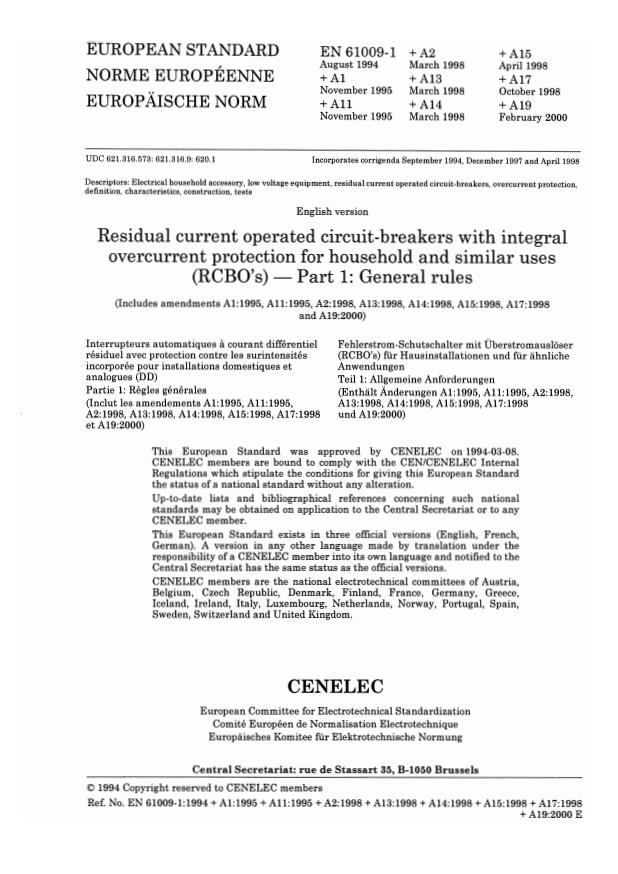
(Main)Electrical accessories - Residual current operated circuit-breakers with integral overcurrent protection for household and similar uses (RCBO's) - Part 1: General rules
General Information
- Abstract
This Standard applies to residual current operated circuit-breakers with integral overcurrent protection functionally independent of, or functionally dependent on, line voltage for household and similar uses (hereafter referred to as RCBO's) for rated voltages not exceeding 440 V a.c., rated currents not exceeding 125A for fixed installation and rated short-circuit capacities not exceeding 25 000 A for operation at 50 Hz or 60 Hz. These devices are intended to protect people against indirect contact, the exposed conductive parts of the installation being connected to an appropriate earth electrode and to protect against overcurrents the wiring installations of buildings and similar applications. They may be used to provide protection against fire hazards due to a persistent earth fault current, without the operation of the overcurrent protective device. RCBO's having a rated residual operating current not exceeding 30 mA are also used as a means for additional protection in the case of failure of the protective means against electric shock. This standard applies to devices performing simultaneously the function of detection of the residual current, of comparison of the value of this current with the residual operating value and of opening of the protected circuit when the residual current exceeds this value, and also of performing the function of making, carrying and breaking overcurrents under specified conditions. Special precautions (e.g. lightning arresters) may be necessary when excessive overvoltages are likely to occur on the supply side (for example in the case of supply through overhead lines). This standard also applies to RCBO's obtained by the assembly of an adaptable residual current device with a circuit-breaker. The mechanical assembly shall be effected in the factory by the manufacturer, or on site, in which case the requirements of annex G shall apply. It also applies to RCBO's having more than one rated current, provided that the means for changing from one discrete rating to another is not accessible in normal service and that the rating cannot be changed without the use of a tool. Supplementary requirements may be necessary for RCBO's of the plug-in type. Particular requirements are necessary for RCBO's integrated in one unit with a socket-outlet or designed exclusively for being associated locally with a socket-outlet in the same mounting box. This standard does not apply to: RCBO's intended to protect motors, RCBO's the current setting of which is adjustable by means accessible to the user in normal service; RCBO's having more than one rated current. The requirements of this standard apply for normal environmental conditions. Additional requirements may be necessary for RCBO's used in locations having severe environmental conditions. RCBO's including batteries are not covered by this standard.
- Status
- Withdrawn
- Publication Date
- 04-Aug-1994
- Withdrawal Date
- 30-Jun-2000
- Technical Committee
- CLC/TC 23E - Circuit breakers and similar devices for household and similar applications
- Drafting Committee
- IEC/SC 23E - IEC_SC_23E
- Parallel Committee
- IEC/SC 23E - IEC_SC_23E
- Current Stage
- 9960 - Withdrawal effective - Withdrawal
- Start Date
- 01-Apr-2009
- Completion Date
- 01-Apr-2009
- Directive
- Not Harmonized2004/108/EC - Directive 2004/108/EC of the European Parliament and of the Council of 15 December 2004 on the approximation of the laws of the Member States relating to electromagnetic compatibility and repealing Directive 89/336/EECOJ Ref: C 126, C 126/1 OJ Date: 05-Jun-2009
Not Harmonized2004/108/EU - DIRECTIVE 2004/108/EC OF THE EUROPEAN PARLIAMENT AND OF THE COUNCIL of 15 December 2004 on the approximation of the laws of the Member States relating to electromagnetic compatibility and repealing Directive 89/336/EECOJ Ref: C 126, C 126/1 OJ Date: 05-Jun-2009
Not Harmonized2006/95/EC - Directive 2006/95/EC of the European Parliament and of the Council of 12 December 2006 on the harmonisation of the laws of Member States relating to electrical equipment designed for use within certain voltage limits (codified version)OJ Ref: C1, C144/1 OJ Date: 10-Jun-2008
Not Harmonized73/23/EEC - Electrical equipment designed for use within certain voltage limitsOJ Ref: C 208
Not Harmonized89/336/EEC - Electromagnetic compatibility (EMC)OJ Ref: C 201/31

Relations
- Effective Date
- 28-Jan-2023
- Effective Date
- 10-Feb-2026
- Effective Date
- 09-Feb-2026
- Effective Date
- 09-Feb-2026
- Effective Date
- 03-Feb-2026
- Effective Date
- 03-Feb-2026
- Effective Date
- 03-Feb-2026
- Effective Date
- 03-Feb-2026
- Effective Date
- 03-Feb-2026
- Effective Date
- 03-Feb-2026
- Effective Date
- 03-Feb-2026
- Effective Date
- 03-Feb-2026
- Effective Date
- 03-Feb-2026
- Effective Date
- 03-Feb-2026
- Effective Date
- 03-Feb-2026
Get Certified
Connect with accredited certification bodies for this standard

IMQ S.p.A. (Certification)
Italian electrical product certification.

SLG Prüf- und Zertifizierungs GmbH
German testing and certification body.

UL Solutions
Global safety science company with testing, inspection and certification.
Sponsored listings
Frequently Asked Questions
EN 61009-1:1994 is a standard published by CLC. Its full title is "Electrical accessories - Residual current operated circuit-breakers with integral overcurrent protection for household and similar uses (RCBO's) - Part 1: General rules". This standard covers: This Standard applies to residual current operated circuit-breakers with integral overcurrent protection functionally independent of, or functionally dependent on, line voltage for household and similar uses (hereafter referred to as RCBO's) for rated voltages not exceeding 440 V a.c., rated currents not exceeding 125A for fixed installation and rated short-circuit capacities not exceeding 25 000 A for operation at 50 Hz or 60 Hz. These devices are intended to protect people against indirect contact, the exposed conductive parts of the installation being connected to an appropriate earth electrode and to protect against overcurrents the wiring installations of buildings and similar applications. They may be used to provide protection against fire hazards due to a persistent earth fault current, without the operation of the overcurrent protective device. RCBO's having a rated residual operating current not exceeding 30 mA are also used as a means for additional protection in the case of failure of the protective means against electric shock. This standard applies to devices performing simultaneously the function of detection of the residual current, of comparison of the value of this current with the residual operating value and of opening of the protected circuit when the residual current exceeds this value, and also of performing the function of making, carrying and breaking overcurrents under specified conditions. Special precautions (e.g. lightning arresters) may be necessary when excessive overvoltages are likely to occur on the supply side (for example in the case of supply through overhead lines). This standard also applies to RCBO's obtained by the assembly of an adaptable residual current device with a circuit-breaker. The mechanical assembly shall be effected in the factory by the manufacturer, or on site, in which case the requirements of annex G shall apply. It also applies to RCBO's having more than one rated current, provided that the means for changing from one discrete rating to another is not accessible in normal service and that the rating cannot be changed without the use of a tool. Supplementary requirements may be necessary for RCBO's of the plug-in type. Particular requirements are necessary for RCBO's integrated in one unit with a socket-outlet or designed exclusively for being associated locally with a socket-outlet in the same mounting box. This standard does not apply to: RCBO's intended to protect motors, RCBO's the current setting of which is adjustable by means accessible to the user in normal service; RCBO's having more than one rated current. The requirements of this standard apply for normal environmental conditions. Additional requirements may be necessary for RCBO's used in locations having severe environmental conditions. RCBO's including batteries are not covered by this standard.
This Standard applies to residual current operated circuit-breakers with integral overcurrent protection functionally independent of, or functionally dependent on, line voltage for household and similar uses (hereafter referred to as RCBO's) for rated voltages not exceeding 440 V a.c., rated currents not exceeding 125A for fixed installation and rated short-circuit capacities not exceeding 25 000 A for operation at 50 Hz or 60 Hz. These devices are intended to protect people against indirect contact, the exposed conductive parts of the installation being connected to an appropriate earth electrode and to protect against overcurrents the wiring installations of buildings and similar applications. They may be used to provide protection against fire hazards due to a persistent earth fault current, without the operation of the overcurrent protective device. RCBO's having a rated residual operating current not exceeding 30 mA are also used as a means for additional protection in the case of failure of the protective means against electric shock. This standard applies to devices performing simultaneously the function of detection of the residual current, of comparison of the value of this current with the residual operating value and of opening of the protected circuit when the residual current exceeds this value, and also of performing the function of making, carrying and breaking overcurrents under specified conditions. Special precautions (e.g. lightning arresters) may be necessary when excessive overvoltages are likely to occur on the supply side (for example in the case of supply through overhead lines). This standard also applies to RCBO's obtained by the assembly of an adaptable residual current device with a circuit-breaker. The mechanical assembly shall be effected in the factory by the manufacturer, or on site, in which case the requirements of annex G shall apply. It also applies to RCBO's having more than one rated current, provided that the means for changing from one discrete rating to another is not accessible in normal service and that the rating cannot be changed without the use of a tool. Supplementary requirements may be necessary for RCBO's of the plug-in type. Particular requirements are necessary for RCBO's integrated in one unit with a socket-outlet or designed exclusively for being associated locally with a socket-outlet in the same mounting box. This standard does not apply to: RCBO's intended to protect motors, RCBO's the current setting of which is adjustable by means accessible to the user in normal service; RCBO's having more than one rated current. The requirements of this standard apply for normal environmental conditions. Additional requirements may be necessary for RCBO's used in locations having severe environmental conditions. RCBO's including batteries are not covered by this standard.
EN 61009-1:1994 is classified under the following ICS (International Classification for Standards) categories: 29.120.50 - Fuses and other overcurrent protection devices. The ICS classification helps identify the subject area and facilitates finding related standards.
EN 61009-1:1994 has the following relationships with other standards: It is inter standard links to EN 61009-1:2004, IEC 60050-441:1984, EN ISO 3680:2004, EN 12629-6:2004, HD 243 S12:1995, EN 60529:1991, EN 60068-2-30:1999, HD 323.2.28 S1:1988, EN 61008-1:1994, HD 472 S1:1989, EN 60947-2:2003, EN 61543:1995, HD 384.7.711 S1:2003, HD 384.4.41 S2:1996, EN 60947-2:1996. Understanding these relationships helps ensure you are using the most current and applicable version of the standard.
EN 61009-1:1994 is associated with the following European legislation: EU Directives/Regulations: 2004/108/EC, 2004/108/EU, 2006/95/EC, 73/23/EEC, 89/336/EEC. When a standard is cited in the Official Journal of the European Union, products manufactured in conformity with it benefit from a presumption of conformity with the essential requirements of the corresponding EU directive or regulation.
EN 61009-1:1994 is available in PDF format for immediate download after purchase. The document can be added to your cart and obtained through the secure checkout process. Digital delivery ensures instant access to the complete standard document.