

EN 60068-2-67:1996/A1:2019
(Amendment)Environmental testing - Part 2-67: Tests - Test Cy: Damp heat, steady state, accelerated test primarily intended for components
General Information
- Abstract
Provides a standard test procedure for the purpose of evaluating the resistance of small electrotechnical products, primarily non-hermetically sealed components, to the deteriorative effect of damp heat. Is not intended to evaluate external effects such as corrosion and deformation.
- Status
- Published
- Publication Date
- 29-Aug-2019
- Withdrawal Date
- 05-Aug-2022
- Technical Committee
- CLC/SR 104 - Environmental conditions, classification and methods of test
- Drafting Committee
- IEC/TC 104 - IEC_TC_104
- Current Stage
- 9093 - Decision to confirm - Review Enquiry
- Start Date
- 05-Jan-2026
- Completion Date
- 25-Aug-2026


Overview
EN 60068-2-67:1996/A1:2019 specifies an environmental test method known as Test Cy: Damp heat, steady state, accelerated test, primarily intended for electronic components. Developed by the European Committee for Electrotechnical Standardization (CENELEC), this standard outlines procedures to evaluate how electronic and electrical components perform under prolonged exposure to high humidity and temperature. The accelerated approach helps manufacturers and quality assurance teams assess component reliability efficiently, supporting compliance with international regulatory and market requirements.
Key Topics
- Damp heat testing: Focuses on exposing components to a controlled environment of elevated temperature and high humidity.
- Accelerated steady-state conditions: The method is designed to shorten test duration while still revealing potential failure modes.
- Suitability for components: Most applicable to individual components rather than finished products or systems.
- Water quality requirements: Distilled or deionised water must be used with specific conductivity parameters (between 5 µS/cm and 20 µS/cm at 23°C) to avoid negative effects like corrosion or limescale.
- Chamber maintenance: All internal parts of test chambers should be thoroughly cleaned before humidification, following guidance in referenced clauses, ensuring test accuracy and repeatability.
Applications
The EN 60068-2-67 standard is vital for organizations involved in the design, manufacturing, and quality assurance of electronic components, including but not limited to:
- Electronic and electrical parts manufacturers verifying product durability for harsh climates or demanding operational environments.
- Research and development labs simulating long-term exposure to moisture and heat to inform material selection and design parameters.
- Certification and compliance testing prior to product launch or market entry in regulated sectors such as automotive, aerospace, telecommunications, and industrial electronics.
- Quality control teams conducting routine or batch testing of components to identify early failures and ensure ongoing process reliability.
By following this standard, companies can reliably identify environmental vulnerabilities, reduce warranty costs, and sustain product performance throughout its intended lifecycle.
Related Standards
EN 60068-2-67:1996/A1:2019 is part of a larger family of environmental testing standards:
- EN 60068 Series: Covers a wide range of environmental testing methods, such as thermal cycling, vibration, and salt mist corrosion.
- IEC 60068-2-67: The international equivalent, harmonized for European use.
- EN 60068-2-78: Deals with damp heat, steady state test for equipment, complementing component-level methods.
- EN 60068-2-30: Another related standard for damp heat, cyclic (12h + 12h) testing.
By adhering to EN 60068-2-67 and related standards, manufacturers ensure their products are robust, reliable, and compliant with international requirements for environmental resistance, greatly contributing to customer satisfaction and market competitiveness.
Relations
- Effective Date
- 09-Feb-2026
- Effective Date
- 03-Feb-2026
- Effective Date
- 03-Feb-2026
- Effective Date
- 03-Feb-2026
- Effective Date
- 11-Apr-2017
- Effective Date
- 03-Jun-2025
Get Certified
Connect with accredited certification bodies for this standard

IMP NDT d.o.o.
Non-destructive testing services. Radiography, ultrasonic, magnetic particle, penetrant, visual inspection.
Inštitut za kovinske materiale in tehnologije
Institute of Metals and Technology. Materials testing, metallurgical analysis, NDT.
Q Techna d.o.o.
NDT and quality assurance specialist. 30+ years experience. NDT personnel certification per ISO 9712, nuclear and thermal power plant inspections, QA/
Sponsored listings
Frequently Asked Questions
EN 60068-2-67:1996/A1:2019 is a amendment published by CLC. Its full title is "Environmental testing - Part 2-67: Tests - Test Cy: Damp heat, steady state, accelerated test primarily intended for components". This standard covers: Provides a standard test procedure for the purpose of evaluating the resistance of small electrotechnical products, primarily non-hermetically sealed components, to the deteriorative effect of damp heat. Is not intended to evaluate external effects such as corrosion and deformation.
Provides a standard test procedure for the purpose of evaluating the resistance of small electrotechnical products, primarily non-hermetically sealed components, to the deteriorative effect of damp heat. Is not intended to evaluate external effects such as corrosion and deformation.
EN 60068-2-67:1996/A1:2019 is classified under the following ICS (International Classification for Standards) categories: 19.040 - Environmental testing. The ICS classification helps identify the subject area and facilitates finding related standards.
EN 60068-2-67:1996/A1:2019 has the following relationships with other standards: It is inter standard links to EN 15267-3:2007, EN 62047-4:2010, EN 61969-1:2012, EN 60252-2:2011, EN 60068-2-67:1996, prEN IEC 60068-2-67:2026. Understanding these relationships helps ensure you are using the most current and applicable version of the standard.
EN 60068-2-67:1996/A1:2019 is available in PDF format for immediate download after purchase. The document can be added to your cart and obtained through the secure checkout process. Digital delivery ensures instant access to the complete standard document.
Standards Content (Sample)
SLOVENSKI STANDARD
01-november-2019
Okoljsko preskušanje - 2-67. del: Preskusi - Preskus Cy: Pospešeno preskušanje z
vlažno vročino, v ustaljenem stanju, predvideno predvsem za komponente -
Dopolnilo A1 (IEC 60068-2-67:1995/A1:2019)
Environmental testing - Part 2-67: Tests - Test Cy: Damp heat, steady state, accelerated
test primarily intended for components (IEC 60068-2-67:1995/A1:2019)
Umgebungseinflüsse - Teil 2-67: Prüfverfahren – Prüfung Cy: Feuchte Wärme, konstant,
beschleunigte Prüfung, vorzugsweise für Bauelemente (IEC 60068-2-67:1995/A1:2019)
Essai d'environnement - Partie 2-67: Essais - Essai Cy: Essai continu de chaleur
humide, essai accéléré applicable en premier lieu aux composants (IEC 60068-2-
67:1995/A1:2019)
Ta slovenski standard je istoveten z: EN 60068-2-67:1996/A1:2019
ICS:
19.040 Preskušanje v zvezi z Environmental testing
okoljem
2003-01.Slovenski inštitut za standardizacijo. Razmnoževanje celote ali delov tega standarda ni dovoljeno.
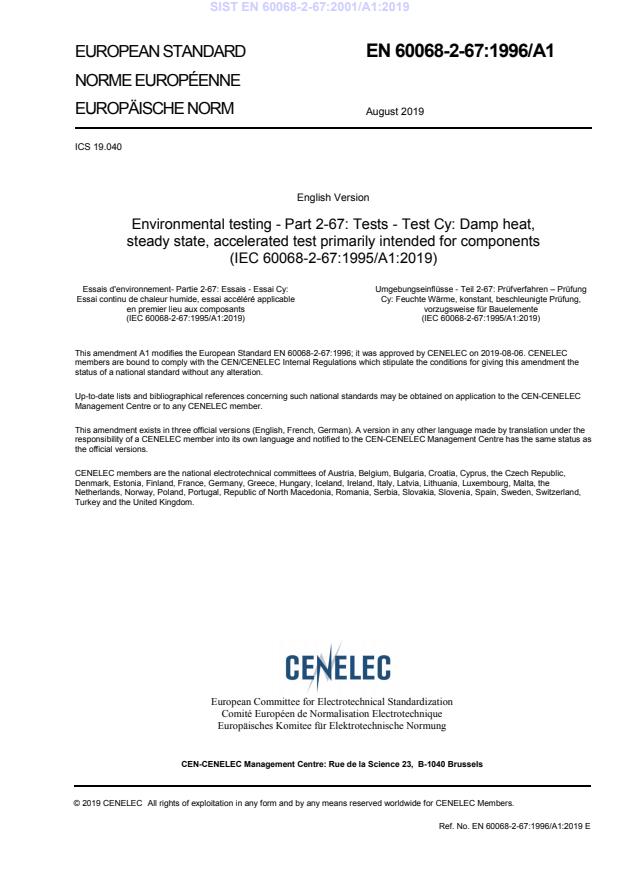
EUROPEAN STANDARD EN 60068-2-67:1996/A1
NORME EUROPÉENNE
EUROPÄISCHE NORM
August 2019
ICS 19.040
English Version
Environmental testing - Part 2-67: Tests - Test Cy: Damp heat,
steady state, accelerated test primarily intended for components
(IEC 60068-2-67:1995/A1:2019)
Essais d'environnement- Partie 2-67: Essais - Essai Cy: Umgebungseinflüsse - Teil 2-67: Prüfverfahren – Prüfung
Essai continu de chaleur humide, essai accéléré applicable Cy: Feuchte Wärme, konstant, beschleunigte Prüfung,
en premier lieu aux composants vorzugsweise für Bauelemente
(IEC 60068-2-67:1995/A1:2019) (IEC 60068-2-67:1995/A1:2019)
This amendment A1 modifies the European Standard EN 60068-2-67:1996; it was approved by CENELEC on 2019-08-06. CENELEC
members are bound to comply with the CEN/CENELEC Internal Regulations which stipulate the conditions for giving this amendment the
status of a national standard without any alteration.
Up-to-date lists and bibliographical references concerning such national standards may be obtained on application to the CEN-CENELEC
Management Centre or to any CENELEC member.
This amendment exists in three official versions (English, French, German). A version in any other language made by translation under the
responsibility of a CENELEC member into its own language and notified to the CEN-CENELEC Management Centre has the same status as
the official versions.
CENELEC members are the national electrotechnical committees of Austria, Belgium, Bulgaria, Croatia, Cyprus, the Czech Republic,
Denmark, Estonia, Finland, France, Germany, Greece, Hungary, Iceland, Ireland, Italy, Latvia, Lithuania, Luxembourg, Malta, the
Netherlands, Norway, Poland, Portugal, Republic of North Macedonia, Romania, Serbia, Slovakia, Slovenia, Spain, Sweden, Switzerland,
Turkey and the United Kingdom.
European Committee for Electrotechnical Standardization
Comité Européen de Normalisation Electrotechnique
Europäisches Komitee für Elektrotechnische Normung
CEN-CENELEC Management Centre: Rue de la Science 23, B-1040 Brussels
© 2019 CENELEC All rights of exploitation in any form and by any means reserved worldwide for CENELEC Members.
Ref. No. EN 60068-2-67:1996/A1:2019 E
European foreword
The text of document 104/831/FDIS, future IEC 60068-2-67/A1, prepared by IEC/TC 104
"Environmental cond
...