

EN 60315-4:1998/A1:2026
(Amendment)Methods of measurement on radio receivers for various classes of emission - Part 4: Receivers for frequency-modulated sound broadcasting emissions
General Information
- Abstract
- Status
- Published
- Publication Date
- 12-Feb-2026
- Current Stage
- 6060 - Document made available - Publishing
- Start Date
- 13-Feb-2026
- Due Date
- 31-Oct-2025
- Completion Date
- 13-Feb-2026

Overview
EN 60315-4:1998/A1:2026 is an international standard from CLC, prepared in alignment with IEC guidelines, that details test methods for evaluating the performance of radio receivers designed for frequency-modulated (FM) sound broadcasting emissions. This standard is critically relevant to manufacturers and testing bodies in the audio, broadcast, and multimedia sectors. The amendment ensures the ongoing relevance and accuracy of testing methods in a landscape influenced by technological advances and regulatory changes.
The main focus is to provide standardized procedures for assessing how FM radio receivers handle selectivity and rejection of adjacent channel signals, using precise measurement techniques. Applying this standard supports international market access and helps guarantee a high quality of service for end users.
Key Topics
EN 60315-4:1998/A1:2026 covers vital aspects in measuring and qualifying FM sound broadcasting receivers, including:
- Selectivity Measurement: Defines test setups for evaluating a receiver's ability to distinguish between the desired (wanted) signal and nearby (unwanted) interfering signals. This involves tests using both sinusoidal signal and coloured noise modulation.
- Signal-to-Interference Ratio (S/I Ratio): Measurement procedures are established to determine the ratio of audio output signals with and without interference, at specific frequency offsets from the wanted signal.
- Adjacent and Alternate Channel Rejection: Procedures for measuring how effectively the receiver rejects signals on frequencies immediately adjacent to, or spaced further apart from, the desired frequency.
- Standard Test Conditions: Specifies the configuration of test equipment, such as combining networks or artificial antennas, and outlines standard modulating signals and test setups to ensure consistent and repeatable results.
- Data Presentation: Guidance on plotting results, showing how the S/I ratio and wanted signal level vary with frequency separation between desired and interfering signals, and how to document and interpret the findings.
Applications
This standard and its amendment are widely adopted in several practical contexts:
- Receiver Manufacturing: Used by radio and audio electronics manufacturers to design and certify FM receivers, ensuring compliance with international requirements on selectivity and interference rejection.
- Quality Assurance and Laboratory Testing: Applied by test laboratories and certification bodies to assess the conformity of new radio receivers before market introduction or regulatory approval.
- Broadcast Engineering: Assists broadcasters, network planners, and frequency managers in understanding the receiver performance required to meet quality of service objectives, particularly in dense signal environments.
- Regulatory Compliance: Provides a harmonized framework for demonstrating that FM receiver products meet technical standards mandated in various jurisdictions, supporting cross-border trade and consumer protection.
Related Standards
The following standards are closely aligned with EN 60315-4:1998/A1:2026 and may be referenced for comprehensive test coverage or specialized measurement techniques:
- IEC 60315-1 - General methods of measurement on radio receivers
- ITU-R BS.468-4 - Standard for measuring audio-frequency interference using specific weighting networks
- EN 55020 / CISPR 20 - Sound and television broadcast receivers and associated equipment - Immunity characteristics
- EN 60065 / IEC 60065 - Audio, video and similar electronic apparatus - Safety requirements
Adopting EN 60315-4:1998/A1:2026 ensures FM radio receivers meet internationally recognized levels of performance, selectivity, and robustness, aiding in device reliability, regulatory conformity, and user satisfaction. This standard remains a cornerstone for those involved in FM receiver production, testing, and certification.
Relations
- Effective Date
- 10-Oct-2023
Get Certified
Connect with accredited certification bodies for this standard

ANCE
Mexican certification and testing association.

Intertek Slovenia
Intertek testing, inspection, and certification services in Slovenia.

LNE (Laboratoire National de Métrologie et d'Essais)
French national laboratory for metrology and testing.
Sponsored listings
Frequently Asked Questions
EN 60315-4:1998/A1:2026 is a amendment published by CLC. Its full title is "Methods of measurement on radio receivers for various classes of emission - Part 4: Receivers for frequency-modulated sound broadcasting emissions". This standard covers: Methods of measurement on radio receivers for various classes of emission - Part 4: Receivers for frequency-modulated sound broadcasting emissions
Methods of measurement on radio receivers for various classes of emission - Part 4: Receivers for frequency-modulated sound broadcasting emissions
EN 60315-4:1998/A1:2026 is classified under the following ICS (International Classification for Standards) categories: 33.160.20 - Radio receivers. The ICS classification helps identify the subject area and facilitates finding related standards.
EN 60315-4:1998/A1:2026 has the following relationships with other standards: It is inter standard links to EN 60315-4:1998. Understanding these relationships helps ensure you are using the most current and applicable version of the standard.
EN 60315-4:1998/A1:2026 is available in PDF format for immediate download after purchase. The document can be added to your cart and obtained through the secure checkout process. Digital delivery ensures instant access to the complete standard document.
Standards Content (Sample)
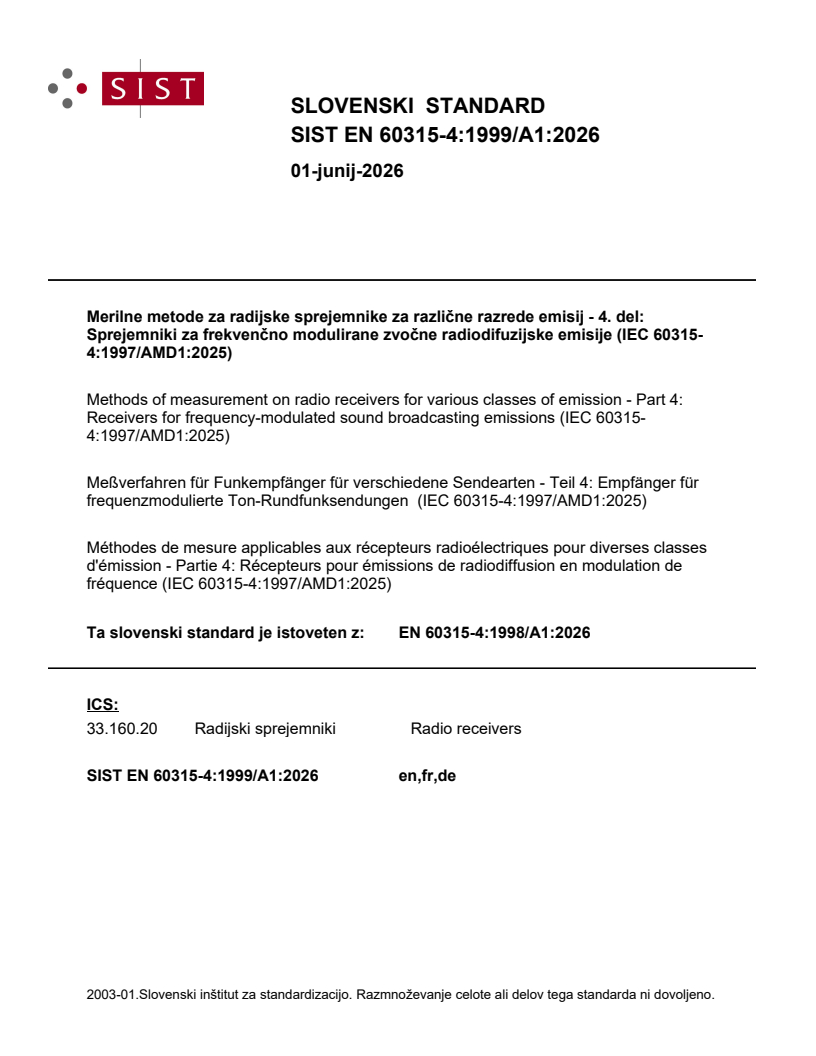
SLOVENSKI STANDARD
01-junij-2026
Merilne metode za radijske sprejemnike za različne razrede emisij - 4. del:
Sprejemniki za frekvenčno modulirane zvočne radiodifuzijske emisije (IEC 60315-
4:1997/AMD1:2025)
Methods of measurement on radio receivers for various classes of emission - Part 4:
Receivers for frequency-modulated sound broadcasting emissions (IEC 60315-
4:1997/AMD1:2025)
Meßverfahren für Funkempfänger für verschiedene Sendearten - Teil 4: Empfänger für
frequenzmodulierte Ton-Rundfunksendungen (IEC 60315-4:1997/AMD1:2025)
Méthodes de mesure applicables aux récepteurs radioélectriques pour diverses classes
d'émission - Partie 4: Récepteurs pour émissions de radiodiffusion en modulation de
fréquence (IEC 60315-4:1997/AMD1:2025)
Ta slovenski standard je istoveten z: EN 60315-4:1998/A1:2026
ICS:
33.160.20 Radijski sprejemniki Radio receivers
2003-01.Slovenski inštitut za standardizacijo. Razmnoževanje celote ali delov tega standarda ni dovoljeno.
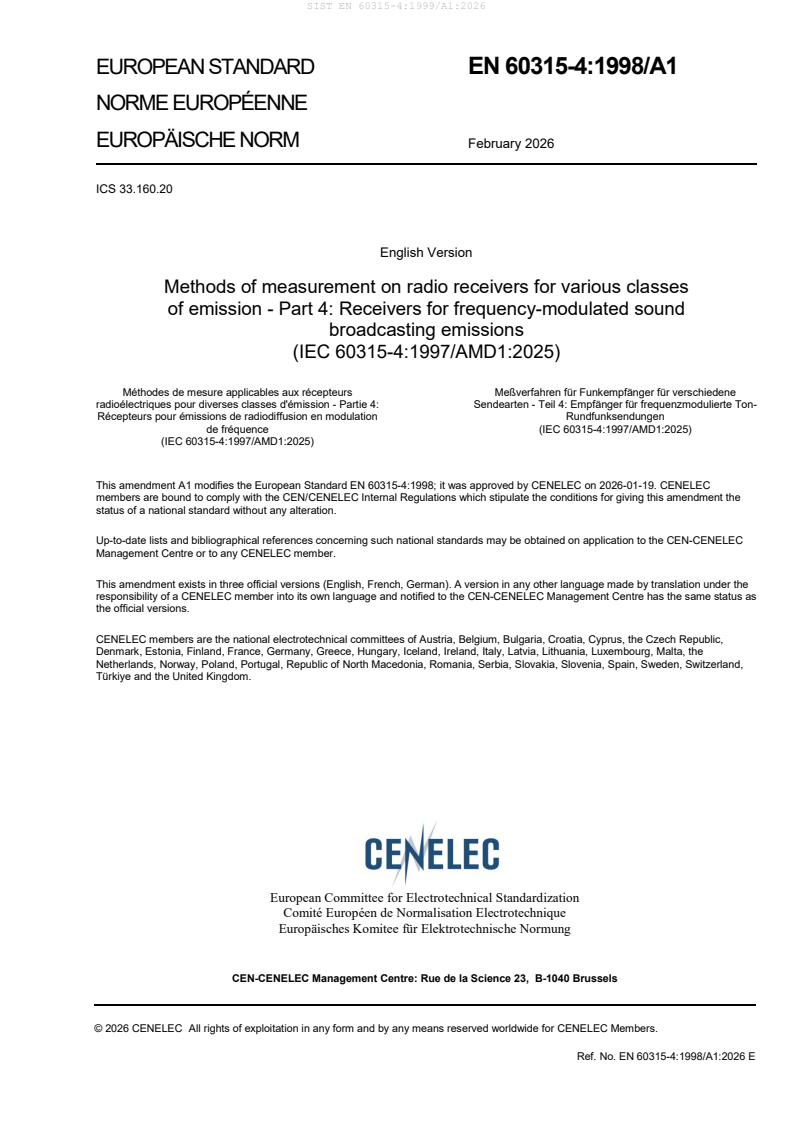
EUROPEAN STANDARD EN 60315-4:1998/A1
NORME EUROPÉENNE
EUROPÄISCHE NORM February 2026
ICS 33.160.20
English Version
Methods of measurement on radio receivers for various classes
of emission - Part 4: Receivers for frequency-modulated sound
broadcasting emissions
(IEC 60315-4:1997/AMD1:2025)
Méthodes de mesure applicables aux récepteurs Meßverfahren für Funkempfänger für verschiedene
radioélectriques pour diverses classes d'émission - Partie 4: Sendearten - Teil 4: Empfänger für frequenzmodulierte Ton-
Récepteurs pour émissions de radiodiffusion en modulation Rundfunksendungen
de fréquence (IEC 60315-4:1997/AMD1:2025)
(IEC 60315-4:1997/AMD1:2025)
This amendment A1 modifies the European Standard EN 60315-4:1998; it was approved by CENELEC on 2026-01-19. CENELEC
members are bound to comply with the CEN/CENELEC Internal Regulations which stipulate the conditions for giving this amendment the
status of a national standard without any alteration.
Up-to-date lists and bibliographical references concerning such national standards may be obtained on application to the CEN-CENELEC
Management Centre or to any CENELEC member.
This amendment exists in three official versions (English, French, German). A version in any other language made by translation under the
responsibility of a CENELEC member into its own language and notified to the CEN-CENELEC Management Centre has the same status as
the official versions.
CENELEC members are the national electrotechnical committees of Austria, Belgium, Bulgaria, Croatia, Cyprus, the Czech Republic,
Denmark, Estonia, Finland, France, Germany, Greece, Hungary, Iceland, Ireland, Italy, Latvia, Lithuania, Luxembourg, Malta, the
Netherlands, Norway, Poland, Portugal, Republic of North Macedonia, Romania, Serbia, Slovakia, Slovenia, Spain, Sweden, Switzerland,
Türkiye and the United Kingdom.
European Committee for Electrotechnical Standardization
Comité Européen de Normalisation Electrotechnique
Europäisches Komitee für Elektrotechnische Normung
CEN-CENELEC Management Centre: Rue de la Science 23, B-1040 Brussels
© 2026 CENELEC All rights of exploitation in any form and by any means reserved worldwide for CENELEC Members.
Ref. No. EN 60315-4:1998/A1:2026 E
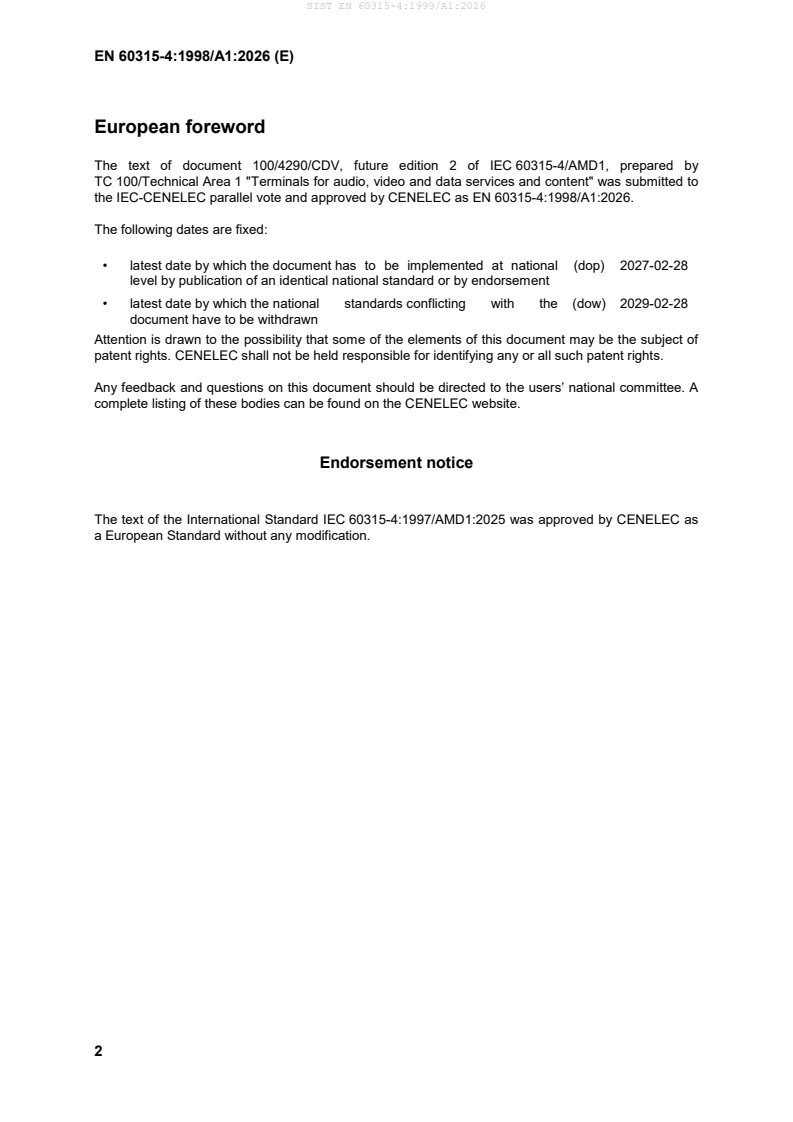
European foreword
The text of document 100/4290/CDV, future edition 2 of IEC 60315-4/AMD1, prepared by
TC 100/Technical Area 1 "Terminals for audio, video and data services and content" was submitted to
the IEC-CENELEC parallel vote and approved by CENELEC as EN 60315-4:1998/A1:2026.
The following dates are fixed:
• latest date by which the document has to be implemented at national (dop) 2027-02-28
level by publication of an identical national standard or by endorsement
• latest date by which the national standards conflicting with the (dow) 2029-02-28
document have to be withdrawn
Attention is drawn to the possibility that some of the elements of this document may be the subject of
patent rights. CENELEC shall not be held responsible for identifying any or all such patent rights.
Any feedback and questions on this document should be directed to the users’ national committee. A
complete listing of these bodies can be found on the CENELEC website.
Endorsement notice
The text of the International Standard IEC 60315-4:1997/AMD1:2025 was approved by CENELEC as
a European Standard without any modification.
IEC 60315-4 ®
Edition 2.0 2025-12
INTERNATIONAL
STANDARD
AMENDMENT 1
Methods of measurement on radio receivers for various classes of emission -
Part 4: Receivers for frequency-modulated sound broadcasting emissions
ICS 33.160.20 ISBN 978-2-8327-0901-6
IEC 60315-4:1997-11/AMD1:2025-12(en)
IEC 60315-4:1997/AMD1:2025 © IEC 2025
INTERNATIONAL ELECTROTECHNICAL COMMISSION
____________
Methods of measurement on radio receivers
for various classes of emission -
Part 4: Receivers for frequency-modulated sound broadcasting emissions
AMENDMENT 1
FOREWORD
1) The International Electrotechnical Commission (IEC) is a worldwide organization for standardization comprising
all national electrotechnical committees (IEC National Committees). The object of IEC is to promote international
co-operation on all questions concerning standardization in the electrical and electronic fields. To this end and
in addition to other activities, IEC publishes International Standards, Technical Specifications, Technical Reports,
Publicly Available Specifications (PAS) and Guides (hereafter referred to as "IEC Publication(s)"). Their
preparation is entrusted to technical committees; any IEC National Committee interested in the subject dealt with
may participate in this preparatory work. International, governmental and non-governmental organizations liaising
with the IEC also participate in this preparation. IEC collaborates closely with the International Organization for
Standardization (ISO) in accordance with conditions determined by agreement between the two organizations.
2) The formal decisions or agreements of IEC on technical matters express, as nearly as possible, an international
consensus of opinion on the relevant subjects since each technical committee has representation from all
interested IEC National Committees.
3) IEC Publications have the form of recommendations for international use and are accepted by IEC National
Committees in that sense. While all reasonable efforts are made to ensure that the technical content of IEC
Publications is accurate, IEC cannot be held responsible for the way in which they are used or for any
misinterpretation by any end user.
4) In order to promote international uniformity, IEC National Committees undertake to apply IEC Publications
transparently to the maximum extent possible in their national and regional publications. Any divergence between
any IEC Publication an
...