


EN 60794-3:2002
(Main)Optical fibre cables - Part 3: Sectional specification - Outdoor cables
General Information
- Abstract
Specifies the requirements of single-mode optical fibre cables and cable elements primarily for public telecommunications networks. Other applications are considered. It includes requirements for cables in ducts, for directly buried application, aerial cables and cables for lake and river crossings. For aerial application, it does not cover all functional aspects of cables installed near overhead power lines. For lake and river crossings, it does not cover cable repair nor cables for use with underwater line amplifiers.
- Status
- Withdrawn
- Publication Date
- 21-Mar-2002
- Withdrawal Date
- 28-Feb-2005
- Technical Committee
- CLC/TC 86A - Optical fibres and optical fibre cables
- Drafting Committee
- IEC/SC 86A - IEC_SC_86A
- Parallel Committee
- IEC/SC 86A - IEC_SC_86A
- Current Stage
- 9960 - Withdrawal effective - Withdrawal
- Start Date
- 14-Oct-2017
- Completion Date
- 14-Oct-2017

Relations
- Effective Date
- 29-Jan-2023
- Replaced By
EN 60794-3:2015 - Optical fibre cables - Part 3: Sectional specification - Outdoor cables - Effective Date
- 28-Jan-2023
- Effective Date
- 09-Feb-2026
- Effective Date
- 03-Feb-2026
- Effective Date
- 03-Feb-2026
- Effective Date
- 03-Feb-2026
- Effective Date
- 03-Feb-2026
- Effective Date
- 03-Feb-2026
- Effective Date
- 03-Feb-2026
- Effective Date
- 03-Feb-2026
- Effective Date
- 03-Feb-2026
- Effective Date
- 03-Feb-2026
- Effective Date
- 03-Feb-2026
- Effective Date
- 03-Feb-2026
- Effective Date
- 03-Feb-2026
Get Certified
Connect with accredited certification bodies for this standard

ANCE
Mexican certification and testing association.

Intertek Slovenia
Intertek testing, inspection, and certification services in Slovenia.

LNE (Laboratoire National de Métrologie et d'Essais)
French national laboratory for metrology and testing.
Sponsored listings
Frequently Asked Questions
EN 60794-3:2002 is a standard published by CLC. Its full title is "Optical fibre cables - Part 3: Sectional specification - Outdoor cables". This standard covers: Specifies the requirements of single-mode optical fibre cables and cable elements primarily for public telecommunications networks. Other applications are considered. It includes requirements for cables in ducts, for directly buried application, aerial cables and cables for lake and river crossings. For aerial application, it does not cover all functional aspects of cables installed near overhead power lines. For lake and river crossings, it does not cover cable repair nor cables for use with underwater line amplifiers.
Specifies the requirements of single-mode optical fibre cables and cable elements primarily for public telecommunications networks. Other applications are considered. It includes requirements for cables in ducts, for directly buried application, aerial cables and cables for lake and river crossings. For aerial application, it does not cover all functional aspects of cables installed near overhead power lines. For lake and river crossings, it does not cover cable repair nor cables for use with underwater line amplifiers.
EN 60794-3:2002 is classified under the following ICS (International Classification for Standards) categories: 33.180.10 - Fibres and cables. The ICS classification helps identify the subject area and facilitates finding related standards.
EN 60794-3:2002 has the following relationships with other standards: It is inter standard links to EN 60794-3:1998, EN 60794-3:2015, EN 159:1991, EN 60794-1-1:1999, EN 60793-1-32:2003, HD 402 S2:1984, EN 60794-1-2:1999, EN 60793-1-21:2002, EN 60793-1-44:2002, EN 60793-1-40:2003, EN 60811-5-1:1999, EN 60793-1-48:2003, EN 60794-3-10:2015, EN 60794-5:2007, EN 60794-3-60:2008. Understanding these relationships helps ensure you are using the most current and applicable version of the standard.
EN 60794-3:2002 is available in PDF format for immediate download after purchase. The document can be added to your cart and obtained through the secure checkout process. Digital delivery ensures instant access to the complete standard document.
Standards Content (Sample)
2003-01.Slovenski inštitut za standardizacijo. Razmnoževanje celote ali delov tega standarda ni dovoljeno.Optical fibres cables -- Part 3: Sectional specification - Outdoor cabless (IEC 60794-3:2001)Lichtwellenleiterkabel - Teil 3: Rahmenspezifikation - Außenkabel (IEC 60794-3:2001)Câbles à fibres optiques - Partie 3: Spécification intermédiaire - Câbles extérieurs (IEC 60794-3:2001)Optical fibres cables - Part 3: Sectional specification - Outdoor cables (IEC 60794-3:2001)33.180.10Fibres and cablesICS:Ta slovenski standard je istoveten z:EN 60794-3:2002SIST EN 60794-3:2004en01-oktober-2004SIST EN 60794-3:2004SLOVENSKI
STANDARDSIST EN 60794-3:20011DGRPHãþD
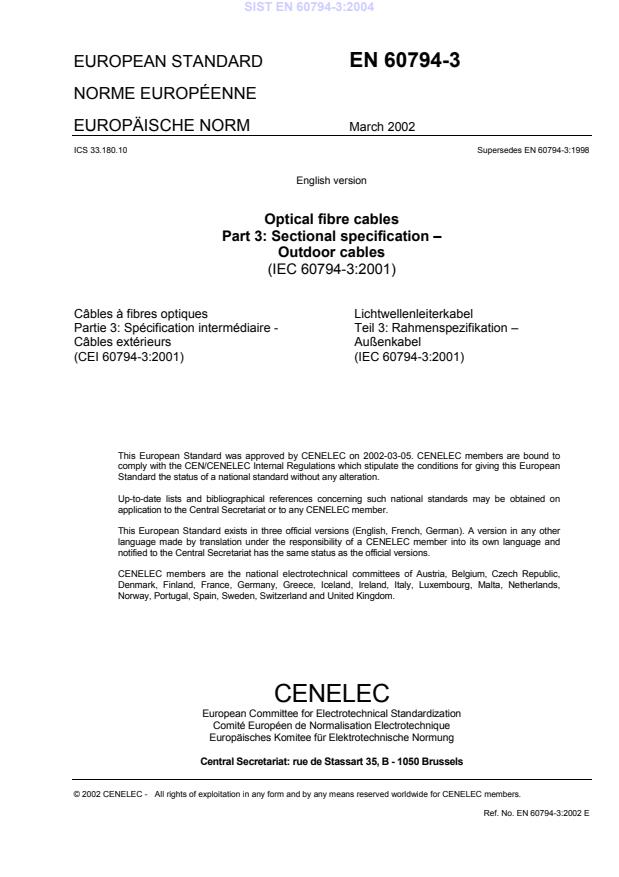
EUROPEAN STANDARDEN 60794-3NORME EUROPÉENNEEUROPÄISCHE NORMMarch 2002CENELECEuropean Committee for Electrotechnical StandardizationComité Européen de Normalisation ElectrotechniqueEuropäisches Komitee für Elektrotechnische NormungCentral Secretariat: rue de Stassart 35, B - 1050 Brussels© 2002 CENELEC -All rights of exploitation in any form and by any means reserved worldwide for CENELEC members.Ref. No. EN 60794-3:2002 EICS 33.180.10Supersedes EN 60794-3:1998English versionOptical fibre cablesPart 3: Sectional specification –Outdoor cables(IEC 60794-3:2001)Câbles à fibres optiquesPartie 3: Spécification intermédiaire -Câbles extérieurs(CEI 60794-3:2001)LichtwellenleiterkabelTeil 3: Rahmenspezifikation –Außenkabel(IEC 60794-3:2001)This European Standard was approved by CENELEC on 2002-03-05. CENELEC members are bound tocomply with the CEN/CENELEC Internal Regulations which stipulate the conditions for giving this EuropeanStandard the status of a national standard without any alteration.Up-to-date lists and bibliographical references concerning such national standards may be obtained onapplication to the Central Secretariat or to any CENELEC member.This European Standard exists in three official versions (English, French, German). A version in any otherlanguage made by translation under the responsibility of a CENELEC member into its own language andnotified to the Central Secretariat has the same status as the official versions.CENELEC members are the national electrotechnical committees of Austria, Belgium, Czech Republic,Denmark, Finland, France, Germany, Greece, Iceland, Ireland, Italy, Luxembourg, Malta, Netherlands,Norway, Portugal, Spain, Sweden, Switzerland and United Kingdom.SIST EN 60794-3:2004
- 3 -EN 60794-3:2002Annex ZA(normative)Normative references to international publicationswith their corresponding European publicationsThis European Standard incorporates by dated or undated reference, provisions from otherpublications. These normative references are cited at the appropriate places in the text and thepublications are listed hereafter. For dated references, subsequent amendments to or revisions of anyof these publications apply to this European Standard only when incorporated in it by amendment orrevision. For undated references the latest edition of the publication referred to applies (includingamendments).NOTEWhen an international publication has been modified by common modifications, indicated by (mod), the relevantEN/HD applies.PublicationYearTitleEN/HDYearIEC 60189SeriesLow-frequency cables and wires withPVC insulation and PVC sheath--IEC 603041982Standard colours for insulation for low-frequency cables and wiresHD 402 S21984IEC 60708-11981Low-frequency cables with polyolefininsulation and moisture barrier polyolefinsheathPart 1: General design details andrequirements--IEC 60793SeriesOptical fibresEN 60793SeriesIEC 60793-1-212001Part 1-21: Measurement methods andtest procedures - Coating geometryEN 60793-1-212002IEC 60793-1-322001Part 1-32: Measurement methods andtest procedures - Coating strippabilityEN 60793-1-32- 1)IEC 60793-1-402001Part 1-40: Measurement methods andtest procedures – AttenuationEN 60793-1-40- 1)IEC 60793-1-442001Part 1-44: Measurement methods andtest procedures - Cut-off wavelengthEN 60793-1-442002IEC 60793-21998Part 2: Product specifications--IEC 60794-1-11999Optical fibre cablesPart 1-1: Generic specification - GeneralEN 60794-1-11999 2)IEC 60794-1-21999Part 1-2: Generic specification - Basicoptical cable test proceduresEN 60794-1-21999
1) To be published.2) EN 60794-1-1:1999 is superseded by EN 60794-1-1:2002 based on IEC 60794-1-1:2001.SIST EN 60794-3:2004
NORMEINTERNATIONALECEIIECINTERNATIONALSTANDARD60794-3Troisième éditionThird edition2001-09Câbles à fibres optiques –Partie 3:Spécification intermédiaire –Câbles extérieursOptical fibre cables –Part 3:Sectional specification –Outdoor cables Commission Electrotechnique Internationale International Electrotechnical CommissionPour prix, voir catalogue en vigueurFor price, see current catalogue IEC 2001
Droits de reproduction réservés
Copyright - all rights reservedAucune partie de cette publication ne peut être reproduite niutilisée sous quelque forme que ce soit et par aucun procédé,électronique ou mécanique, y compris la photocopie et lesmicrofilms, sans l'accord écrit de l'éditeur.No part of this publication may be reproduced or utilized inany form or by any means, electronic or mechanical,including photocopying and microfilm, without permission inwriting from the publisher.International Electrotechnical Commission3, rue de Varembé
Geneva, SwitzerlandTelefax: +41 22 919 0300e-mail: inmail@iec.ch IEC web site
http://www.iec.chCODE PRIXPRICE CODEUSIST EN 60794-3:2004
60794-3 © IEC:2001– 3 –CONTENTSFOREWORD.71Scope.112Normative references.113Terms and definitions.134Symbols and abbreviations.155Optical fibre.155.1General.155.2Attenuation.155.2.1Attenuation coefficient.155.2.2Attenuation uniformity – Attenuation discontinuities.155.3Cut-off wavelength.155.4Fibre colouring.155.5Polarisation mode dispersion (PMD).155.6Jumper cable cut-off wavelength.176Cable element.176.1Tight secondary coating or buffer.196.2Ruggedized fibre.196.3Slotted core.196.4Tube.196.5Ribbon.197Optical fibre cable construction.217.1General.217.2Lay-up of the cable elements.237.3Cable core filling.237.4Strength member.257.5Moisture barrier.257.6Cable sheath and armouring.257.6.1Inner sheath.257.6.2Armouring.277.6.3Outer sheath.277.6.4Outer protection of cables for lake and river crossings.277.7Sheath marking.277.8Hydrogen gas.278Installation and operating conditions.278.1General.278.2Characterisation of cable elements for splicing purposes.298.2.1General purpose tests.298.2.2Tests applicable to tubes.298.2.3Tests applicable to ribbons.29SIST EN 60794-3:2004
60794-3 © IEC:2001– 5 –9Optical fibre cable tests.359.1Tensile performance.359.2Installation capability.359.2.1Bending under tension.359.2.2Repeated bending.359.2.3Impact.359.2.4Kink.359.2.5Torsion.359.2.6Hydrostatic pressure.359.2.7Coiling performance.379.2.8Sheath abrasion resistance.379.3Cable bend.379.4Crush.379.5Temperature cycling.379.6Ageing.379.6.1Fibre coating compatibility.379.6.2Finished cable.379.7Water penetration (for filled cables only).379.8Pneumatic resistance (for unfilled cables only).399.9Lightning (for cables containing metallic elements).399.10Special aerial installation conditions.399.10.1Aeolian vibration.399.10.2Shotgun resistance.3910Quality assurance.39Annex A (informative)
Guide to the statistical specification of polarisation modedispersion of optical fibre cables.41A.1Introductory remarks.41A.2Apparatus.43A.3Test sample.43A.4Test procedure.43A.5Calculations.43A.5.1Concatenation of individual cable sections.43A.5.2Method 1: PMD design value.45A.5.3Method 2: Maximum DGD.51A.5.4Relation between method 1 link PMD and digital system performance.55A.6Results.57A.6.1Information to be provided with each test.57A.6.2Information to be provided upon request.57A.7Reference documents.59Figure 1 – Cross-section of a typical edge-bonded ribbon.21Figure 2 – Cross-section of a typical encapsulated ribbon.21Figure 3 – Cross-sectional drawing illustrating fibre ribbon geometry.31Figure A.1 – Equivalence envelopes using gamma.55Table 1 – Maximum dimensions of optical fibre ribbons.31SIST EN 60794-3:2004
60794-3 © IEC:2001– 7 –INTERNATIONAL ELECTROTECHNICAL COMMISSION____________OPTICAL FIBRE CABLES –Part 3: Sectional specification –Outdoor cablesFOREWORD1)The IEC (International Electrotechnical Commission) is a worldwide organization for standardization comprisingall national electrotechnical committees (IEC National Committees). The object of the IEC is to promoteinternational co-operation on all questions concerning standardization in the electrical and electronic fields. Tothis end and in addition to other activities, the IEC publishes International Standards. Their preparation isentrusted to technical committees; any IEC National Committee interested in the subject dealt with mayparticipate in this preparatory work. International, governmental and non-governmental organizations liaisingwith the IEC also participate in this preparation. The IEC collaborates closely with the InternationalOrganization for Standardization (ISO) in accordance with conditions determined by agreement between thetwo organizations.2)The formal decisions or agreements of the IEC on technical matters express, as nearly as possible, aninternational consensus of opinion on the relevant subjects since each technical committee has representationfrom all interested National Committees.3)The documents produced have the form of recommendations for international use and are published in the formof standards, technical specifications, technical reports or guides and they are accepted by the NationalCommittees in that sense.4)In order to promote international unification, IEC National Committees undertake to apply IEC InternationalStandards transparently to the maximum extent possible in their national and regional standards. Anydivergence between the IEC Standard and the corresponding national or regional standard shall be clearlyindicated in the latter.5)The IEC provides no marking procedure to indicate its approval and cannot be rendered responsible for anyequipment declared to be in conformity with one of its standards.6)Attention is drawn to the possibility that some of the elements of this International Standard may be the subjectof patent rights. The IEC shall not be held responsible for identifying any or all such patent rights.International Standard IEC 60794-3 has been prepared by subcommittee 86A: Fibres andcables, of IEC technical committee 86: Fibre optics.This third edition cancels and replaces the second edition, published in 1998, and constitutesa technical revision.The text of this standard is based on the following documents:FDISReport on voting86A/684/FDIS86A/723/RVDFull information on the voting for the approval of this standard can be found in the report onvoting indicated in the above table.This publication has been drafted in accordance with the ISO/IEC Directives, Part 2.Annex A is for information only.SIST EN 60794-3:2004
60794-3 © IEC:2001– 9 –IEC 60794 consists of the following parts under the general title Optical fibre cables:– Part 1-1: Generic specification – General– Part 1-2: Generic specification – Basic optical cable test procedures– Part 2: Product specification– Part 3: Sectional specification – Outdoor cables– Part 4-1: Aerial optical cables for high-voltage power linesThe committee has decided that the contents of this publication will remain unchanged until 2005.At this date, the publication will bereconfirmed;withdrawn;replaced by a revised edition, oramended.SIST EN 60794-3:2004
60794-3 © IEC:2001– 11 –OPTICAL FIBRE CABLES –Part 3: Sectional specification –Outdoor cables1 ScopeThis part of IEC 60794 specifies the requirements of single-mode optical fibre cables andcable elements which are intended to be used primarily in public telecommunicationsnetworks. Other types of applications requiring similar types of cables can be considered.Requirements for cables to be used in ducts, for directly buried application, aerial cables andcables for lake and river crossings are included in this standard.For aerial application, this standard does not cover all functional aspects of cables installed inthe vicinity of overhead power lines. In the case of such application, additional requirementsand test methods may be necessary. Moreover, this standard excludes optical ground wiresand cables attached to the phase or earth conductors of overhead power lines.For cables for lake and river crossings, this standard does not cover methods of cable repair,nor repair capability, nor does it cover cables for use with underwater line amplifiers.2 Normative referencesThe following referenced documents are indispensable for the application of this document.For dated references, only the edition cited applies. For undated references, the latest editionof the referenced document (including any amendments) applies.IEC 60189 (all parts), Low-frequency cables and wires with PVC insulation and PVC sheathIEC 60304:1982, Standard colours for insulation for low-frequency cables and wiresIEC 60708-1:1981, Low-frequency cables with polyolefin insulation and moisture barrierpolyolefin sheath – Part 1: General design details and requirementsIEC 60793 (all parts), Optical fibresIEC 60793-1-21:2001, Optical fibres – Part 1-21: Measurement and test procedures – Coatinggeometry measuring methodsIEC 60793-1-32:2001, Optical fibres – Part 1-32: Measurement and test procedures – CoatingstrippabilityIEC 60793-1-40:2001, Optical fibres – Part 1-40: Attenuation measurement methodsIEC 60793-1-44:2001, Optical fibres – Part 1-44: Cut-off wavelength measurement methodsSIST EN 60794-3:2004
60794-3 © IEC:2001– 13 –IEC 60793-2:1998, Optical fibres – Part 2: Product specificationsIEC 60794-1-1:1999, Optical fibre cables – Part 1-1: Generic specification – GeneralIEC 60794-1-2:1999, Optical fibre cables – Part 1-2: Generic specification – Basic opticalcable test proceduresIEC 60811-5-1:1990, Common test methods for insulating and sheathing materials of electriccables – Part 5: Methods specific to filling compounds – Section 1: Drop point – Separationof oil – Lower temperature brittleness – Total acid number – Absence of corrosivecomponents – Permittivity at 23 °C – DC resistivity at 23 °C and 100 °CIEC/TR 61282-3:2001, Guidelines for the calculation of PMD in fibre optic systemsIEC/TS 61941:2000, Optical fibres – Polarization mode dispersion measurement techniquesfor single-mode optical fibresITU-T Recommendation K.25:2000, Protection of optical fibre cables3 Terms and definitionsFor the purpose of this part of IEC 60794, the following terms and definitions apply.3.1differential group delay, psDGDrelative time delay between the two fundamental polarisation modes (principal states ofpolarisation) at the end of an optical fibre cable, at a particular time and wavelength3.2polarisation mode dispersion value, psPMD valueaverage of DGD values across wavelengths3.3polarisation mode dispersion coefficient, ps/√kmPMD coefficientPMD value of an optical fibre cable divided by the square root of its length (km)3.4cable sectionindividual reel of cable, as produced3.5linklength of cable composed of a number of individual cable sectionsNOTE
Link PMD values are generally calculated according to the formulas in this standard but may be measured.SIST EN 60794-3:2004
60794-3 © IEC:2001– 15 –4 Symbols and abbreviationsλccCabled fibre cut-off wavelengthSZTechnique in which the lay reverses direction periodically5 Optical fibre5.1 GeneralSingle-mode optical fibre which meets the requirements of IEC 60793-2 shall be used.5.2 Attenuation5.2.1 Attenuation coefficientThe typical maximum attenuation coefficient of a cable is dependent on the fibre type(s) used.Typical values are shown in 5.1 of IEC 60794-1-1. Particular values shall be agreed betweenthe user and the manufacturer.The attenuation coefficient shall be measured in accordance with method A, B or C ofIEC 60793-1-40.5.2.2 Attenuation uniformity – Attenuation discontinuitiesThe local attenuation shall not have point discontinuities in excess of 0,10 dB. The testmethod best suited to provide the functional requirements is under consideration.5.3 Cut-off wavelengthThe cabled fibre cut-off wavelength, λcc, shall be less than the operational wavelength.5.4 Fibre colouringIf the primary coated fibres are coloured for identification, the coloured coating shall bereadily identifiable throughout the lifetime of the cable and shall be a reasonable match toIEC 60304. If required, the colouring shall permit sufficient light to be transmitted through theprimary coating to allow local light injection and detection. Alternatively, the colour may beremoved for this application.5.5 Polarisation mode dispersion (PMD)Cabled fibre PMD shall be specified/characterised on a statistical basis, not on an individualfibre basis, as described in annex A. Measurements on individual cabled fibres may beperformed by any of the PMD measurement methods recognised by the IEC. Measurementson uncabled fibre can be used to generate cabled fibre statistics when the design andprocesses are stable and the relationship between the PMD coefficients of uncabled andcabled fibre are known. The following requirements pertain only to the aspect of the linkcalculated from cable information. To combine this information with other parts of the link,such as components and optical amplifiers, reference should be made to IEC 61282-3.SIST EN 60794-3:2004
60794-3 © IEC:2001– 17 –One of the following two methods shall be used to specify/characterise PMD. The methodchosen shall be agreed upon between the buyer and the cable manufacturer.a)Method 1The manufacturer shall supply a PMD design value, PMDQ, that serves as a statisticalupper bound PMD coefficient of the concatenated optical fibre cables within a possibleoptical link. Unless otherwise specified in the detail specification, the PMDQ value shall beless than 0,5 ps/km1/2 with a probability of 10–4 that this value be exceeded for anumerical concatenation of at least 20 cables. The value shall be computed using amethod agreed upon between the buyer and cable manufacturer. The relationship betweenthis PMD design value and the performance of a digital transmission system is discussedin annex A.b)Method 2Provide cabled fibre with a low probability, PF, that the instantaneous end-to-end PMD at agiven wavelength exceeds a given value, Itot. The probability, PF, shall be calculated for a400 km concatenated reference link comprised of 40 cable sections. The values for PF andItot, and the particular statistical methodology shall be agreed between the buyer and thecable manufacturer. Unless otherwise specified in the detail specification, PF ≤ 6,5 × 10⁻⁸for Itot = 25 ps.NOTE
PF ≤ 6,5 × 10⁻⁸ for Itot = 25 ps corresponds to time over 25 ps equal to 0,002 min/year/km/circuit.5.6 Jumper cable cut-off wavelengthIf specified, the cut-off wavelength for jumper cables (λcj) shall be measured in accordancewith IEC 60793-1-44, using a loop bend diameter of X mm. This jumper cable cut-offwavelength shall be less than the operational wavelength. (Lower values may be required forapplications using jumper lengths of less than 2 m.)NOTE
Some administrations specify X = 152 mm.6 Cable elementGenerally, optical cables comprise several elements or individual constituents, depending onthe cable design which takes into account the cable application, operating environment andmanufacturing processes, as well as the need to protect the fibre during handling and cabling.The material(s) used for a cable element shall be selected so as to be compatible with theother elements in contact with it. An appropriate compatibility test method shall be defined inthe family or detail specification.Optical elements are cable elements containing optical fibres and are designed to be aprimary functional unit of the cable core. They may comprise any of the cable elementsdescribed below. Optical elements and each fibre within a cable element shall be uniquelyidentified, for example, by colours, by a positional scheme, by markings or as specified in thedetail specification.Tests may be performed on cable elements either in uncabled form or in finished cable.Unless otherwise specified, testing shall be performed on cable elements in a finished cable.(This means that testing shall be performed only on a finished cable if the cable elementmanufacturing operation is done by the same manufacturer as the cabling operation. Testingshall be performed on cable elements only if the cable element is supplied by a third party;this does not exclude testing of the finished cable.)SIST EN 60794-3:2004
60794-3 © IEC:2001– 19 –Different types of optical elements are described below.6.1 Tight secondary coating or bufferIf a tight secondary coating is required, it shall consist of one or more layers of polymericmaterial. The coating shall be easily removable for fibre splicing. The nominal overalldiameter of the secondary coating shall be between 800 µm and 900 µm. The value, whichshall be agreed between the user and the manufacturer, shall have a tolerance of ±50 µm.The fibre/secondary coating eccentricity shall not exceed 75 µm unless otherwise agreedbetween the user and the manufacturer.The colour of the tight secondary coating shall be readily identifiable throughout the lifetime ofthe cable.6.2 Ruggedized fibreFurther protection can be provided to tight secondary coated fibres by surrounding one ormore with non-metallic strength members within a sheath of suitable material (for example, forfan-out cables).6.3 Slotted coreThe slotted core is obtained by extruding a suitable material (for example, polyethylene orpolypropylene) with a defined number of slots, providing helical or SZ configuration along thecore. One or more primary coated fibres or optical elements are located in each slot that maybe filled.The slotted core usually contains a central element, which may be either metallic or non-metallic. In this case, there shall be adequate adhesion between the central element and theextruded core in order to obtain the required temperature stability and tensile behaviour forthe slotted core element.The profile of the slot shall be uniform and shall ensure the optical and mechanicalperformance required of the optical cable.6.4 TubeOne or more primary coated fibres or other optical elements are packaged (loosely or not) in atube construction that may be filled. The tube may be reinforced with a composite wall.If required, the suitability of the tube shall be determined by an evaluation of its kinkresistance in accordance with method G7 of IEC 60794-1-2.The filling compound in the tube shall comply with method E14 or method E15 of IEC 60794-1-2.6.5 RibbonOptical fibre ribbons are optical fibres assembled in a composite linear array.Fibres shall be arranged in parallel and formed into ribbons of typically 2, 4, 6, 8, 10, 12 or 24fibres each according to user requirements. The fibres within the ribbons shall remain paralleland not cross over.SIST EN 60794-3:2004
60794-3 © IEC:2001– 21 –The design intent is that adjacent fibres within a ribbon are contiguous and that fibre centrelines are straight, parallel and coplanar.Unless otherwise specified, each ribbon shall be uniquely identified with a printed legend orby uniquely colouring the reference fibre in the ribbon and/or by colouring the matrix materialof the ribbon.Ribbon structures are typically designated as either edge-bonded or encapsulated, dependingon the amount of buffering afforded the fibres by the bonding agent.Figure 1 illustrates the edge-bonded structure in which the bonding agent is appliedpredominantly between the fibres. Figure 2 illustrates the encapsulated structure in which thebonding agent extends well beyond the extreme surface of any fibre. Both ribbon structuresare capable of meeting the requirements of this standard.orIEC
1401/01Figure 1 – Cross-section of a typical edge-bonded ribbonIEC
1402/01Figure 2 – Cross-section of a typical encapsulated ribbonSome parameters shall be measured in the ribbon since the corresponding tests on theprimary coated fibre or finished cable are not sufficient for complete characterisation. Theseparameters are identified below.7 Optical fibre cable construction7.1 GeneralThe cable shall be designed and manufactured for a predicted operating lifetime of at least20 years. In this context, the attenuation of the installed cable at the operationalwavelength(s) shall not exceed the values agreed between the user and the manufacturer.The materials in the cable shall not present a health hazard within its intended use.The fibres in the cables are usually of the same type, but attention is drawn to the fact thatsome cables are hybrids, containing multiple specified fibre types, and fibres of the same typemay have different origins.SIST EN 60794-3:2004
60794-3 © IEC:2001– 23 –There shall be no fibre splice in a delivery length, unless otherwise agreed by the user andthe manufacturer.It shall be possible to identify each individual fibre throughout the length of the cable.For the particular case of cables for aerial application, to avoid excess fibre strain induced bythe environmental conditions, such as wind loading or ice loading, the cable construction andparticularly the strength members shall be selected to limit this strain to the value agreedbetween the user and the manufacturer.7.2 Lay-up of the cable elementsOptical elements as described in clause 6 may be laid up as follows:a)optical element(s) without a stranding lay (for a single tube its kink resistance shall beevaluated only if required);b)a number of homogeneous optical elements using helical or SZ configurations (ribbonelements may be laid up by stacking two or more elements);c)a number of hybrid configurations in slotted core such as tight-coated, ribbon or tube;d)a number of hybrid configurations in a tube such as tight-coated or ribbon.If required, insulated copper conductors in single, pair or quad construction may be laid upwith the optical elements.With the cable set at its minimum bend radius, the maximum fibre strain due to the bending ofthe fibre shall be agreed between the user and the manufacturer.7.3 Cable core fillingIf specified, the element(s) and, in addition, the cable core shall be continuously filled withwater blocking material. Alternatively, water blocks may be applied at regular intervals.The material shall be easily removed without the use of materials considered to be hazardousor dangerous. The cable shall pass the compound flow test of method E14 of IEC 60794-1-2.The blocking material used shall be compatible with the other relevant cable elements. Wherea filling compound is used, its suitability shall be demonstrated by the use of the following testmethods:a) the amount of oil separation from the filling compound shall meet the requirements ofclause 5 of IEC 60811-5-1; alternatively the filling compound shall be tested in accordancewith method E15 of IEC 60794-1-2;b) for cables containing metallic elements, the filling compound shall be tested for thepresence of corrosive compounds in accordance with clause 8 of IEC 60811-5-1;c) only if testing of oil separation according to IEC 60811-5-1 is chosen in 7.3a) above, thefilling compound shall not be liquid at temperatures lower than a specified value.The determination of the drop point shall be in accordance with clause 4 of IEC 60811-5-1.Suitability tests are under consideration for situations where the blocking material is likely toswell in water.SIST EN 60794-3:2004
60794-3 © IEC:2001– 25 –7.4 Strength memberThe cable shall be designed with sufficient strength members to meet installation and serviceconditions so that the fibres are not subjected to strain of more than the limits agreedbetween the user and the manufacturer.The strength member may be either metallic or non-metallic and may be located in the cablecore and/or under the sheath and/or in the sheath.If required, the aerial cable shall be equipped with a separate suspension strand. The locationand the type of suspension strand depend on the installation practice and environmentalconditions and shall be determined by agreement between the user and the manufacturer.For example, the suspension strand and the cable core may form a "figure 8" construction orthe cable may be fastened to a separate suspension strand by lashing or by other suitablemeans.7.5 Moisture barrierIf specified, a moisture barrier shall be provided either by a continuous metallic sheath or by ametallic tape applied over the cable core with a longitudinal overlap and bonded to thesheath.Alternatively, other constructions may be adopted by agreement between the user and themanufacturer.In the case of a continuous metallic sheath, the material and its thickness shall be agreedbetween the user and the manufacturer.Metallic materials that may be used include, but are not limited to, coated and uncoatedaluminium and steel, copper and copper alloys. These metals may be either flat or corrugatedas designated by the procurement document. Splicing of metallic tapes may be allowed,provided electrical continuity is ensured in the finished cable.In the case of an aluminium moisture barrier tape, the amount of overlap and the thickness ofthe aluminium tape shall be in accordance with IEC 60708-1. The tape may have a reducednominal thickness by agreement between the user and the manufacturer. The adhesion of thealuminium tape to the sheath shall comply with 19.2 of IEC 60708-1. A sample of the sheath,taken from each end of a finished cable, shall be examined to ensure that the overlap of themoisture barrier tape is closed and that it meets the requirements of this subclause.The effectiveness of the moisture barrier may be proved by an alternative test with agreementbetween the user and the manufacturer.7.6 Cable sheath and armouring7.6.1 Inner sheathA cable inner sheath may be applied by agreement between the user and the manufacturer.When required for a specific construction or for manufacturing purposes, cable cores or sub-units within the core, or both, may be covered by inner sheaths. Unless otherwise specified,the inner sheath shall be made of polyethylene.SIST EN 60794-3:2004
60794-3 © IEC:2001– 27 –7.6.2 ArmouringWhere additional tensile strength or protection from external damage is required, armouringshall be provided.7.6.3 Outer sheathThe cable shall have a seamless sheath made of UV-stabilised weather-resistant polyethylenein accordance with clause 22 of IEC 60708-1, unless otherwise agreed between the user andthe manufacturer.The sheath thickness and cable overall diameter and its variations shall take into account theinstallation conditions and shall be determined by agreement between the user and themanufacturer.7.6.4 Outer protection of cables for lake and river crossingsThe outer protection may be either a layer of polypropylene roves or an outer sheath ofpolyethylene or appropriate materials. The particular outer sheath shall be agreed betweenuser and manufacturer.If required, the outermost layer shall be coloured to facilitate the visibility of cable movementduring installation and maintenance operations.7.7 Sheath markingIf required, the cable shall be marked by a method agreed between the user and themanufacturer. Common methods of marking are embossing, sintering, imprinting, hot foil andsurface printing.Other information required in the marking text is under consideration.Marking may be provided as a single or double line of marking. A single line of marking shallbe provided by marking longitudinally along the length of the cable. A double line of markingshall be provided with the two lines diametrically opposite each other, longitudinally along thelength of the cable.The abrasion resistance of the sheath markings shall be demonstrated in accordance withmethod E2B of IEC 60794-1-2.For a double line of marking, the abrasion resistance test needs only be carried out on oneline of marking.7.8 Hydrogen gasAn informative guideline is given in annex D to IEC 60794-1-1.8 Installation and operating conditions8.1 GeneralInstallation and operating conditions shall be agreed between the user and the manufacturer.SIST EN 60794-3:2004
60794-3 © IEC:2001– 29 –8.2 Characterisation of cable elements for splicing purposesThe following tests are intended to characterise the different types of cable elements forsplicing purposes.8.2.1 General purpose testsUnless otherwise specified, these tests are applicable to all types of optical elements.8.2.1.1 DimensionsUse the following test methods where appropriate:–secondary coating and tight buffer diameters: method B of IEC 60793-1-21;–tube, slotted core and ruggedized elements: method B of IEC 60793-1-21 or IEC 60189;–ribbons: methods G2, G3 or G4 of IEC 60794-1-2.8.2.1.2 Bend testIf required, use method G1 of IEC 60794-1-2.8.2.1.3 StrippabilityUse IEC 60793-1-32 for the strippability of primary or secondary fibre coatings and tightbuffers.Other tests are under consideration.8.2.2 Tests applicable to tubes8.2.2.1 Tube kinkingUse method G7 of IEC 60794-1-2.Other tests are under consideration.8.2.3 Tests applicable to ribbons8.2.3.1 DimensionsFigure 3 shows an illustrative cross-sectional drawing of an optical fibre ribbon with variousgeometric and alignment dimensions.SIST EN 60794-3:2004
60794-3 © IEC:2001– 31 –Basis lineFibre12Fibren-1FibrenFibrepbwdhIEC
1403/01KeybCentre-centre distance between the extreme fibresdCentre-centre distance between adjacent fibreshHeight of the ribbonpPlanarity of the ribbon structurewWidth of the ribbonFigure 3 – Cross-sectional drawing illustrating fibre ribbon geometryUnless otherwise specified in the detail specification, the maximum dimensions and thestructural geometry of optical fibre ribbons shall be as shown in table 1.Table 1 – Maximum dimensions of optical fibre ribbonsFibre alignmentHorizontal separationPlanarityWidthHeightAdjacent fibresExtreme fibreswhdbpNumberof fibresµmµmµmµmµm2700480280280–41 2204802808355061 7704802801 3855082 3004803001 92050*102 8504803002 45050*123 4004803002 98075*246 800480300Per unit**75** *Provisional values.**Per unit values are measured with the ribbon separated into the intended subunits.SIST EN 60794-3:2004
60794-3 © IEC:2001– 33 –More stringent requirements may need to be agreed between the user and the manufacturer,depending on the splice or the connector technique employed.The dimensions and structural geometry can be verified with a type test, described as thevisual measurement method (method G2 of IEC 60794-1-2) to establish and assure propercontrol of the ribbon manufacturing process. Once the process is established, and in order toensure functional performance, the width and height of the ribbons may be controlled andverified, for final inspection purposes, with an aperture gauge (method G3 of IEC 60794-1-2)or a dial gauge (method G4 of IEC 60794-1-2) or by the visual measurement methods.8.2.3.2 Mechanical requirements8.2.3.2.1
Separability of individual fibres from a ribbonIf fibre breakout capability is required, the ribbons shall be constructed in such a way thatfibres can be separated from the ribbon construction, into subunits or individual optical fibres,while meeting the following criteria:–the ribbon shall be tested for the ability to break out individual fibres using the tear(separability) test shown in method G5 of IEC 60794-1-2, or a method agreed uponbetween the manufacturer and the user;–breakout shall be accomplished without specialised tools or apparatus;–the fibre breakout procedure shall not be permanently detrimental to the fibre optical andmechanical performance;–any colour coding of fibres shall remain sufficiently intact to enable individual fibres to bedistinguished from each other.8.2.3.2.2
Ribbon strippingThe coating from individual fibres as well as the residual ribbon bonding material shall beeasily removable. The method of removal shall be agreed between manufacturer and user orshall be defined in the detail specification.8.2.3.2.3
TorsionThe mechanical and functional integrity of a fibre ribbon can be verified by carrying out thetorsion test shown in method G6 of
...