

EN 61970-501:2006
(Main)Energy management system application program interface (EMS-API) - Part 501: Common Information Model Resource Description Framework (CIM RDF) schema
General Information
- Abstract
Specifies the format and rules for producing a machine readable form of the Common Information Model (CIM) as specified in the IEC 61970-301 standard. Describes a CIM vocabulary to support the data access facility and associated CIM semantics.
- Status
- Published
- Publication Date
- 08-Jun-2006
- Withdrawal Date
- 31-Mar-2009
- Technical Committee
- CLC/TC 57 - Power systems management and associated information exchange
- Drafting Committee
- IEC/TC 57 - IEC_TC_57
- Parallel Committee
- IEC/TC 57 - IEC_TC_57
- Current Stage
- 9093 - Decision to confirm - Review Enquiry
- Start Date
- 05-Jan-2026
- Completion Date
- 25-Aug-2026

Overview
EN 61970-501:2006 (CENELEC adoption of IEC 61970-501) defines the CIM RDF schema for the Energy Management System Application Program Interface (EMS‑API). The standard specifies the format and rules for producing a machine‑readable representation of the Common Information Model (CIM) (as defined in IEC 61970-301) using the Resource Description Framework (RDF) expressed in XML. It provides a standardized CIM vocabulary and metadata model to support programmatic data access, CIM semantics, versioning and extensibility for site‑specific needs.
Key Topics and Requirements
- CIM-to-RDF mapping: Specifies how the UML conceptual CIM model is mapped into an RDF/XML schema so systems can consume CIM metadata programmatically.
- RDF Schema and metadata: Defines RDF Schema constructs to describe CIM resources, properties, namespaces and relationships.
- XML structure and DOM access: Requires RDF output to be well‑formed XML accessible via the Document Object Model (DOM) for use with common web tools.
- Self‑describing, web‑standards based: Emphasizes use of W3C standards (XML, RDF, RDF Schema, namespaces) so metadata is both machine‑readable and human‑readable.
- Versioning and extensibility: Provides mechanisms to support CIM versioning and to extend schemas for site‑specific or vendor‑specific needs.
- Schema generation guidance: Includes narrative rules and examples (and an informative annex) for generating CIM RDF Schema elements from the UML model.
Applications and Practical Value
- Interoperability: Enables independent vendors and utilities to share a common, machine‑readable CIM vocabulary to integrate EMS applications and systems.
- Metadata discovery: Allows applications to programmatically discover data models and semantics before accessing runtime CIM data.
- Integration and configuration tools: Useful for middleware, data access services, mapping tools, and configuration utilities that need to interpret CIM metadata.
- Automation and validation: Supports automated generation, validation and version control of CIM schemas used in data exchange, model translation and system testing.
Who Should Use It
- EMS vendors and software developers implementing EMS‑API interfaces
- Utility IT and integration teams implementing CIM‑based data exchange
- System integrators, middleware authors and tool vendors needing standardized CIM metadata
- Architects working on power systems interoperability and model governance
Related Standards
- IEC 61970-301 (CIM base) - canonical CIM model referenced by this part
- IEC 61970-1 / IEC 61970-2 - EMS‑API guidelines and glossary
- IEC/IEC 60050 series (IEV) - terminology
Keywords: EN 61970-501, CIM RDF, EMS‑API, Common Information Model, RDF Schema, IEC 61970-301, energy management system, XML, DOM, CIM metadata.
Relations
- Effective Date
- 03-Feb-2026
- Effective Date
- 03-Feb-2026
- Effective Date
- 03-Feb-2026
- Effective Date
- 03-Feb-2026
- Effective Date
- 03-Feb-2026
- Effective Date
- 03-Feb-2026
- Effective Date
- 03-Feb-2026
- Effective Date
- 03-Feb-2026
- Effective Date
- 03-Feb-2026
- Effective Date
- 03-Feb-2026
- Effective Date
- 03-Feb-2026
- Effective Date
- 03-Feb-2026
- Effective Date
- 03-Feb-2026
- Effective Date
- 03-Feb-2026
- Effective Date
- 03-Feb-2026
Get Certified
Connect with accredited certification bodies for this standard

ANCE
Mexican certification and testing association.

Intertek Slovenia
Intertek testing, inspection, and certification services in Slovenia.

LNE (Laboratoire National de Métrologie et d'Essais)
French national laboratory for metrology and testing.
Sponsored listings
Frequently Asked Questions
EN 61970-501:2006 is a standard published by CLC. Its full title is "Energy management system application program interface (EMS-API) - Part 501: Common Information Model Resource Description Framework (CIM RDF) schema". This standard covers: Specifies the format and rules for producing a machine readable form of the Common Information Model (CIM) as specified in the IEC 61970-301 standard. Describes a CIM vocabulary to support the data access facility and associated CIM semantics.
Specifies the format and rules for producing a machine readable form of the Common Information Model (CIM) as specified in the IEC 61970-301 standard. Describes a CIM vocabulary to support the data access facility and associated CIM semantics.
EN 61970-501:2006 is classified under the following ICS (International Classification for Standards) categories: 33.200 - Telecontrol. Telemetering. The ICS classification helps identify the subject area and facilitates finding related standards.
EN 61970-501:2006 has the following relationships with other standards: It is inter standard links to EN 61970-1:2006, EN 61970-301:2004, EN 61970-453:2008, EN 61968-13:2008, EN IEC 61970-401:2022, EN 61970-452:2015, EN 61970-453:2014, EN 61968-11:2010, EN 61968-11:2013, EN 62656-3:2015, EN IEC 61968-13:2021, EN 61970-452:2013, EN 61970-552:2014, EN 62361-2:2013, EN 61970-452:2017. Understanding these relationships helps ensure you are using the most current and applicable version of the standard.
EN 61970-501:2006 is associated with the following European legislation: Standardization Mandates: M/490. When a standard is cited in the Official Journal of the European Union, products manufactured in conformity with it benefit from a presumption of conformity with the essential requirements of the corresponding EU directive or regulation.
EN 61970-501:2006 is available in PDF format for immediate download after purchase. The document can be added to your cart and obtained through the secure checkout process. Digital delivery ensures instant access to the complete standard document.
Standards Content (Sample)
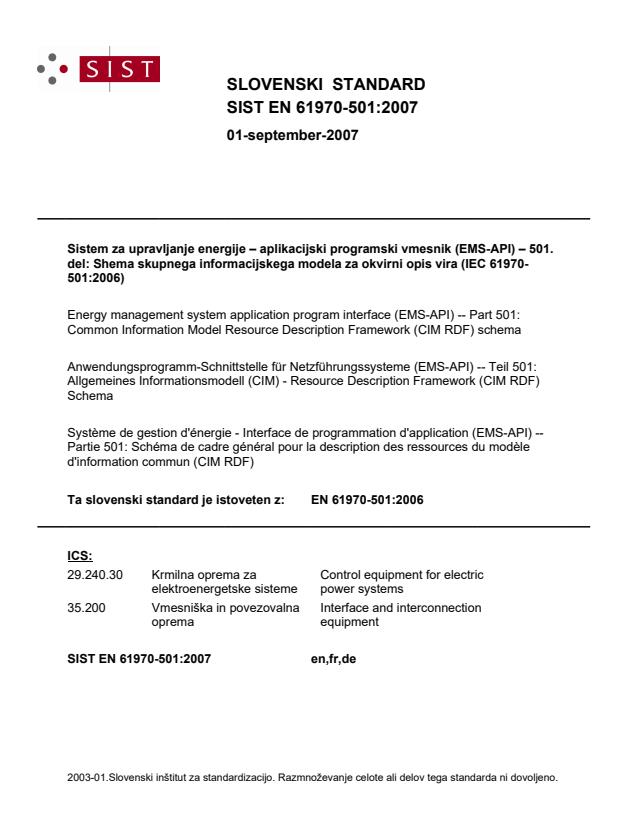
SLOVENSKI STANDARD
01-september-2007
Sistem za upravljanje energije – aplikacijski programski vmesnik (EMS-API) – 501.
del: Shema skupnega informacijskega modela za okvirni opis vira (IEC 61970-
501:2006)
Energy management system application program interface (EMS-API) -- Part 501:
Common Information Model Resource Description Framework (CIM RDF) schema
Anwendungsprogramm-Schnittstelle für Netzführungssysteme (EMS-API) -- Teil 501:
Allgemeines Informationsmodell (CIM) - Resource Description Framework (CIM RDF)
Schema
Système de gestion d'énergie - Interface de programmation d'application (EMS-API) --
Partie 501: Schéma de cadre général pour la description des ressources du modèle
d'information commun (CIM RDF)
Ta slovenski standard je istoveten z: EN 61970-501:2006
ICS:
29.240.30 Krmilna oprema za Control equipment for electric
elektroenergetske sisteme power systems
35.200 Vmesniška in povezovalna Interface and interconnection
oprema equipment
2003-01.Slovenski inštitut za standardizacijo. Razmnoževanje celote ali delov tega standarda ni dovoljeno.
EUROPEAN STANDARD
EN 61970-501
NORME EUROPÉENNE
June 2006
EUROPÄISCHE NORM
ICS 33.200
English version
Energy management system application program interface (EMS-API)
Part 501: Common Information Model Resource Description Framework
(CIM RDF) schema
(IEC 61970-501:2006)
Système de gestion d'énergie Anwendungsprogramm-Schnittstelle
Interface de programmation d'application für Netzführungssysteme (EMS-API)
(EMS-API) Teil 501: Allgemeines Informationsmodell
Partie 501: Schéma de cadre général (CIM) –
pour la description des ressources Resource Description Framework
du modèle d'information commun (CIM RDF) Schema
(CIM RDF) (IEC 61970-501:2006)
(CEI 61970-501:2006)
This European Standard was approved by CENELEC on 2006-04-01. CENELEC members are bound to comply
with the CEN/CENELEC Internal Regulations which stipulate the conditions for giving this European Standard
the status of a national standard without any alteration.
Up-to-date lists and bibliographical references concerning such national standards may be obtained on
application to the Central Secretariat or to any CENELEC member.
This European Standard exists in three official versions (English, French, German). A version in any other
language made by translation under the responsibility of a CENELEC member into its own language and notified
to the Central Secretariat has the same status as the official versions.
CENELEC members are the national electrotechnical committees of Austria, Belgium, Cyprus, the Czech
Republic, Denmark, Estonia, Finland, France, Germany, Greece, Hungary, Iceland, Ireland, Italy, Latvia,
Lithuania, Luxembourg, Malta, the Netherlands, Norway, Poland, Portugal, Romania, Slovakia, Slovenia, Spain,
Sweden, Switzerland and the United Kingdom.
CENELEC
European Committee for Electrotechnical Standardization
Comité Européen de Normalisation Electrotechnique
Europäisches Komitee für Elektrotechnische Normung
Central Secretariat: rue de Stassart 35, B - 1050 Brussels
© 2006 CENELEC - All rights of exploitation in any form and by any means reserved worldwide for CENELEC members.
Ref. No. EN 61970-501:2006 E
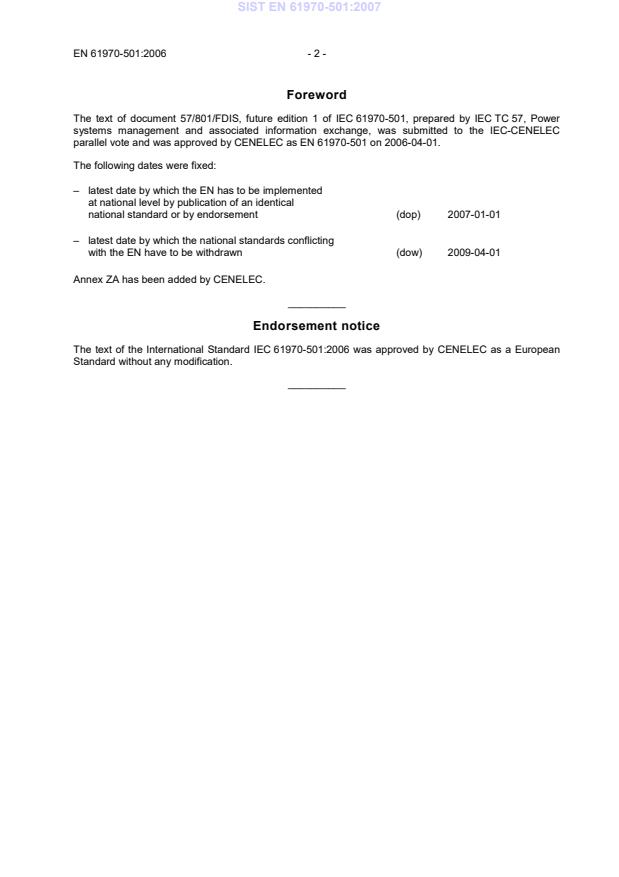
Foreword
The text of document 57/801/FDIS, future edition 1 of IEC 61970-501, prepared by IEC TC 57, Power
systems management and associated information exchange, was submitted to the IEC-CENELEC
parallel vote and was approved by CENELEC as EN 61970-501 on 2006-04-01.
The following dates were fixed:
– latest date by which the EN has to be implemented
at national level by publication of an identical
national standard or by endorsement (dop) 2007-01-01
– latest date by which the national standards conflicting
with the EN have to be withdrawn (dow) 2009-04-01
Annex ZA has been added by CENELEC.
__________
Endorsement notice
The text of the International Standard IEC 61970-501:2006 was approved by CENELEC as a European
Standard without any modification.
__________
- 3 - EN 61970-501:2006
Annex ZA
(normative)
Normative references to international publications
with their corresponding European publications
The following referenced documents are indispensable for the application of this document. For dated
references, only the edition cited applies. For undated references, the latest edition of the referenced
document (including any amendments) applies.
NOTE When an international publication has been modified by common modifications, indicated by (mod), the relevant EN/HD
applies.
Publication Year Title EN/HD Year
1) 2)
IEC 61970-1 Energy management system application EN 61970-1
- 2006
program interface (EMS-API)
Part 1: Guidelines and general requirements
1)
IEC/TS 61970-2 - Energy management system appliction - -
program interface (EMS-API)
Part 2: Glossary
1) 2)
IEC 61970-301 Energy management system application EN 61970-301
- 2004
program interface (EMS-API)
Part 301: Common Information Model (CIM)
Base
IEC 60050 Series International Electrotechnical Vocabulary - -
(IEV)
1)
Undated reference.
2)
Valid edition at date of issue.
INTERNATIONAL IEC
STANDARD 61970-501
First edition
2006-03
Energy management system application
program interface (EMS-API) –
Part 501:
Common Information Model Resource
Description Framework (CIM RDF) schema
IEC 2006 Copyright - all rights reserved
No part of this publication may be reproduced or utilized in any form or by any means, electronic or
mechanical, including photocopying and microfilm, without permission in writing from the publisher.
International Electrotechnical Commission, 3, rue de Varembé, PO Box 131, CH-1211 Geneva 20, Switzerland
Telephone: +41 22 919 02 11 Telefax: +41 22 919 03 00 E-mail: inmail@iec.ch Web: www.iec.ch
PRICE CODE
Commission Electrotechnique Internationale R
International Electrotechnical Commission
МеждународнаяЭлектротехническаяКомиссия
For price, see current catalogue
– 2 – 61970-501 IEC:2006(E)
CONTENTS
FOREWORD.3
INTRODUCTION.5
1 Scope.6
2 Normative references .6
3 Terms and definitions .7
4 Structure of an XML document .7
4.1 General .7
4.2 Elements .8
4.3 Attributes.8
5 Metadata and RDF Schema.8
5.1 General .8
5.2 Resource.8
5.3 Property .9
5.4 Namespaces .9
5.5 CIM RDF Schema extensions .9
6 CIM metadata.12
6.1 General .12
6.2 Schema.12
6.3 Mapping from UML .13
6.4 Example CIM RDF Schema elements .15
Annex A (informative) CIM RDF Schema generation – Mechanism for schema generation .18
61970-501 IEC:2006(E) – 3 –
INTERNATIONAL ELECTROTECHNICAL COMMISSION
______________
ENERGY MANAGEMENT SYSTEM APPLICATION
PROGRAM INTERFACE (EMS-API) –
Part 501: Common Information Model Resource
Description Framework (CIM RDF) schema
FOREWORD
1) The International Electrotechnical Commission (IEC) is a worldwide organization for standardization comprising
all national electrotechnical committees (IEC National Committees). The object of IEC is to promote
international co-operation on all questions concerning standardization in the electrical and electronic fields. To
this end and in addition to other activities, IEC publishes International Standards, Technical Specifications,
Technical Reports, Publicly Available Specifications (PAS) and Guides (hereafter referred to as “IEC
Publication(s)”). Their preparation is entrusted to technical committees; any IEC National Committee interested
in the subject dealt with may participate in this preparatory work. International, governmental and non-
governmental organizations liaising with the IEC also participate in this preparation. IEC collaborates closely
with the International Organization for Standardization (ISO) in accordance with conditions determined by
agreement between the two organizations.
2) The formal decisions or agreements of IEC on technical matters express, as nearly as possible, an international
consensus of opinion on the relevant subjects since each technical committee has representation from all
interested IEC National Committees.
3) IEC Publications have the form of recommendations for international use and are accepted by IEC National
Committees in that sense. While all reasonable efforts are made to ensure that the technical content of IEC
Publications is accurate, IEC cannot be held responsible for the way in which they are used or for any
misinterpretation by any end user.
4) In order to promote international uniformity, IEC National Committees undertake to apply IEC Publications
transparently to the maximum extent possible in their national and regional publications. Any divergence
between any IEC Publication and the corresponding national or regional publication shall be clearly indicated in
the latter.
5) IEC provides no marking procedure to indicate its approval and cannot be rendered responsible for any
equipment declared to be in conformity with an IEC Publication.
6) All users should ensure that they have the latest edition of this publication.
7) No liability shall attach to IEC or its directors, employees, servants or agents including individual experts and
members of its technical committees and IEC National Committees for any personal injury, property damage or
other damage of any nature whatsoever, whether direct or indirect, or for costs (including legal fees) and
expenses arising out of the publication, use of, or reliance upon, this IEC Publication or any other IEC
Publications.
8) Attention is drawn to the Normative references cited in this publication. Use of the referenced publications is
indispensable for the correct application of this publication.
9) Attention is drawn to the possibility that some of the elements of this IEC Publication may be the subject of
patent rights. IEC shall not be held responsible for identifying any or all such patent rights.
International Standard IEC 61970-501 has been prepared by IEC technical committee 57:
Power systems management and associated information exchange.
The text of this standard is based on the following documents:
FDIS Report on voting
57/801/FDIS 57/813/RVD
Full information on the voting for the approval of this standard can be found in the report on
voting indicated in the above table.
This publication has been drafted in accordance with the ISO/IEC Directives, Part 2.
– 4 – 61970-501 IEC:2006(E)
IEC 61970 consists of the following parts, under the general title Energy Management System
Application Program Interface (EMS-API):
Part 1: Guidelines and general requirements
Part 2: Glossary
Part 301: Common Information Model (CIM) base
Part 302: Common information model (CIM) financial, energy scheduling and reservations
Part 401: Component interface specification (CIS) framework
Part 402: Component interface specification (CIS) – Common services
Part 403: Component Interface Specification (CIS) – Generic data access
Part 404: Component Interface Specification (CIS) – High speed data access
Part 405: Component Interface Specification (CIS) – Generic eventing and subscription
Part 407: Component Interface Specification (CIS) – Time series data access
Part 453: Exchange of Graphics Schematics Definitions (Common Graphics Exchange)
Part 501: Common Information Model Resource Description Framework (CIM RDF) schema
The committee has decided that the contents of this publication will remain unchanged until
the maintenance result date indicated on the IEC web site under "http://webstore.iec.ch" in
the data related to the specific publication. At this date, the publication will be
• reconfirmed,
• withdrawn,
• replaced by a revised edition, or
• amended.
A bilingual edition of this standard may be issued at a later date.
—————————
Under consideration.
61970-501 IEC:2006(E) – 5 –
INTRODUCTION
This standard is part of the IEC 61970 series that define an Application Program Interface
(API) for an Energy Management System (EMS). This standard is based upon the work of the
EPRI Control Center API (CCAPI) research project (RP-3654-1).
This part specifies the mapping between the conceptual model specified as Unified Modeling
Language (UML) defined in IEC 61970-3XX series: Common Information Model and the
machine readable Extensible Markup Language (XML) representation of that schema using
the Resource Description Framework (RDF) Schema specification language.
– 6 – 61970-501 IEC:2006(E)
ENERGY MANAGEMENT SYSTEM APPLICATION
PROGRAM INTERFACE (EMS-API) –
Part 501: Common Information Model Resource
Description Framework (CIM RDF) schema
1 Scope
This International Standard specifies a Component Interface Specification (CIS) for energy
management systems application program interfaces. This part of IEC 61970 specifies the
format and rules for producing a machine readable form of the Common Information Model
(CIM) as specified in the IEC 61970-301 standard. It describes a CIM vocabulary to support
the data access facility and associated CIM semantics.
This part of IEC 61970 supports a mechanism for applications from independent suppliers to
access CIM metadata in a common format and with standard services for the purpose of
subsequent CIM data access. Secondary objectives are to provide CIM versioning capabilities
and a mechanism that is easily extensible to support site-specific needs. The proposed
solution:
• is both machine readable and human readable, although primarily intended for
programmatic access;
• can be accessed using any tool that supports the Document Object Model (DOM)
application program interface;
• is self-describing;
• takes advantage of current web standards.
This document is the Level 2 Component Interface Specification document that describes in
narrative terms (with text and examples based on the CIM), the detailed definition of the CIM
metadata interface to be standardized.
2 Normative references
The following referenced documents are indispensable for the application of this document.
For dated references, only the edition cited applies. For undated references, the latest edition
of the referenced document (including any amendments) applies.
IEC 61970-1, Energy management system application program interface (EMS-API) – Part 1:
Guidelines and general requirements
IEC 61970-2, Energy management system application program interface (EMS-API) – Part 2:
Glossary
IEC 61970-301, Energy management system application program interface (EMS-API) –
Part 301: Common Information Model (CIM) base
IEC 60050 series: International Electrotechnical Vocabulary
61970-501 IEC:2006(E) – 7 –
3 Terms and definitions
For the purposes of this part of IEC 61970, the terms and definitions given in IEC 61970-2, as
well as the following, apply.
3.1
Common Information Model
CIM
abstract model that represents all the major objects in an electric utility enterprise typically
contained in an EMS information model
NOTE By providing a standard way of representing power system resources as object classes and attributes,
along with their relationships, the CIM facilitates the integration of EMS applications developed independently by
different vendors, between entire EMS systems developed independently, or between an EMS system and other
systems concerned with different aspects of power system operations, such as generation or distribution
management.
3.2
Document Object Model
DOM
platform- and language-neutral interface defined by the World Wide Web Consortium (W3C)
that allows programs and scripts to dynamically access and exchange the content, structure
and style of documents
3.3
Resource Description Framework
RDF
language recommended by the W3C for expressing metadata that machines can process
simply. It is expressed as a special kind of XML document
3.4
RDF Schema
schema specification language expressed using RDF to describe resources and their
properties, including how resources are related to other resources, which is used to specify
an application-specific schema
3.5
Unified Modelling Language
UML
modelling language and methodology for specifying, visualizing, constructing, and
documenting the artefacts of a system-intensive process
3.6
Extensible Markup Language
XML
subset of Standard Generalized Markup Language (SGML), ISO 8879, for putting structured
data in a text file. It is an endorsed recommendation from the W3C
NOTE It is license-free, platform-independent and well-supported by many readily available software tools.
4 Structure of an XML document
4.1 General
An XML document is a set of containers. The containers can contain other containers as well
as content. The two required pieces of a well-formed XML document are the prolog and the
root element. The prolog contains statements that indicate the version of the XML standard to
which the document conforms and the encoding that is used. The prolog for the CIM RDF
Schema file is simply:
– 8 – 61970-501 IEC:2006(E)
The root element contains the XML document's actual contents, which are contained within
starting and ending tags. The CIM RDF Schema contains the root element:
.
:
The root element also contains references to namespaces, which define a context for
elements that are used within the rest of the document. The element name is preceded by the
namespace alias followed by a colon. For example, the RDF Schema namespace is declared:
xmlns:rdfs="http://www.w3.org/TR/1999/PR-rdf-schema-19990303#"
References to it within the document use the syntax:
Comments can appear anywhere within an XML document; they are delimited with characters.
4.2 Elements
An element is a container enclosed between start and stop tags. The start tag defines the
name of the element and contains any attributes of the element. In the following example,
Class is the name of the element and ID is its attribute.
The stop tag for this element is .
4.3 Attributes
The ID attribute is used for the Class elements to be able to reference other element nodes
within the CIM RDF Schema document. The element with ID="Bay" can be referenced by
other elements using the # symbol in front of the attribute's value, as "#Bay".
Note that the XML concept of attribute is not the same as the UML definition. XML attributes
store information about the element that are not directly or immediately relevant to the reader,
such as an ID which is used for linking internal elements. UML attributes are data in this
context. They shall hold structure of their own, such as datatype, constraints, and description.
Therefore, they are specified as elements in the CIM RDF Schema.
5 Metadata and RDF Schema
5.1 General
RDF Schema allows the definition of application-specific vocabularies. It is a very concise
way to represent the CIM classes and their attributes and relationships. It is designed to be
extensible, so that local extensions to the CIM can easily be referenced.
5.2 Resource
A resource is anything that can be referenced by a Uniform Resource Identifier (URI). For the
purposes of the CIM RDF Schema, a resource corresponds to a class. By convention,
resources are named with an initial uppercase letter.
61970-501 IEC:2006(E) – 9 –
5.3 Property
A property is a specific aspect, characteristic, attribute, or relation used to describe a
resource. Each property has a specific meaning, defines its permitted values, the types of
resources it can describe, and its relationship with other properties. Within the context of the
CIM RDF Schema, a property can be either a class attribute or a rolename for an association
of the class. By convention, properties are named with an initial lowercase letter.
5.4 Namespaces
Namespaces are a way to tie a specific use of a word in context to the dictionary (schema)
where the intended definition is to be found. RDF requires the XML namespace facility to
precisely associate each
...