

EN 50131-2-7-3:2012/A1:2013
(Amendment)Alarm systems - Intrusion and hold-up systems - Part 2-7-3: Intrusion detectors - Glass break detectors (active)
General Information
- Abstract
2013-09-09: Publication allocated to cpalagi@cencenelec.eu
2021: CLC legacy converted by DCLab NISOSTS
- Status
- Published
- Publication Date
- 19-Dec-2013
- Withdrawal Date
- 13-Oct-2016
- Technical Committee
- CLC/TC 79 - Alarm systems
- Drafting Committee
- CLC/TC 79 - Alarm systems
- Current Stage
- 6060 - Document made available - Publishing
- Start Date
- 20-Dec-2013
- Completion Date
- 20-Dec-2013

Overview
EN 50131-2-7-3:2012/A1:2013 is a European standard developed by the CLC (European Committee for Electrotechnical Standardization). It focuses on alarm systems, specifically intrusion and hold-up systems, and details requirements for active glass break detectors. This amendment applies to intrusion detectors that identify the breaking of glass, a common point of unauthorized entry in security situations. Adherence to this standard supports the consistent performance, safety, and reliability of alarm systems used throughout Europe. As part of the EN 50131 family, it enhances the detection capabilities of security systems aimed at protection against crime.
Key Topics
- Event Processing: Defines mandatory and optional events alarm detectors must process, such as intrusion attempts, tampering, masking, low supply voltage, and total power loss, differentiated by security grades.
- Detection of Masking: Clarifies the requirements for detectors to reliably identify any attempt to obscure or block the sensor.
- Immunity Testing: Establishes methods for assessing detector immunity to various disturbances, improving reliability and minimizing false alarms:
- Soft or hard objects hitting the glass
- Static and dynamic pressure changes
- Wide-band noise using flat steel rulers
- Power Supply Requirements: Specifies performance under changing voltage conditions and procedures for handling total power loss, ensuring that detectors function or report faults as required.
- Environmental Conditions: Outlines environmental classifications and operational conditions, further ensuring detectors’ correct function across a range of real-world scenarios.
- System Grades: Provides event handling and immunity requirements based on system grades (Grades 1–4), allowing alignment with the necessary security level.
Applications
The standard is directly relevant to organizations and professionals involved in the design, installation, and maintenance of intrusion and hold-up alarm systems. Its typical applications include:
- Commercial Buildings: Ensuring comprehensive glass break detection in offices, retail spaces, and warehouses for property protection.
- Residential Security: Enhancing home security alarm systems, particularly for windows and glass doors prone to attack.
- Financial Institutions: Providing a reliable layer of protection in banks and similar high-risk environments.
- Critical Infrastructure: Supporting the security needs of utilities, telecommunications, and transportation hubs.
- Compliance and Certification: Serving as a benchmark for security system certification according to European and national requirements.
By following EN 50131-2-7-3:2012/A1:2013, stakeholders ensure the use of high-quality, reliable, and standardized intrusion detectors, reducing the likelihood of false alarms and missed detection events in case of attempted burglary or forced entry.
Related Standards
- EN 50131-1: Alarm systems - Intrusion and hold-up systems - Part 1: System requirements
- EN 50131-2-7-1: Intrusion detectors - Glass break detectors (passive)
- EN 50131-2-7-2: Intrusion detectors - Glass break detectors (combined)
- EN 50131-3: Control and indicating equipment requirements
- EN 50136 series: Alarm transmission systems and equipment
These related standards provide a holistic framework for the design, integration, and certification of comprehensive alarm and intrusion detection systems across Europe.
Keywords: EN 50131-2-7-3, glass break detectors, active intrusion detectors, alarm systems standard, hold-up systems, CLC, CENELEC, security system compliance, intrusion detection, false alarm immunity, alarm certification, environmental performance.
Relations
- Effective Date
- 09-Feb-2026
- Effective Date
- 28-Jan-2023
Get Certified
Connect with accredited certification bodies for this standard

CIS Institut d.o.o.
Personal Protective Equipment (PPE) certification body. Notified Body NB-2890 for EU Regulation 2016/425 PPE.

Kiwa BDA Testing
Building and construction product certification.
Kmetijski inštitut Slovenije
Agricultural Institute of Slovenia. Soil testing, plant health, agricultural product analysis.
Sponsored listings
Frequently Asked Questions
EN 50131-2-7-3:2012/A1:2013 is a amendment published by CLC. Its full title is "Alarm systems - Intrusion and hold-up systems - Part 2-7-3: Intrusion detectors - Glass break detectors (active)". This standard covers: 2013-09-09: Publication allocated to cpalagi@cencenelec.eu 2021: CLC legacy converted by DCLab NISOSTS
2013-09-09: Publication allocated to cpalagi@cencenelec.eu 2021: CLC legacy converted by DCLab NISOSTS
EN 50131-2-7-3:2012/A1:2013 is classified under the following ICS (International Classification for Standards) categories: 13.320 - Alarm and warning systems. The ICS classification helps identify the subject area and facilitates finding related standards.
EN 50131-2-7-3:2012/A1:2013 has the following relationships with other standards: It is inter standard links to EN 15999-2:2025, EN 50131-2-7-3:2012. Understanding these relationships helps ensure you are using the most current and applicable version of the standard.
EN 50131-2-7-3:2012/A1:2013 is available in PDF format for immediate download after purchase. The document can be added to your cart and obtained through the secure checkout process. Digital delivery ensures instant access to the complete standard document.
Standards Content (Sample)
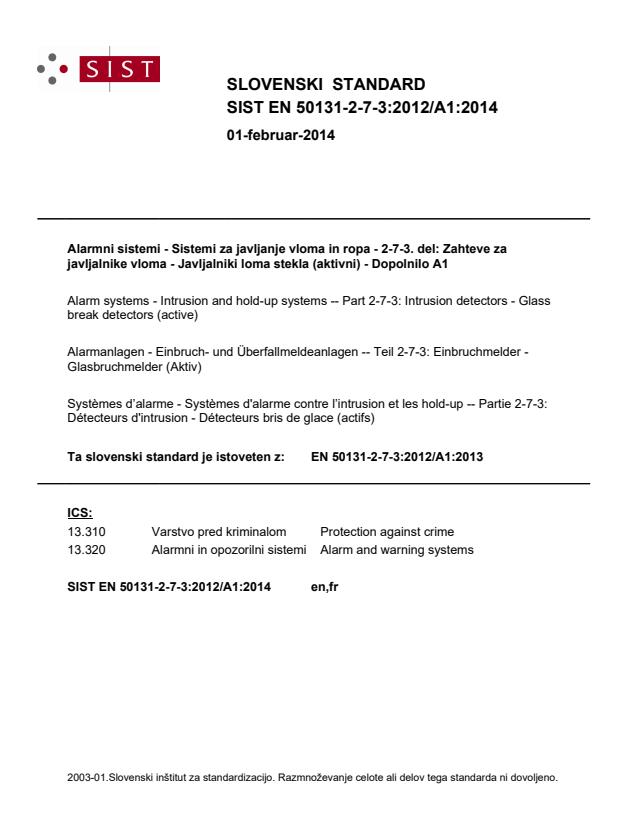
SLOVENSKI STANDARD
01-februar-2014
Alarmni sistemi - Sistemi za javljanje vloma in ropa - 2-7-3. del: Zahteve za
javljalnike vloma - Javljalniki loma stekla (aktivni) - Dopolnilo A1
Alarm systems - Intrusion and hold-up systems -- Part 2-7-3: Intrusion detectors - Glass
break detectors (active)
Alarmanlagen - Einbruch- und Überfallmeldeanlagen -- Teil 2-7-3: Einbruchmelder -
Glasbruchmelder (Aktiv)
Systèmes d’alarme - Systèmes d'alarme contre l’intrusion et les hold-up -- Partie 2-7-3:
Détecteurs d'intrusion - Détecteurs bris de glace (actifs)
Ta slovenski standard je istoveten z: EN 50131-2-7-3:2012/A1:2013
ICS:
13.310 Varstvo pred kriminalom Protection against crime
13.320 Alarmni in opozorilni sistemi Alarm and warning systems
2003-01.Slovenski inštitut za standardizacijo. Razmnoževanje celote ali delov tega standarda ni dovoljeno.
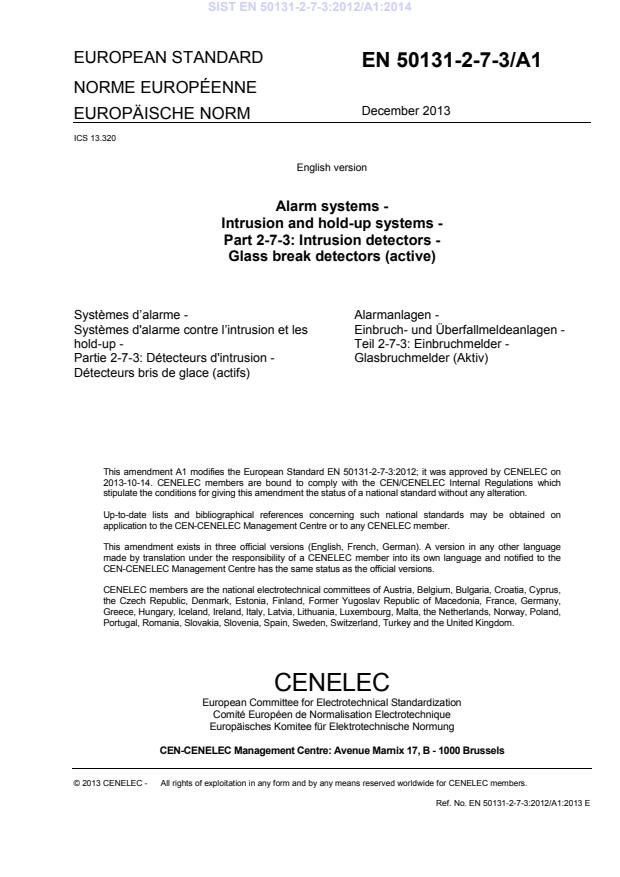
EUROPEAN STANDARD
EN 50131-2-7-3/A1
NORME EUROPÉENNE
December 2013
EUROPÄISCHE NORM
ICS 13.320
English version
Alarm systems -
Intrusion and hold-up systems -
Part 2-7-3: Intrusion detectors -
Glass break detectors (active)
Systèmes d’alarme - Alarmanlagen -
Systèmes d'alarme contre l’intrusion et les Einbruch- und Überfallmeldeanlagen -
hold-up - Teil 2-7-3: Einbruchmelder -
Partie 2-7-3: Détecteurs d'intrusion - Glasbruchmelder (Aktiv)
Détecteurs bris de glace (actifs)
This amendment A1 modifies the European Standard EN 50131-2-7-3:2012; it was approved by CENELEC on
2013-10-14. CENELEC members are bound to comply with the CEN/CENELEC Internal Regulations which
stipulate the conditions for giving this amendment the status of a national standard without any alteration.
Up-to-date lists and bibliographical references concerning such national standards may be obtained on
application to the CEN-CENELEC Management Centre or to any CENELEC member.
This amendment exists in three official versions (English, French, German). A version in any other language
made by translation under the responsibility of a CENELEC member into its own language and notified to the
CEN-CENELEC Management Centre has the same status as the official versions.
CENELEC members are the national electrotechnical committees of Austria, Belgium, Bulgaria, Croatia, Cyprus,
the Czech Republic, Denmark, Estonia, Finland, Former Yugoslav Republic of Macedonia, France, Germany,
Greece, Hungary, Iceland, Ireland, Italy, Latvia, Lithuania, Luxembourg, Malta, the Netherlands, Norway, Poland,
Portugal, Romania, Slovakia, Slovenia, Spain, Sweden, Switzerland, Turkey and the United Kingdom.
CENELEC
European Committee for Electrotechnical Standardization
Comité Européen de Normalisation Electrotechnique
Europäisches Komitee für Elektrotechnische Normung
CEN-CENELEC Management Centre: Avenue Marnix 17, B - 1000 Brussels
© 2013 CENELEC - All rights of exploitation in any form and by any means reserved worldwide for CENELEC members.
Ref. No. EN 50131-2-7-3:2012/A1:2013 E
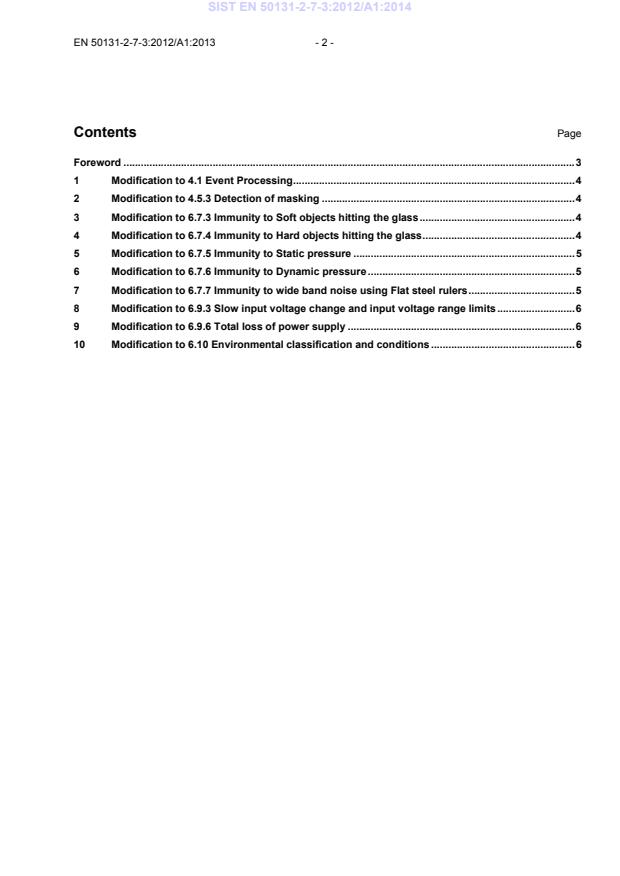
Contents Page
Foreword . 3
1 Modification to 4.1 Event Processing . 4
2 Modification to 4.5.3 Detection of masking . 4
3 Modification to 6.7.3 Immunity to Soft objects hitting the glass . 4
4 Modification to 6.7.4 Immunity to Hard objects hitting the glass . 4
5 Modification to 6.7.5 Immunity to Static pressure . 5
6 Modification to 6.7.6 Immunity to Dynamic pressure . 5
7 Modification to 6.7.7 Immunity to wide band noise using Flat steel rulers . 5
8 Modification to 6.9.3 Slow input voltage change and input voltage range limits . 6
9 Modification to 6.9.6 Total loss of power supply . 6
10 Modification to 6.10 Environmental classification and conditions . 6
- 3 - EN 50131-2-7-3:2012/A1:2013
Foreword
This document (EN 50131-2-7-3:2012/A1:2013) has been prepared by CLC/TC 79 "Alarm systems".
The following dates are fixed:
(dop) 2014-10-14
• latest date by which this document has to be implemented at
national level by publication of an identical national standard or
by endorsement
• latest date by which the national standards conflicting with this (dow) 2016-10-14
document have to be withdrawn
Attention is drawn to the possibility that some of the elements o
...