

EN 50110-1:2023
(Main)Operation of electrical installations - Part 1: General requirements
General Information
- Abstract
This document is applicable to all operation of and work activity on, with, or near electrical installations. These are electrical installations operating at voltage levels from and including extra-low voltage up to and including high voltage. This latter term includes those levels commonly referred to as medium and extra-high voltage. These electrical installations are designed for the generation, transmission, conversion, distribution and use of electrical power. Some of these electrical installations are permanent and fixed, such as a distribution installation in a factory or office complex, others are temporary, such as on construction sites and others are mobile or capable of being moved either whilst energised or whilst not energised nor charged. Examples are electrically driven excavating machines in quarries or open-cast coal sites. This document sets out the requirements for the safe operation of and work activity on, with, or near these electrical installations. The requirements apply to all operational, working and maintenance procedures. They apply to all non-electrical work such as building work near to overhead lines or underground cables as well as electrical work, when there is a risk of electrical danger. This document does not apply to ordinary persons when using installations and equipment, provided that the installations and equipment comply with relevant standards and are designed and installed for use by ordinary persons. This document has not been developed specifically to apply to the electrical installations listed below. However, if there are no other rules or procedures, the principles of this document could be applied to them: - on any aircraft and hovercraft moving under its own power, (these are subject to International Aviation laws which take precedence over national laws in these situations); - on any sea going ship moving under its own power, or under the direction of the master, (these are subject to International Marine laws which take precedence over national laws in these situations); - electronic telecommunications and information systems; - electronic instrumentation, control and automation systems; - at coal or other mines; - on off-shore installations subject to International Marine laws; - on vehicles; - on electric traction systems; - on experimental electrical research work.
- Status
- Published
- Publication Date
- 22-Jun-2023
- Technical Committee
- TC 221 - Operation of electrical installations
- Drafting Committee
- CLC/BTTF 62-3 - Operation of electrical installations
- Current Stage
- 6060 - Document made available - Publishing
- Start Date
- 23-Jun-2023
- Due Date
- 22-Jul-2022
- Completion Date
- 23-Jun-2023

Overview
EN 50110-1:2023 - Operation of electrical installations, Part 1: General requirements (CLC/CENELEC) - defines minimum European requirements for the safe operation of and work on, with, or near electrical installations. It covers installations operating from extra‑low voltage up to high voltage (including medium and extra‑high voltage), and applies to permanent, temporary and mobile installations used for generation, transmission, conversion, distribution and consumption of electrical power. The standard sets out roles, responsibilities and core safety principles for operational, working and maintenance procedures, while noting cases (aircraft, ships, telecoms, traction systems, mines, offshore, experimental work) where other international laws may take precedence.
Key Topics
- Scope and definitions: clear terminology for personnel, working zones and protective devices.
- Organization and responsibilities: roles such as Installation Manager (IM), Operation Controller (OC), Work Controller (WC) and Worker (W), and rules for supervision and communication.
- Basic safety principles: safe operation, documentation, signage, emergency arrangements and ergonomic considerations.
- Working zones and distances: limit and working distances, vicinity zones, and guidance for determining safe clearances.
- Operational procedures: routine operation, measurement, testing and inspection requirements.
- Working procedures: detailed rules for dead working (disconnect, secure against re‑connection, verify absence of voltage, earthing/short‑circuiting) and live working (training, methods, tools, environmental conditions).
- Maintenance procedures: repair and replacement work, temporary interruptions, and end‑of‑work requirements.
- Informative annexes: guidance on distances in air, arc hazard, emergency arrangements, and alphabetic terms and definitions.
Applications
- Utility operators and power distribution companies implementing safe work practices across transmission and distribution networks.
- Plant and facility managers responsible for on‑site electrical distribution in factories, commercial buildings and construction sites.
- Safety managers, maintenance teams, contractors and supervisors who plan and execute electrical work (dead or live).
- Training coordinators and auditors using the standard to align procedures, competence requirements and emergency planning.
Using EN 50110-1:2023 helps organizations reduce electrical risk, harmonize procedures across jurisdictions, and support compliance with national regulations and occupational safety requirements.
Related Standards
- EN 50110 Part 2: national annexes and supplements (provides country‑specific requirements and additions).
- Complementary national laws, occupational safety standards and applicable IEC standards for equipment and testing.
Keywords: EN 50110-1:2023, operation of electrical installations, safe working, live working, dead working, vicinity zone, electrical safety, CLC.
Relations
- Effective Date
- 22-Oct-2019
- Effective Date
- 09-Feb-2026
- Effective Date
- 09-Feb-2026
- Effective Date
- 09-Feb-2026
- Effective Date
- 09-Feb-2026
- Effective Date
- 03-Feb-2026
- Effective Date
- 03-Feb-2026
- Referred By
EN 50556:2018 - Road traffic signal systems - Effective Date
- 03-Feb-2026
- Amended By
EN 50110-1:2023/prA1:2026 - Operation of electrical installations - Part 1: General requirements - Effective Date
- 15-Jul-2025
Get Certified
Connect with accredited certification bodies for this standard

IMQ S.p.A. (Certification)
Italian electrical product certification.

SLG Prüf- und Zertifizierungs GmbH
German testing and certification body.

UL Solutions
Global safety science company with testing, inspection and certification.
Sponsored listings
Frequently Asked Questions
EN 50110-1:2023 is a standard published by CLC. Its full title is "Operation of electrical installations - Part 1: General requirements". This standard covers: This document is applicable to all operation of and work activity on, with, or near electrical installations. These are electrical installations operating at voltage levels from and including extra-low voltage up to and including high voltage. This latter term includes those levels commonly referred to as medium and extra-high voltage. These electrical installations are designed for the generation, transmission, conversion, distribution and use of electrical power. Some of these electrical installations are permanent and fixed, such as a distribution installation in a factory or office complex, others are temporary, such as on construction sites and others are mobile or capable of being moved either whilst energised or whilst not energised nor charged. Examples are electrically driven excavating machines in quarries or open-cast coal sites. This document sets out the requirements for the safe operation of and work activity on, with, or near these electrical installations. The requirements apply to all operational, working and maintenance procedures. They apply to all non-electrical work such as building work near to overhead lines or underground cables as well as electrical work, when there is a risk of electrical danger. This document does not apply to ordinary persons when using installations and equipment, provided that the installations and equipment comply with relevant standards and are designed and installed for use by ordinary persons. This document has not been developed specifically to apply to the electrical installations listed below. However, if there are no other rules or procedures, the principles of this document could be applied to them: - on any aircraft and hovercraft moving under its own power, (these are subject to International Aviation laws which take precedence over national laws in these situations); - on any sea going ship moving under its own power, or under the direction of the master, (these are subject to International Marine laws which take precedence over national laws in these situations); - electronic telecommunications and information systems; - electronic instrumentation, control and automation systems; - at coal or other mines; - on off-shore installations subject to International Marine laws; - on vehicles; - on electric traction systems; - on experimental electrical research work.
This document is applicable to all operation of and work activity on, with, or near electrical installations. These are electrical installations operating at voltage levels from and including extra-low voltage up to and including high voltage. This latter term includes those levels commonly referred to as medium and extra-high voltage. These electrical installations are designed for the generation, transmission, conversion, distribution and use of electrical power. Some of these electrical installations are permanent and fixed, such as a distribution installation in a factory or office complex, others are temporary, such as on construction sites and others are mobile or capable of being moved either whilst energised or whilst not energised nor charged. Examples are electrically driven excavating machines in quarries or open-cast coal sites. This document sets out the requirements for the safe operation of and work activity on, with, or near these electrical installations. The requirements apply to all operational, working and maintenance procedures. They apply to all non-electrical work such as building work near to overhead lines or underground cables as well as electrical work, when there is a risk of electrical danger. This document does not apply to ordinary persons when using installations and equipment, provided that the installations and equipment comply with relevant standards and are designed and installed for use by ordinary persons. This document has not been developed specifically to apply to the electrical installations listed below. However, if there are no other rules or procedures, the principles of this document could be applied to them: - on any aircraft and hovercraft moving under its own power, (these are subject to International Aviation laws which take precedence over national laws in these situations); - on any sea going ship moving under its own power, or under the direction of the master, (these are subject to International Marine laws which take precedence over national laws in these situations); - electronic telecommunications and information systems; - electronic instrumentation, control and automation systems; - at coal or other mines; - on off-shore installations subject to International Marine laws; - on vehicles; - on electric traction systems; - on experimental electrical research work.
EN 50110-1:2023 is classified under the following ICS (International Classification for Standards) categories: 29.240.01 - Power transmission and distribution networks in general. The ICS classification helps identify the subject area and facilitates finding related standards.
EN 50110-1:2023 has the following relationships with other standards: It is inter standard links to EN 50110-1:2013, CEN/TR 15276-2:2009, EN 13243:2004, EN 16704-2-2:2016, EN 13243:2015, EN 50438:2007, CLC/TR 50488:2006, EN 50556:2018, EN 50110-1:2023/prA1:2026. Understanding these relationships helps ensure you are using the most current and applicable version of the standard.
EN 50110-1:2023 is available in PDF format for immediate download after purchase. The document can be added to your cart and obtained through the secure checkout process. Digital delivery ensures instant access to the complete standard document.
Standards Content (Sample)
SLOVENSKI STANDARD
01-september-2023
Obratovanje električnih postrojev - 1. del: Splošne zahteve
Operation of electrical installations - Part 1: General requirements
Betrieb von elektrischen Anlagen - Teil 1: Allgemeine Anforderungen
Exploitation des installations électriques - Partie 1: Exigences générales
Ta slovenski standard je istoveten z: EN 50110-1:2023
ICS:
29.240.01 Omrežja za prenos in Power transmission and
distribucijo električne energije distribution networks in
na splošno general
2003-01.Slovenski inštitut za standardizacijo. Razmnoževanje celote ali delov tega standarda ni dovoljeno.
EUROPEAN STANDARD EN 50110-1
NORME EUROPÉENNE
EUROPÄISCHE NORM June 2023
ICS 29.240.01 Supersedes EN 50110-1:2013
English Version
Operation of electrical installations - Part 1: General
requirements
Exploitation des installations électriques - Partie 1: Betrieb von elektrischen Anlagen - Teil 1: Allgemeine
Exigences générales Anforderungen
This European Standard was approved by CENELEC on 2023-05-29. CENELEC members are bound to comply with the CEN/CENELEC
Internal Regulations which stipulate the conditions for giving this European Standard the status of a national standard without any alteration.
Up-to-date lists and bibliographical references concerning such national standards may be obtained on application to the CEN-CENELEC
Management Centre or to any CENELEC member.
This European Standard exists in three official versions (English, French, German). A version in any other language made by translation
under the responsibility of a CENELEC member into its own language and notified to the CEN-CENELEC Management Centre has the
same status as the official versions.
CENELEC members are the national electrotechnical committees of Austria, Belgium, Bulgaria, Croatia, Cyprus, the Czech Republic,
Denmark, Estonia, Finland, France, Germany, Greece, Hungary, Iceland, Ireland, Italy, Latvia, Lithuania, Luxembourg, Malta, the
Netherlands, Norway, Poland, Portugal, Republic of North Macedonia, Romania, Serbia, Slovakia, Slovenia, Spain, Sweden, Switzerland,
Türkiye and the United Kingdom.
European Committee for Electrotechnical Standardization
Comité Européen de Normalisation Electrotechnique
Europäisches Komitee für Elektrotechnische Normung
CEN-CENELEC Management Centre: Rue de la Science 23, B-1040 Brussels
© 2023 CENELEC All rights of exploitation in any form and by any means reserved worldwide for CENELEC Members.
Ref. No. EN 50110-1:2023 E
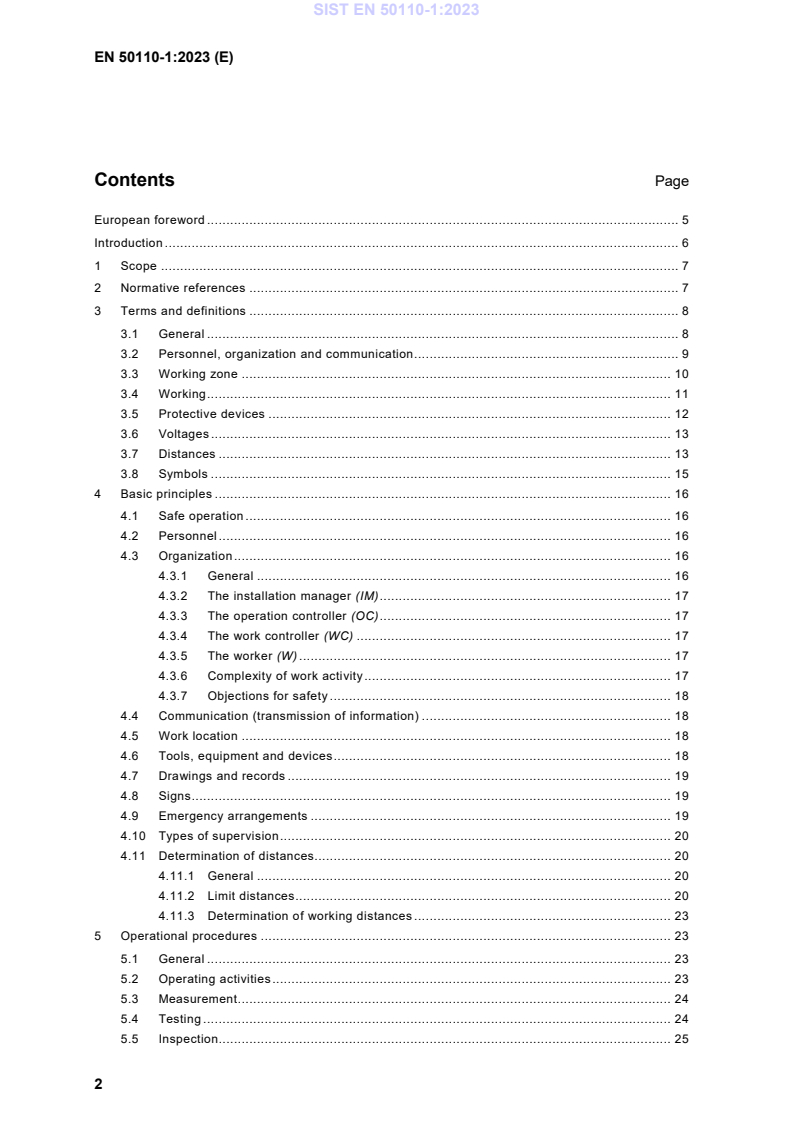
Contents Page
European foreword . 5
Introduction . 6
1 Scope . 7
2 Normative references . 7
3 Terms and definitions . 8
3.1 General . 8
3.2 Personnel, organization and communication . 9
3.3 Working zone . 10
3.4 Working . 11
3.5 Protective devices . 12
3.6 Voltages . 13
3.7 Distances . 13
3.8 Symbols . 15
4 Basic principles . 16
4.1 Safe operation . 16
4.2 Personnel . 16
4.3 Organization . 16
4.3.1 General . 16
4.3.2 The installation manager (IM) . 17
4.3.3 The operation controller (OC) . 17
4.3.4 The work controller (WC) . 17
4.3.5 The worker (W) . 17
4.3.6 Complexity of work activity . 17
4.3.7 Objections for safety . 18
4.4 Communication (transmission of information) . 18
4.5 Work location . 18
4.6 Tools, equipment and devices . 18
4.7 Drawings and records . 19
4.8 Signs . 19
4.9 Emergency arrangements . 19
4.10 Types of supervision . 20
4.11 Determination of distances. 20
4.11.1 General . 20
4.11.2 Limit distances . 20
4.11.3 Determination of working distances . 23
5 Operational procedures . 23
5.1 General . 23
5.2 Operating activities . 23
5.3 Measurement. 24
5.4 Testing . 24
5.5 Inspection. 25
6 Working procedures . 26
6.1 General . 26
6.1.1 General requirements . 26
6.1.2 Specific requirements in case of induction . 27
6.1.3 Specific requirements according to weather conditions . 27
6.2 Dead working . 27
6.2.1 General . 27
6.2.2 Disconnect completely . 28
6.2.3 Secure against re-connection . 28
6.2.4 Verify absence of operating voltage. 28
6.2.5 Earthing and short-circuiting . 29
6.2.6 Protection against adjacent live parts . 30
6.2.7 Permission to start work . 30
6.2.8 Re-energizing after work . 31
6.3 Live working . 31
6.3.1 General . 31
6.3.2 Training and qualification . 32
6.3.3 Maintenance of personnel ability . 32
6.3.4 Working methods . 32
6.3.5 Working instructions . 32
6.3.6 Tools, equipment and devices . 33
6.3.7 Environmental conditions . 33
6.3.8 Organization of work . 33
6.3.9 Specific requirements for extra-low voltage installations . 34
6.3.10 Specific requirements for low voltage installations . 34
6.3.11 Specific requirements for high voltage installations . 34
6.3.12 Specific works on live parts . 34
6.4 Working within the vicinity zone . 34
6.4.1 General . 34
6.4.2 Protection by screen, barrier, enclosure or insulating covering . 35
6.4.3 Protection by safe distance and supervision . 35
6.5 Working outside the vicinity zone . 36
6.5.1 General . 36
6.5.2 Specific requirements for non-electrical work, e.g. construction work, and
electrical work . 36
7 Maintenance procedures . 37
7.1 General . 37
7.2 Personnel . 37
7.3 Repair work . 38
7.4 Replacement work . 38
7.4.1 Replacement of fuses . 38
7.4.2 Replacement of lamps and accessories . 38
7.5 Temporary interruption of maintenance work . 39
7.6 End of maintenance work . 39
Annex A (informative) Guidance for distances in air for working procedures . 40
A.1 Limit distances . 40
A.2 Working distances . 40
Annex B (informative) Additional information for safe working. 43
B.1 Example for responsibility levels . 43
B.2 Example of application of live working . 44
B.3 Atmospheric conditions that are part of environmental conditions to be assessed . 44
B.4 Fire protection – Fire fighting . 45
B.5 Work location presenting explosion risks . 45
B.6 Arc hazard. 46
B.7 Emergency arrangements . 47
Annex C (informative) Terms and definitions in alphabetic order . 48
C.1 English . 48
C.2 French . 49
C.3 German . 51
Bibliography . 53
Figures
Figure 1 — Distances in air and zones . 21
Figure 2 — Example of eliminating limit zones by the use of an insulating protective device . 21
Figure 3 — Example of eliminating limit zones by the use of a barrier (insulating or non-insulating) . 22
Figure 4 — Flowchart “Planning working procedure” . 26
Figure B.1 — Responsibility levels . 43
Tables
Table 1 — Estimated values for distances D and D . 22
L V
European foreword
This document (EN 50110-1:2023) has been prepared by CLC/BTTF 62-3 “Operation of electrical
installations”.
The following dates are fixed:
• latest date by which this document has to be (dop) 2024-05-29
implemented at national level by publication of
an identical national standard or by
endorsement
• latest date by which the national standards (dow) 2026-05-29
conflicting with this document have to be
withdrawn
This document supersedes EN 50110-1:2013 and all of its amendments and corrigenda (if any).
EN 50110-1:2013:
— simplification of the terms concerning the definitions of persons responsible and level of responsibility;
— improvement of terms and definitions of Clause 3;
— introduction and clarification of supervision;
— improvement of structure of Clause 5 “Operational procedures” ;
— improvement of 6.1.1 – general requirement for working procedures;
— improvement of 6.2 – dead working;
— improvement of 6.3 – live working;
— improvement of 6.4 – Working within the vicinity zone;
— improvement of 6.5 – Working outside the vicinity zone;
— Transfer of Table A.1 from informative Annex A into normative subclause 4.11.2 as Table 1;
— adjunction of Clause A.4 Ergonomic considerations;
— introduction of alphabetic list of defined terms;
— update of the normative references and of the Bibliography.
Attention is drawn to the possibility that some of the elements of this document may be the subject of patent
rights. CENELEC shall not be held responsible for identifying any or all such patent rights.
Any feedback and questions on this document should be directed to the users’ national committee. A
complete listing of these bodies can be found on the CENELEC website.
Introduction
There are many national laws, standards and internal rules dealing with the matters coming within the
scope of EN 50110 and these practices have been taken as a basis for this work.
EN 50110 consists of two parts:
— Part 1 of EN 50110 contains minimum requirements valid for all CENELEC countries and some
additional informative annexes dealing with safe working on, with, or near electrical installations;
— Part 2 of EN 50110 consists of a set of normative annexes (one per country) which either specify the
present safety requirements or give the national supplements to these minimum requirements.
This concept, following Directive 89/391/EEC, promotes the alignment of the safety levels associated with
the operation of, work activity on, with, or near electrical installations in Europe. This document
acknowledges the present different national requirements for safety. The intention is, over the course of
time, to promote a gradual alignment in Europe of the safety levels against the electrical risk.
Even the best rules and procedures are of no value unless all persons working on, with, or near electrical
installations are thoroughly conversant with them and with all legal requirements and comply strictly with
them.
1 Scope
This document is applicable to all operation of and work activity on, with, or near electrical installations.
These are electrical installations operating at voltage levels from and including extra-low voltage up to and
including high voltage.
This latter term includes those levels commonly referred to as medium and extra-high voltage.
These electrical installations are designed for the generation, transmission, conversion, distribution and
use of electrical power. Some of these electrical installations are permanent and fixed, such as a distribution
installation in a factory or office complex, others are temporary, such as on construction sites and others
are mobile or capable of being moved either whilst energised or whilst not energised nor charged. Examples
are electrically driven excavating machines in quarries or open-cast coal sites.
This document sets out the requirements for the safe operation of and work activity on, with, or near these
electrical installations. The requirements apply to all operational, working and maintenance procedures.
They apply to all non-electrical work such as building work near to overhead lines or underground cables
as well as electrical work, when there is a risk of electrical danger.
This document does not apply to ordinary persons when using installations and equipment, provided that
the installations and equipment comply with relevant standards and are designed and installed for use by
ordinary persons.
This document has not been developed specifically to apply to the electrical installations listed below.
However, if there are no other rules or procedures, the principles of this document could be applied to them:
— on any aircraft and hovercraft moving under its own power, (these are subject to International Aviation
laws which take precedence over national laws in these situations);
— on any sea going ship moving under its own power, or under the direction of the master, (these are
subject to International Marine laws which take precedence over national laws in these situations);
— electronic telecommunications and information systems;
— electronic instrumentation, control and automation systems;
— at coal or other mines;
— on off-shore installations subject to International Marine laws;
— on vehicles;
— on electric traction systems;
— on experimental electrical research work.
2 Normative references
The following documents are referred to in the text in such a way that some or all of their content constitutes
requirements of this document. For dated references, only the edition cited applies. For undated references,
the latest edition of the referenced document (including any amendments) applies.
EN 50191, Erection and operation of electrical test equipment
EN 61219, Live working - Earthing or earthing and short-circuiting equipment using lances as short-
circuiting device - Lance earthing (IEC 61219)
EN 61230, Live working - Portable equipment for earthing or earthing and short-circuiting (IEC 61230)
EN 61243 (all parts), Live working – Voltage detectors (IEC 61243, all parts)
EN 62271-1, High-voltage switchgear and controlgear - Part 1: Common specifications for alternating
current switchgear and controlgear (IEC 62271-1)
EN IEC 62271-102, High-voltage switchgear and controlgear - Part 102: Alternating current disconnectors
and earthing switches (IEC 62271-102)
EN IEC 62271-213, High-voltage switchgear and controlgear - Part 213: Voltage detecting and indicating
system (IEC 62271-213)
3 Terms and definitions
For the purposes of this document, the following terms and definitions apply.
ISO and IEC maintain terminology databases for use in standardization at the following addresses:
— IEC Electropedia: available at https://www.electropedia.org/
— ISO Online browsing platform: available at https://www.iso.org/obp
3.1 General
3.1.1
electrical installation
assembly of electrical equipment which is used for the generation, transmission, conversion, distribution
and use of electrical energy
Note 1 to entry: The electrical installation includes energy sources such as batteries, capacitors and all other sources
of stored electrical energy.
Note 2 to entry: This entry was numbered 651-01-04 in IEC 60050-651:1999
[SOURCE: IEC 60050-651:2014, 651-26-01]
3.1.2
operation
combination of activities including work activities necessary to permit an electrical installation to function
Note 1 to entry: The operation includes such matters as switching, controlling, monitoring, verification of the electrical
installation, inspection and maintenance as well as both electrical work and non-electrical work.
Note 2 to entry: This entry was numbered 651-01-05 in IEC 60050-651:1999. It has been modified as follows: the
reference to IEC 60050-151 has been added.
[SOURCE: IEC 60050-651:2014, 651-26-02 modified, the term “verification of the electrical installation”
was added in Note 1 to entry.]
3.1.3
risk
combination of the probability of occurrence of harm and the severity of that harm
Note 1 to entry: The term “harm” in this context relates to damage to either persons and/or electrical installations.
[SOURCE: IEC 60050-351:2013, 351-57-03 modified, Note 1 to entry was added.]
3.1.4
electrical hazard
potential source of harm when electric energy is present in an electrical installation
Note 1 to entry: The term “harm” in this context relates to damage to either persons and/or electrical installations.
Note 2 to entry: This entry was numbered 651-01-30 in IEC 60050-651:1999. It has been modified to follow the new
translation of ISO/IEC Guide 51 and to precise the term “harm”.
[SOURCE: IEC 60050-651:2014, 651-26-05]
3.1.5
electrical danger
risk of electrical injury when electrical energy is present in an electrical installation
[SOURCE: IEC 60050-651:2014, 651-26-07]
3.1.6
electrical injury
death or personal injury from electric shock, electric burn, arcing, or from fire or explosion initiated by
electrical energy caused by any operation of an electrical installation
[SOURCE: IEC 60050-651:2014, 651-26-08 modified, the definition was reworded to use the defined terms
of this document]
3.2 Personnel, organization and communication
3.2.1
installation manager
IM
designated person with the overall responsibility to ensure the safe operation of the electrical installation
by setting rules and organization or framework
Note 1 to entry: The wording “Person responsible for an electrical installation” was the term used in the previous version
EN 50110-1:2013.
Note 2 to entry: This person can be the owner, employer, proprietor or a delegated person or legal entity represented
by a natural person.
Note 3 to entry: Some of these duties can be delegated to others as required. For large or complex electrical
installations or networks, the duties can be delegated for parts of the installations or the network (see 4.3).
Note 4 to entry: See Figure B.1, classification a).
3.2.2
operation controller
OC
designated person who is responsible during work activities for the safe operation of the electrical
installation
Note 1 to entry: The wording “Nominated person in control of an electrical installation during work activities” was the
term used in the previous version EN 50110-1:2013
Note 2 to entry: This person has to judge the possible effects of the work activities on the electrical installation or parts
of it which are under their responsibility and the effects of the electrical installation on persons carrying out the work
activities. Some of these duties can be delegated to others as required (see 4.3).
Note 3 to entry: See Figure B.1, classification b).
3.2.3
work controller
WC
designated person with direct management responsibility for the work activity at work location
Note 1 to entry: The wording “nominated person in control of a work activity” was the term used in previous version
EN 50110-1:2013.
Note 2 to entry: Parts of this responsibility may be delegated to others as required.
Note 3 to entry: This entry was numbered 651-01-36 in IEC 60050-651:1999. It has been modified as follows: Use of
more appropriate English to provide greater clarity to the definition
Note 4 to entry: See Figure B.1, classification c)
[SOURCE: IEC 60050-651:2014, 651-26-09 modified, the term “work controller” was added and also the
symbol “WC”, addition of “work location” in the definition]
3.2.4
worker
W
person carrying out work activities
Note 1 to entry: See Figure B.1, classification d)
3.2.5
skilled person,
person with relevant education, knowledge and experience to enable them to analyse risks and to avoid
hazards which electricity can create
[SOURCE: IEC 60050-651:2014, 651-26-11 modified, the term “training”” was deleted,” perceive” was
replaced by “analyse”; “danger” was replaced by “hazard”]
3.2.6
instructed person,
person adequately advised by a skilled person to enable them to perceive risks as instructed and to avoid
hazards which electricity can create
[SOURCE: IEC 60050-651:2014, 651-26-12 modified, the term “supervised” was deleted, “electrically” was
deleted “danger” was replaced by “hazard” and added “as instructed”]
3.2.7
ordinary person,
person who is neither a skilled person nor an instructed person
[SOURCE: IEC 60050-826:2004, 826-18-03]
3.2.8
notification
messages or instructions which are either verbal or in writing associated with operation of any electrical
installation
3.3 Working zone
3.3.1
work location
any site, place or area where a work activity is to be, is being, or has been carried out
[SOURCE: IEC 60050-651:2014, 651-26-03]
3.3.2
live working zone
space around live parts in which the insulation level to prevent electrical danger is not assured when
reaching into or entering it without protective measures
Note 1 to entry: The outer limit of the live working zone is denoted as the distance D (see Figures 1, 2 and 3).
L
3.3.3
vicinity zone
limited space outside the live working zone
Note 1 to entry: The outer limit of the vicinity zone is denoted as the distance D (see Figures 1, 2 and 3).
V
Note 2 to entry: In this zone, specific precautions are taken to avoid encroaching into the live working zone.
3.4 Working
3.4.1
work activity
any form of electrical work or non-electrical work where there is the possibility of an electrical hazard
3.4.2
electrical work
work on, with or near an electrical installation such as testing and measurement, repairing, replacing,
modifying, extending, erecting, maintaining and inspecting
[SOURCE: IEC 60050-651:2014, 651-26-04, modified, the definition was reworded by combining the
definition and the Note 1 to entry. Note 2 and 3 were deleted]
3.4.3
non-electrical work
work near to an electrical installation such as construction, excavation, cleaning, painting, etc
3.4.4
live working
all work in which a worker (W) deliberately makes contact with live parts or reaches into the live working
zone with either parts of their body or with tools, equipment or devices being handled
Note 1 to entry: At low voltage, live working is carried out by the worker (W), when making contact with bare live parts.
At high voltage, live working is carried out by the worker (W), when entering the live working zone, regardless of whether
contact is made with bare live parts or not.
[SOURCE: IEC 60050-651:2014, 651-21-01, modified, the definition was reworded; the three Notes to entry
deleted and a new Note 1 to entry is created]
3.4.5
working within the vicinity zone
all work activity in which a worker (W) with part of their body, with a tool or with any other object enters into
the vicinity zone without encroaching into the live working zone
3.4.6
isolate, verb
disconnect completely a device or an electric circuit from other devices or electric circuits
[SOURCE: IEC 60050-151:2001, 151-15-37]
3.4.7
dead, adj,
at an electric potential equal to or not significantly different from that of earth at the worksite
Note 1 to entry: This entry was numbered 651-01-15 in IEC 60050-651:1999
[SOURCE: IEC 60050-651:2014, IEV 651-21-09]
3.4.8
dead working
work activity on electrical installations which are neither live nor charged, carried out after having taken all
measures to prevent electrical danger
3.4.9
authorization
formal approval to perform planned work, in writing or instruction
3.4.10
permission to start work
direct instruction to the workers (W) at work location to commence work after all safety measures are taken
3.4.11
supervision
task to apply electrical safety control to the work activity
3.5 Protective devices
3.5.1
screen
any device, which may be insulated or not, which is used to prevent approach to any equipment or part of
electrical installation which presents electrical danger
3.5.2
barrier
part providing protection against direct contact from any usual direction of access
[SOURCE: IEC 60050-826:2004, 826-12-23 modified by deleting the words “(electrically)” and “protective”]
3.5.3
insulating covering
rigid or flexible cover made of insulating material used to cover live and/or un-energised parts and/or
adjacent parts in order to prevent accidental contact
3.5.4
enclosure
part providing protection of equipment against certain external influences and, in any direction, protection
against direct contact
3.5.5
voltage detector
portable device used to detect reliably the presence or the absence of the operating voltage and used to
verify that the electrical installation is ready for earthing
Note 1 to entry: These devices are generally described as either capacitive types or resistive types.
[SOURCE: IEC 60050-651:2014, 651-24-02, modified by replacing “diagnostic” by “portable” and by
completing the definition with the following words: “and used to verify that the electrical installation is ready
for earthing”]
3.5.6
portable equipment for earthing and short-circuiting
equipment which is portable and is connected by insulating component(s) to parts of an electrical installation
for earthing, short-circuiting or earthing and short-circuiting purposes
Note 1 to entry: The portable equipment for earthing and short-circuiting comprises earthing components, short-
circuiting components and one or more insulating components, for instance earthing sticks
Note 2 to entry: This entry was numbered 651-14-01 in IEC 60050-651:1999. It has been modified to precise the
definition and make use of preferred terms
[SOURCE: IEC 60050-651:2014, 651-25-01]
3.5.7
personal protective equipment
PPE
any device or appliance designed to be worn or held by an individual for protection against one or more
health and safety hazards
Note 1 to entry: This entry was numbered 651-07-01 in IEC 60050-651:1999. It has been modified for greater clarity
on the role of PPE
[SOURCE: IEC 60050-651:2014, 651-23-01, modified by “whilst performing live working” was deleted]
3.6 Voltages
3.6.1
extra-low voltage
ELV
normally not exceeding 50 V alternating current AC or 120 V ripple free direct current DC whether between
conductors or to earth
Note 1 to entry: This definition includes SELV, PELV and FELV (see HD 60364-4-41).
3.6.2
low voltage
LV
normally not exceeding 1 000 V AC or 1 500 V DC
3.6.3
high voltage
HV
normally exceeding 1 kV AC or 1,5 kV DC
3.6.4
operating voltage
value of the voltage under normal conditions, at a given instant and a given point of the system or an
electrical installation
Note 1 to entry: This value can be expected, estimated or measured.
[SOURCE: IEC 60050-601:2001, 601-01-22 modified by adding: “or an electrical installation”]
3.7 Distances
3.7.1
live working limit distance
D
L
distance defining the outer limit of the live working zone
3.7.2
vicinity limit distance
D
V
distance defining the outer limit of the vicinity zone
3.7.3
minimum approach distance for live working
D
A
minimum distance in air for live working to be maintained between any part of the body of a worker (W),
including any object (except tools appropriate for live working) being handled directly, and any part(s) at
different electric potential(s)
Note 1 to entry: The minimum approach distance for live working is the sum of the electrical distance appropriate for
the maximum nominal voltage and of the selected ergonomic distance.
[SOURCE: IEC 60050-651: 2014, 651-21-11 modified by adding ”for live working”]
3.7.4
minimum working distance
D
W
minimum distance in air to be maintained between any part of the body of a worker (including tools, objects
and equipment) and bare live parts when working near a bare live part during work activities within or
outside the vicinity zone
Note 1 to entry: For minimum working distance within the vicinity zone the symbol is D
WL
Note 2 to entry: For minimum working distance outside the vicinity zone the symbol is D
WV
3.7.5
electrical distance
D
U
distance in air required to prevent a disruptive discharge between energised parts or between energised
parts and earthed parts during live working
Note 1 to entry: This entry was numbered 651-01-21 in IEC 60050-651:1999. It has been modified as follows: Editorial,
to take into consideration the changes being made to IEC 60050-604
[SOURCE: IEC 60050-651: 2014, 651-21-12]
3.7.6
ergonomic distance,
D
E
distance in air, to take into account inadvertent movement and errors in judgement of distances while
performing live working
Note 1 to entry: This distance is not fixed because it is necessary to make an evaluation for different situations of work
Note 2 to entry: This entry was numbered 651-01-22 in IEC 60050-651:1999. It has been modified as follows: Revision
for clarification and suppression of the parenthesis in the second preferred term.
[SOURCE: IEC 60050-651: 2014, 651-21-13, modified by addition of Note 1 to entry to be suitable for this
document and by deleting “added to the electrical distance, existing Note 1 to entry was renumbered as
Note 2 to entry”]
3.7.7
ergonomic distance,
E
distance in air, to take into account inadvertent movement and errors in judgement of distances while
performing work within or outside the vicinity zone
Note 1 to entry: This distance is not fixed because it is necessary to make an evaluation for different situations of work
3.7.8
floating conductive distance,
F
sum of all lengths, in the direction of the gap axis, of all floating conductive objects in the air gap
[SOURCE: EN 61472:2013, 4.3.1] modified by adding after the term: “”
3.7.9
distance of the equipment,
L
distance in air corresponding to longitudinal dimensions of equipment, objects or tools, while performing
work within or outside the vicinity zone
3.8 Symbols
The following symbols are used in this document:
— D minimum approach distance for live working
A
— D ergonomic distance,
E
— D live working limit distance
L
— D electrical distance
U
— D vicinity limit distance
V
— D minimum working distance
W
— D minimum working distance within the vicinity zone
WL
— D minimum working distance outside the vicinity zone
WV
— E ergonomic distance,
— ELV extra low voltage
— F floating conductive distance,
— HV high voltage
— IM installation manager
— IR infrared
— L distance of the equipment,
— LV low voltage
— OC operation controller
— PPE personal protective equipment
— UV ultraviolet
— W Worker
— WC work controller
4 Basic principles
4.1 Safe operation
Before carrying out any operation on an electrical installation an assessment of the electrical risks shall be
made. This assessment shall specify how the operation shall be carried out and which safety measures
and precautions are to be implemented to ensure safety. If it is determined, that the work cannot be carried
out as planned work shall be stopped immediately or not be started.
If defects or any failure are observed on or in electrical installations, which may result in an electrical hazard,
the installation manager (IM) for this electrical installation shall immediately be notified and necessary
measures shall be taken.
4.2 Personnel
National legislation can provide additional rules on the responsibilities placed upon persons for the safety
of those engaged in a work activity and those who are or may be affected by the work activity.
All personnel involved in a work activity on, with, or near an electrical installation shall be instructed in the
safety requirements, safety rules and company instructions applicable to their work. These instructions shall
be repeated during the course of the work where the work activity is of long duration or is complex. The
personnel involved shall be required to comply with these requirements, rules and instructions.
Personnel shall wear clothing suitable for the locations and conditions where they are working. This could
include the use of close-fitting clothing or additional personal protective equipment (PPE).
Before any work activity is started and during that work activity, the work controller (WC) shall ensure that
all relevant requirements, rules and instructions are complied with.
The work controller (WC) shall instruct all persons engaged upon the work activities of all reasonably
foreseeable dangers that are not immediately apparent to them.
No person shall undertake any work activity where technical knowledge or experience is needed to prevent
electrical danger or injury, unless that person has such technical knowledge or experience, or is under such
supervision (see 4.10) as is necessary for the work undertaken.
National legislation can set out the minimum age and the criteria for competence of persons.
Where there are no national requirements for competence, the following criteria shall be used in assessing
the competence of persons:
— knowledge of electricity;
— experience of electrical work;
— understanding of the electrical installation to be worked on and practical experience of that work;
— understanding the hazards which can arise during the work and the precautions to be observed;
— ability to recognize at all time whether it is safe to continue working.
The complexity of the work activity shall be assessed before the activity starts such that the appropriate
choice of skilled, instructed, or ordinary person is made for carrying out the work activity.
4.3 Organization
4.3.1 General
Each electrical installation shall be placed under the responsibility of a person, the installation manager
(IM).
Each part of an electrical installation which is subject of a work activity shall be placed under the
responsibility of an operation controller (OC).
Each work activity shall be under the responsibility of a work controller (WC).
The duties of the installation manager (IM), the operation controller (OC) and work controller (WC) may be
carried out by a single person.
4.3.2 The installation manager (IM)
The installation manager (IM) is a designated person with the overall responsibility to ensure the safe
operation of the electrical installation by setting rules and organization or framework
The installation manager (IM) can be a natural person from the own organization or a third-party
organization. In the case of a person from another organization, it is recommended to document the
nomination, the part of the installation the person is responsible for and the timescale of nomination in
writing.
The installation manager (IM) can delegate a part of their duties to other persons. Th
...