


EN 61924-2:2013
(Main)Maritime navigation and radiocommunication equipment and systems - Integrated navigation systems - Part 2: Modular structure for INS - Operational and performance requirements, methods of testing and required test results
General Information
- Abstract
IEC 61924-2:2012(E) specifies the minimum requirements for the design, manufacture, integration, methods of testing and required test results for an integrated navigation system (INS) to comply with the International Maritime Organization (IMO) requirements of Resolution MSC.252(83). In addition, it takes account of IMO Resolution A.694(17) to which IEC 60945 is associated. When a requirement in this standard is different from IEC 60945, the requirement of this standard takes precedence.
- Status
- Withdrawn
- Publication Date
- 14-Mar-2013
- Withdrawal Date
- 08-Jan-2016
- Technical Committee
- CLC/SR 80 - Maritime navigation and radiocommunication equipment and systems
- Drafting Committee
- IEC/TC 80 - IEC_TC_80
- Current Stage
- 9960 - Withdrawal effective - Withdrawal
- Start Date
- 19-Mar-2024
- Completion Date
- 19-Mar-2024

Relations
- Effective Date
- 19-Mar-2019
- Effective Date
- 03-Feb-2026
- Effective Date
- 03-Feb-2026
- Effective Date
- 03-Feb-2026
- Effective Date
- 03-Feb-2026
- Effective Date
- 03-Feb-2026
- Effective Date
- 03-Feb-2026
- Effective Date
- 03-Feb-2026
- Effective Date
- 03-Feb-2026
- Effective Date
- 03-Feb-2026
- Effective Date
- 03-Feb-2026
- Effective Date
- 03-Feb-2026
- Effective Date
- 03-Feb-2026
- Effective Date
- 03-Feb-2026
- Effective Date
- 03-Feb-2026
Get Certified
Connect with accredited certification bodies for this standard

DNV
DNV is an independent assurance and risk management provider.

Lloyd's Register
Lloyd's Register is a global professional services organisation specialising in engineering and technology.

FSC International
Forest Stewardship Council certification.
Sponsored listings
Frequently Asked Questions
EN 61924-2:2013 is a standard published by CLC. Its full title is "Maritime navigation and radiocommunication equipment and systems - Integrated navigation systems - Part 2: Modular structure for INS - Operational and performance requirements, methods of testing and required test results". This standard covers: IEC 61924-2:2012(E) specifies the minimum requirements for the design, manufacture, integration, methods of testing and required test results for an integrated navigation system (INS) to comply with the International Maritime Organization (IMO) requirements of Resolution MSC.252(83). In addition, it takes account of IMO Resolution A.694(17) to which IEC 60945 is associated. When a requirement in this standard is different from IEC 60945, the requirement of this standard takes precedence.
IEC 61924-2:2012(E) specifies the minimum requirements for the design, manufacture, integration, methods of testing and required test results for an integrated navigation system (INS) to comply with the International Maritime Organization (IMO) requirements of Resolution MSC.252(83). In addition, it takes account of IMO Resolution A.694(17) to which IEC 60945 is associated. When a requirement in this standard is different from IEC 60945, the requirement of this standard takes precedence.
EN 61924-2:2013 is classified under the following ICS (International Classification for Standards) categories: 47.020.70 - Navigation and control equipment. The ICS classification helps identify the subject area and facilitates finding related standards.
EN 61924-2:2013 has the following relationships with other standards: It is inter standard links to EN IEC 61924-2:2021, EN 62616:2010, EN 61162-1:2016, EN 61162-400:2002, EN 61162-1:2011, EN 61162-401:2002, EN 61174:2008, EN 61162-410:2002, EN 61162-420:2002, EN 61162-3:2008/A1:2010, EN 61162-3:2008/A2:2014, EN 62065:2002, EN 60945:2002, EN IEC 61162-2:2024, EN 61162-460:2015. Understanding these relationships helps ensure you are using the most current and applicable version of the standard.
EN 61924-2:2013 is available in PDF format for immediate download after purchase. The document can be added to your cart and obtained through the secure checkout process. Digital delivery ensures instant access to the complete standard document.
Standards Content (Sample)
SLOVENSKI STANDARD
01-junij-2013
Pomorska navigacijska in radiokomunikacijska oprema in sistemi - Integrirani
navigacijski sistemi (INS) - 2. del: Modularna struktura za INS - Zahteve za
delovanje in lastnosti, preskusne metode in zahtevani rezultat preskušanja
Maritime navigation and radiocommunication equipment and systems - Integrated
navigation systems (INS) - Part 2: Modular structure for INS - Operational and
performance requirements, methods of testing and required test results
/
/
Ta slovenski standard je istoveten z: EN 61924-2:2013
ICS:
47.020.70 Navigacijska in krmilna Navigation and control
oprema equipment
2003-01.Slovenski inštitut za standardizacijo. Razmnoževanje celote ali delov tega standarda ni dovoljeno.
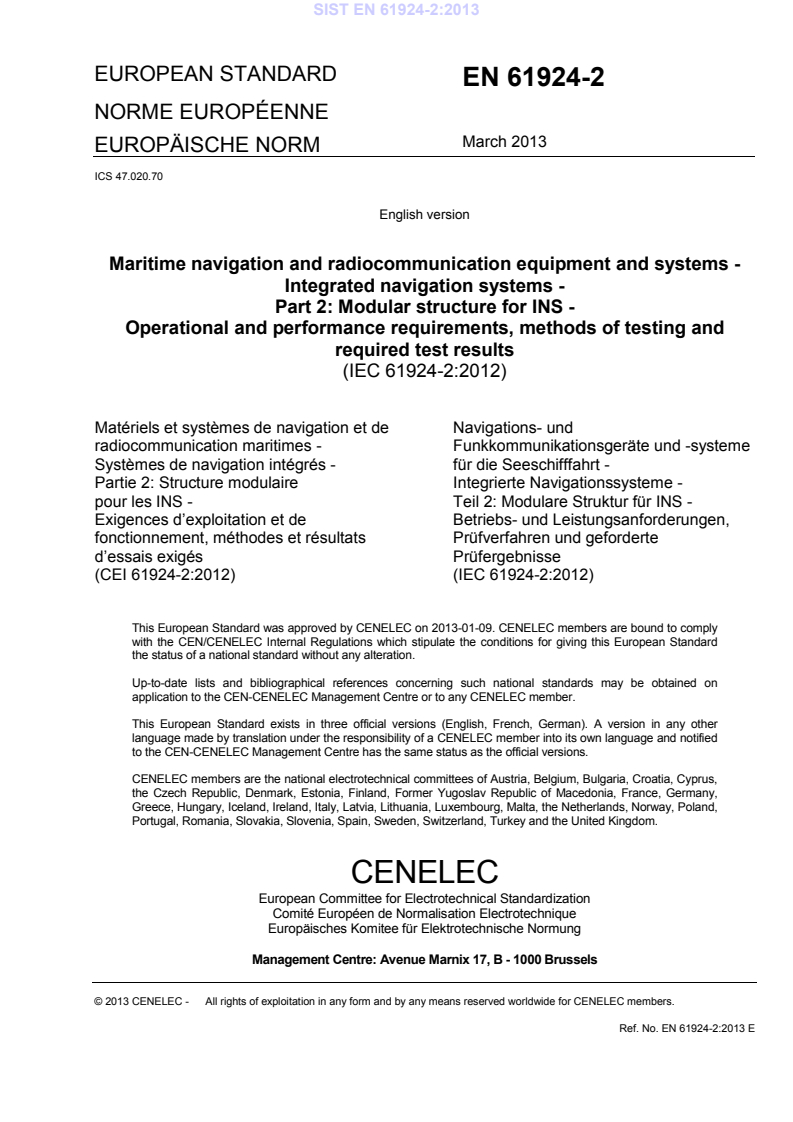
EUROPEAN STANDARD
EN 61924-2
NORME EUROPÉENNE
March 2013
EUROPÄISCHE NORM
ICS 47.020.70
English version
Maritime navigation and radiocommunication equipment and systems -
Integrated navigation systems -
Part 2: Modular structure for INS -
Operational and performance requirements, methods of testing and
required test results
(IEC 61924-2:2012)
Matériels et systèmes de navigation et de Navigations- und
radiocommunication maritimes - Funkkommunikationsgeräte und -systeme
Systèmes de navigation intégrés - für die Seeschifffahrt -
Partie 2: Structure modulaire Integrierte Navigationssysteme -
pour les INS - Teil 2: Modulare Struktur für INS -
Exigences d’exploitation et de Betriebs- und Leistungsanforderungen,
fonctionnement, méthodes et résultats Prüfverfahren und geforderte
d’essais exigés Prüfergebnisse
(CEI 61924-2:2012) (IEC 61924-2:2012)
This European Standard was approved by CENELEC on 2013-01-09. CENELEC members are bound to comply
with the CEN/CENELEC Internal Regulations which stipulate the conditions for giving this European Standard
the status of a national standard without any alteration.
Up-to-date lists and bibliographical references concerning such national standards may be obtained on
application to the CEN-CENELEC Management Centre or to any CENELEC member.
This European Standard exists in three official versions (English, French, German). A version in any other
language made by translation under the responsibility of a CENELEC member into its own language and notified
to the CEN-CENELEC Management Centre has the same status as the official versions.
CENELEC members are the national electrotechnical committees of Austria, Belgium, Bulgaria, Croatia, Cyprus,
the Czech Republic, Denmark, Estonia, Finland, Former Yugoslav Republic of Macedonia, France, Germany,
Greece, Hungary, Iceland, Ireland, Italy, Latvia, Lithuania, Luxembourg, Malta, the Netherlands, Norway, Poland,
Portugal, Romania, Slovakia, Slovenia, Spain, Sweden, Switzerland, Turkey and the United Kingdom.
CENELEC
European Committee for Electrotechnical Standardization
Comité Européen de Normalisation Electrotechnique
Europäisches Komitee für Elektrotechnische Normung
Management Centre: Avenue Marnix 17, B - 1000 Brussels
© 2013 CENELEC - All rights of exploitation in any form and by any means reserved worldwide for CENELEC members.
Ref. No. EN 61924-2:2013 E
Foreword
The text of document 80/677/FDIS, future edition 1 of IEC 61924-2, prepared by IEC TC 80 "Maritime
navigation and radiocommunication equipment and systems" was submitted to the IEC-CENELEC
parallel vote and approved by CENELEC as EN 61924-2:2013.
The following dates are fixed:
(dop) 2013-10-09
• latest date by which the document has
to be implemented at national level by
publication of an identical national
standard or by endorsement
(dow) 2016-01-09
• latest date by which the national
standards conflicting with the
document have to be withdrawn
Attention is drawn to the possibility that some of the elements of this document may be the subject of
patent rights. CENELEC [and/or CEN] shall not be held responsible for identifying any or all such patent
rights.
Endorsement notice
The text of the International Standard IEC 61924-2:2012 was approved by CENELEC as a European
Standard without any modification.
In the official version, for Bibliography, the following notes have to be added for the standards indicated:
IEC 60812:2006 NOTE Harmonized as EN 60812:2006 (not modified).
IEC 61924:2006 NOTE Harmonized as EN 61924:2006 (not modified).
ISO 9241-12 NOTE Harmonized as EN ISO 9241-12.
- 3 - EN 61924-2:2013
Annex ZA
(normative)
Normative references to international publications
with their corresponding European publications
The following documents, in whole or in part, are normatively referenced in this document and are
indispensable for its application. For dated references, only the edition cited applies. For undated
references, the latest edition of the referenced document (including any amendments) applies.
NOTE When an international publication has been modified by common modifications, indicated by (mod), the relevant EN/HD
applies.
Publication Year Title EN/HD Year
IEC 60945 2002 Maritime navigation and radiocommunication EN 60945 2002
+ corr. April 2008 equipment and systems - General
requirements - Methods of testing and
required test results
IEC 61162 Series Maritime navigation and radiocommunication EN 61162 Series
equipment and systems - Digital interfaces
IEC 61162-1 2010 Maritime navigation and radiocommunication EN 61162-1 2011
equipment and systems - Digital interfaces -
Part 1: Single talker and multiple listeners
IEC 61162-2 - Maritime navigation and radiocommunication EN 61162-2 -
equipment and systems - Digital interfaces -
Part 2: Single talker and multiple listeners,
high-speed transmission
IEC 61162-3 - Maritime navigation and radiocommunication EN 61162-3 -
equipment and systems - Digital interfaces -
Part 3: Serial data instrument network
IEC 61162-450 - Maritime navigation and radiocommunication EN 61162-450 -
equipment and systems - Digital interfaces -
Part 450: Multiple talkers and multiple
listeners - Ethernet interconnection
IEC 61174 2008 Maritime navigation and radiocommunication EN 61174 2008
equipment and systems - Electronic chart
display and information system (ECDIS) -
Operational and performance requirements,
methods of testing and required test results
IEC 62065 2002 Maritime navigation and radiocommunication EN 62065 2002
equipment and systems - Track control
systems - Operational and performance
requirements, methods of testing and required
test results
IEC 62288 2008 Maritime navigation and radiocommunication EN 62288 2008
equipment and systems - Presentation of
navigation-related information on shipborne
navigational displays - General requirements,
methods of testing and required test results
IEC 62388 2007 Maritime navigation and radio-communication EN 62388 2008
equipment and systems - Shipborne radar -
Performance requirements, methods of testing
and required test results
IEC 62616 2010 Maritime navigation and radiocommunication EN 62616 2010
+ corr. August 2012 equipment and systems - Bridge navigational
watch alarm system (BNWAS)
Publication Year Title EN/HD Year
ISO 11674 2006 Ships and marine technology - Heading - -
control systems
IMO A.694(17) - General requirements for shipborne radio - -
equipment forming part of the global maritime
distress and safety system (GMDSS) and for
electronic navigational aids
IMO/ICAO - International Aeronautical and Maritime - -
Search and Rescue Manual (IAMSAR
Manual) Volume 3
IMO MSC/ - Guidelines on ergonomic criteria for bridge - -
Circular 982 equipment and layout
IMO MSC.191(79) - Performance standards for the presentation of - -
navigation-related information on shipborne
navigational displays
IMO MSC.232(82) - Adoption of the revised performance - -
standards for electronic chart display and
information systems (ECDIS)
IMO MSC.252(83) - Performance Standards for Integrated - -
Navigation Systems (INS)
IMO MSC.302(87) - Performance standards for Bridge Alert - -
Management (BAM)
IEC 61924-2 ®
Edition 1.0 2012-12
INTERNATIONAL
STANDARD
colour
inside
Maritime navigation and radiocommunication equipment and systems –
Integrated navigation systems –
Part 2: Modular structure for INS – Operational and performance requirements,
methods of testing and required test results
INTERNATIONAL
ELECTROTECHNICAL
COMMISSION
PRICE CODE
XG
ICS 47.020.70 ISBN 978-2-83220-503-7
– 2 – 61924-2 © IEC:2012(E)
CONTENTS
FOREWORD . 7
1 Scope . 9
2 Normative references . 9
3 Terms, definitions and abbreviations . 10
3.1 Terms and definitions . 10
3.2 Abbreviations . 19
4 MSC resolutions . 19
4.1 General . 19
4.2 Purpose of integrated navigation systems . 20
4.3 Application . 21
5 Test requirements and results . 23
5.1 General . 23
5.2 Exceptions for tests previously performed . 23
5.3 Test site . 23
5.4 Methods of test. 24
6 Module A – Requirements for integration of navigational information . 24
6.1 Interfacing and data exchange. 24
6.1.1 Combination, processing and evaluation of data . 24
6.1.2 Availability, validity and integrity . 24
6.1.3 Failure of data exchange . 25
6.1.4 Interfaces in general . 25
6.1.5 Interface to alert management . 25
6.2 Accuracy . 25
6.2.1 Requirement . 25
6.2.2 Methods of test and required results . 25
6.3 Validity, plausibility, latency . 26
6.3.1 Validity . 26
6.3.2 Plausibility . 27
6.3.3 Latency . 27
6.4 Consistent common reference system (CCRS) . 28
6.4.1 Consistency of data . 28
6.4.2 Consistent common reference point (CCRP) . 28
6.4.3 Consistency of thresholds . 30
6.5 Integrity monitoring . 31
6.5.1 Requirement . 31
6.5.2 Methods of test and required results . 32
6.6 Marking of data . 33
6.6.1 Requirement . 33
6.6.2 Methods of tests and required results . 33
6.7 Selection of sensors and sources . 33
6.7.1 Requirement . 33
6.7.2 Methods of test and required results . 34
7 Module B – Task related requirements for Integrated Navigation Systems . 34
7.1 Description . 34
7.2 Task and functional requirements for an INS . 35
7.2.1 General . 35
61924-2 © IEC:2012(E) – 3 –
7.2.2 Task “Route planning” . 35
7.2.3 Task “Route monitoring” . 37
7.2.4 Task “Collision Avoidance” . 40
7.2.5 Task “Navigation Control Data” . 44
7.2.6 Task “Alert management“ . 46
7.2.7 Task “Status and data display“ . 46
7.3 Functional requirements for INS task stations . 47
7.3.1 Number of task stations . 47
7.3.2 Track control . 49
7.3.3 Automatic control functions . 49
7.4 Functional requirements for displays of INS . 50
7.4.1 General . 50
7.4.2 Default display configurations and operational modes. 53
7.4.3 Mode and status awareness . 54
7.4.4 Information display . 55
7.5 Human machine interface . 56
7.5.1 General . 56
7.5.2 System design . 57
7.5.3 Display . 57
7.5.4 Input . 57
7.6 INS Back-up requirements and redundancies . 58
7.6.1 General . 58
7.6.2 Hardware redundancies (back-up) . 60
7.7 System failures and fallback arrangement . 60
7.7.1 General description . 60
7.7.2 Restored operation . 60
7.7.3 Failure or change of sensor for automatic control function . 61
7.7.4 Failure of sensor. 61
7.7.5 Storage of system related parameters . 62
7.7.6 Safe response to malfunction . 62
7.7.7 Alert management . 63
7.7.8 Fallback for navigational information failure . 64
7.8 Technical requirements . 65
7.8.1 General . 65
7.8.2 Hardware and/or processors . 66
7.8.3 Power supply . 66
7.8.4 Power interruptions and shutdown . 67
7.8.5 Data communication interface and protocols . 68
7.8.6 Installation . 68
8 Module C – Alert management. 69
8.1 Description . 69
8.1.1 Purpose of alert management . 69
8.1.2 Scope of alert management . 69
8.1.3 Application of alert management . 69
8.2 General requirements . 70
8.2.1 Provisions . 70
8.2.2 Number of alerts for one situation . 70
8.2.3 Alerts to be handled by the alert management . 70
8.2.4 Logical architecture of the alert management . 71
– 4 – 61924-2 © IEC:2012(E)
8.2.5 Alert management HMI . 71
8.2.6 Audible announcements . 72
8.2.7 Display at several locations . 72
8.3 Priorities and categories . 72
8.3.1 Priorities of alerts . 72
8.3.2 Criteria for classification of alerts. 73
8.3.3 Categories of alerts . 73
8.4 State of alerts . 74
8.4.1 General . 74
8.4.2 Alarms . 76
8.4.3 Warnings . 80
8.4.4 Cautions . 84
8.4.5 Alert escalation . 84
8.5 Consistent presentation of alerts within the INS . 86
8.5.1 Requirement . 86
8.5.2 Methods of test and required results . 86
8.6 Central alert management HMI . 88
8.6.1 General requirements . 88
8.6.2 Silencing of audible alerts . 91
8.6.3 Category A and B alert history list. 91
8.7 Acknowledgement location . 93
8.7.1 Requirement . 93
8.7.2 Methods of test and required results . 93
8.8 Self-monitoring of alert management . 94
8.8.1 Monitoring of system communication . 94
8.8.2 Testing of alerts . 94
8.8.3 Failures . 94
8.9 Interface requirements for alert related communication . 95
8.9.1 Communication concept . 95
8.9.2 Alert priorities, states, etc. . 95
8.9.3 Alert source identity . 97
8.9.4 Acknowledge and silence . 98
8.9.5 Fault tolerance of alert communication . 99
8.10 Integration of systems in alert management. 99
8.10.1 Overall alert management . 99
8.10.2 Inclusion of other equipment . 100
8.10.3 Connection of other equipment . 100
9 Module D – Documentation requirements . 100
9.1 Manuals . 100
9.1.1 Requirement . 100
9.1.2 Methods of tests and required results . 101
9.2 Information regarding the system configuration . 101
9.2.1 Requirement . 101
9.2.2 Methods of tests and required results . 102
9.3 Failure analysis . 102
9.3.1 Requirement . 102
9.3.2 Methods of test and required results . 102
9.4 Onboard familiarization material . 102
9.4.1 Requirement . 102
61924-2 © IEC:2012(E) – 5 –
9.4.2 Methods of test and required results . 102
Annex A (informative) Modular structure for IMO performance standards . 104
Annex B (informative) Guidance to equipment manufacturers for the provision of on-
board familiarization material . 107
Annex C (normative) Classification of alerts . 110
Annex D (normative) Default display configurations . 112
Annex E (informative) Data flow diagram/consistent common reference system
(CCRS) . 114
Annex F (normative) IEC 61162 interfaces . 116
Annex G (informative) Guidance for testing . 120
Annex H (normative) Verification of CCRP calculations . 122
Annex I (normative) Sentence for integrity and plausibility . 124
Annex J (normative) INS alert related communication . 125
Annex K (normative) Sentences for advanced alert related communication . 138
Annex L (normative) Alert communication with ALR and ACK . 143
Annex M (normative) Icons for alert management . 146
Bibliography . 148
Figure E.1 – Data flow diagram/consistent common reference system (CCRS) . 115
Figure F.1 – INS logical interfaces . 116
Figure J.1 – Legacy sensor communication showing priority reduction . 128
Figure J.2 – Legacy sensor communication in case priority reduction is not possible . 129
Figure J.3 – Alerts' communication showing priority reduction . 131
Figure J.4 – Alerts with communication in case priority reduction is not possible . 132
Figure J.5 – Alert state diagram . 136
Figure L.1 – State diagram. 143
Table 1 – Applicable modules of performance standards of stand alone equipment. 22
Table 2 – Applicable modules of other standards for INS to substitute for individual
equipment . 22
Table 3 – Marking of data . 33
Table 4 – Announcement states and related conditions . 74
Table 5 – Announcement state and presentation for Alarms . 75
Table 6 – Announcement state and presentation for Warnings . 75
Table 7 – Announcement state and presentation for Cautions . 76
Table A.1 – Modular structure for radar performance standards . 104
Table A.2 – Modular structure for track control performance standards . 106
Table C.1 – Classification of INS alerts as specified in these performance standards . 110
Table C.2 – Classification for INS for alerts specified in the individual equipment
performance standards . 110
Table D.1 – Task “Route monitoring” . 112
Table D.2 – Task “Collision avoidance” . 112
Table F.1 – IEC 61162-1 sentences transmitted by the INS . 117
Table F.2 – IEC 61162-1 sentences received by the INS . 118
– 6 – 61924-2 © IEC:2012(E)
Table H.1 – Required results . 122
Table H.2 – Required results . 123
Table H.3 – Required results for dynamic scenario . 123
Table H.4 – Required resolution for test . 123
Table J.1 – Conversion from ALR to ALF . 126
Table J.2 – Conversion from ACM to ACK . 127
Table J.3 – Unique alert identifier at alert source . 134
Table M.1 – Alert management icons – Basic . 146
Table M.2 – Alert management icons – Additional qualifiers . 147
61924-2 © IEC:2012(E) – 7 –
INTERNATIONAL ELECTROTECHNICAL COMMISSION
____________
MARITIME NAVIGATION AND
RADIOCOMMUNICATION EQUIPMENT AND SYSTEMS –
INTEGRATED NAVIGATION SYSTEMS –
Part 2: Modular structure for INS –
Operational and performance requirements,
methods of testing and required test results
FOREWORD
1) The International Electrotechnical Commission (IEC) is a worldwide organization for standardization comprising
all national electrotechnical committees (IEC National Committees). The object of IEC is to promote
international co-operation on all questions concerning standardization in the electrical and electronic fields. To
this end and in addition to other activities, IEC publishes International Standards, Technical Specifications,
Technical Reports, Publicly Available Specifications (PAS) and Guides (hereafter referred to as “IEC
Publication(s)”). Their preparation is entrusted to technical committees; any IEC National Committee interested
in the subject dealt with may participate in this preparatory work. International, governmental and non-
governmental organizations liaising with the IEC also participate in this preparation. IEC collaborates closely
with the International Organization for Standardization (ISO) in accordance with conditions determined by
agreement between the two organizations.
2) The formal decisions or agreements of IEC on technical matters express, as nearly as possible, an international
consensus of opinion on the relevant subjects since each technical committee has representation from all
interested IEC National Committees.
3) IEC Publications have the form of recommendations for international use and are accepted by IEC National
Committees in that sense. While all reasonable efforts are made to ensure that the technical content of IEC
Publications is accurate, IEC cannot be held responsible for the way in which they are used or for any
misinterpretation by any end user.
4) In order to promote international uniformity, IEC National Committees undertake to apply IEC Publications
transparently to the maximum extent possible in their national and regional publications. Any divergence
between any IEC Publication and the corresponding national or regional publication shall be clearly indicated in
the latter.
5) IEC itself does not provide any attestation of conformity. Independent certification bodies provide conformity
assessment services and, in some areas, access to IEC marks of conformity. IEC is not responsible for any
services carried out by independent certification bodies.
6) All users should ensure that they have the latest edition of this publication.
7) No liability shall attach to IEC or its directors, employees, servants or agents including individual experts and
members of its technical committees and IEC National Committees for any personal injury, property damage or
other damage of any nature whatsoever, whether direct or indirect, or for costs (including legal fees) and
expenses arising out of the publication, use of, or reliance upon, this IEC Publication or any other IEC
Publications.
8) Attention is drawn to the Normative references cited in this publication. Use of the referenced publications is
indispensable for the correct application of this publication.
9) Attention is drawn to the possibility that some of the elements of this IEC Publication may be the subject of
patent rights. IEC shall not be held responsible for identifying any or all such patent rights.
International Standard IEC 61924-2 has been prepared by IEC technical committee 80:
Maritime navigation and radiocommunication equipment and systems.
The text of this standard is based on the following documents:
FDIS Report on voting
80/677/FDIS 80/684/RVD
Full information on the voting for the approval of this standard can be found in the report on
voting indicated in the above table.
– 8 – 61924-2 © IEC:2012(E)
This publication has been drafted in accordance with the ISO/IEC Directives, Part 2.
A list of all parts in the IEC 61924 series, published under the general title Maritime
navigation and radiocommunication equipment and systems – Integrated navigation systems,
can be found on the IEC website.
Text in italics signifies that the wording is identical to that of the referenced IMO resolution
and/or the SOLAS convention.
The committee has decided that the contents of this publication will remain unchanged until
the stability date indicated on the IEC web site under "http://webstore.iec.ch" in the data
related to the specific publication. At this date, the publication will be
• reconfirmed,
• withdrawn,
• replaced by a revised edition, or
• amended.
A bilingual version of this standard may be issued at a later date.
IMPORTANT – The 'colour inside' logo on the cover page of this publication indicates
that it contains colours which are considered to be useful for the correct
understanding of its contents. Users should therefore print this document using a
colour printer.
61924-2 © IEC:2012(E) – 9 –
MARITIME NAVIGATION AND
RADIOCOMMUNICATION EQUIPMENT AND SYSTEMS –
INTEGRATED NAVIGATION SYSTEMS –
Part 2: Modular structure for INS –
Operational and performance requirements,
methods of testing and required test results
1 Scope
This part of IEC 61924 specifies the minimum requirements for the design, manufacture,
integration, methods of testing and required test results for an integrated navigation system
(INS) to comply with the International Maritime Organization (IMO) requirements of Resolution
MSC.252(83). In addition, it takes account of IMO Resolution A.694(17) to which IEC 60945 is
associated. When a requirement in this standard is different from IEC 60945, the requirement
of this standard takes precedence.
NOTE 1 IEC 61924:2006 specifies the minimum requirements for the design, manufacture, integration, methods
of testing and required test results for an integrated navigation system to comply with the earlier IMO requirements
of Resolution MSC 86(70), Annex 3. Integrated navigation systems in accordance with IEC 61924:2006 are not
suitable for installation after 1 January 2011.
NOTE 2 All text of this standard, whose wording is identical to that in IMO Resolution MSC.252(83) will be printed
in italics and the Resolution and paragraph number indicated between brackets.
2 Normative references
The following documents, in whole or in part, are normatively referenced in this document and
are indispensable for its application. For dated references, only the edition cited applies. For
undated references, the latest edition of the referenced document (including any
amendments) applies.
IEC 60945:2002, Maritime navigation and radiocommunication equipment and systems –
General requirements – Methods of testing and required test results
IEC 61162 (all parts), Maritime navigation and radiocommunication equipment and systems –
Digital interfaces
IEC 61162-1:2010, Maritime navigation and radiocommunication equipment and systems –
Digital interfaces – Part 1: Single talker and multiple listeners
IEC 61162-2, Maritime navigation and radiocommunication equipment and systems – Digital
interfaces – Part 2: Single talker and multiple listeners, high-speed transmission
IEC 61162-3, Maritime navigation and radiocommunication equipment and systems – Digital
interfaces – Part 3: Serial data instrument network
IEC 61162-450, Maritime navigation and radiocommunication equipment and systems –
Digital interfaces – Part 450: Multiple talkers and multiple listeners – Ethernet interconnection
IEC 61174:2008, Maritime navigation and radiocommunication equipment and systems –
Electronic chart display and information system (ECDIS) – Operational and performance
requirements, methods of testing and required test results
– 10 – 61924-2 © IEC:2012(E)
IEC 62065:2002, Maritime navigation and radiocommunication equipment and systems –
Track control systems – Operational and performance requirements, methods of testing and
required test results
IEC 62288:2008, Maritime navigation and radiocommunication equipment and systems –
Presentation of navigation-related information on shipborne navigational displays – General
requirements, methods of testing and required test results
IEC 62388:2007, Maritime navigation and radiocommunication equipment and systems –
Shipborne radar – Performance requirements, methods of testing and required test results
IEC 62616:2010, Maritime navigation and radiocommunication equipment and systems –
Bridge navigational watch alarm system (BNWAS)
IMO A.694(17), General requirements for shipborne radio equipment forming part of the
Global maritime distress and safety system (GMDSS) and for electronic navigational aids
IMO/ICAO, International Aeronautical and Maritime Search and Rescue Manual (IAMSAR
Manual) Volume 3
IMO MSC/Circ.982, Guidelines on ergonomic criteria for bridge equipment and layout
IMO MSC.191(79), Performance standards for presentation of navigation-related information
on shipborne navigational displays
IMO MSC.232(82), Revised performance standards for Electronic Chart Display and
Information Systems (ECDIS)
IMO MSC.252(83), Performance Standards for Integrated Navigation Systems (INS)
IMO MSC.302(87), Performance standards for Bridge Alert Management (BAM)
ISO 11674:2006, Ships and marine technology – Heading control systems
3 Terms, definitions and abbreviations
3.1 Terms and definitions
For the purposes of this document, the following terms and definitions apply.
3.1.1
accuracy
degree of conformance between the estimated or measured parameter value at a given time
and its true parameter value at that time
3.1.2
added value
functionality and information, which are provided by the INS, in addition to the requirements of
the performance standard for the individual equipment
3.1.3
aggregated alert
alert indicating the existence of multiple individual alerts of the same kind
61924-2 © IEC:2012(E) – 11 –
3.1.4
aid to navigation
AtoN
any device or system external to a vessel intended to assist a navigator to determine position
or safe course, or to warn of hazards to navigation
3.1.5
alarm
the highest priority of an alert as defined in MSC.252(83). Announcing a situation or condition
requiring immediate attention, decision and if necessary action by the bridge team, to
maintain the safe navigation of the ship
3.1.6
alert
announcing abnormal situations and conditions requiring attention, decision and/or action.
Alerts are divided in three priorities: alarms, warnings and cautions
3.1.7
alert announcements
visual and where applicable acoustical presentation of alerts
3.1.8
alert history list
accessible list of past alerts
3.1.9
alert management
concept for the harmonized regulation of the monitoring, handling, distribution and
presentation of alerts on the bridge
3.1.10
announcement
visual and/or audible signal issued to the user by the system
3.1.11
automatic control functions
functions that include automatic heading, and/or track and/or speed control or other
navigation related automatic control functions
3.1.12
backup
use of data, function and/or hardware of similar type and quality
3.1.13
Category A alerts
alerts where graphical e.g. radar, ECDIS, information at the task station directly assigned to
the function generating the alert is necessary, as decision support for the evaluation the alert
related condition
3.1.14
Category B alerts
alerts where no additional information for decision support is necessary besides the
information which can be presented at the central alert management HMI
– 12 – 61924-2 © IEC:2012(E)
3.1.15
caution
lowest priority of an alert. Raising bridge team’s awareness of a condition which does not
warrant an alarm or warning condition, but still requires attention out of the ordinary
consideration of the situation or of given information
3.1.16
collision avoidance
navigational task of detecting and plotting other ships a
...