


EN ISO 4757:1994
(Main)Cross recesses for screws (ISO 4757:1983)
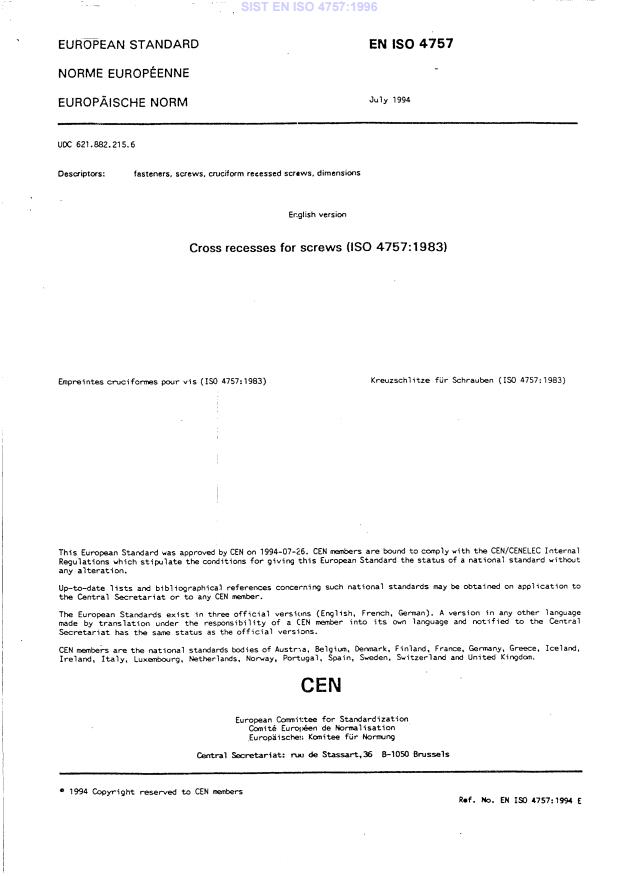
Cross recesses for screws (ISO 4757:1983)
Defines the type H and type Z; dimensions are illustrated by figures; tabulates gauge dimensions from No. 0 up to and including No. 4; includes a method of penetration gauging for both types.
Kreuzschlitze für Schrauben (ISO 4757:1983)
Diese Norm enthält zwei Formen Kreuzschlitzen für Schrauben: - Kreuzschlitz H; - Kreuzschlitz Z. Weiterhin legt die Norm für beide Kreuzschlitzformen ein Verfahren zum Messen der Eindringtiefen der Kreuzschlitze fest.
Empreintes cruciformes pour vis (ISO 4757:1983)
La présente Norme internationale définit deux types d'empreintes cruciformes pour vis :
l'empreinte type H ;
l'empreinte type Z.
Elle comporte une méthode de vérification de la profondeur de pénétration
dans les deux cas.
Križne zareze za vijake
General Information
- Status
- Published
- Publication Date
- 30-Jul-1994
- Technical Committee
- CEN/TC 185 - Threaded and nonthreaded mechanical fasteners and accessories
- Current Stage
- 9093 - Decision to confirm - Review Enquiry
- Start Date
- 04-Sep-2009
- Completion Date
- 04-Sep-2009
Relations
- Effective Date
- 28-Jan-2026
Overview
EN ISO 4757:1994 is a European and international standard that specifies the requirements for cross recesses on screws. This standard aligns with ISO 4757:1983 and is endorsed by CEN (European Committee for Standardization). It defines two types of cross recesses-Type H and Type Z-and provides detailed dimensions and gauging methods for these recesses. The standard covers sizes from No. 0 through No. 4, ensuring uniformity and compatibility in screw designs across industries.
Key Topics
Cross Recess Types
The standard defines two specific types of cross recesses for screws:- Type H: A particular design of cross recess widely used in various fastening applications.
- Type Z: Another design variant offering alternative performance or manufacturing benefits.
Dimensional Specifications
EN ISO 4757:1994 illustrates the geometric dimensions of both recess types through detailed figures. Precise dimensions facilitate consistent manufacturing and quality control.Gauge Dimensions
The standard tabulates gauge sizes from No. 0 up to No. 4. These gauges are essential tools for verifying recess dimensions during production and inspection processes.Penetration Gauging Method
A method is included for penetration gauging applicable to both cross recess types. This ensures that the screw head recess has the correct depth and profile for optimal tool engagement.
Applications
Fasteners Manufacturing
Screw manufacturers use EN ISO 4757:1994 to design and produce cross-recessed screws that meet internationally accepted quality and dimensional criteria.Quality Control and Inspection
Quality assurance teams rely on the gauge dimensions and penetration gauging methods detailed in the standard to verify recess accuracy, improving reliability in assembly processes.Tool Design
Manufacturers of hand tools and power drivers benefit from the standard’s defined recess profiles to optimize tool tip design for enhanced fit and torque transfer.Mechanical Assembly
Engineers select screws conforming to EN ISO 4757 to ensure compatibility with standardized driving tools and to maintain consistency across global supply chains in automotive, electronics, and machinery industries.
Related Standards
ISO 4757:1983
The original international standard upon which EN ISO 4757:1994 is based, providing cross recess definitions and specifications.ISO 7045
Specifies cross recess dimensions for pan head screws, complementing EN ISO 4757 for different screw head types.ISO 10664
Covers dimensions and designation of screw drives, including recessed types, contributing additional context for screw and tool compatibility.EN ISO 898-1
Defines mechanical properties of fasteners made of carbon steel and alloy steel, often used alongside EN ISO 4757 to specify both geometry and strength.
By standardizing the types, dimensions, and gauging methods for cross recesses on screws, EN ISO 4757:1994 ensures interchangeability, quality assurance, and optimal tool compatibility in screw fastening applications worldwide. This contributes to enhanced reliability and efficiency in mechanical assemblies across numerous industries.

Frequently Asked Questions
EN ISO 4757:1994 is a standard published by the European Committee for Standardization (CEN). Its full title is "Cross recesses for screws (ISO 4757:1983)". This standard covers: Defines the type H and type Z; dimensions are illustrated by figures; tabulates gauge dimensions from No. 0 up to and including No. 4; includes a method of penetration gauging for both types.
Defines the type H and type Z; dimensions are illustrated by figures; tabulates gauge dimensions from No. 0 up to and including No. 4; includes a method of penetration gauging for both types.
EN ISO 4757:1994 is classified under the following ICS (International Classification for Standards) categories: 21.060.10 - Bolts, screws, studs. The ICS classification helps identify the subject area and facilitates finding related standards.
EN ISO 4757:1994 has the following relationships with other standards: It is inter standard links to EN ISO 25239-4:2011. Understanding these relationships helps ensure you are using the most current and applicable version of the standard.
EN ISO 4757:1994 is available in PDF format for immediate download after purchase. The document can be added to your cart and obtained through the secure checkout process. Digital delivery ensures instant access to the complete standard document.
Standards Content (Sample)
SLOVENSKI STANDARD
01-april-1996
Križne zareze za vijake
Cross recesses for screws (ISO 4757:1983)
Kreuzschlitze für Schrauben (ISO 4757:1983)
Empreintes cruciformes pour vis (ISO 4757:1983)
Ta slovenski standard je istoveten z: EN ISO 4757:1994
ICS:
21.060.10 Sorniki, vijaki, stebelni vijaki Bolts, screws, studs
2003-01.Slovenski inštitut za standardizacijo. Razmnoževanje celote ali delov tega standarda ni dovoljeno.
...
Questions, Comments and Discussion
Ask us and Technical Secretary will try to provide an answer. You can facilitate discussion about the standard in here.
Loading comments...