

EN 18216:2026
(Main)Digital product passport - Data exchange protocols
General Information
- Abstract
This document defines a standard for secure and efficient data exchange protocols and data formats to be used for the digital product passport. Data exchange protocols establish the rules and procedures that systems follow when communicating and exchanging information. Data formats define the structure and presentation of that information so it can be understood and processed correctly by the involved systems. Together, protocols and formats ensure that data can be exchanged in a manner that is secure, interoperable, reliable, and compatible across various platforms and sectors.
This will guarantee that data are human and machine-readable, structured, searchable, and transferable through an open, interoperable network without vendor lock-in.
a) Secure communication:
This document defines protocols that ensure secure and authenticated data exchange between systems, ensuring that data are protected against unauthorised access and, when necessary, only authorized entities can access the information.
b) Interoperability for data exchange:
The protocols and data formats defined in this document support easy integration with existing data exchange systems, ensure compatibility of protocols and formats across various sectors and supporting a wide range of applications and use cases.
c) Ease of use and integration:
Ensure that the identified protocols and formats can be implemented easily, especially for mobile devices, and are user-friendly in order to facilitate widespread adoption.
d) Data integrity:
The protocols and data formats defined in this document ensure the integrity of information linked to physical objects and electronic data throughout the entire value chain, extending to the product's or asset's end-of-life.
e) Documentation and discoverability:
The protocols and formats are available to individuals without specialized knowledge, enabling broader adoption across sectors.
In order to promote interoperability, reduce costs for businesses, and align with existing European regulations and initiatives, this document considers the data exchange protocols and data formats already in use in other legislations. Relevant existing standards are integrated into the development process to ensure consistency and coherence with industry practices and regulatory frameworks.
- Status
- Published
- Publication Date
- 26-May-2026
- Technical Committee
- JTC 24 - Digital Product Passport (DPP)
- Drafting Committee
- WG 4 - Interoperability framework
- Current Stage
- 6060 - Definitive text made available (DAV) - Publishing
- Start Date
- 27-May-2026
- Due Date
- 22-May-2026
- Completion Date
- 27-May-2026
- Directive
- 2024/1781 - Regulation (EU) 2024/1781 of the European Parliament and of the Council of 13 June 2024 establishing a framework for the setting of ecodesign requirements for sustainable products, amending Directive (EU) 2020/1828 and Regulation (EU) 2023/1542 and repealing Directive 2009/125/ECText with EEA relevanceOJ Ref: OJ L, 2026/1736 OJ Date: 15-Jul-2026

Overview
EN 18216:2026 - Digital Product Passport Data Exchange Protocols is a European standard developed by CEN to define secure, efficient, and interoperable data exchange protocols and data formats for digital product passports (DPPs). It lays out the rules and structures for data communication between systems, ensuring that digital product information is machine-readable, structured, easily searchable, and transferable across various sectors and platforms. The standard aims to protect data integrity, support secure communication, ensure ease of adoption, and allow seamless integration, all while preventing vendor lock-in and facilitating compliance with European regulations.
Key Topics
Secure Communication:
EN 18216 specifies protocols that prioritize secure, authenticated data exchange. All DPP data exchanges must use encryption methods (such as HTTPS over TLS), protecting information from unauthorized access and guaranteeing that only authenticated entities can view sensitive product data.Interoperability:
The standard ensures data formats and exchange protocols are compatible across multiple sectors (manufacturing, supply chain, retail, regulatory, etc.) and with existing systems. This supports machine-to-machine communication and integration without sectoral or vendor-specific barriers.Ease of Implementation:
Special attention is given to user-friendly protocols and formats, allowing quick adoption even for mobile applications. Solutions like RESTful APIs and standard web technologies facilitate easy and cost-effective implementation for both SMEs and large organizations.Data Integrity:
The protocols guarantee that product information remains unaltered throughout its journey across the value chain, from production to end-of-life. Mechanisms such as message authentication and cryptographic validation preserve the reliability and trustworthiness of the exchanged data.Documentation and Discoverability:
The standard encourages open documentation of protocols and formats so both experts and non-experts can understand, implement, and adopt DPP systems. This broadens market accessibility and sectoral participation.Open, Vendor-Neutral Networking:
By mandating open, standardized protocols and data formats, EN 18216 reduces the risk of vendor lock-in, decreases integration costs, and aligns with existing European policies and initiatives on sustainable products.
Applications
EN 18216 is essential for various practical applications related to digital product passports and product lifecycle management:
Manufacturing, Distribution, and Retail:
Manufacturers, suppliers, and retailers use standardized data exchange to track, share, and verify product data efficiently and securely at every stage.Product Compliance and Sustainability:
Regulatory bodies and businesses leverage the DPP system for conformity with EU ecodesign requirements and traceability for sustainability reporting.Consumer Engagement:
Consumers and service providers (repairers, recyclers) access structured, real-time product data through DPP-enabled apps and portals, empowering informed decisions and responsible end-of-life management.Cross-border and Multi-stakeholder Interactions:
Secure, interoperable communication enables seamless product data transfers among international partners, ensuring data access, verification, and updating.Digital Transformation and Circular Economy:
Organizations digitizing supply chains or targeting circular economy models benefit from the integrity, security, and interoperability of standardized digital product passports.
Related Standards
EN 18216 aligns and interoperates with various other international and European standards, supporting broader digital infrastructure:
- Network Security Protocols (e.g., TLS, HTTPS):
Ensures encryption, data integrity, and authenticity during data exchange. - RESTful APIs:
Enables scalable, standardized web-based data access. - JSON, XML, and JSON-LD:
Machine- and human-readable data formats enhancing data structuring and semantic interoperability. - Identity and Authorization Standards:
- OAuth 2.0
- OpenID Connect (OIDC)
- CEF eID
- Decentralized Identifiers (DIDs)
- EDI (Electronic Data Interchange) and Asset Administration Shell (AAS):
For business document exchange and digital asset representation. - Regulatory References:
Supports compliance with Commission Regulation (EU) No 2024/1781 and related ecodesign directives.
By following EN 18216, organizations position themselves at the forefront of secure, interoperable, and future-ready digital product data management across the EU's single market.
Relations
- Effective Date
- 15-Jul-2026
Get Certified
Connect with accredited certification bodies for this standard

BSI Group
BSI (British Standards Institution) is the business standards company that helps organizations make excellence a habit.

NYCE
Mexican standards and certification body.
Sponsored listings
Frequently Asked Questions
EN 18216:2026 is a standard published by the European Committee for Standardization (CEN). Its full title is "Digital product passport - Data exchange protocols". This standard covers: This document defines a standard for secure and efficient data exchange protocols and data formats to be used for the digital product passport. Data exchange protocols establish the rules and procedures that systems follow when communicating and exchanging information. Data formats define the structure and presentation of that information so it can be understood and processed correctly by the involved systems. Together, protocols and formats ensure that data can be exchanged in a manner that is secure, interoperable, reliable, and compatible across various platforms and sectors. This will guarantee that data are human and machine-readable, structured, searchable, and transferable through an open, interoperable network without vendor lock-in. a) Secure communication: This document defines protocols that ensure secure and authenticated data exchange between systems, ensuring that data are protected against unauthorised access and, when necessary, only authorized entities can access the information. b) Interoperability for data exchange: The protocols and data formats defined in this document support easy integration with existing data exchange systems, ensure compatibility of protocols and formats across various sectors and supporting a wide range of applications and use cases. c) Ease of use and integration: Ensure that the identified protocols and formats can be implemented easily, especially for mobile devices, and are user-friendly in order to facilitate widespread adoption. d) Data integrity: The protocols and data formats defined in this document ensure the integrity of information linked to physical objects and electronic data throughout the entire value chain, extending to the product's or asset's end-of-life. e) Documentation and discoverability: The protocols and formats are available to individuals without specialized knowledge, enabling broader adoption across sectors. In order to promote interoperability, reduce costs for businesses, and align with existing European regulations and initiatives, this document considers the data exchange protocols and data formats already in use in other legislations. Relevant existing standards are integrated into the development process to ensure consistency and coherence with industry practices and regulatory frameworks.
This document defines a standard for secure and efficient data exchange protocols and data formats to be used for the digital product passport. Data exchange protocols establish the rules and procedures that systems follow when communicating and exchanging information. Data formats define the structure and presentation of that information so it can be understood and processed correctly by the involved systems. Together, protocols and formats ensure that data can be exchanged in a manner that is secure, interoperable, reliable, and compatible across various platforms and sectors. This will guarantee that data are human and machine-readable, structured, searchable, and transferable through an open, interoperable network without vendor lock-in. a) Secure communication: This document defines protocols that ensure secure and authenticated data exchange between systems, ensuring that data are protected against unauthorised access and, when necessary, only authorized entities can access the information. b) Interoperability for data exchange: The protocols and data formats defined in this document support easy integration with existing data exchange systems, ensure compatibility of protocols and formats across various sectors and supporting a wide range of applications and use cases. c) Ease of use and integration: Ensure that the identified protocols and formats can be implemented easily, especially for mobile devices, and are user-friendly in order to facilitate widespread adoption. d) Data integrity: The protocols and data formats defined in this document ensure the integrity of information linked to physical objects and electronic data throughout the entire value chain, extending to the product's or asset's end-of-life. e) Documentation and discoverability: The protocols and formats are available to individuals without specialized knowledge, enabling broader adoption across sectors. In order to promote interoperability, reduce costs for businesses, and align with existing European regulations and initiatives, this document considers the data exchange protocols and data formats already in use in other legislations. Relevant existing standards are integrated into the development process to ensure consistency and coherence with industry practices and regulatory frameworks.
EN 18216:2026 is classified under the following ICS (International Classification for Standards) categories: 35.240.63 - IT applications in trade. The ICS classification helps identify the subject area and facilitates finding related standards.
EN 18216:2026 has the following relationships with other standards: It is inter standard links to ISO/IEC 21778:2017. Understanding these relationships helps ensure you are using the most current and applicable version of the standard.
EN 18216:2026 is associated with the following European legislation: EU Directives/Regulations: 2024/1781, (EU) 2024/1781; Standardization Mandates: M/604, M/604 Amd 1. When a standard is cited in the Official Journal of the European Union, products manufactured in conformity with it benefit from a presumption of conformity with the essential requirements of the corresponding EU directive or regulation.
EN 18216:2026 is available in PDF format for immediate download after purchase. The document can be added to your cart and obtained through the secure checkout process. Digital delivery ensures instant access to the complete standard document.
Standards Content (Sample)
SLOVENSKI STANDARD
01-julij-2026
Digitalni potni list izdelka - Protokoli izmenjave podatkov
Digital product passport - Data exchange protocols
Digitaler Produktpass - Protokolle zum Datenaustausch
Passeport numérique des produits - Protocoles d'échange de données
Ta slovenski standard je istoveten z: EN 18216:2026
ICS:
13.020.20 Okoljska ekonomija. Environmental economics.
Trajnostnost Sustainability
35.240.63 Uporabniške rešitve IT v IT applications in trade
trgovini
2003-01.Slovenski inštitut za standardizacijo. Razmnoževanje celote ali delov tega standarda ni dovoljeno.
EUROPEAN STANDARD EN 18216
NORME EUROPÉENNE
EUROPÄISCHE NORM
May 2026
ICS 35.240.63
English version
Digital product passport - Data exchange protocols
Passeport numérique des produits - Protocoles Digitaler Produktpass - Protokolle zum
d'échange de données Datenaustausch
This European Standard was approved by CEN on 3 May 2026.
CEN and CENELEC members are bound to comply with the CEN/CENELEC Internal Regulations which stipulate the conditions for
giving this European Standard the status of a national standard without any alteration. Up-to-date lists and bibliographical
references concerning such national standards may be obtained on application to the CEN-CENELEC Management Centre or to
any CEN and CENELEC member.
This European Standard exists in three official versions (English, French, German). A version in any other language made by
translation under the responsibility of a CEN and CENELEC member into its own language and notified to the CEN-CENELEC
Management Centre has the same status as the official versions.
CEN and CENELEC members are the national standards bodies and national electrotechnical committees of Austria, Belgium,
Bulgaria, Croatia, Cyprus, Czech Republic, Denmark, Estonia, Finland, France, Germany, Greece, Hungary, Iceland, Ireland, Italy,
Latvia, Lithuania, Luxembourg, Malta, Netherlands, Norway, Poland, Portugal, Republic of North Macedonia, Romania, Serbia,
Slovakia, Slovenia, Spain, Sweden, Switzerland, Türkiye and United Kingdom.
CEN-CENELEC Management Centre:
Rue de la Science 23, B-1040 Brussels
© 2026 CEN/CENELEC All rights of exploitation in any form and by any means
Ref. No. EN 18216:2026 E
reserved worldwide for CEN national Members and for
CENELEC Members.
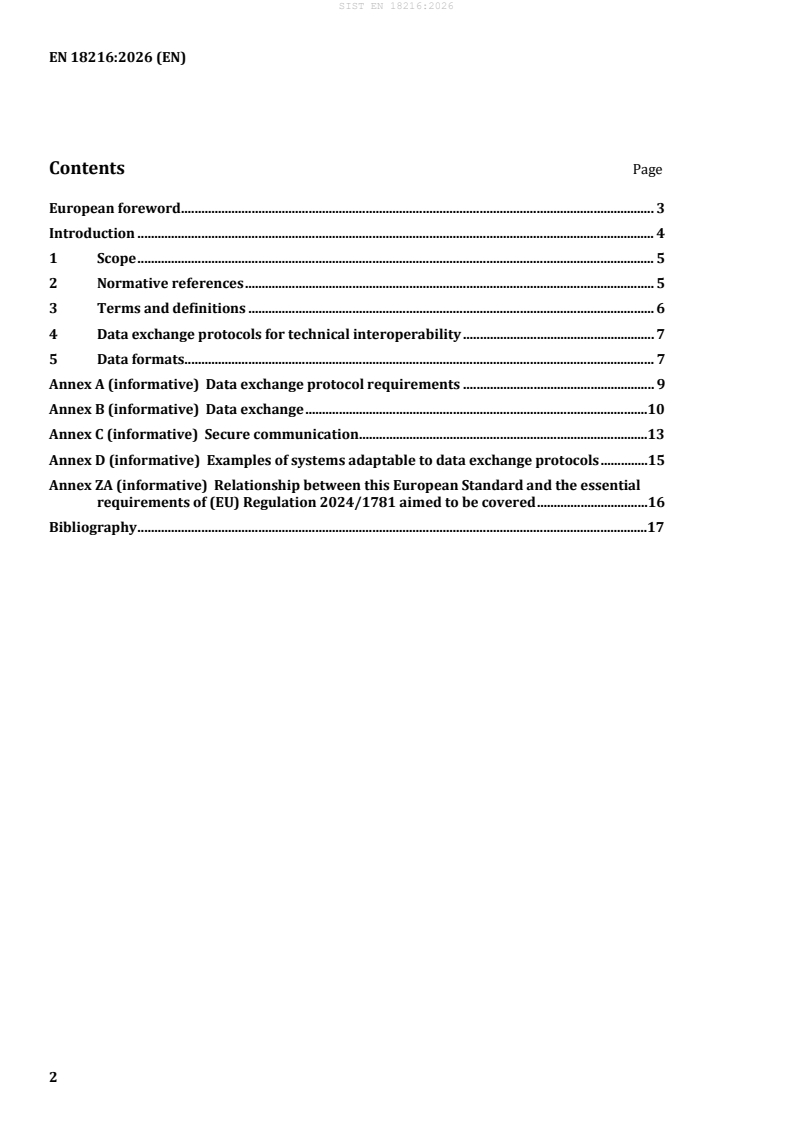
Contents Page
European foreword . 3
Introduction . 4
1 Scope . 5
2 Normative references . 5
3 Terms and definitions . 6
4 Data exchange protocols for technical interoperability . 7
5 Data formats . 7
Annex A (informative) Data exchange protocol requirements . 9
Annex B (informative) Data exchange .10
Annex C (informative) Secure communication .13
Annex D (informative) Examples of systems adaptable to data exchange protocols .15
Annex ZA (informative) Relationship between this European Standard and the essential
requirements of (EU) Regulation 2024/1781 aimed to be covered .16
Bibliography .17
European foreword
This document (EN 18216:2026) has been prepared by Technical Committee CEN/CLC/JTC 24 “Digital
Product Passport - Framework and System”, the secretariat of which is held by DIN.
This European Standard shall be given the status of a national standard, either by publication of an
identical text or by endorsement, at the latest by November 2026, and conflicting national standards shall
be withdrawn at the latest by November 2026.
Attention is drawn to the possibility that some of the elements of this document may be the subject of
patent rights. CEN shall not be held responsible for identifying any or all such patent rights.
This document has been prepared under a standardization request addressed to CEN by the European
Commission. The Standing Committee of the EFTA States subsequently approves these requests for its
Member States.
For the relationship with EU Legislation, see informative Annex ZA, which is an integral part of this
document.
Any feedback and questions on this document should be directed to the users’ national standards body.
A complete listing of these bodies can be found on the CEN website.
According to the CEN-CENELEC Internal Regulations, the national standards organisations of the
following countries are bound to implement this European Standard: Austria, Belgium, Bulgaria, Croatia,
Cyprus, Czech Republic, Denmark, Estonia, Finland, France, Germany, Greece, Hungary, Iceland, Ireland,
Italy, Latvia, Lithuania, Luxembourg, Malta, Netherlands, Norway, Poland, Portugal, Republic of North
Macedonia, Romania, Serbia, Slovakia, Slovenia, Spain, Sweden, Switzerland, Türkiye and the United
Kingdom.
Introduction
0.1 Background
A digital product passport (DPP) is a key enabling mechanism to make product information traceable and
accessible across value chains - supporting economic operators, manufacturers, distributors, repairers,
recyclers and consumers to make informed decisions and to support a circular economy. The
implementation of digital product passports will be carried out progressively. Sector-specific initiatives
will determine the precise DPP content and requirements for individual product groups.
To support the implementation of DPPs, 8 standards have been developed so far:
— EN 18219:2026 – Digital product passport – Unique identifiers
— EN 18220:2026 – Digital product passport – Data carriers
— EN 18216:2026 – Digital product passport – Data exchange protocols (this document)
— EN 18222:2026 – Digital Product Passport – Application Programming Interfaces (APIs) for the
product passport lifecycle management and searchability
— EN 18223:2026 – Digital Product Passport – System interoperability
— EN 18221:2026 – Digital product passport – data storage, archiving, and data persistence
— EN 18239:— – Digital Product Passport – access rights management, information system security,
and business confidentiality
— EN 18246:— – Digital Product Passport – Data authentication, reliability and integrity
0.2 Overview
A digital product passport (DPP) is a dynamic digital record that contains information about a product
throughout its lifecycle. For DPPs to be effective and universally accessible, standardized data exchange
protocols and frameworks need to be in place. Standardization and harmonization of these protocols
ensure that actors of the DPP - such as manufacturers, suppliers, retailers, consumers, repairers, waste
treatment facilities, and regulatory authorities - can access, extract, utilize, and update the shared product
passport information seamlessly depending on actors’ information needs and authorization. The
subsequent sections of this document outline the standardization for data exchange protocols and data
formats.
In addition, this document includes informative annexes to support practical understanding and
implementation:
— Annex A: Data exchange protocol requirements;
— Annex B: Data exchange;
— Annex C: Secure communication;
— Annex D: Examples of systems adaptable to data exchange protocols.
Under preparation. Stage at the time of publication: prEN 18239:2025.
Under preparation. Stage at the time of publication: prEN 18246:2025.
1 Scope
This document defines a standard for secure and efficient data exchange protocols and data formats to
be used for the digital product passport. Data exchange protocols establish the rules and procedures that
systems follow when communicating and exchanging information. Data formats define the structure and
presentation of that information so it can be understood and processed correctly by the involved systems.
Together, protocols and formats ensure that data can be exchanged in a manner that is secure,
interoperable, reliable, and compatible across various platforms and sectors.
This will guarantee that data are human and machine-readable, structured, searchable, and transferable
through an open, interoperable network without vendor lock-in.
a) Secure communication:
This document defines protocols that ensure secure and authenticated data exchange between
systems, ensuring that data are protected against unauthorised access and, when necessary, only
authorized entities can access the information.
b) Interoperability for data exchange:
The protocols and data formats defined in this document support easy integration with existing data
exchange systems, ensure compatibility of protocols and formats across various sectors and
supporting a wide range of applications and use cases.
c) Ease of use and integration:
Ensure that the identified protocols and formats can be implemented easily, especially for mobile
devices, and are user-friendly in order to facilitate widespread adoption.
d) Data integrity:
The protocols and data formats defined in this document ensure the integrity of information linked
to physical objects and electronic data throughout the entire value chain, extending to the product's
or asset's end-of-life.
e) Documentation and discoverability:
The protocols and formats are available to individuals without specialized knowledge, enabling
broader adoption across sectors.
In order to promote interoperability, reduce costs for businesses, and align with existing European
regulations and initiatives, this document considers the data exchange protocols and data formats
already in use in other legislations. Relevant existing standards are integrated into the development
process to ensure consistency and coherence with industry practices and regulatory frameworks.
2 Normative references
The following documents are referred to in the text in such a way that some or all of their content
constitutes requirements of this document. For dated references, only the edition cited applies. For
undated references, the latest edition of the referenced document (including any amendments) applies.
ISO/IEC 21778:2017, Information technology — The JSON data interchange syntax
EN 301549:2021, Accessibility requirements for ICT products and services
3 Terms and definitions
For the purposes of this document, the following terms and definitions apply.
ISO and IEC maintain terminology databases for use in standardization at the following addresses:
— ISO Online browsing platform: available at http://www.iso.org/obp
— IEC Electropedia: available at http://www.electropedia.org/
3.1
identifier
digital identifier
sequence of characters associated with digital, non-digital, or abstract entities, such as books, images,
reports, metadata records or events
[SOURCE: ISO 24619 [1], 3.2.1]
3.2
data exchange
storing, accessing, transferring, and archiving of data
[SOURCE: ISO 15531-43 [2], 3.1.5]
3.3
identification
process of recognizing an object in a particular domain as distinct from other objects
[SOURCE: EN ISO/IEC 24760-1 [3], 3.2.1]
3.4
authentication
verification that a claimed identity is correct
[SOURCE: ISO/IEC/IEEE 8802-1AR [4], 3.2]
3.5
data integrity
property that data has not been altered or destroyed in an unauthorised manner
Note 1 to entry: In the context of secure communication, data integrity ensures that data transmitted between
parties remains unaltered and intact from the moment it leaves the sender to the moment it reaches the receiver.
This means that the data has not been tampered with, modified, or corrupted during transmission – whether
accidentally or through malicious actions.
[SOURCE: ISO 7498-2:1989, 3.3.21, modified - note to entry added [5]]
3.6
secure communication
mechanism of transmitting data between systems in a way that ensures its confidentiality, integrity and
authenticity
3.7
digital product passport
DPP
digital record of product characteristics throughout its lifecycle
Note 1 to entry: Example characteristics include environmental sustainability, environmental impact, and
recyclability
3.8
controlled DPP data
information on digital product passport whose access is controlled based on the user's access rights
Note 1 to entry: User: person who interacts with a system, product or service [SOURCE: ISO 26800:2011, 2.10;
modified, Notes changed]
4 Data exchange protocols for technical interoperability
The data exchange protocols specified in this clause shall be used for standardized DPP access.
The data exchange protocols shall maintain confidentiality and integrity of DPP data.
HTTP over TLS (HTTPS)
Protocol: HTTPS (Hypertext Transfer Protocol Secure) is the secure version of HTTP [6], used for secure
communication over a computer network.
Standards:
— TLS (Transport Layer Security): TLS 1.2 (e.g. defined by [7]) shall be the minimum version supported.
The use of TLS 1.3 (e.g. defined by [8]) or later is strongly recommended. Use of older versions
(TLS 1.0, 1.1, and all SSL versions) is prohibited.
— HTTP/2 shall be the minimum version supported. The use of HTTP/3 [9] is recommended. Older
versions than HTTP/2 shall not be used.
The API specification based on the data exchange protocol should follow the architectural style of
RESTful.
EN 18222 [14] specifies the HTTPS interaction with the API.
5 Data formats
The data format listed below shall be used for syntactic interoperability.
a) JSON (JavaScript Object Notation, ISO/IEC 21778:2017) is a human and machine)readable data-
interchange format used to transmit data between a server and a client.
In addition to the abovementioned, any of the following message formats may be used based on http
content negotiation [10]:
b) XML (eXtensible Markup Language) [11] is a markup language and file format for storing,
transmitting and reconstructing arbitrary data. It defines a set of rules for encoding documents in a
format that is both human-readable and machine-readable.
c) JSON-LD (JavaScript Object Notation for Linked Data) [12] is a human-readable data format that
provides context and links
...