

EN 2390:2019
(Main)Aerospace series - Aluminium alloy 6082-T6 - Tubes for structures 0,6 mm ≤ a ≤ 12,5 mm
General Information
- Abstract
This document specifies the requirements relating to:
Aluminium alloy 6082-
T6
Tubes for structures
0,6 mm ≤ a ≤ 12,5 mm
for aerospace applications.
- Status
- Published
- Publication Date
- 17-Sep-2019
- Withdrawal Date
- 30-Mar-2020
- Technical Committee
- ASD-STAN - Aerospace
- Drafting Committee
- ASD-STAN/D 4 - Metallic
- Current Stage
- 9093 - Decision to confirm - Review Enquiry
- Start Date
- 21-Jan-2025
- Completion Date
- 30-Sep-2026

Overview
EN 2390:2019 - Aerospace Series - Aluminium Alloy 6082-T6 Tubes for Structures (0.6 mm ≤ a ≤ 12.5 mm) is a European standard developed by CEN, specifying requirements for aluminium alloy 6082-T6 tubes intended for structural applications in the aerospace industry. This standard covers tubes with wall thicknesses ranging from 0.6 mm to 12.5 mm, ensuring consistent quality, mechanical properties, and compliance for use in demanding aerospace environments.
Key Topics
- Material Specification: Aluminium alloy 6082-T6 is recognized for its high strength, corrosion resistance, and favorable machining properties, making it suitable for aerospace structural components.
- Dimensional Range: The standard applies to tube wall thicknesses from 0.6 mm up to 12.5 mm, catering to various structural requirements.
- Mechanical Properties: Minimum proof stress, tensile strength, and elongation values are established to ensure reliable performance under operational conditions.
- Manufacturing Requirements:
- Tubes must be produced in the T6 temper (solution treated and artificially aged) for optimum mechanical properties.
- Quality assurance procedures and test methods (such as tube flattening as per EN 2002-10) are referenced for conformity.
- Compliance and Qualification: Procedures for product qualification must be agreed between manufacturer and purchaser, reinforcing traceability and compliance throughout the supply chain.
Applications
Aluminium alloy 6082-T6 structural tubes standardized under EN 2390:2019 are essential in aerospace engineering, where weight, strength, and durability are critical factors. Key application areas include:
- Aircraft Structures: Framework, fuselage components, and load-bearing assemblies.
- Spacecraft: Structural reinforcement and lightweight assemblies requiring high mechanical strength.
- Landing Gear Assemblies: Where high stress and reliability are crucial.
- Maintenance and Repair: Ensuring replacement components meet uniform safety and quality standards.
- Aeronautical Prototyping: Providing spec-compliant materials for design validation and testing.
By adhering to this standard, manufacturers and engineers can ensure that aluminium alloy tubes used in aerospace structures meet stringent industry requirements, enabling safe, reliable aircraft and aerospace operations.
Related Standards
EN 2390:2019 closely interacts with several other European standards relevant to aerospace materials and mechanical testing. Key related documents include:
- EN 2002-10: Test methods for metallic materials in the aerospace series, specifically covering tube flattening tests.
- EN 2070-1: Technical specifications for aluminium and aluminium alloy wrought products, detailing general requirements.
- EN 2070-4: Technical specifications specifically for tubes used in structural applications.
- EN 2257: Specifications for circular tubes for structures in aluminium and aluminium alloys, giving dimensions and tolerances.
- EN 4258: Guidance on the general organization of metallic material standards in the aerospace sector.
- EN 4500-2: Rules for drafting and presentation of standards specific to aluminium, aluminium alloys, and magnesium alloys.
These supporting standards ensure that aluminium alloy 6082-T6 tubes are tested and specified in line with best practices, supporting quality assurance and interoperability in aerospace manufacturing.
Key terms: EN 2390, aluminium alloy 6082-T6, aerospace tubes, structural applications, mechanical properties, CEN standard, manufacturing requirements, aerospace engineering, product qualification, European standardization.
Relations
- Effective Date
- 28-Jan-2026
- Effective Date
- 28-Jan-2026
- Effective Date
- 28-Jan-2026
- Effective Date
- 28-Jan-2026
- Effective Date
- 28-Jan-2026
- Effective Date
- 28-Jan-2026
Get Certified
Connect with accredited certification bodies for this standard

BUREAU VERITAS Certification Germany
Bureau Veritas certification in Germany.

Element Materials Technology
Materials testing and product certification.

AQMS Ltd.
AQMS provides ISO certification to SMEs across the UK.
Sponsored listings
Frequently Asked Questions
EN 2390:2019 is a standard published by the European Committee for Standardization (CEN). Its full title is "Aerospace series - Aluminium alloy 6082-T6 - Tubes for structures 0,6 mm ≤ a ≤ 12,5 mm". This standard covers: This document specifies the requirements relating to: Aluminium alloy 6082- T6 Tubes for structures 0,6 mm ≤ a ≤ 12,5 mm for aerospace applications.
This document specifies the requirements relating to: Aluminium alloy 6082- T6 Tubes for structures 0,6 mm ≤ a ≤ 12,5 mm for aerospace applications.
EN 2390:2019 is classified under the following ICS (International Classification for Standards) categories: 49.025.20 - Aluminium. The ICS classification helps identify the subject area and facilitates finding related standards.
EN 2390:2019 has the following relationships with other standards: It is inter standard links to EN 4400-6:2019, EN 4400-1:2019, EN 2070-4:1989, EN 4400-3:2019, EN 2257:1997, EN 4400-2:2019. Understanding these relationships helps ensure you are using the most current and applicable version of the standard.
EN 2390:2019 is available in PDF format for immediate download after purchase. The document can be added to your cart and obtained through the secure checkout process. Digital delivery ensures instant access to the complete standard document.
Standards Content (Sample)
SLOVENSKI STANDARD
01-december-2019
Aeronavtika - Aluminijeva zlitina 6082-T6 - Cevi za konstrukcije 0,6 mm ≤ a ≤ 12,5
mm
Aerospace series - Aluminium alloy 6082-T6 - Tubes for structures 0,6 mm ≤ a ≤ 12,5
mm
Luft- und Raumfahrt - Aluminium legierung 6082-T6 - Konstruktionsrohre 0,6 mm ≤ a ≤
12,5 mm
Série aérospatiale - Alliage d'aluminium 6082-T6 - Tubes pour structures 0,6 mm ≤ a ≤
12,5 mm
Ta slovenski standard je istoveten z: EN 2390:2019
ICS:
49.025.20 Aluminij Aluminium
2003-01.Slovenski inštitut za standardizacijo. Razmnoževanje celote ali delov tega standarda ni dovoljeno.
EN 2390
EUROPEAN STANDARD
NORME EUROPÉENNE
September 2019
EUROPÄISCHE NORM
ICS
English Version
Aerospace series - Aluminium alloy 6082-T6 - Tubes for
structures 0,6 mm ≤ a ≤ 12,5 mm
Série aérospatiale - Alliage d'aluminium 6082-T6 - Luft- und Raumfahrt - Aluminium legierung 6082-T6 -
Tubes pour structures 0,6 mm ≤ a ≤ 12,5 mm Konstruktionsrohre 0,6 mm ≤ a ≤ 12,5 mm
This European Standard was approved by CEN on 14 July 2019.
CEN members are bound to comply with the CEN/CENELEC Internal Regulations which stipulate the conditions for giving this
European Standard the status of a national standard without any alteration. Up-to-date lists and bibliographical references
concerning such national standards may be obtained on application to the CEN-CENELEC Management Centre or to any CEN
member.
This European Standard exists in three official versions (English, French, German). A version in any other language made by
translation under the responsibility of a CEN member into its own language and notified to the CEN-CENELEC Management
Centre has the same status as the official versions.
CEN members are the national standards bodies of Austria, Belgium, Bulgaria, Croatia, Cyprus, Czech Republic, Denmark, Estonia,
Finland, France, Germany, Greece, Hungary, Iceland, Ireland, Italy, Latvia, Lithuania, Luxembourg, Malta, Netherlands, Norway,
Poland, Portugal, Republic of North Macedonia, Romania, Serbia, Slovakia, Slovenia, Spain, Sweden, Switzerland, Turkey and
United Kingdom.
EUROPEAN COMMITTEE FOR STANDARDIZATION
COMITÉ EUROPÉEN DE NORMALISATION
EUROPÄISCHES KOMITEE FÜR NORMUNG
CEN-CENELEC Management Centre: Rue de la Science 23, B-1040 Brussels
© 2019 CEN All rights of exploitation in any form and by any means reserved Ref. No. EN 2390:2019 E
worldwide for CEN national Members.
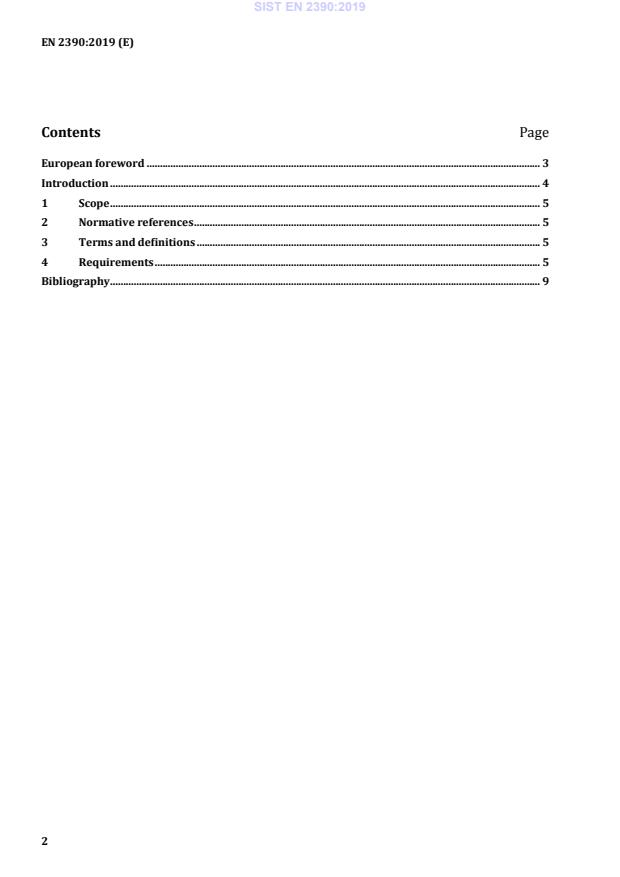
Contents Page
European foreword . 3
Introduction . 4
1 Scope . 5
2 Normative references . 5
3 Terms and definitions . 5
4 Requirements . 5
Bibliography . 9
European foreword
This document (EN 2390:2019) has been prepared by the Aerospace and Defence Industries Association
of Europe - Standardization (ASD-STAN).
After enquiries and votes carried out in accordance with the rules of this Association, this Standard has
received the approval of the National Associations and the Official Services of the member countries of
ASD, prior to its presentation to CEN.
This European Standard shall be given the status of a national standard, either by publication of an
identical text or by endorsement, at the latest by March 2020, and conflicting national standards shall be
withdrawn at the latest by March 2020.
Attention is drawn to the possibility that some of the elements of this document may be the subject of
patent rights. CEN shall not be held responsible for identifying any or all such patent rights.
According to the CEN-CENELEC Internal Regulations, the national standards organisations of the
following countries are bound to implement
...