

EN 407:2020
(Main)Protective gloves and other hand protective equipments against thermal risks (heat and/or fire)
General Information
- Abstract
This document specifies requirements, test methods, marking and information for protective gloves and other hand protective equipment’s against thermal risks for professional use, consumer, domestic use.
This document is also applicable to arm protective equipment.
It is used for all gloves and other hand protective equipment’s which protect the hands or part of the hand against heat and/or fire in one or more of the following forms: flame, contact heat, convective heat, radiant heat, small splashes or large quantities of molten metal.
This standarddocument is only applicable in conjunction with EN ISO 21420:2020.
This document doesn’tdoes not apply to gloves for fire-fighters or welding that have their own standards.
- Status
- Published
- Publication Date
- 07-Apr-2020
- Withdrawal Date
- 29-Apr-2021
- Technical Committee
- CEN/TC 162 - Protective clothing including hand and arm protection and lifejackets
- Drafting Committee
- CEN/TC 162/WG 8 - Protective gloves
- Current Stage
- 9060 - Closure of 2 Year Review Enquiry - Review Enquiry
- Start Date
- 02-Dec-2025
- Completion Date
- 02-Dec-2025


Overview
EN 407:2020 is the European standard for protective gloves and hand (and arm) protective equipment against thermal risks (heat and/or fire). Prepared by CEN, it specifies requirements, test methods, marking and manufacturer information for gloves and related hand/arm protectors used in professional, consumer and domestic settings. EN 407:2020 supersedes EN 407:2004 and is intended to be used in conjunction with EN ISO 21420:2020 (general glove requirements).
Key topics and technical requirements
- Scope of protection: flame, contact heat, convective heat, radiant heat, small splashes and large quantities of molten metal.
- Test methods: detailed methods in clauses 6.2–6.8 (limited flame spread, contact heat, convective heat, radiant heat, small/large molten metal splash, tear resistance).
- Limited flame spread: performance levels 1–4 with quantified after‑flame and afterglow time limits (e.g., level 3: after‑flame ≤ 3 s and afterglow ≤ 25 s).
- Contact heat: four levels tied to contact temperatures (level 1 = 100 °C to level 4 = 500 °C) with minimum threshold times (≥ 15 s). Note: contact heat level 3 or 4 requires at least level 3 in limited flame spread or contact heat performance is capped at level 2.
- Mechanical strength: tear resistance requirement of at least 10 N (clause 6.8).
- Cleaning and conditioning: tests on unused items and, if care instructions are supplied, before/after recommended cleaning cycles; lowest result determines performance.
- Sizing and dimensions: includes minimal glove lengths when metal splash protection is claimed (e.g., size 8 minimal length 320 mm).
- Marking and manufacturer information: mandatory marking, pictogram (updated in 2020), and clear user guidance on intended use and limitations.
Applications and who uses EN 407:2020
- Manufacturers and designers developing thermal protective gloves and arm protectors.
- PPE test laboratories that perform standardized performance testing and certification.
- Procurement and safety managers specifying gloves for industries such as metallurgy, foundries, glass handling, emergency services (non‑firefighter applications), kitchen and domestic thermal protection.
- Regulators and conformity assessors verifying compliance with EU Regulation on PPE.
Related standards
- EN ISO 21420:2020 - general requirements for protective gloves (mandatory companion standard).
- Normative test references used by EN 407 include EN ISO 15025, EN ISO 12127‑1, EN ISO 9151, EN ISO 6942, EN ISO 9185 and others for specific heat and molten‑metal tests.
- EN 407 does not replace specialized standards for firefighters’ gloves (EN 659) or welding gloves.
Using EN 407:2020 ensures consistent, testable performance against thermal hazards and helps purchasers and users choose the right thermal protective gloves for their application.
Relations
- Effective Date
- 15-Apr-2020
- Effective Date
- 28-Jan-2026
- Effective Date
- 28-Jan-2026
- Effective Date
- 28-Jan-2026
- Effective Date
- 28-Jan-2026
- Effective Date
- 28-Jan-2026
- Effective Date
- 28-Jan-2026
- Refers
EN ISO 21420:2020 - Protective gloves - General requirements and test methods (ISO 21420:2020) - Effective Date
- 28-Jan-2026
- Effective Date
- 28-Jan-2026
- Effective Date
- 28-Jan-2026
- Effective Date
- 28-Jan-2026
- Effective Date
- 26-May-2021
Get Certified
Connect with accredited certification bodies for this standard

CIS Institut d.o.o.
Personal Protective Equipment (PPE) certification body. Notified Body NB-2890 for EU Regulation 2016/425 PPE.

Kiwa BDA Testing
Building and construction product certification.
Kmetijski inštitut Slovenije
Agricultural Institute of Slovenia. Soil testing, plant health, agricultural product analysis.
Sponsored listings
Frequently Asked Questions
EN 407:2020 is a standard published by the European Committee for Standardization (CEN). Its full title is "Protective gloves and other hand protective equipments against thermal risks (heat and/or fire)". This standard covers: This document specifies requirements, test methods, marking and information for protective gloves and other hand protective equipment’s against thermal risks for professional use, consumer, domestic use. This document is also applicable to arm protective equipment. It is used for all gloves and other hand protective equipment’s which protect the hands or part of the hand against heat and/or fire in one or more of the following forms: flame, contact heat, convective heat, radiant heat, small splashes or large quantities of molten metal. This standarddocument is only applicable in conjunction with EN ISO 21420:2020. This document doesn’tdoes not apply to gloves for fire-fighters or welding that have their own standards.
This document specifies requirements, test methods, marking and information for protective gloves and other hand protective equipment’s against thermal risks for professional use, consumer, domestic use. This document is also applicable to arm protective equipment. It is used for all gloves and other hand protective equipment’s which protect the hands or part of the hand against heat and/or fire in one or more of the following forms: flame, contact heat, convective heat, radiant heat, small splashes or large quantities of molten metal. This standarddocument is only applicable in conjunction with EN ISO 21420:2020. This document doesn’tdoes not apply to gloves for fire-fighters or welding that have their own standards.
EN 407:2020 is classified under the following ICS (International Classification for Standards) categories: 13.340.40 - Hand and arm protection. The ICS classification helps identify the subject area and facilitates finding related standards.
EN 407:2020 has the following relationships with other standards: It is inter standard links to EN 407:2004, EN ISO 7500-1:2018, EN ISO 9185:2007, EN ISO 6942:2002, EN 348:1992, EN ISO 15025:2016, EN ISO 9151:2016, EN ISO 21420:2020, EN ISO 12127-1:2015, EN 659:2003+A1:2008, EN 420:2003+A1:2009, EN 407:2020/prA1. Understanding these relationships helps ensure you are using the most current and applicable version of the standard.
EN 407:2020 is associated with the following European legislation: EU Directives/Regulations: 2016/425, 89/686/EEC; Standardization Mandates: M/031. When a standard is cited in the Official Journal of the European Union, products manufactured in conformity with it benefit from a presumption of conformity with the essential requirements of the corresponding EU directive or regulation.
EN 407:2020 is available in PDF format for immediate download after purchase. The document can be added to your cart and obtained through the secure checkout process. Digital delivery ensures instant access to the complete standard document.
Standards Content (Sample)
SLOVENSKI STANDARD
01-junij-2020
Nadomešča:
SIST EN 407:2004
Varovalne rokavice in druga oprema za zaščito rok pred toplotnimi tveganji
(toplote in/ali ognja)
Protective gloves and other hand protective equipments against thermal risks (heat
and/or fire)
Schutzhandschuhe und andere Handschutzausrüstung gegen thermische Risiken (Hitze
und/oder Feuer)
Gants de protection et autres équipements de protection de la main contre les risques
thermiques (chaleur et/ou feu)
Ta slovenski standard je istoveten z: EN 407:2020
ICS:
13.340.40 Varovanje dlani in rok Hand and arm protection
2003-01.Slovenski inštitut za standardizacijo. Razmnoževanje celote ali delov tega standarda ni dovoljeno.
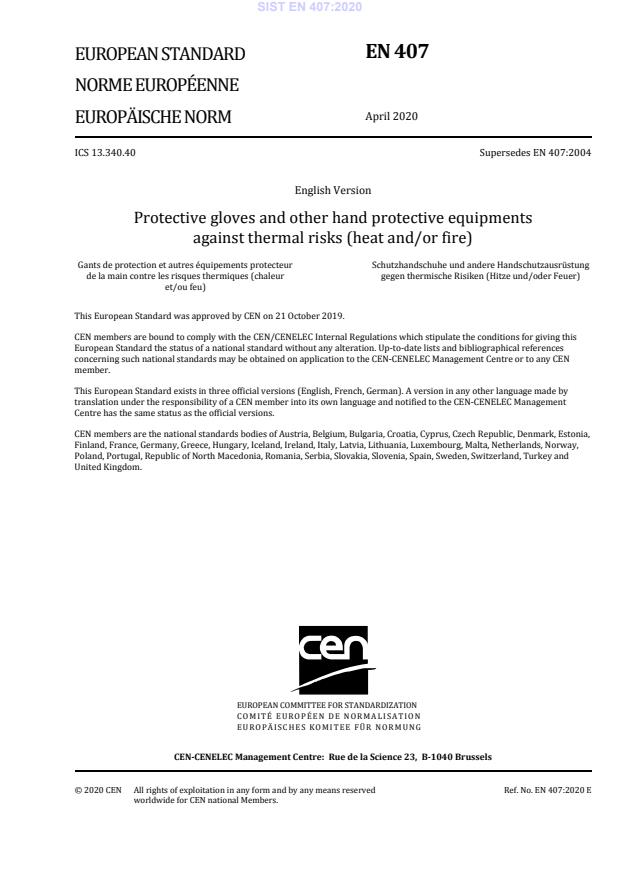
EN 407
EUROPEAN STANDARD
NORME EUROPÉENNE
April 2020
EUROPÄISCHE NORM
ICS 13.340.40 Supersedes EN 407:2004
English Version
Protective gloves and other hand protective equipments
against thermal risks (heat and/or fire)
Gants de protection et autres équipements protecteur Schutzhandschuhe und andere Handschutzausrüstung
de la main contre les risques thermiques (chaleur gegen thermische Risiken (Hitze und/oder Feuer)
et/ou feu)
This European Standard was approved by CEN on 21 October 2019.
CEN members are bound to comply with the CEN/CENELEC Internal Regulations which stipulate the conditions for giving this
European Standard the status of a national standard without any alteration. Up-to-date lists and bibliographical references
concerning such national standards may be obtained on application to the CEN-CENELEC Management Centre or to any CEN
member.
This European Standard exists in three official versions (English, French, German). A version in any other language made by
translation under the responsibility of a CEN member into its own language and notified to the CEN-CENELEC Management
Centre has the same status as the official versions.
CEN members are the national standards bodies of Austria, Belgium, Bulgaria, Croatia, Cyprus, Czech Republic, Denmark, Estonia,
Finland, France, Germany, Greece, Hungary, Iceland, Ireland, Italy, Latvia, Lithuania, Luxembourg, Malta, Netherlands, Norway,
Poland, Portugal, Republic of North Macedonia, Romania, Serbia, Slovakia, Slovenia, Spain, Sweden, Switzerland, Turkey and
United Kingdom.
EUROPEAN COMMITTEE FOR STANDARDIZATION
COMITÉ EUROPÉEN DE NORMALISATION
EUROPÄISCHES KOMITEE FÜR NORMUNG
CEN-CENELEC Management Centre: Rue de la Science 23, B-1040 Brussels
© 2020 CEN All rights of exploitation in any form and by any means reserved Ref. No. EN 407:2020 E
worldwide for CEN national Members.
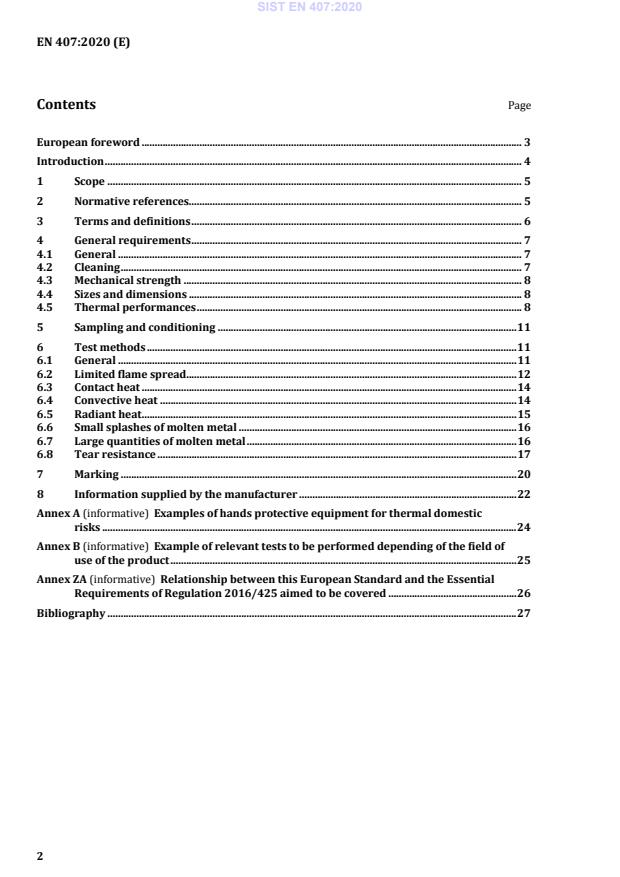
Contents Page
European foreword . 3
Introduction . 4
1 Scope . 5
2 Normative references. 5
3 Terms and definitions . 6
4 General requirements . 7
4.1 General . 7
4.2 Cleaning . 7
4.3 Mechanical strength . 8
4.4 Sizes and dimensions . 8
4.5 Thermal performances . 8
5 Sampling and conditioning . 11
6 Test methods . 11
6.1 General . 11
6.2 Limited flame spread. 12
6.3 Contact heat . 14
6.4 Convective heat . 14
6.5 Radiant heat . 15
6.6 Small splashes of molten metal . 16
6.7 Large quantities of molten metal . 16
6.8 Tear resistance . 17
7 Marking . 20
8 Information supplied by the manufacturer . 22
Annex A (informative) Examples of hands protective equipment for thermal domestic
risks . 24
Annex B (informative) Example of relevant tests to be performed depending of the field of
use of the product . 25
Annex ZA (informative) Relationship between this European Standard and the Essential
Requirements of Regulation 2016/425 aimed to be covered . 26
Bibliography . 27
European foreword
This document (EN 407:2020) has been prepared by Technical Committee CEN/TC 162 “Protective
clothing including hand and arm protection and lifejackets”, the secretariat of which is held by DIN.
This European Standard shall be given the status of a national standard, either by publication of an
identical text or by endorsement, at the latest by October 2020, and conflicting national standards
shall be withdrawn at the latest by April 2021.
Attention is drawn to the possibility that some of the elements of this document may be the subject of
patent rights. CEN shall not be held responsible for identifying any or all such patent rights.
This document supersedes EN 407:2004.
The major changes are:
— New tests 6.2, 6.3, 6.4, 6.8;
— Mechanical strength;
— Hand protective equipment;
— New pictogram Figure 7;
— Clause 8 (information supplied by the manufacturer: revised);
— New Annex A;
— New Annex B.
This document has been prepared under a mandate given to CEN by the European Commission and
the European Free Trade Association, and supports essential requirements of EU Regulation.
For relationship with EU Regulation, see informative Annex ZA, which is an integral part of this
document.
According to the CEN-CENELEC Internal Regulations, the national standards organisations of the
following countries are bound to implement this European Standard: Austria, Belgium, Bulgaria,
Croatia, Cyprus, Czech Republic, Denmark, Estonia, Finland, France, Germany, Greece, Hungary,
Iceland, Ireland, Italy, Latvia, Lithuania, Luxembourg, Malta, Netherlands, Norway, Poland, Portugal,
Republic of North Macedonia, Romania, Serbia, Slovakia, Slovenia, Spain, Sweden, Switzerland,
Turkey and the United Kingdom.
Introduction
This document has been developed to cover all type of Personal Protective Equipment protecting the
hand, a part of the hand or a part of the arm against thermal risks, no matter where they are used
(professional use, consumer, domestic use…).
1 Scope
This document specifies requirements, test methods, marking and information for protective gloves
and other hand protective equipment’s against thermal risks for professional use, consumer,
domestic use.
This document is also applicable to arm protective equipment.
It is used for all gloves and other hand protective equipment’s which protect the hands or part of the
hand against heat and/or fire in one or more of the following forms: flame, contact heat, convective
heat, radiant heat, small splashes or large quantities of molten metal.
This document is only applicable in conjunction with EN ISO 21420:2020.
This document does not apply to gloves for fire-fighters or welding that have their own standards.
2 Normative references
The following documents are referred to in the text in such a way that some or all of their content
constitutes requirements of this document. For dated references, only the edition cited applies. For
undated references, the latest edition of the referenced document (including any amendments)
applies.
EN 348:1992, Protective clothing — Test method: Determination of behaviour of materials on impact of
small splashes of molten metal
EN ISO 21420:2020, Protective gloves — General requirements and test methods (ISO 21420:2020)
EN 659:2003+A1:2008, Protective gloves for firefighters
EN ISO 6942:2002, Protective clothing — Protection against heat and fire — Method of test:
Evaluation of materials and material assemblies when exposed to a source of radiant heat (ISO 6942)
EN ISO 7500-1:2018, Metallic materials — Calibration and verification of static uniaxial testing
machines — Part 1: Tension/compression testing machines — Calibration and verification of the force-
measuring system (ISO 7500-1:2018)
EN ISO 9151:2016, Protective clothing against heat and flame — Determination of heat transmission
on exposure to flame (ISO 9151)
EN ISO 9185:2007, Protective clothing — Assessment of resistance of materials to molten metal splash
(ISO 9185)
EN ISO 12127-1:2015, Clothing for protection against heat and flame — Determination of contact heat
transmission through protective clothing or constituent materials — Part 1: Contact heat produced by
heating cylinder (ISO 12127-1)
EN ISO 15025:2016, Protective clothing — Protection against flame — Method of test for limited flame
spread (ISO 15025)
3 Terms and definitions
For the purposes of this document, the following terms and definitions apply.
ISO and IEC maintain terminological databases for use in standardization at the following addresses:
— IEC Electropedia: available at http://www.electropedia.org/
— ISO Online browsing platform: available at https://www.iso.org/obp
3.1
after flame time
length of time for which a material continues to flame, under the specified test conditions, after the
ignition source has been removed
3.2
afterglow time
time for which a material continues to afterglow, under specified test conditions after cessation of
after flaming or after removal of the ignition source
3.3
back of the glove
back of hand, excluding fingers
3.4
char
formation of a carbonaceous brittle residue when material is exposed to thermal energy
[SOURCE: EN ISO 15025:2016, 3.4]
3.5
cuff
part of the glove that extends beyond the opening of glove body to cover the wrist area and
sometimes part of the forearm
3.6
debris
material separating from the specimen during the test procedure and falling from the specimen
without flaming
3.7
dripping
detachment of molten droplets during the melting process
3.8
flaming debris
material separating from the specimen during the test procedure and igniting the filter paper
3.9
hands protective equipment against thermal risks
equipment which protect hand and/or areas of the hand intended to be exposed to thermal risks
Note 1 to entry: See examples in Annex A.
3.10
high thermal resistant gloves
gloves which claimed at least level 3 for one of the following properties: convective heat, contact
heat, radiant heat, small metal splashes, large quantities of molten metal
3.11
hole
opening, break, or discontinuity of any size in the original structure of the test specimen's material
caused by application of the test flame
3.12
melting
liquefaction of the material under the influence of heat
3.13
innermost layer
layer closest to the wearer's skin
3.14
reinforcement
additional layer which does not cover the full area where the protection is claimed
Note 1 to entry: Most of the time, this area has a limited surface to preserve comfort and dexterity of the gloves.
4 General requirements
4.1 General
Where protection against other than thermal risk is needed the specific standard shall be used.
The protective gloves according to this document shall meet all the applicable requirements of
EN ISO 21420:2020.
When parts of the glove are made from dissimilar materials, these dissimilar materials shall be tested
separately, except if another way is specified in the standard. The results of each material shall
comply with the requirements given in 4.5.
In those circumstances when the sample size is significantly larger than the particular part of the
glove or hands protective equipment being tested, then the manufacturer shall be requested to
supply samples of identical material.
4.2 Cleaning
All tests required in this document shall be performed on unused gloves or hand protective
equipment unless otherwise specified.
If care instructions are provided, the relevant tests shall be performed on the gloves or hand
protective equipment, before and after they have been subjected to the procedure described in the
care instruction, including the maximum recommended number of cleaning cycles. The levels of
performance and the mechanical strength (4.3) are given by the lowest of the 2 results obtained
before and after cleaning.
NOTE Manufacturer’s instructions typically indicate one or several of the various methods and processes
of ISO 6330, ISO 15797 or equivalent as standardized processes for cleaning.
4.3 Mechanical strength
The glove material(s) shall be tested according to 6.8. The tear strength resistance shall have at least
a value of 10 N.
4.4 Sizes and dimensions
4.4.1 Gloves
The gloves shall correspond to the relevant requirements of EN ISO 21420:2020.
If according the intended use, the hand protector needs to be taken off quickly, the protective gloves
of performance levels 3 and 4 as specified in 4.5.2 to 4.5.7 shall be manufactured so that they can
easily be removed in case of an emergency. The test shall be performed according to
EN 659:2003+A1:2008, 3.15 using the same requirement. This property shall be justified and
explained in a warning included in the manufacturer’s information.
The removal test shall be carried out only in the dry state if the manufacturer’s information states
that the glove is not intended for use in wet conditions.
If protection against metal splashes as described in 4.5.6 and/or 4.5.7 is claimed, the minimal length
of the glove shall correspond to the requirements of Table 1.
Table 1 — Minimal length of the glove
Size of the hand 5 6 7 8 9 10 11 12 13
Minimal length of
290 300 310 320 330 340 350 360 370
glove (mm)
4.4.2 Hand protective equipment’s
Hand protective equipment’s against thermal risks shall have a sufficient dimension to fully cover the
part of the hand intended to be protected against thermal risk. The property shall be verified by
visual inspection.
The manufacturer information shall contain precise information about how to use the hand
protective equipment and which part of the hand is protected.
4.5 Thermal performances
4.5.1 General
For each of the following test methods the defined performance level depends upon the intended
field of application of the glove or hand protective equipment. Only the tests which are relevant to
the risks in the intended end-use application shall be carried out.
For the choice of relevant testing, examples are given in Annex B.
4.5.2 Limited flame spread
Using test method 6.2 the glove and other hand protective equipment, as well as all outer materials
shall correspond to the requirements of Table 2. Surface of the innermost layer of the glove shall be
inspected, it shall show no sign of melting. No hole shall appear on all layers of the tested area. The
seam shall not come apart after the ignition time.
For high thermal resistant gloves (level 3 or 4), all outer materials different to the finger area shall be
tested according to EN ISO 15025:2016, method A and comply at least with level 3 of Table 2. Seams
and outer accessories with a surface area greater than 10 cm shall also be tested.
If the outermost layer melts, the material shall not produce molten or flaming debris.
Table 2 — Performance levels for limited flame spread
After flame
After glow time
Performance
time
level
s
s
1 ≤ 15 no requirement
2 ≤ 10 ≤ 120
3 ≤ 3 ≤ 25
4 ≤ 2 ≤ 5
After flame time is measured to the nearest second and after flame times of less than 1,0 s should be
recorded as zero.
Afterglow time is measured to the nearest second and afterglow times of less than 1,0 s should be
recorded as zero.
4.5.3 Contact heat
Using the test method 6.3 the material shall correspond to the requirements of Table 3.
Table 3 — Performance levels for contact heat test
Contact Temperature T
c
Threshold time t
t
Performance level
s
°C
1 100 ≥ 15
2 250 ≥ 15
3 350 ≥ 15
4 500 ≥ 15
For contact heat performance levels of 3 or 4, the limited flame spread test according to 6.2 shall be
performed. The product shall reach at least level 3 in the limited flame spread test, otherwise the
maximum contact heat performance that shall be reported is level 2.
Innermost layers of the glove shall be inspected, it shall show no sign of melting and holing.
4.5.4 Convective heat
Using the test method 6.4 the material shall correspond to the requirements of Table 4.
Table 4 — Performance levels for convective heat
Heat transfer index HTI
Performance level
s
1 ≥ 4
2 ≥ 7
3 ≥ 10
4 ≥ 18
For convective heat performance levels of 3 or 4, the limited flame spread test according to 6.2 shall
be performed. The product shall reach at least level 3 in the limited flame spread test, otherwise the
maximum convective heat performance that shall be reported is level 2.
Innermost layers of the glove shall be inspected, it shall show no sign of melting and holing.
4.5.5 Radiant heat
Using the test method 6.5 the material shall correspond to the requirements of Table 5.
Table 5 — Performance levels for radiant heat
Heat transfer t
Performance level
s
1 ≥ 7
2 ≥ 20
3 ≥ 50
4 ≥ 95
For radiant heat performance levels of 3 or 4, the limited flame spread test according to 6.2 shall be
performed. The product shall reach at least level 3 in the limited flame spread test, otherwise the
maximum radiant heat performance that shall be reported is level 2.
Innermost layers of the glove shall be inspected, it shall show no sign of melting and holing.
4.5.6 Small splashes of molten metal
Using the test method 6.6 the number of droplets which produce a temperature rise of 40 °C, shall
correspond to the requirements of Table 6.
Table 6 — Levels of performance for the test of small splashes of molten metal
Performance level Number of droplets
1 ≥ 10
2 ≥ 15
3 ≥ 25
4 ≥ 35
For small splashes of molten metal performance levels of 3 or 4, the limited flame spread test
according to 6.2 shall be performed. The product shall reach at least level 3 in the limited flame
spread test, otherwise the maximum small splashes of molten metal performance that shall be
reported is level 2.
Outermost and innermost layers of the glove shall be inspected, it shall show no sign of melting. No
hole shall appear on innermost layer.
4.5.7 Large quantities of molten metal
Using the test method 6.7 the PVC foil skin-simulant shall not exhibit any smoothness or other
changes to the grained surface with the relevant quantities of molten iron used. See Table 7.
For large quantities of molten metal performance levels of 3 or 4, the limited flame spread test
according to 6.2 shall be performed. The product shall reach at least level 3 in the limited flame
spread test, otherwise the maximum large quantities of molten metal performance that shall be
reported is level 2.
Material and material assemblies which ignite during the test do not meet the requirement of this
test.
Table 7 — Levels of performances for the test of large quantities of molten metal
Molten iron
Performance Level
g
1 30
2 60
3 120
4 200
Innermost layers of the glove shall be inspected, it shall
...