

EN 2865:2009
(Main)Aerospace series - Nuts, anchor, self-locking, floating, two lugs, with counterbore, in heat resisting steel, MoS2 lubricated - Classification: 1 100 MPa (at ambient temperature) / 315 °C
General Information
- Abstract
This European Standard specifies the characteristics of two lugs, counterbored floating anchor nuts, with a self-locking feature achieved by forming the upper portion out-of-round, in heat resisting steel, MoS2 lubricated.
Classification: 1 100 MPa / 315 °C.
- Status
- Published
- Publication Date
- 10-Nov-2009
- Withdrawal Date
- 30-May-2010
- Technical Committee
- ASD-STAN - Aerospace
- Drafting Committee
- ASD-STAN/D 3 - Mechanical
- Current Stage
- 9093 - Decision to confirm - Review Enquiry
- Start Date
- 21-Jan-2025
- Completion Date
- 30-Sep-2026


Overview
EN 2865:2009, developed by the European Committee for Standardization (CEN), defines the characteristics of floating, self-locking anchor nuts used in aerospace applications. These nuts are manufactured with two lugs and a counterbore, produced from heat resisting steel and lubricated with molybdenum disulphide (MoS2). The self-locking feature is obtained by deforming the upper portion of the nut, ensuring enhanced vibration resistance and secure fastening in high-stress environments. This standard applies to anchor nuts classified for a strength of 1,100 MPa at ambient temperature and a maximum operating temperature of 315°C.
Key Topics
- Self-Locking Floating Anchor Nuts: The document focuses on nuts that offer a self-locking mechanism by intentional deformation, preventing loosening under vibration.
- Heat Resisting Steel: Specifies the use of materials capable of withstanding high mechanical loads and temperatures typical in aerospace conditions.
- MoS2 Lubrication: Molybdenum disulphide is applied as a dry lubricant to reduce installation torque and improve corrosion resistance.
- Two-Lug, Counterbored Design: The two-lug feature facilitates secure riveting to structure, while the counterbore ensures flush or recessed installation.
- Performance Classification: The anchor nuts are designed to withstand stresses up to 1,100 MPa and temperatures up to 315°C, aligning with demanding aerospace standards.
- Dimensional and Tolerance Requirements: All geometric and mass specifications conform to relevant ISO standards for compatibility and interchangeability.
Applications
EN 2865:2009 anchor nuts are intended for use primarily in the aerospace sector, where high strength, temperature resistance, and reliability are mandatory. Typical applications include:
- Aircraft Structures: Used in fuselage, wing, and tail assemblies where access from only one side is possible and high vibration is present.
- Engine and Exhaust Attachments: Suitable for harsh, high-temperature environments due to their heat resistant properties and MoS2 lubrication.
- Maintenance and Repair: The floating design compensates for slight misalignments in mating fastener holes, facilitating installation and maintenance tasks in confined or difficult-to-access locations.
- Defense and Space Equipment: Applied where secure, reliable fastening is crucial under dynamic loads and temperature extremes.
Utilization of anchor nuts conforming to EN 2865 ensures not only mechanical reliability but also interoperability across international aerospace programs and suppliers.
Related Standards
EN 2865:2009 references and is complemented by several important documents in the aerospace standardization framework:
- EN 2398, EN 2399, EN 3638, EN 3639, EN 3816: Standards defining material specifications for heat resisting steel components.
- EN 2491: Specifications for MoS2 dry lubricant coating methods.
- EN 2424:2008: Guidelines for proper marking of aerospace products.
- EN 9100: Quality management systems requirements for aviation, space, and defense organizations.
- EN 9133: Qualification procedures for aerospace standard parts.
- ISO 3209, ISO 5855-2, ISO 5858, ISO 8788: International standards covering technical dimensions, thread tolerances, and mechanical requirements for nuts and bolts in aerospace applications.
Following EN 2865:2009 helps organizations meet stringent quality and safety demands, promote industry consistency, and achieve compliance in both European and global aerospace supply chains.
Keywords: EN 2865:2009, anchor nuts, self-locking nuts, floating nuts, aerospace nuts, MoS2 lubricated, heat resisting steel, 1100 MPa, 315°C, CEN standard, aircraft fasteners, aerospace hardware, two-lug nuts, counterbore.
Relations
- Effective Date
- 03-Jun-2026
- Effective Date
- 03-Jun-2026
- Effective Date
- 03-Jun-2026
- Effective Date
- 03-Jun-2026
- Effective Date
- 28-Jan-2026
- Effective Date
- 28-Jan-2026
- Effective Date
- 28-Jan-2026
- Effective Date
- 28-Jan-2026
- Effective Date
- 28-Jan-2026
- Effective Date
- 28-Jan-2026
- Effective Date
- 28-Jan-2026
- Effective Date
- 28-Jan-2026
- Effective Date
- 28-Jan-2026
- Effective Date
- 28-Jan-2026
- Effective Date
- 28-Jan-2026
Get Certified
Connect with accredited certification bodies for this standard

BUREAU VERITAS Certification Germany
Bureau Veritas certification in Germany.

Element Materials Technology
Materials testing and product certification.

AQMS Ltd.
AQMS provides ISO certification to SMEs across the UK.
Sponsored listings
Frequently Asked Questions
EN 2865:2009 is a standard published by the European Committee for Standardization (CEN). Its full title is "Aerospace series - Nuts, anchor, self-locking, floating, two lugs, with counterbore, in heat resisting steel, MoS2 lubricated - Classification: 1 100 MPa (at ambient temperature) / 315 °C". This standard covers: This European Standard specifies the characteristics of two lugs, counterbored floating anchor nuts, with a self-locking feature achieved by forming the upper portion out-of-round, in heat resisting steel, MoS2 lubricated. Classification: 1 100 MPa / 315 °C.
This European Standard specifies the characteristics of two lugs, counterbored floating anchor nuts, with a self-locking feature achieved by forming the upper portion out-of-round, in heat resisting steel, MoS2 lubricated. Classification: 1 100 MPa / 315 °C.
EN 2865:2009 is classified under the following ICS (International Classification for Standards) categories: 49.030.30 - Nuts. The ICS classification helps identify the subject area and facilitates finding related standards.
EN 2865:2009 has the following relationships with other standards: It is inter standard links to ISO 5858:1999, ISO 5855-2:1999, ISO 8788:2000, ISO 3209:1998, EN ISO 15792-1:2008, EN 2399:2008, EN 2424:2008, EN 2398:2008, EN 3638:2025, EN 9133:2018, EN 3816:2006, EN 13001-2:2004/AC:2006, EN 9100:2018, EN 840-6:2004+A1:2008, EN 2491:2011. Understanding these relationships helps ensure you are using the most current and applicable version of the standard.
EN 2865:2009 is available in PDF format for immediate download after purchase. The document can be added to your cart and obtained through the secure checkout process. Digital delivery ensures instant access to the complete standard document.
Standards Content (Sample)
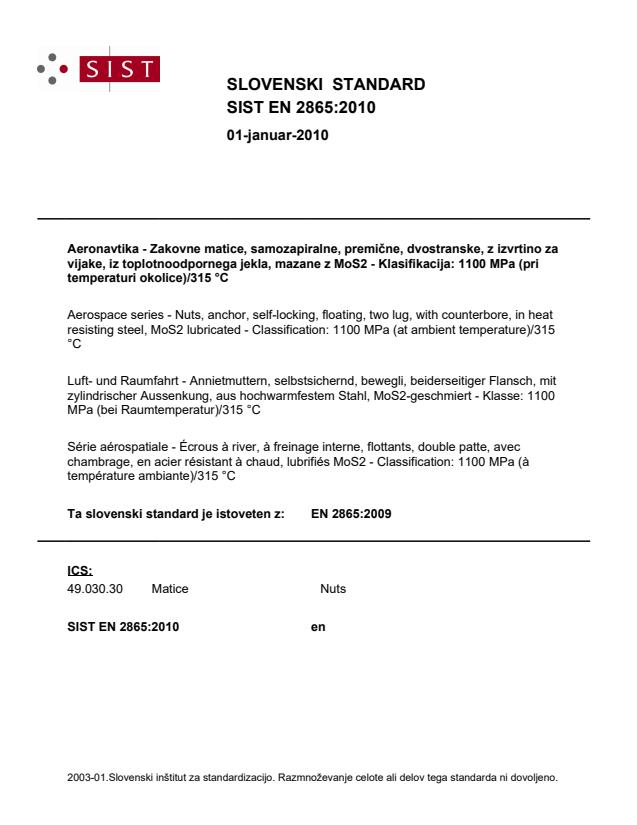
2003-01.Slovenski inštitut za standardizacijo. Razmnoževanje celote ali delov tega standarda ni dovoljeno.Luft- und Raumfahrt - Annietmuttern, selbstsichernd, bewegli, beiderseitiger Flansch, mit zylindrischer Aussenkung, aus hochwarmfestem Stahl, MoS2-geschmiert - Klasse: 1100 MPa (bei Raumtemperatur)/315 °CSérie aérospatiale - Écrous à river, à freinage interne, flottants, double patte, avec chambrage, en acier résistant à chaud, lubrifiés MoS2 - Classification: 1100 MPa (à température ambiante)/315 °CAerospace series - Nuts, anchor, self-locking, floating, two lug, with counterbore, in heat resisting steel, MoS2 lubricated - Classification: 1100 MPa (at ambient temperature)/315 °C49.030.30MaticeNutsICS:Ta slovenski standard je istoveten z:EN 2865:2009SIST EN 2865:2010en01-januar-2010SIST EN 2865:2010SLOVENSKI
STANDARD
EUROPEAN STANDARD NORME EUROPÉENNE EUROPÄISCHE NORM
EN 2865
November 2009 ICS 49.030.30 English Version
Aerospace series - Nuts, anchor, self-locking, floating, two lugs, with counterbore, in heat resisting steel, MoS2 lubricated - Classification: 1 100 MPa (at ambient temperature) / 315 °C
Série aérospatiale - Écrous à river, à freinage interne, flottants, double patte, avec chambrage, en acier résistant à chaud, lubrifiés MoS2 - Classification : 1 100 MPa (à température ambiante) / 315 °C
Luft- und Raumfahrt - Annietmuttern, selbstsichernd, bewegli, beiderseitiger Flansch, mit zylindrischer Aussenkung, aus hochwarmfestem Stahl, MoS2-geschmiert - Klasse : 1 100 MPa (bei Raumtemperatur) / 315 °C This European Standard was approved by CEN on 17 October 2009.
CEN members are bound to comply with the CEN/CENELEC Internal Regulations which stipulate the conditions for giving this European Standard the status of a national standard without any alteration. Up-to-date lists and bibliographical references concerning such national standards may be obtained on application to the CEN Management Centre or to any CEN member.
This European Standard exists in three official versions (English, French, German). A version in any other language made by translation under the responsibility of a CEN member into its own language and notified to the CEN Management Centre has the same status as the official versions.
CEN members are the national standards bodies of Austria, Belgium, Bulgaria, Cyprus, Czech Republic, Denmark, Estonia, Finland, France, Germany, Greece, Hungary, Iceland, Ireland, Italy, Latvia, Lithuania, Luxembourg, Malta, Netherlands, Norway, Poland, Portugal, Romania, Slovakia, Slovenia, Spain, Sweden, Switzerland and United Kingdom.
EUROPEAN COMMITTEE FOR STANDARDIZATION
COMITÉ EUROPÉEN DE NORMALISATION EUROPÄISCHES KOMITEE FÜR NORMUNG
Management Centre:
Avenue Marnix 17,
B-1000 Brussels © 2009 CEN All rights of exploitation in any form and by any means reserved worldwide for CEN national Members. Ref. No. EN 2865:2009: ESIST EN 2865:2010
...