


EN 17391:2022
(Main)Non-destructive testing - Acoustic emission testing - In-service acoustic emission monitoring of metallic pressure equipment and structures - General requirements
Non-destructive testing - Acoustic emission testing - In-service acoustic emission monitoring of metallic pressure equipment and structures - General requirements
This document specifies general requirements for in-service acoustic emission (AE) monitoring. It relates to detection, location and grading of AE sources with application to metallic pressure equipment and other structures such as bridges, bridge ropes, cranes, storage tanks, pipelines, wind turbine towers, marine applications, offshore structures. The monitoring can be periodic, temporary or continuous, on site or remote-controlled, supervised or automated. The objectives of AE monitoring are to define regions which are acoustically active as a result of damage or defect evolution.
Zerstörungsfreie Prüfung - Schallemissionsprüfung - Überwachung der Schallemission von metallischen Druckgeräten und -strukturen im Betrieb - Allgemeine Grundsätze
Dieses Dokument legt allgemeine Anforderungen an die Überwachung der Schallemission (AE) während des Betriebs fest. Es bezieht sich auf die Erkennung, Ortung und Klassifizierung von AE-Quellen von metallischen Druckgeräten und andere Konstruktionen, wie Brücken, Brückenseile, Krane, Lagertanks, Rohrleitungen, Windenergiemaste, Schiffe und Offshore-Bauwerke. Die Überwachung kann periodisch, temporär oder kon¬tinuierlich, vor Ort oder ferngesteuert, beaufsichtigt oder automatisiert erfolgen. Das Ziel der AE-Überwachung ist, Bereiche zu bestimmen, die aufgrund von Schäden oder Fehlerentwicklungen akustisch aktiv sind.
Essais non destructifs - Contrôle par émission acoustique - Surveillance en service par émission acoustique des équipements et structures métalliques sous pression - Exigences générales
Le présent document spécifie les exigences générales relatives à la surveillance en service par émission acoustique (EA). Il porte sur la détection, la localisation et le classement des sources d’EA, avec une application aux équipements sous pression et autres structures métalliques tels que ponts, câbles de pont, grues, réservoirs de stockage, pipelines, mâts d’éoliennes, applications maritimes, structures offshore. La surveillance peut être périodique, temporaire ou continue, sur site ou à distance, supervisée ou automatisée. Les objectifs de la surveillance par EA sont de définir les zones qui sont acoustiquement actives à la suite de l’évolution d’un dommage ou d’un défaut.
Neporušitvene preiskave - Akustična emisija - Nadzorovanje akustične emisije pri uporabi kovinske tlačne opreme in drugih kovinskih struktur - Splošne zahteve
Ta standard opisuje nadzorovanje akustične emisije (AE) za ugotavljanje, iskanje in razvrščanje virov akustične emisije pri uporabi kovinske tlačne opreme in drugih kovinskih struktur. Nadzorovanje je lahko periodično, začasno ali stalno; izvaja se lahko na kraju samem ali na daljavo, pod nadzorom ali avtomatizirano. Cilj nadzorovanja akustične emisije je določitev območij, ki so akustično aktivna zaradi nastanka škode ali napak v razvoju.
General Information
- Status
- Published
- Publication Date
- 28-Jun-2022
- Withdrawal Date
- 30-Dec-2022
- Technical Committee
- CEN/TC 138 - Non-destructive testing
- Drafting Committee
- CEN/TC 138/WG 7 - Acoustic emission testing
- Current Stage
- 6060 - Definitive text made available (DAV) - Publishing
- Start Date
- 29-Jun-2022
- Due Date
- 17-Feb-2021
- Completion Date
- 29-Jun-2022
Relations
- Effective Date
- 28-Jan-2026
- Effective Date
- 28-Jan-2026
- Effective Date
- 28-Jan-2026
- Effective Date
- 28-Jan-2026
- Effective Date
- 28-Jan-2026
- Effective Date
- 28-Jan-2026
- Effective Date
- 28-Jan-2026
Overview
EN 17391:2022 is a CEN European Standard that defines general requirements for in‑service acoustic emission (AE) monitoring of metallic pressure equipment and other metallic structures. It covers detection, location and grading of AE sources to identify regions that are acoustically active due to damage or defect evolution. The standard applies to a wide range of assets including pressure vessels, pipelines, tanks, bridges, cranes, wind turbine towers, marine and offshore structures. Monitoring may be periodic, temporary or continuous, carried out on‑site or remotely, and can be supervised or automated.
Key Topics
The standard addresses practical and technical requirements for reliable AE monitoring, including:
- Personnel qualification: competency expectations for staff performing AE monitoring and interpretation.
- Pre‑test information: required structural, operating and environmental information and expected AE event mechanisms (e.g., crack growth, corrosion, friction/fretting).
- Monitoring methodology: selection between periodic, temporary or continuous monitoring and options for on‑site vs remote and supervised vs automated operation.
- Instrumentation requirements: system components and verification such as sensors and preamplifiers, frequency/bandwidth considerations, coupling agents, mounting methods, wave guides, grounding and use in hazardous or immersed environments.
- Pre‑monitoring measurements: wave propagation behaviour, wall thickness/geometry effects, insulation and surface preparation, plus background and process noise surveys.
- Monitoring procedure: sensor positioning, external parameter logging, instrumentation checks and data acquisition/online filtering.
- Data analysis: online analysis, background noise filtering, pre‑location processing, event location (linear/planar), cluster and pattern analysis.
- Source interpretation & grading: criteria for interpreting AE sources, grading severity, follow‑up NDT and verification.
- Documentation & reporting: required records and reporting elements for traceability and asset integrity management.
Applications and Users
EN 17391:2022 is intended for professionals involved in structural integrity and condition monitoring, including:
- NDT and AE engineers and technicians
- Asset owners and operators (oil & gas, petrochemical, maritime, utilities, wind energy, civil infrastructure)
- Inspection and maintenance planners, integrity engineers and risk assessors
- Certification bodies and regulatory inspectors
Practical uses include early detection of active cracks, through‑life damage assessment, prioritising targeted NDT, and supporting maintenance or shutdown decisions.
Related Standards
Relevant referenced standards include:
- EN 1330 (NDT terminology) and EN 1330‑9 (AE terms)
- EN 13477‑1 / EN 13477‑2 (AE equipment characterisation)
- EN 13554 (AE testing general principles)
- EN ISO/IEC 17025 (laboratory competence)
- EN 60529 (IP code for enclosures)
Keywords: EN 17391:2022, acoustic emission, AE monitoring, in‑service monitoring, non‑destructive testing, metallic pressure equipment, structural integrity.


Get Certified
Connect with accredited certification bodies for this standard

IMP NDT d.o.o.
Non-destructive testing services. Radiography, ultrasonic, magnetic particle, penetrant, visual inspection.
Inštitut za kovinske materiale in tehnologije
Institute of Metals and Technology. Materials testing, metallurgical analysis, NDT.
Q Techna d.o.o.
NDT and quality assurance specialist. 30+ years experience. NDT personnel certification per ISO 9712, nuclear and thermal power plant inspections, QA/
Sponsored listings
Frequently Asked Questions
EN 17391:2022 is a standard published by the European Committee for Standardization (CEN). Its full title is "Non-destructive testing - Acoustic emission testing - In-service acoustic emission monitoring of metallic pressure equipment and structures - General requirements". This standard covers: This document specifies general requirements for in-service acoustic emission (AE) monitoring. It relates to detection, location and grading of AE sources with application to metallic pressure equipment and other structures such as bridges, bridge ropes, cranes, storage tanks, pipelines, wind turbine towers, marine applications, offshore structures. The monitoring can be periodic, temporary or continuous, on site or remote-controlled, supervised or automated. The objectives of AE monitoring are to define regions which are acoustically active as a result of damage or defect evolution.
This document specifies general requirements for in-service acoustic emission (AE) monitoring. It relates to detection, location and grading of AE sources with application to metallic pressure equipment and other structures such as bridges, bridge ropes, cranes, storage tanks, pipelines, wind turbine towers, marine applications, offshore structures. The monitoring can be periodic, temporary or continuous, on site or remote-controlled, supervised or automated. The objectives of AE monitoring are to define regions which are acoustically active as a result of damage or defect evolution.
EN 17391:2022 is classified under the following ICS (International Classification for Standards) categories: 19.100 - Non-destructive testing. The ICS classification helps identify the subject area and facilitates finding related standards.
EN 17391:2022 has the following relationships with other standards: It is inter standard links to EN ISO/IEC 17025:2017, EN 1330-1:2014, EN 1330-9:2017, EN 13477-1:2001, EN 13554:2011, EN 1330-2:1998, EN 13477-2:2010. Understanding these relationships helps ensure you are using the most current and applicable version of the standard.
EN 17391:2022 is available in PDF format for immediate download after purchase. The document can be added to your cart and obtained through the secure checkout process. Digital delivery ensures instant access to the complete standard document.
Standards Content (Sample)
SLOVENSKI STANDARD
01-november-2022
Neporušitvene preiskave - Akustična emisija - Nadzorovanje akustične emisije pri
uporabi kovinske tlačne opreme in drugih kovinskih struktur - Splošne zahteve
Non-destructive testing - Acoustic emission testing - Inservice acoustic emission
monitoring of metallic pressure equipment and structures - General requirements
Zerstörungsfreie Prüfung - Schallemissionsprüfung - Überwachung der Schallemission
von metallischen Druckgeräten und -strukturen im Betrieb - Allgemeine Grundsätze
Essais non destructifs - Contrôle par émission acoustique - Surveillance en service par
émission acoustique des équipements et structures métalliques sous pression -
Exigences générales
Ta slovenski standard je istoveten z: EN 17391:2022
ICS:
19.100 Neporušitveno preskušanje Non-destructive testing
2003-01.Slovenski inštitut za standardizacijo. Razmnoževanje celote ali delov tega standarda ni dovoljeno.
EN 17391
EUROPEAN STANDARD
NORME EUROPÉENNE
June 2022
EUROPÄISCHE NORM
ICS 19.100
English Version
Non-destructive testing - Acoustic emission testing - In-
service acoustic emission monitoring of metallic pressure
equipment and structures - General requirements
Essais non destructifs - Contrôle par émission Zerstörungsfreie Prüfung - Schallemissionsprüfung -
acoustique - Surveillance en service par émission Überwachung der Schallemission von metallischen
acoustique des équipements et structures métalliques Druckgeräten und Strukturen im Betrieb - Allgemeine
sous pression - Exigences générales Grundsätze
This European Standard was approved by CEN on 5 March 2021.
CEN members are bound to comply with the CEN/CENELEC Internal Regulations which stipulate the conditions for giving this
European Standard the status of a national standard without any alteration. Up-to-date lists and bibliographical references
concerning such national standards may be obtained on application to the CEN-CENELEC Management Centre or to any CEN
member.
This European Standard exists in three official versions (English, French, German). A version in any other language made by
translation under the responsibility of a CEN member into its own language and notified to the CEN-CENELEC Management
Centre has the same status as the official versions.
CEN members are the national standards bodies of Austria, Belgium, Bulgaria, Croatia, Cyprus, Czech Republic, Denmark, Estonia,
Finland, France, Germany, Greece, Hungary, Iceland, Ireland, Italy, Latvia, Lithuania, Luxembourg, Malta, Netherlands, Norway,
Poland, Portugal, Republic of North Macedonia, Romania, Serbia, Slovakia, Slovenia, Spain, Sweden, Switzerland, Turkey and
United Kingdom.
EUROPEAN COMMITTEE FOR STANDARDIZATION
COMITÉ EUROPÉEN DE NORMALISATION
EUROPÄISCHES KOMITEE FÜR NORMUNG
CEN-CENELEC Management Centre: Rue de la Science 23, B-1040 Brussels
© 2022 CEN All rights of exploitation in any form and by any means reserved Ref. No. EN 17391:2022 E
worldwide for CEN national Members.
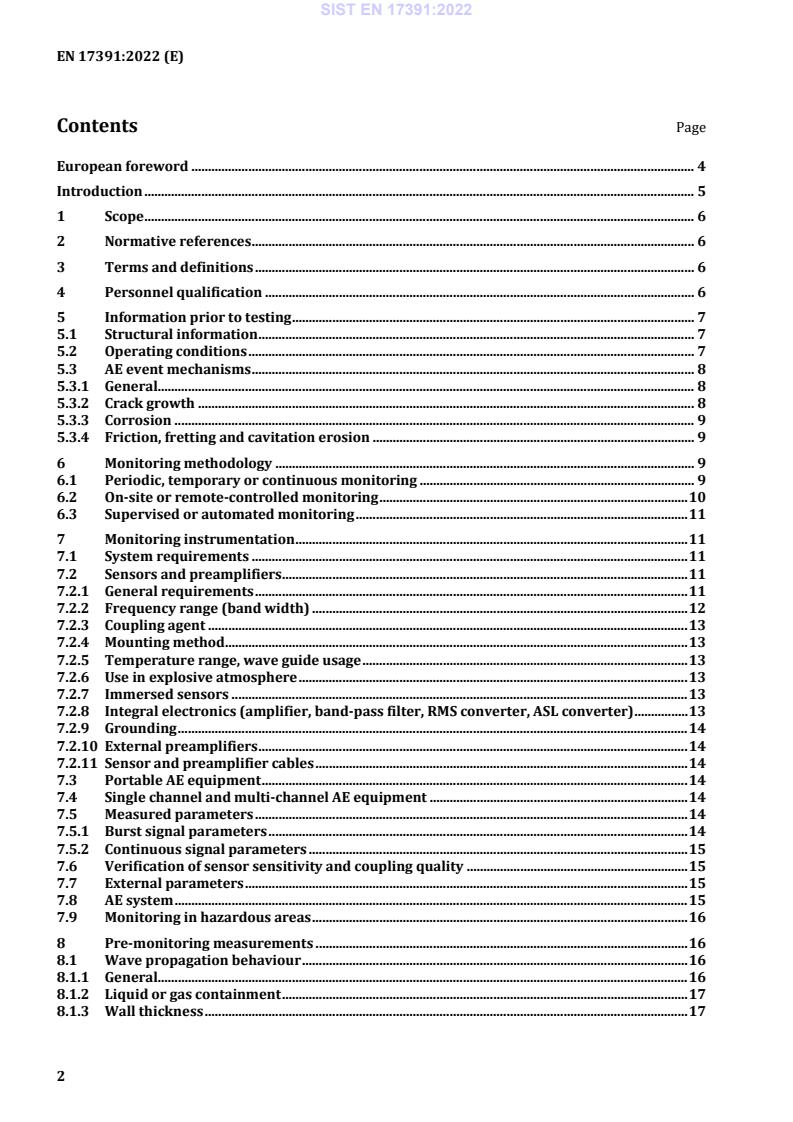
Contents Page
European foreword . 4
Introduction . 5
1 Scope . 6
2 Normative references . 6
3 Terms and definitions . 6
4 Personnel qualification . 6
5 Information prior to testing . 7
5.1 Structural information . 7
5.2 Operating conditions . 7
5.3 AE event mechanisms . 8
5.3.1 General. 8
5.3.2 Crack growth . 8
5.3.3 Corrosion . 9
5.3.4 Friction, fretting and cavitation erosion . 9
6 Monitoring methodology . 9
6.1 Periodic, temporary or continuous monitoring . 9
6.2 On-site or remote-controlled monitoring . 10
6.3 Supervised or automated monitoring . 11
7 Monitoring instrumentation . 11
7.1 System requirements . 11
7.2 Sensors and preamplifiers. 11
7.2.1 General requirements . 11
7.2.2 Frequency range (band width) . 12
7.2.3 Coupling agent . 13
7.2.4 Mounting method . 13
7.2.5 Temperature range, wave guide usage . 13
7.2.6 Use in explosive atmosphere . 13
7.2.7 Immersed sensors . 13
7.2.8 Integral electronics (amplifier, band-pass filter, RMS converter, ASL converter) . 13
7.2.9 Grounding . 14
7.2.10 External preamplifiers . 14
7.2.11 Sensor and preamplifier cables . 14
7.3 Portable AE equipment . 14
7.4 Single channel and multi-channel AE equipment . 14
7.5 Measured parameters . 14
7.5.1 Burst signal parameters . 14
7.5.2 Continuous signal parameters . 15
7.6 Verification of sensor sensitivity and coupling quality . 15
7.7 External parameters . 15
7.8 AE system . 15
7.9 Monitoring in hazardous areas . 16
8 Pre-monitoring measurements . 16
8.1 Wave propagation behaviour . 16
8.1.1 General. 16
8.1.2 Liquid or gas containment . 17
8.1.3 Wall thickness . 17
8.1.4 Geometry of the structure . 17
8.1.5 Insulation . 17
8.1.6 Surface preparation . 17
8.2 Background noise measurement . 17
8.2.1 Representative location . 17
8.2.2 Process noise . 18
8.2.3 Other disturbance noise . 18
8.2.4 Noise sampling period . 18
8.3 Sensitivity of AE monitoring using linear or planar location . 18
9 Monitoring procedure . 19
9.1 Sensor positioning . 19
9.2 External parameters . 19
9.3 Instrumentation verification . 19
9.4 Data acquisition and online filtering . 19
10 Data analysis . 20
10.1 General . 20
10.2 Online analysis . 20
10.3 Data processing . 20
10.3.1 General . 20
10.3.2 Background noise analysis . 20
10.3.3 Pre-location data analysis . 21
10.3.4 AE event location . 21
10.3.5 Cluster analysis . 22
10.3.6 Pattern recognition . 22
11 AE source interpretation and evaluation . 22
11.1 Interpretation of AE results . 22
11.2 Source evaluation criteria . 23
11.3 Grading of AE sources . 25
11.4 Verification of AE sources and follow-up NDT . 26
12 Documentation and reporting . 26
Annex A (informative) Fatigue crack growth and associated acoustic emission applied to
monitoring of marine structures . 27
Bibliography . 38
European foreword
This document (EN 17391:2022) has been prepared by Technical Committee CEN/TC 138 “Non-
destructive testing”, the secretariat of which is held by AFNOR.
This European Standard shall be given the status of a national standard, either by publication of an
identical text or by endorsement, at the latest by December 2022, and conflicting national standards
shall be withdrawn at the latest by December 2022.
Attention is drawn to the possibility that some of the elements of this document may be the subject of
patent rights. CEN shall not be held responsible for identifying any or all such patent rights.
Any feedback and questions on this document should be directed to the users’ national standards body.
A complete listing of these bodies can be found on the CEN website.
According to the CEN-CENELEC Internal Regulations, the national standards organisations of the
following countries are bound to implement this European Standard: Austria, Belgium, Bulgaria,
Croatia, Cyprus, Czech Republic, Denmark, Estonia, Finland, France, Germany, Greece, Hungary, Iceland,
Ireland, Italy, Latvia, Lithuania, Luxembourg, Malta, Netherlands, Norway, Poland, Portugal, Republic of
North Macedonia, Romania, Serbia, Slovakia, Slovenia, Spain, Sweden, Switzerland, Turkey and the
United Kingdom.
Introduction
Acoustic emission testing (AT) is well established for the detection of discontinuities in metallic
structures. Furthermore, AT is widely accepted and applied during hydraulic or pneumatic test. In-
service acoustic emission (AE) monitoring can provide global surveillance of structural details for early
detection of active cracks and damage evolution. It allows through life damage assessment guiding
subsequent non-destructive testing (NDT) for damage verification and damage sizing purposes.
1 Scope
This document specifies general requirements for in-service acoustic emission (AE) monitoring. It
relates to detection, location and grading of AE sources with application to metallic pressure equipment
and other structures such as bridges, bridge ropes, cranes, storage tanks, pipelines, wind turbine
towers, marine applications, offshore structures. The monitoring can be periodic, temporary or
continuous, on site or remote-controlled, supervised or automated. The objectives of AE monitoring are
to define regions which are acoustically active as a result of damage or defect evolution.
2 Normative references
The following documents are referred to in the text in such a way that some or all of their content
constitutes requirements of this document. For dated references, only the edition cited applies. For
undated references, the latest edition of the referenced document (including any amendments) applies.
EN 1330-1:2014, Non destructive testing — Terminology — Part 1: List of general terms
EN 1330-2:1998, Non destructive testing — Terminology — Part 2: Terms common to the non-destructive
testing methods
EN 1330-9:2017, Non-destructive testing — Terminology — Part 9: Terms used in acoustic emission
testing
EN 13477-1:2001, Non-destructive testing — Acoustic emission — Equipment characterisation — Part 1:
Equipment description
EN 13477-2:2010, Non-destructive testing — Acoustic emission — Equipment characterisation — Part 2:
Verification of operating characteristic
EN 13554:2011, Non-destructive testing — Acoustic emission testing — General principles
EN 60529:1991, Degrees of protection provided by enclosures (IP Code)
EN ISO/IEC 17025:2017, General requirements for the competence of testing and calibration laboratories
(ISO/IEC 17025:2017)
3 Terms and definitions
For the purposes of this document, the terms and definitions given in EN 1330-1:2014, EN 1330-2:1998
and EN 1330-9:2017 apply.
ISO and IEC maintain terminological databases for use in standardization at the following addresses:
— ISO Online browsing platform: available at https://www.iso.org/obp
— IEC Electropedia: available at http://www.electropedia.org/
4 Personnel qualification
It is assumed that acoustic emission monitoring is performed by qualified personnel. In order to prove
this qualification, it is recommended to qualify the personnel in accordance with EN ISO 9712.
As impacted by EN 60529:1991/corrigendum May 1993, EN 60529:1991/A1:2000, EN 60529:1991/A2:2013,
EN 60529:1991/AC:2016-12 and EN 60529:1991/A2:2013/AC:2019-02.
5 Information prior to testing
5.1 Structural information
The monitoring of the structure depends on the historical operational data. The knowledge of the
operating conditions (e.g. maximum load level, cycling, environmental conditions) and possible repairs
are key factors for the determination of the monitoring strategy.
The accessibility of the structure shall be considered when the monitoring task is planned, designed and
performed.
The type and size of the structure (as well as other factors) shall determine whether the monitoring can
be global or local. If damage is expected in some specific areas of the structure, the sensor configuration
shall focus on these areas to monitor for possible damage evolution. In this case the monitoring may be
restricted to:
— a known damage mechanism at a specific location from experience; or
— highly stressed areas (hot spots) of known or predicted susceptibility to failure (e.g. finite element
analysis).
5.2 Operating conditions
In the case of a potentially explosive environment, the instrumentation used and its installation should
conform to Directive 2014/34/EU (ATEX) [7]. In particular sensors and preamplifiers shall be ATEX
certified.
For structures operating above or below a certain temperature level (e.g. above +80 °C or below
−40 °C), specific high/low temperature instrumentation shall be used. Appropriate attention shall be
given to the sensor coupling agent (see 7.2.3).
A high operating temperature, either by itself or in combination with the load, can influence the damage
mechanisms in the structure (e.g. high-temperature corrosion requires a high-temperature
environment).
In case of low-temperature operating conditions, attention shall be paid to the fracture toughness
(ductile-to-brittle transition) of the structure material. If the structure is insulated, as in many cases, the
formation of frost in the insulation windows should be avoided so that cracking of the frozen product
does not disturb AE monitoring.
Where the structure is located outside (in the open air), natural phenomena like wind, rain or hail can
disturb the AE monitoring. Such phenomena shall be taken into account during the preparation of the
monitoring methodology. If the structure cannot be protected from the environment, these natural
phenomena shall be measured as well as recorded and the data of the associated parametric inputs
correlated with the AE data.
In case of aggressive and/or corrosive environment such as exist in:
— marine or offshore structures (e.g. saline mist, waves, storms, etc.);
— chemical plant structures (e.g. acid);
— nuclear plants (e.g. radiation);
special care shall be taken for the protection of all the exposed AE instrumentation, sensors and
preamplifiers. The acquisition system shall be located as far as possible away from the above risks.
In case of high- or low-temperature operating structure, preliminary measurements shall be performed
in conditions as close as possible to real operating conditions.
The influence of the process noise on the sensitivity of the monitoring shall be identified before starting
the monitoring itself.
All information on the various phases of the process shall be provided by the
customer/owner/operator. The severest process periods shall be taken into account to determine if the
monitoring is possible continuously or periodically.
5.3 AE event mechanisms
5.3.1 General
In technical application, detectability of early stages of structural degradation or damage, e.g. due to
fatigue and stress corrosion, is supported by material embrittlement (low temperature, hydrogen or
radiation induced embrittlement, hardened heat-affected zone of weld). Detectability can be enhanced
by major induced AE events in the material volume from secondary effects or processes. Secondary
effects are often of greater importance for early detectability compared to stable crack growth.
Simultaneously occurring secondary effects or processes can create intense sources of high AE activity
and/or higher burst signal maximum amplitudes from overlapping of many single low-energy events
e.g.:
— dislocation avalanche processes within an extended plastic zone at the tip of large cracks;
— fretting of non-corroded or corroded crack faces or stress transfer induced local interfacial friction
during opening/closure actions of fatigue cracks without any crack growth itself;
— AE emitting processes due to material morphology caused by local stress fields around/ahead of
crack tips, e.g. breakage of hard inclusions or high melting impurity phases in the ferrite grain or of
grain boundary precipitations;
— breakage of corrosion products (e.g. rust particles) internally or on corroded crack faces, etc.
5.3.2 Crack growth
Fatigue is the most common cause of mechanical failure of machinery and structures subjected to cyclic
loading. Stress corrosion cracking (SCC) is one of the common causes for failure in chemical reactors
and fluid transmission lines.
AE is sensitive to the brittle microscopic fracture events accompanying stable fatigue crack propagation
and corrosion related fracture events. The relationship between the acoustic emission from stable crack
growth in metals and the associated damage mechanisms, whether fatigue or stress corrosion cracking,
requires greater understanding of the physics of plastic deformation and fracture on the crystal
microstructure scale.
Annex A contains fracture parameters associated with acoustic emission from stable fatigue crack
growth with reference to marine structures. The driving force behind crack growth is the stress
concentration at the crack tip. Unless the crack is continually supplied with strain energy it will cease to
propagate.
Other stable crack growth mechanisms giving rise to acoustic emission include hydrogen cracking and
thermally induced cracks. AE monitoring may be used also for detection of hydrogen blistering,
delamination, creep and aging (material degradation).
5.3.3 Corrosion
The mechanisms of corrosion are different to stable crack growth. General corrosion is usually a surface
oxidation over a large area. The AE activity and intensity depends on the severity of the ongoing
corrosion process.
Furthermore, stress due to pressure or temperature cycling usually leads to cracking and de-bonding of
the brittle oxide layer resulting in high AE activity over the corroded area.
Other localized corrosion processes may lead to damage with local stress concentration and subsequent
crack initiation (e.g. at the area of pin holes or pitting).
5.3.4 Friction, fretting and cavitation erosion
These damage mechanisms are particularly intense sources of acoustic emission.
Cavitation in a liquid leads to the implosion of bubbles that generates strong intensity (up to 1000 MPa)
and short duration (approximately µs) pressure waves. Notably AE from cavitation results in discrete
events, whose acoustic energy is at least an order of magnitude higher than those events generated by
turbulence phenomenon.
Fretting and friction phenomena generate AE of high energy and these mechanisms can be produced
within a crack during loading and unloading of the structure.
6 Monitoring methodology
6.1 Periodic, temporary or continuous monitoring
The integrity or health of a structure can be investigated by AE monitoring at any time of its working
life, i.e. in-service under normal operating loads, start up and shutdowns, provided that possible
variations of operating conditions do not come into conflict with the technical specifications of the AE
instrumentation or the measurement setup during data acquisition.
Large-scale and/or complex structures, e.g. ship hulls, offshore platforms or bridges permit AE
monitoring only for areas identified as highly stressed and fatigue and/or corrosion-sensitive.
Different in-service AE monitoring methodologies can be adapted depending on the objective of the
measurement, e.g.:
— temporary (short or medium term), if the monitoring is performed for a single short (hours/days)
or medium (weeks/month) time interval;
— periodic, if the monitoring is done repeatedly on the same structure for specific time periods not
necessarily based on the same time interval;
— continuous, if the monitoring is conducted permanently on the same structure for a long duration
(months or years).
The methodology and the time period of AE monitoring shall be selected taking into account:
— type of known or expected damage mechanisms activating AE sources like crack growth, corrosion,
cavitation;
— operating conditions such as temperature, hazardous environment, rate of pressure changes, flow
of fluids, vibration or frictional noise, process cycle duration;
— environmental noise, e.g. caused by wind, rain, thermal stress release.
The required time periods and minimum duration of AE monitoring shall be specified for each type of
defect or damage mechanism as well as the stage and rate of degradation.
Other factors to be taken into account include for example: plant age, material type and wall thickness,
changing of fluids or storage media with different corrosiveness dependent on time or in-service use,
the service pressure and temperature.
If the parameters needed to estimate the minimum duration of AE monitoring are known only with a
large uncertainty, continuous monitoring shall be applied.
In any case, the minimum AE monitoring duration shall be extended if relevant indications (e.g. AE
location clusters) are detected or significant variation of the AE activity or intensity rate occurs.
The AE measuring system shall be adapted with respect to the monitored structure, the damage
mechanism to be detected and the particular measuring conditions.
In-service AE monitoring of the structure may not be possible if disturbances due to intense operating
or environmental noise sources appear. In this case actions shall be taken to eliminate or reduce the
effect of the noise to acceptable limits using AE hardware or software filters or to discriminate them by
subsequent classification of the AE signals.
AE monitoring of structures may also be supported by acoustic emission testing (AT) in conjunction
with the application of appropriate stressing of the structure to stimulate AE from damaged regions
during dwell times, or could be performed in line with routine periodic inspection during shutdown.
6.2 On-site or remote-controlled monitoring
AE monitoring can be carried out either on-site or remote-controlled.
Apart from the traditional AE wired-sensor technology, the AE monitoring based on Wireless Sensor
Network (WSN) is also useable as long as the requirements for AE source location and the power supply
autonomy are met.
The written test instruction shall specify the type of supervision of the AE monitoring instrumentation.
During on-site controlled monitoring the AE system is supervised by the operator, who shall
immediately undertake appropriate actions (hardware and software) or adaptations, if necessary.
The advantages of remote-controlled monitoring are:
— the possibility to view and control data as well as to perform data processing from remote locations
using the Internet data transfer without the permanent presence of an AE system operator on-site;
and
— the possibility to supervise multiple sites with one team.
The limitations for a remote-controlled system are:
— risk of a delayed reaction time of the operator for necessary changes of the acquisition settings and
hardware solutions for problems occurring during data acquisition; and
— need to handle and compress AE data to key features by specific algorithms for fast data transfer
and hardware cost reduction.
6.3 Supervised or automated monitoring
An automated monitoring instrumentation has warning and alert capabilities. A supervised AE
monitoring instrumentation requires the presence of the AE test operator either on-site or off-site with
appropriate remote access.
In cases where AE monitoring has never been carried out or, where no experience exists with the AE
behaviour due to initiation and evolution of a specific damage under particularly critical in-service
conditions, a careful initial trial monitoring is strongly recommended. The AE data acquisition should be
supervised until an acceptable learning status is achieved, as well as reliable alarm/warning settings
are defined and false alarms avoided.
Frequently encountered AE sources, which exhibit one or more characteristics of growing cracks or
which may mask the AE from fatigue crack growth include:
— welds of poor quality with innocuous (insignificant) non-metallic inclusions, which can fracture or
de-bond under cyclic stress without developing a crack;
— localized fretting, abrasion, friction at contact points with other metal components within the
sensor array;
— friction between two components as a result of relative movement due to vibration, thermal
expansion, e.g. on pipe support saddles;
— repetitive impacts of particles, liquid drops at the same spot on a structure;
— occasional use of mechanical tools during maintenance works;
— de-bonding and fracture of brittle coatings and corrosion products;
— fluid leaks.
In cases where such AE sources are non-relevant the AE monitoring instrumentation shall be
configured to avoid false alarms.
7 Monitoring instrumentation
7.1 System requirements
The AE monitoring instrumentation consists of the AE system, the AE sensors and preamplifiers, the
cables as well as all other components necessary to perform the monitoring.
The hardware and software components of the monitoring instrumentation shall conform at least to the
requirements of EN 13477-1:2001 and EN 13477-2:2010.
7.2 Sensors and preamplifiers
7.2.1 General requirements
AE sensors, preamplifiers, coupling agent and cables shall be selected in compliance with the functional
needs and the mechanical and environmental conditions where they are installed.
The following functional requirements on the sensor external or integral preamplifier shall be
considered:
— single or differential ended input;
— input voltage range and required gain;
— input noise specifications and required dynamic range;
— frequency range and integral or external frequency filters;
— long-term stability;
— pulsing capability and test pulse generation method (separate or in preamplifier) for automated
verification of coupling quality.
The following mechanical conditions shall be considered:
— weight and size of sensor and external preamplifier, if not integral;
— mounting method, mounting aids and coupling agent;
— whether grounding of the sensor case at the test object or ground isolation at the test object is
acceptable.
NOTE For instrumentation installed in a potentially explosive atmosphere, grounding conditions are
specified in the respective standards, e.g. EN 60079-14:2014, Clauses 9 to 14.
The instrumentation shall be protected against damage resulting from the operating environment, such
as chemical, radiation, ingress of particles or liquid. The protection level against ingress of solid
particles and liquid shall be specified by the IP code with reference to EN 60529:1991 .
The instrumentation itself shall not introduce hazards or compromise the integrity of the
equipment/structure (see 7.2.6).
Consideration shall be given to unusual changes in operating environment associated with maintenance
to avoid damage by e.g. chemicals, radiation or a potentially explosive atmosphere.
The following environmental conditions shall also be considered:
— temperature range for operation;
— maximum pressure in case of liquid-immersed instrumentation.
The instrumentation shall also meet the industrial standard requirements for cable connectors and
cable glands.
7.2.2 Frequency range (band width)
The optimum frequency range for continuous monitoring depends on:
— the purpose of the monitoring, e.g. detection of fatigue cracking, corrosion activity, leakage, wear;
— the requirements on the event location;
— the sensor to source maximum distance.
7.2.3 Coupling agent
Usually a sensor is in direct contact with the object being monitored. A coupling agent shall be used
between the sensor and the object for optimum and stable wave transfer. Durability, consistency, and
chemical composition of the coupling agent shall comply with the intended duration of the monitoring,
the temperature range and the corrosion resistance of the test object.
7.2.4 Mounting method
The sensor mounting method depends on the duration of the monitoring, the vibration and acceleration
conditions and the requirements of mechanical protection. For a monitoring period of days to weeks,
magnetic holders should be the preferred mounting tool. For long term installations, sensors should be
fastened by metallic clamps or bonded to the test object using a suitable adhesive coupling. Additional
protection against unauthorized sensor contact, movement or removal shall be considered.
7.2.5 Temperature range, wave guide usage
The specified temperature range of the AE sensor shall meet the operating temperature conditions of
the test object, otherwise waveguides shall be used between sensor and test object.
7.2.6 Use in explosive atmosphere
If the AE sensor is to be installed in a potentially explosive atmosphere, Directive 1999/92/EC [8]
should be taken into account for the classification of the hazardous area.
In accordance with the identified zone, the AE sensor and the protective system should comply with
Directive 2014/34/EU [7].
Applicable standards regarding electrical equipment in explosive atmospheres are:
— EN 60079-0:2012 for the general requirements on equipment;
— EN 60079-11:2012 for equipment protection by intrinsic safety;
— EN 60079-14:2014 for electrical installations design, selection and erection.
7.2.7 Immersed sensors
If the sensors shall be immersed in a liquid, the sensor's IP-code (defined in EN 60529:1991 ) shall be
specified to at least IP 68. The sensors and other immersed accessories shall be leak tight for the
maximum possible pressure of the liquid. Sensors and cabling shall comply with the chemical
properties/composition of the liquid.
7.2.8 Integral electronics (amplifier, band-pass filter, RMS converter, ASL converter)
Both passive sensors and sensors with an integral preamplifier of suitable bandwidth are available.
Sensors with built-in electronics are less susceptible to electromagnetic disturbances, due to the
elimination of a sensor-to-preamplifier cable. These sensors are usually a little larger in size and weight
and have a more limited temperature range.
Sensors may also include:
— a signal to RMS converter;
— a signal to ASL converter and/or a limit-comparator with digital output;
— a complete signal processor with a wired or wireless interface.
7.2.9 Grounding
The grounding of the sensor case may increase noise and decrease the signal-to-noise ratio and
sensitivity when it is connected to the shield of the signal cable.
Intrinsically safe sensors usually require grounding at the test object side. In this case the ground
connections of sensor and signal processor shall be isolated using isolation barriers (also called signal
isolators).
7.2.10 External preamplifiers
When the external preamplifiers are used, the functional, mechanical and environmental conditions
summarized in 7.2.1 shall be considered for the sensor, preamplifier and cable combination.
7.2.11 Sensor and preamplifier cables
In addition to 7.2.1, cables used to connect sensors, preamplifiers and signal processor shall be in
accordance with manufacturer’s specifications and require consideration of the following conditions:
— single or multi-core;
— cable impedance, attenuation, DC resistance, maximum length;
— coaxial or twisted pairs;
— type of cable connector and cable gland in case of an integral cable;
— cable shielding requirements (EMI, cross-talk, etc.);
— other installation requirements (fastening, minimum bending radius, protection of cable connector
or inlet);
— flame retardance.
7.3 Portable AE equipment
An AE monitoring instrument designed for portable use contains usually one or a small number of AE
channels. The choice of a portable device is generally based on several factors such as cost, test
duration, hazard and availability of external power. For example, portable devices are often used for
valve leak monitoring.
7.4 Single channel and multi-channel AE equipment
Single channel systems are used usually for small test objects, where no event location calculation is
required, or where multiple sensors are connected in parallel with sufficient sensitivity to cover the
object.
Multi-channel systems are used on larger structures for event location and discrimination purposes.
7.5 Measured parameters
7.5.1 Burst signal parameters
AE systems for hit based measurement with location capability shall conform to EN 13477-1:2001 and
may in addition acquire and store waveform data for frequency and/or envelope analysis. Location
calculation shall be based on time differences between hit arrivals or on the cross-correlation method.
7.5.2 Continuous signal parameters
AE systems for continuous signal measurements shall conform to EN 13477-1:2001 and may in
addition acquire and store waveform data for frequency analysis. One or any combination of the
following features may be measured continuously:
— ASL (the arithmetic average of the logarithm of the rectified AE signal over a specified period of
time), continuously sampled in a defined time interval;
— RMS (the square root of the average of squared AE signal over a specified period of time),
continuously sampled in a defined time interval;
— maximum amplitude over a defined time interval;
— number of hits or ring down counts over a defined time interval;
— signal energy over a defined time interval.
NOTE The measurements of maximum amplitude, hits, ring down counts and signal energy described in 7.5.2
are time driven.
7.6 Verification of sensor sensitivity and coupling quality
Reliable continuous operation of the AE monitoring instrumentation requires the implementation of a
software-controlled verification method that detects a decrease of sensor coupling quality or sensor
sensitivity for each sensor. Any degradation of sensitivity, e.g. due to normal aging processes, radiation
influences and changes in coupling quality, shall be detected and corrective actions taken within a
defined reaction time.
7.7 External parameters
External parameters which can influence the AE activity are usually also monitored, e.g. load, strain,
pressure and environmental conditions such as temperature, rain, wind, process noise, vibration.
The following shall be considered:
— number and type of external parameter(s);
— required accuracy and resolution;
— analogue signal conditioning, if required, e.g. bridge amplifier;
— additional digital interface, if required.
The instrumentation shall allow correlation of the external and burst AE parameters with the required
time resolution. The higher the sampling rate of the external parameters, the better is the correlation.
7.8 AE system
The AE system shall meet the requirements giv
...
Questions, Comments and Discussion
Ask us and Technical Secretary will try to provide an answer. You can facilitate discussion about the standard in here.
Loading comments...