

EN ISO 105-C07:2001
(Main)Textiles - Tests for colour fastness - Part C07: Colour fastness to wet scrubbing of pigment printed textiles (ISO 105-C07:1999)
General Information
- Abstract
Migrated from Progress Sheet (TC Comment) (2000-07-10): rev. draft BP: UAP when ISO published (TA/990831)
- Status
- Published
- Publication Date
- 26-Jun-2001
- Technical Committee
- CEN/TC 248 - Textiles and textile products
- Drafting Committee
- CEN/TC 248 - Textiles and textile products
- Current Stage
- 9093 - Decision to confirm - Review Enquiry
- Start Date
- 14-Jun-2006
- Completion Date
- 14-Jun-2006

Overview
EN ISO 105-C07:2001, also known as "Textiles - Tests for Colour Fastness - Part C07: Colour fastness to wet scrubbing of pigment printed textiles (ISO 105-C07:1999)", is a harmonized European and international standard published by CEN. This standard provides a reliable test method to determine the colour fastness of pigment printed textiles to wet scrubbing, ensuring consistent evaluation of how pigment colors withstand cleaning processes involving wet brushing.
The standard covers all types of pigment printed or pigment dyed textiles, both fabrics and yarns, but is not applicable to loose fibres. Its adoption helps textile producers, testing laboratories, and quality assessment professionals evaluate and compare products’ performance in wet cleaning conditions.
Key Topics
- Colour fastness assessment: Establishes procedures to measure the resistance of pigment printed textiles to colour change when subjected to wet scrubbing.
- Standardized apparatus and reagents: Details the use of a defined scrubbing device, polyamide-bristle brushes, and specified soap or detergent solutions to ensure repeatable results.
- Test conditions: Regulates parameters such as temperature, scrub cycles, and solution-to-specimen ratios to mimic real-world cleaning processes.
- Grading Colour Change: Utilizes an ISO grey scale for a uniform and objective evaluation of colour change post-testing.
- Reporting requirements: Specifies essential details to be recorded in the test report, enhancing traceability and consistency.
Applications
The EN ISO 105-C07:2001 standard is crucial in multiple sectors of the textiles industry, particularly where high colour durability against washing and cleaning is essential. Typical applications include:
- Textile manufacturing: Assisting manufacturers in evaluating and optimizing the wet scrubbing resistance of their pigment printed or dyed fabrics before market release.
- Quality assurance: Serving retail brands and suppliers to verify incoming material compliance with predefined colour fastness standards.
- Research & Development: Supporting R&D teams in developing improved pigments, binders, and printing processes with enhanced wet fastness.
- Product labeling: Enabling accurate consumer information about textile care, ensuring satisfactory long-term appearance and quality.
- Third-party testing & certification: Providing a unified method for laboratories and certification bodies to assess product durability in accordance with internationally recognized criteria.
Related Standards
EN ISO 105-C07:2001 is part of the broader ISO 105 series, which covers comprehensive tests for colour fastness in textiles. Key related standards include:
- ISO 105-A01: General principles of testing for colour fastness.
- ISO 105-A02: Grey scale for assessing change in colour.
- ISO 105-C01: Colour fastness to washing - Test 1.
- ISO 105-C06: Colour fastness to domestic and commercial laundering.
These interlinked standards ensure a holistic approach to evaluating textile colour fastness under various conditions, including washing, laundering, exposure to light, rubbing, and more.
By following EN ISO 105-C07:2001, organizations can enhance product quality, minimize complaints, and elevate customer satisfaction. The standard provides both manufacturers and consumers assurance that pigment printed textiles retain their appearance and performance throughout their lifecycle, particularly under repeated wet cleaning. For any textiles-related business focused on durability, usability, and international compliance, adherence to this standard is a critical factor.
Relations
- Effective Date
- 25-Aug-2026
- Refers
ISO 105-A01:1994 - Textiles — Tests for colour fastness — Part A01: General principles of testing - Effective Date
- 25-Aug-2026
- Effective Date
- 25-Aug-2026
- Effective Date
- 25-Aug-2026
- Effective Date
- 28-Jan-2026
- Effective Date
- 28-Jan-2026
- Refers
EN 771-4:2003 - Specification for masonry units - Part 4: Autoclaved aerated concrete masonry units - Effective Date
- 28-Jan-2026
- Effective Date
- 28-Jan-2026
- Effective Date
- 28-Jan-2026
Get Certified
Connect with accredited certification bodies for this standard

Control Union Certifications
Global certification for agriculture and sustainability.

Hohenstein Institut
Textile testing and certification.

Bureau Veritas Bangladesh
Bureau Veritas certification services in Bangladesh.
Sponsored listings
Frequently Asked Questions
EN ISO 105-C07:2001 is a standard published by the European Committee for Standardization (CEN). Its full title is "Textiles - Tests for colour fastness - Part C07: Colour fastness to wet scrubbing of pigment printed textiles (ISO 105-C07:1999)". This standard covers: Migrated from Progress Sheet (TC Comment) (2000-07-10): rev. draft BP: UAP when ISO published (TA/990831)
Migrated from Progress Sheet (TC Comment) (2000-07-10): rev. draft BP: UAP when ISO published (TA/990831)
EN ISO 105-C07:2001 is classified under the following ICS (International Classification for Standards) categories: 59.080.01 - Textiles in general. The ICS classification helps identify the subject area and facilitates finding related standards.
EN ISO 105-C07:2001 has the following relationships with other standards: It is inter standard links to ISO 105-C06:1994, ISO 105-A01:1994, ISO 105-A02:1993, ISO 105-C01:1989, EN 300:2006, EN 772-19:2000, EN 771-4:2003, EN 622-1:2003, EN 340:2003. Understanding these relationships helps ensure you are using the most current and applicable version of the standard.
EN ISO 105-C07:2001 is available in PDF format for immediate download after purchase. The document can be added to your cart and obtained through the secure checkout process. Digital delivery ensures instant access to the complete standard document.
Standards Content (Sample)
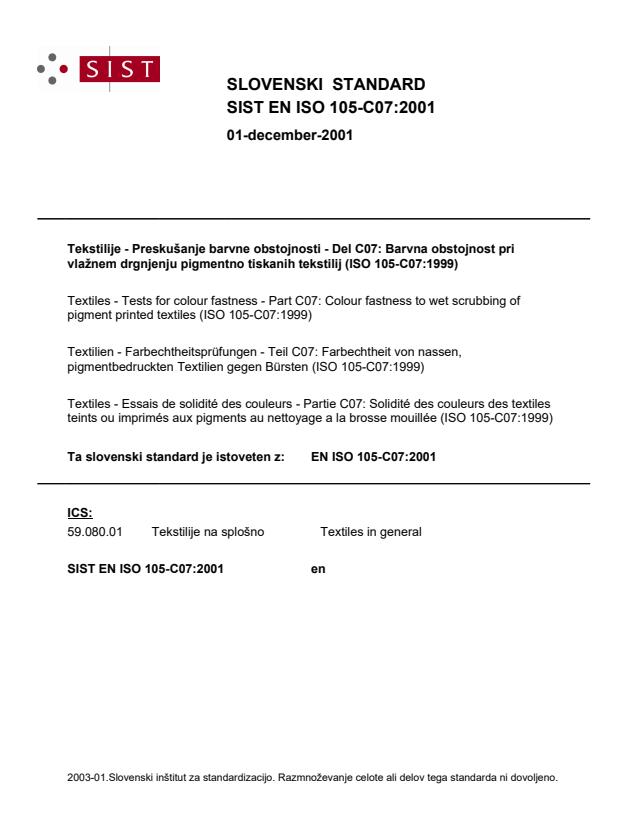
SLOVENSKI STANDARD
01-december-2001
Tekstilije - Preskušanje barvne obstojnosti - Del C07: Barvna obstojnost pri
vlažnem drgnjenju pigmentno tiskanih tekstilij (ISO 105-C07:1999)
Textiles - Tests for colour fastness - Part C07: Colour fastness to wet scrubbing of
pigment printed textiles (ISO 105-C07:1999)
Textilien - Farbechtheitsprüfungen - Teil C07: Farbechtheit von nassen,
pigmentbedruckten Textilien gegen Bürsten (ISO 105-C07:1999)
Textiles - Essais de solidité des couleurs - Partie C07: Solidité des couleurs des textiles
teints ou imprimés aux pigments au nettoyage a la brosse mouillée (ISO 105-C07:1999)
Ta slovenski standard je istoveten z: EN ISO 105-C07:2001
ICS:
59.080.01 Tekstilije na splošno Textiles in general
2003-01.Slovenski inštitut za standardizacijo. Razmnoževanje celote ali delov tega standarda ni dovoljeno.
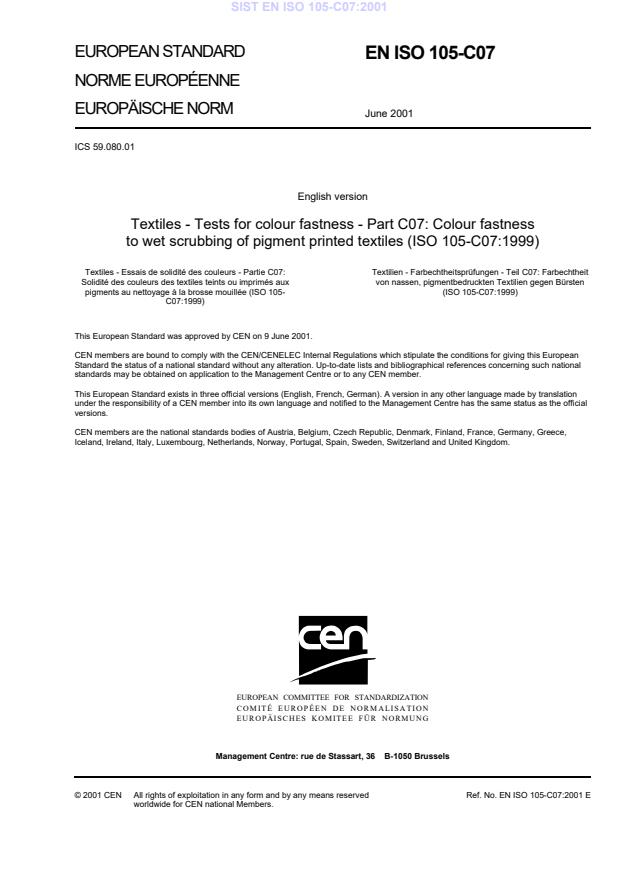
EUROPEAN STANDARD
EN ISO 105-C07
NORME EUROPÉENNE
EUROPÄISCHE NORM
June 2001
ICS 59.080.01
English version
Textiles - Tests for colour fastness - Part C07: Colour fastness
to wet scrubbing of pigment printed textiles (ISO 105-C07:1999)
Textiles - Essais de solidité des couleurs - Partie C07: Textilien - Farbechtheitsprüfungen - Teil C07: Farbechtheit
Solidité des couleurs des textiles teints ou imprimés aux von nassen, pigmentbedruckten Textilien gegen Bürsten
pigments au nettoyage à la brosse mouillée (ISO 105- (ISO 105-C07:1999)
C07:1999)
This European Standard was approved by CEN on 9 June 2001.
CEN members are bound to comply with the CEN/CENELEC Internal Regulations which stipulate the conditions for giving this European
Standard the status of a national standard without any alteration. Up-to-date lists and bibliographical references concerning such national
standards may be obtained on application to the Management Centre or to any CEN member.
This European Standard exists in three official versions (English, French, German). A version in any other language made by translation
under the responsibility of a CEN member into its own language and notified to the Management Centre has the same status as the official
versions.
CEN members are the national standards bodies of Austria, Belgium, Czech Republic, Denmark, Finland, France, Germany, Greece,
Iceland, Ireland, Italy, Luxembourg, Netherlands, Norway, Portugal, Spain, Sweden, Switzerland and United Kingdom.
EUROPEAN COMMITTEE FOR STANDARDIZATION
COMITÉ EUROPÉEN DE NORMALISATION
EUROPÄISCHES KOMITEE FÜR NORMUNG
Management Centre: rue de Stassart, 36 B-1050 Brussels
© 2001 CEN All rights of exploitation in any form and by any means reserved Ref. No. EN ISO 105-C07:2001 E
worldwide for CEN national Members.
Page 2
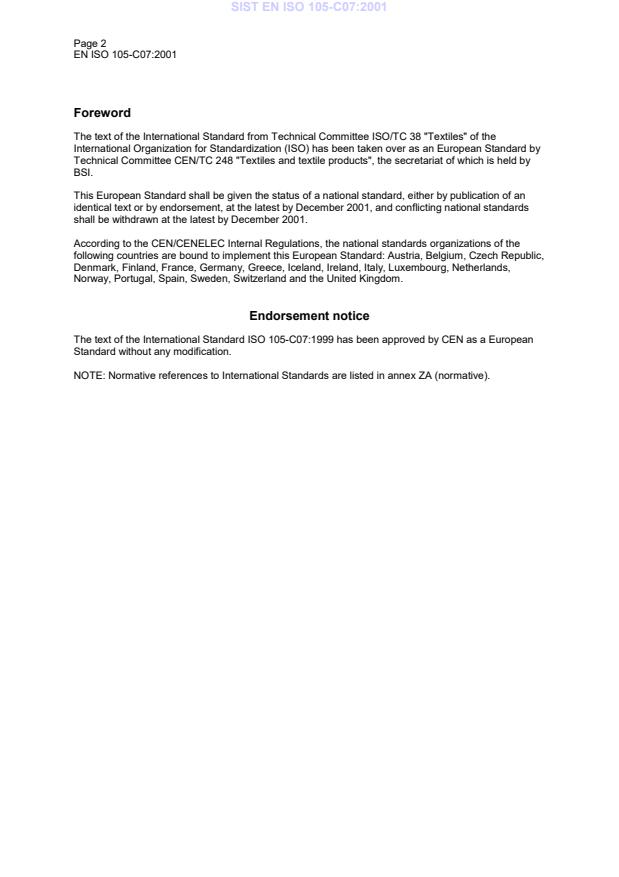
Foreword
The text of the International Standard from Technical Committee ISO/TC 38 "Textiles" of the
International Organization for Standardization (ISO) has been taken over as an European Standard by
Technical Committee CEN/TC 248 "Textiles and textile products", the secretariat of which is held by
BSI.
This European Standard shall be given the status of a national standard, either by publication of an
identical text or by endorsement, at the latest by December 2001, and conflicting national standards
shall be withdrawn at the latest by December 2001.
According to the CEN/CENELEC Internal Regulations, the national standards organizations of the
following countries are bound to implement this European Standard: Austria, Belgium, Czech Republic,
Denmark, Finland, France, Germany, Greece, Iceland, Ireland, Italy, Luxembourg, Netherlands,
Norway, Portugal, Spain, Sweden, Switzerland and the United Kingdom.
Endorsement notice
The text of the International Standard ISO 105-C07:1999 has been approved by CEN as a European
Standard without any modification.
NOTE: Normative references to International Standards are listed in annex ZA (normative).
Page 3
Annex ZA (normative)
Normative references to international publications
with their relevant European publications
This European Standard incorporates by dated or undated reference, provisions from other publications.
These normative references are cited at the appropriate places in the text and the publications are listed
hereafter. For dated references, subsequent amendments to or revisions of any of these publications
apply to this European Standard only when incorporated in it by amendment or revision. For undated
references the latest edition of the publication referred to applies (including amendments).
NOTE Where an International Publication has been modified by common modifications, indicated by
(mod.), the relevant EN/HD applies.
Publication Year Title EN Year
ISO 105-A01 1994 Textiles - Tests for colour fastness - EN ISO 105-A01 1995
Part A01: General principles of
testing
ISO 105-A02 1993 Textiles - Tests for colour fastness - EN ISO 20105-A02 1994
Part A02: Grey scale for assessing
change in colour
ISO 105-C01 1989 Textiles - Tests for colour fastness - EN ISO 20105-C01 1992
Part C01: Colour fastness to
washing - Test 1
ISO 105-C06 1994 Textiles - Tests for colour fastness - EN ISO 105-C06 1997
Part C06: Colour fastness to
domestic and commercial laundering
INTERNATIONAL ISO
STANDARD 105-C07
First edition
1999-03-15
Textiles — Tests for colour fastness —
Part C07:
Colour fastness to wet scrubbing of pigment
printed textiles
Textiles — Essais de solidité des couleurs —
Partie C07: Solidité des couleurs des textiles teints ou imprimés aux
pigments au nettoyage à la brosse mouillée
A
Reference number
ISO 105-C07:1999(E)
ISO 105-C07:1999(E)
Foreword
ISO (the International Organization for Standardization) is a worldwide federation of national standards bodies (ISO
member bodies). The work of preparing International Standards is normally carried out through ISO technical
committees. Each member body interested in a subject for which a technical committee has been established has
the right to be represented on that committee. International organizations, governmental and non-governmental, in
liaison with ISO, also take part in the work. ISO collaborates closely with the International Electrotechnical
Commission (IEC) on all matters of electrotechnical standardization.
International Standards are drafted in accordance with the rules given in the ISO/IEC Directives, Part 3.
Draft International Standards adopted by the technical committees are circulated to the member bodies for voting.
Publication as an International Standard requires approval by at least 75 % of the member bodies casting a vote.
International Standard ISO 105-C07 was prepared by Technical Committee ISO/TC 38, Textiles, Subcommittee
SC 1, Tests for coloured textiles and colorants.
ISO 105 was previously published in thirteen “parts”, each designated by a letter (e.g. “Part A”), with publication
dates between 1978 and 1985. Each part contained a series of “sections”, each designated by the respective part
letter and by a two-digit serial number (e.g. “Section A01”). These sections are now being republished as separate
documents, themselves designated “parts” but retaining their earlier alphanumeric designations. A complete list of
these par
...