


FprEN ISO 80601-2-90
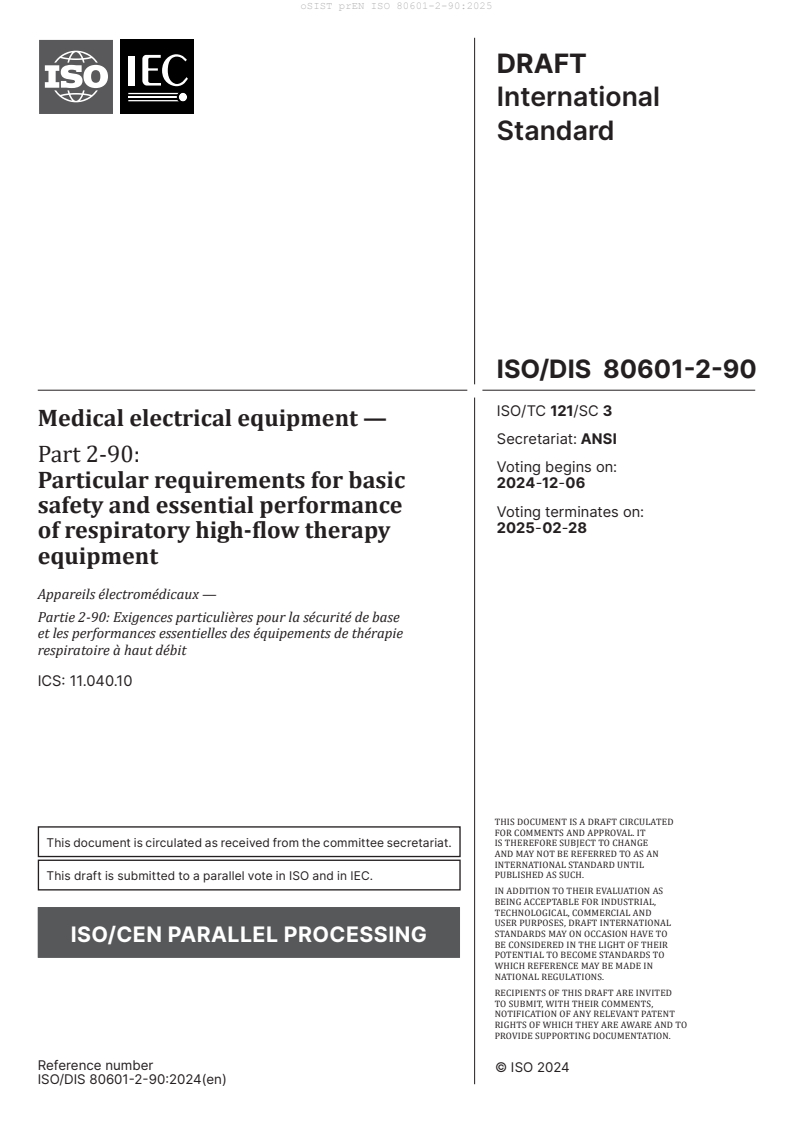
(Main)Medical electrical equipment - Part 2-90: Particular requirements for basic safety and essential performance of respiratory high-flow therapy equipment (ISO/FDIS 80601-2-90:2025)
Medical electrical equipment - Part 2-90: Particular requirements for basic safety and essential performance of respiratory high-flow therapy equipment (ISO/FDIS 80601-2-90:2025)
This document applies to the basic safety and essential performance of respiratory high-flow therapy equipment, as defined in 201.3.220, hereafter also referred to as ME equipment or ME system, in combination with its accessories:
— intended for use with patients who can breathe spontaneously; and
— intended for patients who would benefit from improved alveolar gas exchange; and who would benefit from receiving high-flow humidified respiratory gases, which can include a patient whose upper airway is bypassed.
EXAMPLE 1 Patients with Type 1 Respiratory Failure who exhibit a reduction in arterial blood oxygenation.
EXAMPLE 2 Patients who would benefit from reduced work of breathing, as needed in Type 2 Respiratory Failure, where arterial carbon dioxide is high.
EXAMPLE 3 Patients requiring humidification to improve mucociliary clearance.
Respiratory high-flow therapy equipment can be intended for use in the home healthcare environment or intended for use in professional healthcare facilities.
NOTE 1 In the home healthcare environment, the supply mains is often not reliable.
Respiratory high-flow therapy equipment can be:
— fully integrated ME equipment; or
— a combination of separate items forming a ME system.
This standard also applies to other types of respiratory equipment when that equipment includes a respiratory high-flow therapy mode.
NOTE 2 This standard and ISO 80601-2-12[14] are applicable to a critical care ventilator with a high-flow therapy mode.
Respiratory high-flow therapy equipment can be transit-operable.
This document is also applicable to those accessories intended by their manufacturer to be connected to the respiratory high-flow therapy equipment, where the characteristics of those accessories can affect the basic safety or essential performance of the respiratory high-flow therapy equipment.
EXAMPLE 4 Breathing sets, connectors, humidifier, breathing system filter, external electrical power source, distributed alarm system, high-flow nasal cannula, tracheal tube, tracheostomy tube, face mask and supra-laryngeal airway.
If a clause or subclause is specifically intended to be applicable to ME equipment only, or to ME systems only, the title and content of that clause or subclause will say so. If that is not the case, the clause or subclause applies both to ME equipment and to ME systems, as relevant.
Hazards inherent in the intended physiological function of ME equipment or ME systems within the scope of this document are not covered by specific requirements in this document except in the general standard, 7.2.13 and 8.4.1.
NOTE 3 Additional information can be found in the general standard, 4.2.
This document does not specify the requirements for:
— ventilators or accessories for ventilator-dependent patients intended for critical care applications, which are given in ISO 80601‑2‑12[14];
— ventilators or accessories intended for anaesthetic applications, which are given in ISO 80601‑2‑13[15];
— ventilators or accessories intended for the emergency medical services environment, which are given in ISO 80601‑2‑84[20];
— ventilators or accessories intended for ventilator-dependent patients in the home healthcare environment, which are given in ISO 80601‑2‑72[17];
— ventilatory support equipment or accessories intended for patients with ventilatory impairment, which are given in ISO 80601‑2‑79[18];
— ventilatory support equipment or accessories intended for patients with ven
Medizinische elektrische Geräte - Teil 2-90: Besondere Festlegungen für die Sicherheit und die wesentlichen Leistungsmerkmale von Geräten für die Beatmungstherapie mit hohem Durchfluss (ISO/FDIS 80601-2-90:2025)
ANMERKUNG 1 Abschnitt AA.2 enthält eine Anleitung und Begründung für diesen Unterabschnitt.
Dieses Dokument gilt für die Basissicherheit und die wesentlichen Leistungsmerkmale von Atemtherapiegeräten mit hohem Durchfluss, wie in 201.3.262 definiert, im Folgenden auch als ME Geräte oder ME Systeme bezeichnet, in Kombination mit ihrem Zubehör:
die für die Verwendung bei Patienten, die spontan atmen können bestimmt sind; und
die für Patienten bestimmt sind, die von einem verbesserten alveolären Gasaustausch profitieren würden; und die davon profitieren würden, befeuchtete Atemgase mit hohem Durchfluss zu erhalten, was einen Patienten, dessen obere Atemwege umgangen werden, beinhalten kann.
BEISPIEL 1 Patienten mit Typ 1 Atmungsinsuffizienz, die eine Verminderung der Oxygenierung arteriellen Bluts aufweisen.
BEISPIEL 2 Patienten, die von einer verminderten Atemarbeit profitieren würden, wie sie bei Typ 2-Atmungsinsuffizienz mit hohem arteriellem Kohlendioxid erforderlich ist.
BEISPIEL 3 Patienten, die eine Anfeuchtung zur Verbesserung der mukoziliären Reinigung benötigen.
Atemtherapiegeräte mit hohem Durchfluss können für die medizinische Versorgung in häuslicher Umgebung oder in professionellen Gesundheitseinrichtungen vorgesehen sein.
ANMERKUNG 2 Bei der medizinischen Versorgung in häuslicher Umgebung ist das Versorgungsnetz oft nicht zuverlässig.
Atemtherapiegeräte mit hohem Durchfluss können sein:
voll integrierte ME Geräte; oder
eine Kombination aus separaten Elementen, die ein ME System bilden.
Dieses Dokument ist auch anzuwenden für andere Typen von Atemgeräten, wenn diese Geräte eine Betriebsart für Atemtherapie mit hohem Durchfluss aufweisen.
ANMERKUNG 3 Dieses Dokument und ISO 80601 2 12 für ein Intensivpflege-Beatmungsgerät mit einer Betriebsart für Therapie mit hohem Durchfluss.
Atemtherapiegeräte mit hohem Durchfluss können betriebsfähig bei Bewegung sein.
Dieses Dokument gilt auch für Zubehör, das durch den Hersteller für den Anschluss an Atemtherapiegeräte mit hohem Durchfluss vorgesehen ist, sofern die Merkmale dieses Zubehörs die Basissicherheit oder die wesentlichen Leistungsmerkmale der Atemtherapiegeräte mit hohem Durchfluss beeinflussen können.
BEISPIEL 4 Atemsets, Verbindungsstücke, Anfeuchter, Atemsystemfilter, externe elektrische Spannungsquelle, verteiltes Alarmsystem, Nasenbrille mit hohem Durchfluss, Trachealtubus, Tracheotomietubus, Gesichtsmaske und supra-laryngealer Luftweg.
ANMERKUNG 4 Zubehör wird anhand der zutreffenden Abschnitte dieses Dokuments beurteilt, wenn es als Teil eines Atemtherapiegeräts mit hohem Durchfluss konfiguriert ist.
Ist ein Abschnitt oder Unterabschnitt speziell für die Anwendung nur auf ME Geräten oder nur auf ME Systemen vorgesehen, ist dies aus Überschrift und Inhalt des Abschnitts oder Unterabschnitts ersichtlich. Ist dies nicht der Fall, gilt der Abschnitt oder Unterabschnitt, je nach Zutreffen, für das ME Gerät und das ME System.
Gefährdungen, die der vorgesehenen physiologischen Funktion der in den Anwendungsbereich dieses Dokuments fallenden ME Geräte oder ME Systeme inhärent sind, werden nicht durch die spezifischen Anforderungen in diesem Dokument abgedeckt, ausgenommen in der Allgemeinen Norm, 7.2.13 und 8.4.1.
ANMERKUNG 5 Zusätzliche Informationen können der Allgemeinen Norm, 4.2, entnommen werden.[...]
Appareils électromédicaux - Partie 2-90: Exigences particulières pour la sécurité de base et les performances essentielles des équipements de thérapie respiratoire à haut débit (ISO/FDIS 80601-2-90:2025)
Le présent document s'applique à la sécurité de base et aux performances essentielles des équipements de thérapie respiratoire à haut débit, tels que définis en 201.3.220, ci-après également désignés par appareils EM ou systèmes EM, en association avec leurs accessoires:
— destinés à être utilisés sur des patients qui peuvent respirer spontanément; et
— destinés à être utilisés chez des patients, dont ceux qui ont une dérivation des voies aériennes supérieures, pour qui un meilleur échange gazeux alvéolaire et une administration de gaz respiratoires humidifiés à haut débit seraient bénéfiques.
EXEMPLE 1 Patients atteints d'insuffisance respiratoire de type 1, c'est-à-dire présentant des signes d'hypoxémie artérielle
EXEMPLE 2 Patients qui gagneraient à réduire leur travail respiratoire, comme c'est le cas pour une insuffisance respiratoire de type 2, où le patient souffre d'hypercapnie.
EXEMPLE 3 Patients nécessitant une humidification pour améliorer la clairance mucociliaire.
Les équipements de thérapie respiratoire à haut débit peuvent être destinés à être utilisés dans l'environnement des soins à domicile ou dans des établissements de soins professionnels.
NOTE 1 Dans l'environnement des soins à domicile, il est fréquent que le réseau d'alimentation ne soit pas fiable.
Les équipements de thérapie respiratoire à haut débit peuvent être:
— des équipements EM entièrement intégrés; ou
— une combinaison d'éléments séparés formant un système EM.
La présente norme s'applique également à d'autres types d'équipements respiratoires lorsque ces équipements comportent un mode de thérapie respiratoire à haut débit.
NOTE 2 La présente norme et l'ISO 80601-2-12[14] s'appliquent à un ventilateur de soins intensifs disposant d'un mode de thérapie à haut débit.
Les équipements de thérapie respiratoire à haut débit peuvent être opérationnels en déplacement.
Le présent document s'applique également aux accessoires destinés par leur fabricant à être raccordés à un équipement de thérapie respiratoire à haut débit, les caractéristiques de ces accessoires pouvant avoir un impact sur la sécurité de base ou sur les performances essentielles de l'équipement de thérapie respiratoire à haut débit.
EXEMPLE 4 Systèmes respiratoires, raccords, humidificateur, filtre pour système respiratoire, source d'énergie électrique externe, système d'alarme réparti, canule nasale à débit élevé, sonde trachéale, canule de trachéotomie, masque facial et canule supralaryngée.
Si un article ou un paragraphe est spécifiquement destiné à être appliqué uniquement aux appareils EM ou uniquement aux systèmes EM, le titre et le contenu dudit article ou paragraphe l'indiqueront. Si cela n'est pas le cas, l'article ou le paragraphe s'applique à la fois aux appareils EM et aux systèmes EM, selon le cas.
Les dangers inhérents à la fonction physiologique prévue des appareils EM ou des systèmes EM dans le cadre du domaine d'application du présent document ne sont pas couverts par des exigences spécifiques contenues dans le présent document, à l'exception de la norme générale, 7.2.13 et 8.4.1.
NOTE 3 Des informations supplémentaires sont disponibles dans la norme générale, 4.2.
Le présent document ne spécifie pas les exigences relatives aux:
— ventilateurs ou accessoires pour patients ventilo-dépendants prévus pour les applications en soins intensifs, qui sont données dans l'ISO 80601‑2‑12[14];
— ventilateurs ou accessoires prévus pour les application
Medicinska električna oprema - 2-90. del: Posebne zahteve za osnovno varnost in bistvene lastnosti opreme za respiratorno terapijo z velikim pretokom (ISO/FDIS 80601-2-90:2025)
General Information
- Status
- Not Published
- Publication Date
- 25-Mar-2026
- Technical Committee
- CEN/TC 215 - Respiratory and anaesthetic equipment
- Drafting Committee
- CEN/TC 215/WG 2 - Lung ventilators
- Current Stage
- 6055 - CEN Ratification completed (DOR) - Publishing
- Start Date
- 26-Jan-2026
- Completion Date
- 26-Jan-2026
Relations
- Effective Date
- 07-Jun-2023
Overview
The standard FprEN ISO 80601-2-90:2025 specifies particular requirements for the basic safety and essential performance of respiratory high-flow therapy equipment. This equipment is designed to deliver high-flow humidified respiratory gases to patients who can breathe spontaneously and would benefit from improved alveolar gas exchange. These devices are critical in managing respiratory conditions by providing effective humidification and gas flow, especially in cases like Type 1 and Type 2 respiratory failures or where mucociliary clearance needs enhancement.
Developed under the auspices of CEN and aligned with ISO technical committees, this standard ensures that respiratory high-flow therapy equipment-whether a fully integrated system or a combination of separate medical electrical (ME) devices and accessories-meets stringent safety, performance, and compatibility criteria. Importantly, it covers use cases in both professional healthcare facilities and home healthcare environments. The standard recognizes challenges such as unreliable power supply in home settings and establishes protections accordingly.
Key Topics
Scope and Application
Covers respiratory high-flow therapy equipment intended for patients benefiting from high-flow humidified gases, including those with upper airway bypass. Applies to equipment used at home or in healthcare facilities and includes transit-operable systems.Safety and Performance Requirements
Defines basic safety protocols, risk control measures, and essential performance parameters such as accurate flowrate delivery, oxygen concentration levels, and alarm conditions for device faults or power interruptions.Compatibility and Accessories
Addresses integration with accessories like breathing sets, humidifiers, filters, nasal cannulas, tracheal tubes, and external power sources. Ensures that all connected parts do not compromise the safety or performance of the ME equipment or system.Testing and Risk Management
Specifies test conditions tailored to respiratory high-flow therapy including continuous flow accuracy, obstruction alarms, and protection from electrical, mechanical, and radiation hazards. Also guides on failure modes like gas supply interruption.User Information and Documentation
Requires clear labeling, operating instructions for both lay operators and healthcare professionals, maintenance guidelines, and cleaning or sterilization protocols to uphold device safety and effectiveness.
Applications
Clinical Respiratory Therapy
Utilized in hospitals, clinics, and critical care for patients with respiratory insufficiency who can breathe independently but require assisted high-flow humidified oxygen therapy for improved gas exchange.Home Healthcare
Enables patients with chronic respiratory conditions to receive therapeutic respiratory support safely at home, addressing reliability issues such as irregular mains power supply through design features complying with the standard.Emergency and Transport Care
Supports transit-operable respiratory high-flow systems for patient transport, ensuring continuous respiratory support outside standard clinical settings.Respiratory Support for Various Conditions
Effective for patients with Type 1 respiratory failure (hypoxemia), Type 2 respiratory failure (hypercapnia), and for those with impaired mucociliary function needing humidification.
Related Standards
- ISO 80601-2-12: Requirements for critical care ventilators with high-flow therapy mode
- ISO 80601-2-13: Standards for anesthetic ventilators and accessories
- ISO 80601-2-72: Ventilatory support equipment for home healthcare use
- ISO 80601-2-84: Ventilators used in emergency medical services
- ISO 80601-2-79: Ventilatory equipment for patients with ventilatory impairment
These complementary standards establish specific criteria for ventilators and respiratory devices in different clinical contexts, while ISO 80601-2-90 focuses uniquely on the safety and performance of high-flow therapy systems.
Keywords: respiratory high-flow therapy, medical electrical equipment, patient safety, humidified respiratory gases, alveolar gas exchange, medical device standards, respiratory equipment testing, home healthcare respiratory devices, respiratory failure treatment, CEN ISO standard.


Get Certified
Connect with accredited certification bodies for this standard

BSI Group
BSI (British Standards Institution) is the business standards company that helps organizations make excellence a habit.

TÜV Rheinland
TÜV Rheinland is a leading international provider of technical services.

TÜV SÜD
TÜV SÜD is a trusted partner of choice for safety, security and sustainability solutions.
Sponsored listings
Frequently Asked Questions
FprEN ISO 80601-2-90 is a draft published by the European Committee for Standardization (CEN). Its full title is "Medical electrical equipment - Part 2-90: Particular requirements for basic safety and essential performance of respiratory high-flow therapy equipment (ISO/FDIS 80601-2-90:2025)". This standard covers: This document applies to the basic safety and essential performance of respiratory high-flow therapy equipment, as defined in 201.3.220, hereafter also referred to as ME equipment or ME system, in combination with its accessories: — intended for use with patients who can breathe spontaneously; and — intended for patients who would benefit from improved alveolar gas exchange; and who would benefit from receiving high-flow humidified respiratory gases, which can include a patient whose upper airway is bypassed. EXAMPLE 1 Patients with Type 1 Respiratory Failure who exhibit a reduction in arterial blood oxygenation. EXAMPLE 2 Patients who would benefit from reduced work of breathing, as needed in Type 2 Respiratory Failure, where arterial carbon dioxide is high. EXAMPLE 3 Patients requiring humidification to improve mucociliary clearance. Respiratory high-flow therapy equipment can be intended for use in the home healthcare environment or intended for use in professional healthcare facilities. NOTE 1 In the home healthcare environment, the supply mains is often not reliable. Respiratory high-flow therapy equipment can be: — fully integrated ME equipment; or — a combination of separate items forming a ME system. This standard also applies to other types of respiratory equipment when that equipment includes a respiratory high-flow therapy mode. NOTE 2 This standard and ISO 80601-2-12[14] are applicable to a critical care ventilator with a high-flow therapy mode. Respiratory high-flow therapy equipment can be transit-operable. This document is also applicable to those accessories intended by their manufacturer to be connected to the respiratory high-flow therapy equipment, where the characteristics of those accessories can affect the basic safety or essential performance of the respiratory high-flow therapy equipment. EXAMPLE 4 Breathing sets, connectors, humidifier, breathing system filter, external electrical power source, distributed alarm system, high-flow nasal cannula, tracheal tube, tracheostomy tube, face mask and supra-laryngeal airway. If a clause or subclause is specifically intended to be applicable to ME equipment only, or to ME systems only, the title and content of that clause or subclause will say so. If that is not the case, the clause or subclause applies both to ME equipment and to ME systems, as relevant. Hazards inherent in the intended physiological function of ME equipment or ME systems within the scope of this document are not covered by specific requirements in this document except in the general standard, 7.2.13 and 8.4.1. NOTE 3 Additional information can be found in the general standard, 4.2. This document does not specify the requirements for: — ventilators or accessories for ventilator-dependent patients intended for critical care applications, which are given in ISO 80601‑2‑12[14]; — ventilators or accessories intended for anaesthetic applications, which are given in ISO 80601‑2‑13[15]; — ventilators or accessories intended for the emergency medical services environment, which are given in ISO 80601‑2‑84[20]; — ventilators or accessories intended for ventilator-dependent patients in the home healthcare environment, which are given in ISO 80601‑2‑72[17]; — ventilatory support equipment or accessories intended for patients with ventilatory impairment, which are given in ISO 80601‑2‑79[18]; — ventilatory support equipment or accessories intended for patients with ven
This document applies to the basic safety and essential performance of respiratory high-flow therapy equipment, as defined in 201.3.220, hereafter also referred to as ME equipment or ME system, in combination with its accessories: — intended for use with patients who can breathe spontaneously; and — intended for patients who would benefit from improved alveolar gas exchange; and who would benefit from receiving high-flow humidified respiratory gases, which can include a patient whose upper airway is bypassed. EXAMPLE 1 Patients with Type 1 Respiratory Failure who exhibit a reduction in arterial blood oxygenation. EXAMPLE 2 Patients who would benefit from reduced work of breathing, as needed in Type 2 Respiratory Failure, where arterial carbon dioxide is high. EXAMPLE 3 Patients requiring humidification to improve mucociliary clearance. Respiratory high-flow therapy equipment can be intended for use in the home healthcare environment or intended for use in professional healthcare facilities. NOTE 1 In the home healthcare environment, the supply mains is often not reliable. Respiratory high-flow therapy equipment can be: — fully integrated ME equipment; or — a combination of separate items forming a ME system. This standard also applies to other types of respiratory equipment when that equipment includes a respiratory high-flow therapy mode. NOTE 2 This standard and ISO 80601-2-12[14] are applicable to a critical care ventilator with a high-flow therapy mode. Respiratory high-flow therapy equipment can be transit-operable. This document is also applicable to those accessories intended by their manufacturer to be connected to the respiratory high-flow therapy equipment, where the characteristics of those accessories can affect the basic safety or essential performance of the respiratory high-flow therapy equipment. EXAMPLE 4 Breathing sets, connectors, humidifier, breathing system filter, external electrical power source, distributed alarm system, high-flow nasal cannula, tracheal tube, tracheostomy tube, face mask and supra-laryngeal airway. If a clause or subclause is specifically intended to be applicable to ME equipment only, or to ME systems only, the title and content of that clause or subclause will say so. If that is not the case, the clause or subclause applies both to ME equipment and to ME systems, as relevant. Hazards inherent in the intended physiological function of ME equipment or ME systems within the scope of this document are not covered by specific requirements in this document except in the general standard, 7.2.13 and 8.4.1. NOTE 3 Additional information can be found in the general standard, 4.2. This document does not specify the requirements for: — ventilators or accessories for ventilator-dependent patients intended for critical care applications, which are given in ISO 80601‑2‑12[14]; — ventilators or accessories intended for anaesthetic applications, which are given in ISO 80601‑2‑13[15]; — ventilators or accessories intended for the emergency medical services environment, which are given in ISO 80601‑2‑84[20]; — ventilators or accessories intended for ventilator-dependent patients in the home healthcare environment, which are given in ISO 80601‑2‑72[17]; — ventilatory support equipment or accessories intended for patients with ventilatory impairment, which are given in ISO 80601‑2‑79[18]; — ventilatory support equipment or accessories intended for patients with ven
FprEN ISO 80601-2-90 is classified under the following ICS (International Classification for Standards) categories: 11.040.10 - Anaesthetic, respiratory and reanimation equipment. The ICS classification helps identify the subject area and facilitates finding related standards.
FprEN ISO 80601-2-90 has the following relationships with other standards: It is inter standard links to EN ISO 80601-2-90:2021. Understanding these relationships helps ensure you are using the most current and applicable version of the standard.
FprEN ISO 80601-2-90 is available in PDF format for immediate download after purchase. The document can be added to your cart and obtained through the secure checkout process. Digital delivery ensures instant access to the complete standard document.
Standards Content (Sample)
SLOVENSKI STANDARD
oSIST prEN ISO 80601-2-90:2025
01-februar-2025
Medicinska električna oprema - 2-90. del: Posebne zahteve za osnovno varnost in
bistvene lastnosti opreme za respiratorno terapijo z velikim pretokom (ISO/DIS
80601-2-90:2024)
Medical electrical equipment - Part 2-90: Particular requirements for basic safety and
essential performance of respiratory high-flow therapy equipment (ISO/DIS 80601-2-
90:2024)
Medizinische elektrische Geräte - Teil 2-90: Besondere Festlegungen für die Sicherheit
und die wesentlichen Leistungsmerkmale von Geräten für die Beatmungstherapie mit
hohem Durchfluss (ISO/DIS 80601-2-90:2024)
Appareils électromédicaux - Partie 2-90: Exigences particulières pour la sécurité de base
et les performances essentielles des équipements de thérapie respiratoire à haut débit
(ISO/DIS 80601-2-90:2024)
Ta slovenski standard je istoveten z: prEN ISO 80601-2-90
ICS:
11.040.10 Anestezijska, respiratorna in Anaesthetic, respiratory and
reanimacijska oprema reanimation equipment
oSIST prEN ISO 80601-2-90:2025 en,fr,de
2003-01.Slovenski inštitut za standardizacijo. Razmnoževanje celote ali delov tega standarda ni dovoljeno.
oSIST prEN ISO 80601-2-90:2025
oSIST prEN ISO 80601-2-90:2025
DRAFT
International
Standard
ISO/DIS 80601-2-90
ISO/TC 121/SC 3
Medical electrical equipment —
Secretariat: ANSI
Part 2-90:
Voting begins on:
Particular requirements for basic 2024-12-06
safety and essential performance
Voting terminates on:
2025-02-28
of respiratory high-flow therapy
equipment
Appareils électromédicaux —
Partie 2-90: Exigences particulières pour la sécurité de base
et les performances essentielles des équipements de thérapie
respiratoire à haut débit
ICS: 11.040.10
THIS DOCUMENT IS A DRAFT CIRCULATED
FOR COMMENTS AND APPROVAL. IT
This document is circulated as received from the committee secretariat. IS THEREFORE SUBJECT TO CHANGE
AND MAY NOT BE REFERRED TO AS AN
INTERNATIONAL STANDARD UNTIL
PUBLISHED AS SUCH.
This draft is submitted to a parallel vote in ISO and in IEC.
IN ADDITION TO THEIR EVALUATION AS
BEING ACCEPTABLE FOR INDUSTRIAL,
TECHNOLOGICAL, COMMERCIAL AND
USER PURPOSES, DRAFT INTERNATIONAL
STANDARDS MAY ON OCCASION HAVE TO
ISO/CEN PARALLEL PROCESSING
BE CONSIDERED IN THE LIGHT OF THEIR
POTENTIAL TO BECOME STANDARDS TO
WHICH REFERENCE MAY BE MADE IN
NATIONAL REGULATIONS.
RECIPIENTS OF THIS DRAFT ARE INVITED
TO SUBMIT, WITH THEIR COMMENTS,
NOTIFICATION OF ANY RELEVANT PATENT
RIGHTS OF WHICH THEY ARE AWARE AND TO
PROVIDE SUPPORTING DOCUMENTATION.
Reference number
ISO/DIS 80601-2-90:2024(en)
oSIST prEN ISO 80601-2-90:2025
DRAFT
ISO/DIS 80601-2-90:2024(en)
International
Standard
ISO/DIS 80601-2-90
ISO/TC 121/SC 3
Medical electrical equipment —
Secretariat: ANSI
Part 2-90:
Voting begins on:
Particular requirements for basic
safety and essential performance
Voting terminates on:
of respiratory high-flow therapy
equipment
Appareils électromédicaux —
Partie 2-90: Exigences particulières pour la sécurité de base
et les performances essentielles des équipements de thérapie
respiratoire à haut débit
ICS: 11.040.10
THIS DOCUMENT IS A DRAFT CIRCULATED
FOR COMMENTS AND APPROVAL. IT
IS THEREFORE SUBJECT TO CHANGE
This document is circulated as received from the committee secretariat.
AND MAY NOT BE REFERRED TO AS AN
INTERNATIONAL STANDARD UNTIL
PUBLISHED AS SUCH.
This draft is submitted to a parallel vote in ISO and in IEC.
IN ADDITION TO THEIR EVALUATION AS
BEING ACCEPTABLE FOR INDUSTRIAL,
© ISO 2024
TECHNOLOGICAL, COMMERCIAL AND
USER PURPOSES, DRAFT INTERNATIONAL
All rights reserved. Unless otherwise specified, or required in the context of its implementation, no part of this publication may
STANDARDS MAY ON OCCASION HAVE TO
ISO/CEN PARALLEL PROCESSING
be reproduced or utilized otherwise in any form or by any means, electronic or mechanical, including photocopying, or posting on
BE CONSIDERED IN THE LIGHT OF THEIR
the internet or an intranet, without prior written permission. Permission can be requested from either ISO at the address below
POTENTIAL TO BECOME STANDARDS TO
WHICH REFERENCE MAY BE MADE IN
or ISO’s member body in the country of the requester.
NATIONAL REGULATIONS.
ISO copyright office
RECIPIENTS OF THIS DRAFT ARE INVITED
CP 401 • Ch. de Blandonnet 8
TO SUBMIT, WITH THEIR COMMENTS,
CH-1214 Vernier, Geneva
NOTIFICATION OF ANY RELEVANT PATENT
Phone: +41 22 749 01 11
RIGHTS OF WHICH THEY ARE AWARE AND TO
PROVIDE SUPPORTING DOCUMENTATION.
Email: copyright@iso.org
Website: www.iso.org
Published in Switzerland Reference number
ISO/DIS 80601-2-90:2024(en)
ii
oSIST prEN ISO 80601-2-90:2025
ISO/DIS 80601-2-90:2024(en)
1 Contents
2 Contents . iii
3 Introduction . viii
4 201.1 Scope, object and related standards . 1
5 201.1.1 Scope . 1
6 201.1.2 Object . 2
7 201.1.3 Collateral standards . 3
8 201.1.4 Particular standards . 3
9 201.2 Normative references . 4
10 201.3 Terms and definitions . 6
11 201.4 General requirements . 21
12 201.4.3 Essential performance . 21
13 201.4.3.101 Additional requirements for essential performance . 21
14 201.4.5 Alternative risk control measures or test methods for ME equipment or
15 ME system. 22
16 201.4.6 ME equipment or ME system parts that contact the patient . 22
17 201.4.11.101 Additional requirements for pressurized gas input . 23
18 201.4.11.101.1 Overpressure requirement . 23
19 201.4.11.101.2 Compatibility requirement . 23
20 201.5 General requirements for testing of ME equipment . 24
21 201.5.101 Additional requirements for the general requirements for testing of
22 ME equipment . 24
23 201.5.101.1 Respiratory high-flow therapy equipment test conditions . 24
24 201.5.101.2 Gas flowrate specifications . 24
25 201.5.101.3 Respiratory high-flow therapy equipment testing errors . 24
26 201.6 Classification of ME equipment and ME systems . 25
27 201.7 ME equipment identification, marking and documents . 25
28 201.7.1.101 Information supplied by the manufacturer . 25
29 201.7.2.4.101 Additional requirements for accessories . 25
30 201.7.2.18 External gas source . 26
31 201.7.4.3 Units of measurement. 27
32 201.7.9.2.1 General . Error! Bookmark not defined.
33 201.7.9.2.1.101 Additional general requirements . 27
34 201.7.9.2.2.101 Additional requirements for warnings and safety notices . 27
35 201.7.9.2.8.101 Additional requirements for start-up procedure . 29
36 201.7.9.2.9.101 Additional requirements for operating instructions . 30
37 201.7.9.2.9.101.1 Lay operator operating instructions . 30
38 201.7.9.2.9.101.2 Healthcare professional operator operating instructions . 31
39 201.7.9.2.12 Cleaning, disinfection and sterilization. . 31
40 201.7.9.2.13.101 Additional requirements for maintenance . 32
41 201.7.9.2.14.101 Additional requirements for accessories, supplementary equipment,
42 used material . 32
43 201.7.9.3.1.101 Additional general requirements . 32
44 201.7.9.3.101 Additional requirements for the technical description. 33
45 201.8 Protection against electrical hazards from ME equipment . 33
46 201.9 Protection against mechanical hazards of ME equipment and ME systems . 33
47 201.9.4.3.101 Additional requirements for instability from unwanted lateral movement . 33
iii
oSIST prEN ISO 80601-2-90:2025
ISO/DIS 80601-2-90:2024(en)
48 201.9.6.2.1.101 Additional requirements for audible acoustic energy. 33
49 201.10 Protection against unwanted and excessive radiation hazards . 34
50 201.11 Protection against excessive temperatures and other hazards . 35
51 201.11.1.2.2 Applied parts not intended to supply heat to a patient . 35
52 201.11.6.6 Cleaning and disinfection of ME equipment or ME system . 35
53 201.11.6.7 Sterilization of ME equipment or ME system . 36
54 201.11.7 Biocompatibility of ME equipment and ME systems . 36
55 201.11.8.101 Additional requirements for interruption of the power supply/supply mains
56 to ME equipment alarm condition . 37
57 201.11.8.101.1 Alarm conditions . 37
58 201.11.8.101.2 Alternative power supply/supply mains . 39
59 201.12 Accuracy of controls and instruments and protection against hazardous outputs . 39
60 201.12.1 Accuracy of controls and instruments . 39
61 201.12.1.101 Continuous flow breathing-therapy mode . 40
62 201.12.1.101.1 Flowrate accuracy . 40
63 201.12.1.101.2 Accuracy of delivered oxygen concentration . 42
64 201.12.2.101 Usability of ME equipment . 43
65 201.12.4 Protection against hazardous output . 44
66 201.12.4.101 Oxygen monitor . 44
67 201.12.4.102 Maximum limited pressure protection device . 45
68 201.12.4.103 Flowrate monitoring. 45
69 201.12.4.104 Obstruction alarm condition . 46
70 201.12.4.105 SpO monitoring equipment . 46
71 201.12.101 Protection against accidental adjustments . 47
72 201.13 Hazardous situations and fault conditions for ME equipment . 47
73 201.13.2.101 Additional specific single fault conditions . 48
74 201.13.101 Failure of one gas supply to respiratory high-flow therapy equipment . 48
75 201.13.102 Independence of delivery control function and related risk control measures . 48
76 201.14 Programmable electrical medical systems (PEMS) . 49
77 201.15 Construction of ME equipment . 50
78 201.15.101 Mode of operation . 50
79 201.15.102 Delivered oxygen concentration . 50
80 201.15.103 Pre-use check . 51
81 201.16 ME systems . 51
82 201.16.1.101 Additional general requirements for ME systems . 51
83 201.16.2 Accompanying documents of an ME system . 52
84 201.17 Electromagnetic compatibility of ME equipment and ME systems . 52
85 201.101 Gas connections . 52
86 201.101.1 Connections to an inlet . 52
87 201.101.1.1 Low-pressure hose assembly . 52
88 201.101.2 Breathing system connectors. 52
89 201.101.2.1 General. 52
90 201.101.2.2 Other named ports . 53
91 201.101.2.2.1 General . 53
92 201.101.2.2.2 Patient-connection port . 53
93 201.101.2.2.6 Gas pathway connection port . 54
94 201.101.2.2.7 Monitoring probe port . Error! Bookmark not defined.
95 201.101.2.2.8 Temperature sensor port . 54
96 201.101.2.2.9 Nebulization port . 54
iv
oSIST prEN ISO 80601-2-90:2025
ISO/DIS 80601-2-90:2024(en)
97 201.101.3 Oxygen inlet connector . 55
98 201.101.4 Gas intake port . 55
99 201.102 Requirements for the breathing system and accessories . 55
100 201.102.1 General . 55
101 201.102.2 Labelling . 55
102 201.102.3 Breathing sets . 56
103 201.102.4 Humidification system . 56
104 201.102.5 Breathing system filter (BSF) . 56
105 201.102.6 Airway devices . 56
106 201.103 Indication of duration of operation . 57
107 201.104 Functional connection . 57
108 201.104.1 General . 57
109 201.104.2 Connection to an electronic health record . 57
110 201.104.3 Connection to a distributed alarm system . 57
111 201.104.4 Connection for remote control . 58
112 201.105 Power supply cords . 58
113 201.106 Respiratory high-flow therapy equipment security . 58
114 202 Electromagnetic disturbances — Requirements and tests . 58
115 202.4.3.1 Compliance criteria . 59
116 202.5.2.2.1 Requirements applicable to all ME equipment and ME systems . 59
117 202.8.1.101 Additional general requirements . 59
118 206 Usability . 59
119 208 General requirements, tests and guidance for alarm systems in medical electrical
120 equipment and medical electrical systems . 61
121 208.6.5.4.2 Selection of default alarm preset . 61
122 208.6.12.2 Operator alarm system logging . 62
123 211 Requirements for medical electrical equipment and medical electrical systems used
124 in the home healthcare environment . 63
125 211.7.4.7 Additional requirements for cleaning, disinfection and sterilization . 63
126 211.10.1.1 General requirements for mechanical strength . 63
127 Annexes . 63
128 Annex C (informative) Guide to marking and labelling requirements for ME equipment and
129 ME systems . 64
130 Annex D (informative) Symbols on marking . 72
131 Annex AA (informative) Particular guidance and rationale . 74
132 AA.1 General guidance . 74
133 AA.2 Rationale for particular clauses and subclauses . 74
134 Annex BB (informative) Data interface requirements . 92
135 BB.1 Background and purpose. 92
136 BB.2 Data definition . 93
137 Annex CC (informative) Reference to the IMDRF essential principles and labelling guidances . 96
138 Annex DD (informative) Terminology — Alphabetized index of defined terms . 100
v
oSIST prEN ISO 80601-2-90:2025
ISO/DIS 80601-2-90:2024(en)
140 Foreword
141 ISO (the International Organization for Standardization) and IEC (the International Electrotechnical
142 Commission) form the specialized system for worldwide standardization. National bodies that are
143 members of ISO or IEC participate in the development of International Standards through technical
144 committees established by the respective organization to deal with particular fields of technical activity.
145 ISO and IEC technical committees collaborate in fields of mutual interest. Other international
organizations, governmental and non-governmental, in liaison with ISO and IEC, also take part in the
147 work.
148 The procedures used to develop this document and those intended for its further maintenance are
149 described in the ISO/IEC Directives, Part 1. In particular, the different approval criteria needed for the
150 different types of document should be noted. This document was drafted in accordance with the editorial
151 rules of the ISO/IEC Directives, Part 2 (see www.iso.org/directives or
152 www.iec.ch/members_experts/refdocs).
153 Attention is drawn to the possibility that some of the elements of this document may be the subject of
154 patent rights. ISO and IEC shall not be held responsible for identifying any or all such patent rights. Details
155 of any patent rights identified during the development of the document will be in the Introduction and/or
156 on the ISO list of patent declarations received (see www.iso.org/patents) or the IEC list of patent
157 declarations received (see patents.iec.ch).
158 Any trade name used in this document is information given for the convenience of users and does not
159 constitute an endorsement.
160 For an explanation of the voluntary nature of standards, the meaning of ISO specific terms and
161 expressions related to conformity assessment, as well as information about ISO's adherence to the World
162 Trade Organization (WTO) principles in the Technical Barriers to Trade (TBT),
163 see www.iso.org/iso/foreword.html. In the IEC, see www.iec.ch/understanding-standards.
164 This document was prepared by Technical Committee ISO/TC 121, Anaesthetic and respiratory
165 equipment, Subcommittee SC 3, Respiratory devices and related equipment used for patient care, and
166 Technical Committee IEC/TC 62, Medical equipment, software, and systems, Subcommittee SC D,
Particular medical equipment, software, and systems, in collaboration with the European Committee for
168 Standardization (CEN) Technical Committee CEN/TC 215, Respiratory and anaesthetic equipment, in
169 accordance with the Agreement on technical cooperation between ISO and CEN (Vienna Agreement).
170 This second edition cancels and replaces the first edition (ISO 80601-2-90:2021), which has been
171 technically revised.
172 The main changes are as follows:
173 — updated normative references;
174 — clarified system recovery requirements;
175 — added cybersecurity requirements; and
176 — added requirements for SpO monitoring equipment.
177 A list of all parts in the ISO 80601 series and the IEC 80601 series can be found on the ISO and IEC
178 websites.
vi
oSIST prEN ISO 80601-2-90:2025
ISO/DIS 80601-2-90:2024(en)
179 Any feedback or questions on this document should be directed to the user’s national standards body. A
180 complete listing of these bodies can be found at www.iso.org/members.html and www.iec.ch/national-
181 committees.
vii
oSIST prEN ISO 80601-2-90:2025
ISO/DIS 80601-2-90:2024(en)
182 Introduction
183 Respiratory high-flow therapy equipment has been used successfully for years with neonatal patients. In
184 recent years there is more information about treating adults with respiratory high-flow therapy
185 equipment when it is used as an intermediate therapy to improve oxygenation in adult critical care
patients, respiratory care units and for palliative care. High-flow therapy equipment is also used in the
treatment of chronic respiratory disease to reduce exacerbation, improve physiological outcomes and
[31][44][45][48] 1
quality of life . The use of respiratory high-flow therapy equipment continues to increase as it
189 is easily set up and is well tolerated by patients.
190 Since the outbreak of COVID-19 in January of 2020, its spread has been rapid and fierce. In hospitals
191 across the world, all kinds of respiratory high-flow therapy equipment have been widely used. In general,
there is a trend to use more non-invasive respiratory therapy. More and more new manufacturers of
193 respiratory high-flow therapy equipment have rapidly emerged. Neither international nor national
194 standards are available for respiratory high-flow therapy equipment. With the spread of the epidemic
195 globally, the demand for this document is clear and very urgent.
196 The first respiratory high-flow therapy equipment was constructed by the connection of a humidifier,
197 air/oxygen mixer/blender, flowmeter, breathing tube and cannula. Based on the improvement in
198 technical integration in recent years, there are several technical routes for respiratory high-flow therapy
199 equipment on the market. Respiratory high-flow therapy equipment is not fully covered by the existing
200 standards for humidifiers, gas mixers for medical use, flowmeters or ventilators.
201 This document addresses the basic safety and essential performance requirements of respiratory high-
202 flow therapy equipment, including risks related to oxygen (e.g., fires, incorrect oxygen concentration,
203 incorrect flow delivery, etc.).
204 Specifically, the following risks and related requirements were considered in the development of this
205 document.
206 — Contaminated air entering the gas intake port of the respiratory high-flow therapy equipment.
207 — Instability of gas supply from a high-pressure inlet.
208 — Insufficient pressure from a high-pressure inlet, and subsequent effects on oxygen delivered to the
patient.
210 — Insufficient oxygen being delivered to the patient, and related alarm condition.
211 — Usability by operators wearing personal protective equipment (such as gloves and blurred visors),
212 when setting up equipment, or viewing or changing settings.
213 — Instability of output delivered to patients, necessitating frequent operator adjustment.
214 — Processing of equipment, including the surface of the enclosure and internal gas pathways,
215 particularly after use on infectious patients.
216 — Infectious exhaled gas.
217 — Overheating of respiratory high-flow therapy equipment.
218 — Insufficient flow capability from a medical gas pipeline system, and subsequent effects on oxygen
219 supply to other patients in a care area.
220 In this document, the following print types are used:
221 — requirements and definitions: roman type;
Numbers in square brackets refer to the Bibliography.
viii
oSIST prEN ISO 80601-2-90:2025
ISO/DIS 80601-2-90:2024(en)
222 — terms defined in Clause 3 of the general standard, in this document or as noted: italic type;
223 — informative material appearing outside of tables, such as notes, examples and references: in smaller type.
224 Normative text of tables is also in a smaller type.
225 In referring to the structure of this document, the term:
226 — “clause” means one of the five numbered divisions within the table of contents, inclusive of all
227 subdivisions (e.g. Clause 201 includes subclauses 201.7, 201.8, etc.);
228 — “subclause” means a numbered subdivision of a clause (e.g. 201.7, 201.8 and 201.9 are all subclauses
229 of Clause 201).
230 References to clauses within this document are preceded by the term “Clause” followed by the clause
231 number. References to subclauses within this particular document are by number only.
232 In this document, the conjunctive “or” is used as an “inclusive or” so a statement is true if any combination
233 of the conditions is true.
234 For the purposes of this document, the auxiliary verb:
235 — “shall” indicates a requirement;
236 — “should” indicates a recommendation;
237 — “may” indicates a permission;
238 — "can" is used to describe a possibility or capability; and
239 — "must" is used express an external constraint.
ix
oSIST prEN ISO 80601-2-90:2025
oSIST prEN ISO 80601-2-90:2025
ISO/DIS 80601-2-90:2024(en)
DRAFT International Standard
241 Medical electrical equipment —
242 Part 2-90:
243 Particular requirements for basic safety and essential
244 performance of respiratory high-flow therapy equipment
245 201.1 Scope, object and related standards
246 Clause 1 of IEC 60601-1:2005+AMD1:2012+AMD2:2020 applies, except as follows:
247 NOTE The general standard is IEC 60601-1:2005+AMD1:2012+AMD2:2020.
248 201.1.1 Scope
249 Replacement:
250 NOTE 1 There is guidance or rationale for this subclause contained in Clause AA.2.
251 This document applies to the basic safety and essential performance of respiratory high-flow therapy
252 equipment, as defined in 201.3.262, hereafter also referred to as ME equipment or ME system, in
253 combination with its accessories:
254 — intended for use with patients who can breathe spontaneously; and
255 — intended for patients who would benefit from improved alveolar gas exchange; and who would
256 benefit from receiving high-flow humidified respiratory gases, which can include a patient whose
257 upper airway is bypassed.
258 EXAMPLE 1 Patients with Type 1 Respiratory Failure who exhibit a reduction in arterial blood oxygenation.
259 EXAMPLE 2 Patients who would benefit from reduced work of breathing, as needed in Type 2 Respiratory
260 Failure, where arterial carbon dioxide is high.
261 EXAMPLE 3 Patients requiring humidification to improve mucociliary clearance.
262 Respiratory high-flow therapy equipment can be intended for use in the home healthcare environment or
263 intended for use in professional healthcare facilities.
264 NOTE 2 In the home healthcare environment, the supply mains is often not reliable.
265 Respiratory high-flow therapy equipment can be:
266 — fully integrated ME equipment; or
267 — a combination of separate items forming a ME system.
268 This document also applies to other types of respiratory equipment when that equipment includes a
269 respiratory high-flow therapy mode.
270 NOTE 3 This document and ISO 80601-2-12 are applicable to a critical care ventilator with a high-flow therapy
271 mode.
oSIST prEN ISO 80601-2-90:2025
ISO/DIS 80601-2-90:2024(en)
272 Respiratory high-flow therapy equipment can be transit-operable.
273 This document is also applicable to those accessories intended by their manufacturer to be connected to
274 the respiratory high-flow therapy equipment, where the characteristics of those accessories can affect the
275 basic safety or essential performance of the respiratory high-flow therapy equipment.
276 EXAMPLE 4 Breathing sets, connectors, humidifier, breathing system filter, external electrical power source,
277 distributed alarm system, high-flow nasal cannula, tracheal tube, tracheostomy tube, face mask and supra-laryngeal
278 airway.
279 NOTE 4 Accessories are assessed with the relevant clauses of this document when configured as part of
280 respiratory high-flow therapy equipment.
281 If a clause or subclause is specifically intended to be applicable to ME equipment only, or to ME systems
282 only, the title and content of that clause or subclause will say so. If that is not the case, the clause or
283 subclause applies both to ME equipment and to ME systems, as relevant.
284 Hazards inherent in the intended physiological function of ME equipment or ME systems within the scope
285 of this document are not covered by specific requirements in this document except in the general
286 standard, 7.2.13 and 8.4.1.
287 NOTE 5 Additional information can be found in the general standard, 4.2.
288 This document does not specify the requirements for:
289 — ventilators or accessories for ventilator-dependent patients intended for critical care applications,
290 which are given in ISO 80601-2-12;
291 — ventilators or accessories intended for anaesthetic applications, which are given in ISO 80601-2-13;
292 — ventilators or accessories intended for the emergency medical services environment, which are given
293 in ISO 80601-2-84;
294 — ventilators or accessories intended for ventilator-dependent patients in the home healthcare
295 environment, which are given in ISO 80601-2-72;
296 — ventilatory support equipment or accessories intended for patients with ventilatory impairment,
297 which are given in ISO 80601-2-79;
298 — ventilatory support equipment or accessories intended for patients with ventilatory insufficiency,
299 which are given in ISO 80601-2-80;
300 — sleep apnoea therapy ME equipment, which are given in ISO 80601-2-70;
301 — continuous positive airway pressure (CPAP) ME equipment;
[33]
302 — high-frequency jet ventilators (HFJVs) , which are given in ISO 80601-2-87;
303 — gas mixers for medical use, which are given in ISO 11195;
304 — flowmeters, which are given in ISO 15002;
305 — high-frequency oscillatory ventilators (HFOVs), which are given in ISO 80601-2-87; and
306 — cuirass or “iron-lung” ventilation equipment.
307 This document is a particular standard in the IEC 60601 series, the IEC 80601 series and the ISO 80601
308 series.
309 201.1.2 Object
310 Replacement:
oSIST prEN ISO 80601-2-90:2025
ISO/DIS 80601-2-90:2024(en)
311 The object of this document is to establish particular basic safety and essential performance requirements
312 for respiratory high-flow therapy equipment, as defined in 201.3.220, and its accessories.
313 NOTE 1 Accessories are included because the combination of the respiratory high-flow therapy equipment and the
314 accessories needs to be adequately safe. Accessories can have a significant impact on the basic safety or essential
315 performance of the respiratory high-flow therapy equipment.
316 NOTE 2 This document has been prepared to address the relevant International Medical Device Regulators Forum
317 (IMDRF) essential principles and labelling guidances as indicated in Annex CC.
318 NOTE 3 This document has been prepared to address the relevant general safety and performance requirements of
[27]
319 European regulation (EU) 2017/745 .
320 201.1.3 Collateral standards
321 Amendment (add after existing text):
322 This document refers to those applicable collateral standards that are listed in Clause 2 of the general
323 standard and Clause 201.2 of this document.
324 IEC 60601-1-2:2014+AMD1:2020+AMD2:2020, IEC 60601-1-6:2010+AMD1:2013+AMD2:2020,
325 IEC 60601-1-8:2006+AMD1:2012+AMD2:2020 and IEC 60601-1-11:2015+AMD1:2020 apply as
326 modified in Clauses 202, 206, 208 and 211 respectively. IEC 60601-1-3 and IEC 60601-1-9 do not apply.
327 All other published collateral standards in the IEC 60601-1 series apply as published.
328 201.1.4 Particular standards
329 Replacement:
330 In the IEC 60601 series, particular standards define basic safety and essential performance requirements,
331 and may modify, replace or delete requirements contained in the general standard, including the
332 collateral standards as appropriate for the particular ME equipment under consideration.
333 A requirement of a particular standard takes priority over the general standard.
334 For brevity, IEC 60601-1:2005+AMD1:2012+AMD2:2020 is referred to in this particular document as the
335 general standard. Collateral standards are referred to by their document number.
336 The numbering of clauses and subclauses of this document corresponds to that of the general standard
337 with the prefix “201” (e.g. 201.1 in this document addresses the content of Clause 1 of the general
338 standard) or applicable collateral standard with the prefix “2xx”, where xx is the final digits of the
339 collateral standard document number (e.g. 202.4 in this document addresses the content of Clause 4 of
340 the IEC 60601-1-2 collateral standard, 211.10 in this document addresses the content of Clause 10 of the
341 IEC 60601-1-11 collateral standard, etc.). The changes to the text of the general standard are specified by
342 the use of the following words:
343 "Replacement" means that the clause or subclause of the general standard or applicable collateral
344 standard is replaced completely by the text of this document.
345 "Addition" means that the text of this document is additional to the requirements of the general standard
346 or applicable collateral standard.
347 "Amendment" means that the clause or subclause of the general standard or applicable collateral
348 standard is amended as indicated by the text of this document.
349 Subclauses, figures or tables that are additional to those of the general standard are numbered starting
350 from 201.101. However, due to the fact that definitions in the general standard are numbered 3.1 through
351 3.154, additional definitions in this document are numbered beginning from 201.3.201. Additional
352 annexes are lettered AA, BB, etc., and additional items aa), bb), etc.
oSIST prEN ISO 80601-2-90:2025
ISO/DIS 80601-2-90:2024(en)
353 Subclauses, figures or tables which are additional to those of a collateral standard are numbered starting
354 from 20x, where “x” is the number of the collateral standard, e.g. 202 for IEC 60601-1-2, 203 for
355 IEC 60601-1-3, etc.
356 The term "this document" is used to make reference to the general standard, any applicable collateral
357 standards and this particular document taken together.
358 Where there is no corresponding clause or subclause in this particular document, the clause or subclause
359 of the general standard or applicable collateral standard, although possibly not relevant, applies without
360 modification; where it is intended that any part of the general standard or applicable collateral standard,
361 although possibly relevant, is not to be applied, a statement to that effect is given in this document.
362 201.2 Normative references
363 The following documents are referred to in the text in such a way that some or all of their content
364 constitutes requirements of this document. For dated references, only the edition cited applies. For
365 undated references, the latest edition of the referenced document (including any amendments) applies.
366 Clause 2 of IEC 60601-1:2005+AMD1:2012+AMD2:2020 applies, except as follows:
367 Replacement:
368 IEC 61672-1:2013, Electroacoustics — Sound level meters — Part 1: Specifications
369 Addition:
370 ISO 32:1977, Gas cylinders for medical use — Marking for identification of content
371 ISO 3744:2010, Acoustics — Determination of sound power levels and sound energy levels of noise sources
372 using sound pressure — Engineering methods for an essentially free field over a reflecting plane
373 ISO 4871:1996, Acoustics — Declaration and verification of noise emission values of machinery and
374 equipment
375 ISO 5356-1:2015, Anaesthetic and respiratory equipment — Conical connectors — Part 1: Cones and
376 sockets
377 ISO 5359:2014+AMD1:2017, Anaesthetic and respiratory equipment — Low-pressure hose
...
Questions, Comments and Discussion
Ask us and Technical Secretary will try to provide an answer. You can facilitate discussion about the standard in here.
Loading comments...