


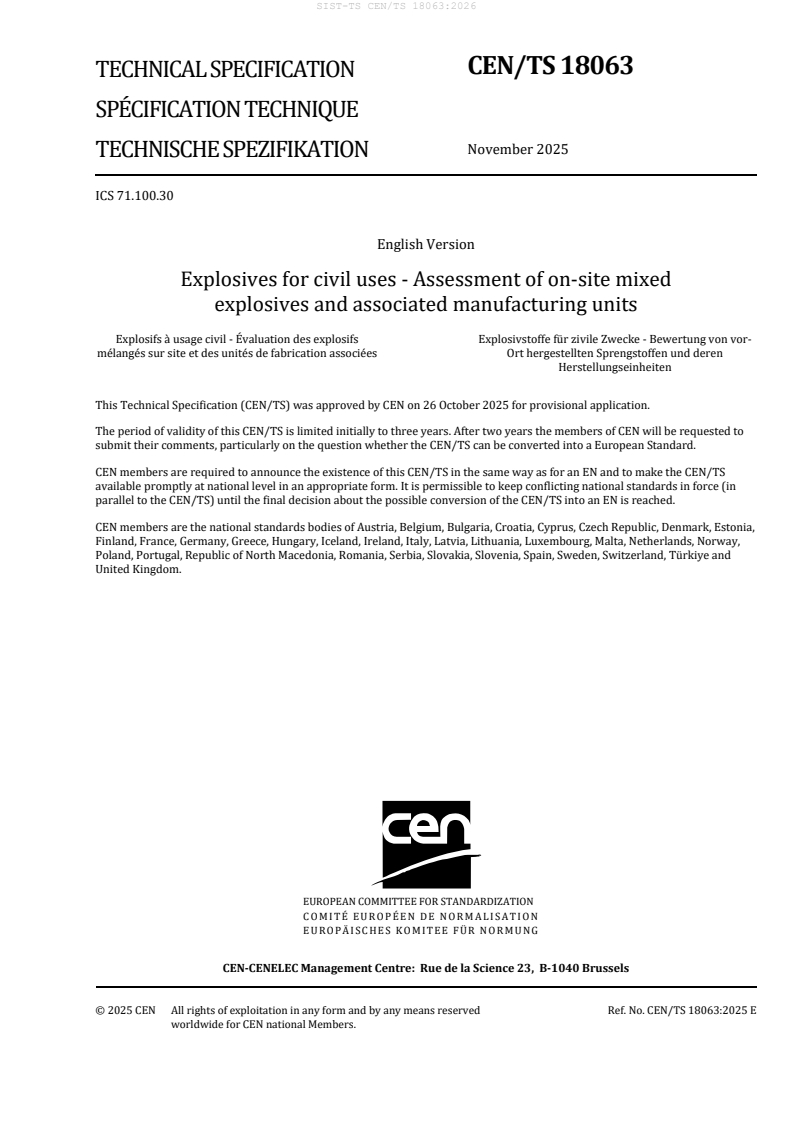
CEN/TS 18063:2025
(Main)Explosives for civil uses - Assessment of on-site mixed explosives and associated manufacturing units
Explosives for civil uses - Assessment of on-site mixed explosives and associated manufacturing units
This document gives guidance on the issues related to the conformity assessment of explosives manufactured on-site.
On one hand, it specifies requirements to be considered for the assessment during the design phase of the explosive and a simple and robust approach to follow for the assessment of the conformity in the production phase.
And on the other hand, it specifies requirements for the mobile manufacturing units and their accessories as a contribution to the guarantee of the conformity of explosives produced in on-site conditions with no access to a laboratory.
This document gives guidance on also basic requirements for explosives loading equipment.
This document does not apply to the preparation of multi-component explosives as they neither require manufacturing equipment nor mechanical loading.
NOTE 1 This document does not address the requirements of the transport of dangerous goods regulations.
NOTE 2 This document does not address the requirements established in Directive 2006/42/EC (Machinery).
NOTE 3 Despite the provisions given in this document, other provisions provided for in state, federal or local regulations apply.
NOTE 4 The intention of this document is not to hinder the development and use of new technologies (including equipment and processes) for the on-site manufacture of explosive, but because of limited access to testing resources on site, the approach consisting of having specified requirements for the equipment is valid to ensure the conformity of future products and technologies.
Explosivstoffe für zivile Zwecke - Bewertung von vor-Ort hergestellten Sprengstoffen und deren Herstellungseinheiten
Dieses Dokument gibt Hilfestellungen auf Fragen im Zusammenhang mit der Konformitätsbewertung von vor Ort hergestellten Explosivstoffen.
Einerseits legt es für die Bewertung in der Entwicklungsphase des Explosivstoffs zu berücksichtigende Anforderungen und einen einfachen und soliden Ansatz für die Konformitätsbewertung in der Produktionsphase fest.
Andererseits legt es Anforderungen an die mobilen Herstellungseinheiten und ihr Zubehör als Beitrag zur Sicherstellung der Konformität von Explosivstoffen, die unter Vor-Ort-Bedingungen ohne Zugang zu einem Labor hergestellt werden fest.
Dieses Dokument gibt auch Hilfestellungen für grundlegende Anforderungen an Ladeausrüstung für Explosivstoffe behandelt.
ANMERKUNG 1 Dieses Dokument befasst sich nicht mit den Anforderungen der Gefahrguttransportvorschriften.
ANMERKUNG 2 Dieses Dokument befasst sich nicht mit den Anforderungen in Richtlinie 2006/42/EG (Maschinen-richtlinie).
ANMERKUNG 3 Neben den Bestimmungen in diesem Dokument gelten weitere Bestimmungen in Landes , Bundes- oder lokalen Vorschriften.
ANMERKUNG 4 Mit diesem Dokument wird nicht beabsichtigt, die Entwicklung und den Einsatz neuer Technologien (einschließlich Ausrüstung und Prozessen) für die Vor-Ort-Herstellung von Explosivstoffen zu behindern, aber aufgrund des eingeschränkten Zugangs zu Prüfressourcen vor Ort ist der Ansatz mit konkreten Anforderungen an die Ausrüstung zur Sicherstellung der Konformität zukünftiger Produkte und Technologien berechtigt.
Explosifs à usage civil - Évaluation des explosifs mélangés sur site et des unités de fabrication associées
Le présent document donne des recommandations relatives à l'évaluation de la conformité des explosifs fabriqués sur site.
D'une part, il spécifie les exigences à prendre en compte pour l'évaluation lors de la phase de conception de l'explosif et une approche simple et robuste à suivre pour l'évaluation de la conformité lors de la phase de production.
D'autre part, il spécifie les exigences applicables aux unités mobiles de fabrication et à leurs accessoires à titre de contribution à la garantie de la conformité des explosifs produits dans des conditions sur site sans accès à un laboratoire.
Le présent document donne des recommandations sur les exigences de base relatives aux équipements de chargement d'explosifs.
NOTE 1 Le présent document ne traite pas des exigences de la réglementation relative au transport des marchandises dangereuses.
NOTE 2 Le présent document ne traite pas des exigences établies dans la Directive 2006/42/CE (Machines).
NOTE 3 Malgré les dispositions fournies dans le présent document, d'autres dispositions prévues par les réglementations nationales, fédérales ou locales s'appliquent.
NOTE 4 L'intention du présent document n'est pas d'entraver le développement et l'utilisation de nouvelles technologies (y compris les équipements et les procédés) pour la fabrication sur site d'explosifs, mais en raison de l'accès limité aux ressources d'essai sur site, l'approche consistant à avoir des exigences spécifiées pour l'équipement est valable pour garantir la conformité des technologies et produits futurs.
Eksplozivi za civilno uporabo - Ocenjevanje mešanih eksplozivov na kraju samem in povezanih proizvodnih enot
General Information
Standards Content (Sample)
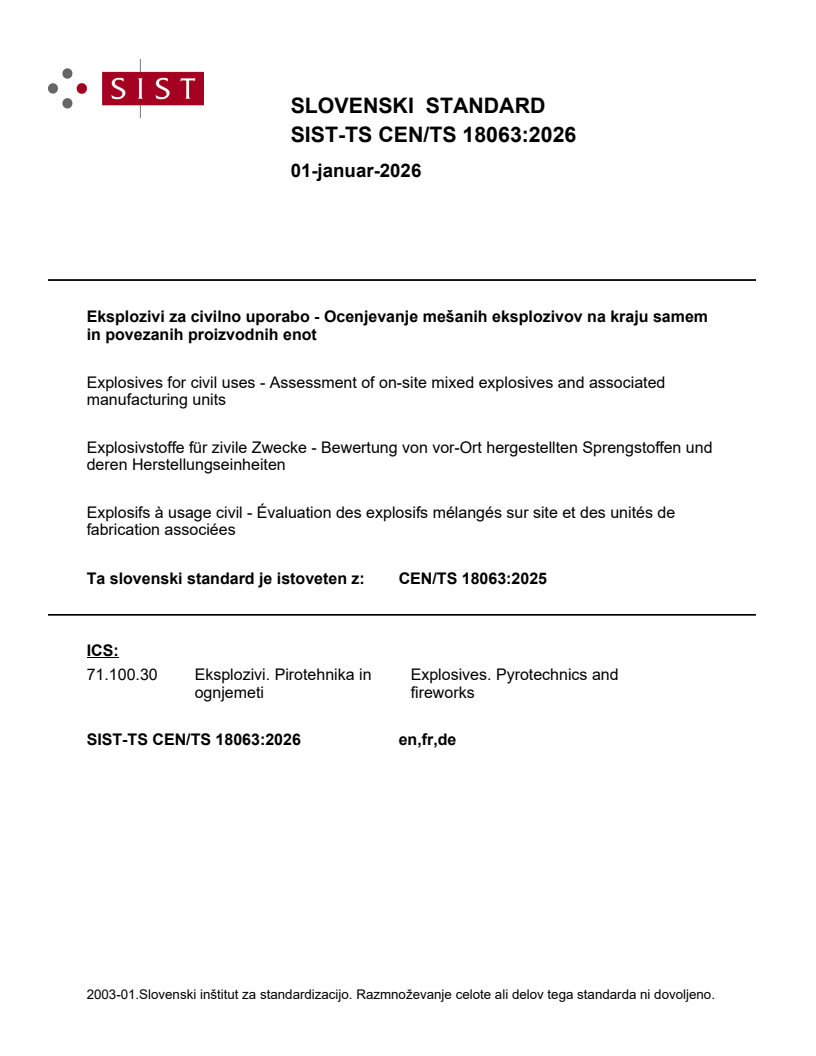
SLOVENSKI STANDARD
01-januar-2026
Eksplozivi za civilno uporabo - Ocenjevanje mešanih eksplozivov na kraju samem
in povezanih proizvodnih enot
Explosives for civil uses - Assessment of on-site mixed explosives and associated
manufacturing units
Explosivstoffe für zivile Zwecke - Bewertung von vor-Ort hergestellten Sprengstoffen und
deren Herstellungseinheiten
Explosifs à usage civil - Évaluation des explosifs mélangés sur site et des unités de
fabrication associées
Ta slovenski standard je istoveten z: CEN/TS 18063:2025
ICS:
71.100.30 Eksplozivi. Pirotehnika in Explosives. Pyrotechnics and
ognjemeti fireworks
2003-01.Slovenski inštitut za standardizacijo. Razmnoževanje celote ali delov tega standarda ni dovoljeno.
CEN/TS 18063
TECHNICAL SPECIFICATION
SPÉCIFICATION TECHNIQUE
November 2025
TECHNISCHE SPEZIFIKATION
ICS 71.100.30
English Version
Explosives for civil uses - Assessment of on-site mixed
explosives and associated manufacturing units
Explosifs à usage civil - Évaluation des explosifs Explosivstoffe für zivile Zwecke - Bewertung von vor-
mélangés sur site et des unités de fabrication associées Ort hergestellten Sprengstoffen und deren
Herstellungseinheiten
This Technical Specification (CEN/TS) was approved by CEN on 26 October 2025 for provisional application.
The period of validity of this CEN/TS is limited initially to three years. After two years the members of CEN will be requested to
submit their comments, particularly on the question whether the CEN/TS can be converted into a European Standard.
CEN members are required to announce the existence of this CEN/TS in the same way as for an EN and to make the CEN/TS
available promptly at national level in an appropriate form. It is permissible to keep conflicting national standards in force (in
parallel to the CEN/TS) until the final decision about the possible conversion of the CEN/TS into an EN is reached.
CEN members are the national standards bodies of Austria, Belgium, Bulgaria, Croatia, Cyprus, Czech Republic, Denmark, Estonia,
Finland, France, Germany, Greece, Hungary, Iceland, Ireland, Italy, Latvia, Lithuania, Luxembourg, Malta, Netherlands, Norway,
Poland, Portugal, Republic of North Macedonia, Romania, Serbia, Slovakia, Slovenia, Spain, Sweden, Switzerland, Türkiye and
United Kingdom.
EUROPEAN COMMITTEE FOR STANDARDIZATION
COMITÉ EUROPÉEN DE NORMALISATION
EUROPÄISCHES KOMITEE FÜR NORMUNG
CEN-CENELEC Management Centre: Rue de la Science 23, B-1040 Brussels
© 2025 CEN All rights of exploitation in any form and by any means reserved Ref. No. CEN/TS 18063:2025 E
worldwide for CEN national Members.
Contents Page
European foreword . 4
Introduction . 5
1 Scope . 7
2 Normative references . 7
3 Terms and definitions . 7
4 Requirements for each couple “explosive – manufacturing equipment” . 10
5 Products type definition, production phase assessment parameters and requirements . 12
5.1 General. 12
5.2 ANFO . 13
5.2.1 Product type definition . 13
5.2.2 Production phase assessment . 13
5.2.3 Requirement during production phase assessment . 13
5.3 ANFO + metal powder . 13
5.3.1 Product type definition . 13
5.3.2 Production phase assessment . 14
5.3.3 Requirement during production phase assessment . 14
5.4 Sensitized emulsion matrix . 14
5.4.1 Type definition. 14
5.4.2 Production phase assessment . 14
5.4.3 Requirement during production phase assessment . 14
5.5 Pumpable blend (emulsion matrix + AN / ANFO) . 15
5.5.1 Product type definition . 15
5.5.2 Production phase assessment . 15
5.5.3 Requirement during production phase assessment . 15
5.6 Pourable blend (emulsion matrix + AN / ANFO) . 15
5.6.1 Product type definition . 15
5.6.2 Production phase assessment . 16
5.6.3 Requirement during production phase assessment . 16
5.7 Slurry, water gel . 16
5.7.1 Product type definition . 16
5.7.2 Production phase assessment . 16
5.7.3 Requirement during production phase assessment . 17
5.8 Other products . 17
6 Equipment . 17
6.1 General. 17
6.2 Single auger + injector . 17
6.3 Auger + injector + other . 17
6.4 Mixing process + pump + gassing/crosslinking equipment . 18
6.4.1 General requirements . 18
6.4.2 Ancillary equipment . 18
6.5 Mixing process + pump + other equipment for sensitization (microballoons, aluminium,
etc.) . 18
6.5.1 General requirements . 18
6.5.2 Ancillary equipment . 19
6.6 Hand mixing . 19
6.7 Explosive pumping/loading unit . 19
6.7.1 General requirements . 19
6.7.2 Ancillary equipment . 19
6.8 Pneumatic loading . 19
7 Design and construction of Mobile Manufacturing Unit (MoMU) . 20
7.1 General requirements . 20
7.2 Tank and bulk containers requirements . 20
7.3 Driving power requirements . 20
7.4 Electrical requirements. 20
7.5 Management of change . 20
7.6 Security requirements . 21
7.7 Identification requirements . 21
8 Process. 21
8.1 Process description. 21
8.2 Safety risk assessment . 21
9 Operation . 22
10 Maintenance . 23
11 Training . 23
12 Production records . 24
13 Calibration. 24
14 Requirements for certification . 24
14.1 Characterization of explosive suitable for on-site manufacturing technologies . 24
14.2 Product type assessment . 25
14.3 Production conformity assessment . 25
14.3.1 General . 25
14.3.2 Conformity to type based on internal production control plus supervised product checks
at random intervals assessment . 25
14.3.3 Conformity to type based on quality assurance assessment . 25
15 Documentation, Logbook, Test report . 26
15.1 General documentation . 26
16 Other considerations . 26
Annex A (informative) Typical descriptors for appearance . 27
A.1 Texture . 27
A.2 Colour . 27
A.3 Odour . 27
Annex B (normative) On-site testing methods . 28
B.1 Density measurement test . 28
B.2 Velocity of detonation . 29
Bibliography . 30
European foreword
This document (CEN/TS 18063:2025) has been prepared by Technical Committee CEN/TC 321
“Explosives for civil uses”, the secretariat of which is held by UNE.
Attention is drawn to the possibility that some of the elements of this document may be the subject of
patent rights. CEN shall not be held responsible for identifying any or all such patent rights.
This document has been prepared under a standardization request addressed to CEN by the European
Commission. The Standing Committee of the EFTA States subsequently approves these requests for its
Member States.
Any feedback and questions on this document should be directed to the users’ national standards body.
A complete listing of these bodies can be found on the CEN website.
According to the CEN/CENELEC Internal Regulations, the national standards organisations of the
following countries are bound to announce this Technical Specification: Austria, Belgium, Bulgaria,
Croatia, Cyprus, Czech Republic, Denmark, Estonia, Finland, France, Germany, Greece, Hungary, Iceland,
Ireland, Italy, Latvia, Lithuania, Luxembourg, Malta, Netherlands, Norway, Poland, Portugal, Republic of
North Macedonia, Romania, Serbia, Slovakia, Slovenia, Spain, Sweden, Switzerland, Türkiye and the
United Kingdom.
Introduction
Background
Manufacturing units are production facilities which are used on-site and contain raw materials with all
necessary production machinery. This technology has become more and more common in infrastructure
and mining, not only for economic reasons but also, quite importantly, for the higher safety of handling
of such explosives.
The assessment of conformity of on-site mixed explosives in the production phase requires a different
approach than in a stationary manufacturing unit with access to a laboratory. The approach to
verification shall be simple and robust, given the conditions of manufacturing on-site.
One of the main challenges is to determine the limit of the manufacturing unit characteristics that have
to be taken into account in order to reach the proper conformity assessment of the explosives
manufactured on-site.
Given this context and the lack of existing reference documents, this Technical Specification will help to
compile the current knowledge and best practices, by fixing requirements related to explosives
manufactured on-site and their associated manufacturing units.
Overview on on-site mixed explosives and associated manufacturing units
The following types of on-site mixed explosives are currently known:
— ANFO (ammonium nitrate fuel oil);
— ANFO mixed with metal powder;
— blends from AN (ammonium nitrate) and ANE (ammonium nitrate emulsion) (multiple variants are
possible: the AN may be porous or non-porous; the emulsion may be sensitized or not; with or
without aluminium) (known also as heavy ANFO). These blends may be pourable or pumpable;
— blends from ANFO and ANE (multiple variants are possible: the emulsion may be sensitized or not;
with or without aluminium) (known also as heavy ANFO). These blends may be pourable or
pumpable;
— emulsion explosive (with or without aluminium) manufactured from an emulsion matrix and
sensitized by micro balloons or by chemical gassing;
— emulsion explosive (with or without aluminium) manufactured from the basic ingredients (including
formation of the emulsion) and sensitized by micro balloons or by chemical gassing;
— emulsion explosive manufactured from an emulsion matrix;
— emulsion explosive manufactured from the basic ingredients;
— multi-component explosives including those manufactured from (normally two) pre-formulated
components by simple shaking or hand mixing;
— slurry;
— water gel.
The following types of equipment for mixing on-site explosives are currently known:
— pumps/auger(s)/sensitization unit;
— pumps/emulsion formation unit/auger(s)/mixing unit/sensitization unit;
— auger/injector/other;
— single auger or (mixing) pump(s)/ sensitization unit;
— single auger/injector;
— single injector/auger or (mixing) pump(s)/sensitization unit.
Although in some cases the final explosive product is not immediately present after the mixing of raw
materials and it is required to wait a certain time before the sensitization of the mixed raw materials
occurs, the operation of mixing raw materials on-site in view of obtaining a product used for its explosive
properties is considered as the manufacture of explosives.
1 Scope
This document gives guidance on the issues related to the conformity assessment of explosives
manufactured on-site.
On one hand, it specifies requirements to be considered for the assessment during the design phase of
the explosive and a simple and robust approach to follow for the assessment of the conformity in the
production phase.
And on the other hand, it specifies requirements for the mobile manufacturing units and their accessories
as a contribution to the guarantee of the conformity of explosives produced in on-site conditions with no
access to a laboratory.
This document gives guidance on also basic requirements for explosives loading equipment.
This document does not apply to the preparation of multi-component explosives as they neither require
manufacturing equipment nor mechanical loading.
NOTE 1 This document does not address the requirements of the transport of dangerous goods regulations.
NOTE 2 This document does not address the requirements established in Directive 2006/42/EC (Machinery).
NOTE 3 Despite the provisions given in this document, other provisions provided for in state, federal or local
regulations apply.
NOTE 4 The intention of this document is not to hinder the development and use of new technologies (including
equipment and processes) for the on-site manufacture of explosive, but because of limited access to testing
resources on site, the approach consisting of having specified requirements for the equipment is valid to ensure the
conformity of future products and technologies.
2 Normative references
The following documents are referred in the text in such a way that some or all of their content constitutes
requirements of this document. For dated references, only the edition cited applies. For undated
references, the latest edition of the referenced document (including any amendments) applies.
EN 13857-1:2025, Explosives for civil uses — Part 1: Vocabulary
EN 13631-1:2025, Explosives for civil uses — Explosives for blasting, boosters and explosive substances —
Part 1: Requirements
3 Terms and definitions
For the purposes of this document, the terms and definitions given in EN 13857-1:2025, and the following
terms and definitions apply.
3.1
ammonium nitrate
AN
inorganic chemical substance having the formula NH NO
4 3
3.2
ammonium nitrate emulsion
ANE
emulsion matrix
non-sensitized mixture of mainly ammonium nitrate (3.1) aqueous solution droplets dispersed in an oily
continuous phase by means of an emulsifier, which may also contain other inorganic salts or additives in
small quantities
3.3
ammonium nitrate fuel oil
ANFO
mixture of ammonium nitrate and fuel oil to form an explosive product
3.4
ammonium nitrate suspension
non-sensitized viscous mixture consisting essentially of a saturated aqueous solution of oxidizing salts
like ammonium nitrate (3.1), thickeners (e.g. polymers) and/or other reducing salts, having dispersed
therein oxidizing solid particles and, in some cases, fuels
3.5
auger
device consisting of a shaft with a broad helical flange rotating within a cylindrical casing to force bulk
materials from one end to the other
3.6
bursting disk
passive safety venting device, made of frangible material (e.g. metal, plastic or carbon graphite) specially
designed to rupture at a defined pressure
3.7
chemical gassing
generation of gas bubbles by means of a chemical reaction in an emulsion matrix (3.2) to modify the
density of the emulsion matrix
3.8
chute
inclined channel, as a trough or tube, for conveying loose material by gravity to a lower level
3.9
crosslinker
crosslinking agent
cross-linking agent
chemical agent (typically, metallic salts) that connects large molecule such as a polymer or protein
3.10
crosslinking
chemical reaction between polymers which allows the formation of a multidimensional net by the joining
of the different polymeric chains by means of crosslinkers (3.9)
Note 1 to entry: This reaction results in an increase in the viscosity and/or in the stiffness/tackiness of the product,
giving special characteristics like water resistance.
3.11
explosive hydrogel
ammonium nitrate gel
water gel
explosive formed from an ammonium nitrate suspension (3.4) by adding a sensitizer (3.22) and a
crosslinking agent (3.9) causing thickening
3.12
explosive pumping unit
UPEx
unit comprising of different pieces of equipment which can move, transfer or deliver a finished explosive
product without any modification
3.13
hopper
funnel-shaped bin or tank in which loose material being filled through the top and dispensed through the
bottom is stored temporarily
3.14
manufacturing unit
unit comprising different pieces of equipment which can move and process raw materials to form a
finished explosive product
3.15
micro balloons
microspheres
small hollow spheres for example made of glass or plastic for sensitizing (3.23) an explosive
3.16
mixing
mix
operation consisting of combining physically at least two components in one mixture
3.17
mixing unit
manufacturing unit which allows only mixing of at least two components (no chemical reaction)
3.18
mobile manufacturing unit
MoMU
mobile explosive manufacturing unit
manufacturing unit designed to be easily moved from one point to another
Note 1 to entry: A MoMU can be either self-propelled, but this does not mean necessary that it can legally go on
public road or can require an external means of transport (e.g. trailer).”
Note 2 to entry: The term MoMU is used in this document in the general meaning of the definition. This definition
is different from the definition given in the ADR for Mobile Explosives Manufacturing Unit as MEMU (which is a
definition for a particular type of vehicles in road transport).
3.19
multi-component explosive
CE marked explosive prepared from pre-formulated mixtures, each mixture being nonexplosive
Note 1 to entry: The mixtures are packed separately in specific containers of given quantities.
Note 2 to entry: The blending of the mixtures is obtained by pouring them into a single container. The preparation
may require a gentle shaking for homogenization.
Note 3 to entry: When only two mixtures are used, this is called a bi-component explosive.
3.20
pourable blend
blend that can be loaded into a borehole by gravity
3.21
pumping
pump
action to move, transfer or deliver a fluid by means of a mechanical device
3.22
sensitizer
substance or solid material used to increase susceptibility to initiation
Note 1 to entry: The sensitizer itself may have explosive properties.
3.23
sensitizing
sensitize
process in which a product without explosive properties is further transformed (physically or chemically)
to gain explosive properties
3.24
single
only one
3.25
slurry
explosive material containing substantial portions of liquid, oxidizers, and fuel, plus a thickener
3.26
stationary manufacturing unit
assembly of several pieces of equipment capable of producing an explosive product when operated
together but not able to be moved easily to proceed with the loading of the explosive (e.g. at the borehole)
made
4 Requirements for each couple “explosive – manufacturing equipment”
Table 1 gives an overview of the applicable Subclauses of this document for each couple “explosive –
manufacturing equipment”.
Whether an explosive and/or a manufacturing unit corresponds to several boxes in Table 1, all the
corresponding Subclauses indicated in the boxes are applicable.
Table 1 — Applicable requirements depending on each couple “explosive – manufacturing
equipment”
Explosive
Unit
5.1 5.1
5.2 5.8
Single auger+ single
ODS ODS N/A N/A ODS N/A
injector
6.1 6.1
6.2 6.2
5.1 5.1 5.1
Auger + injector(s) +
5.2 5.3 5.8
other (except ODS N/A N/A ODS N/A
6.1 6.1 6.1
pumping devices)
6.3 6.3 6.3
5.1 5.1 5.1 5.1 5.1 5.1
Mixing unit + pump +
5.4 5.5 5.6 5.7 5.7 5.8
gassing/crosslinking N/A N/A
6.1 6.1 6.1 6.1 6.1 6.1
equipment
6.4 6.4 6.4 6.4 6.4 6.4
5.1 5.1 5.1 5.1 5.1 5.1
Mixing unit + pump +
other equipment for
5.4 5.5 5.6 5.7 5.7 5.8
sensitization N/A N/A
6.1 6.1 6.1 6.1 6.1 6.1
(microballoons,
aluminium, etc.)
6.5 6.5 6.5 6.5 6.5 6.5
5.1
5.8
Explosive 6.7 6.7 6.7 6.7
6.8 6.8 ODS
pumping/loading unit (UPEx) (UPEx) (UPEx) (UPEx)
6.1
6.7 or 6.8
See
definition
Hand mixing 6.6 6.6 6.6 6.6 6.6 6.6 6.6
3.19 and
6.6
5.1 5.1 5.1 5.1 5.1 5.1 5.1
5.8
Other equipment 5.2 5.3 5.4 5.5 5.6 5.7 5.7
6.1
6.1 6.1 6.1 6.1 6.1 6.1 6.1
ODS: out of document’s scope (this combination is not covered by the TS)
N/A: not applicable
ANFO
ANFO + metal powder
Sensitized emulsion
matrix (with or without
aluminium)
Pumpable blend
(emulsion matrix + AN or
ANFO or aluminium)
Pourable blend (emulsion
matrix + ANFO or
Aluminium)
Slurry, water gel
Slurry, water gel + ANFO
or ammonium nitrate
Other products
5 Products type definition, production phase assessment parameters and
requirements
5.1 General
For the design phase, on-site mixed explosive products shall be assessed according to the applicable
requirements of EN 13631-1:2025.
The type examination assessment shall be performed on a sample representative of the production
envisaged. This sample should be obtained either directly from the on-site mixing equipment itself or
from an adequate equivalent process.
When a sample is taken from a continuous process for the purpose of type examination assessment, the
start and the end of production shall be avoided to allow a better representability of the product in
nominal process conditions.
When the characteristics of the product are not supposed to evolve within a short time, sample portions
taken at different times of a same production can be combined for averaging the composition.
When a characteristic of the product may evolve within a short time (for example gassed product) this
evolution shall be documented (for example density versus time) and combination of sample portions
taken at different times of a production shall be avoided. This shall be considered during the assessment
of the product.
Acceptable tolerances for a given nominal composition of an on-site mixed explosives are given in
Table 2.
Table 2 — Acceptable tolerances for a nominal composition
Nominal value x in % weight Maximum value for the tolerance in % weight
x < 2,7 ±0,75x
2,7 ≤ x < 5 ±2,0
5 ≤ x < 10 ±3,0
10 ≤ x < 20 ±4,0
20 ≤ x < 40 ±5,0
40 ≤ x < 70 ±6,0
70 ≤ x ±8,0
In addition, for a given explosive the total of the tolerances shall not be greater than twice the highest
tolerance.
EXAMPLE: For a mixture of three components A at 50 %, B at 35 % and C at 15 %, it is accepted for A
between 44 % to 56 %, for B between 32 % to 38 % and for C between 12 % to 18 %. The limitation of the
total of the tolerances reduces what is acceptable on B and C.
During the production phase assessment, on-site verification and testing shall be made on a
representative sample i.e. the start and the end of production shall be avoided for sampling. The
characteristics measured shall be compared with the nominal characteristics and within the range
specified for the product.
5.2 ANFO
5.2.1 Product type definition
The following characteristics shall be used to define the type of product:
— nominal composition with tolerances as % ammonium nitrate and % fuel by weight;
— granulometry of ammonium nitrate;
— density.
The following characteristics may be used as information for the type of product:
— appearance.
5.2.2 Production phase assessment
For conformity assessment during the production phase, the following characteristics should be used on-
site as control or monitoring parameters:
— consumption of the required raw materials;
— density;
— noticeable change of visual aspect.
5.2.3 Requirement during production phase assessment
The composition of the explosive, when determined by the consumption of t
...
Questions, Comments and Discussion
Ask us and Technical Secretary will try to provide an answer. You can facilitate discussion about the standard in here.