

CEN/TS 13001-3-2:2004
(Main)Cranes - General design - Part 3-2: Limit states and proof of competence of wire ropes in reeving systems
General Information
- Abstract
This Part 3-2 of the Technical Specification EN 13001 is to be used together with Part 1 and Part 2 and as such they specify general conditions, requirements and methods to prevent mechanical hazards of wire ropes in reeving systems of cranes by design and theoretical verification.
NOTE 1 Specific requirements for particular types of crane are given in the appropriate Technical Specification for the particular crane type.
The following is a list of significant hazardous situations and hazardous events that could result in risks to persons during normal use and foreseeable misuse. Clauses 5 to 6 of this standard are necessary to reduce or eliminate the risks associated with the following hazard:
Exceeding the limits of strength.
This Technical Specification is applicable to cranes which are manufactured after the date of approval by CEN of this standard and serves as reference base for the Technical Specifications for particular crane types.
NOTE 2 prCEN/TS 13001-3-2 deals only with limit state method according to prEN 13001-1
- Status
- Withdrawn
- Publication Date
- 14-Dec-2004
- Withdrawal Date
- 23-Sep-2008
- Technical Committee
- CEN/TC 147 - Cranes - Safety
- Drafting Committee
- CEN/TC 147/WG 2 - Design - General
- Current Stage
- 9960 - Withdrawal effective - Withdrawal
- Start Date
- 24-Sep-2008
- Completion Date
- 24-Sep-2008
- Directive
- 98/37/EC - Machinery

Relations
- Effective Date
- 22-Dec-2008
- Effective Date
- 22-Dec-2008
Frequently Asked Questions
CEN/TS 13001-3-2:2004 is a technical specification published by the European Committee for Standardization (CEN). Its full title is "Cranes - General design - Part 3-2: Limit states and proof of competence of wire ropes in reeving systems". This standard covers: This Part 3-2 of the Technical Specification EN 13001 is to be used together with Part 1 and Part 2 and as such they specify general conditions, requirements and methods to prevent mechanical hazards of wire ropes in reeving systems of cranes by design and theoretical verification. NOTE 1 Specific requirements for particular types of crane are given in the appropriate Technical Specification for the particular crane type. The following is a list of significant hazardous situations and hazardous events that could result in risks to persons during normal use and foreseeable misuse. Clauses 5 to 6 of this standard are necessary to reduce or eliminate the risks associated with the following hazard: Exceeding the limits of strength. This Technical Specification is applicable to cranes which are manufactured after the date of approval by CEN of this standard and serves as reference base for the Technical Specifications for particular crane types. NOTE 2 prCEN/TS 13001-3-2 deals only with limit state method according to prEN 13001-1
This Part 3-2 of the Technical Specification EN 13001 is to be used together with Part 1 and Part 2 and as such they specify general conditions, requirements and methods to prevent mechanical hazards of wire ropes in reeving systems of cranes by design and theoretical verification. NOTE 1 Specific requirements for particular types of crane are given in the appropriate Technical Specification for the particular crane type. The following is a list of significant hazardous situations and hazardous events that could result in risks to persons during normal use and foreseeable misuse. Clauses 5 to 6 of this standard are necessary to reduce or eliminate the risks associated with the following hazard: Exceeding the limits of strength. This Technical Specification is applicable to cranes which are manufactured after the date of approval by CEN of this standard and serves as reference base for the Technical Specifications for particular crane types. NOTE 2 prCEN/TS 13001-3-2 deals only with limit state method according to prEN 13001-1
CEN/TS 13001-3-2:2004 is classified under the following ICS (International Classification for Standards) categories: 53.020.20 - Cranes. The ICS classification helps identify the subject area and facilitates finding related standards.
CEN/TS 13001-3-2:2004 has the following relationships with other standards: It is inter standard links to CEN/TS 13001-3-2:2008, CEN/TS 13001-3-2:2004/AC:2006. Understanding these relationships helps ensure you are using the most current and applicable version of the standard.
CEN/TS 13001-3-2:2004 is associated with the following European legislation: EU Directives/Regulations: 98/37/EC; Standardization Mandates: M/BC/CEN/91/1. When a standard is cited in the Official Journal of the European Union, products manufactured in conformity with it benefit from a presumption of conformity with the essential requirements of the corresponding EU directive or regulation.
CEN/TS 13001-3-2:2004 is available in PDF format for immediate download after purchase. The document can be added to your cart and obtained through the secure checkout process. Digital delivery ensures instant access to the complete standard document.
Standards Content (Sample)
SLOVENSKI STANDARD
01-marec-2005
Dvigala (žerjavi) - Konstrukcija, splošno – 3-2. del: Mejna stanja in dokaz varnosti
jeklenih vrvi pri vrvnih pogonih
Cranes - General design - Part 3-2: Limit states and proof of competence of wire ropes in
reeving systems
Krane - Konstruktion allgemein - Teil 3-2: Grenzzustände und Sicherheitsnachweis von
Drahtseilen in Seiltrieben
Appareils de levage a charge suspendue - Conception générale - Partie 3-2 : États
limites et vérification d'aptitude des systemes de mouflage
Ta slovenski standard je istoveten z: CEN/TS 13001-3-2:2004
ICS:
53.020.20 Dvigala Cranes
2003-01.Slovenski inštitut za standardizacijo. Razmnoževanje celote ali delov tega standarda ni dovoljeno.
TECHNICAL SPECIFICATION
CEN/TS 13001-3-2
SPÉCIFICATION TECHNIQUE
TECHNISCHE SPEZIFIKATION
December 2004
ICS 53.020.20
English version
Cranes - General design - Part 3-2: Limit states and proof of
competence of wire ropes in reeving systems
Appareils de levage à charge suspendue - Conception Krane - Konstruktion allgemein - Teil 3-2: Grenzzustände
générale - Partie 3-2 : États limites et vérification d'aptitude und Sicherheitsnachweis von Drahtseilen in Seiltrieben
des systèmes de mouflage
This Technical Specification (CEN/TS) was approved by CEN on 18 March 2004 for provisional application.
The period of validity of this CEN/TS is limited initially to three years. After two years the members of CEN will be requested to submit their
comments, particularly on the question whether the CEN/TS can be converted into a European Standard.
CEN members are required to announce the existence of this CEN/TS in the same way as for an EN and to make the CEN/TS available
promptly at national level in an appropriate form. It is permissible to keep conflicting national standards in force (in parallel to the CEN/TS)
until the final decision about the possible conversion of the CEN/TS into an EN is reached.
CEN members are the national standards bodies of Austria, Belgium, Cyprus, Czech Republic, Denmark, Estonia, Finland, France,
Germany, Greece, Hungary, Iceland, Ireland, Italy, Latvia, Lithuania, Luxembourg, Malta, Netherlands, Norway, Poland, Portugal, Slovakia,
Slovenia, Spain, Sweden, Switzerland and United Kingdom.
EUROPEAN COMMITTEE FOR STANDARDIZATION
COMITÉ EUROPÉEN DE NORMALISATION
EUROPÄISCHES KOMITEE FÜR NORMUNG
Management Centre: rue de Stassart, 36 B-1050 Brussels
© 2004 CEN All rights of exploitation in any form and by any means reserved Ref. No. CEN/TS 13001-3-2:2004: E
worldwide for CEN national Members.
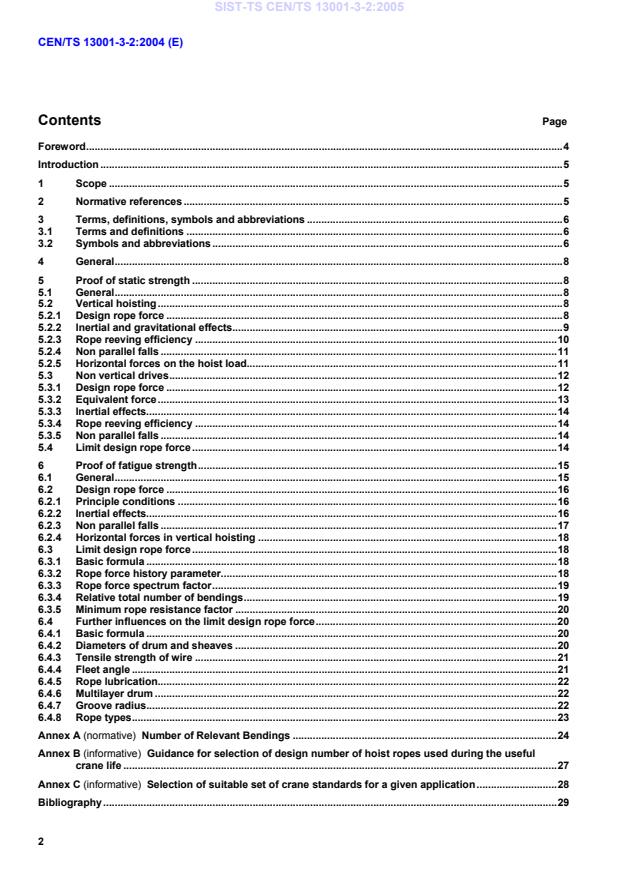
Contents Page
Foreword.4
Introduction.5
1 Scope .5
2 Normative references .5
3 Terms, definitions, symbols and abbreviations .6
3.1 Terms and definitions .6
3.2 Symbols and abbreviations .6
4 General.8
5 Proof of static strength .8
5.1 General.8
5.2 Vertical hoisting.8
5.2.1 Design rope force .8
5.2.2 Inertial and gravitational effects.9
5.2.3 Rope reeving efficiency .10
5.2.4 Non parallel falls .11
5.2.5 Horizontal forces on the hoist load.11
5.3 Non vertical drives.12
5.3.1 Design rope force .12
5.3.2 Equivalent force.13
5.3.3 Inertial effects.14
5.3.4 Rope reeving efficiency .14
5.3.5 Non parallel falls .14
5.4 Limit design rope force .14
6 Proof of fatigue strength.15
6.1 General.15
6.2 Design rope force .16
6.2.1 Principle conditions .16
6.2.2 Inertial effects.16
6.2.3 Non parallel falls .17
6.2.4 Horizontal forces in vertical hoisting .18
6.3 Limit design rope force .18
6.3.1 Basic formula .18
6.3.2 Rope force history parameter.18
6.3.3 Rope force spectrum factor.19
6.3.4 Relative total number of bendings.19
6.3.5 Minimum rope resistance factor .20
6.4 Further influences on the limit design rope force.20
6.4.1 Basic formula .20
6.4.2 Diameters of drum and sheaves .20
6.4.3 Tensile strength of wire .21
6.4.4 Fleet angle .21
6.4.5 Rope lubrication.22
6.4.6 Multilayer drum .22
6.4.7 Groove radius.22
6.4.8 Rope types.23
Annex A (normative) Number of Relevant Bendings .24
Annex B (informative) Guidance for selection of design number of hoist ropes used during the useful
crane life .27
Annex C (informative) Selection of suitable set of crane standards for a given application.28
Bibliography.29
Figures
Figure 1— Example for the acting parts of hoist mass .9
Figure 2 — Example for Rope Reeving Efficiency .10
Figure 3 — Angle β .11
max
Figure 4— Horizontal force.12
Figure 5 — Examples for non vertical drive.13
Figure 6— Example for rope tightening .13
Figure 7 — Lifting positions .18
Figure 8 — Fleet angles .21
Figure 9 — Groove radius.22
Table 7 — Factor f .22
f6
Figure A.1 — Number of relevant bendings.26
Tables
Table 1 — Symbols and abbreviations.6
Table 2 — Partial safety factors γ .14
p
Table 3 — Minimum rope resistance factor γ .15
rb
Table 4 — Classes S of rope force history parameter s .19
R r
Table 5 — Reference ratio R .20
Dd
Table 6 — Factor f .22
f3
Table 7 — Factor f .22
f6
Table A.1 — Bending counts.24
Table A.2 — Examples for the number of relevant bendings w .25
Foreword
This document (CEN/TS 13001-3.2:2004) has been prepared by Technical Committee CEN/TC 147 “Cranes —
Safety”, the secretariat of which is held by BSI.
The CEN/TC 147/WG 2 "Cranes — Design and Principles" is held by DIN.
According to the CEN/CENELEC Internal Regulations, the national standards organizations of the following
countries are bound to announce this Technical Specification: Austria, Belgium, Cyprus, Czech Republic, Denmark,
Estonia, Finland, France, Germany, Greece, Hungary Iceland, Ireland, Italy, Latvia, Lithuania, Luxembourg, Malta,
Netherlands, Norway, Poland, Portugal, Slovakia, Slovenia, Spain, Sweden, Switzerland and the United Kingdom.
This European Technical Specification is one Part of EN 13001. The other parts are as follows:
Part 1: General principles and requirements;
Part 2: Load effects;
Part 3.1: Limit states and proof of competence of steel structures;
Part 3.3: Limit states and proof of competence of wheel/rail contacts;
Part 3.4: Limit states and proof of competence of machinery.
Annex A is normative, annexes B and C are informative.
Introduction
This Technical Specification has been prepared to be a harmonized standard to provide one means for the
mechanical design and theoretical verification of cranes to conform with the essential health and safety
requirements of the Machinery Directive, as amended. This standard also establishes interfaces between the user
(purchaser) and the designer, as well as between the designer and the component manufacturer, in order to form a
basis for selecting cranes and components.
This Technical Specification is a type C standard as stated in EN ISO 12100-1:2003.
The machinery concerned and the extent to which hazards are covered are indicated in the scope of this standard.
1 Scope
This Part 3-2 of the Technical Specification EN 13001 is to be used together with Part 1 and Part 2 and as such
they specify general conditions, requirements and methods to prevent mechanical hazards of wire ropes in reeving
systems of cranes by design and theoretical verification.
NOTE 1 Specific requirements for particular types of crane are given in the appropriate Technical Specification for the
particular crane type.
The following is a list of significant hazardous situations and hazardous events that could result in risks to persons
during normal use and foreseeable misuse. Clauses 5 to 6 of this standard are necessary to reduce or eliminate
the risks associated with the following hazard:
Exceeding the limits of strength.
This Technical Specification is applicable to cranes which are manufactured after the date of approval by CEN of
this standard and serves as reference base for the Technical Specifications for particular crane types.
NOTE 2 CEN/TS 13001-3-2 deals only with limit state method according to EN 13001-1.
2 Normative references
This Technical Specification incorporates by dated or undated reference, provisions from other publications. These
normative references are cited at the appropriate places in the text and the publications are listed hereafter. For
dated references, subsequent amendments to or revisions of any of these publications apply to this Technical
Specification only when incorporated in it by amendment or revision. For undated references the latest edition of
the publication referred to applies (including amendments).
ENV 1990-1:2002, Eurocode : Basic of structural design.
EN 12385-4, Steel wire ropes — Safety — Part 4: Stranded ropes for general lifting applications.
EN 13001-1, Cranes — General Design — Part 1: General principles and requirements.
EN 13001-2, Cranes — General Design — Part 2: Load effects.
CEN/TS 13001-3.2 Cranes — General design — Part 3-2: Limit states and proof of competence of wire ropes in
reeving systems.
EN 13411-1, Terminations for steel wire ropes — Safety — Part 1: Thimbles for steel wire rope slings.
EN 13411-2, Terminations for steel wire ropes — Safety — Part 2: Splicing of eyes for wire rope slings.
EN 13411-3, Terminations for steel wire ropes — Safety — Part 3: Ferrules and ferrule-securing.
EN 13411-4, Terminations for steel wire ropes — Safety — Part 4: Metal and resin socketing.
EN 13411-6, Terminations for steel wire ropes — Safety — Part 6: Asymmetric wedge sockets.
EN ISO 12100-1:2003, Safety of machinery — Basic concepts, general principles for design — Part 1:Basic
terminology, methodology (ISO 12100-1:2003).
ISO 4306-1:1990, Cranes vocabulary.
ISO 4309, Cranes — Wire ropes — Code of practice for examination and discard.
3 Terms, definitions, symbols and abbreviations
3.1 Terms and definitions
For the purposes of this Technical Specification, the terms and definitions given in EN ISO 12100-1:2003,
EN 1990-1:2002 and clause 6 of ISO 4306-1:1990 apply.
3.2 Symbols and abbreviations
For the purposes of this Technical Specification, the symbols and abbreviations given in Table 1 apply.
Table 1 — Symbols and abbreviations
Symbols,
Description
abbreviations
a Acceleration
Total number of working cycles (see EN 13001-1) during useful life of crane
C
D Relevant diameter
D Minimum pitch diameter of drum
drum
D Minimum pitch diameter of sheave
sheave
D Minimum pitch diameter of compensating sheave
comp
d Rope diameter
Diameter of bearing or shaft
d
bearing
F Equivalent force
equ
F Part of F induced by gravity, exclusive mass of payload, amplified by γ
gd equ p
F Part of F induced by gravity forces of mass of payload, amplified by γ
gl equ p
F Part of F induced by any other forces, amplified by γ
o equ p
F Limit design rope force for the proof of static strength
Rd,s
F Limit design rope force for the proof of fatigue strength
Rd,f
Design rope force for the proof of static strength
F
Sd,s
F
r Part of F induced by resistances, amplified by γ
equ p
F Design rope force for the proof of fatigue strength
Sd,f
F Part of F induced by rope tightening forces, amplified by γ
t equ p
F Minimum rope breaking force
u
F
w Part of F induced by wind forces, amplified by γ
equ p
f Factor of further influences
f
f Factor of diameter ratio influence
f1
f Factor tensile strength of wire influence
f2
f Factor of fleet angle influence
f3
f Factor of lubrication influence
f4
f Factor of multilayer drum influence
f5
f Factor of groove radius influence
f6
f Factor of rope type influence
f7
Table 1 (concluded)
Symbols,
Description
abbreviations
f Rope force increasing factor from rope reeving efficiency
S1
f Rope force increasing factor from non parallel falls
S2
f Rope force increasing factor from horizontal acceleration
S3
*
f Rope force increasing factors in fatigue
Si
g Gravity constant
Index for cycles of lifting and lowering
i
k Rope force spectrum factor
r
l Number of ropes used during useful life of the crane
r
q Height distribution
m Mass of hoist load (see EN13001-2)
H
m Mass of hoist load that is acting on the rope falls under consideration
Hr
Rotatory rope driven mass
m
red
m Translational rope driven mass
trans
n Number of contact points passed by rope
n Number of falls or reeving lines
f
Number of fixed sheave between drum and moving part
n
fs
n Mechanical advantage
m
R Minimum tensile strength of the wire used in the rope
R Reference ratio of rope bending diameter to rope diameter
Dd
r Groove radius
g
S Class of rope force history
R
Rope force history parameter
s
r
t Rope type factor
w Number of relevant bendings per lifting movement
w Bending count
c
w Number of bendings at reference point
D
w Total number of bendings
tot
Height coordinates
z, z, z , z
i min max
α Angle of slope
β, β Angles between falls and line of acting force
max
Angle between gravity and projected rope in plane of F and g
γ h
Risk coefficient
γ
n
Partial safety factor
γ
p
Minimum rope resistance factor (static)
γ
rb
Minimum rope resistance factor (fatigue)
γ
rf
δ Design fleet angle
ε Angle between sheave planes
η Efficiency of single sheave
s
η Total efficiency of rope drive
tot
ν Relative total number of bendings
r
φ Dynamic factor for inertial or gravity effects
*
φ Dynamic factor for inertial or gravity effects in fatigue
φ Dynamic factor for hoisting an unrestrained grounded load
φ Dynamic factor for loads caused by acceleration
φ Dynamic factor for testload
ω Angle between the sheave groove sides
4 General
In all cranes running wire ropes are stressed by loads (described by a load spectrum) and by bendings. Both
constitute the rope force history, classified in classes S (see 6.3.2). Classes S are used for the selection of the
R R
wire rope and diameters of drums and/or sheaves. They are independent of time.
The proof of competence for static strength and the proof of competence for fatigue strength shall be fulfilled for the
selection of ropes and components. This standard is for design purposes only and should not be seen as a
guarantee of actual performance.
To ensure safe use of the rope the discard criteria according to ISO 4309 shall be applied.
The wire rope should be in accordance with EN 12385-4. Rope terminations shall meet the requirements of
EN 13411-1, EN 13411-2, EN 13411-3, EN 13411-4 and EN 13411-6.
5 Proof of static strength
5.1 General
For the proof of static strength it shall be proven that for all relevant load combinations of EN 13001-2
F ≤ F (1)
Sd ,s Rd ,s
where:
F is the design rope force
Sd,s
F is the limit design rope force.
Rd,s
5.2 Vertical hoisting
5.2.1 Design rope force
The design rope force F in vertical hoisting shall be calculated as follows:
Sd,s
m ⋅ g
Hr
F = ⋅φ⋅ f ⋅ f ⋅ f ⋅γ ⋅γ (2)
Sd ,s S1 S 2 S 3 p n
n
f
where:
m is the mass of the hoist load (m ) or that part of the mass of the hoist load that is acting on the rope
Hr H
falls under consideration (see Figure 1). The mass of the hoist load includes the masses of the
payload, lifting attachments and a portion of the suspended hoist ropes. In statically undetermined
systems, the unequal load distribution between ropes depends on elasticities and shall be taken into
account.
g is the gravity constant
n is the number of falls carrying m
f Hr
φ is the dynamic factor for inertial and gravity effects as shown in 5.2.2
f to f are the rope force increasing factors as shown in 5.2.3 to 5.2.5
S1 S3
γ is the partial safety factor (see EN 13001-2)
p
γ = 1,34 for regular loads (load combinations A)
p
SIST-TS CEN/TS 13001-3-2:20
...