

CEN/TR 15175:2006
(Main)Characterization of sludges - Protocol for organizing and conducting inter-laboratory tests of methods for chemical and microbiological analysis of sludges
General Information
- Abstract
This Technical Report specifies the requirements for interlaboratory tests to validate chemical and microbiological methods for sludges.
- Status
- Published
- Publication Date
- 14-Mar-2006
- Technical Committee
- CEN/TC 308 - Characterization of sludges
- Drafting Committee
- CEN/TC 308/WG 1 - Characterization methods
- Current Stage
- 6060 - Definitive text made available (DAV) - Publishing
- Start Date
- 15-Mar-2006
- Due Date
- 19-Jan-2006
- Completion Date
- 15-Mar-2006


Overview
CEN/TR 15175:2006 is a technical report developed by the European Committee for Standardization (CEN) that provides a protocol for organizing and conducting interlaboratory tests of chemical and microbiological analysis methods for sludges. This standard is crucial for laboratories and organizations involved in sludge characterization, supporting the consistent validation and harmonization of analytical methods across Europe. The document outlines comprehensive requirements to plan, execute, and report interlaboratory studies, ensuring reliable and reproducible results.
Keywords: CEN/TR 15175:2006, sludge characterization, interlaboratory validation, chemical analysis, microbiological analysis, laboratory quality assurance, sludge analysis methods, CEN standards
Key Topics
Requirements for Interlaboratory Tests:
CEN/TR 15175:2006 specifies how to structure collaborative laboratory studies, including choosing participating laboratories, test samples, and analysis parameters.Planning and Organization:
The report provides guidance on planning variables such as:- Designation of organizing laboratory
- Selection and documentation of methods to be tested
- Protocol for spiking solutions and calibration checks
- Scheduling timelines for sample dispatch, analysis, and result submissions
Sample Preparation and Distribution:
- Ensures homogenous bulk material and standardized sample handling
- Detailed packaging requirements to preserve sample integrity during shipment
- Use of temperature control and chain of custody documentation
Statistical Analysis and Reporting:
- Recommends use of robust statistical methods in line with ISO 5725 for result evaluation
- Procedures for outlier detection and treatment are described
- Guidance on anonymous reporting and comprehensive final test reporting
Applications
CEN/TR 15175:2006 is widely applicable in the field of environmental analysis and wastewater treatment, specifically for:
Validation of Analytical Methods:
Essential for laboratories seeking to validate new or existing tests for chemical or microbiological parameters in sludge samples.Quality Assurance:
Provides a standardized approach for external quality assessment of laboratory performance, supporting accreditation and compliance with regulatory requirements.Harmonization of Practices:
Facilitates consistency between laboratories at national and international levels, supporting mutual recognition of analytical results.Support for Method Development:
Useful for method developers and research institutions who need a protocol to verify method reliability before publication or standardization.Environmental Monitoring:
Improves reliability of data used in environmental monitoring, regulatory reporting, and risk assessment related to sludge management.
Related Standards
ISO 5725 - Accuracy (trueness and precision) of measurement methods and results
Referenced within CEN/TR 15175:2006 for statistical protocols and procedures for handling outliers and result evaluation.Other CEN Sludge Characterization Standards:
Laboratories may also need to consult related documents in the CEN/TC 308 family that address sampling, pretreatment, and analysis techniques for sludge.National and International Accreditation Guidelines:
Standards such as ISO/IEC 17025 (General requirements for the competence of testing and calibration laboratories) are relevant for ensuring overall laboratory quality.
By following CEN/TR 15175:2006, organizations can ensure their chemical and microbiological sludge analysis methods are validated transparently, consistently, and with cross-laboratory comparability, enhancing both analytical quality and regulatory compliance in sludge management practices.
Get Certified
Connect with accredited certification bodies for this standard

CIS Institut d.o.o.
Personal Protective Equipment (PPE) certification body. Notified Body NB-2890 for EU Regulation 2016/425 PPE.

Kiwa BDA Testing
Building and construction product certification.
Kmetijski inštitut Slovenije
Agricultural Institute of Slovenia. Soil testing, plant health, agricultural product analysis.
Sponsored listings
Frequently Asked Questions
CEN/TR 15175:2006 is a technical report published by the European Committee for Standardization (CEN). Its full title is "Characterization of sludges - Protocol for organizing and conducting inter-laboratory tests of methods for chemical and microbiological analysis of sludges". This standard covers: This Technical Report specifies the requirements for interlaboratory tests to validate chemical and microbiological methods for sludges.
This Technical Report specifies the requirements for interlaboratory tests to validate chemical and microbiological methods for sludges.
CEN/TR 15175:2006 is classified under the following ICS (International Classification for Standards) categories: 13.030.20 - Liquid wastes. Sludge. The ICS classification helps identify the subject area and facilitates finding related standards.
CEN/TR 15175:2006 is available in PDF format for immediate download after purchase. The document can be added to your cart and obtained through the secure checkout process. Digital delivery ensures instant access to the complete standard document.
Standards Content (Sample)
SLOVENSKI STANDARD
01-julij-2006
Karakterizacija blata – Protokol za organiziranje in vodenje medlaboratorijskih
preskušanj metod za kemijske in mikrobiološke analize blata
Characterization of sludges - Protocol for organizing and conducting inter-laboratory
tests of methods for chemical and microbiological analysis of sludges
Charakterisierung von Schlämmen - Protokoll zur Durchführung von Ringversuchen für
Verfahren zur chemischen, mikrobiologischen und physikalischen Analyse von
Schlämmen
Caractérisation des boues - Protocole d'exécution d'essais interlaboratoires portant sur
des méthodes d'analyses chimiques et microbiologiques des boues
Ta slovenski standard je istoveten z: CEN/TR 15175:2006
ICS:
13.030.20
2003-01.Slovenski inštitut za standardizacijo. Razmnoževanje celote ali delov tega standarda ni dovoljeno.
TECHNICAL REPORT
CEN/TR 15175
RAPPORT TECHNIQUE
TECHNISCHER BERICHT
March 2006
ICS 13.030.20
English Version
Characterization of sludges - Protocol for organizing and
conducting inter-laboratory tests of methods for chemical and
microbiological analysis of sludges
Caractérisation des boues - Protocole d'exécution d'essais Charakterisierung von Schlämmen - Protokoll zur
interlaboratoires portant sur des méthodes d'analyses Durchführung von Ringversuchen für Verfahren zur
chimiques et microbiologiques des boues chemischen, mikrobiologischen und physikalischen
Analyse von Schlämmen
This Technical Report was approved by CEN on 30 September 2005. It has been drawn up by the Technical Committee CEN/TC 308.
CEN members are the national standards bodies of Austria, Belgium, Cyprus, Czech Republic, Denmark, Estonia, Finland, France,
Germany, Greece, Hungary, Iceland, Ireland, Italy, Latvia, Lithuania, Luxembourg, Malta, Netherlands, Norway, Poland, Portugal, Romania,
Slovakia, Slovenia, Spain, Sweden, Switzerland and United Kingdom.
EUROPEAN COMMITTEE FOR STANDARDIZATION
COMITÉ EUROPÉEN DE NORMALISATION
EUROPÄISCHES KOMITEE FÜR NORMUNG
Management Centre: rue de Stassart, 36 B-1050 Brussels
© 2006 CEN All rights of exploitation in any form and by any means reserved Ref. No. CEN/TR 15175:2006: E
worldwide for CEN national Members.
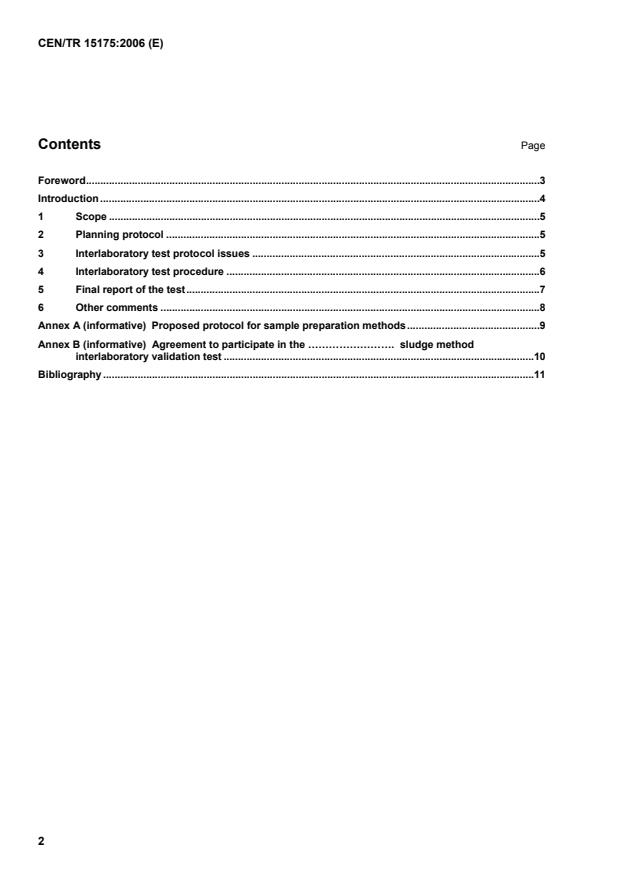
Contents Page
Foreword.3
Introduction .4
1 Scope .5
2 Planning protocol .5
3 Interlaboratory test protocol issues .5
4 Interlaboratory test procedure .6
5 Final report of the test.7
6 Other comments .8
Annex A (informative) Proposed protocol for sample preparation methods.9
Annex B (informative) Agreement to participate in the ……………………. sludge method
interlaboratory validation test .10
Bibliography .11
Foreword
This Technical Report (CEN/TR 15175:2006) has been prepared by Technical Committee CEN/TC 308
“Characterization of sludges”, the secretariat of which is held by AFNOR.
Attention is drawn to the possibility that some of the elements of this document may be the subject of patent
rights. CEN [and/or CENELEC] shall not be held responsible for identifying any or all such patent rights.
Introduction
For international harmonization it is essential that a fit for purpose interlaboratory test using a range of typical
sludges with relevant analyte concentrations be carried out prior to proposing for publication any method as a
Technical Report.
At least ten laboratories from three different countries should participate in this test.
Only experienced laboratories routinely carrying out sludge analysis should participate.
The organizer should aim for 12 to 15 laboratories to participate in each test in as many countries as possible.
Efforts are needed to ensure that there is a minimum of intersample variation amongst the circulated samples.
It is recommended that each test includes a range of sludges that is representative of the proposed scope of
the method, as a minimum this should include an untreated (raw) sludge, a treated (an aerobically digested)
sludge, a presscake and samples of any other sludges relevant to the method being tested. In addition a
spiking solution and a calibration check standard will generally be distributed.
If possible, samples should be in the same form as would normally be submitted to a laboratory for analysis.
For sample preparation methods without a final measurement stage (e.g. Aqua regia digestion for metal
analysis), see Annex A.
1 Scope
This Technical Report specifies the requirements for interlaboratory tests to validate chemical and
microbiological methods for sludges.
2 Planning protocol
The main test variables to be agreed are:
a) organising laboratory;
b) documented method to be tested;
c) number and nature of the samples;
d) statistical calculations including rejection of outliers;
e) deadlines for sending out samples, receipt of results from participants and final test report from the
organizer;
f) spiking protocol to calculate recovery;
g) analysis of a calibration check standard. It will also allow a check to be made on the comparative
accuracy of the calibration standards used by all the participants. This can sometimes explain differences
between laboratories).
3 Interlaboratory test protocol issues
3.1 Test organiser and dispatch of samples
It is essential that the bulk material is homogeneous. This should be checked using a suitable low cost
parameter (e.g. Cu, Zn).
The organizer will compile a test contact list with:
a) contact name;
b) contact full address;
c) contact phone numbers (named contact and switchboard);
d) contact fax number;
e) contact E-mail address.
The organizer will obtain a written statement (see Annex B) from each laboratory agreeing to participate,
agreeing to follow the provided method exactly and meet the deadlines for start and completion of analysis
and for submission of the results on the appropriate form.
An additional 20 % of samples shall be prepared and held by the organizer at –18 °C or less. These can be
used if any problems are encountered during the test. For microbiology this may not be appropriate.
3.2 Participating laboratories
Participating laboratories should be laboratories that routinely carry out sludge analysis.
3.3 Statistical calculations
An initial check should be made to confirm a normal distribution of results. If the distribution is not normal then
appropriate robust statistics should be employed.
Assuming a normal distribution, the statistical calculations should be carried out according to ISO 5725 by a
suitably experienced person for chemical parameters.
Suitable rejection procedures should be used for microbiological parameters.
Rejection of outliers should also follow ISO 5725. All Type B (reproducibility) outliers should be eliminated.
All Type C outliers from the mean of one lab (repeatability) should be included.
In addition the elimination of ‘obvious’ outliers by the statistical organizer (Type D) shall be allowed as long as
they are fully documented with the reason for elimination.
Each sample shall be analysed in replicate (x times) on y separate days (x and y to be agreed for each
individual t
...